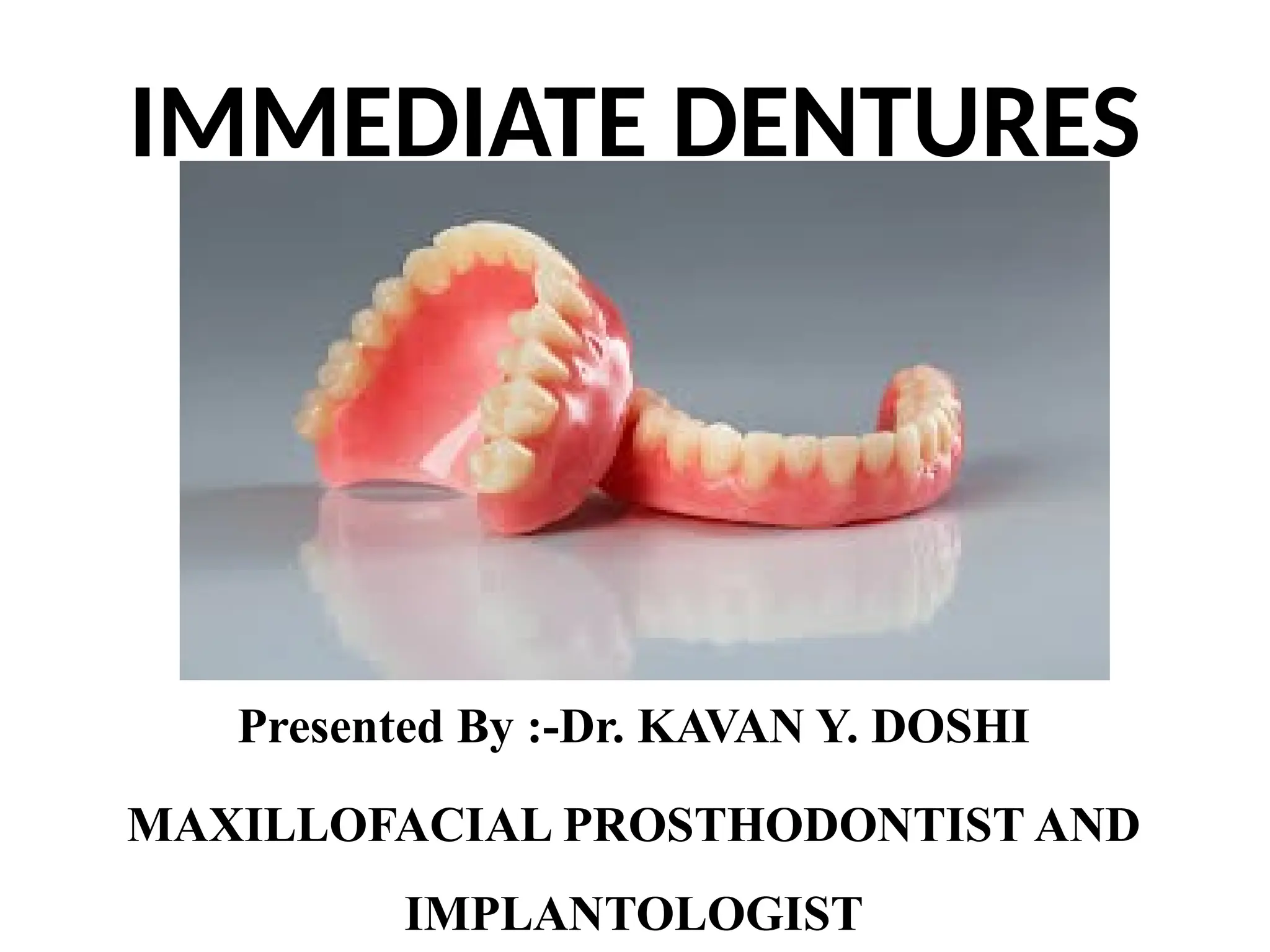
IMMEDIATE DENTURES
Presented By :-Dr. KAVAN Y. DOSHI
MAXILLOFACIAL PROSTHODONTIST AND
IMPLANTOLOGIST
Content
• Introduction
• Definition and types
• Advantages and disadvantages
• Indication and contraindication
• Diagnosis and treatment planning
• Clinical and Laboratory procedures
• Surgery and Immediate Denture Insertion
• Postoperative Care and Patient Instructions
• Conclusion
• References
Introduction
• Patients who have extracted all their natural
teeth in one or both the jaws have to wait for
at least 6-8 weeks for healing period to
construct a conventional complete denture.
• Consequently patient suffers the social
indignity and functional difficulty of going
without teeth for several weeks.
• The immediate denture offers solution to this
problem as it is constructed before and placed
immediately following the extraction of
natural teeth.
• It is more challenging than conventional
complete denture because try-in procedure is
not possible to verify the arrangement of
anterior teeth.
Definition and Types
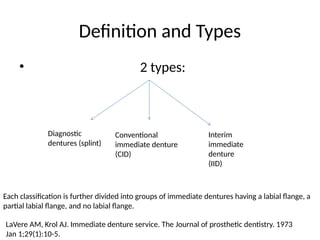
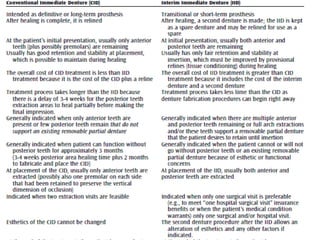
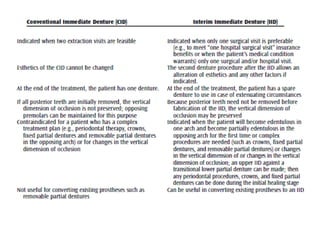
• 2 types:
Conventional
immediate denture
(CID)
Interim
immediate
denture
(IID)
Each classification is further divided into groups of immediate dentures having a labial flange, a
partial labial flange, and no labial flange.
Diagnostic
dentures (splint)
LaVere AM, Krol AJ. Immediate denture service. The Journal of prosthetic dentistry. 1973
Jan 1;29(1):10-5.
• Conventional immediate denture:
• Any fixed or removable dental prosthesis fabricated for
placement immediately following the removal of a natural
tooth/teeth.
-GPT9
• Interim immediate denture:
• A fixed or removable dental prosthesis designed to enhance
esthetics, stabilization, and/or function for a limited period of
time, after which it is to be replaced by a definitive dental
prosthesis.
• -GPT9
• Diagnostic dentures (splint):
• The diagnostic denture is one in which the
anterior segment contains the artificial teeth,
while the posterior segment consists of flat
occlusal blocks made of plastic resin.
• Diagnostic dentures are indicated for patients
with advanced periodontal disease.
LaVere AM, Krol AJ. Immediate denture service. The Journal of prosthetic dentistry. 1973
Jan 1;29(1):10-5.
labial flange vs no labial flange
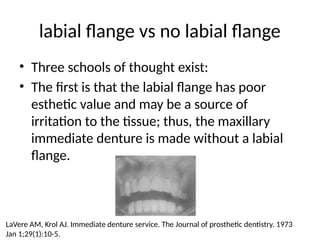
• Three schools of thought exist:
• The first is that the labial flange has poor
esthetic value and may be a source of
irritation to the tissue; thus, the maxillary
immediate denture is made without a labial
flange.
LaVere AM, Krol AJ. Immediate denture service. The Journal of prosthetic dentistry. 1973
Jan 1;29(1):10-5.
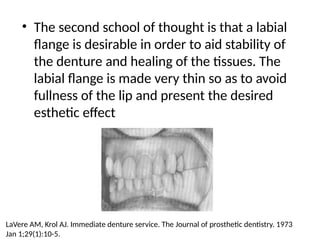
• The second school of thought is that a labial
flange is desirable in order to aid stability of
the denture and healing of the tissues. The
labial flange is made very thin so as to avoid
fullness of the lip and present the desired
esthetic effect
LaVere AM, Krol AJ. Immediate denture service. The Journal of prosthetic dentistry. 1973
Jan 1;29(1):10-5.
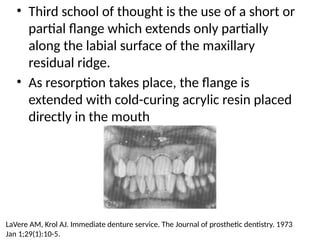
• Third school of thought is the use of a short or
partial flange which extends only partially
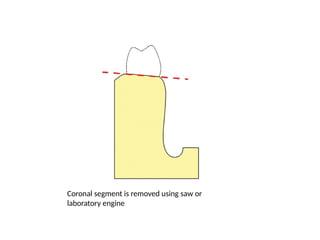
along the labial surface of the maxillary
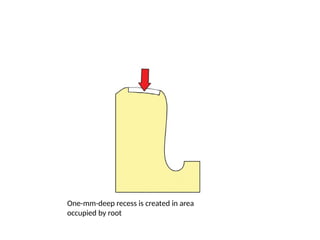
residual ridge.
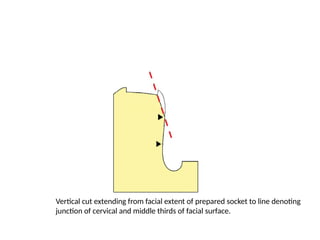
• As resorption takes place, the flange is
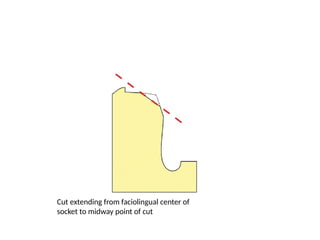
extended with cold-curing acrylic resin placed
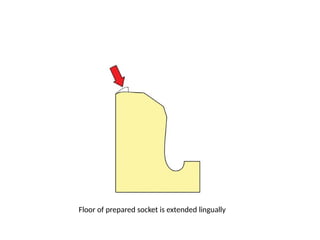
directly in the mouth
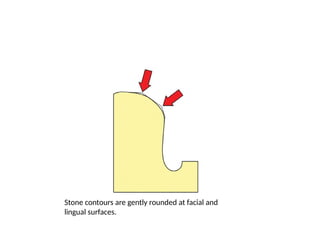
LaVere AM, Krol AJ. Immediate denture service. The Journal of prosthetic dentistry. 1973
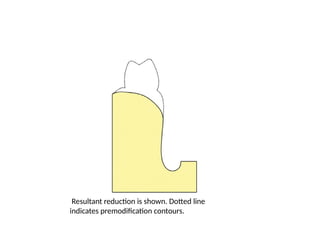
Jan 1;29(1):10-5.
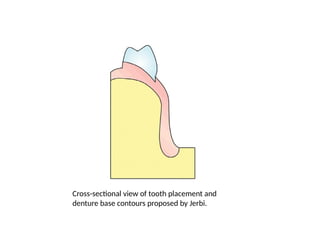
Flangeless immediate dentures.
• The flangeless immediate dentures are
indicated when:
• deep undercuts are present on the anterior
labial residual ridge,
• a high lip line and an active lip would expose
an unesthetic flange,
• minimal amount of surgery is considered
desirable.
LaVere AM, Krol AJ. Immediate denture service. The Journal of prosthetic dentistry. 1973
Jan 1;29(1):10-5.
Advantages
• Maintenance of patients’ appearance as they are not
without teeth even for 1 day.
• Acts as a bandage or splint to control bleeding.
• Less postoperative pain as extraction site is protected
• Vertical dimension, jaw relationship, muscle tone, face
height and tongue position is maintained.
• Patient’s social, professional and psychological status is
not hampered.
• Better preservation of residual ridges
Winkler S, editor. Essentials of complete denture prosthodontics. Year Book Medical Pub; 1988.
Disadvantages
• Anterior try-in not possible, patient has no idea
how the denture will look on the day of insertion.
• Requires more chairside time, additional
appointments and cost.
• As the jaw relations are recorded with the
natural teeth, inaccurate centric and vertical
records are possible.
• There will be a temporary impairment in speech
and mastication.
Winkler S, editor. Essentials of complete denture prosthodontics. Year Book Medical Pub; 1988.
Indications
• Patient whose remaining natural teeth are
indicated for extraction.
• Patient whose aesthetics cannot be
compromised even for a short period due to
social and professional commitments.
CONTRAINDICATIONS
• Patients who are poor surgical risks - like
cardiac disease, uncontrolled diabetes, blood
dyscrasias
• Patients who are uncooperative because they
cannot understand and appreciate the scope,
demands, and limitations of immediate
denture treatment.
DIAGNOSIS AND TREATMENT
PLANNING
• Prior to the start of treatment, a thorough
diagnosis must be completed and a treatment
plan prepared.
• The patient’s medical and dental history
should be reviewed.
Hickey JC, Zarb GA. Bolender Cl. Boucher’s prosthodontic treatment for edentulous patient. 12th
ed. St. Louis: Mosby Co. 2004:401-14.
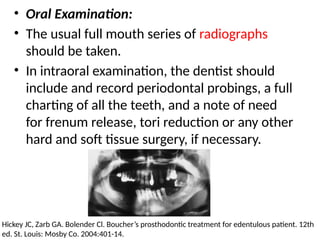
• Oral Examination:
• The usual full mouth series of radiographs
should be taken.
• In intraoral examination, the dentist should
include and record periodontal probings, a full
charting of all the teeth, and a note of need
for frenum release, tori reduction or any other
hard and soft tissue surgery, if necessary.
Hickey JC, Zarb GA. Bolender Cl. Boucher’s prosthodontic treatment for edentulous patient. 12th
ed. St. Louis: Mosby Co. 2004:401-14.
• A careful evaluation denture-supporting
tissues and the posterior palatal seal area
should be carried out.
• The shade and mold of the existing teeth
should be determined.
Hickey JC, Zarb GA. Bolender Cl. Boucher’s prosthodontic treatment for edentulous patient. 12th
ed. St. Louis: Mosby Co. 2004:401-14.
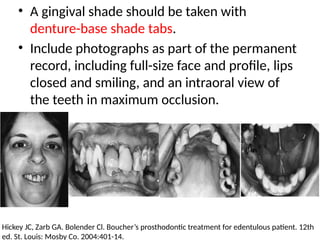
• A gingival shade should be taken with
denture-base shade tabs.
• Include photographs as part of the permanent
record, including full-size face and profile, lips
closed and smiling, and an intraoral view of
the teeth in maximum occlusion.
Hickey JC, Zarb GA. Bolender Cl. Boucher’s prosthodontic treatment for edentulous patient. 12th
ed. St. Louis: Mosby Co. 2004:401-14.
• Examination of Existing Prosthesis:
• Any existing prostheses should be examined
for shade, mold, tooth position, lip support,
and smile line.
• The shade of the denture base should also be
noted.
Hickey JC, Zarb GA. Bolender Cl. Boucher’s prosthodontic treatment for edentulous patient. 12th
ed. St. Louis: Mosby Co. 2004:401-14.
• Tooth Modification:
• Many immediate dentures will require
modification of opposing teeth to correct the
occlusal plane.
• This will affect the correct registration of
centric relation.
• Tooth modifications should be made to the
patient in advance of the final impressions.
• The analysis of the occlusion and the plane of
occlusion is best made by performing a
diagnostic mounting of the preliminary casts.
• These preliminary casts also serve as a pre
extraction record.
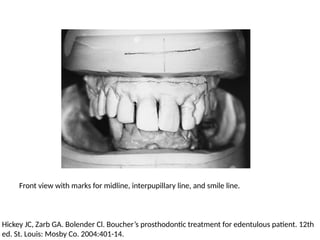
Front view with marks for midline, interpupillary line, and smile line.
Hickey JC, Zarb GA. Bolender Cl. Boucher’s prosthodontic treatment for edentulous patient. 12th
ed. St. Louis: Mosby Co. 2004:401-14.
• Prognosis:
• All of the foregoing features will allow the
dentist to determine a prognosis for the
immediate denture.
• At this point, esthetic demands of the patient, a
compromised residual ridge for denture
support, systemic diseases and sensitive tissues
or sharp, bony prominences should be checked.
• Adjunctive Care:
• If other dentists are to be involved in the
patient’s treatment, referrals for required
consultations are requested.
• The patient should have a general scaling of the
teeth to minimize calculus deposits.
• Patients with single immediate dentures also
require restorations, crowns, or removable
partial dentures.
CLINICAL AND LABORATORY
PROCEDURES
• First Extraction/Surgical Visit:
• If a clinical decision is made to undertake
preliminary extractions, the patient should
have the identified teeth removed as soon as
possible.
Hickey JC, Zarb GA. Bolender Cl. Boucher’s prosthodontic treatment for edentulous patient. 12th
ed. St. Louis: Mosby Co. 2004:401-14.
• Opposing premolars may be retained to
preserve the vertical dimension of occlusion.
• Any other required hard and soft tissue
operation is also usually done at this first
surgical visit. Examples include tori reduction,
tuberosity reduction, and frenectomy.
Hickey JC, Zarb GA. Bolender Cl. Boucher’s prosthodontic treatment for edentulous patient. 12th
ed. St. Louis: Mosby Co. 2004:401-14.
• These posterior extraction and other operated
areas are allowed to heal for a short time,
usually only 3 to 4 weeks, before the
preliminary impressions are made.
Hickey JC, Zarb GA. Bolender Cl. Boucher’s prosthodontic treatment for edentulous patient. 12th
ed. St. Louis: Mosby Co. 2004:401-14.
• Preliminary Impressions and Diagnostic
Casts:
• Impressions are made in irreversible
hydrocolloid (alginate) in stock metal or plastic
trays.
• The tray should reach all peripheral tissue
borders and posterior extensions.
Hickey JC, Zarb GA. Bolender Cl. Boucher’s prosthodontic treatment for edentulous patient. 12th
ed. St. Louis: Mosby Co. 2004:401-14.
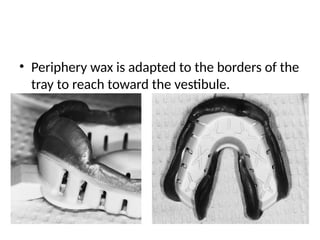
• Periphery wax is adapted to the borders of the
tray to reach toward the vestibule.
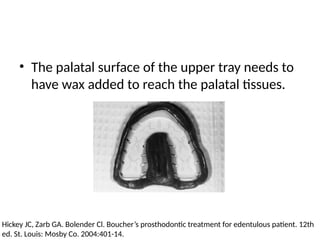
• The palatal surface of the upper tray needs to
have wax added to reach the palatal tissues.
Hickey JC, Zarb GA. Bolender Cl. Boucher’s prosthodontic treatment for edentulous patient. 12th
ed. St. Louis: Mosby Co. 2004:401-14.
• These impressions are poured in stone and are
used to make custom trays for the final
impressions.
Hickey JC, Zarb GA. Bolender Cl. Boucher’s prosthodontic treatment for edentulous patient. 12th
ed. St. Louis: Mosby Co. 2004:401-14.
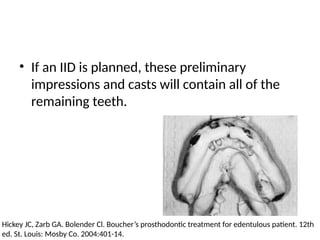
• If an IID is planned, these preliminary
impressions and casts will contain all of the
remaining teeth.
Hickey JC, Zarb GA. Bolender Cl. Boucher’s prosthodontic treatment for edentulous patient. 12th
ed. St. Louis: Mosby Co. 2004:401-14.
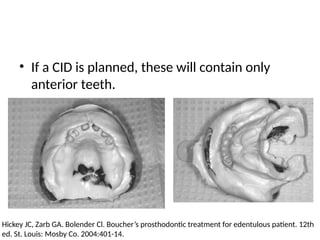
• If a CID is planned, these will contain only
anterior teeth.
Hickey JC, Zarb GA. Bolender Cl. Boucher’s prosthodontic treatment for edentulous patient. 12th
ed. St. Louis: Mosby Co. 2004:401-14.
• For Loose Teeth, Several authors have made
suggestions Loose teeth can be blocked out by
adding periphery wax at the cervical areas, by
generously applying a lubricating medium to
the teeth, by placing copper bands over the
loose teeth.
Hickey JC, Zarb GA. Bolender Cl. Boucher’s prosthodontic treatment for edentulous patient. 12th
ed. St. Louis: Mosby Co. 2004:401-14.
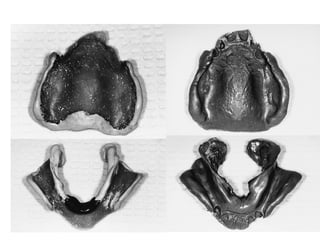
Custom Trays, Final Impressions,
and Final Casts
• There are two basic ways to fabricate the final
impression tray,
• Type 1: Single Full Arch Custom Impression
Tray
• Type 2: Two-Tray or Sectional Custom
Impression Tray
Hickey JC, Zarb GA. Bolender Cl. Boucher’s prosthodontic treatment for edentulous patient. 12th
ed. St. Louis: Mosby Co. 2004:401-14.
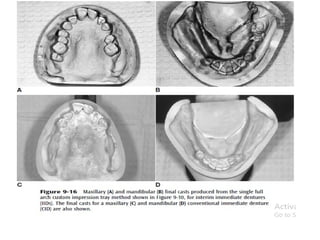
• Type One: Single Full Arch Custom Impression
Tray
• This technique can be used for both CID as
well as IID procedure.
• This type of tray is effective when only
anterior teeth are remaining.
Hickey JC, Zarb GA. Bolender Cl. Boucher’s prosthodontic treatment for edentulous patient. 12th
ed. St. Louis: Mosby Co. 2004:401-14.
• The process for tray fabrication is as follows:
• The areas of the casts with remaining teeth
are blocked out with two sheet wax
thicknesses.
• Undercuts in the edentulous areas are blocked
out.
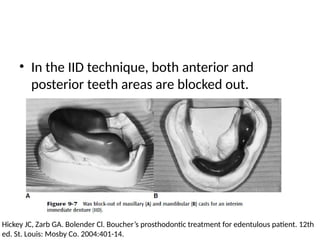
• In the IID technique, both anterior and
posterior teeth areas are blocked out.
Hickey JC, Zarb GA. Bolender Cl. Boucher’s prosthodontic treatment for edentulous patient. 12th
ed. St. Louis: Mosby Co. 2004:401-14.
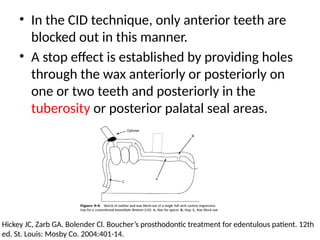
• In the CID technique, only anterior teeth are
blocked out in this manner.
• A stop effect is established by providing holes
through the wax anteriorly or posteriorly on
one or two teeth and posteriorly in the
tuberosity or posterior palatal seal areas.
Hickey JC, Zarb GA. Bolender Cl. Boucher’s prosthodontic treatment for edentulous patient. 12th
ed. St. Louis: Mosby Co. 2004:401-14.
• The tray is outlined to be 2 to 3 mm short of
the vestibular roll and to extend and include
the posterior limit.
• Autopolymerizing acrylic resin or lightcured
resin is adapted over the cast.
• A handle is added to the anterior palate or to
the midpalate.
• This is advantageous because if the anterior
handle is too long, it may interfere with
proper anterior vestibule border molding.
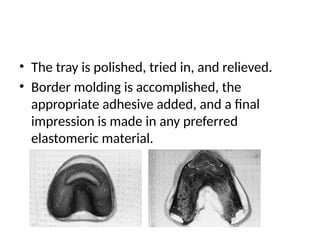
• The tray is polished, tried in, and relieved.
• Border molding is accomplished, the
appropriate adhesive added, and a final
impression is made in any preferred
elastomeric material.
• Type Two: Two-Tray or Sectional Custom
Impression Tray
• Can be used only when the posterior teeth
have been removed.
• 2 trays are fabricated—one in the posterior,
which is made like a complete denture tray,
and one in the anterior.
Hickey JC, Zarb GA. Bolender Cl. Boucher’s prosthodontic treatment for edentulous patient. 12th
ed. St. Louis: Mosby Co. 2004:401-14.
• Procedure:
• Outline the borders of the tray again to be 2 to
3 mm short of the vestibule
• Use melted wax to block out tissue undercuts,
interdental spaces, and undercuts around the
teeth.
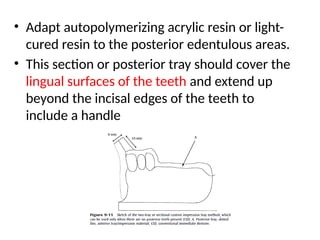
• Adapt autopolymerizing acrylic resin or light-
cured resin to the posterior edentulous areas.
• This section or posterior tray should cover the
lingual surfaces of the teeth and extend up
beyond the incisal edges of the teeth to
include a handle
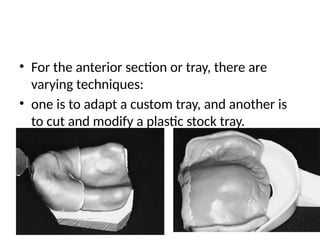
• For the anterior section or tray, there are
varying techniques:
• one is to adapt a custom tray, and another is
to cut and modify a plastic stock tray.
• The posterior sectional tray is tried in, border
molded, and adhesive applied; then the
posterior impression is made in any
impression material desired (zinc oxide–
eugenol paste, polysulfide rubber base,
polyvinyl silicones, polyether)
Hickey JC, Zarb GA. Bolender Cl. Boucher’s prosthodontic treatment for edentulous patient. 12th
ed. St. Louis: Mosby Co. 2004:401-14.
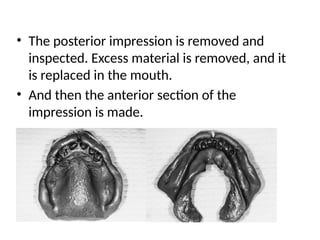
• The posterior impression is removed and
inspected. Excess material is removed, and it
is replaced in the mouth.
• And then the anterior section of the
impression is made.
Jaw Relation Records
• If there are enough anterior and posterior
teeth remaining (in some patients with IIDs),
there may not be a need for a record base and
occlusion rim.
• If not (all patients with CIDs) record bases and
occlusion rims are made on the master casts.
Hickey JC, Zarb GA. Bolender Cl. Boucher’s prosthodontic treatment for edentulous patient. 12th
ed. St. Louis: Mosby Co. 2004:401-14.
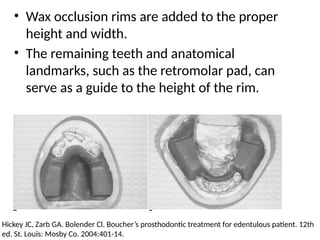
• Wax occlusion rims are added to the proper
height and width.
• The remaining teeth and anatomical
landmarks, such as the retromolar pad, can
serve as a guide to the height of the rim.
Hickey JC, Zarb GA. Bolender Cl. Boucher’s prosthodontic treatment for edentulous patient. 12th
ed. St. Louis: Mosby Co. 2004:401-14.
• The record bases and occlusion rims are tried
in for patient comfort.
• An evaluation of the patient’s existing vertical
dimension of occlusion is accomplished
determining if it should be retained.
Hickey JC, Zarb GA. Bolender Cl. Boucher’s prosthodontic treatment for edentulous patient. 12th
ed. St. Louis: Mosby Co. 2004:401-14.
• On occasion, the operator may wish to restore
it by opening because the patient’s uneven
tooth loss, loosening of the remaining teeth,
and tooth wear created overclosure.
Hickey JC, Zarb GA. Bolender Cl. Boucher’s prosthodontic treatment for edentulous patient. 12th
ed. St. Louis: Mosby Co. 2004:401-14.
• A face-bow transfer and a recording of centric
relation are made.
• The casts are mounted on the articulator.
• Protrusive relation records are made, if
desired, to transfer to the articulator in order
to set the condylar guidance.
Hickey JC, Zarb GA. Bolender Cl. Boucher’s prosthodontic treatment for edentulous patient. 12th
ed. St. Louis: Mosby Co. 2004:401-14.
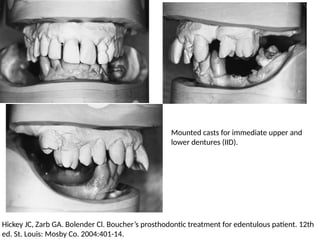
Mounted casts for immediate upper and
lower dentures (IID).
Hickey JC, Zarb GA. Bolender Cl. Boucher’s prosthodontic treatment for edentulous patient. 12th
ed. St. Louis: Mosby Co. 2004:401-14.
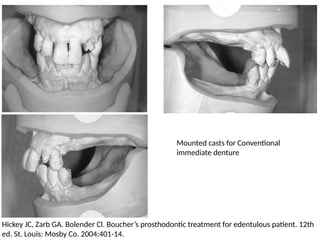
Mounted casts for Conventional
immediate denture
Hickey JC, Zarb GA. Bolender Cl. Boucher’s prosthodontic treatment for edentulous patient. 12th
ed. St. Louis: Mosby Co. 2004:401-14.
Verifying JawRelations and the Patient Try-
in Appointment
• The articulated casts are used for setting any
anterior/posterior teeth that are missing so
that a try-in can be accomplished.
• A try-in is not always possible(IID), but the
mounting should still be confirmed at a
patient visit.
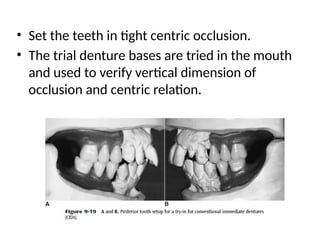
• Set the teeth in tight centric occlusion.
• The trial denture bases are tried in the mouth
and used to verify vertical dimension of
occlusion and centric relation.
• If necessary, the lower cast is remounted with
a new centric relation record until the
articulator mounting and the patient’s centric
relation coincide.
• Teeth are reset to any new mounting and tried
in again.
Hickey JC, Zarb GA. Bolender Cl. Boucher’s prosthodontic treatment for edentulous patient. 12th
ed. St. Louis: Mosby Co. 2004:401-14.
• Now it is important to take time with the
patient to record landmarks on the casts and
to confirm the patient’s esthetic desires.
• The mounted diagnostic casts should
accompany this visit to serve as a reference.
Hickey JC, Zarb GA. Bolender Cl. Boucher’s prosthodontic treatment for edentulous patient. 12th
ed. St. Louis: Mosby Co. 2004:401-14.
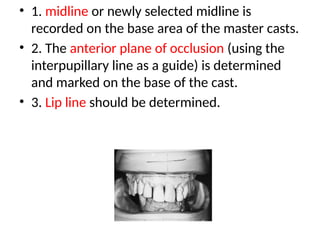
• 1. midline or newly selected midline is
recorded on the base area of the master casts.
• 2. The anterior plane of occlusion (using the
interpupillary line as a guide) is determined
and marked on the base of the cast.
• 3. Lip line should be determined.
• Discuss with patient how much display of
tooth/gingiva is needed.
• If too much tooth/gingiva display is
anticipated, localized anterior alveolectomy
should be done.
• 4. A discussion of placement of diastema,
rotated teeth, notches, and other natural
arrangements should occur for the esthetic
decisions.
• Some patients want perfect-looking teeth
because they never had them, whereas other
patients will prefer a more natural
arrangement.
• 5. Note the existing anterior vertical and
horizontal overlap.
• Often, in patients in whom drifting and
excursion have occurred, this will be severe.
• Most patients will want to duplicate the
position of their natural teeth,
• but some do have rather unesthetic
arrangements.
• Determine how much vertical overlap needs
to be maintained for esthetics and phonetics.
• Deep vertical overlaps are detrimental to
denture stability. If it is excessive, there is
possibility of denture retentive loss during
excursions.
Hickey JC, Zarb GA. Bolender Cl. Boucher’s prosthodontic treatment for edentulous patient. 12th
ed. St. Louis: Mosby Co. 2004:401-14.
• If horizontal overlap is excessive, determine if
maxillary anterior teeth need to be placed
farther back into the mouth to eliminate an
unesthetic position or if the horizontal overlap
needs to be preserved for lip support and
phonetics.
Hickey JC, Zarb GA. Bolender Cl. Boucher’s prosthodontic treatment for edentulous patient. 12th
ed. St. Louis: Mosby Co. 2004:401-14.
• 6. Reevaluate any further tooth modifications
for a smooth occlusal plane or for better
centric relation.
• 7. The casts are marked and should include
pocket depths, free gingival margins, a line
marking the interproximal of each tooth, and
a drawing of where the new tooth position
should be.
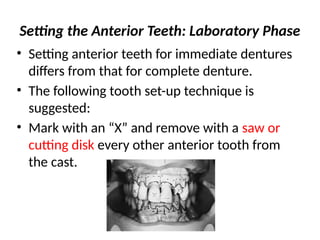
Setting the Anterior Teeth: Laboratory Phase
• Setting anterior teeth for immediate dentures
differs from that for complete denture.
• The following tooth set-up technique is
suggested:
• Mark with an “X” and remove with a saw or
cutting disk every other anterior tooth from
the cast.
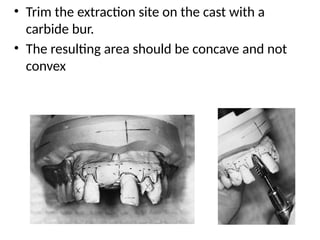
• Trim the extraction site on the cast with a
carbide bur.
• The resulting area should be concave and not
convex
• Be conservative in this trimming using the
pocket depths as guides.
• The facial (only) portion of the extraction site
can be further trimmed conservatively to the
pocket depth line with a bur or a knife blade.
• The lingual or palatal tissues should not be
trimmed because they will not collapse to the
pocket depth after extraction.
Hickey JC, Zarb GA. Bolender Cl. Boucher’s prosthodontic treatment for edentulous patient. 12th
ed. St. Louis: Mosby Co. 2004:401-14.
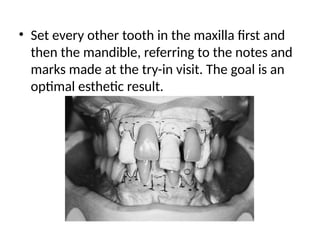
• Set every other tooth in the maxilla first and
then the mandible, referring to the notes and
marks made at the try-in visit. The goal is an
optimal esthetic result.
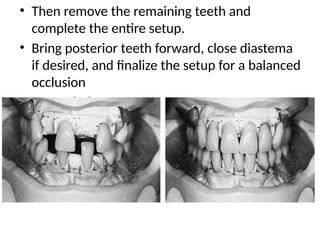
• Then remove the remaining teeth and
complete the entire setup.
• Bring posterior teeth forward, close diastema
if desired, and finalize the setup for a balanced
occlusion
• as needed
Cast modification techniques
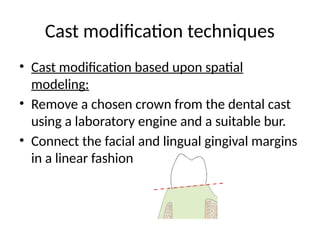
• Cast modification based upon spatial
modeling:
• Remove a chosen crown from the dental cast
using a laboratory engine and a suitable bur.
• Connect the facial and lingual gingival margins
in a linear fashion
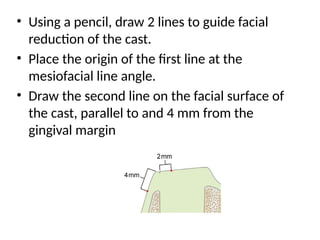
• Using a pencil, draw 2 lines to guide facial
reduction of the cast.
• Place the origin of the first line at the
mesiofacial line angle.
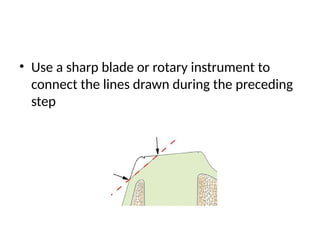
• Draw the second line on the facial surface of
the cast, parallel to and 4 mm from the
gingival margin
• Use a sharp blade or rotary instrument to
connect the lines drawn during the preceding
step
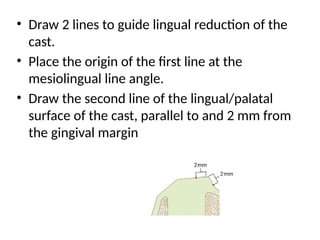
• Draw 2 lines to guide lingual reduction of the
cast.
• Place the origin of the first line at the
mesiolingual line angle.
• Draw the second line of the lingual/palatal
surface of the cast, parallel to and 2 mm from
the gingival margin
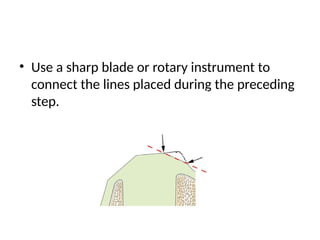
• Use a sharp blade or rotary instrument to
connect the lines placed during the preceding
step.
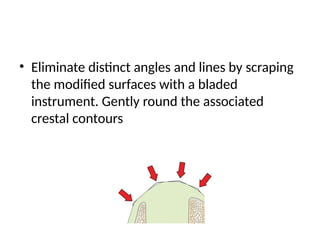
• Eliminate distinct angles and lines by scraping
the modified surfaces with a bladed
instrument. Gently round the associated
crestal contours
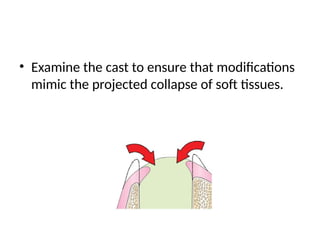
• Examine the cast to ensure that modifications
mimic the projected collapse of soft tissues.
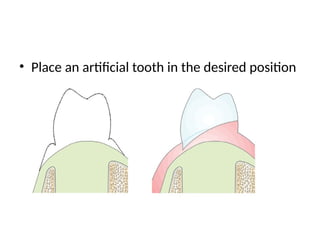
• Place an artificial tooth in the desired position
• Repeat steps 1 through 8 until all artificial
teeth have been properly positioned.
• Complete the associated waxing, contouring,
investment, and wax elimination procedures.
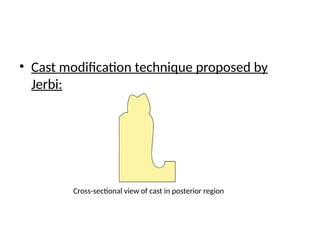
• Cast modification technique proposed by
Jerbi:
Cross-sectional view of cast in posterior region
Coronal segment is removed using saw or
laboratory engine
One-mm-deep recess is created in area
occupied by root
Vertical cut extending from facial extent of prepared socket to line denoting
junction of cervical and middle thirds of facial surface.
Cut extending from faciolingual center of
socket to midway point of cut
Floor of prepared socket is extended lingually
Stone contours are gently rounded at facial and
lingual surfaces.
Resultant reduction is shown. Dotted line
indicates premodification contours.
Cross-sectional view of tooth placement and
denture base contours proposed by Jerbi.
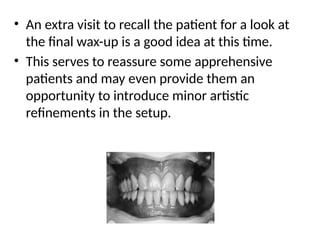
• An extra visit to recall the patient for a look at
the final wax-up is a good idea at this time.
• This serves to reassure some apprehensive
patients and may even provide them an
opportunity to introduce minor artistic
refinements in the setup.
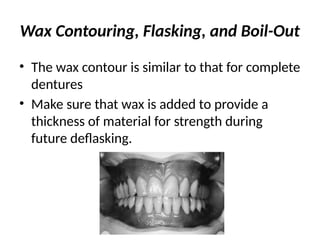
Wax Contouring, Flasking, and Boil-Out
• The wax contour is similar to that for complete
dentures
• Make sure that wax is added to provide a
thickness of material for strength during
future deflasking.
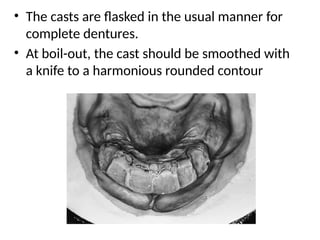
• The casts are flasked in the usual manner for
complete dentures.
• At boil-out, the cast should be smoothed with
a knife to a harmonious rounded contour
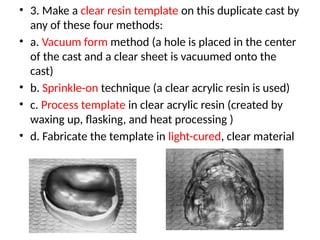
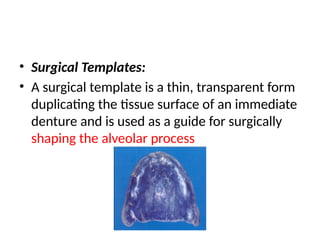
• Surgical Templates:
• A surgical template is a thin, transparent form
duplicating the tissue surface of an immediate
denture and is used as a guide for surgically
shaping the alveolar process
• It is essential when any amount of bone
trimming is necessary.
• This template is fabricated by the following
procedure:
• 1. Make an irreversible hydrocolloid (alginate)
impression of the edentulous ridge after the
cast has been trimmed at boil-out.
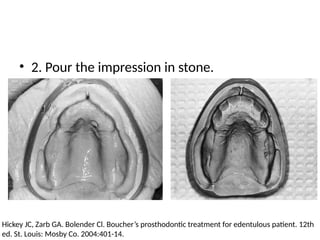
• 2. Pour the impression in stone.
Hickey JC, Zarb GA. Bolender Cl. Boucher’s prosthodontic treatment for edentulous patient. 12th
ed. St. Louis: Mosby Co. 2004:401-14.
• 3. Make a clear resin template on this duplicate cast by
any of these four methods:
• a. Vacuum form method (a hole is placed in the center
of the cast and a clear sheet is vacuumed onto the
cast)
• b. Sprinkle-on technique (a clear acrylic resin is used)
• c. Process template in clear acrylic resin (created by
waxing up, flasking, and heat processing )
• d. Fabricate the template in light-cured, clear material
• Processing and Finishing:
• The immediate dentures are processed and
finished in the usual manner of complete
dentures.
• Keep the undercut areas of the denture
slightly thick at this point to allow for insertion
over undercuts.
Hickey JC, Zarb GA. Bolender Cl. Boucher’s prosthodontic treatment for edentulous patient. 12th
ed. St. Louis: Mosby Co. 2004:401-14.
• Both the immediate denture and the surgical
template should be placed in a chemical
sterilizing solution in a bag for delivery.
Hickey JC, Zarb GA. Bolender Cl. Boucher’s prosthodontic treatment for edentulous patient. 12th
ed. St. Louis: Mosby Co. 2004:401-14.
Surgery and Immediate Denture Insertion:
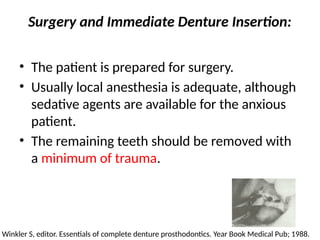
• The patient is prepared for surgery.
• Usually local anesthesia is adequate, although
sedative agents are available for the anxious
patient.
• The remaining teeth should be removed with
a minimum of trauma.
Winkler S, editor. Essentials of complete denture prosthodontics. Year Book Medical Pub; 1988.
• The surgical template is used as a guide to
ensure that the prescribed bone trimming is
done adequately.
• The template should fit and be in contact with
all tissue surfaces.
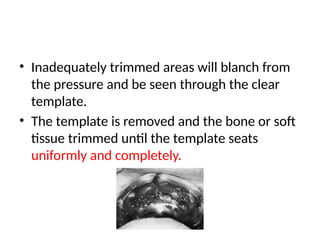
• Inadequately trimmed areas will blanch from
the pressure and be seen through the clear
template.
• The template is removed and the bone or soft
tissue trimmed until the template seats
uniformly and completely.
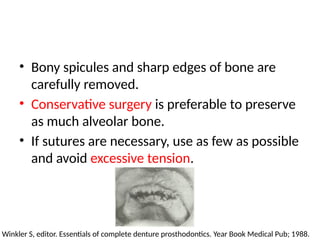
• Bony spicules and sharp edges of bone are
carefully removed.
• Conservative surgery is preferable to preserve
as much alveolar bone.
• If sutures are necessary, use as few as possible
and avoid excessive tension.
Winkler S, editor. Essentials of complete denture prosthodontics. Year Book Medical Pub; 1988.
• After the surgical procedures are completed,
the denture can be positioned and seated.
• If the denture base will not seat completely,
the inner aspect of the denture should be
examined and adjusted as needed.
Winkler S, editor. Essentials of complete denture prosthodontics. Year Book Medical Pub; 1988.
• All denture borders should be checked for
overextension.
• Once the denture is seated, gross occlusal
prematurities can be eliminated while the
patient is still under local anesthesia.
• A little adhesive powder can be added before
the final seating of the denture.
Winkler S, editor. Essentials of complete denture prosthodontics. Year Book Medical Pub; 1988.
• If the denture is poorly adapted or lacking in
retention and stability, a tissue conditioner
can be placed.
• If a tissue conditioner is used, it should not
project into the extraction sites as this may
interfere with healing.
Winkler S, editor. Essentials of complete denture prosthodontics. Year Book Medical Pub; 1988.
• It is wise to avoid showing the patient the
results immediately after the denture is seated:
• The upper lip is generally distorted by the
anesthetic and creates an unfavorable esthetic
impression
• There is usually some small amount of blood on
the denture, which hardly enhances its
appearance
• The normal lip and jaw movements are
distorted
Sharry JJ. Complete denture prosthodontics. McGraw-Hill Companies; 1974.
Postoperative Care and Patient Instructions
• First 24 Hours:
• The patient should be instructed avoid
expectorating, smoking, hot liquids or alcohol.
• Cold packs are suggested for the first several
hours after surgery.
Winkler S, editor. Essentials of complete denture prosthodontics. Year Book Medical Pub; 1988.
• The patient must not remove the denture.
• Tissue inflammation and edema from the
surgery may prevent the reinsertion of the
denture for several days.
Winkler S, editor. Essentials of complete denture prosthodontics. Year Book Medical Pub; 1988.
• A soft diet (eg, bouillon, milk shakes, jello, ice
cream) is advised to minimize trauma.
• Analgesics are prescibed to relieve the pain.
• The patient is seen 24 hours following
insertion.
Winkler S, editor. Essentials of complete denture prosthodontics. Year Book Medical Pub; 1988.
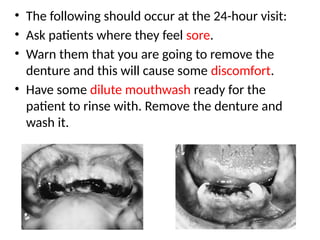
• The following should occur at the 24-hour visit:
• Ask patients where they feel sore.
• Warn them that you are going to remove the
denture and this will cause some discomfort.
• Have some dilute mouthwash ready for the
patient to rinse with. Remove the denture and
wash it.
• Adjust any gross occlusal discrepancy in
centric relation or excursions.
• Reevaluate the denture for retention. Place a
tissue conditioner if denture retention is
unsatisfactory.
Hickey JC, Zarb GA. Bolender Cl. Boucher’s prosthodontic treatment for edentulous patient.
12th ed. St. Louis: Mosby Co. 2004:401-14.
• First Postoperative Week:
• Counsel the patient to continue to wear the
immediate denture at night for 7 days after
extraction or until swelling reduction.
• The patient should be shown how to remove
the denture after eating to clean it and to
rinse the mouth at least three to four times
daily to keep the extraction sites clean.
Hickey JC, Zarb GA. Bolender Cl. Boucher’s prosthodontic treatment for edentulous patient.
12th ed. St. Louis: Mosby Co. 2004:401-14.
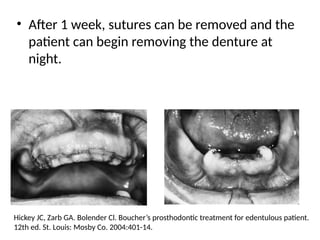
• After 1 week, sutures can be removed and the
patient can begin removing the denture at
night.
Hickey JC, Zarb GA. Bolender Cl. Boucher’s prosthodontic treatment for edentulous patient.
12th ed. St. Louis: Mosby Co. 2004:401-14.
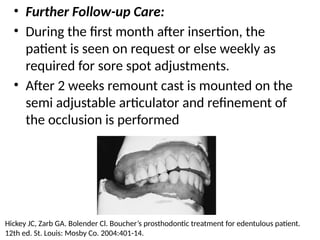
• Further Follow-up Care:
• During the first month after insertion, the
patient is seen on request or else weekly as
required for sore spot adjustments.
• After 2 weeks remount cast is mounted on the
semi adjustable articulator and refinement of
the occlusion is performed
Hickey JC, Zarb GA. Bolender Cl. Boucher’s prosthodontic treatment for edentulous patient.
12th ed. St. Louis: Mosby Co. 2004:401-14.
Subsequent Service for the Patient with an
Immediate Denture
• Ridge resorption is fastest during the first 3
months, so a recall program for changing the
tissue conditioner liner is organized.
• Changing of tissue conditioner is influenced by
denture hygiene frequency and methods, diet
and smoking habits.
Hickey JC, Zarb GA. Bolender Cl. Boucher’s prosthodontic treatment for edentulous patient.
12th ed. St. Louis: Mosby Co. 2004:401-14.
• Patients with CIDs frequently prefer to have a
definitive reline done within the first 3 to 6
months.
• Regular visits and adjustments are needed
throughout the first year.
• Patients with IIDs can have their second
denture started within 3 to 6 months if
desired.
• This second denture may need a reline after
tissues complete their full healing.
• Advantage is the IID can be worn as a spare if
a laboratory reline is selected for the second
denture.
Conclusion
• Immediate dentures fulfill an important role in
today’s treatment modalities by providing the
patients with esthetics, function, and psychological
support.
• The technique is more demanding than regular
complete dentures for both the patient and the
dentist.
• If the patient is well prepared and the appropriate
type of immediate denture is selected, the resulting
prosthesis can be a success.
References
• Hickey JC, Zarb GA. Bolender Cl. Boucher’s prosthodontic
treatment for edentulous patient. 12th ed. St. Louis: Mosby Co.
2004:401-14.
• Winkler S, editor. Essentials of complete denture prosthodontics.
Year Book Medical Pub; 1988.
• Sharry JJ. Complete denture prosthodontics. McGraw-Hill
Companies; 1974.
• LaVere AM, Krol AJ. Immediate denture service. The Journal of
prosthetic dentistry. 1973 Jan 1;29(1):10-5.
• Glossary of Prosthodontic Terms, Ninth Edition, GPT 9. The
‐
Academy of Prosthodontics Foundation. J. Prosthet. Dent..
2017;117(5S):e1-05.

Immediate dentures in prosthdontics by Dr kavan doshi

  • 1.
    IMMEDIATE DENTURES Presented By:-Dr. KAVAN Y. DOSHI MAXILLOFACIAL PROSTHODONTIST AND IMPLANTOLOGIST
  • 2.
    Content • Introduction • Definitionand types • Advantages and disadvantages • Indication and contraindication • Diagnosis and treatment planning • Clinical and Laboratory procedures • Surgery and Immediate Denture Insertion • Postoperative Care and Patient Instructions • Conclusion • References
  • 3.
    Introduction • Patients whohave extracted all their natural teeth in one or both the jaws have to wait for at least 6-8 weeks for healing period to construct a conventional complete denture. • Consequently patient suffers the social indignity and functional difficulty of going without teeth for several weeks.
  • 4.
    • The immediatedenture offers solution to this problem as it is constructed before and placed immediately following the extraction of natural teeth. • It is more challenging than conventional complete denture because try-in procedure is not possible to verify the arrangement of anterior teeth.
  • 5.
    Definition and Types •2 types: Conventional immediate denture (CID) Interim immediate denture (IID) Each classification is further divided into groups of immediate dentures having a labial flange, a partial labial flange, and no labial flange. Diagnostic dentures (splint) LaVere AM, Krol AJ. Immediate denture service. The Journal of prosthetic dentistry. 1973 Jan 1;29(1):10-5.
  • 6.
    • Conventional immediatedenture: • Any fixed or removable dental prosthesis fabricated for placement immediately following the removal of a natural tooth/teeth. -GPT9 • Interim immediate denture: • A fixed or removable dental prosthesis designed to enhance esthetics, stabilization, and/or function for a limited period of time, after which it is to be replaced by a definitive dental prosthesis. • -GPT9
  • 7.
    • Diagnostic dentures(splint): • The diagnostic denture is one in which the anterior segment contains the artificial teeth, while the posterior segment consists of flat occlusal blocks made of plastic resin. • Diagnostic dentures are indicated for patients with advanced periodontal disease. LaVere AM, Krol AJ. Immediate denture service. The Journal of prosthetic dentistry. 1973 Jan 1;29(1):10-5.
  • 8.
    labial flange vsno labial flange • Three schools of thought exist: • The first is that the labial flange has poor esthetic value and may be a source of irritation to the tissue; thus, the maxillary immediate denture is made without a labial flange. LaVere AM, Krol AJ. Immediate denture service. The Journal of prosthetic dentistry. 1973 Jan 1;29(1):10-5.
  • 9.
    • The secondschool of thought is that a labial flange is desirable in order to aid stability of the denture and healing of the tissues. The labial flange is made very thin so as to avoid fullness of the lip and present the desired esthetic effect LaVere AM, Krol AJ. Immediate denture service. The Journal of prosthetic dentistry. 1973 Jan 1;29(1):10-5.
  • 10.
    • Third schoolof thought is the use of a short or partial flange which extends only partially along the labial surface of the maxillary residual ridge. • As resorption takes place, the flange is extended with cold-curing acrylic resin placed directly in the mouth LaVere AM, Krol AJ. Immediate denture service. The Journal of prosthetic dentistry. 1973 Jan 1;29(1):10-5.
  • 11.
    Flangeless immediate dentures. •The flangeless immediate dentures are indicated when: • deep undercuts are present on the anterior labial residual ridge, • a high lip line and an active lip would expose an unesthetic flange, • minimal amount of surgery is considered desirable. LaVere AM, Krol AJ. Immediate denture service. The Journal of prosthetic dentistry. 1973 Jan 1;29(1):10-5.
  • 12.
    Advantages • Maintenance ofpatients’ appearance as they are not without teeth even for 1 day. • Acts as a bandage or splint to control bleeding. • Less postoperative pain as extraction site is protected • Vertical dimension, jaw relationship, muscle tone, face height and tongue position is maintained. • Patient’s social, professional and psychological status is not hampered. • Better preservation of residual ridges Winkler S, editor. Essentials of complete denture prosthodontics. Year Book Medical Pub; 1988.
  • 13.
    Disadvantages • Anterior try-innot possible, patient has no idea how the denture will look on the day of insertion. • Requires more chairside time, additional appointments and cost. • As the jaw relations are recorded with the natural teeth, inaccurate centric and vertical records are possible. • There will be a temporary impairment in speech and mastication. Winkler S, editor. Essentials of complete denture prosthodontics. Year Book Medical Pub; 1988.
  • 14.
    Indications • Patient whoseremaining natural teeth are indicated for extraction. • Patient whose aesthetics cannot be compromised even for a short period due to social and professional commitments.
  • 15.
    CONTRAINDICATIONS • Patients whoare poor surgical risks - like cardiac disease, uncontrolled diabetes, blood dyscrasias • Patients who are uncooperative because they cannot understand and appreciate the scope, demands, and limitations of immediate denture treatment.
  • 16.
    DIAGNOSIS AND TREATMENT PLANNING •Prior to the start of treatment, a thorough diagnosis must be completed and a treatment plan prepared. • The patient’s medical and dental history should be reviewed. Hickey JC, Zarb GA. Bolender Cl. Boucher’s prosthodontic treatment for edentulous patient. 12th ed. St. Louis: Mosby Co. 2004:401-14.
  • 17.
    • Oral Examination: •The usual full mouth series of radiographs should be taken. • In intraoral examination, the dentist should include and record periodontal probings, a full charting of all the teeth, and a note of need for frenum release, tori reduction or any other hard and soft tissue surgery, if necessary. Hickey JC, Zarb GA. Bolender Cl. Boucher’s prosthodontic treatment for edentulous patient. 12th ed. St. Louis: Mosby Co. 2004:401-14.
  • 18.
    • A carefulevaluation denture-supporting tissues and the posterior palatal seal area should be carried out. • The shade and mold of the existing teeth should be determined. Hickey JC, Zarb GA. Bolender Cl. Boucher’s prosthodontic treatment for edentulous patient. 12th ed. St. Louis: Mosby Co. 2004:401-14.
  • 19.
    • A gingivalshade should be taken with denture-base shade tabs. • Include photographs as part of the permanent record, including full-size face and profile, lips closed and smiling, and an intraoral view of the teeth in maximum occlusion. Hickey JC, Zarb GA. Bolender Cl. Boucher’s prosthodontic treatment for edentulous patient. 12th ed. St. Louis: Mosby Co. 2004:401-14.
  • 20.
    • Examination ofExisting Prosthesis: • Any existing prostheses should be examined for shade, mold, tooth position, lip support, and smile line. • The shade of the denture base should also be noted. Hickey JC, Zarb GA. Bolender Cl. Boucher’s prosthodontic treatment for edentulous patient. 12th ed. St. Louis: Mosby Co. 2004:401-14.
  • 21.
    • Tooth Modification: •Many immediate dentures will require modification of opposing teeth to correct the occlusal plane. • This will affect the correct registration of centric relation. • Tooth modifications should be made to the patient in advance of the final impressions.
  • 22.
    • The analysisof the occlusion and the plane of occlusion is best made by performing a diagnostic mounting of the preliminary casts. • These preliminary casts also serve as a pre extraction record.
  • 23.
    Front view withmarks for midline, interpupillary line, and smile line. Hickey JC, Zarb GA. Bolender Cl. Boucher’s prosthodontic treatment for edentulous patient. 12th ed. St. Louis: Mosby Co. 2004:401-14.
  • 24.
    • Prognosis: • Allof the foregoing features will allow the dentist to determine a prognosis for the immediate denture. • At this point, esthetic demands of the patient, a compromised residual ridge for denture support, systemic diseases and sensitive tissues or sharp, bony prominences should be checked.
  • 25.
    • Adjunctive Care: •If other dentists are to be involved in the patient’s treatment, referrals for required consultations are requested. • The patient should have a general scaling of the teeth to minimize calculus deposits. • Patients with single immediate dentures also require restorations, crowns, or removable partial dentures.
  • 26.
    CLINICAL AND LABORATORY PROCEDURES •First Extraction/Surgical Visit: • If a clinical decision is made to undertake preliminary extractions, the patient should have the identified teeth removed as soon as possible. Hickey JC, Zarb GA. Bolender Cl. Boucher’s prosthodontic treatment for edentulous patient. 12th ed. St. Louis: Mosby Co. 2004:401-14.
  • 27.
    • Opposing premolarsmay be retained to preserve the vertical dimension of occlusion. • Any other required hard and soft tissue operation is also usually done at this first surgical visit. Examples include tori reduction, tuberosity reduction, and frenectomy. Hickey JC, Zarb GA. Bolender Cl. Boucher’s prosthodontic treatment for edentulous patient. 12th ed. St. Louis: Mosby Co. 2004:401-14.
  • 28.
    • These posteriorextraction and other operated areas are allowed to heal for a short time, usually only 3 to 4 weeks, before the preliminary impressions are made. Hickey JC, Zarb GA. Bolender Cl. Boucher’s prosthodontic treatment for edentulous patient. 12th ed. St. Louis: Mosby Co. 2004:401-14.
  • 29.
    • Preliminary Impressionsand Diagnostic Casts: • Impressions are made in irreversible hydrocolloid (alginate) in stock metal or plastic trays. • The tray should reach all peripheral tissue borders and posterior extensions. Hickey JC, Zarb GA. Bolender Cl. Boucher’s prosthodontic treatment for edentulous patient. 12th ed. St. Louis: Mosby Co. 2004:401-14.
  • 30.
    • Periphery waxis adapted to the borders of the tray to reach toward the vestibule.
  • 31.
    • The palatalsurface of the upper tray needs to have wax added to reach the palatal tissues. Hickey JC, Zarb GA. Bolender Cl. Boucher’s prosthodontic treatment for edentulous patient. 12th ed. St. Louis: Mosby Co. 2004:401-14.
  • 32.
    • These impressionsare poured in stone and are used to make custom trays for the final impressions. Hickey JC, Zarb GA. Bolender Cl. Boucher’s prosthodontic treatment for edentulous patient. 12th ed. St. Louis: Mosby Co. 2004:401-14.
  • 33.
    • If anIID is planned, these preliminary impressions and casts will contain all of the remaining teeth. Hickey JC, Zarb GA. Bolender Cl. Boucher’s prosthodontic treatment for edentulous patient. 12th ed. St. Louis: Mosby Co. 2004:401-14.
  • 34.
    • If aCID is planned, these will contain only anterior teeth. Hickey JC, Zarb GA. Bolender Cl. Boucher’s prosthodontic treatment for edentulous patient. 12th ed. St. Louis: Mosby Co. 2004:401-14.
  • 35.
    • For LooseTeeth, Several authors have made suggestions Loose teeth can be blocked out by adding periphery wax at the cervical areas, by generously applying a lubricating medium to the teeth, by placing copper bands over the loose teeth. Hickey JC, Zarb GA. Bolender Cl. Boucher’s prosthodontic treatment for edentulous patient. 12th ed. St. Louis: Mosby Co. 2004:401-14.
  • 36.
    Custom Trays, FinalImpressions, and Final Casts • There are two basic ways to fabricate the final impression tray, • Type 1: Single Full Arch Custom Impression Tray • Type 2: Two-Tray or Sectional Custom Impression Tray Hickey JC, Zarb GA. Bolender Cl. Boucher’s prosthodontic treatment for edentulous patient. 12th ed. St. Louis: Mosby Co. 2004:401-14.
  • 37.
    • Type One:Single Full Arch Custom Impression Tray • This technique can be used for both CID as well as IID procedure. • This type of tray is effective when only anterior teeth are remaining. Hickey JC, Zarb GA. Bolender Cl. Boucher’s prosthodontic treatment for edentulous patient. 12th ed. St. Louis: Mosby Co. 2004:401-14.
  • 38.
    • The processfor tray fabrication is as follows: • The areas of the casts with remaining teeth are blocked out with two sheet wax thicknesses. • Undercuts in the edentulous areas are blocked out.
  • 39.
    • In theIID technique, both anterior and posterior teeth areas are blocked out. Hickey JC, Zarb GA. Bolender Cl. Boucher’s prosthodontic treatment for edentulous patient. 12th ed. St. Louis: Mosby Co. 2004:401-14.
  • 40.
    • In theCID technique, only anterior teeth are blocked out in this manner. • A stop effect is established by providing holes through the wax anteriorly or posteriorly on one or two teeth and posteriorly in the tuberosity or posterior palatal seal areas. Hickey JC, Zarb GA. Bolender Cl. Boucher’s prosthodontic treatment for edentulous patient. 12th ed. St. Louis: Mosby Co. 2004:401-14.
  • 41.
    • The trayis outlined to be 2 to 3 mm short of the vestibular roll and to extend and include the posterior limit. • Autopolymerizing acrylic resin or lightcured resin is adapted over the cast.
  • 42.
    • A handleis added to the anterior palate or to the midpalate. • This is advantageous because if the anterior handle is too long, it may interfere with proper anterior vestibule border molding.
  • 43.
    • The trayis polished, tried in, and relieved. • Border molding is accomplished, the appropriate adhesive added, and a final impression is made in any preferred elastomeric material.
  • 44.
    • Type Two:Two-Tray or Sectional Custom Impression Tray • Can be used only when the posterior teeth have been removed. • 2 trays are fabricated—one in the posterior, which is made like a complete denture tray, and one in the anterior. Hickey JC, Zarb GA. Bolender Cl. Boucher’s prosthodontic treatment for edentulous patient. 12th ed. St. Louis: Mosby Co. 2004:401-14.
  • 45.
    • Procedure: • Outlinethe borders of the tray again to be 2 to 3 mm short of the vestibule • Use melted wax to block out tissue undercuts, interdental spaces, and undercuts around the teeth.
  • 46.
    • Adapt autopolymerizingacrylic resin or light- cured resin to the posterior edentulous areas. • This section or posterior tray should cover the lingual surfaces of the teeth and extend up beyond the incisal edges of the teeth to include a handle
  • 47.
    • For theanterior section or tray, there are varying techniques: • one is to adapt a custom tray, and another is to cut and modify a plastic stock tray.
  • 48.
    • The posteriorsectional tray is tried in, border molded, and adhesive applied; then the posterior impression is made in any impression material desired (zinc oxide– eugenol paste, polysulfide rubber base, polyvinyl silicones, polyether) Hickey JC, Zarb GA. Bolender Cl. Boucher’s prosthodontic treatment for edentulous patient. 12th ed. St. Louis: Mosby Co. 2004:401-14.
  • 50.
    • The posteriorimpression is removed and inspected. Excess material is removed, and it is replaced in the mouth. • And then the anterior section of the impression is made.
  • 52.
    Jaw Relation Records •If there are enough anterior and posterior teeth remaining (in some patients with IIDs), there may not be a need for a record base and occlusion rim. • If not (all patients with CIDs) record bases and occlusion rims are made on the master casts. Hickey JC, Zarb GA. Bolender Cl. Boucher’s prosthodontic treatment for edentulous patient. 12th ed. St. Louis: Mosby Co. 2004:401-14.
  • 53.
    • Wax occlusionrims are added to the proper height and width. • The remaining teeth and anatomical landmarks, such as the retromolar pad, can serve as a guide to the height of the rim. Hickey JC, Zarb GA. Bolender Cl. Boucher’s prosthodontic treatment for edentulous patient. 12th ed. St. Louis: Mosby Co. 2004:401-14.
  • 54.
    • The recordbases and occlusion rims are tried in for patient comfort. • An evaluation of the patient’s existing vertical dimension of occlusion is accomplished determining if it should be retained. Hickey JC, Zarb GA. Bolender Cl. Boucher’s prosthodontic treatment for edentulous patient. 12th ed. St. Louis: Mosby Co. 2004:401-14.
  • 55.
    • On occasion,the operator may wish to restore it by opening because the patient’s uneven tooth loss, loosening of the remaining teeth, and tooth wear created overclosure. Hickey JC, Zarb GA. Bolender Cl. Boucher’s prosthodontic treatment for edentulous patient. 12th ed. St. Louis: Mosby Co. 2004:401-14.
  • 56.
    • A face-bowtransfer and a recording of centric relation are made. • The casts are mounted on the articulator. • Protrusive relation records are made, if desired, to transfer to the articulator in order to set the condylar guidance. Hickey JC, Zarb GA. Bolender Cl. Boucher’s prosthodontic treatment for edentulous patient. 12th ed. St. Louis: Mosby Co. 2004:401-14.
  • 57.
    Mounted casts forimmediate upper and lower dentures (IID). Hickey JC, Zarb GA. Bolender Cl. Boucher’s prosthodontic treatment for edentulous patient. 12th ed. St. Louis: Mosby Co. 2004:401-14.
  • 58.
    Mounted casts forConventional immediate denture Hickey JC, Zarb GA. Bolender Cl. Boucher’s prosthodontic treatment for edentulous patient. 12th ed. St. Louis: Mosby Co. 2004:401-14.
  • 59.
    Verifying JawRelations andthe Patient Try- in Appointment • The articulated casts are used for setting any anterior/posterior teeth that are missing so that a try-in can be accomplished. • A try-in is not always possible(IID), but the mounting should still be confirmed at a patient visit.
  • 60.
    • Set theteeth in tight centric occlusion. • The trial denture bases are tried in the mouth and used to verify vertical dimension of occlusion and centric relation.
  • 61.
    • If necessary,the lower cast is remounted with a new centric relation record until the articulator mounting and the patient’s centric relation coincide. • Teeth are reset to any new mounting and tried in again. Hickey JC, Zarb GA. Bolender Cl. Boucher’s prosthodontic treatment for edentulous patient. 12th ed. St. Louis: Mosby Co. 2004:401-14.
  • 62.
    • Now itis important to take time with the patient to record landmarks on the casts and to confirm the patient’s esthetic desires. • The mounted diagnostic casts should accompany this visit to serve as a reference. Hickey JC, Zarb GA. Bolender Cl. Boucher’s prosthodontic treatment for edentulous patient. 12th ed. St. Louis: Mosby Co. 2004:401-14.
  • 63.
    • 1. midlineor newly selected midline is recorded on the base area of the master casts. • 2. The anterior plane of occlusion (using the interpupillary line as a guide) is determined and marked on the base of the cast. • 3. Lip line should be determined.
  • 64.
    • Discuss withpatient how much display of tooth/gingiva is needed. • If too much tooth/gingiva display is anticipated, localized anterior alveolectomy should be done.
  • 65.
    • 4. Adiscussion of placement of diastema, rotated teeth, notches, and other natural arrangements should occur for the esthetic decisions. • Some patients want perfect-looking teeth because they never had them, whereas other patients will prefer a more natural arrangement.
  • 66.
    • 5. Notethe existing anterior vertical and horizontal overlap. • Often, in patients in whom drifting and excursion have occurred, this will be severe. • Most patients will want to duplicate the position of their natural teeth, • but some do have rather unesthetic arrangements.
  • 67.
    • Determine howmuch vertical overlap needs to be maintained for esthetics and phonetics. • Deep vertical overlaps are detrimental to denture stability. If it is excessive, there is possibility of denture retentive loss during excursions. Hickey JC, Zarb GA. Bolender Cl. Boucher’s prosthodontic treatment for edentulous patient. 12th ed. St. Louis: Mosby Co. 2004:401-14.
  • 68.
    • If horizontaloverlap is excessive, determine if maxillary anterior teeth need to be placed farther back into the mouth to eliminate an unesthetic position or if the horizontal overlap needs to be preserved for lip support and phonetics. Hickey JC, Zarb GA. Bolender Cl. Boucher’s prosthodontic treatment for edentulous patient. 12th ed. St. Louis: Mosby Co. 2004:401-14.
  • 69.
    • 6. Reevaluateany further tooth modifications for a smooth occlusal plane or for better centric relation. • 7. The casts are marked and should include pocket depths, free gingival margins, a line marking the interproximal of each tooth, and a drawing of where the new tooth position should be.
  • 70.
    Setting the AnteriorTeeth: Laboratory Phase • Setting anterior teeth for immediate dentures differs from that for complete denture. • The following tooth set-up technique is suggested: • Mark with an “X” and remove with a saw or cutting disk every other anterior tooth from the cast.
  • 71.
    • Trim theextraction site on the cast with a carbide bur. • The resulting area should be concave and not convex
  • 72.
    • Be conservativein this trimming using the pocket depths as guides. • The facial (only) portion of the extraction site can be further trimmed conservatively to the pocket depth line with a bur or a knife blade. • The lingual or palatal tissues should not be trimmed because they will not collapse to the pocket depth after extraction. Hickey JC, Zarb GA. Bolender Cl. Boucher’s prosthodontic treatment for edentulous patient. 12th ed. St. Louis: Mosby Co. 2004:401-14.
  • 73.
    • Set everyother tooth in the maxilla first and then the mandible, referring to the notes and marks made at the try-in visit. The goal is an optimal esthetic result.
  • 74.
    • Then removethe remaining teeth and complete the entire setup. • Bring posterior teeth forward, close diastema if desired, and finalize the setup for a balanced occlusion • as needed
  • 75.
    Cast modification techniques •Cast modification based upon spatial modeling: • Remove a chosen crown from the dental cast using a laboratory engine and a suitable bur. • Connect the facial and lingual gingival margins in a linear fashion
  • 76.
    • Using apencil, draw 2 lines to guide facial reduction of the cast. • Place the origin of the first line at the mesiofacial line angle. • Draw the second line on the facial surface of the cast, parallel to and 4 mm from the gingival margin
  • 77.
    • Use asharp blade or rotary instrument to connect the lines drawn during the preceding step
  • 78.
    • Draw 2lines to guide lingual reduction of the cast. • Place the origin of the first line at the mesiolingual line angle. • Draw the second line of the lingual/palatal surface of the cast, parallel to and 2 mm from the gingival margin
  • 79.
    • Use asharp blade or rotary instrument to connect the lines placed during the preceding step.
  • 80.
    • Eliminate distinctangles and lines by scraping the modified surfaces with a bladed instrument. Gently round the associated crestal contours
  • 81.
    • Examine thecast to ensure that modifications mimic the projected collapse of soft tissues.
  • 82.
    • Place anartificial tooth in the desired position
  • 83.
    • Repeat steps1 through 8 until all artificial teeth have been properly positioned. • Complete the associated waxing, contouring, investment, and wax elimination procedures.
  • 84.
    • Cast modificationtechnique proposed by Jerbi: Cross-sectional view of cast in posterior region
  • 85.
    Coronal segment isremoved using saw or laboratory engine
  • 86.
    One-mm-deep recess iscreated in area occupied by root
  • 87.
    Vertical cut extendingfrom facial extent of prepared socket to line denoting junction of cervical and middle thirds of facial surface.
  • 88.
    Cut extending fromfaciolingual center of socket to midway point of cut
  • 89.
    Floor of preparedsocket is extended lingually
  • 90.
    Stone contours aregently rounded at facial and lingual surfaces.
  • 91.
    Resultant reduction isshown. Dotted line indicates premodification contours.
  • 92.
    Cross-sectional view oftooth placement and denture base contours proposed by Jerbi.
  • 93.
    • An extravisit to recall the patient for a look at the final wax-up is a good idea at this time. • This serves to reassure some apprehensive patients and may even provide them an opportunity to introduce minor artistic refinements in the setup.
  • 94.
    Wax Contouring, Flasking,and Boil-Out • The wax contour is similar to that for complete dentures • Make sure that wax is added to provide a thickness of material for strength during future deflasking.
  • 95.
    • The castsare flasked in the usual manner for complete dentures. • At boil-out, the cast should be smoothed with a knife to a harmonious rounded contour
  • 96.
    • Surgical Templates: •A surgical template is a thin, transparent form duplicating the tissue surface of an immediate denture and is used as a guide for surgically shaping the alveolar process
  • 97.
    • It isessential when any amount of bone trimming is necessary. • This template is fabricated by the following procedure: • 1. Make an irreversible hydrocolloid (alginate) impression of the edentulous ridge after the cast has been trimmed at boil-out.
  • 98.
    • 2. Pourthe impression in stone. Hickey JC, Zarb GA. Bolender Cl. Boucher’s prosthodontic treatment for edentulous patient. 12th ed. St. Louis: Mosby Co. 2004:401-14.
  • 99.
    • 3. Makea clear resin template on this duplicate cast by any of these four methods: • a. Vacuum form method (a hole is placed in the center of the cast and a clear sheet is vacuumed onto the cast) • b. Sprinkle-on technique (a clear acrylic resin is used) • c. Process template in clear acrylic resin (created by waxing up, flasking, and heat processing ) • d. Fabricate the template in light-cured, clear material
  • 100.
    • Processing andFinishing: • The immediate dentures are processed and finished in the usual manner of complete dentures. • Keep the undercut areas of the denture slightly thick at this point to allow for insertion over undercuts. Hickey JC, Zarb GA. Bolender Cl. Boucher’s prosthodontic treatment for edentulous patient. 12th ed. St. Louis: Mosby Co. 2004:401-14.
  • 101.
    • Both theimmediate denture and the surgical template should be placed in a chemical sterilizing solution in a bag for delivery. Hickey JC, Zarb GA. Bolender Cl. Boucher’s prosthodontic treatment for edentulous patient. 12th ed. St. Louis: Mosby Co. 2004:401-14.
  • 102.
    Surgery and ImmediateDenture Insertion: • The patient is prepared for surgery. • Usually local anesthesia is adequate, although sedative agents are available for the anxious patient. • The remaining teeth should be removed with a minimum of trauma. Winkler S, editor. Essentials of complete denture prosthodontics. Year Book Medical Pub; 1988.
  • 103.
    • The surgicaltemplate is used as a guide to ensure that the prescribed bone trimming is done adequately. • The template should fit and be in contact with all tissue surfaces.
  • 104.
    • Inadequately trimmedareas will blanch from the pressure and be seen through the clear template. • The template is removed and the bone or soft tissue trimmed until the template seats uniformly and completely.
  • 105.
    • Bony spiculesand sharp edges of bone are carefully removed. • Conservative surgery is preferable to preserve as much alveolar bone. • If sutures are necessary, use as few as possible and avoid excessive tension. Winkler S, editor. Essentials of complete denture prosthodontics. Year Book Medical Pub; 1988.
  • 106.
    • After thesurgical procedures are completed, the denture can be positioned and seated. • If the denture base will not seat completely, the inner aspect of the denture should be examined and adjusted as needed. Winkler S, editor. Essentials of complete denture prosthodontics. Year Book Medical Pub; 1988.
  • 107.
    • All dentureborders should be checked for overextension. • Once the denture is seated, gross occlusal prematurities can be eliminated while the patient is still under local anesthesia. • A little adhesive powder can be added before the final seating of the denture. Winkler S, editor. Essentials of complete denture prosthodontics. Year Book Medical Pub; 1988.
  • 108.
    • If thedenture is poorly adapted or lacking in retention and stability, a tissue conditioner can be placed. • If a tissue conditioner is used, it should not project into the extraction sites as this may interfere with healing. Winkler S, editor. Essentials of complete denture prosthodontics. Year Book Medical Pub; 1988.
  • 109.
    • It iswise to avoid showing the patient the results immediately after the denture is seated: • The upper lip is generally distorted by the anesthetic and creates an unfavorable esthetic impression • There is usually some small amount of blood on the denture, which hardly enhances its appearance • The normal lip and jaw movements are distorted Sharry JJ. Complete denture prosthodontics. McGraw-Hill Companies; 1974.
  • 110.
    Postoperative Care andPatient Instructions • First 24 Hours: • The patient should be instructed avoid expectorating, smoking, hot liquids or alcohol. • Cold packs are suggested for the first several hours after surgery. Winkler S, editor. Essentials of complete denture prosthodontics. Year Book Medical Pub; 1988.
  • 111.
    • The patientmust not remove the denture. • Tissue inflammation and edema from the surgery may prevent the reinsertion of the denture for several days. Winkler S, editor. Essentials of complete denture prosthodontics. Year Book Medical Pub; 1988.
  • 112.
    • A softdiet (eg, bouillon, milk shakes, jello, ice cream) is advised to minimize trauma. • Analgesics are prescibed to relieve the pain. • The patient is seen 24 hours following insertion. Winkler S, editor. Essentials of complete denture prosthodontics. Year Book Medical Pub; 1988.
  • 113.
    • The followingshould occur at the 24-hour visit: • Ask patients where they feel sore. • Warn them that you are going to remove the denture and this will cause some discomfort. • Have some dilute mouthwash ready for the patient to rinse with. Remove the denture and wash it.
  • 114.
    • Adjust anygross occlusal discrepancy in centric relation or excursions. • Reevaluate the denture for retention. Place a tissue conditioner if denture retention is unsatisfactory. Hickey JC, Zarb GA. Bolender Cl. Boucher’s prosthodontic treatment for edentulous patient. 12th ed. St. Louis: Mosby Co. 2004:401-14.
  • 115.
    • First PostoperativeWeek: • Counsel the patient to continue to wear the immediate denture at night for 7 days after extraction or until swelling reduction. • The patient should be shown how to remove the denture after eating to clean it and to rinse the mouth at least three to four times daily to keep the extraction sites clean. Hickey JC, Zarb GA. Bolender Cl. Boucher’s prosthodontic treatment for edentulous patient. 12th ed. St. Louis: Mosby Co. 2004:401-14.
  • 116.
    • After 1week, sutures can be removed and the patient can begin removing the denture at night. Hickey JC, Zarb GA. Bolender Cl. Boucher’s prosthodontic treatment for edentulous patient. 12th ed. St. Louis: Mosby Co. 2004:401-14.
  • 117.
    • Further Follow-upCare: • During the first month after insertion, the patient is seen on request or else weekly as required for sore spot adjustments. • After 2 weeks remount cast is mounted on the semi adjustable articulator and refinement of the occlusion is performed Hickey JC, Zarb GA. Bolender Cl. Boucher’s prosthodontic treatment for edentulous patient. 12th ed. St. Louis: Mosby Co. 2004:401-14.
  • 118.
    Subsequent Service forthe Patient with an Immediate Denture • Ridge resorption is fastest during the first 3 months, so a recall program for changing the tissue conditioner liner is organized. • Changing of tissue conditioner is influenced by denture hygiene frequency and methods, diet and smoking habits. Hickey JC, Zarb GA. Bolender Cl. Boucher’s prosthodontic treatment for edentulous patient. 12th ed. St. Louis: Mosby Co. 2004:401-14.
  • 119.
    • Patients withCIDs frequently prefer to have a definitive reline done within the first 3 to 6 months. • Regular visits and adjustments are needed throughout the first year.
  • 120.
    • Patients withIIDs can have their second denture started within 3 to 6 months if desired. • This second denture may need a reline after tissues complete their full healing. • Advantage is the IID can be worn as a spare if a laboratory reline is selected for the second denture.
  • 123.
    Conclusion • Immediate denturesfulfill an important role in today’s treatment modalities by providing the patients with esthetics, function, and psychological support. • The technique is more demanding than regular complete dentures for both the patient and the dentist. • If the patient is well prepared and the appropriate type of immediate denture is selected, the resulting prosthesis can be a success.
  • 124.
    References • Hickey JC,Zarb GA. Bolender Cl. Boucher’s prosthodontic treatment for edentulous patient. 12th ed. St. Louis: Mosby Co. 2004:401-14. • Winkler S, editor. Essentials of complete denture prosthodontics. Year Book Medical Pub; 1988. • Sharry JJ. Complete denture prosthodontics. McGraw-Hill Companies; 1974. • LaVere AM, Krol AJ. Immediate denture service. The Journal of prosthetic dentistry. 1973 Jan 1;29(1):10-5. • Glossary of Prosthodontic Terms, Ninth Edition, GPT 9. The ‐ Academy of Prosthodontics Foundation. J. Prosthet. Dent.. 2017;117(5S):e1-05.