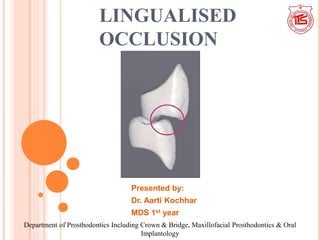
LINGUALISED
OCCLUSION
Presented by:
Dr. Aarti Kochhar
MDS 1st year
Department of Prosthodontics Including Crown & Bridge, Maxillofacial Prosthodontics & Oral
Implantology
“Lingualized occlusion should not be confused with placement
of the mandibular teeth lingual to the ridge crest, as suggested
by several authors.”
Winter, C. M., Woelfel, J. B., and Igarashi, T.: Five Year Changes in the Edentulous Mandible as Determined on Oblique
Cephalometric Radiographs, J. Dent. Res. 1974;53: 1455- 67
INTRODUCTION
 The search for the ideal denture occlusion has been going
on for almost two centuries in an effort to find the tooth
form which provides maximum denture stability and
masticatory efficiency without compromising the health
of the underlying bone.
 Concern about ridge resorption started a trend toward use
of nonanatomic occlusal forms in the 1920’s.
Sears, V. H. : Chewing Members, J. PROSTHET. DENT. 1951; 1: 761-3
OCCLUSAL FORMS
 Today, the available occlusal forms can be classified into three
major groups :
1. Anatomic-30 degree Cusps
2. Semianatomic- 20 degree cusps
3. Nonanatomic or cuspless- 0 degree cusps.
Becker C, Swoope C, Guckes A, Linguatizd occlusion for removable prosthdontics. J. Prosthet. Dent,
1977:601-8
A monoplane occlusal scheme limits esthetic results in the
premolar region.
Becker C, Swoope C, Guckes A, Linguatizd occlusion for removable prosthdontics. J. Prosthet. Dent, 1977:601-8
A lingualized occlusion provides improved esthetics in the
premolar region.
Becker C, Swoope C, Guckes A, Linguatizd occlusion for removable prosthdontics. J. Prosthet. Dent, 1977:601-8
IDEOLOGY
 Lingualized occlusion is an attempt to maintain the
esthetic and food-penetration advantages of the anatomic
form while maintaining the mechanical freedom of the
nonanatomic form.
Becker C, Swoope C, Guckes A, Linguatizd occlusion for removable prosthdontics. J. Prosthet. Dent,
1977:601-8
EVOLUTION
 Gysi was first to report the biomechanical advantages of
lingualized tooth forms (1927).
 The basic concepts of lingualized occlusion were first
suggested by Payne (1941).
 Pound discussed a similar occlusal concept and used the term
“lingualized occlusion” (1973).
 Ortman, Murrell, Becker, and Kelly provided additional
support for this occlusal concept (1977).
Parr GR, Loft GH. The occlusal spectrum and complete dentures. Compend Contin Educ Dent 1982; 3:241-50
Parr GR, Ivanhoe JR. Lingualized occlusion:an occlusion for all reasons. Dent Clin North Am 1996;40:103-12
RATIONALE
 In the early 1900s, Gysi noted that 60% of his denture
patients had developed reverse articulations due to
common resorptive patterns.
 He also recognized the advantages associated with
balanced occlusions, but encountered difficulties while
attempting to create such occlusions with the prosthetic
teeth of the era.
Phoenix R, Engelmeier R, Lingualized occlusion revisited. J Prosthet Dent 2010;104:342-6
OBJECTIVE
 In a lingualized occlusion scheme, the objective is the
elimination of buccal cusp contacts in order to alleviate lateral
stresses or lateral dislodging forces.
The lingual cusps of the upper posteriors make contact in
centric relation in the central fossae of the lower
posteriors. The buccal cusps are out of contact; however
the lingual cusps are in contact in centric, working and
balancing movements.
 For this reason, all the stresses created during working and
balancing motions are of a downward nature, thus creating
stability.
HISTORY
 Gysi designed and patented
“Cross-Bite Posterior Teeth” in
1927.
 Each maxillary tooth featured a
single, linear cusp that fit into a
shallow mandibular depression.
 These teeth were reasonably
esthetic, easy to arrange, and
encouraged vertical force
transmission via their mortar-
and-pestle anatomy.
Gysi A. Special teeth for cross-bite cases.Dent Digest 1927;33:167-71
 By 1935, French had patented
his “Modified Posterior Teeth”.
 The maxillary teeth featured
shallow fossae, while the
mandibular teeth displayed
narrow, planar occlusal
surfaces.
French FA. The problem of building satisfactory dentures. J Prosthet Dent 1954;4:769-81
 The shallow mortar-and-pestle anatomy encouraged vertical
force transmission.
 The facial contours of the maxillary teeth yielded desirable
facial support and esthetics.
 Despite the designs of Gysi and French, early embodiments of
lingualized occlusion failed to gain a significant following.
PAYNE’S CONCEPT
 This changed in 1941, when
Payne introduced a more
cogent form of lingualized
occlusion.
 According to Payne’ article,
a mortar-and-pestle
arrangement was created via
judicious recontouring of 30-
degree teeth.
Payne SH. A posterior set-up to meet individual requirements. Dent Digest 1941;47:20-2
 The maxillary lingual
cusps maintained contact
with the mandibular teeth
in eccentric movements.
 In contrast, the
maxillary buccal cusps
did no contact to the
opposing teeth during
mandibular movements.
Payne SH. A posterior set-up to meet individual requirements. Dent Digest1941;47:20-2
POUND’S CONCEPT
 Pound also championed
lingualized occlusion in his
articles and presentations.
 Pound used maxillary teeth
having cusp angles greater than
30 degrees in conjunction with
mandibular teeth having cusp
angles of 20 degrees or less.
 He carefully reshaped
mandibular fossae to produce
cross-arch balance.
Pound E. Utilizing speech to simplify a personalize denture service. J Prosthet Den1970;24:586-600
 Pound ensured that maxillary
buccal cusps did not contact
mandibular teeth during eccentric
mandibular movements.
 He accomplished this by
reducing the facial surfaces of the
mandibular posterior teeth rather
than elevating the buccal cusps
of the maxillary teeth.
 Though the method for
eliminating maxillary buccal
contact was dissimilar, the
mechanical results were nearly
identical to those described by
Payne.
 Authors such as Ortman, Murrell, Becker, and Kelly provided
additional support for this occlusal concept.
 Proponents of lingualized occlusion reported additional
advantages including
1. Simplified tooth arrangement
2. Simplified occlusal adjustment
3. Reduced lateral forces
4. Efficient bolus penetration
5. Good esthetics.
 Tooth arrangement was characterized by articulation of the
maxillary lingual cusps with the opposing mandibular occlusal
surfaces in centric and eccentric positions.
 Maxillary buccal cusps were not permitted to contact the
mandibular teeth in centric or eccentric positions.
Phoenix R, Engelmeier R, Lingualized occlusion revisited. J Prosthet Dent 2010;104:342-6
ADVANTAGES
1. Lingualized occlusion yielded cross-arch balance. This
resulted in improved denture stability and enhanced patient
comfort.
2. Lateral forces were reduced because maxillary lingual cusps
provided the sole contact with mandibular posterior teeth. As
a result, potentially damaging lateral forces were minimized.
3. Vertical forces could be centered upon the mandibular
residual ridges.
The application of vertical forces was considered
advantageous for denture stability and maintenance of the
supporting hard and soft tissues.
Becker C, Swoope C, Guckes A, Linguatizd occlusion for removable prosthdontics. J. Prosthet. Dent, 1977:601-8
4. Cusp form is more natural in appearance compared to
nonanatomic tooth form.
5. Good penetration of the food bolus is possible.
Becker C, Swoope C, Guckes A, Linguatizd occlusion for removable prosthdontics. J. Prosthet. Dent, 1977:601-8
INDICATIONS
1. Severe alveolar bone resorption resulting in little or no ridge,
or resulting in a discrepancy between the size of the narrowing
and receding upper ridge compared with the widening and
receding lower jaw.
Becker C, Swoope C, Guckes A, Linguatizd occlusion for removable prosthdontics. J. Prosthet. Dent, 1977:601-8
2. Implant-supported overdentures to eliminate lateral
forces that can rock abutments loose over time.
3. Lingualized occlusion is appropriate for free-end
attachment cases to reduce stress on distal extension.
4. Intra-coronal attachments to avoid breakage.
Becker C, Swoope C, Guckes A, Linguatizd occlusion for removable prosthdontics. J. Prosthet. Dent, 1977:601-8
PRINCIPLES
1. Anatomic posterior (30 or 33 degree) teeth are used for
the maxillary denture.
 Tooth forms with prominent lingual cusps are helpful.
2. Nonanatomic or semianatomic teeth are used for the
mandibular denture.
Becker C, Swoope C, Guckes A, Linguatizd occlusion for removable prosthdontics. J. Prosthet. Dent, 1977:601-8
 Either a shallow or flat cusp form is used.
 A narrow occlusal table is preferred when severe resorption of
the residual ridges has occurred.
3. Maxillary lingual cusps should contact mandibular teeth in
centric occlusion.
 The mandibular buccal cusps
should not contact the upper
teeth in centric occlusion, as
is customary with usual
anatomic tooth placement.
 It is helpful to slightly rotate
the maxillary posterior teeth
buccally to allow for slight
clearance of the buccal cusps
in the working position and to
reduce the need for extensive
grinding
4. Balancing and working contacts should occur only on the
maxillary lingual cusps.
 The maxillary lingual cusps remain in contact on the
working side. This helps to reduce lateral movement of
the lower denture by placing occlusal forces more lingual
to and toward the center of the mandibular teeth.
 On the balancing side the maxillary lingual cusps contact
the mandibular buccal cusps as is customary with
anatomic occlusal arrangements
5. Protrusive balancing contacts should occur only
between the maxillary lingual cusps and the lower
teeth.
DENTAL TECHNIQUE
1. Determine and set horizontal condylar guidance
elements using a protrusive jaw relation record.
2. Establish and set lateral condylar guidance values using
Hanau’s formula (L = H/8 + 12).
Javid NS, Porter MR. The importance of the Hanau formula in construction of complete dentures. J Prosthet
Dent 1975;34:397-404
3. Determine the incisal guidance by subtracting 20 degrees from
the average horizontal condylar guidance value.
4. Set lateral components of incisal guidance at 5 degrees on each
side.
5. Establish appropriate soft tissue support, as well as acceptable
esthetics and phonetics.
6. Arrange the maxillary
anterior teeth in
accordance with
rim contours.
7. Arrange mandibular
anterior teeth to
harmonize with
maxillary anterior
teeth.
8. Clearly identify the positions of the retromolar pads.
Identify the medial and lateral extensions of the pads
with distinct lines on the posterior land area of the
mandibular cast.
9. Identify one half the height of each retromolar pad with
a distinct line on the land area of the mandibular cast.
10. Arrange the mandibular posterior teeth determine the
mediolateral placement of the mandibular posterior teeth by
ensuring that mandibular lingual cusps fall within Pound’s
triangle.
Pound E. Utilizing speech to simplify a personalized denture service. J Prosthet Dent 1970;24:586-600
 If they are set too far lingually, they will impinge on the
tongue.
 If they are too far to the buccal, the denture will be
unstable.
11. Modify the vertical dimension of the articulator to
accommodate corrective adjustment procedures.
12. To accomplish this, create a 0.5-mm increase in
occlusal vertical dimension at the incisal pin.
13. Arrange the maxillary posterior teeth, ensuring that the
maxillary lingual cusps are placed in the opposing central
grooves.
14. Position the maxillary buccal cusps 1 mm superior to the
maxillary lingual cusps
Nonworking side contact is limited to maxillary lingual
cusps.
Working side contact is limited to maxillary
lingual cusps. Maxillary buccal cusps do not contact mandibular
teeth in centric or eccentric positions.
15. Return the incisal pin to its neutral (zero) position.
16. Using articulating instrumentation, perform corrective
adjustment procedures.
17. Restrict adjustment to the
mandibular teeth.
18. Stop the procedure when
the incisal pin is in contact
with the incisal table.
19. Perform corrective
adjustment procedures to
ensure appropriate contact in
centric relation position.
20. Be certain that bilateral
posterior contact is present
when anterior teeth are in an
edge-to edge relationship.
21. Accomplish corrective adjustment procedures for right lateral
and left lateral excursions.
 22. Ensure sustained, bilateral contact of the teeth as the
articulator is moved into right lateral and left lateral positions.
REFERENCES
1. Lang BR, Razzoog ME. Lingualized integration: Tooth molds and an
occlusal scheme for edentulous implant patients. Implant Dent
1992;1:204-11
2. Ortman HR. Complete denture occlusion. In: Winkler S, editor.
Essentials of complete denture prosthodontics, vol 1. 2nd ed. St.
Louis:Ishiyaku EuroAmerica; 1994L217-29
3. Hanau RL. Full denture technique for Hanau Articulator Model H.
4th ed. Buffalo:Hanau Engineering; 1930
4. Ortman HR. The role of occlusion in preservation and prevention in
completed denture prosthodontics. J Prosthet Dent 1971;25:121-38
5. Murrell GA. The management of difficult lower dentures. J Prosthet
Dent 1974;32:243-50
6. Becker CM, Swoope CC, Guckes AD. Lingualized occlusion for
removable prosthodontics. J Prosthet Dent 1977;38:601-8
7. Winter, C. M., Woelfel, J. B., And Igarashi, T.: Five Year Changes In
The Edentulous
8. Mandible As Determined On Oblique Cephalometric Radiographs, J.
Dent. Res.1974;53: 1455-67
9. Boswell, J. V.: Practical Occlusion In Relation To Complete
Dentures, J. Prosthet. Dent. 1951;1: 307-21
10. Sears, V. H.: Specifications For Artificial Posterior Teeth, J.
Prosthet. Dent. 1952;2: 353-61
11. Porter, C. G.: The Cuspless Centralized Occlusal Pattern, J.
Prosthet. Dent. 1955;5: 313-8
12. Mcmillian, H. W.: Unilateral Vs. Bilateral Balanced Occlusion, J.
Am. Dent. Assoc. 1930;17:1207-21 13. Sears, V. H. : Chewing
Members, J. Prosthet. Dent. 1951;1: 761-3
14. Hall, R. E.: The Inverted Cusp Tooth, J. Am. Dent. Assoc. 1931;18:
2366-8
15. Hardy, I. R.: The Development In The Occlusal Patterns Of
Artificial Teeth, J. Prosthet. Dent. 1951;1: 14-28
16. Sears, V. H.: Thirty Years Of Non Anatomic Teeth, J. Prosthet.
Dent.1953; 3: 596-617
17. Rapp, R.: The Occlusion And Occlusal Patterns Of Artificial
Posterior Teeth, J. Prosthet. Dent. 1954;4: 461-80
18. French, F.: The Problem Of Building Satisfactory Dentures, J.
Prosthet. Dent.1954; 4: 769-81

Lingualised occlusion revisited

  • 1.
    LINGUALISED OCCLUSION Presented by: Dr. AartiKochhar MDS 1st year Department of Prosthodontics Including Crown & Bridge, Maxillofacial Prosthodontics & Oral Implantology
  • 2.
    “Lingualized occlusion shouldnot be confused with placement of the mandibular teeth lingual to the ridge crest, as suggested by several authors.” Winter, C. M., Woelfel, J. B., and Igarashi, T.: Five Year Changes in the Edentulous Mandible as Determined on Oblique Cephalometric Radiographs, J. Dent. Res. 1974;53: 1455- 67
  • 3.
    INTRODUCTION  The searchfor the ideal denture occlusion has been going on for almost two centuries in an effort to find the tooth form which provides maximum denture stability and masticatory efficiency without compromising the health of the underlying bone.  Concern about ridge resorption started a trend toward use of nonanatomic occlusal forms in the 1920’s. Sears, V. H. : Chewing Members, J. PROSTHET. DENT. 1951; 1: 761-3
  • 4.
    OCCLUSAL FORMS  Today,the available occlusal forms can be classified into three major groups : 1. Anatomic-30 degree Cusps 2. Semianatomic- 20 degree cusps 3. Nonanatomic or cuspless- 0 degree cusps. Becker C, Swoope C, Guckes A, Linguatizd occlusion for removable prosthdontics. J. Prosthet. Dent, 1977:601-8
  • 5.
    A monoplane occlusalscheme limits esthetic results in the premolar region. Becker C, Swoope C, Guckes A, Linguatizd occlusion for removable prosthdontics. J. Prosthet. Dent, 1977:601-8
  • 6.
    A lingualized occlusionprovides improved esthetics in the premolar region. Becker C, Swoope C, Guckes A, Linguatizd occlusion for removable prosthdontics. J. Prosthet. Dent, 1977:601-8
  • 7.
    IDEOLOGY  Lingualized occlusionis an attempt to maintain the esthetic and food-penetration advantages of the anatomic form while maintaining the mechanical freedom of the nonanatomic form. Becker C, Swoope C, Guckes A, Linguatizd occlusion for removable prosthdontics. J. Prosthet. Dent, 1977:601-8
  • 8.
    EVOLUTION  Gysi wasfirst to report the biomechanical advantages of lingualized tooth forms (1927).  The basic concepts of lingualized occlusion were first suggested by Payne (1941).  Pound discussed a similar occlusal concept and used the term “lingualized occlusion” (1973).  Ortman, Murrell, Becker, and Kelly provided additional support for this occlusal concept (1977). Parr GR, Loft GH. The occlusal spectrum and complete dentures. Compend Contin Educ Dent 1982; 3:241-50 Parr GR, Ivanhoe JR. Lingualized occlusion:an occlusion for all reasons. Dent Clin North Am 1996;40:103-12
  • 9.
    RATIONALE  In theearly 1900s, Gysi noted that 60% of his denture patients had developed reverse articulations due to common resorptive patterns.  He also recognized the advantages associated with balanced occlusions, but encountered difficulties while attempting to create such occlusions with the prosthetic teeth of the era. Phoenix R, Engelmeier R, Lingualized occlusion revisited. J Prosthet Dent 2010;104:342-6
  • 10.
  • 11.
     In alingualized occlusion scheme, the objective is the elimination of buccal cusp contacts in order to alleviate lateral stresses or lateral dislodging forces.
  • 12.
    The lingual cuspsof the upper posteriors make contact in centric relation in the central fossae of the lower posteriors. The buccal cusps are out of contact; however the lingual cusps are in contact in centric, working and balancing movements.
  • 14.
     For thisreason, all the stresses created during working and balancing motions are of a downward nature, thus creating stability.
  • 15.
    HISTORY  Gysi designedand patented “Cross-Bite Posterior Teeth” in 1927.  Each maxillary tooth featured a single, linear cusp that fit into a shallow mandibular depression.  These teeth were reasonably esthetic, easy to arrange, and encouraged vertical force transmission via their mortar- and-pestle anatomy. Gysi A. Special teeth for cross-bite cases.Dent Digest 1927;33:167-71
  • 16.
     By 1935,French had patented his “Modified Posterior Teeth”.  The maxillary teeth featured shallow fossae, while the mandibular teeth displayed narrow, planar occlusal surfaces. French FA. The problem of building satisfactory dentures. J Prosthet Dent 1954;4:769-81
  • 17.
     The shallowmortar-and-pestle anatomy encouraged vertical force transmission.  The facial contours of the maxillary teeth yielded desirable facial support and esthetics.  Despite the designs of Gysi and French, early embodiments of lingualized occlusion failed to gain a significant following.
  • 18.
    PAYNE’S CONCEPT  Thischanged in 1941, when Payne introduced a more cogent form of lingualized occlusion.  According to Payne’ article, a mortar-and-pestle arrangement was created via judicious recontouring of 30- degree teeth. Payne SH. A posterior set-up to meet individual requirements. Dent Digest 1941;47:20-2
  • 19.
     The maxillarylingual cusps maintained contact with the mandibular teeth in eccentric movements.  In contrast, the maxillary buccal cusps did no contact to the opposing teeth during mandibular movements. Payne SH. A posterior set-up to meet individual requirements. Dent Digest1941;47:20-2
  • 20.
    POUND’S CONCEPT  Poundalso championed lingualized occlusion in his articles and presentations.  Pound used maxillary teeth having cusp angles greater than 30 degrees in conjunction with mandibular teeth having cusp angles of 20 degrees or less.  He carefully reshaped mandibular fossae to produce cross-arch balance. Pound E. Utilizing speech to simplify a personalize denture service. J Prosthet Den1970;24:586-600
  • 21.
     Pound ensuredthat maxillary buccal cusps did not contact mandibular teeth during eccentric mandibular movements.  He accomplished this by reducing the facial surfaces of the mandibular posterior teeth rather than elevating the buccal cusps of the maxillary teeth.  Though the method for eliminating maxillary buccal contact was dissimilar, the mechanical results were nearly identical to those described by Payne.
  • 22.
     Authors suchas Ortman, Murrell, Becker, and Kelly provided additional support for this occlusal concept.  Proponents of lingualized occlusion reported additional advantages including 1. Simplified tooth arrangement 2. Simplified occlusal adjustment 3. Reduced lateral forces 4. Efficient bolus penetration 5. Good esthetics.
  • 23.
     Tooth arrangementwas characterized by articulation of the maxillary lingual cusps with the opposing mandibular occlusal surfaces in centric and eccentric positions.  Maxillary buccal cusps were not permitted to contact the mandibular teeth in centric or eccentric positions. Phoenix R, Engelmeier R, Lingualized occlusion revisited. J Prosthet Dent 2010;104:342-6
  • 24.
    ADVANTAGES 1. Lingualized occlusionyielded cross-arch balance. This resulted in improved denture stability and enhanced patient comfort. 2. Lateral forces were reduced because maxillary lingual cusps provided the sole contact with mandibular posterior teeth. As a result, potentially damaging lateral forces were minimized. 3. Vertical forces could be centered upon the mandibular residual ridges. The application of vertical forces was considered advantageous for denture stability and maintenance of the supporting hard and soft tissues. Becker C, Swoope C, Guckes A, Linguatizd occlusion for removable prosthdontics. J. Prosthet. Dent, 1977:601-8
  • 25.
    4. Cusp formis more natural in appearance compared to nonanatomic tooth form. 5. Good penetration of the food bolus is possible. Becker C, Swoope C, Guckes A, Linguatizd occlusion for removable prosthdontics. J. Prosthet. Dent, 1977:601-8
  • 26.
    INDICATIONS 1. Severe alveolarbone resorption resulting in little or no ridge, or resulting in a discrepancy between the size of the narrowing and receding upper ridge compared with the widening and receding lower jaw. Becker C, Swoope C, Guckes A, Linguatizd occlusion for removable prosthdontics. J. Prosthet. Dent, 1977:601-8
  • 27.
    2. Implant-supported overdenturesto eliminate lateral forces that can rock abutments loose over time.
  • 28.
    3. Lingualized occlusionis appropriate for free-end attachment cases to reduce stress on distal extension.
  • 29.
    4. Intra-coronal attachmentsto avoid breakage. Becker C, Swoope C, Guckes A, Linguatizd occlusion for removable prosthdontics. J. Prosthet. Dent, 1977:601-8
  • 30.
    PRINCIPLES 1. Anatomic posterior(30 or 33 degree) teeth are used for the maxillary denture.  Tooth forms with prominent lingual cusps are helpful. 2. Nonanatomic or semianatomic teeth are used for the mandibular denture. Becker C, Swoope C, Guckes A, Linguatizd occlusion for removable prosthdontics. J. Prosthet. Dent, 1977:601-8
  • 31.
     Either ashallow or flat cusp form is used.  A narrow occlusal table is preferred when severe resorption of the residual ridges has occurred. 3. Maxillary lingual cusps should contact mandibular teeth in centric occlusion.
  • 32.
     The mandibularbuccal cusps should not contact the upper teeth in centric occlusion, as is customary with usual anatomic tooth placement.
  • 33.
     It ishelpful to slightly rotate the maxillary posterior teeth buccally to allow for slight clearance of the buccal cusps in the working position and to reduce the need for extensive grinding
  • 34.
    4. Balancing andworking contacts should occur only on the maxillary lingual cusps.
  • 35.
     The maxillarylingual cusps remain in contact on the working side. This helps to reduce lateral movement of the lower denture by placing occlusal forces more lingual to and toward the center of the mandibular teeth.  On the balancing side the maxillary lingual cusps contact the mandibular buccal cusps as is customary with anatomic occlusal arrangements
  • 36.
    5. Protrusive balancingcontacts should occur only between the maxillary lingual cusps and the lower teeth.
  • 37.
    DENTAL TECHNIQUE 1. Determineand set horizontal condylar guidance elements using a protrusive jaw relation record. 2. Establish and set lateral condylar guidance values using Hanau’s formula (L = H/8 + 12). Javid NS, Porter MR. The importance of the Hanau formula in construction of complete dentures. J Prosthet Dent 1975;34:397-404
  • 38.
    3. Determine theincisal guidance by subtracting 20 degrees from the average horizontal condylar guidance value. 4. Set lateral components of incisal guidance at 5 degrees on each side. 5. Establish appropriate soft tissue support, as well as acceptable esthetics and phonetics.
  • 39.
    6. Arrange themaxillary anterior teeth in accordance with rim contours. 7. Arrange mandibular anterior teeth to harmonize with maxillary anterior teeth.
  • 40.
    8. Clearly identifythe positions of the retromolar pads. Identify the medial and lateral extensions of the pads with distinct lines on the posterior land area of the mandibular cast. 9. Identify one half the height of each retromolar pad with a distinct line on the land area of the mandibular cast.
  • 42.
    10. Arrange themandibular posterior teeth determine the mediolateral placement of the mandibular posterior teeth by ensuring that mandibular lingual cusps fall within Pound’s triangle. Pound E. Utilizing speech to simplify a personalized denture service. J Prosthet Dent 1970;24:586-600
  • 43.
     If theyare set too far lingually, they will impinge on the tongue.  If they are too far to the buccal, the denture will be unstable.
  • 44.
    11. Modify thevertical dimension of the articulator to accommodate corrective adjustment procedures. 12. To accomplish this, create a 0.5-mm increase in occlusal vertical dimension at the incisal pin.
  • 45.
    13. Arrange themaxillary posterior teeth, ensuring that the maxillary lingual cusps are placed in the opposing central grooves. 14. Position the maxillary buccal cusps 1 mm superior to the maxillary lingual cusps
  • 46.
    Nonworking side contactis limited to maxillary lingual cusps.
  • 47.
    Working side contactis limited to maxillary lingual cusps. Maxillary buccal cusps do not contact mandibular teeth in centric or eccentric positions.
  • 48.
    15. Return theincisal pin to its neutral (zero) position. 16. Using articulating instrumentation, perform corrective adjustment procedures.
  • 49.
    17. Restrict adjustmentto the mandibular teeth. 18. Stop the procedure when the incisal pin is in contact with the incisal table.
  • 50.
    19. Perform corrective adjustmentprocedures to ensure appropriate contact in centric relation position. 20. Be certain that bilateral posterior contact is present when anterior teeth are in an edge-to edge relationship.
  • 51.
    21. Accomplish correctiveadjustment procedures for right lateral and left lateral excursions.
  • 52.
     22. Ensuresustained, bilateral contact of the teeth as the articulator is moved into right lateral and left lateral positions.
  • 54.
    REFERENCES 1. Lang BR,Razzoog ME. Lingualized integration: Tooth molds and an occlusal scheme for edentulous implant patients. Implant Dent 1992;1:204-11 2. Ortman HR. Complete denture occlusion. In: Winkler S, editor. Essentials of complete denture prosthodontics, vol 1. 2nd ed. St. Louis:Ishiyaku EuroAmerica; 1994L217-29 3. Hanau RL. Full denture technique for Hanau Articulator Model H. 4th ed. Buffalo:Hanau Engineering; 1930 4. Ortman HR. The role of occlusion in preservation and prevention in completed denture prosthodontics. J Prosthet Dent 1971;25:121-38
  • 55.
    5. Murrell GA.The management of difficult lower dentures. J Prosthet Dent 1974;32:243-50 6. Becker CM, Swoope CC, Guckes AD. Lingualized occlusion for removable prosthodontics. J Prosthet Dent 1977;38:601-8 7. Winter, C. M., Woelfel, J. B., And Igarashi, T.: Five Year Changes In The Edentulous 8. Mandible As Determined On Oblique Cephalometric Radiographs, J. Dent. Res.1974;53: 1455-67 9. Boswell, J. V.: Practical Occlusion In Relation To Complete Dentures, J. Prosthet. Dent. 1951;1: 307-21
  • 56.
    10. Sears, V.H.: Specifications For Artificial Posterior Teeth, J. Prosthet. Dent. 1952;2: 353-61 11. Porter, C. G.: The Cuspless Centralized Occlusal Pattern, J. Prosthet. Dent. 1955;5: 313-8 12. Mcmillian, H. W.: Unilateral Vs. Bilateral Balanced Occlusion, J. Am. Dent. Assoc. 1930;17:1207-21 13. Sears, V. H. : Chewing Members, J. Prosthet. Dent. 1951;1: 761-3 14. Hall, R. E.: The Inverted Cusp Tooth, J. Am. Dent. Assoc. 1931;18: 2366-8 15. Hardy, I. R.: The Development In The Occlusal Patterns Of Artificial Teeth, J. Prosthet. Dent. 1951;1: 14-28
  • 57.
    16. Sears, V.H.: Thirty Years Of Non Anatomic Teeth, J. Prosthet. Dent.1953; 3: 596-617 17. Rapp, R.: The Occlusion And Occlusal Patterns Of Artificial Posterior Teeth, J. Prosthet. Dent. 1954;4: 461-80 18. French, F.: The Problem Of Building Satisfactory Dentures, J. Prosthet. Dent.1954; 4: 769-81