IMMEDIATE COMPLETE
IMMEDIATE COMPLETE
DENTURES
DENTURES
DR. SUJANA U
READER
DEPT OF PROSTHODONTICS
SREE ANJANEYA INSTITUTE OF DENTAL SCIENCES
INTRODUCTION
According to M.M. Devan,
Stressing the importance removable partial dentures before the patient is
rendered edentulous ,
“A smooth uneventful transition not only results in a better denture
foundation physically and physiologically by maintenance of
normal neuromuscular patterns, but also psychologically, such a
transition diminishes the feeling of toothlessness”.
DEFINITIONS
Acccording to Heartwell,
A dental prosthesis constructed to replace the lost dentition and associated
structures of the maxillae and /or mandible, and inserted immediately
following removal of the remaining natural teeth.
According to GPT 9,
A complete denture or a removable partial denture fabricated for
placement immediately after the removal of natural teeth.
REVIEW OF LITERATURE
 First described by Richardson in 1860.
 1965- Heartwell, C and Salisbury F.W. presented an evaluation of immediate
complete dentures regarding requirements, diagnosis, advantages,
disadvantages and surgical preparation.
 1968 - Campagna S.J., described an impression technique for immediate denture
fabrication.
 Frank C. Jerb, described the technique of trimming the cast
for immediate denture.
 According to him, it is based on anatomic factors and
positional changes that take place in gingival tissue when
teeth are extracted. Considerations must be given to existing
alveolar bone level as well as relative levels of the over lying
soft tissue structures.
 1981 - Passamonti et al: determined the changes that take place in
maxillomandibular relations during a 3-month period following insertion
of immediate dentures. The results were as follows:
1. In the centric occlusion, the mandible moved forward at one week and
remained in that position for the three-month period.
2. The rest position remained relatively constant .
3. VDO and VDR showed a gradual decrease over the period.
4. Reline procedure did not affect the trend of the dimensional changes.
 1990- Gardner et al.described a technique for obtaining the labial
section of an impression for a maxillary immediate complete denture.
 1991- Tallgren ET. Al.: studied the gradual changes in the skeletal and soft
tissue profile of complete denture wearers resulting from residual ridge
reduction. They concluded that ridge resorption is most rapid during the first
half year and denture relining with correction of vertical dimension of
occlusion is indicated.
 1992 - Gary R. Goldstein: presented an alternative immediate complete
denture impression technique for mobile teeth, which have the possibility
of being extracted at the time of impression making.
 1992 - Zafrulla Khan: presented a technique for one appointment
construction of an immediate transitional denture using VLC resin.
 2000 - William C. Elton: presented a method to confirm the intaglio
surface of an immediate complete denture when using a chair side soft
reline procedure after tooth extraction.
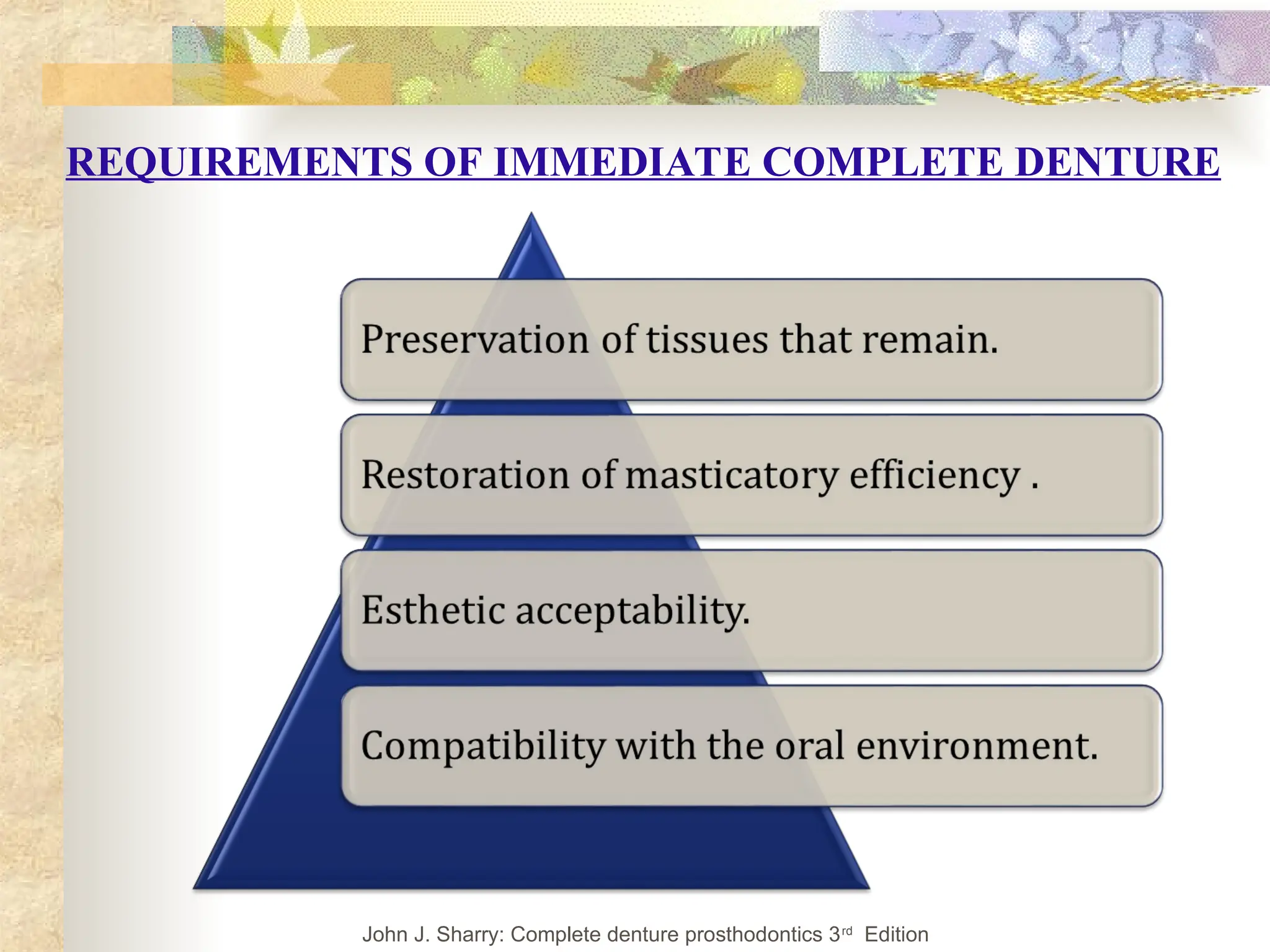
REQUIREMENTS OF IMMEDIATE COMPLETE DENTURE
John J. Sharry: Complete denture prosthodontics 3rd
Edition
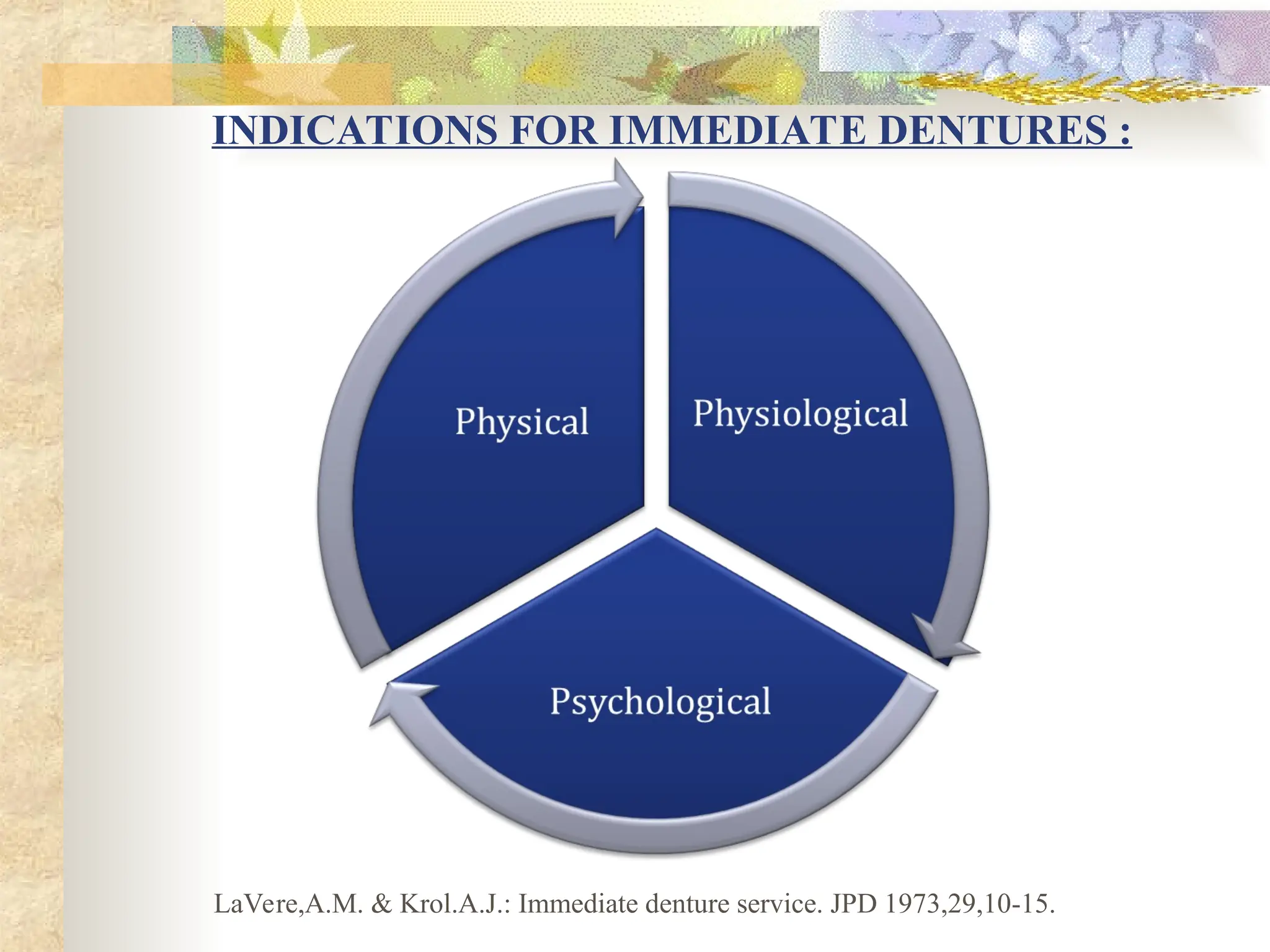
INDICATIONS FOR IMMEDIATE DENTURES :
LaVere,A.M. & Krol.A.J.: Immediate denture service. JPD 1973,29,10-15.
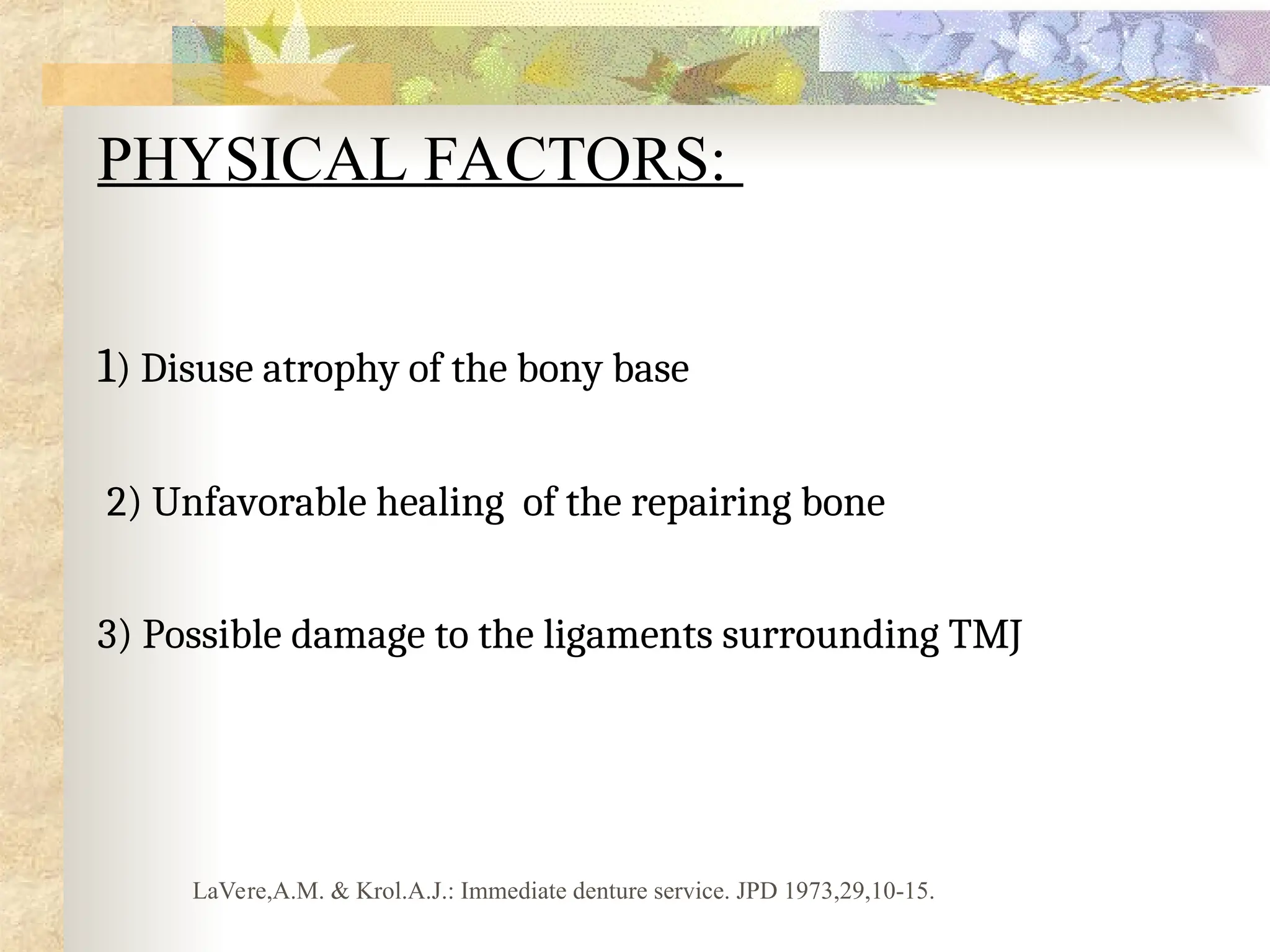
PHYSICAL FACTORS:
1) Disuse atrophy of the bony base
2) Unfavorable healing of the repairing bone
3) Possible damage to the ligaments surrounding TMJ
LaVere,A.M. & Krol.A.J.: Immediate denture service. JPD 1973,29,10-15.
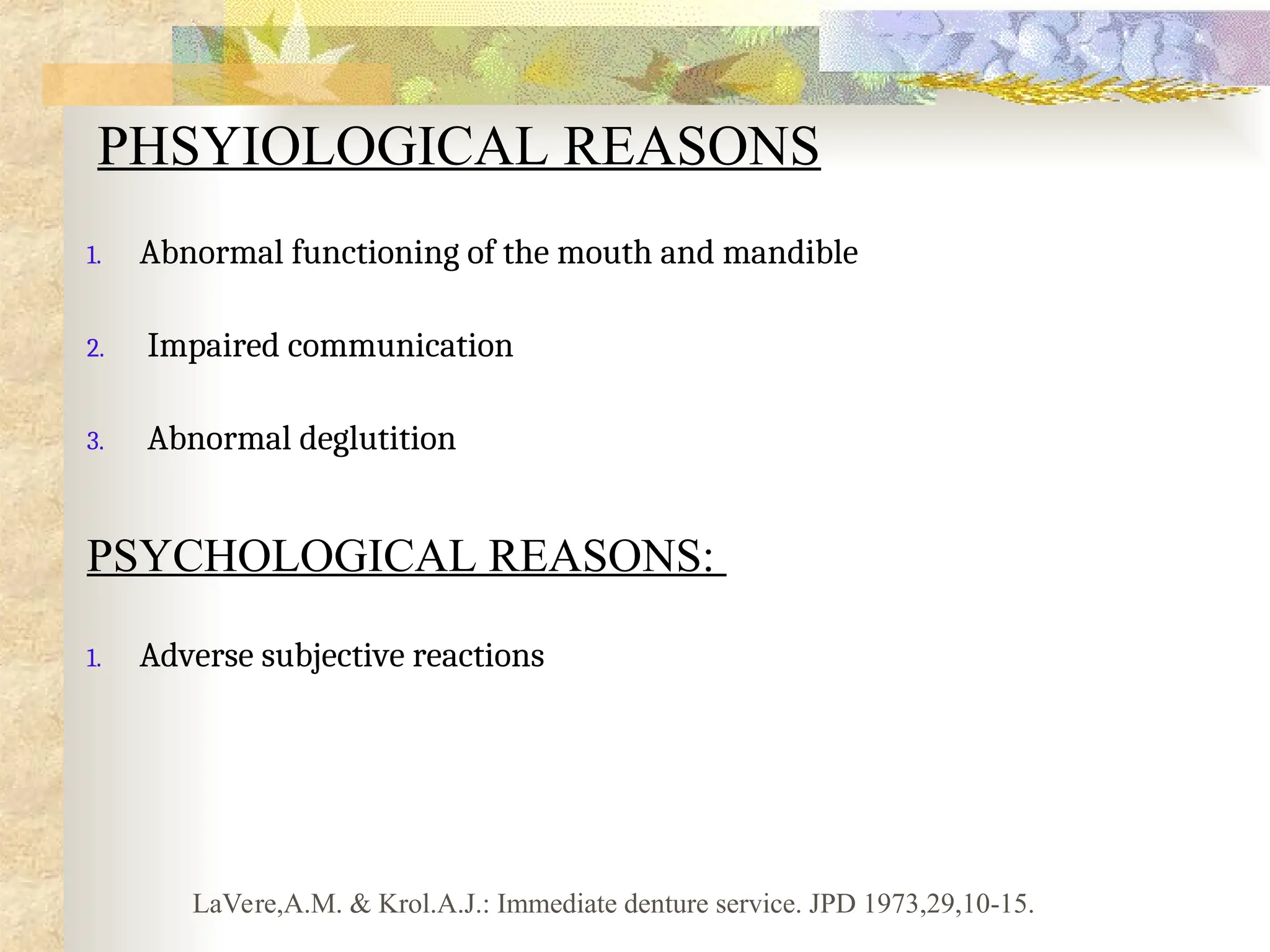
PHSYIOLOGICAL REASONS
1. Abnormal functioning of the mouth and mandible
2. Impaired communication
3. Abnormal deglutition
PSYCHOLOGICAL REASONS:
1. Adverse subjective reactions
LaVere,A.M. & Krol.A.J.: Immediate denture service. JPD 1973,29,10-15.
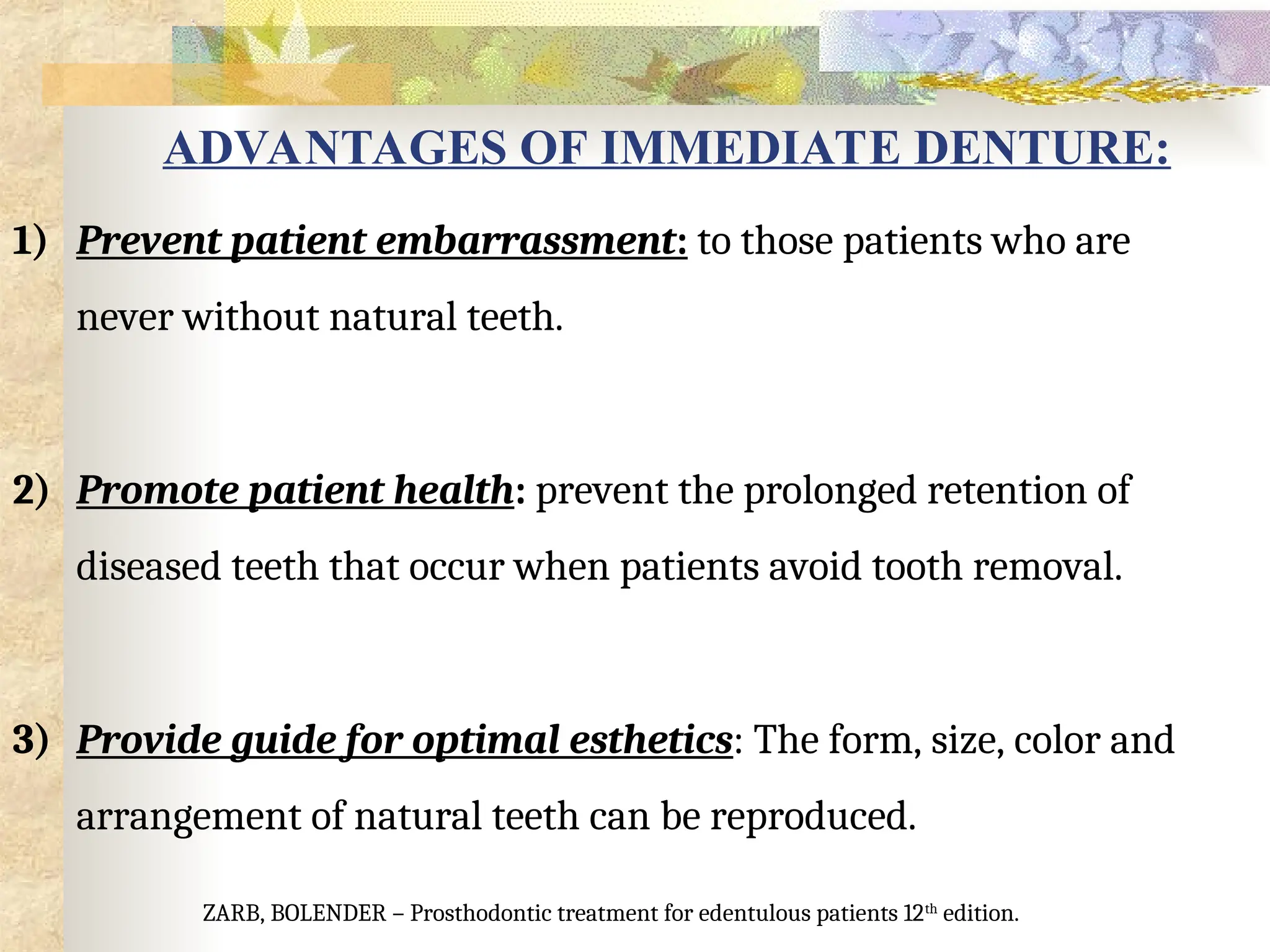
CONTRAINDICATIONS OF IMMEDIATE DENTURES:
•Demer, W.: Minimizing problems in placement of immediate dentures. JPD 1972,27,275-284.
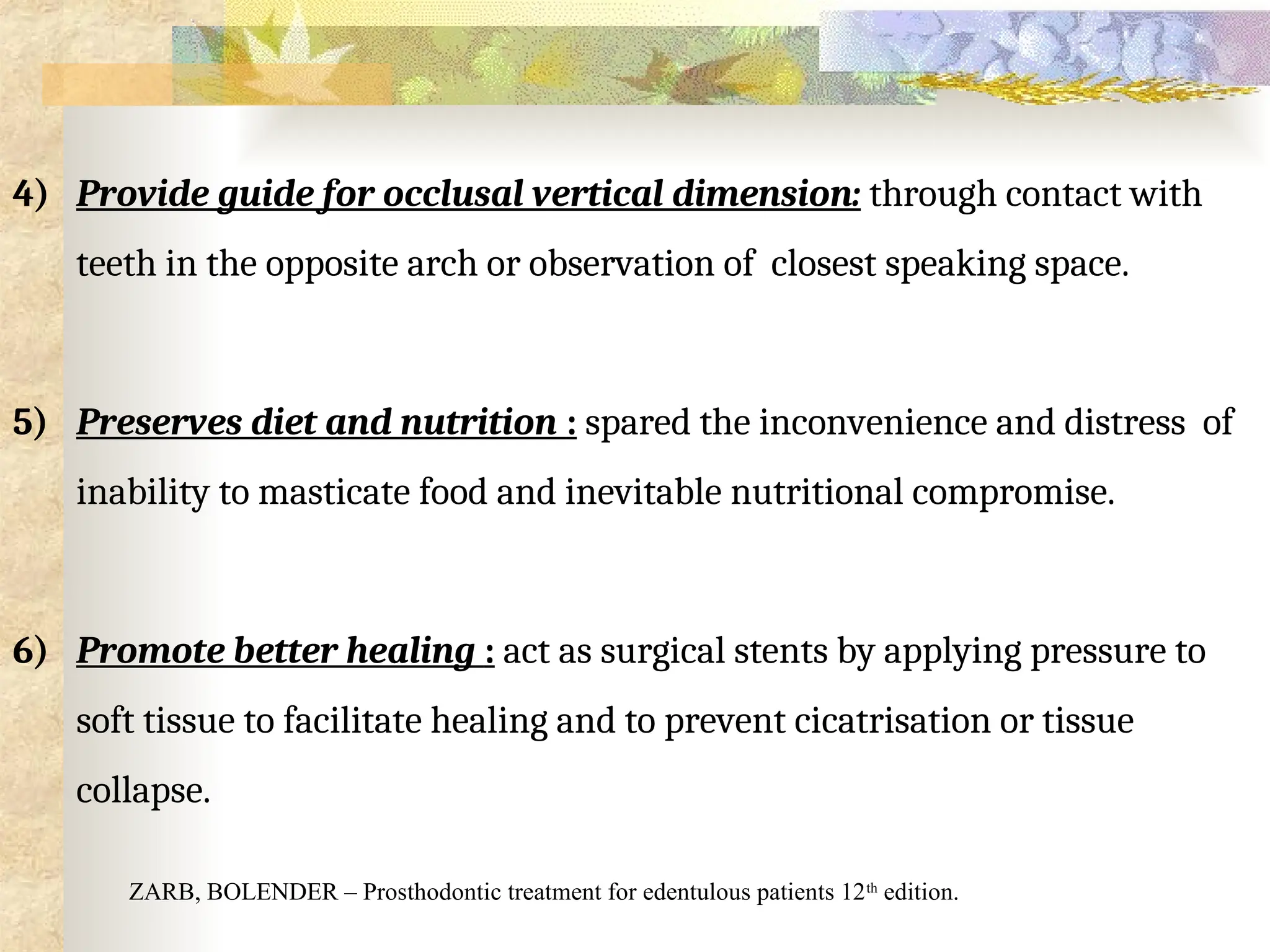
ADVANTAGES OF IMMEDIATE DENTURE:
1) Prevent patient embarrassment: to those patients who are
never without natural teeth.
2) Promote patient health: prevent the prolonged retention of
diseased teeth that occur when patients avoid tooth removal.
3) Provide guide for optimal esthetics: The form, size, color and
arrangement of natural teeth can be reproduced.
ZARB, BOLENDER – Prosthodontic treatment for edentulous patients 12th
edition.
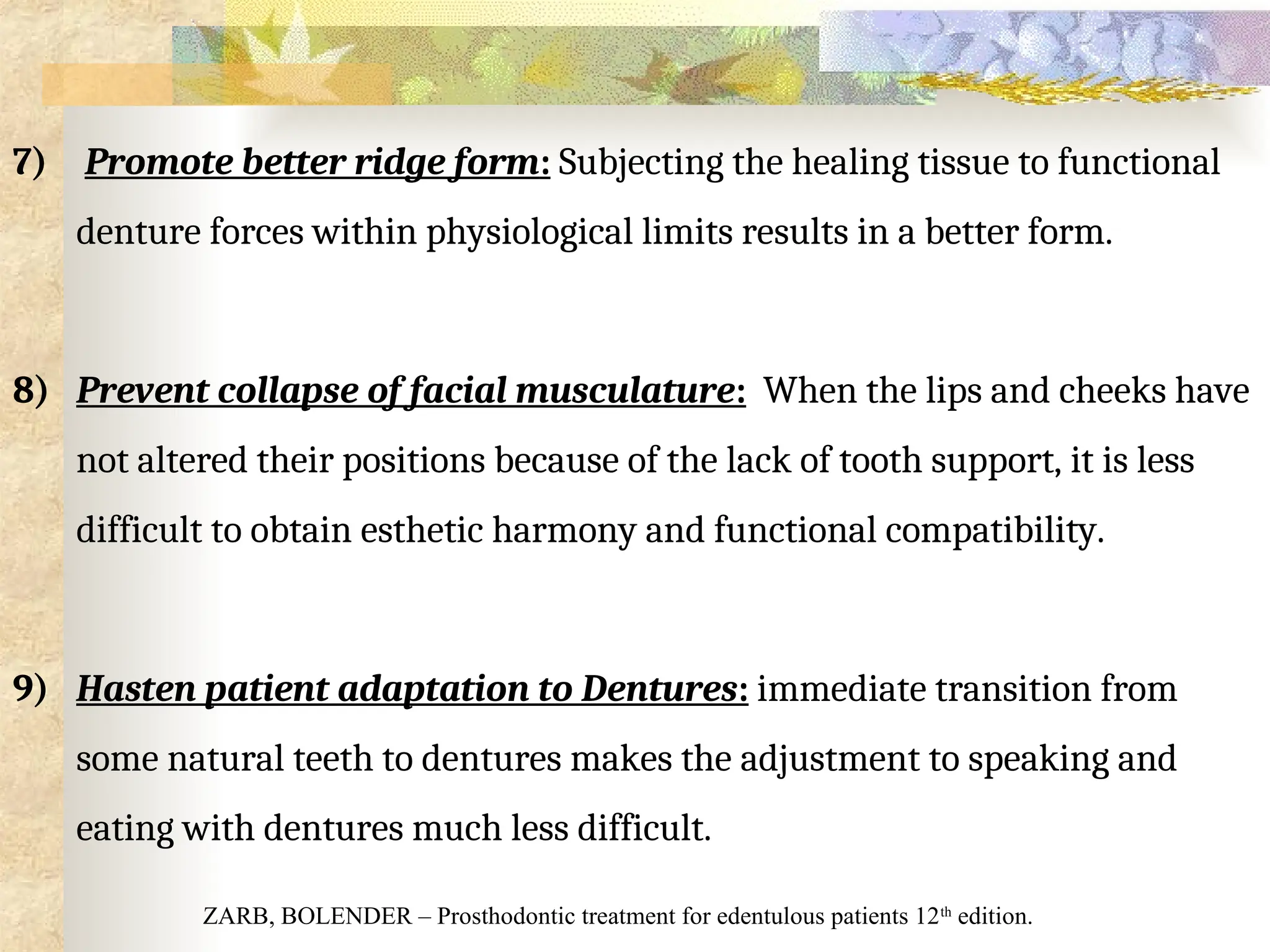
4) Provide guide for occlusal vertical dimension: through contact with
teeth in the opposite arch or observation of closest speaking space.
5) Preserves diet and nutrition : spared the inconvenience and distress of
inability to masticate food and inevitable nutritional compromise.
6) Promote better healing : act as surgical stents by applying pressure to
soft tissue to facilitate healing and to prevent cicatrisation or tissue
collapse.
ZARB, BOLENDER – Prosthodontic treatment for edentulous patients 12th
edition.
7) Promote better ridge form: Subjecting the healing tissue to functional
denture forces within physiological limits results in a better form.
8) Prevent collapse of facial musculature: When the lips and cheeks have
not altered their positions because of the lack of tooth support, it is less
difficult to obtain esthetic harmony and functional compatibility.
9) Hasten patient adaptation to Dentures: immediate transition from
some natural teeth to dentures makes the adjustment to speaking and
eating with dentures much less difficult.
ZARB, BOLENDER – Prosthodontic treatment for edentulous patients 12th
edition.
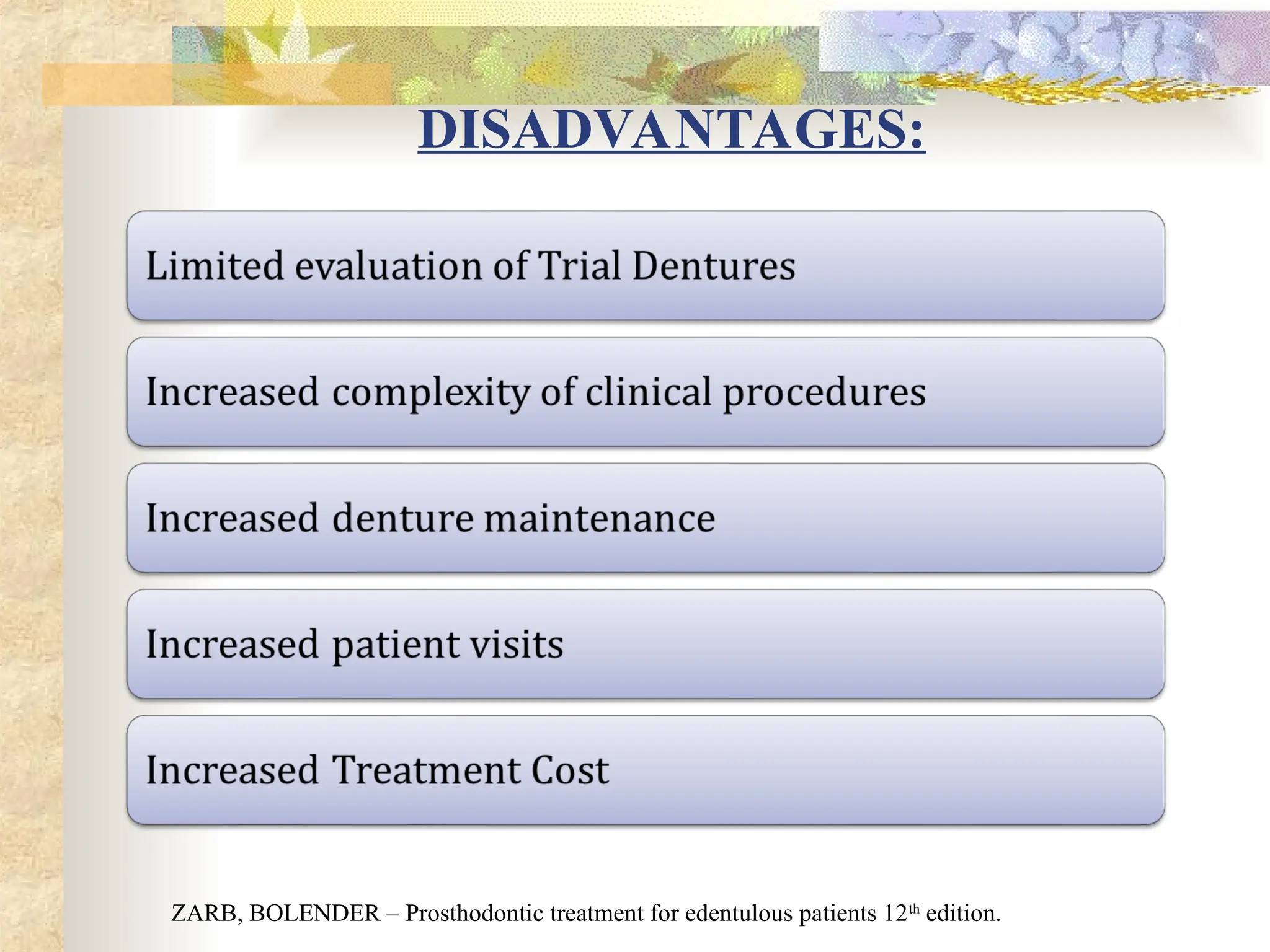
DISADVANTAGES:
ZARB, BOLENDER – Prosthodontic treatment for edentulous patients 12th
edition.
CLASSIFICATION:
LaVere,A.M. & Krol.A.J.: Immediate denture service. JPD 1973,29,10-15.
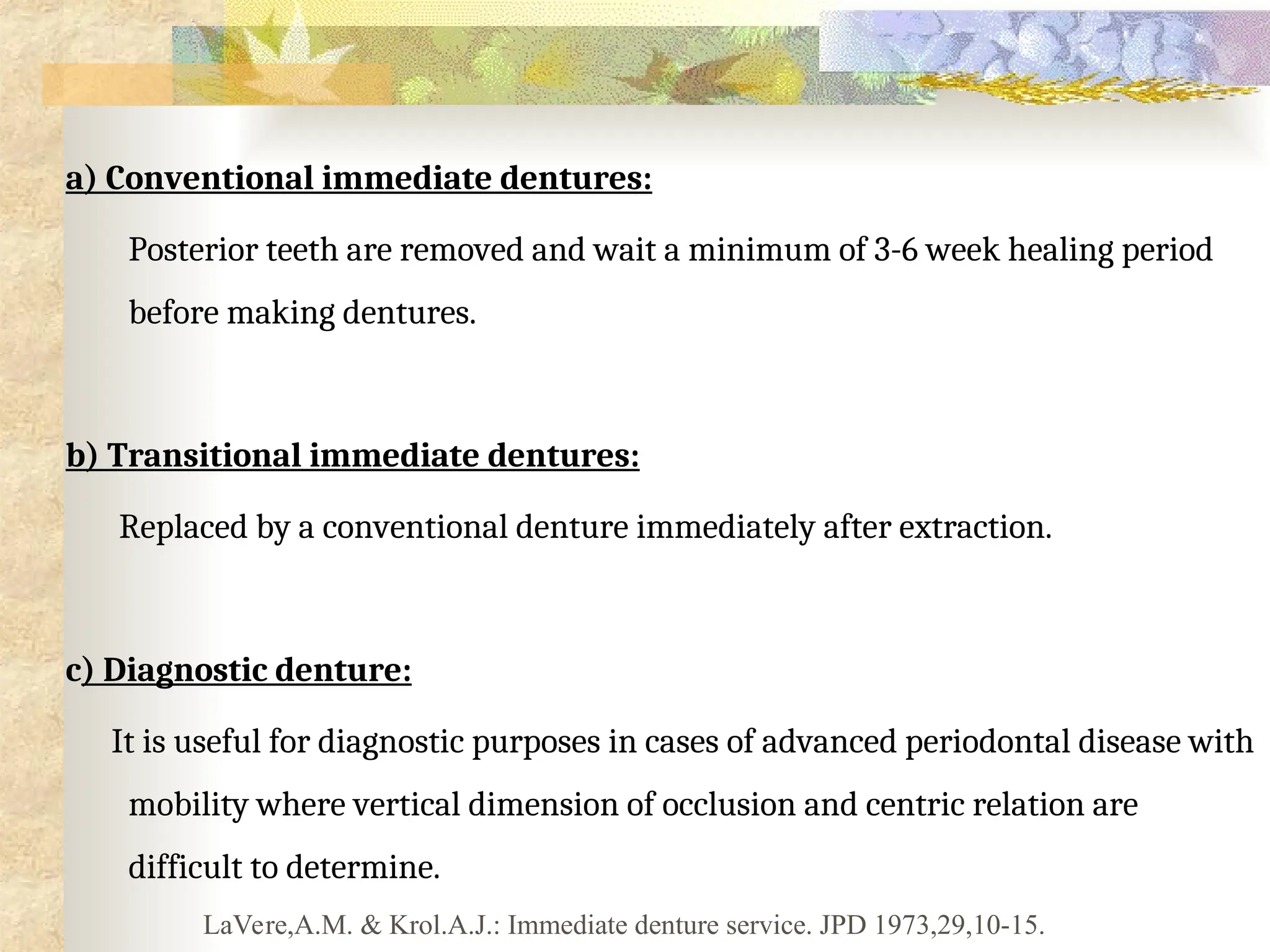
a) Conventional immediate dentures:
Posterior teeth are removed and wait a minimum of 3-6 week healing period
before making dentures.
b) Transitional immediate dentures:
Replaced by a conventional denture immediately after extraction.
c) Diagnostic denture:
It is useful for diagnostic purposes in cases of advanced periodontal disease with
mobility where vertical dimension of occlusion and centric relation are
difficult to determine.
LaVere,A.M. & Krol.A.J.: Immediate denture service. JPD 1973,29,10-15.
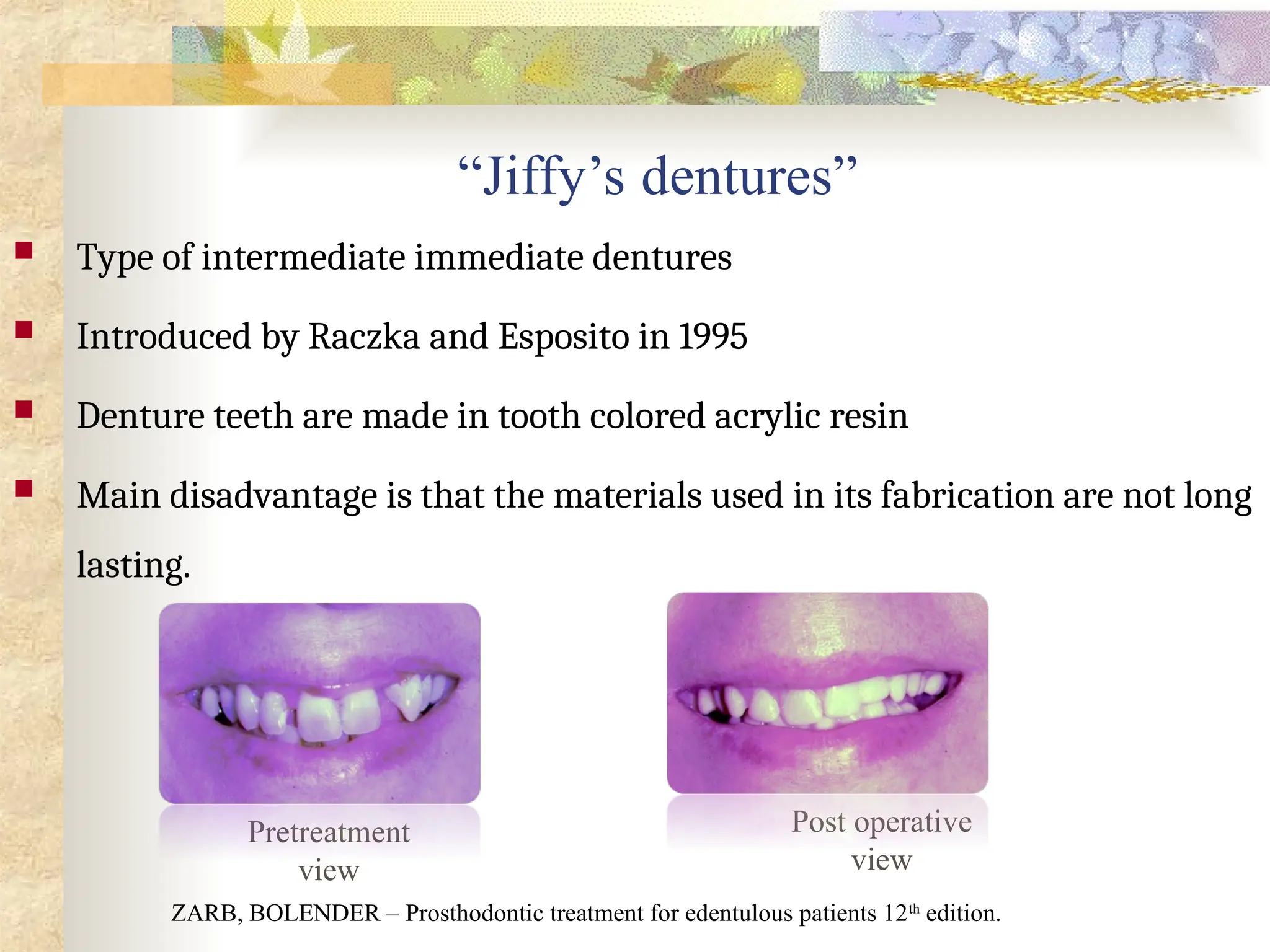
“Jiffy’s dentures”
 Type of intermediate immediate dentures
 Introduced by Raczka and Esposito in 1995
 Denture teeth are made in tooth colored acrylic resin
 Main disadvantage is that the materials used in its fabrication are not long
lasting.
ZARB, BOLENDER – Prosthodontic treatment for edentulous patients 12th
edition.
Post operative
view
Pretreatment
view
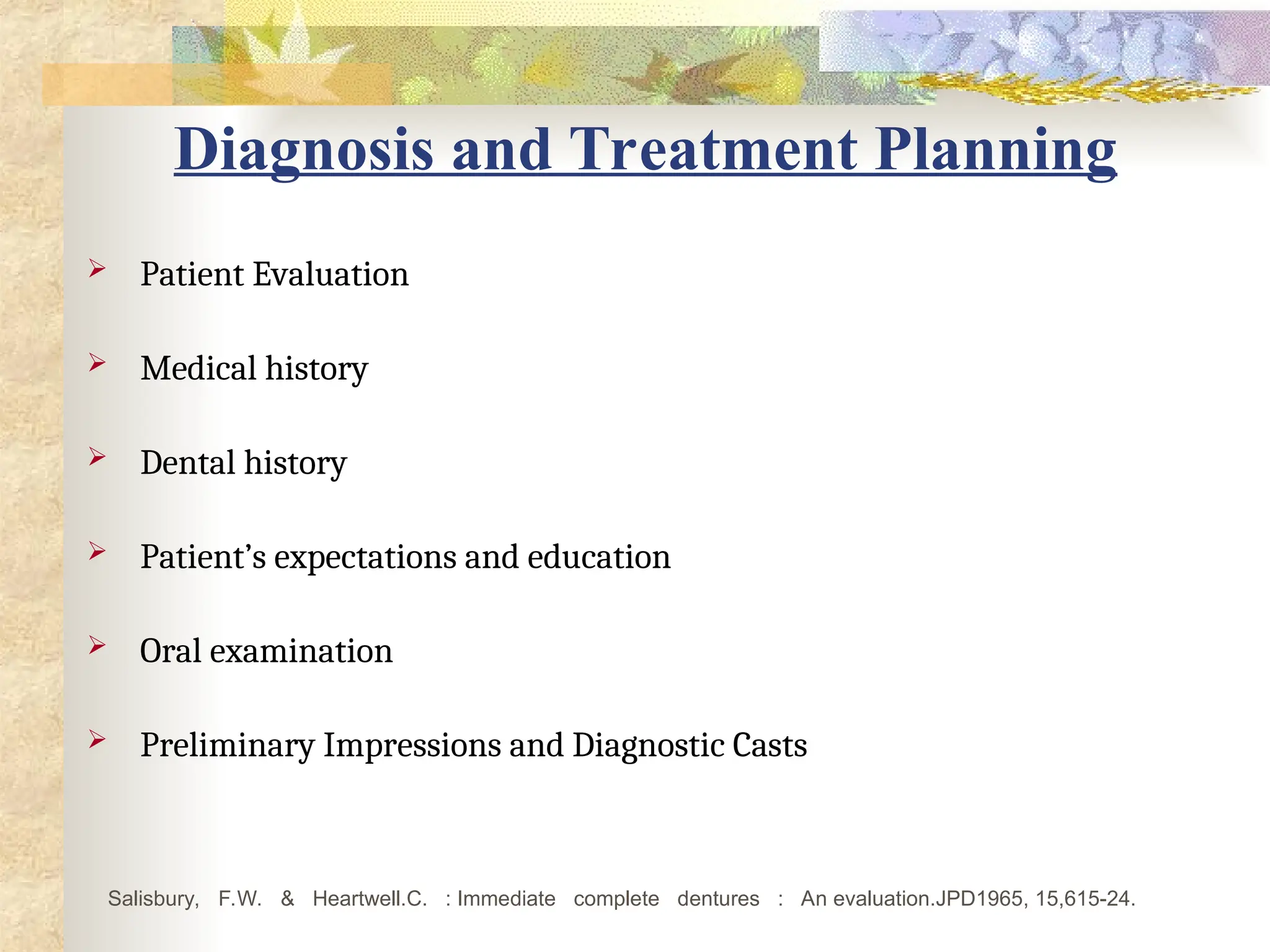
Diagnosis and Treatment Planning
 Patient Evaluation
 Medical history
 Dental history
 Patient’s expectations and education
 Oral examination
 Preliminary Impressions and Diagnostic Casts
Salisbury, F.W. & Heartwell.C. : Immediate complete dentures : An evaluation.JPD1965, 15,615-24.
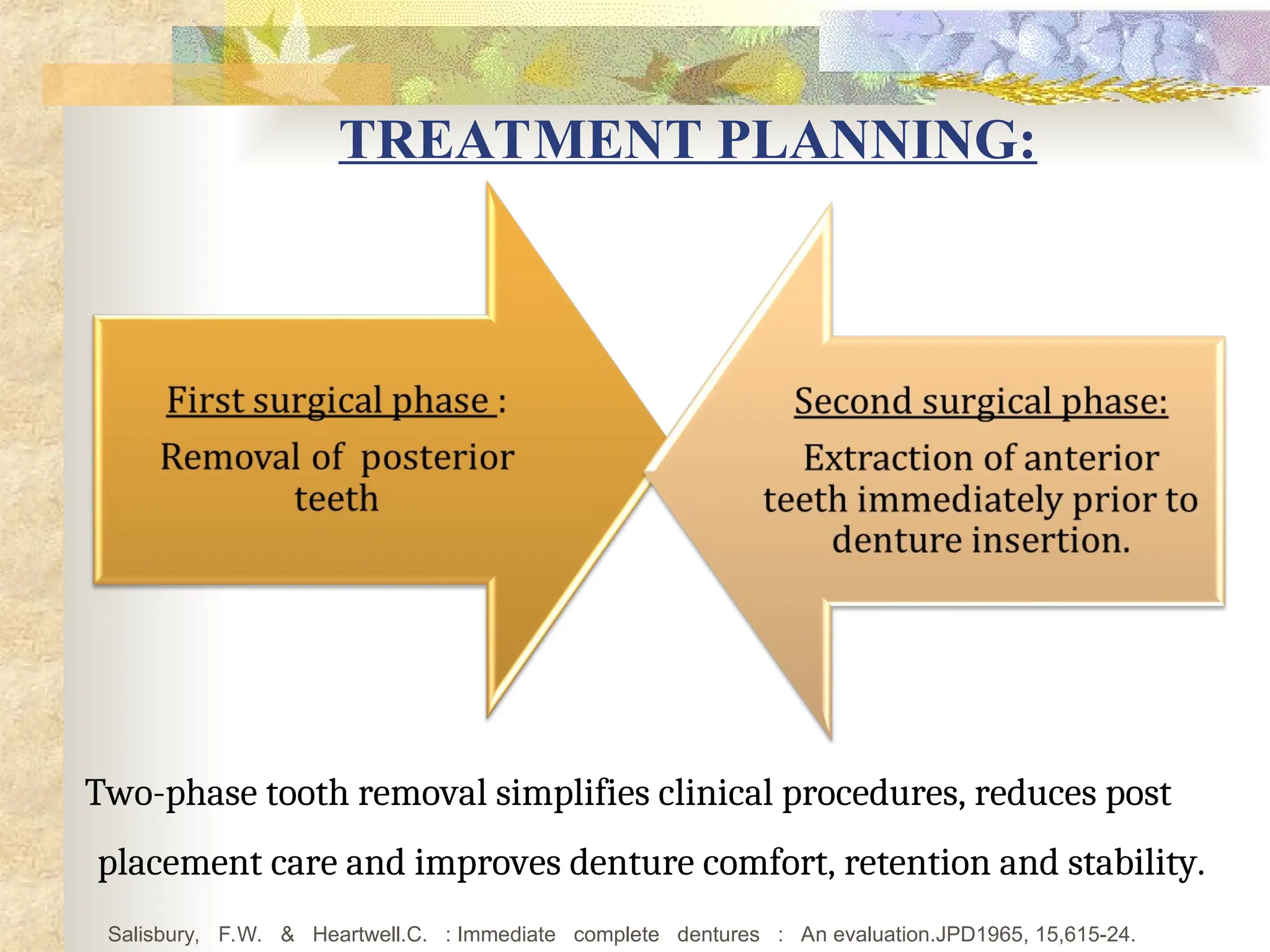
TREATMENT PLANNING:
Two-phase tooth removal simplifies clinical procedures, reduces post
placement care and improves denture comfort, retention and stability.
Salisbury, F.W. & Heartwell.C. : Immediate complete dentures : An evaluation.JPD1965, 15,615-24.
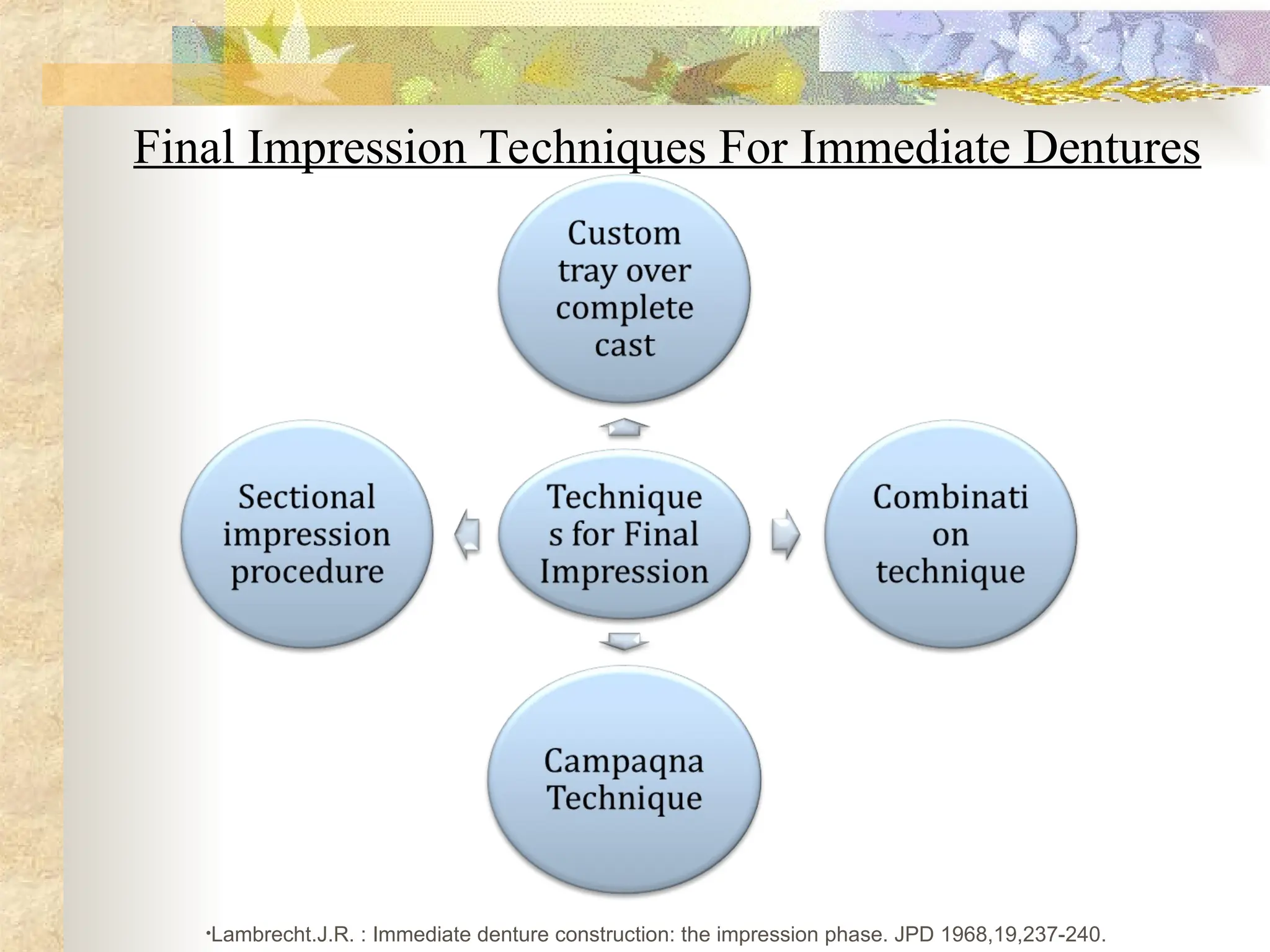
Final Impression Techniques For Immediate Dentures
•Lambrecht.J.R. : Immediate denture construction: the impression phase. JPD 1968,19,237-240.
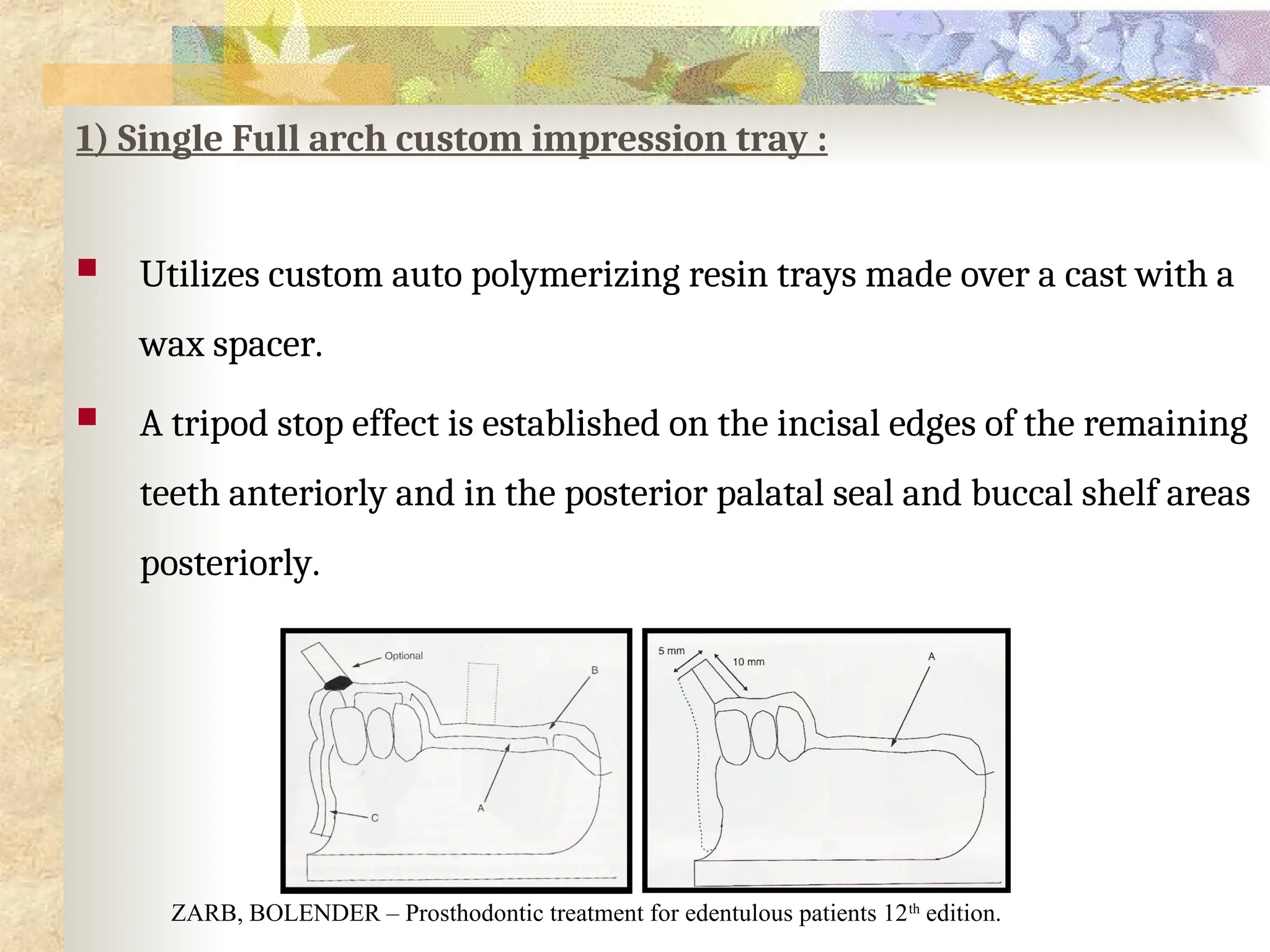
1) Single Full arch custom impression tray :
 Utilizes custom auto polymerizing resin trays made over a cast with a
wax spacer.
 A tripod stop effect is established on the incisal edges of the remaining
teeth anteriorly and in the posterior palatal seal and buccal shelf areas
posteriorly.
ZARB, BOLENDER – Prosthodontic treatment for edentulous patients 12th
edition.
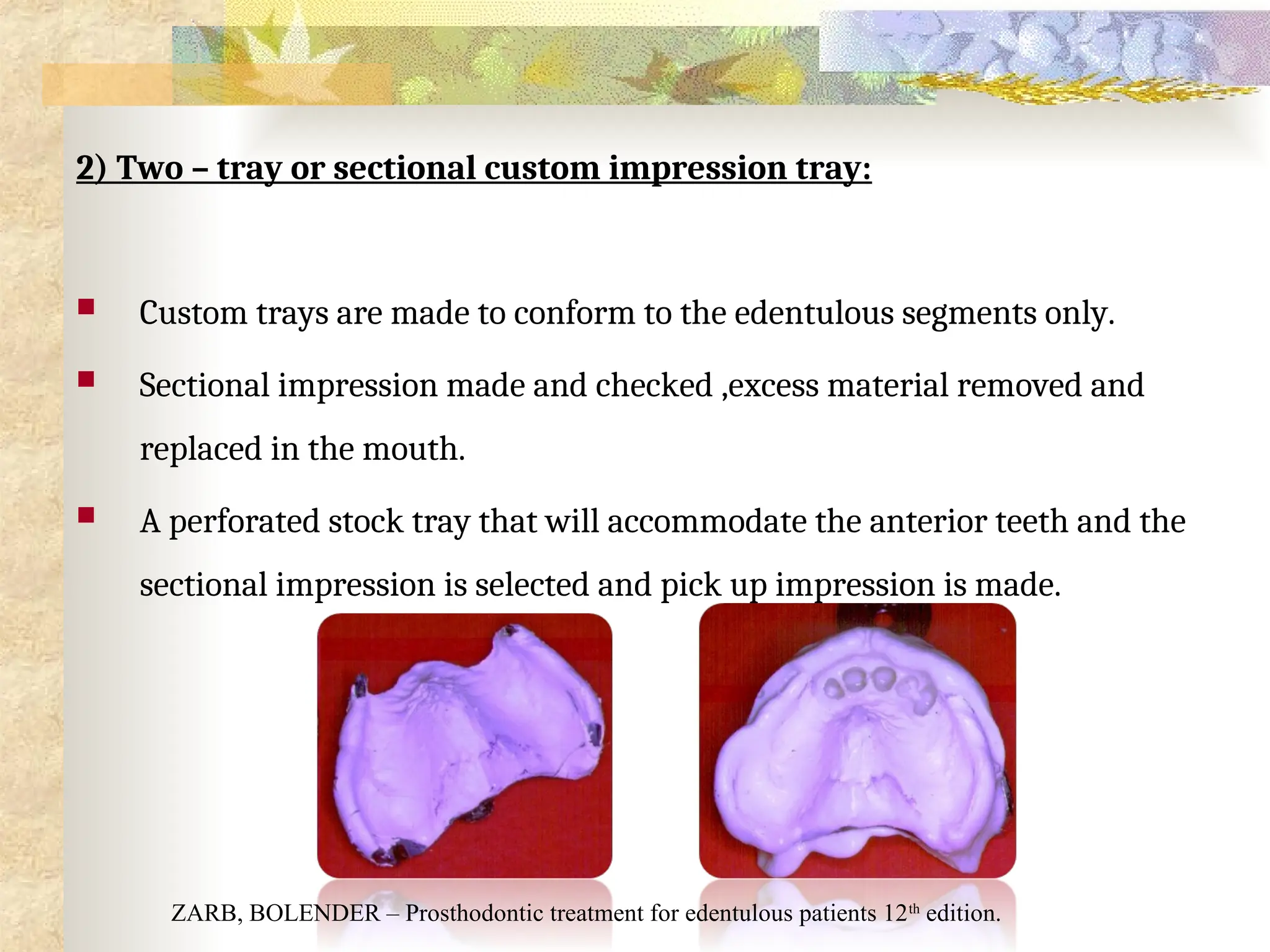
2) Two – tray or sectional custom impression tray:
 Custom trays are made to conform to the edentulous segments only.
 Sectional impression made and checked ,excess material removed and
replaced in the mouth.
 A perforated stock tray that will accommodate the anterior teeth and the
sectional impression is selected and pick up impression is made.
ZARB, BOLENDER – Prosthodontic treatment for edentulous patients 12th
edition.
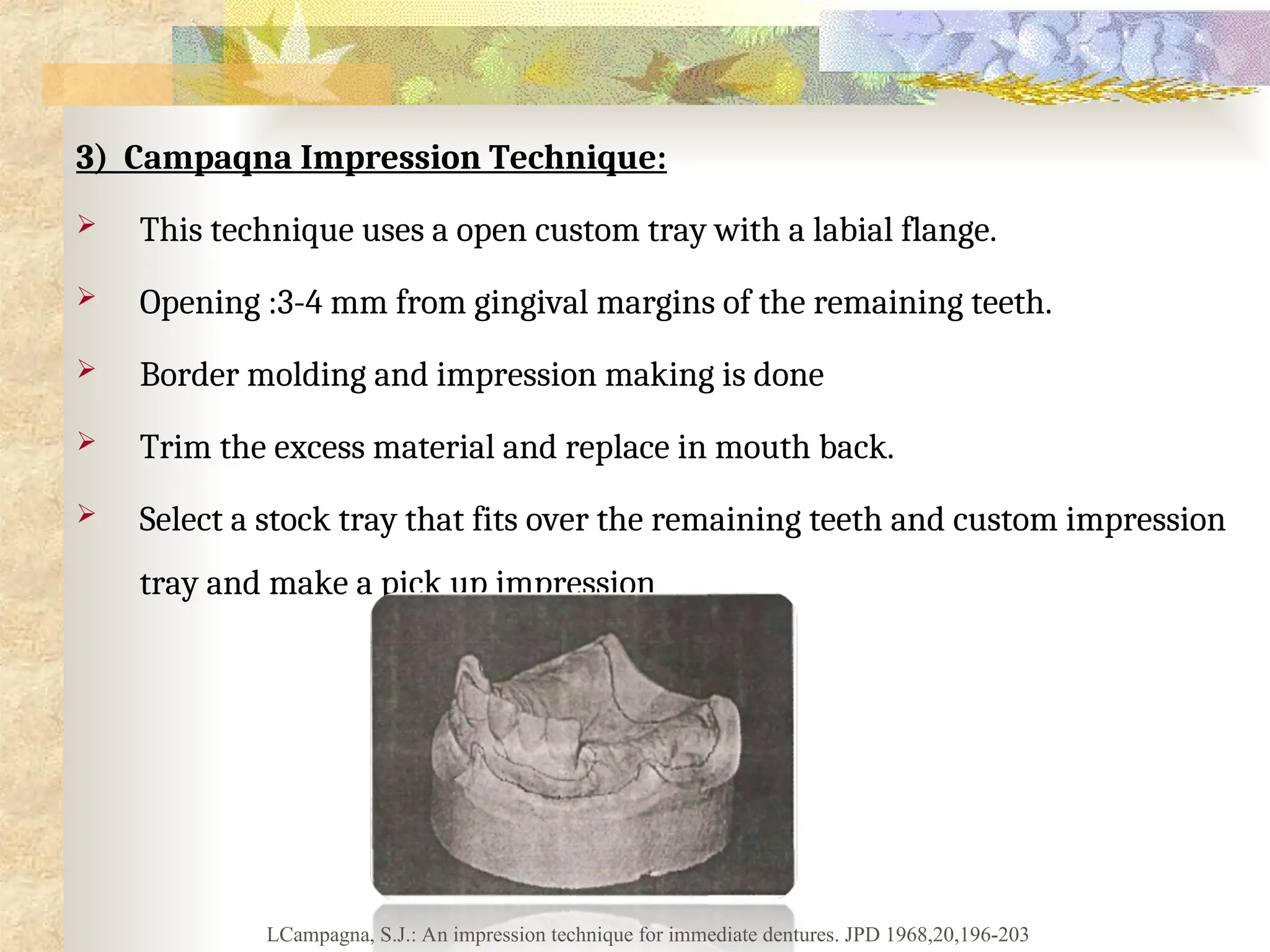
3) Campaqna Impression Technique:
 This technique uses a open custom tray with a labial flange.
 Opening :3-4 mm from gingival margins of the remaining teeth.
 Border molding and impression making is done
 Trim the excess material and replace in mouth back.
 Select a stock tray that fits over the remaining teeth and custom impression
tray and make a pick up impression
LCampagna, S.J.: An impression technique for immediate dentures. JPD 1968,20,196-203
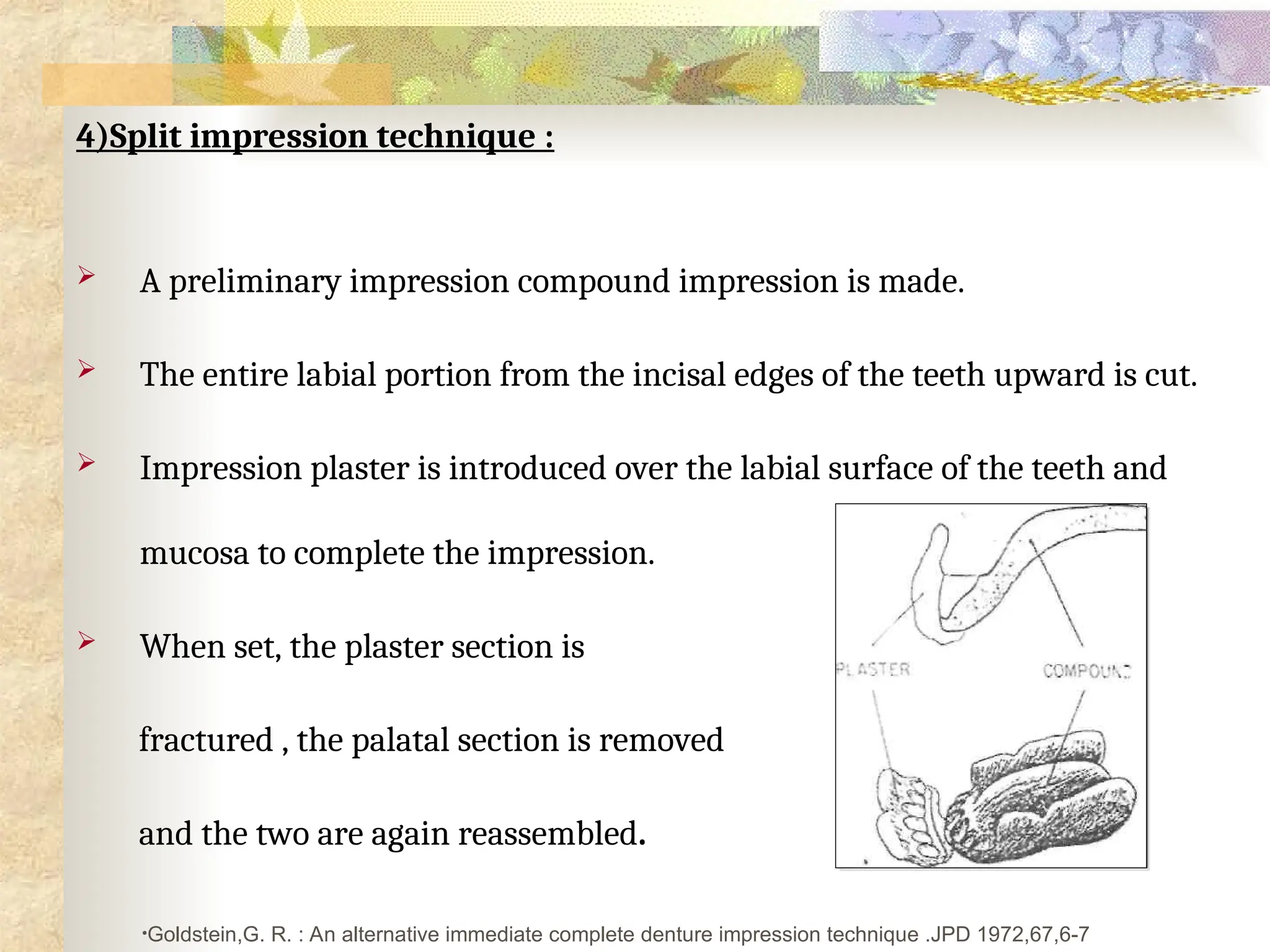
4)Split impression technique :
 A preliminary impression compound impression is made.
 The entire labial portion from the incisal edges of the teeth upward is cut.
 Impression plaster is introduced over the labial surface of the teeth and
mucosa to complete the impression.
 When set, the plaster section is
fractured , the palatal section is removed
and the two are again reassembled.
•Goldstein,G. R. : An alternative immediate complete denture impression technique .JPD 1972,67,6-7
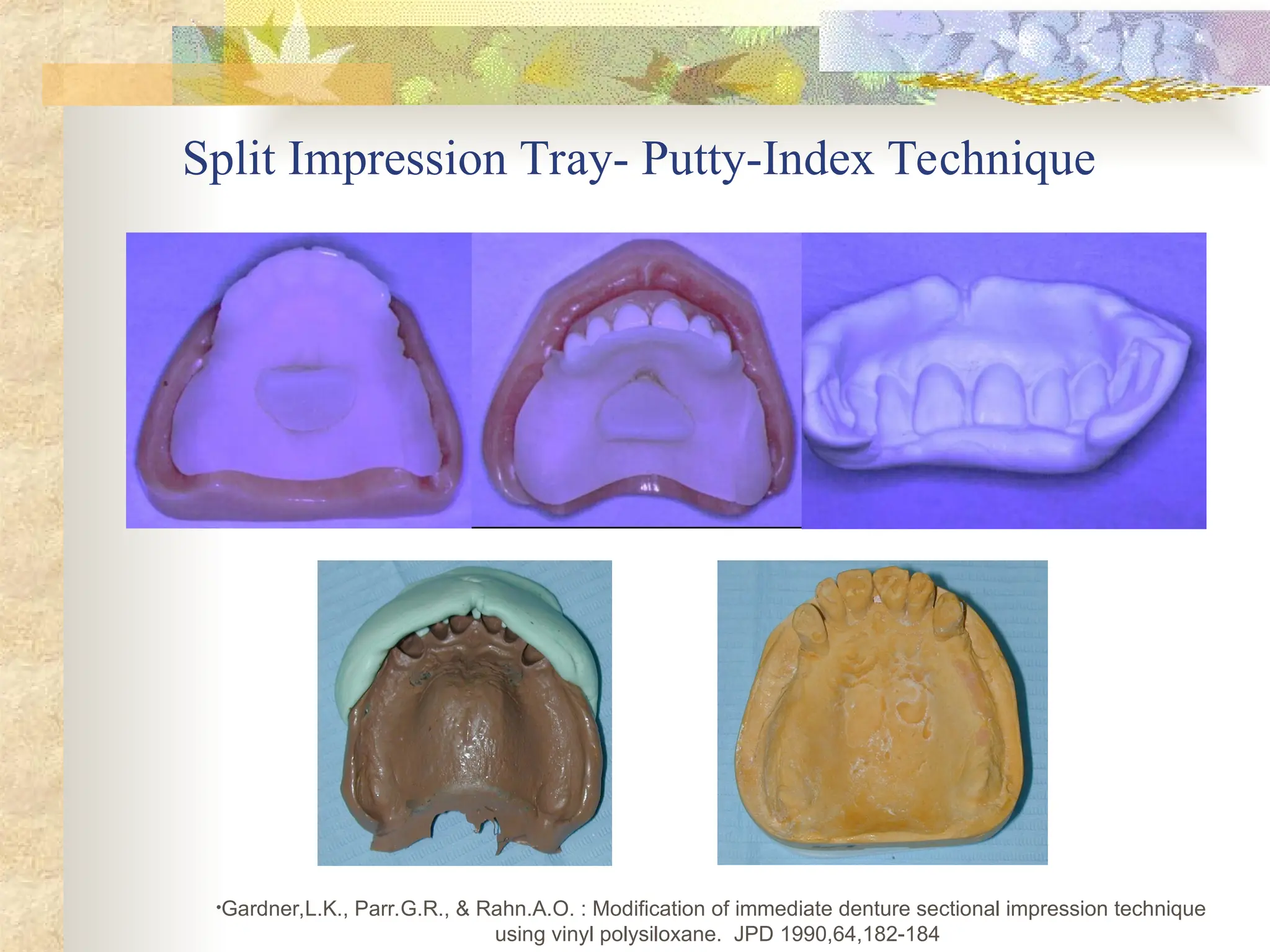
Split Impression Tray- Putty-Index Technique
•Gardner,L.K., Parr.G.R., & Rahn.A.O. : Modification of immediate denture sectional impression technique
using vinyl polysiloxane. JPD 1990,64,182-184
JAW RELATION FOR IMMEDIATE DENTURES
 VR before extraction : Premolars with no attrition or mobility.
 Natural mandibular teeth : Guide to establish the occlusal plane
 If anterior teeth in arch occlude against six anterior teeth in arch: Do
not rely on their occlusal relations for vertical dimension.
 When a vertical overlap cannot be reproduced : Ignore and consider only
the interarch space between occlusal rims for correct VR.
John J. Sharry: Complete denture prosthodontics 3rd
Edition
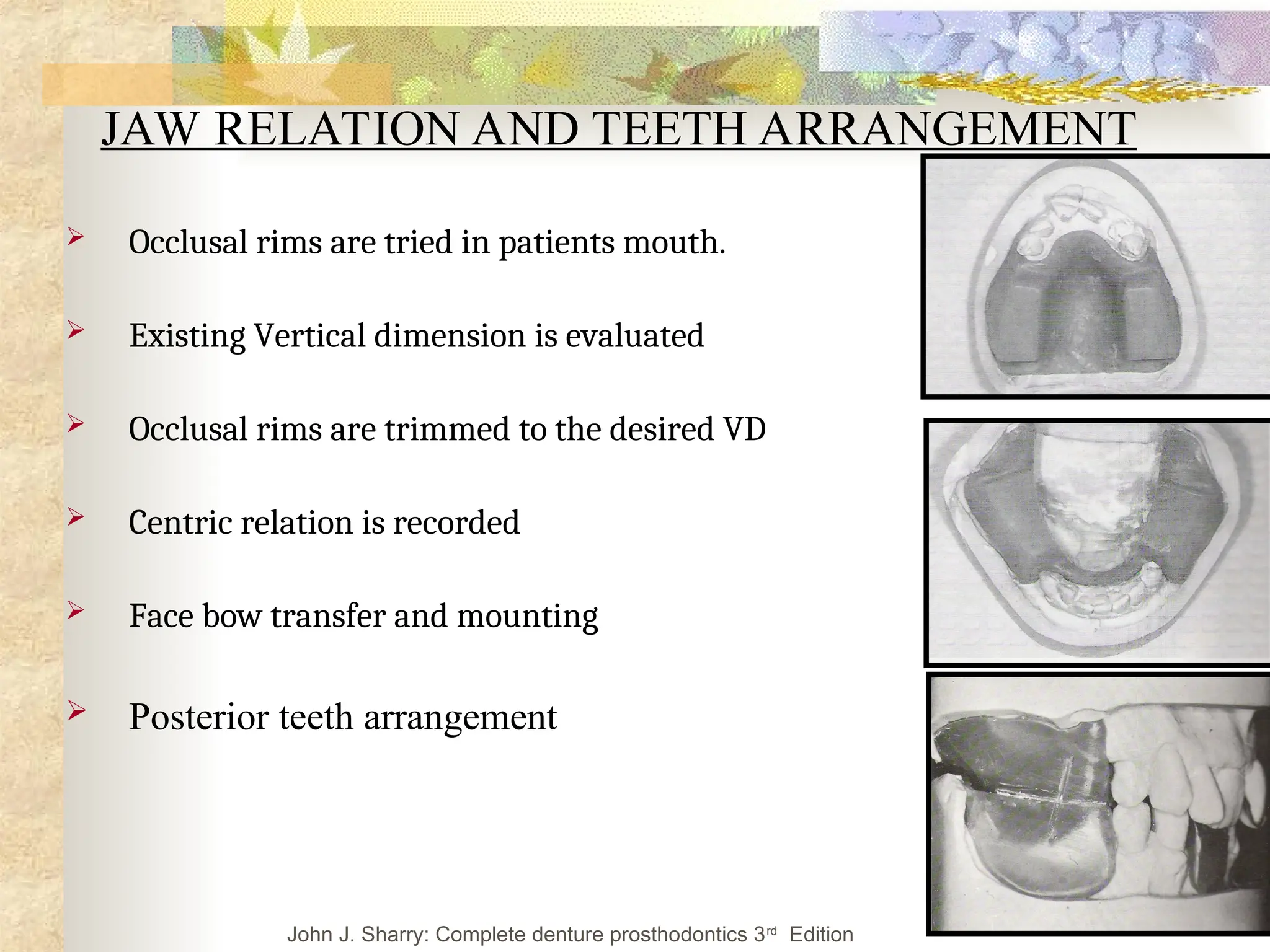
JAW RELATION AND TEETH ARRANGEMENT
 Occlusal rims are tried in patients mouth.
 Existing Vertical dimension is evaluated
 Occlusal rims are trimmed to the desired VD
 Centric relation is recorded
 Face bow transfer and mounting
 Posterior teeth arrangement
John J. Sharry: Complete denture prosthodontics 3rd
Edition
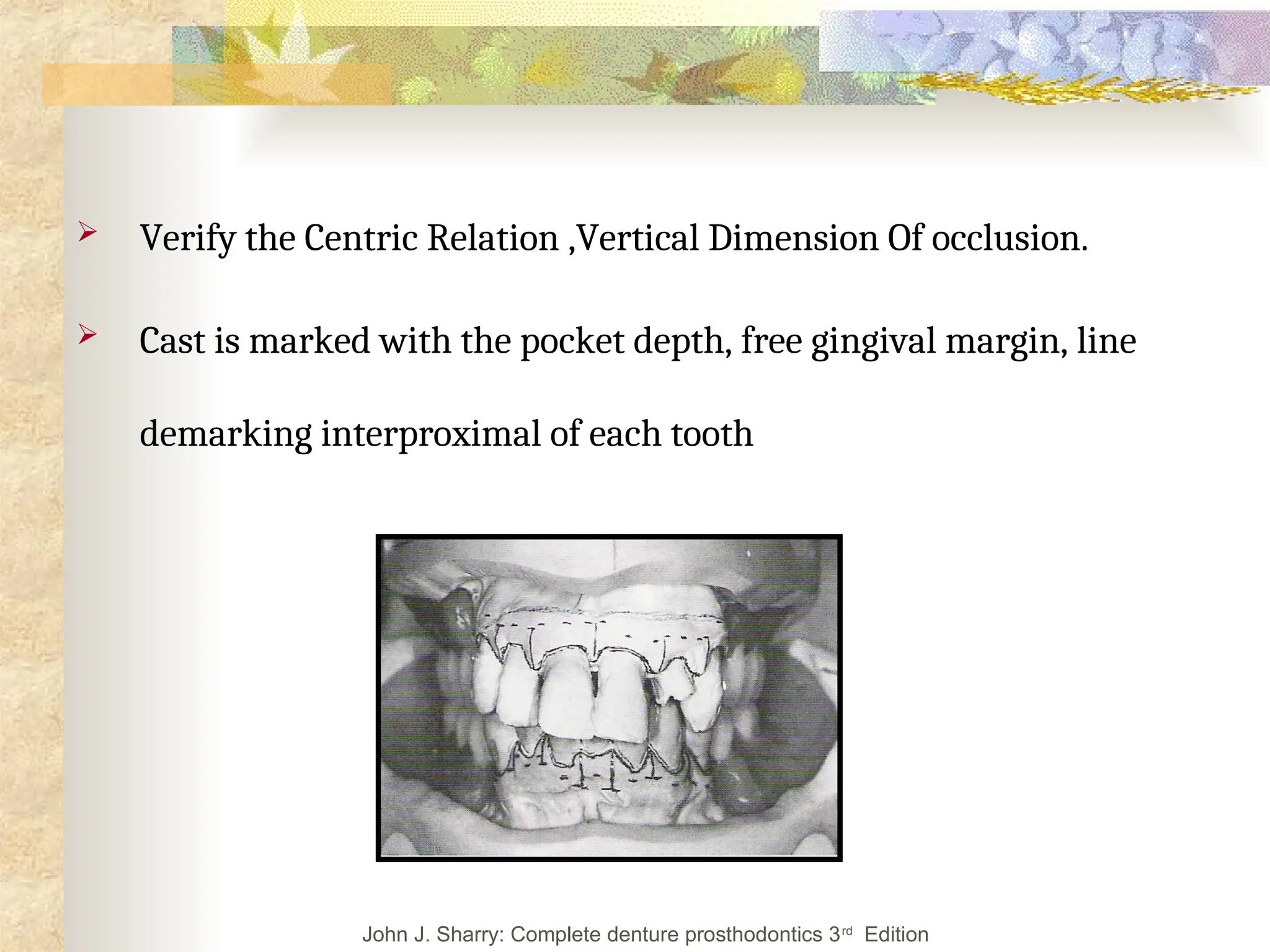
 Verify the Centric Relation ,Vertical Dimension Of occlusion.
 Cast is marked with the pocket depth, free gingival margin, line
demarking interproximal of each tooth
John J. Sharry: Complete denture prosthodontics 3rd
Edition
ARRANGEMENT OF THE ANTERIOR TEETH
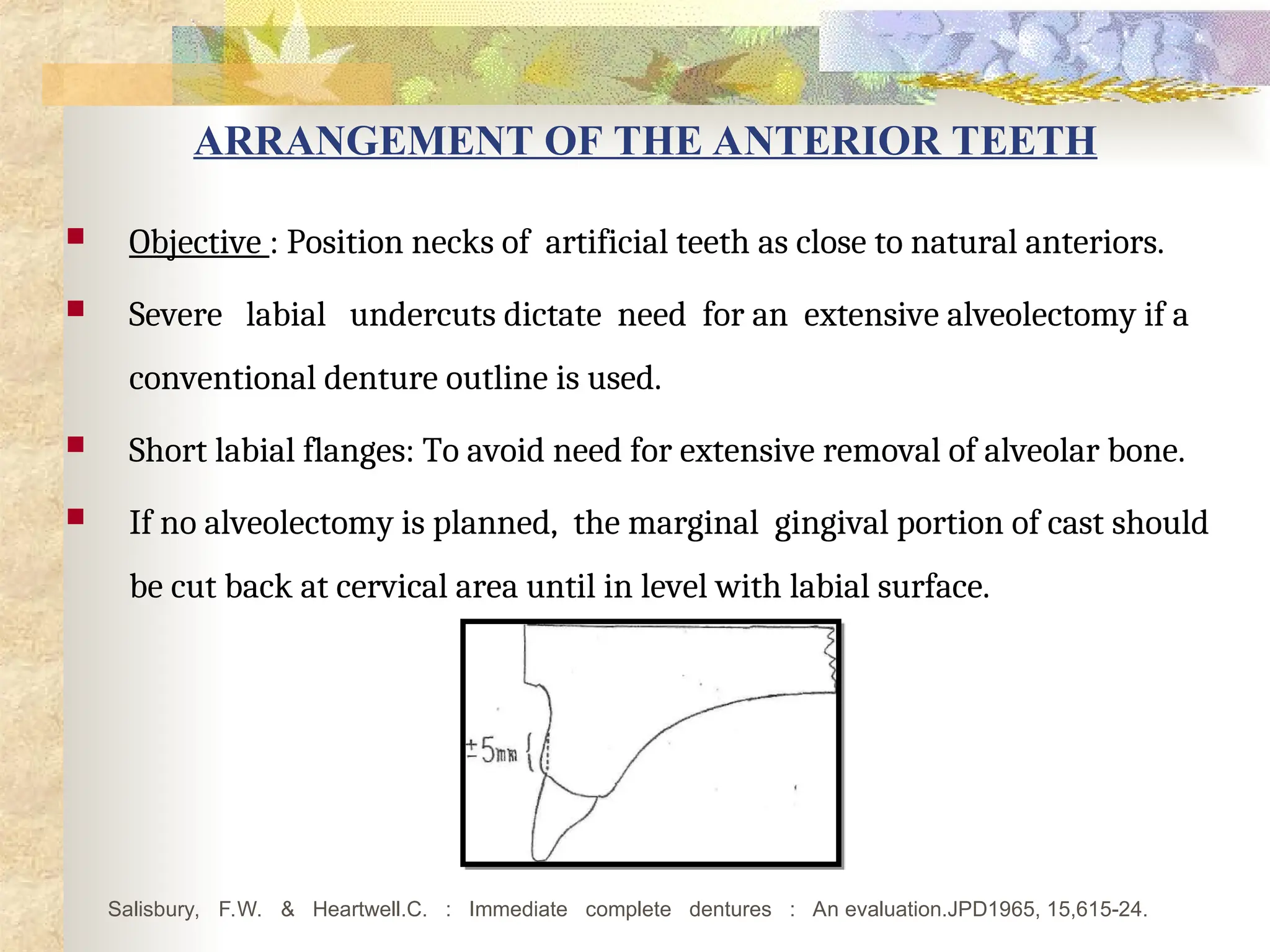
 Objective : Position necks of artificial teeth as close to natural anteriors.
 Severe labial undercuts dictate need for an extensive alveolectomy if a
conventional denture outline is used.
 Short labial flanges: To avoid need for extensive removal of alveolar bone.
 If no alveolectomy is planned, the marginal gingival portion of cast should
be cut back at cervical area until in level with labial surface.
Salisbury, F.W. & Heartwell.C. : Immediate complete dentures : An evaluation.JPD1965, 15,615-24.
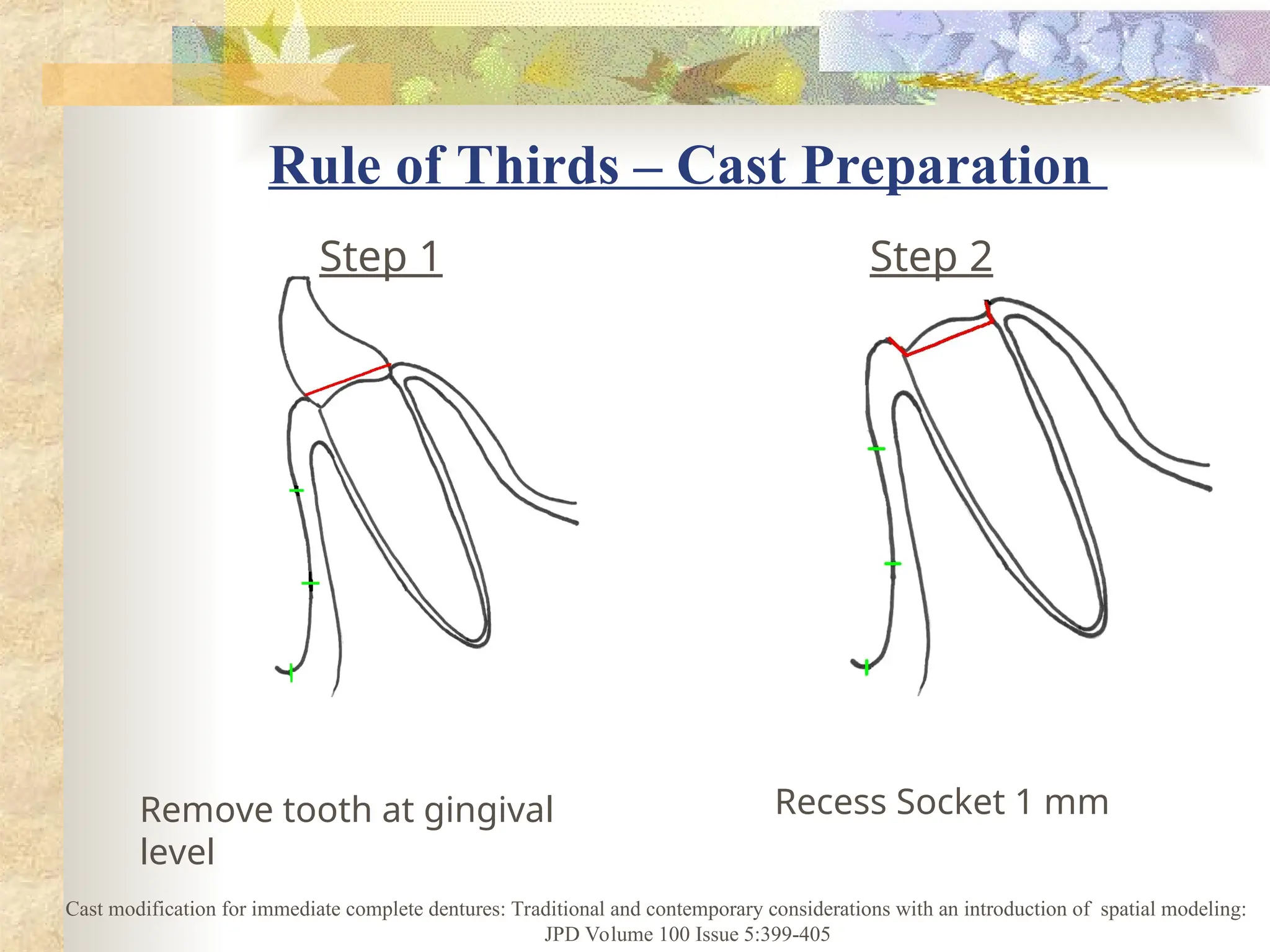
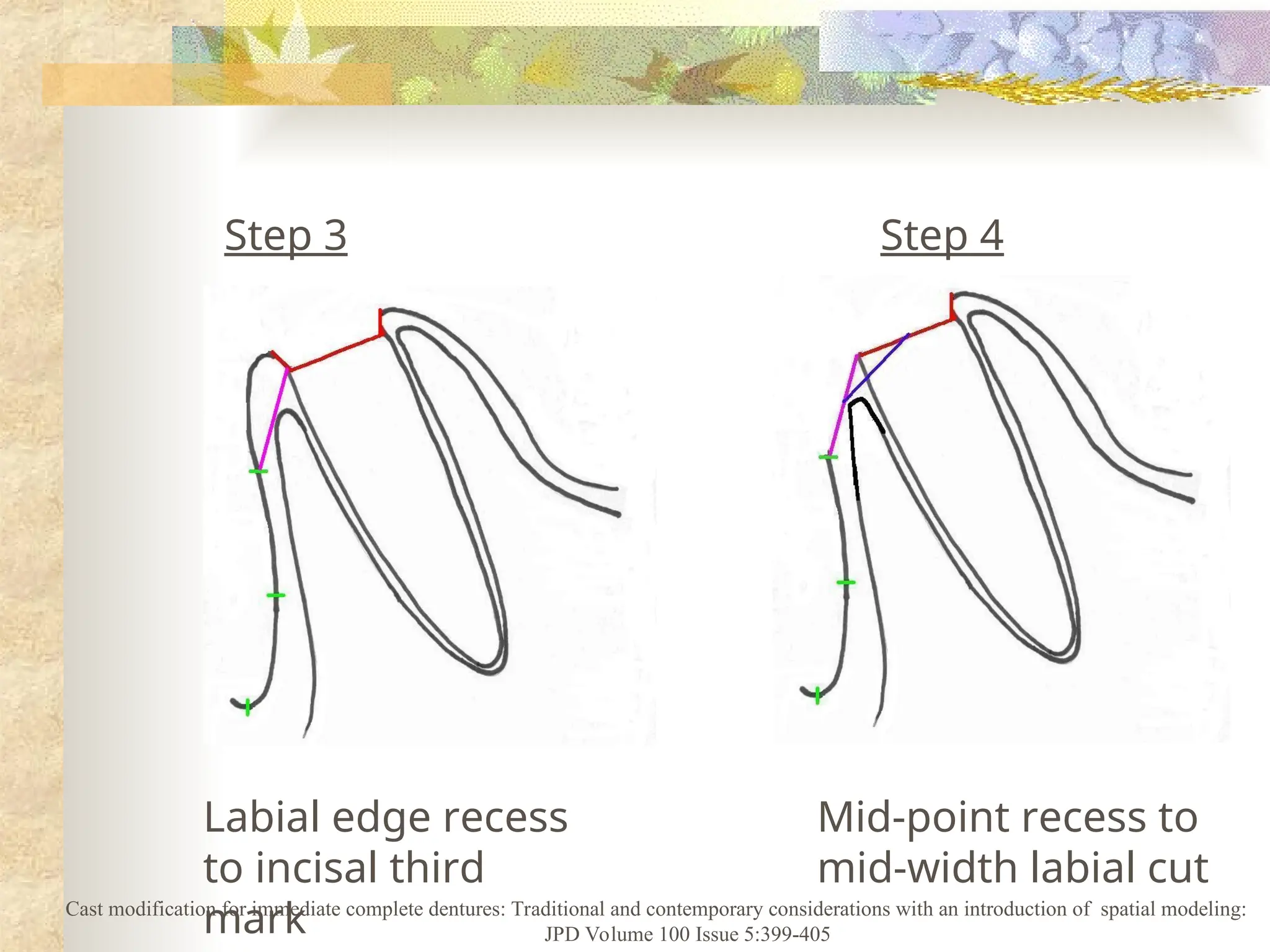
Rule of Thirds – Cast Preparation
Recess Socket 1 mm
Remove tooth at gingival
level
Step 1 Step 2
Cast modification for immediate complete dentures: Traditional and contemporary considerations with an introduction of spatial modeling:
JPD Volume 100 Issue 5:399-405
Step 3 Step 4
Labial edge recess
to incisal third
mark
Mid-point recess to
mid-width labial cut
Cast modification for immediate complete dentures: Traditional and contemporary considerations with an introduction of spatial modeling:
JPD Volume 100 Issue 5:399-405
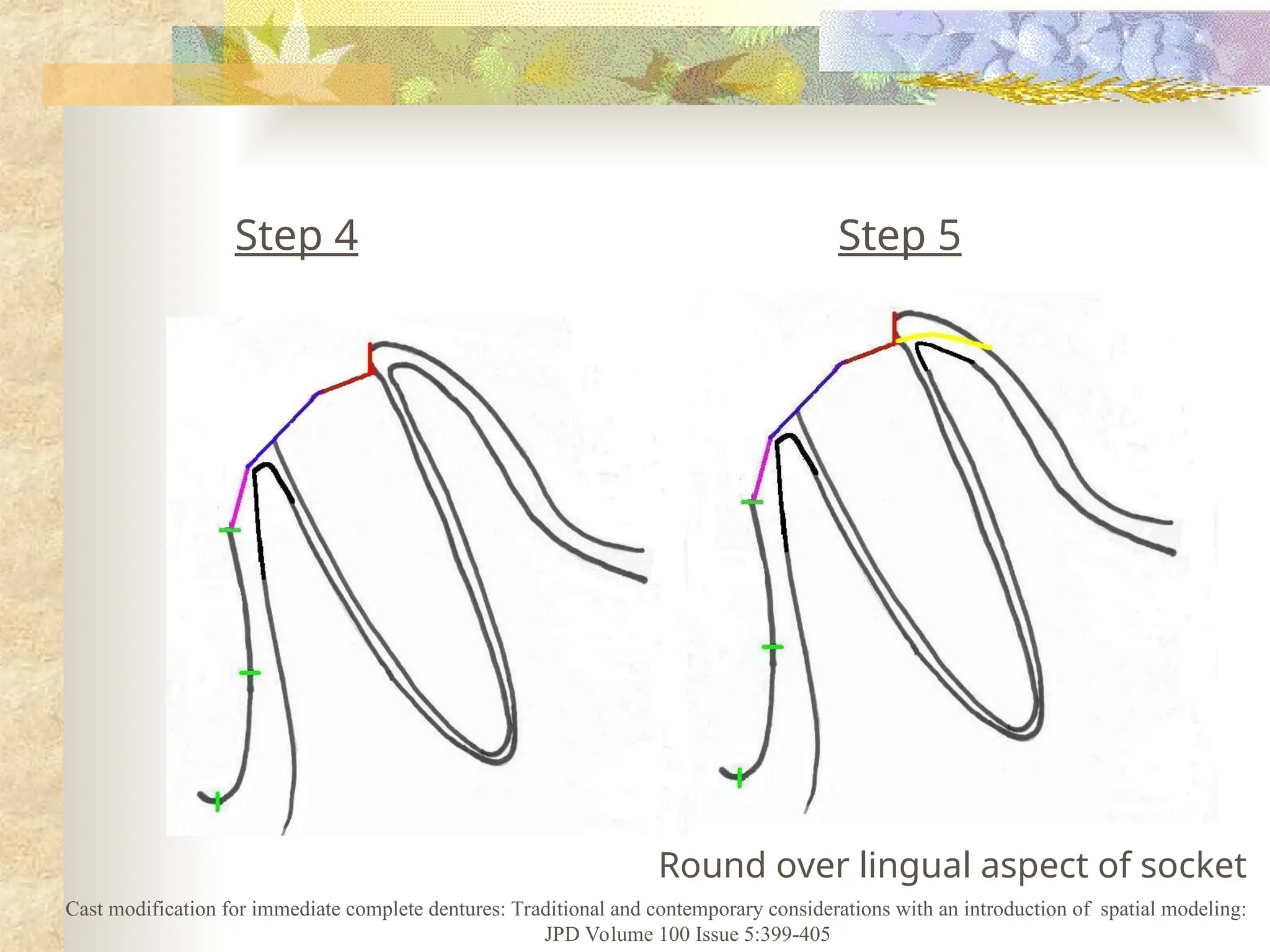
Step 4 Step 5
Round over lingual aspect of socket
Cast modification for immediate complete dentures: Traditional and contemporary considerations with an introduction of spatial modeling:
JPD Volume 100 Issue 5:399-405
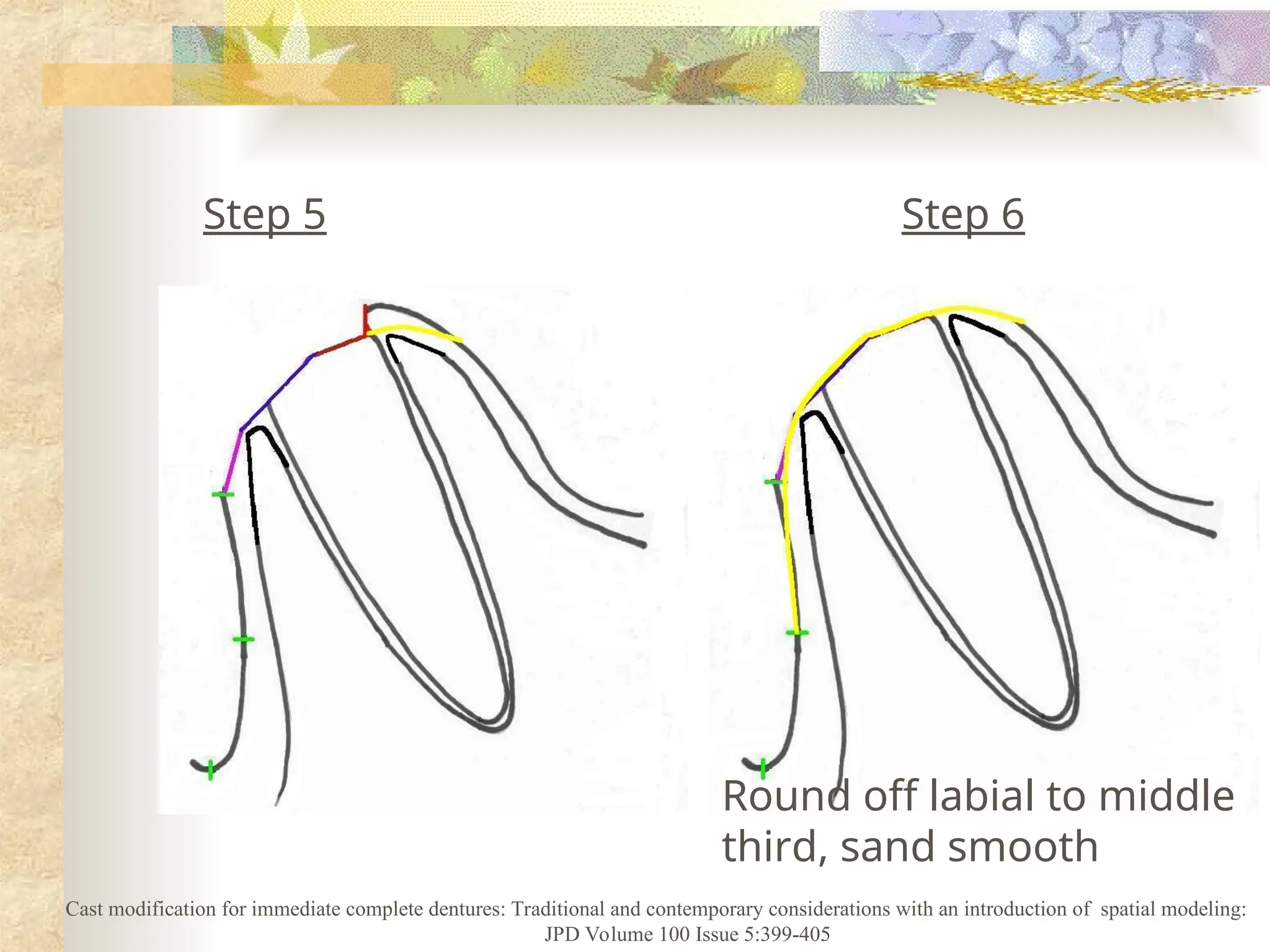
Step 5 Step 6
Round off labial to middle
third, sand smooth
Cast modification for immediate complete dentures: Traditional and contemporary considerations with an introduction of spatial modeling:
JPD Volume 100 Issue 5:399-405
SURGERY AND IMMEDIATE DENTURE INSERTION
 Extractions without alveoloplasty
 Extraction with alveoloplasty
Septal alveolectomy
Radical alveolectomy
ZARB, BOLENDER – Prosthodontic treatment for edentulous patients 12th
edition.
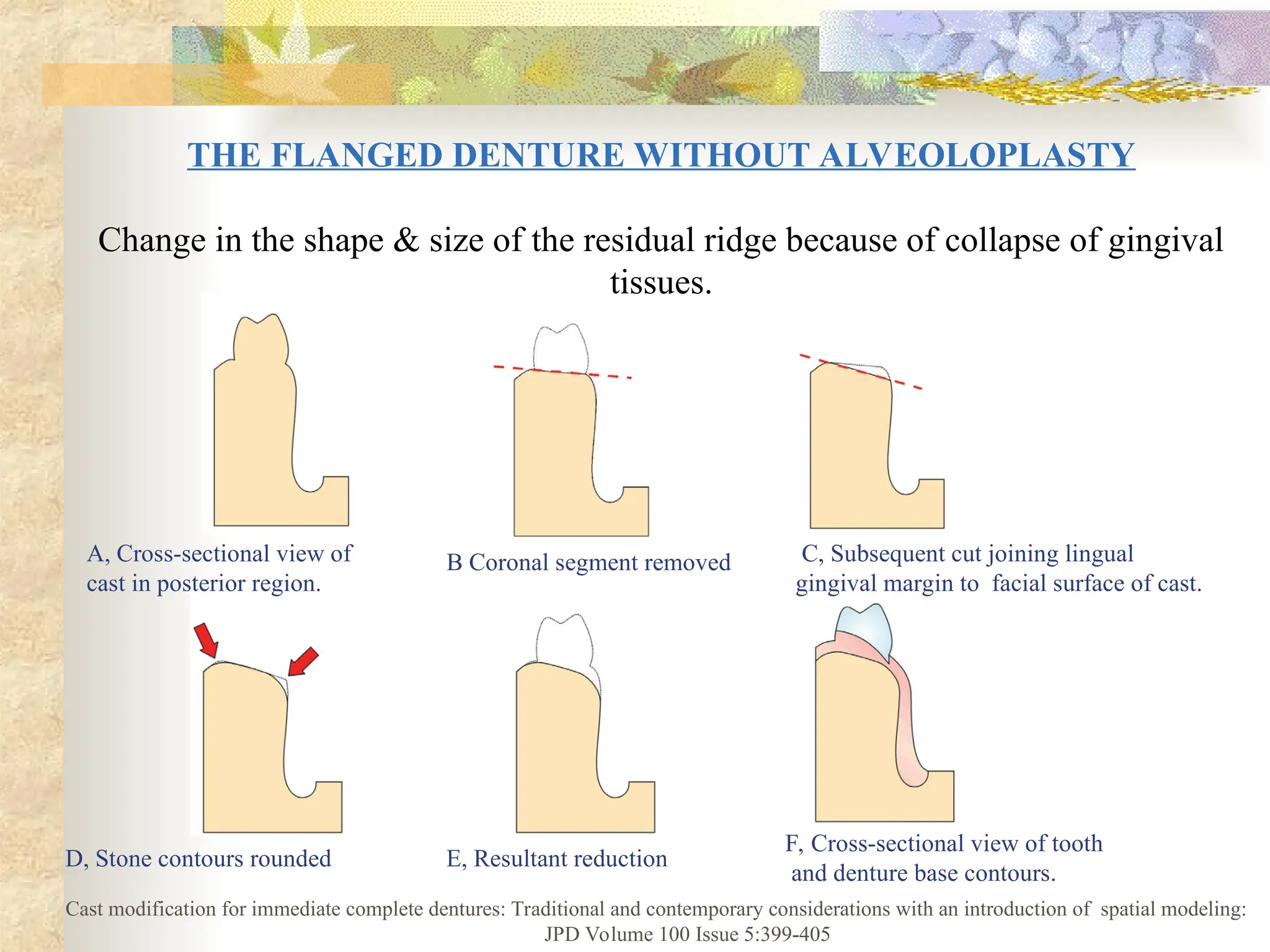
THE FLANGED DENTURE WITHOUT ALVEOLOPLASTY
Change in the shape & size of the residual ridge because of collapse of gingival
tissues.
A, Cross-sectional view of
cast in posterior region.
B Coronal segment removed C, Subsequent cut joining lingual
gingival margin to facial surface of cast.
D, Stone contours rounded E, Resultant reduction
F, Cross-sectional view of tooth
and denture base contours.
Cast modification for immediate complete dentures: Traditional and contemporary considerations with an introduction of spatial modeling:
JPD Volume 100 Issue 5:399-405
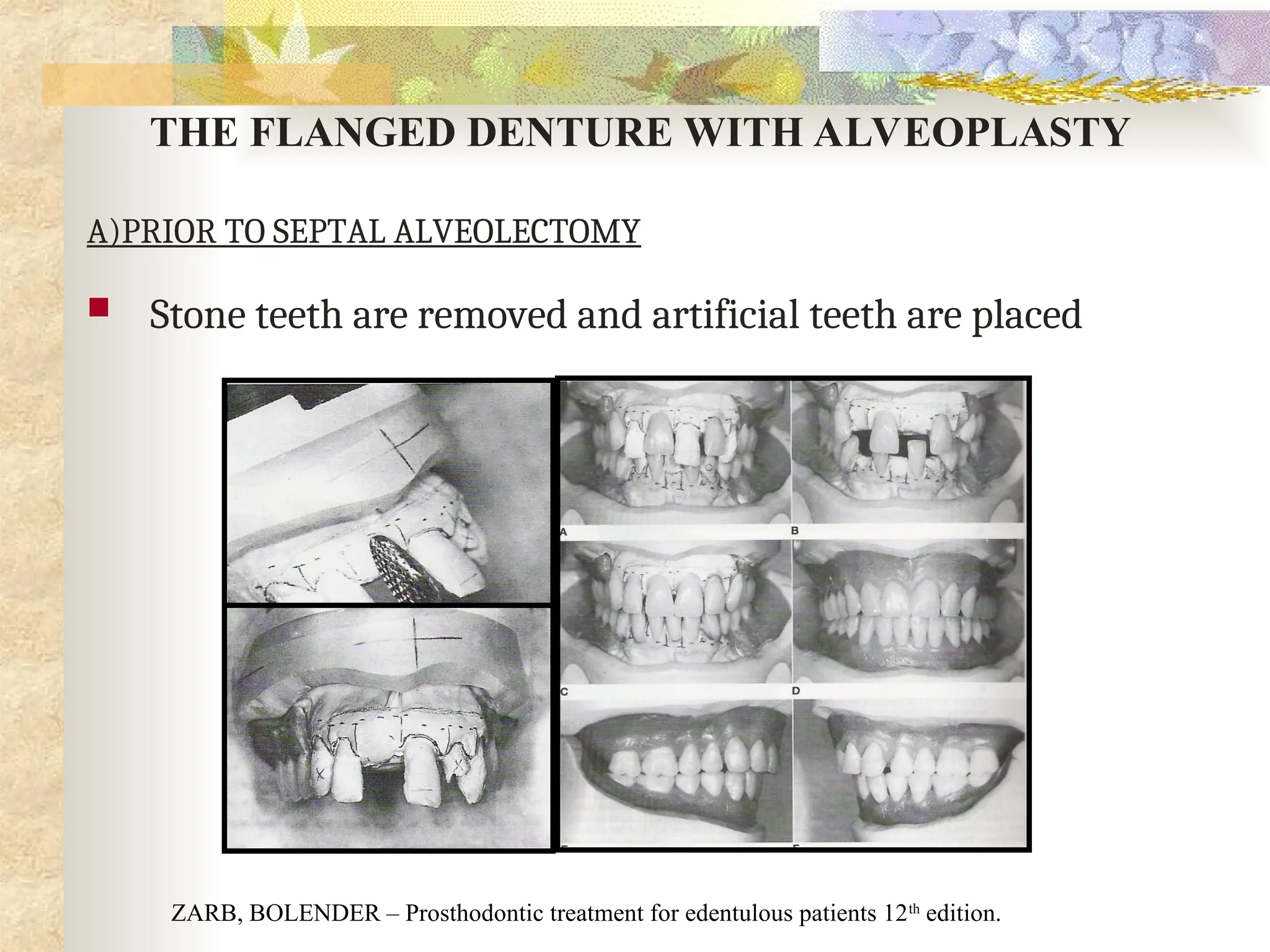
THE FLANGED DENTURE WITH ALVEOPLASTY
A)PRIOR TO SEPTAL ALVEOLECTOMY
 Stone teeth are removed and artificial teeth are placed
ZARB, BOLENDER – Prosthodontic treatment for edentulous patients 12th
edition.
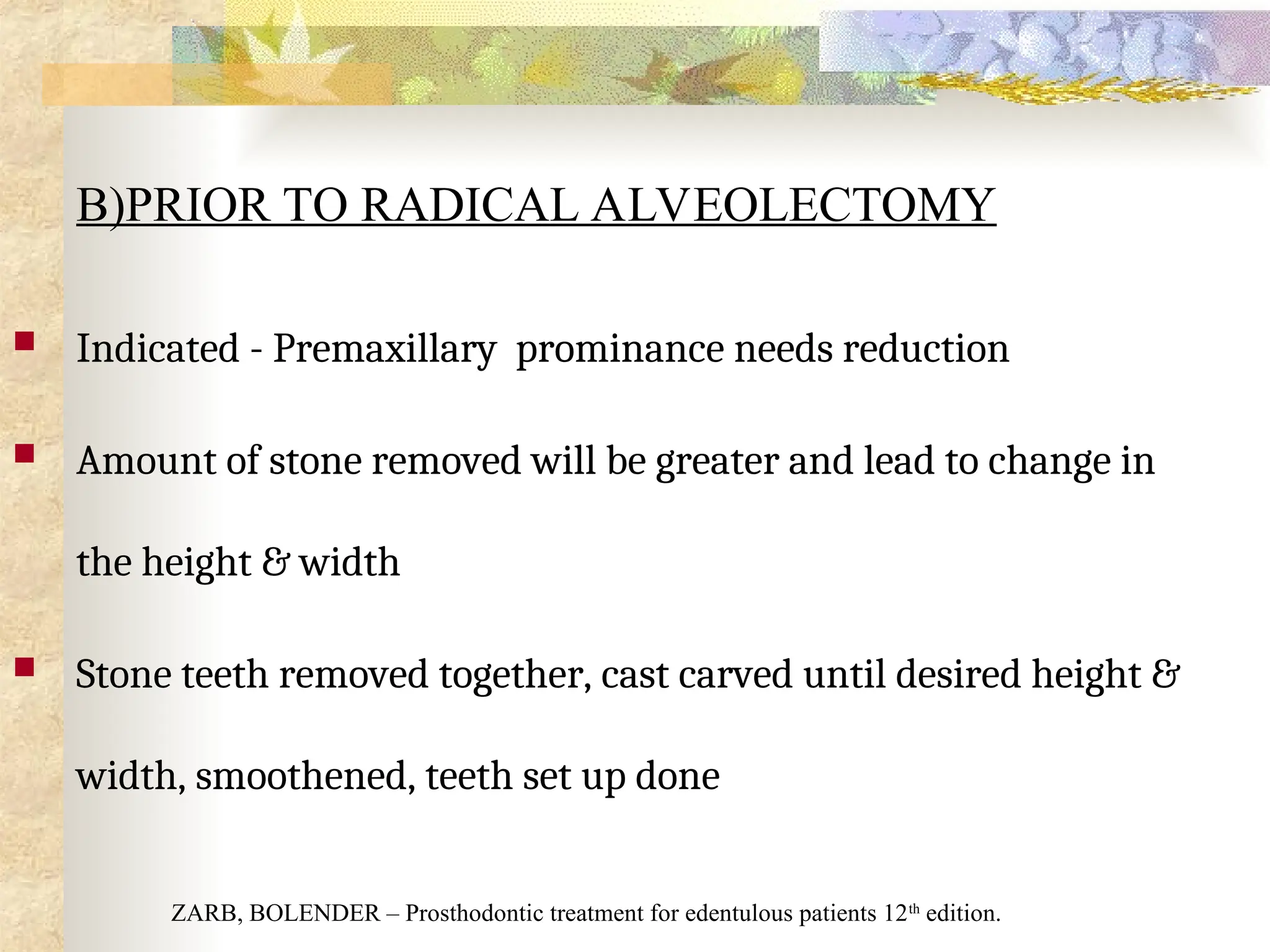
B)PRIOR TO RADICAL ALVEOLECTOMY
 Indicated - Premaxillary prominance needs reduction
 Amount of stone removed will be greater and lead to change in
the height & width
 Stone teeth removed together, cast carved until desired height &
width, smoothened, teeth set up done
ZARB, BOLENDER – Prosthodontic treatment for edentulous patients 12th
edition.
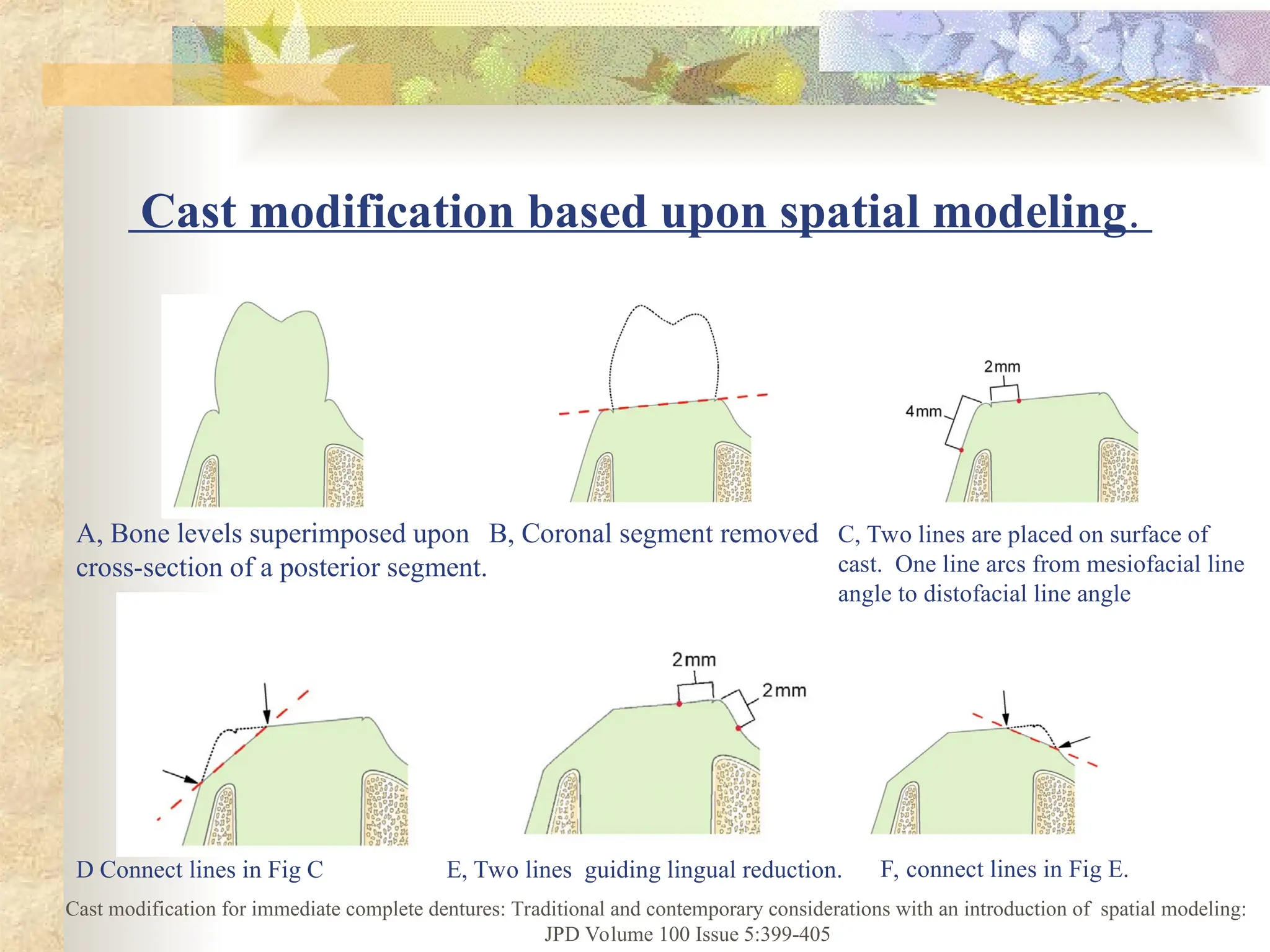
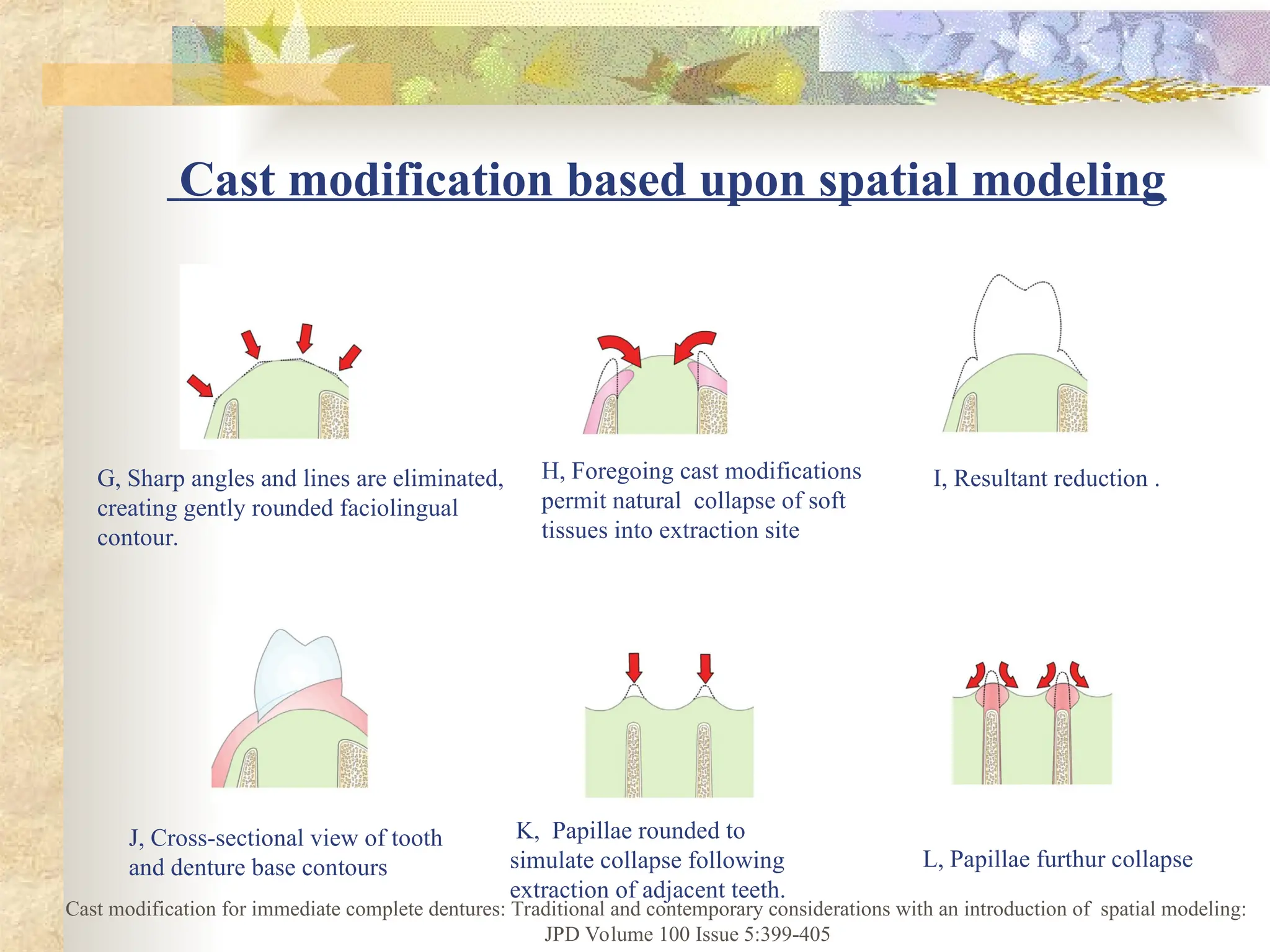
Cast modification based upon spatial modeling.
A, Bone levels superimposed upon
cross-section of a posterior segment.
B, Coronal segment removed C, Two lines are placed on surface of
cast. One line arcs from mesiofacial line
angle to distofacial line angle
D Connect lines in Fig C E, Two lines guiding lingual reduction. F, connect lines in Fig E.
Cast modification for immediate complete dentures: Traditional and contemporary considerations with an introduction of spatial modeling:
JPD Volume 100 Issue 5:399-405
Cast modification based upon spatial modeling
G, Sharp angles and lines are eliminated,
creating gently rounded faciolingual
contour.
H, Foregoing cast modifications
permit natural collapse of soft
tissues into extraction site
I, Resultant reduction .
J, Cross-sectional view of tooth
and denture base contours
K, Papillae rounded to
simulate collapse following
extraction of adjacent teeth.
L, Papillae furthur collapse
Cast modification for immediate complete dentures: Traditional and contemporary considerations with an introduction of spatial modeling:
JPD Volume 100 Issue 5:399-405
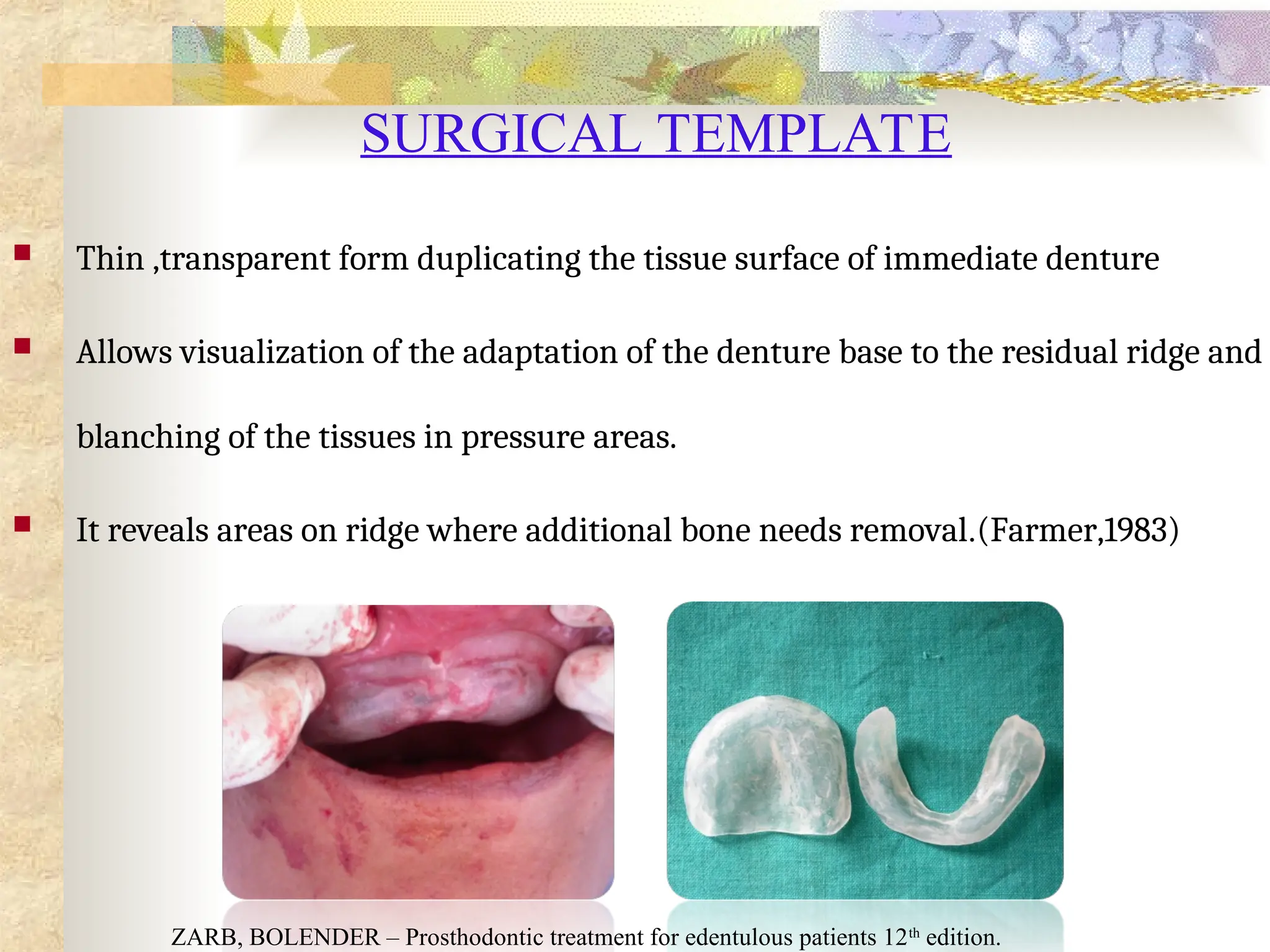
SURGICAL TEMPLATE
 Thin ,transparent form duplicating the tissue surface of immediate denture
 Allows visualization of the adaptation of the denture base to the residual ridge and
blanching of the tissues in pressure areas.
 It reveals areas on ridge where additional bone needs removal.(Farmer,1983)
ZARB, BOLENDER – Prosthodontic treatment for edentulous patients 12th
edition.
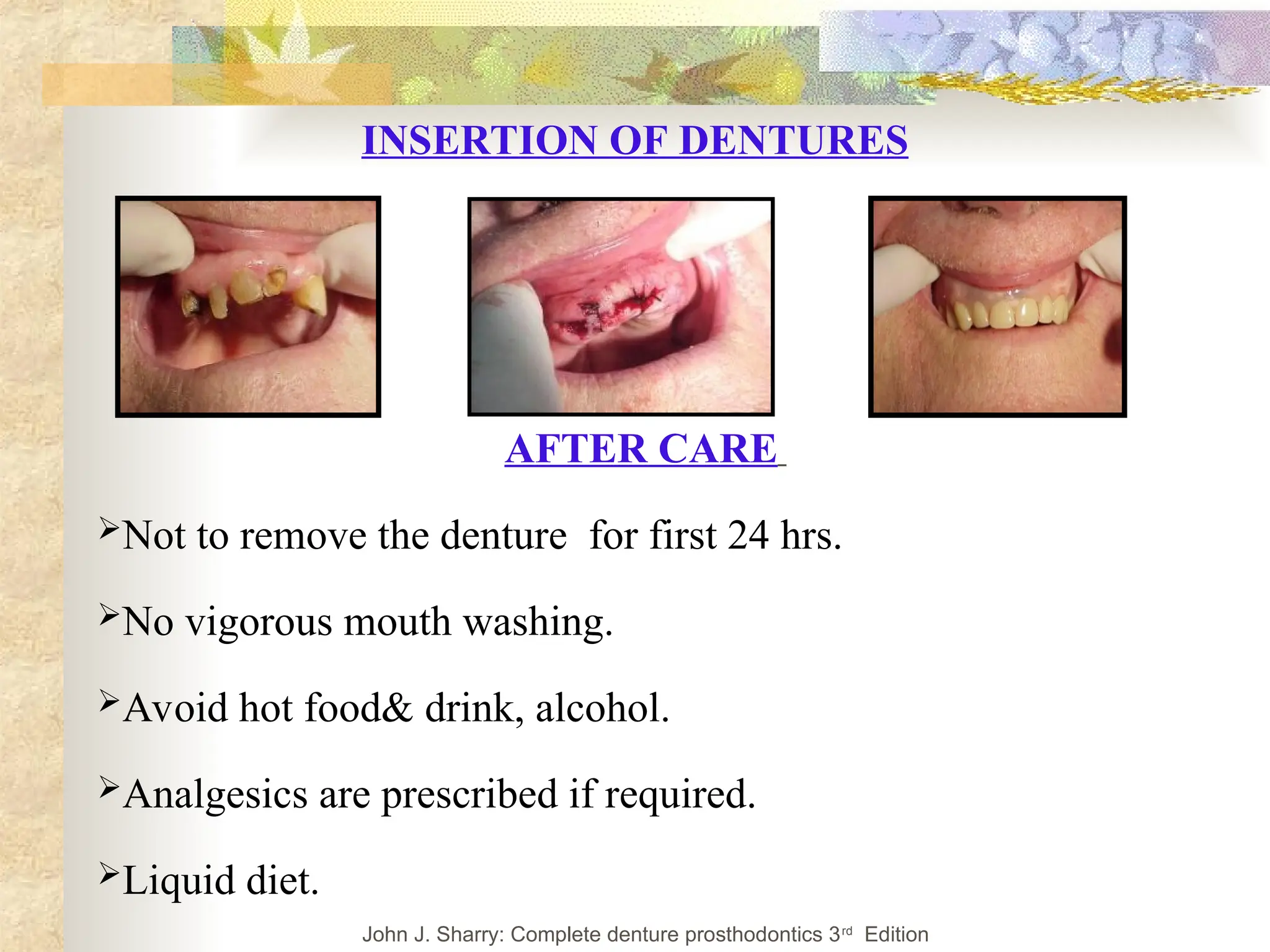
INSERTION OF DENTURES
John J. Sharry: Complete denture prosthodontics 3rd
Edition
AFTER CARE
Not to remove the denture for first 24 hrs.
No vigorous mouth washing.
Avoid hot food& drink, alcohol.
Analgesics are prescribed if required.
Liquid diet.
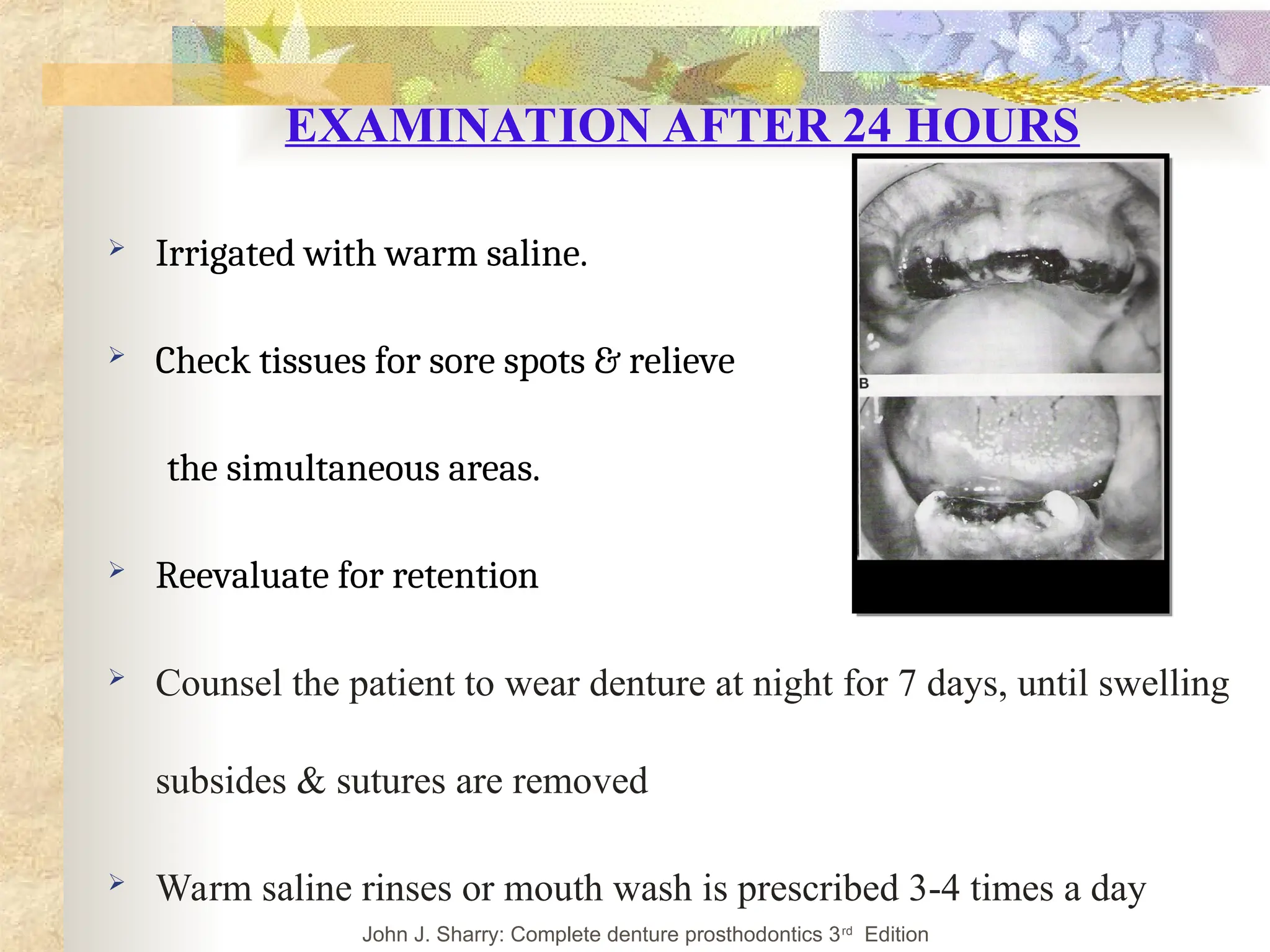
EXAMINATION AFTER 24 HOURS
 Irrigated with warm saline.
 Check tissues for sore spots & relieve
the simultaneous areas.
 Reevaluate for retention
 Counsel the patient to wear denture at night for 7 days, until swelling
subsides & sutures are removed
 Warm saline rinses or mouth wash is prescribed 3-4 times a day
John J. Sharry: Complete denture prosthodontics 3rd
Edition
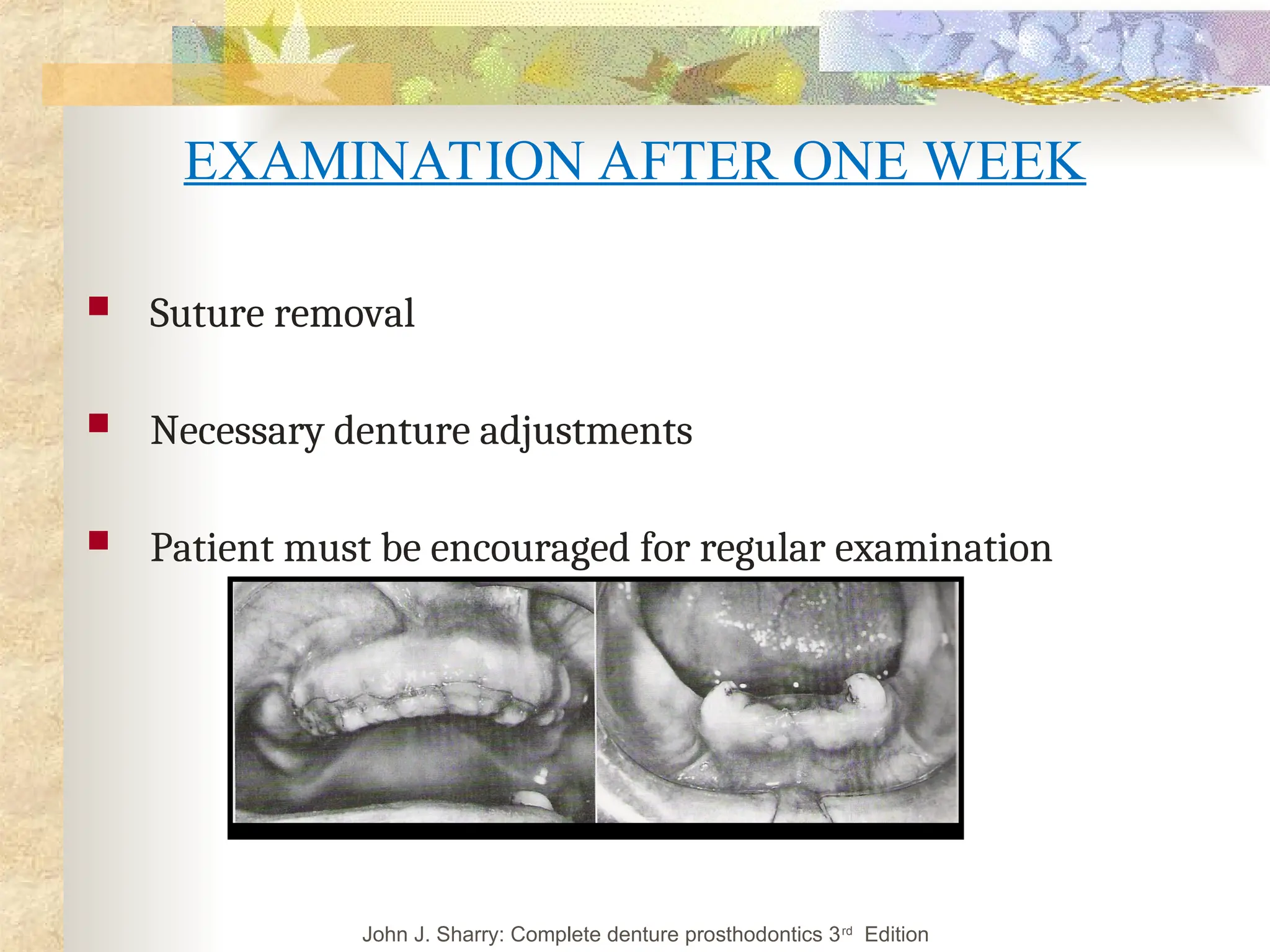
EXAMINATION AFTER ONE WEEK
 Suture removal
 Necessary denture adjustments
 Patient must be encouraged for regular examination
John J. Sharry: Complete denture prosthodontics 3rd
Edition
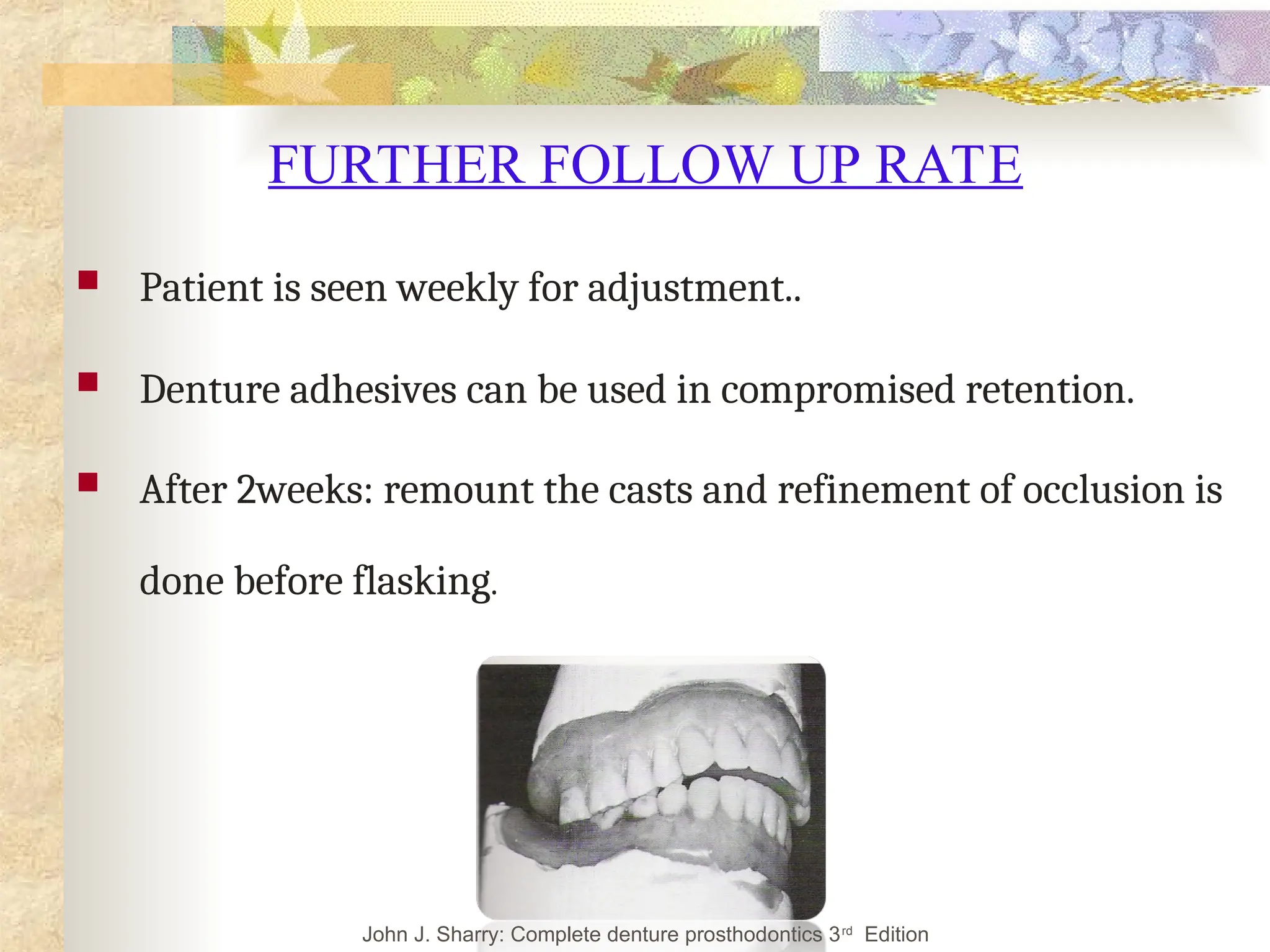
FURTHER FOLLOW UP RATE
 Patient is seen weekly for adjustment..
 Denture adhesives can be used in compromised retention.
 After 2weeks: remount the casts and refinement of occlusion is
done before flasking.
John J. Sharry: Complete denture prosthodontics 3rd
Edition
SUBSEQUENT SERVICE FOR IMMEDIATE
DENTURE PATIENT:
 Sore spots are eliminated
 Recall for changing tissue conditioners
 Relining or rebasing if required to restore the vertical
dimension
 Second denture started after 3-6 months if desired
John J. Sharry: Complete denture prosthodontics 3rd
Edition
CONCLUSION
 Immediate dentures fulfill an important role in today's treatment
modalities by providing the patient with esthetics, function &
psychological support after extraction & during healing phase.
 The technique is more demanding than conventional complete
denture for both patient & operator as well.
 If the patient is prepared & appropriate type of immediate denture
is selected the resulting prosthesis can be a success.
References
 LCampagna, S.J.: An impression technique for immediate dentures. JPD
1968,20,196-203
 Cheirci,G., Parker.M.L., & Hemphill,CD. : Influence of immediate dentures onoral
motor skill & speech. JPD 1978, 39, 21-28
 Demer, W.: Minimizing problems in placement of immediate dentures. JPD
1972,27,275-284.
 Elton,W.C: Method to contour the intaglio surface of an immediate denture when
using a chairside soft reline procedure after tooth extraction. JPD 2000, 83,6,690-2.
 Gardner,L.K., Parr.G.R., & Rahn.A.O. : Modification of immediate denture sectional
impression technique using vinyl polysiloxane. JPD 1990,64,182-184
 Goldstein,G. R. : An alternative immediate complete denture impression
technique .JPD 1992,67,6-7
 George A. Zarb, Charles L. Bolender, Gunnar E. Carlson: Boucher's
prosthodontic treatment for edentulous patients.11th
Edition.
 Jerbi.F. C : Trimming the cast in the construction of immediate dentures. JPD
1996,16,1047-1053.
 John J. Sharry: Complete denture prosthodontics.2nd
Edition
 Khan.Z.: One appointment construction of an immediate transitional
complete denture using visible light cured resin.JPD 1992,68,3,500-2.
 LaVere,A.M. & Krol.A.J.: Immediate denture service. JPD 1973,29,10-15.
 Lambrecht.J.R. : Immediate denture construction: the impression phase. JPD
1968,19,237-240.
 Morrow,R.M.,et al .Immediate interim tooth supported complete dentures. JPD
1973,30,695-99
 Passomonti.G., Kltrajas.P., Gheewala R.K., Clark.R.E. & Manness.W.L: Effectof
immediate denture on maxillomandibular relations.JPD 1981,45,122-27
THANK YOU
THANK YOU

MANAGEMENT OF EDENTULOUS PATIENTS WITH IMMEDIATE COMPLETE DENTURES

  • 1.
    IMMEDIATE COMPLETE IMMEDIATE COMPLETE DENTURES DENTURES DR.SUJANA U READER DEPT OF PROSTHODONTICS SREE ANJANEYA INSTITUTE OF DENTAL SCIENCES
  • 2.
    INTRODUCTION According to M.M.Devan, Stressing the importance removable partial dentures before the patient is rendered edentulous , “A smooth uneventful transition not only results in a better denture foundation physically and physiologically by maintenance of normal neuromuscular patterns, but also psychologically, such a transition diminishes the feeling of toothlessness”.
  • 3.
    DEFINITIONS Acccording to Heartwell, Adental prosthesis constructed to replace the lost dentition and associated structures of the maxillae and /or mandible, and inserted immediately following removal of the remaining natural teeth. According to GPT 9, A complete denture or a removable partial denture fabricated for placement immediately after the removal of natural teeth.
  • 4.
    REVIEW OF LITERATURE First described by Richardson in 1860.  1965- Heartwell, C and Salisbury F.W. presented an evaluation of immediate complete dentures regarding requirements, diagnosis, advantages, disadvantages and surgical preparation.  1968 - Campagna S.J., described an impression technique for immediate denture fabrication.
  • 5.
     Frank C.Jerb, described the technique of trimming the cast for immediate denture.  According to him, it is based on anatomic factors and positional changes that take place in gingival tissue when teeth are extracted. Considerations must be given to existing alveolar bone level as well as relative levels of the over lying soft tissue structures.
  • 6.
     1981 -Passamonti et al: determined the changes that take place in maxillomandibular relations during a 3-month period following insertion of immediate dentures. The results were as follows: 1. In the centric occlusion, the mandible moved forward at one week and remained in that position for the three-month period. 2. The rest position remained relatively constant . 3. VDO and VDR showed a gradual decrease over the period. 4. Reline procedure did not affect the trend of the dimensional changes.
  • 7.
     1990- Gardneret al.described a technique for obtaining the labial section of an impression for a maxillary immediate complete denture.  1991- Tallgren ET. Al.: studied the gradual changes in the skeletal and soft tissue profile of complete denture wearers resulting from residual ridge reduction. They concluded that ridge resorption is most rapid during the first half year and denture relining with correction of vertical dimension of occlusion is indicated.
  • 8.
     1992 -Gary R. Goldstein: presented an alternative immediate complete denture impression technique for mobile teeth, which have the possibility of being extracted at the time of impression making.  1992 - Zafrulla Khan: presented a technique for one appointment construction of an immediate transitional denture using VLC resin.  2000 - William C. Elton: presented a method to confirm the intaglio surface of an immediate complete denture when using a chair side soft reline procedure after tooth extraction.
  • 9.
    REQUIREMENTS OF IMMEDIATECOMPLETE DENTURE John J. Sharry: Complete denture prosthodontics 3rd Edition
  • 10.
    INDICATIONS FOR IMMEDIATEDENTURES : LaVere,A.M. & Krol.A.J.: Immediate denture service. JPD 1973,29,10-15.
  • 11.
    PHYSICAL FACTORS: 1) Disuseatrophy of the bony base 2) Unfavorable healing of the repairing bone 3) Possible damage to the ligaments surrounding TMJ LaVere,A.M. & Krol.A.J.: Immediate denture service. JPD 1973,29,10-15.
  • 12.
    PHSYIOLOGICAL REASONS 1. Abnormalfunctioning of the mouth and mandible 2. Impaired communication 3. Abnormal deglutition PSYCHOLOGICAL REASONS: 1. Adverse subjective reactions LaVere,A.M. & Krol.A.J.: Immediate denture service. JPD 1973,29,10-15.
  • 13.
    CONTRAINDICATIONS OF IMMEDIATEDENTURES: •Demer, W.: Minimizing problems in placement of immediate dentures. JPD 1972,27,275-284.
  • 14.
    ADVANTAGES OF IMMEDIATEDENTURE: 1) Prevent patient embarrassment: to those patients who are never without natural teeth. 2) Promote patient health: prevent the prolonged retention of diseased teeth that occur when patients avoid tooth removal. 3) Provide guide for optimal esthetics: The form, size, color and arrangement of natural teeth can be reproduced. ZARB, BOLENDER – Prosthodontic treatment for edentulous patients 12th edition.
  • 15.
    4) Provide guidefor occlusal vertical dimension: through contact with teeth in the opposite arch or observation of closest speaking space. 5) Preserves diet and nutrition : spared the inconvenience and distress of inability to masticate food and inevitable nutritional compromise. 6) Promote better healing : act as surgical stents by applying pressure to soft tissue to facilitate healing and to prevent cicatrisation or tissue collapse. ZARB, BOLENDER – Prosthodontic treatment for edentulous patients 12th edition.
  • 16.
    7) Promote betterridge form: Subjecting the healing tissue to functional denture forces within physiological limits results in a better form. 8) Prevent collapse of facial musculature: When the lips and cheeks have not altered their positions because of the lack of tooth support, it is less difficult to obtain esthetic harmony and functional compatibility. 9) Hasten patient adaptation to Dentures: immediate transition from some natural teeth to dentures makes the adjustment to speaking and eating with dentures much less difficult. ZARB, BOLENDER – Prosthodontic treatment for edentulous patients 12th edition.
  • 17.
    DISADVANTAGES: ZARB, BOLENDER –Prosthodontic treatment for edentulous patients 12th edition.
  • 18.
    CLASSIFICATION: LaVere,A.M. & Krol.A.J.:Immediate denture service. JPD 1973,29,10-15.
  • 19.
    a) Conventional immediatedentures: Posterior teeth are removed and wait a minimum of 3-6 week healing period before making dentures. b) Transitional immediate dentures: Replaced by a conventional denture immediately after extraction. c) Diagnostic denture: It is useful for diagnostic purposes in cases of advanced periodontal disease with mobility where vertical dimension of occlusion and centric relation are difficult to determine. LaVere,A.M. & Krol.A.J.: Immediate denture service. JPD 1973,29,10-15.
  • 20.
    “Jiffy’s dentures”  Typeof intermediate immediate dentures  Introduced by Raczka and Esposito in 1995  Denture teeth are made in tooth colored acrylic resin  Main disadvantage is that the materials used in its fabrication are not long lasting. ZARB, BOLENDER – Prosthodontic treatment for edentulous patients 12th edition. Post operative view Pretreatment view
  • 21.
    Diagnosis and TreatmentPlanning  Patient Evaluation  Medical history  Dental history  Patient’s expectations and education  Oral examination  Preliminary Impressions and Diagnostic Casts Salisbury, F.W. & Heartwell.C. : Immediate complete dentures : An evaluation.JPD1965, 15,615-24.
  • 22.
    TREATMENT PLANNING: Two-phase toothremoval simplifies clinical procedures, reduces post placement care and improves denture comfort, retention and stability. Salisbury, F.W. & Heartwell.C. : Immediate complete dentures : An evaluation.JPD1965, 15,615-24.
  • 23.
    Final Impression TechniquesFor Immediate Dentures •Lambrecht.J.R. : Immediate denture construction: the impression phase. JPD 1968,19,237-240.
  • 24.
    1) Single Fullarch custom impression tray :  Utilizes custom auto polymerizing resin trays made over a cast with a wax spacer.  A tripod stop effect is established on the incisal edges of the remaining teeth anteriorly and in the posterior palatal seal and buccal shelf areas posteriorly. ZARB, BOLENDER – Prosthodontic treatment for edentulous patients 12th edition.
  • 25.
    2) Two –tray or sectional custom impression tray:  Custom trays are made to conform to the edentulous segments only.  Sectional impression made and checked ,excess material removed and replaced in the mouth.  A perforated stock tray that will accommodate the anterior teeth and the sectional impression is selected and pick up impression is made. ZARB, BOLENDER – Prosthodontic treatment for edentulous patients 12th edition.
  • 26.
    3) Campaqna ImpressionTechnique:  This technique uses a open custom tray with a labial flange.  Opening :3-4 mm from gingival margins of the remaining teeth.  Border molding and impression making is done  Trim the excess material and replace in mouth back.  Select a stock tray that fits over the remaining teeth and custom impression tray and make a pick up impression LCampagna, S.J.: An impression technique for immediate dentures. JPD 1968,20,196-203
  • 27.
    4)Split impression technique:  A preliminary impression compound impression is made.  The entire labial portion from the incisal edges of the teeth upward is cut.  Impression plaster is introduced over the labial surface of the teeth and mucosa to complete the impression.  When set, the plaster section is fractured , the palatal section is removed and the two are again reassembled. •Goldstein,G. R. : An alternative immediate complete denture impression technique .JPD 1972,67,6-7
  • 28.
    Split Impression Tray-Putty-Index Technique •Gardner,L.K., Parr.G.R., & Rahn.A.O. : Modification of immediate denture sectional impression technique using vinyl polysiloxane. JPD 1990,64,182-184
  • 29.
    JAW RELATION FORIMMEDIATE DENTURES  VR before extraction : Premolars with no attrition or mobility.  Natural mandibular teeth : Guide to establish the occlusal plane  If anterior teeth in arch occlude against six anterior teeth in arch: Do not rely on their occlusal relations for vertical dimension.  When a vertical overlap cannot be reproduced : Ignore and consider only the interarch space between occlusal rims for correct VR. John J. Sharry: Complete denture prosthodontics 3rd Edition
  • 30.
    JAW RELATION ANDTEETH ARRANGEMENT  Occlusal rims are tried in patients mouth.  Existing Vertical dimension is evaluated  Occlusal rims are trimmed to the desired VD  Centric relation is recorded  Face bow transfer and mounting  Posterior teeth arrangement John J. Sharry: Complete denture prosthodontics 3rd Edition
  • 31.
     Verify theCentric Relation ,Vertical Dimension Of occlusion.  Cast is marked with the pocket depth, free gingival margin, line demarking interproximal of each tooth John J. Sharry: Complete denture prosthodontics 3rd Edition
  • 32.
    ARRANGEMENT OF THEANTERIOR TEETH  Objective : Position necks of artificial teeth as close to natural anteriors.  Severe labial undercuts dictate need for an extensive alveolectomy if a conventional denture outline is used.  Short labial flanges: To avoid need for extensive removal of alveolar bone.  If no alveolectomy is planned, the marginal gingival portion of cast should be cut back at cervical area until in level with labial surface. Salisbury, F.W. & Heartwell.C. : Immediate complete dentures : An evaluation.JPD1965, 15,615-24.
  • 33.
    Rule of Thirds– Cast Preparation Recess Socket 1 mm Remove tooth at gingival level Step 1 Step 2 Cast modification for immediate complete dentures: Traditional and contemporary considerations with an introduction of spatial modeling: JPD Volume 100 Issue 5:399-405
  • 34.
    Step 3 Step4 Labial edge recess to incisal third mark Mid-point recess to mid-width labial cut Cast modification for immediate complete dentures: Traditional and contemporary considerations with an introduction of spatial modeling: JPD Volume 100 Issue 5:399-405
  • 35.
    Step 4 Step5 Round over lingual aspect of socket Cast modification for immediate complete dentures: Traditional and contemporary considerations with an introduction of spatial modeling: JPD Volume 100 Issue 5:399-405
  • 36.
    Step 5 Step6 Round off labial to middle third, sand smooth Cast modification for immediate complete dentures: Traditional and contemporary considerations with an introduction of spatial modeling: JPD Volume 100 Issue 5:399-405
  • 37.
    SURGERY AND IMMEDIATEDENTURE INSERTION  Extractions without alveoloplasty  Extraction with alveoloplasty Septal alveolectomy Radical alveolectomy ZARB, BOLENDER – Prosthodontic treatment for edentulous patients 12th edition.
  • 38.
    THE FLANGED DENTUREWITHOUT ALVEOLOPLASTY Change in the shape & size of the residual ridge because of collapse of gingival tissues. A, Cross-sectional view of cast in posterior region. B Coronal segment removed C, Subsequent cut joining lingual gingival margin to facial surface of cast. D, Stone contours rounded E, Resultant reduction F, Cross-sectional view of tooth and denture base contours. Cast modification for immediate complete dentures: Traditional and contemporary considerations with an introduction of spatial modeling: JPD Volume 100 Issue 5:399-405
  • 39.
    THE FLANGED DENTUREWITH ALVEOPLASTY A)PRIOR TO SEPTAL ALVEOLECTOMY  Stone teeth are removed and artificial teeth are placed ZARB, BOLENDER – Prosthodontic treatment for edentulous patients 12th edition.
  • 40.
    B)PRIOR TO RADICALALVEOLECTOMY  Indicated - Premaxillary prominance needs reduction  Amount of stone removed will be greater and lead to change in the height & width  Stone teeth removed together, cast carved until desired height & width, smoothened, teeth set up done ZARB, BOLENDER – Prosthodontic treatment for edentulous patients 12th edition.
  • 41.
    Cast modification basedupon spatial modeling. A, Bone levels superimposed upon cross-section of a posterior segment. B, Coronal segment removed C, Two lines are placed on surface of cast. One line arcs from mesiofacial line angle to distofacial line angle D Connect lines in Fig C E, Two lines guiding lingual reduction. F, connect lines in Fig E. Cast modification for immediate complete dentures: Traditional and contemporary considerations with an introduction of spatial modeling: JPD Volume 100 Issue 5:399-405
  • 42.
    Cast modification basedupon spatial modeling G, Sharp angles and lines are eliminated, creating gently rounded faciolingual contour. H, Foregoing cast modifications permit natural collapse of soft tissues into extraction site I, Resultant reduction . J, Cross-sectional view of tooth and denture base contours K, Papillae rounded to simulate collapse following extraction of adjacent teeth. L, Papillae furthur collapse Cast modification for immediate complete dentures: Traditional and contemporary considerations with an introduction of spatial modeling: JPD Volume 100 Issue 5:399-405
  • 43.
    SURGICAL TEMPLATE  Thin,transparent form duplicating the tissue surface of immediate denture  Allows visualization of the adaptation of the denture base to the residual ridge and blanching of the tissues in pressure areas.  It reveals areas on ridge where additional bone needs removal.(Farmer,1983) ZARB, BOLENDER – Prosthodontic treatment for edentulous patients 12th edition.
  • 44.
    INSERTION OF DENTURES JohnJ. Sharry: Complete denture prosthodontics 3rd Edition AFTER CARE Not to remove the denture for first 24 hrs. No vigorous mouth washing. Avoid hot food& drink, alcohol. Analgesics are prescribed if required. Liquid diet.
  • 45.
    EXAMINATION AFTER 24HOURS  Irrigated with warm saline.  Check tissues for sore spots & relieve the simultaneous areas.  Reevaluate for retention  Counsel the patient to wear denture at night for 7 days, until swelling subsides & sutures are removed  Warm saline rinses or mouth wash is prescribed 3-4 times a day John J. Sharry: Complete denture prosthodontics 3rd Edition
  • 46.
    EXAMINATION AFTER ONEWEEK  Suture removal  Necessary denture adjustments  Patient must be encouraged for regular examination John J. Sharry: Complete denture prosthodontics 3rd Edition
  • 47.
    FURTHER FOLLOW UPRATE  Patient is seen weekly for adjustment..  Denture adhesives can be used in compromised retention.  After 2weeks: remount the casts and refinement of occlusion is done before flasking. John J. Sharry: Complete denture prosthodontics 3rd Edition
  • 48.
    SUBSEQUENT SERVICE FORIMMEDIATE DENTURE PATIENT:  Sore spots are eliminated  Recall for changing tissue conditioners  Relining or rebasing if required to restore the vertical dimension  Second denture started after 3-6 months if desired John J. Sharry: Complete denture prosthodontics 3rd Edition
  • 49.
    CONCLUSION  Immediate denturesfulfill an important role in today's treatment modalities by providing the patient with esthetics, function & psychological support after extraction & during healing phase.  The technique is more demanding than conventional complete denture for both patient & operator as well.  If the patient is prepared & appropriate type of immediate denture is selected the resulting prosthesis can be a success.
  • 50.
    References  LCampagna, S.J.:An impression technique for immediate dentures. JPD 1968,20,196-203  Cheirci,G., Parker.M.L., & Hemphill,CD. : Influence of immediate dentures onoral motor skill & speech. JPD 1978, 39, 21-28  Demer, W.: Minimizing problems in placement of immediate dentures. JPD 1972,27,275-284.  Elton,W.C: Method to contour the intaglio surface of an immediate denture when using a chairside soft reline procedure after tooth extraction. JPD 2000, 83,6,690-2.  Gardner,L.K., Parr.G.R., & Rahn.A.O. : Modification of immediate denture sectional impression technique using vinyl polysiloxane. JPD 1990,64,182-184  Goldstein,G. R. : An alternative immediate complete denture impression technique .JPD 1992,67,6-7  George A. Zarb, Charles L. Bolender, Gunnar E. Carlson: Boucher's prosthodontic treatment for edentulous patients.11th Edition.
  • 51.
     Jerbi.F. C: Trimming the cast in the construction of immediate dentures. JPD 1996,16,1047-1053.  John J. Sharry: Complete denture prosthodontics.2nd Edition  Khan.Z.: One appointment construction of an immediate transitional complete denture using visible light cured resin.JPD 1992,68,3,500-2.  LaVere,A.M. & Krol.A.J.: Immediate denture service. JPD 1973,29,10-15.  Lambrecht.J.R. : Immediate denture construction: the impression phase. JPD 1968,19,237-240.  Morrow,R.M.,et al .Immediate interim tooth supported complete dentures. JPD 1973,30,695-99  Passomonti.G., Kltrajas.P., Gheewala R.K., Clark.R.E. & Manness.W.L: Effectof immediate denture on maxillomandibular relations.JPD 1981,45,122-27
  • 52.