REGION-BASED IMAGE
SEGMENTATION
By
Ajay Kumar Singh
Overview
 Definition
 Need

of segmentation
 Classification of methods
 Region based segmentation
Definition


Segmentation refers to the process of
partitioning a image into multiple regions.



Regions:- A group of connected pixels
with similar properties.



Regions are used to interpret images. A
region may correspond to a particular
object, or different parts of an object.
 In

most cases, segmentation should
provide a set of regions having the
following properties





Connectivity and compactness
Regularity of boundaries
Homogeneity in terms of color or texture
Differentiation from neighbor regions
Need of segmentation
The goal of segmentation is to simplify the
representation of an image into something that is
more meaningful and easier to analyze.
Image segmentation is typically used to locate
objects and boundaries in images.
For correct interpretation, image must be
partitioned into regions that correspond to
objects or parts of an object.
Basic Formulation


Let R represent the entire image region. We
want to partition R into n sub regions, R1,
R2, . . ., Rn, such that:

(a) Summation of Ri =R
(b) Ri is a connected region for i=1, 2, . . , n
(c) Ri intersection Rj =φ for all i and j , I≠ j
(d) P(Ri) = TRUE for i=1, 2, . . . n
(e) P( Ri summation Rj)= False , i ≠ j
Basic Formulation








(a) segmentation must be complete
– all pixels must belong to a region
(b) pixels in a region must be connected
(c) Regions must be disjoint
(d) states that pixels in a region must all share the
same property
– The logic predicate P(Ri) over a region must return
TRUE for each point in that region
(e) indicates that regions are different in the sense of
the predicate P.
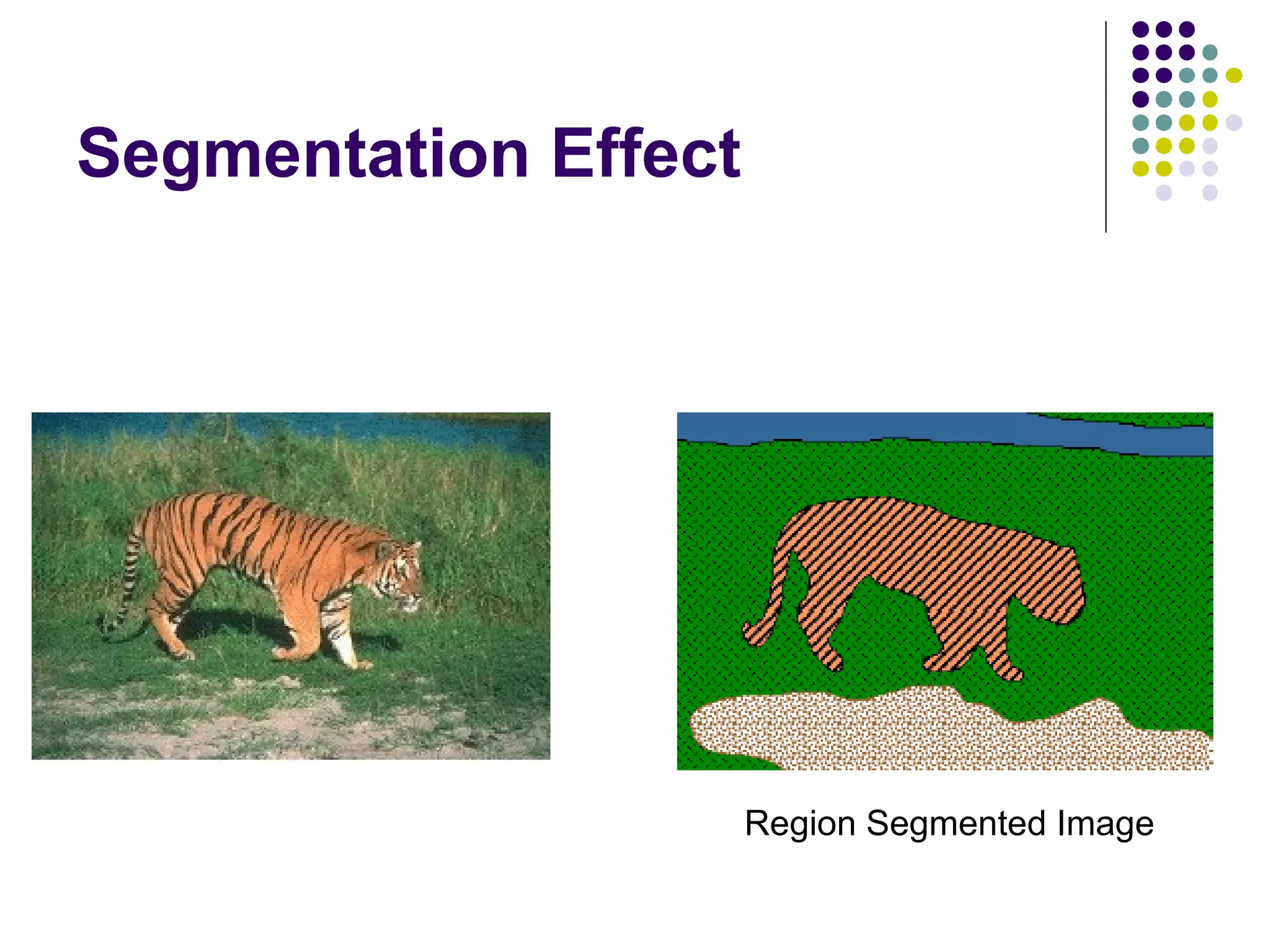
Segmentation Effect

Region Segmented Image
Approaches to
segmentation


Region based approaches





group together pixels with similar
properties
combining proximity and similarity
Classification


Region based approaches are based on
pixel properties such as





Homogeneity
Spatial proximity

The most used methods are





Thresholding
Clustering
Region growing
Split and merge
Pixel Aggregation (Region
Growing)


The basic idea is to grow from a seed pixel
 At a labeled pixel, check each of its neighbors
 If its attributes are similar to those of the already labeled
pixel,label the neighbor accordingly
 Repeat until there is no more pixel that can be labeled



For example, let
 The attribute of a pixel is its pixel value
 The similarity is defined as the difference between
adjacent pixel values
 If the difference is smaller than a threshold, they are
assigned to the same region, otherwise not
Region Growing : Algorithm

a) Chose or determined a group of seed pixel
which can correctly represent the required
region;
 b) Fixed the formula which can contain the
adjacent pixels in the growth;
 c) Made rules or conditions to stop the growth
process

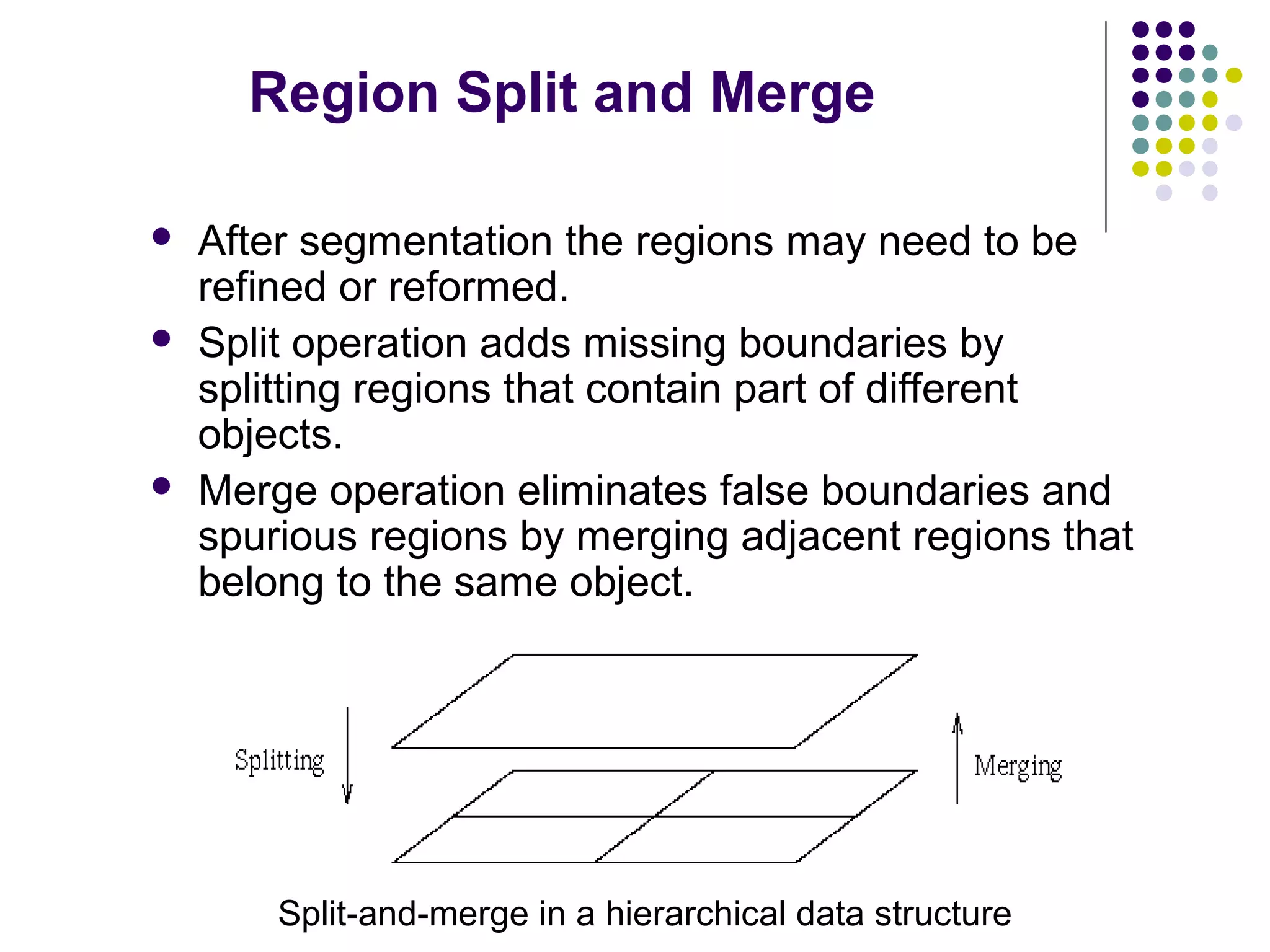
Region Split and Merge





After segmentation the regions may need to be
refined or reformed.
Split operation adds missing boundaries by
splitting regions that contain part of different
objects.
Merge operation eliminates false boundaries and
spurious regions by merging adjacent regions that
belong to the same object.

Split-and-merge in a hierarchical data structure
Algorithm: Region Splitting
 Form

initial region in the image
 For each region in an image,
recursively perform:




Compute the variance in the gray values for
the region
If the variance is above a threshold, split
the region along the appropriate boundary



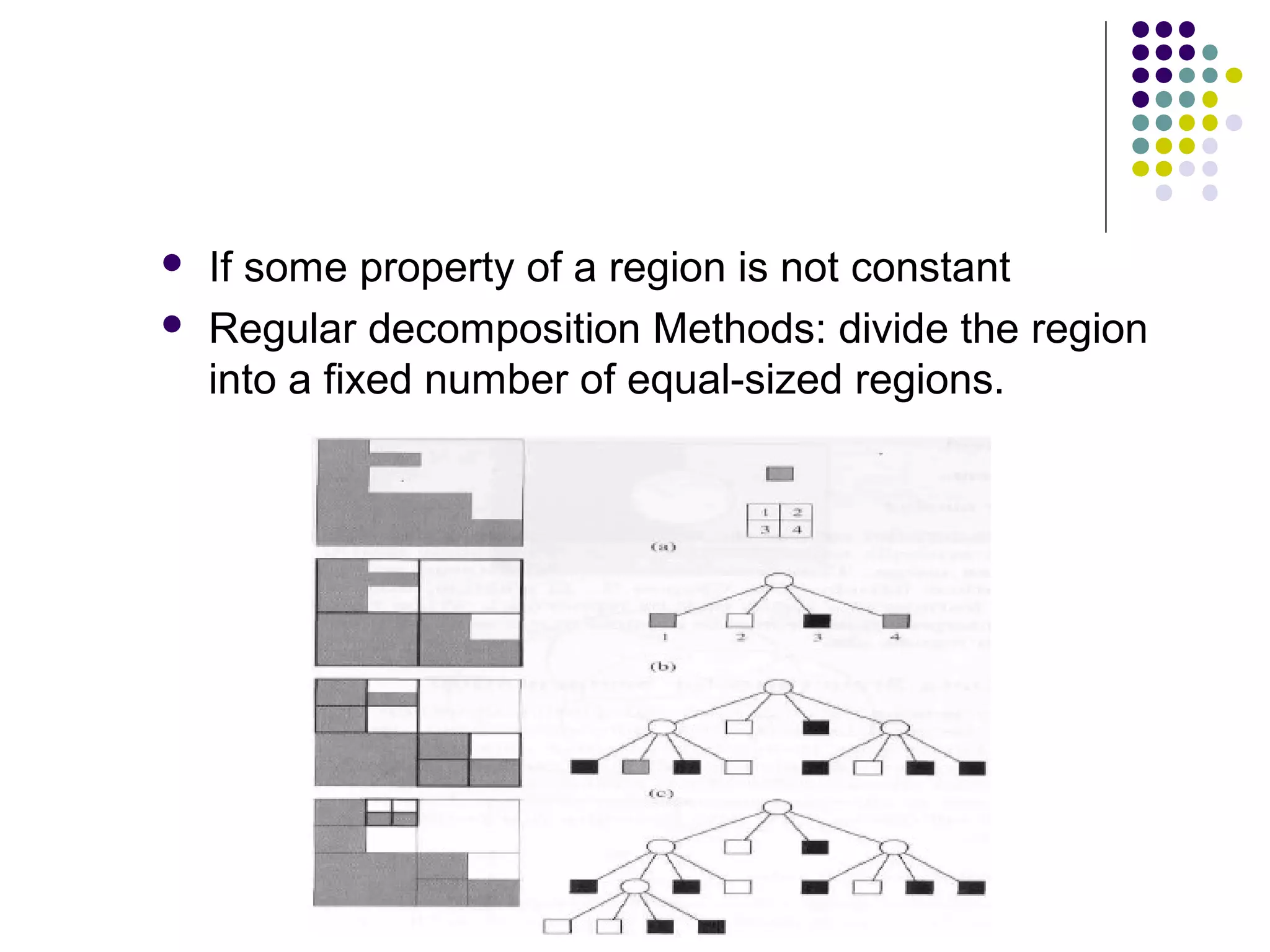
If some property of a region is not constant
Regular decomposition Methods: divide the region
into a fixed number of equal-sized regions.
Algorithm: Region Merging
(1) Form initial regions in the image using thresholding ( or
a similar approach) followed by component labeling.
(2) Prepare a region adjacency graph (RAG) for the image.
(3) For each region in an image, perform the following
steps:
(a) Consider its adjacent region and test to see if they are similar.
(b) For regions that are similar, merge them and modify the RAG.

(4) Repeat step 3 until no regions are merged.
Applications







In image compression
Object recognition
Computer graphics
Medical Imaging
MPEG-4 video object (VO) segmentation
References
[1] Rafael C. Gonzalez and Richard E. woods “DIGITAL
IMAGE PROCESSING,ˮ 2011.p. 762-770.
[2] Jun Tang, “A Color Image Segmentation algorithm
Based on Region Growing,ˮ China School of Electronic
Engineering 2010.
[3] Chaobing Huang, Quan Liu, Xiaopeng Li “Color Image
Segmentation by Seeded Regionˮ China, School of
information engineering, 2010.
[4] Tiancan Mei, Chen Zheng, Sidong Zhong, “Hierarchical
Region Based Markov Random Field for Image
Segmentation”,Wuhan,China,2011
[5] en.wikipedia.org/wiki/Region_growing
Thanks to All
Any Question??

ppt on region segmentation by AJAY KUMAR SINGH (NITK)

  • 1.
  • 2.
    Overview  Definition  Need ofsegmentation  Classification of methods  Region based segmentation
  • 3.
    Definition  Segmentation refers tothe process of partitioning a image into multiple regions.  Regions:- A group of connected pixels with similar properties.  Regions are used to interpret images. A region may correspond to a particular object, or different parts of an object.
  • 4.
     In most cases,segmentation should provide a set of regions having the following properties     Connectivity and compactness Regularity of boundaries Homogeneity in terms of color or texture Differentiation from neighbor regions
  • 5.
    Need of segmentation Thegoal of segmentation is to simplify the representation of an image into something that is more meaningful and easier to analyze. Image segmentation is typically used to locate objects and boundaries in images. For correct interpretation, image must be partitioned into regions that correspond to objects or parts of an object.
  • 6.
    Basic Formulation  Let Rrepresent the entire image region. We want to partition R into n sub regions, R1, R2, . . ., Rn, such that: (a) Summation of Ri =R (b) Ri is a connected region for i=1, 2, . . , n (c) Ri intersection Rj =φ for all i and j , I≠ j (d) P(Ri) = TRUE for i=1, 2, . . . n (e) P( Ri summation Rj)= False , i ≠ j
  • 7.
    Basic Formulation      (a) segmentationmust be complete – all pixels must belong to a region (b) pixels in a region must be connected (c) Regions must be disjoint (d) states that pixels in a region must all share the same property – The logic predicate P(Ri) over a region must return TRUE for each point in that region (e) indicates that regions are different in the sense of the predicate P.
  • 8.
  • 9.
    Approaches to segmentation  Region basedapproaches   group together pixels with similar properties combining proximity and similarity
  • 10.
    Classification  Region based approachesare based on pixel properties such as    Homogeneity Spatial proximity The most used methods are     Thresholding Clustering Region growing Split and merge
  • 11.
    Pixel Aggregation (Region Growing)  Thebasic idea is to grow from a seed pixel  At a labeled pixel, check each of its neighbors  If its attributes are similar to those of the already labeled pixel,label the neighbor accordingly  Repeat until there is no more pixel that can be labeled  For example, let  The attribute of a pixel is its pixel value  The similarity is defined as the difference between adjacent pixel values  If the difference is smaller than a threshold, they are assigned to the same region, otherwise not
  • 12.
    Region Growing :Algorithm a) Chose or determined a group of seed pixel which can correctly represent the required region;  b) Fixed the formula which can contain the adjacent pixels in the growth;  c) Made rules or conditions to stop the growth process 
  • 13.
    Region Split andMerge    After segmentation the regions may need to be refined or reformed. Split operation adds missing boundaries by splitting regions that contain part of different objects. Merge operation eliminates false boundaries and spurious regions by merging adjacent regions that belong to the same object. Split-and-merge in a hierarchical data structure
  • 14.
    Algorithm: Region Splitting Form initial region in the image  For each region in an image, recursively perform:   Compute the variance in the gray values for the region If the variance is above a threshold, split the region along the appropriate boundary
  • 15.
      If some propertyof a region is not constant Regular decomposition Methods: divide the region into a fixed number of equal-sized regions.
  • 16.
    Algorithm: Region Merging (1)Form initial regions in the image using thresholding ( or a similar approach) followed by component labeling. (2) Prepare a region adjacency graph (RAG) for the image. (3) For each region in an image, perform the following steps: (a) Consider its adjacent region and test to see if they are similar. (b) For regions that are similar, merge them and modify the RAG. (4) Repeat step 3 until no regions are merged.
  • 17.
    Applications      In image compression Objectrecognition Computer graphics Medical Imaging MPEG-4 video object (VO) segmentation
  • 18.
    References [1] Rafael C.Gonzalez and Richard E. woods “DIGITAL IMAGE PROCESSING,ˮ 2011.p. 762-770. [2] Jun Tang, “A Color Image Segmentation algorithm Based on Region Growing,ˮ China School of Electronic Engineering 2010. [3] Chaobing Huang, Quan Liu, Xiaopeng Li “Color Image Segmentation by Seeded Regionˮ China, School of information engineering, 2010. [4] Tiancan Mei, Chen Zheng, Sidong Zhong, “Hierarchical Region Based Markov Random Field for Image Segmentation”,Wuhan,China,2011 [5] en.wikipedia.org/wiki/Region_growing
  • 19.
  • 20.