A Vision Syndrome
Dan L. Fortenbacher, O.D., FCOVD
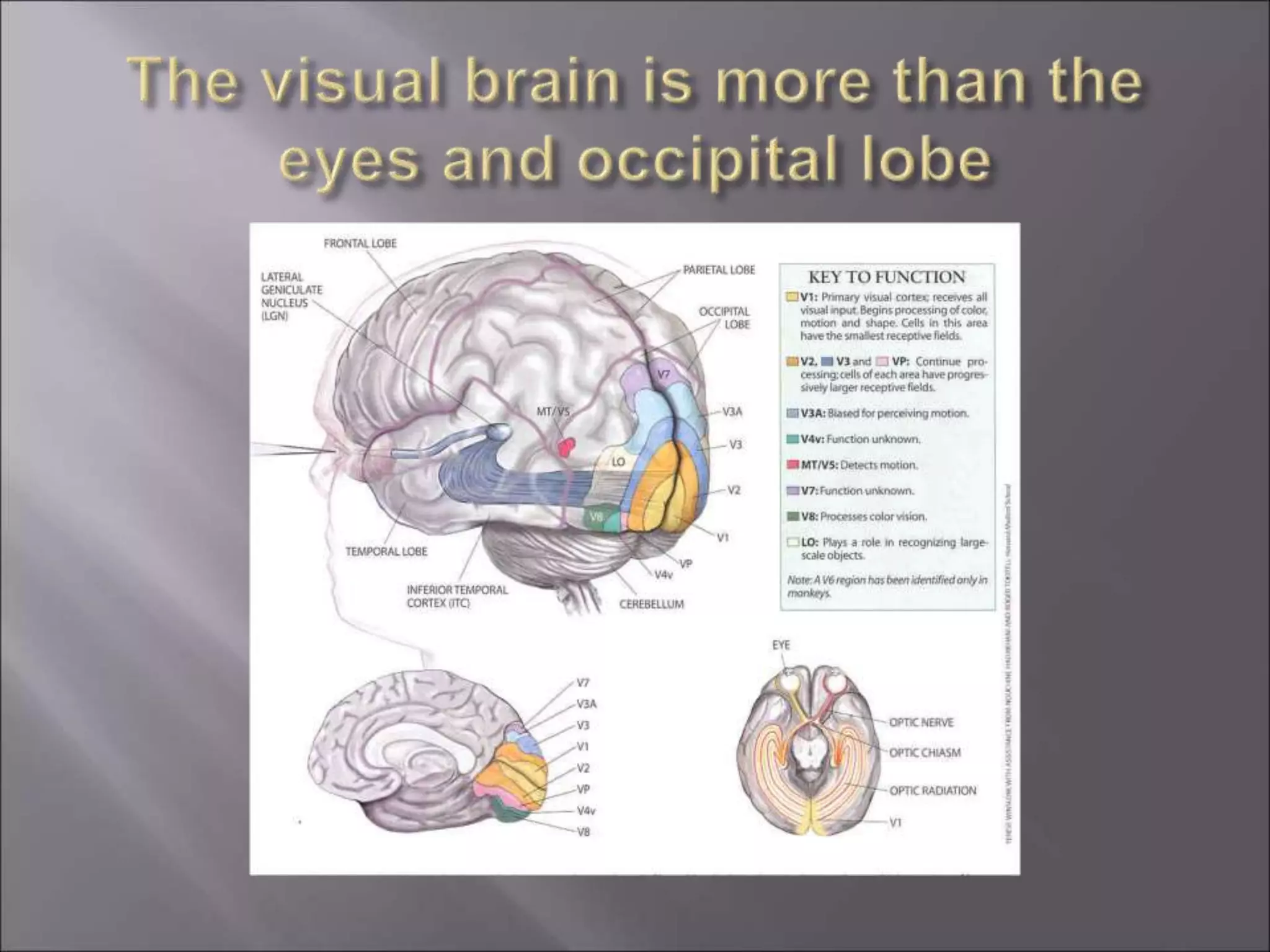
What do you see in this picture?
 Vision is a process
 Good vision requires the effective input of
visual information
 Good vision requires the effective processing
and integration of visual information
 Good vision is this culmination through which
we make use of visual information
 Binocular control
Ranges of fusion and integration with
accommodation
 Accommodative control
Amplitude, flexibility/facility and
integration with binocular control
 Oculomotor control
Fixations, pursuits and saccades
 Visual Spatial Orientation
Bilateral Integration
Laterality and Directionality
 Visual Analysis Skills
Visual Discrimination
Visual Figure Ground
Visual Closure
Visual Memory and Visualization
 Visual – Motor Integration
 Visual – Vestibular Integration
 Visual – Auditory Integration
 Visual –Verbal Integration
 Plans and guides our effective movement
 Substitutes for our need to move/touch to
gather information
 Is the dominant sense in human cognition by
organizing, interpreting, understanding, storing
and recalling information
 Is the foundation for imagination…imagery
 Is learned…
It’s a developmental process!
 n. Med. An aggregate or set of concurrent
symptoms indicating the presence and nature
of a disease. Funk and Wagnalls
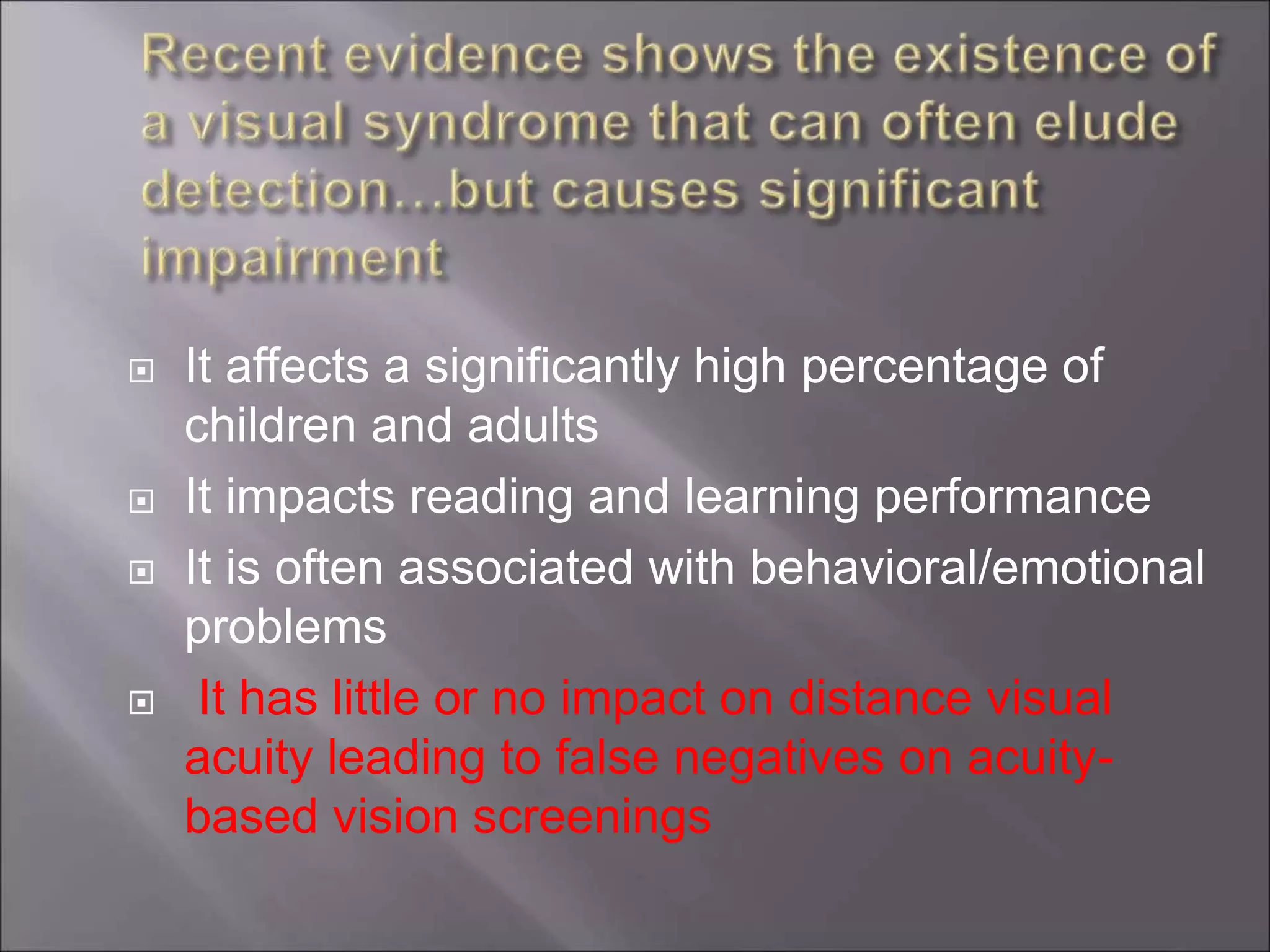
 It affects a significantly high percentage of
children and adults
 It impacts reading and learning performance
 It is often associated with behavioral/emotional
problems
 It has little or no impact on distance visual
acuity leading to false negatives on acuity-
based vision screenings
 Binocular
 Accommodative
 Oculomotor
Dysfunction
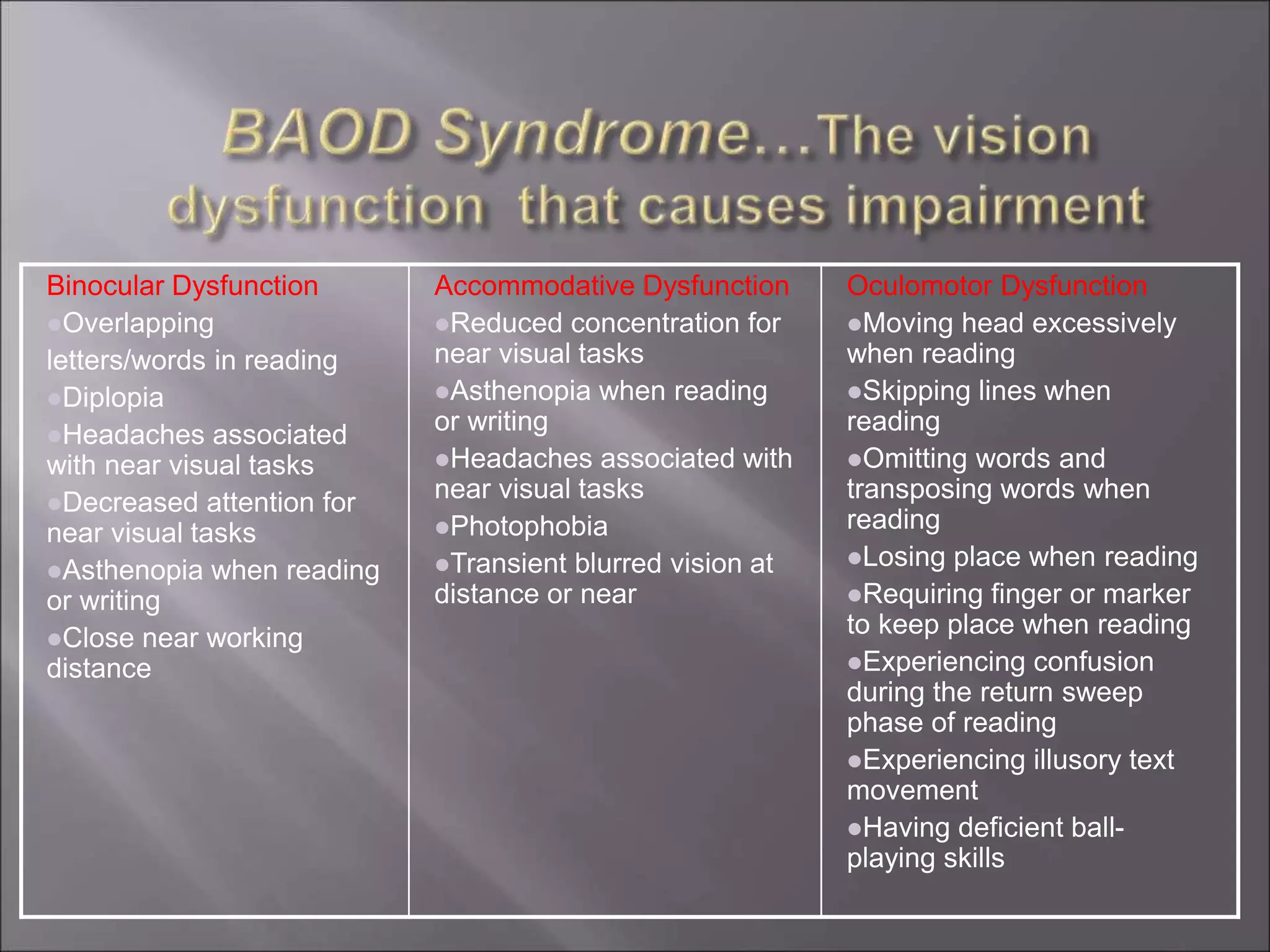
Binocular Dysfunction
Overlapping
letters/words in reading
Diplopia
Headaches associated
with near visual tasks
Decreased attention for
near visual tasks
Asthenopia when reading
or writing
Close near working
distance
Accommodative Dysfunction
Reduced concentration for
near visual tasks
Asthenopia when reading
or writing
Headaches associated with
near visual tasks
Photophobia
Transient blurred vision at
distance or near
Oculomotor Dysfunction
Moving head excessively
when reading
Skipping lines when
reading
Omitting words and
transposing words when
reading
Losing place when reading
Requiring finger or marker
to keep place when reading
Experiencing confusion
during the return sweep
phase of reading
Experiencing illusory text
movement
Having deficient ball-
playing skills
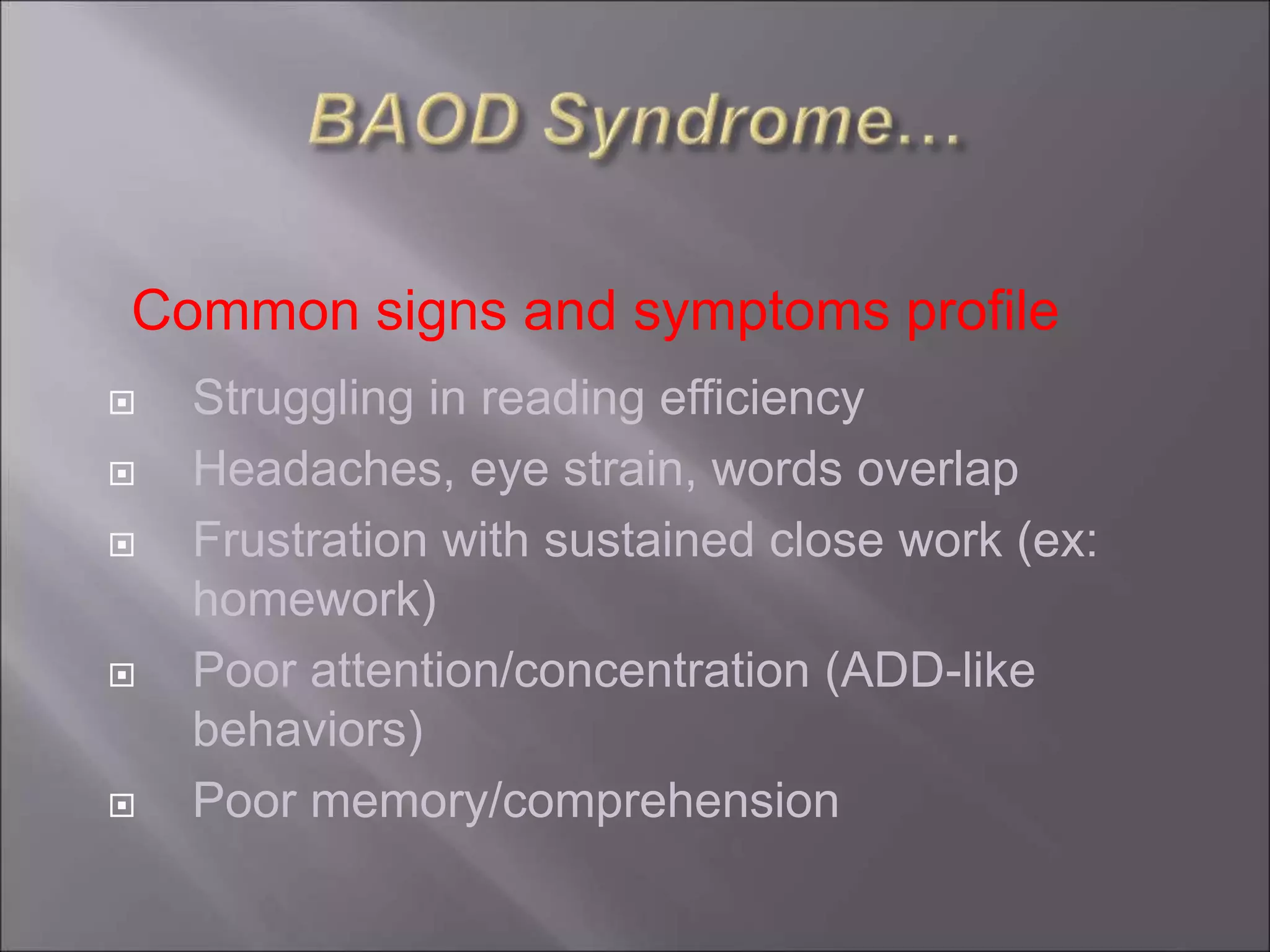
 Struggling in reading efficiency
 Headaches, eye strain, words overlap
 Frustration with sustained close work (ex:
homework)
 Poor attention/concentration (ADD-like
behaviors)
 Poor memory/comprehension
Common signs and symptoms profile
AOA Clinical Practice Guideline: Care of the Patient
with Learning Related Vision Problems (pg 7,13):
 The prevalence of visual efficiency (binocular, accommodative,
motility)problems are thought to be in the 15-20% range.
67-69
 Accommodative dysfunctions have been reported to occur in 60-80%
of individuals with vision efficiency problems
21
 Convergence Insufficiency (CI) is one the most common binocular
vision anomalies.
21
”
 “Deficiencies in ocular motility have been associated with learning
problems.
86-92
”
In Children with Learning Problems
1. Begin to look for the BAOD Syndrome
symptom profile in all patients, especially
children.
 Create a simple checklist in your history repertoire.
Look for:
 Struggling in reading efficiency
 Headaches, eye strain, words overlap
 Frustration with sustained close work (ex: homework)
 Poor attention/concentration (ADD-like behaviors)
 Poor memory/comprehension
2. Check for some of the key clinical findings to
make the Diagnosis:
 Reduced Near Point of Convergence
 Excessive Exophoia or Esophoria at near
 Reduced Positive Fusional Vergence
 Low accommodative abilities (PRA, NRA or Facility)
 Poor oculomotor skills (pursuits, saccades, fixations)
3. Direct a plan of patient management
 Provide office-based, doctor supervised optometric
vision therapy or…
 Refer to a colleague who specializes in developmental
vision and vision therapy care and provides competent
office-based, doctor supervised optometric vision
therapy
 Initial comprehensive diagnostic vision evaluation
 Assessment of visual information processing
 Consultation
 Treatment
 Doctor supervised office-based VT (OBVT)along with
home activities. Patient sessions 1-2 times per week
 Periodic progress evaluations with the doctor
 Exit evaluation with the doctor to confirm patient has
reached automaticity in visual function
 3 month post vision therapy evaluation with the doctor
to verify patient has maintained visual function
 You will be appreciated by your patient – they will
experience greater success through better vision
 You will be appreciated by your patients family
and the community…as a doctor who really cares
 American Optometric Association Clinical
Practice Guideline:
 Care of the Patient with Learning Related Vision
Problems (AOA-CPG 20)
 Websites:
 www.covd.org
 www.aoa.org
 www.oepf.org
 College of Optometrists in Vision Development
(COVD) Annual Meeting:
 Applied Concepts Courses
 Optometric Extension Program Foundation:
 Regional Clinical Seminars
Recommended Books:
 Applied Concepts in Vision Therapy
Press LJ. OEPF 2008
 Binocular Anomalies: Diagnosis and Vision Therapy
(4th ed.)Griffin, JF, Grisham JD, Butterworth-Heinemann
2002
 Clinical Management of Binocular Vision:
Heterophoric, Accommodative, and Eye Movement
Disorders Scheiman M. Wick B. Lippincott 2008

baod-syndrome.ppt

  • 1.
    A Vision Syndrome DanL. Fortenbacher, O.D., FCOVD
  • 2.
    What do yousee in this picture?
  • 5.
     Vision isa process  Good vision requires the effective input of visual information  Good vision requires the effective processing and integration of visual information  Good vision is this culmination through which we make use of visual information
  • 6.
     Binocular control Rangesof fusion and integration with accommodation  Accommodative control Amplitude, flexibility/facility and integration with binocular control  Oculomotor control Fixations, pursuits and saccades
  • 7.
     Visual SpatialOrientation Bilateral Integration Laterality and Directionality  Visual Analysis Skills Visual Discrimination Visual Figure Ground Visual Closure Visual Memory and Visualization
  • 8.
     Visual –Motor Integration  Visual – Vestibular Integration  Visual – Auditory Integration  Visual –Verbal Integration
  • 9.
     Plans andguides our effective movement  Substitutes for our need to move/touch to gather information  Is the dominant sense in human cognition by organizing, interpreting, understanding, storing and recalling information  Is the foundation for imagination…imagery
  • 10.
     Is learned… It’sa developmental process!
  • 11.
     n. Med.An aggregate or set of concurrent symptoms indicating the presence and nature of a disease. Funk and Wagnalls
  • 12.
     It affectsa significantly high percentage of children and adults  It impacts reading and learning performance  It is often associated with behavioral/emotional problems  It has little or no impact on distance visual acuity leading to false negatives on acuity- based vision screenings
  • 13.
  • 14.
    Binocular Dysfunction Overlapping letters/words inreading Diplopia Headaches associated with near visual tasks Decreased attention for near visual tasks Asthenopia when reading or writing Close near working distance Accommodative Dysfunction Reduced concentration for near visual tasks Asthenopia when reading or writing Headaches associated with near visual tasks Photophobia Transient blurred vision at distance or near Oculomotor Dysfunction Moving head excessively when reading Skipping lines when reading Omitting words and transposing words when reading Losing place when reading Requiring finger or marker to keep place when reading Experiencing confusion during the return sweep phase of reading Experiencing illusory text movement Having deficient ball- playing skills
  • 15.
     Struggling inreading efficiency  Headaches, eye strain, words overlap  Frustration with sustained close work (ex: homework)  Poor attention/concentration (ADD-like behaviors)  Poor memory/comprehension Common signs and symptoms profile
  • 16.
    AOA Clinical PracticeGuideline: Care of the Patient with Learning Related Vision Problems (pg 7,13):  The prevalence of visual efficiency (binocular, accommodative, motility)problems are thought to be in the 15-20% range. 67-69  Accommodative dysfunctions have been reported to occur in 60-80% of individuals with vision efficiency problems 21  Convergence Insufficiency (CI) is one the most common binocular vision anomalies. 21 ”  “Deficiencies in ocular motility have been associated with learning problems. 86-92 ” In Children with Learning Problems
  • 17.
    1. Begin tolook for the BAOD Syndrome symptom profile in all patients, especially children.  Create a simple checklist in your history repertoire. Look for:  Struggling in reading efficiency  Headaches, eye strain, words overlap  Frustration with sustained close work (ex: homework)  Poor attention/concentration (ADD-like behaviors)  Poor memory/comprehension
  • 18.
    2. Check forsome of the key clinical findings to make the Diagnosis:  Reduced Near Point of Convergence  Excessive Exophoia or Esophoria at near  Reduced Positive Fusional Vergence  Low accommodative abilities (PRA, NRA or Facility)  Poor oculomotor skills (pursuits, saccades, fixations)
  • 19.
    3. Direct aplan of patient management  Provide office-based, doctor supervised optometric vision therapy or…  Refer to a colleague who specializes in developmental vision and vision therapy care and provides competent office-based, doctor supervised optometric vision therapy
  • 20.
     Initial comprehensivediagnostic vision evaluation  Assessment of visual information processing  Consultation  Treatment  Doctor supervised office-based VT (OBVT)along with home activities. Patient sessions 1-2 times per week  Periodic progress evaluations with the doctor  Exit evaluation with the doctor to confirm patient has reached automaticity in visual function  3 month post vision therapy evaluation with the doctor to verify patient has maintained visual function
  • 21.
     You willbe appreciated by your patient – they will experience greater success through better vision  You will be appreciated by your patients family and the community…as a doctor who really cares
  • 22.
     American OptometricAssociation Clinical Practice Guideline:  Care of the Patient with Learning Related Vision Problems (AOA-CPG 20)  Websites:  www.covd.org  www.aoa.org  www.oepf.org  College of Optometrists in Vision Development (COVD) Annual Meeting:  Applied Concepts Courses  Optometric Extension Program Foundation:  Regional Clinical Seminars
  • 23.
    Recommended Books:  AppliedConcepts in Vision Therapy Press LJ. OEPF 2008  Binocular Anomalies: Diagnosis and Vision Therapy (4th ed.)Griffin, JF, Grisham JD, Butterworth-Heinemann 2002  Clinical Management of Binocular Vision: Heterophoric, Accommodative, and Eye Movement Disorders Scheiman M. Wick B. Lippincott 2008