CASE PRESENTATION
MIKAH TCHALE
ACKNOWLEDGEMENTS
MR SYMON CHIKUMBA, optometrist
MR JALLIFF CHITSEKO, optometrist
PATIENT’S PARTICULARS
NAME: RT
AGE: 21
SEX: F
LOCATION: AREA 1B
OCCUPATION: SECONDARY SCHOOL STUDENT
CASE HISTORY
CHIEF COMPLAINT
Tearing and eyestrain with prolonged near work
OCULAR Hx: has an ocular allergy and
currently on treatment ie sodium
cromoglycate
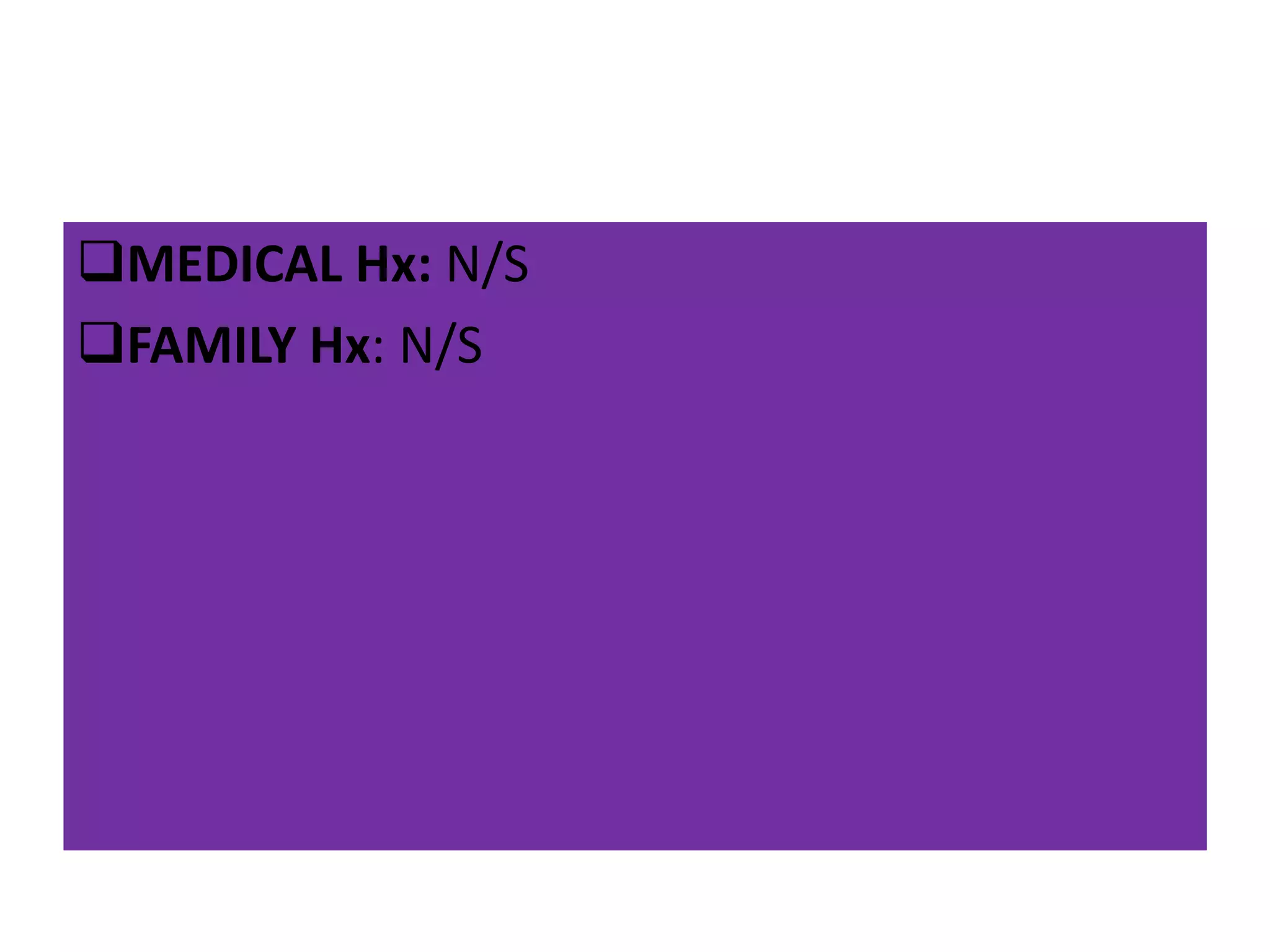
MEDICAL Hx: N/S
FAMILY Hx: N/S
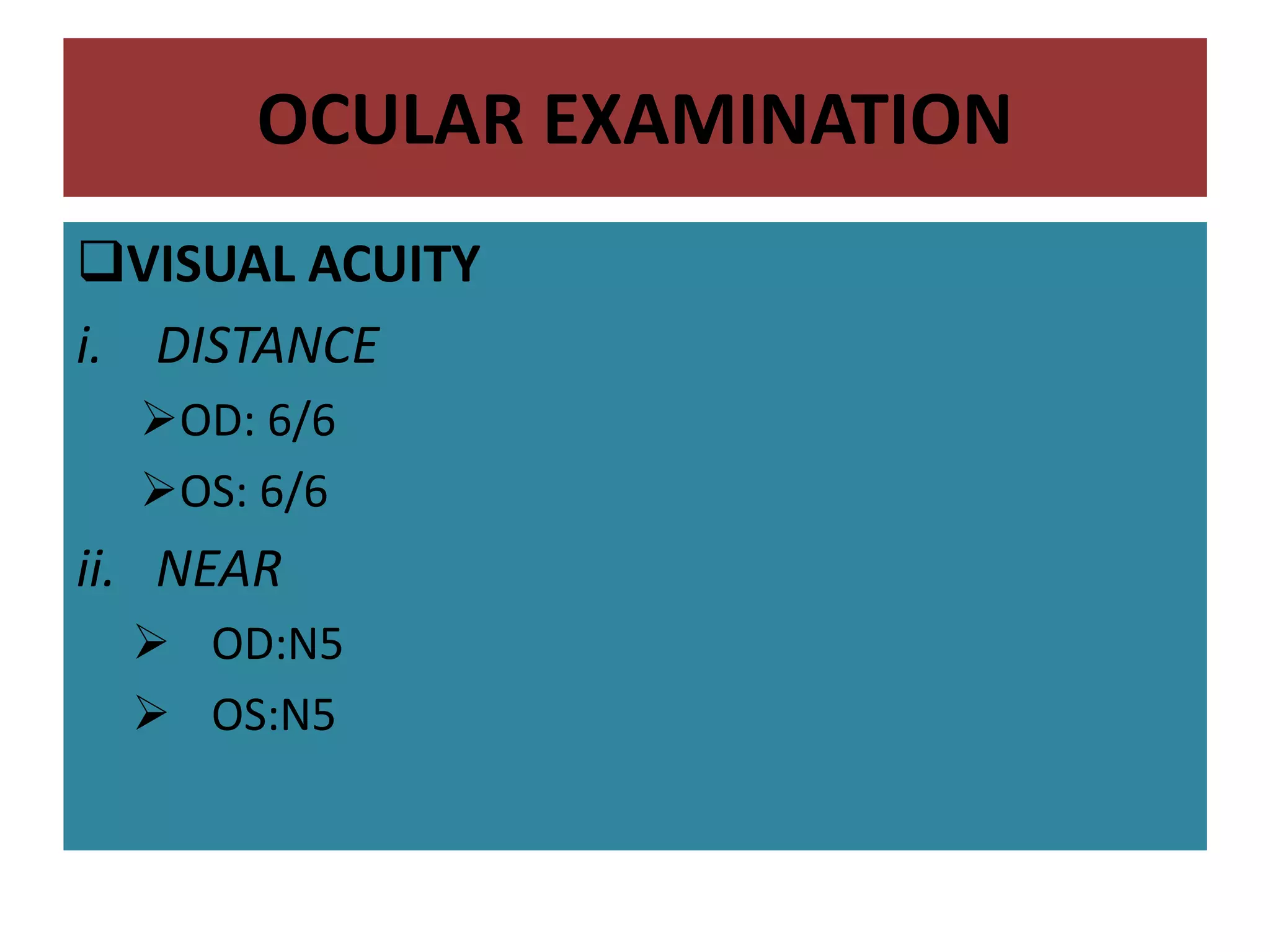
OCULAR EXAMINATION
VISUAL ACUITY
i. DISTANCE
OD: 6/6
OS: 6/6
ii. NEAR
 OD:N5
 OS:N5
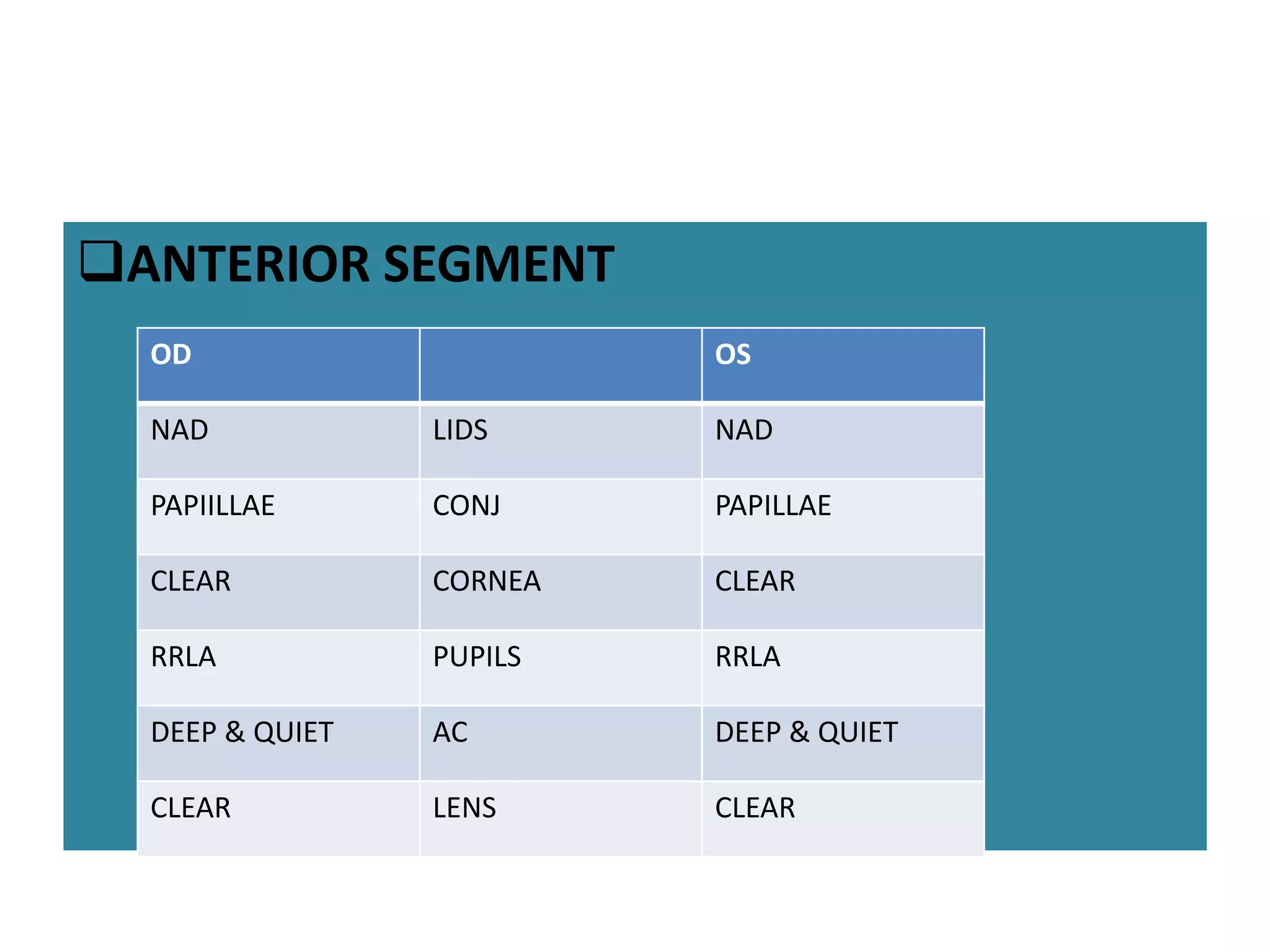
ANTERIOR SEGMENT
OD OS
NAD LIDS NAD
PAPIILLAE CONJ PAPILLAE
CLEAR CORNEA CLEAR
RRLA PUPILS RRLA
DEEP & QUIET AC DEEP & QUIET
CLEAR LENS CLEAR
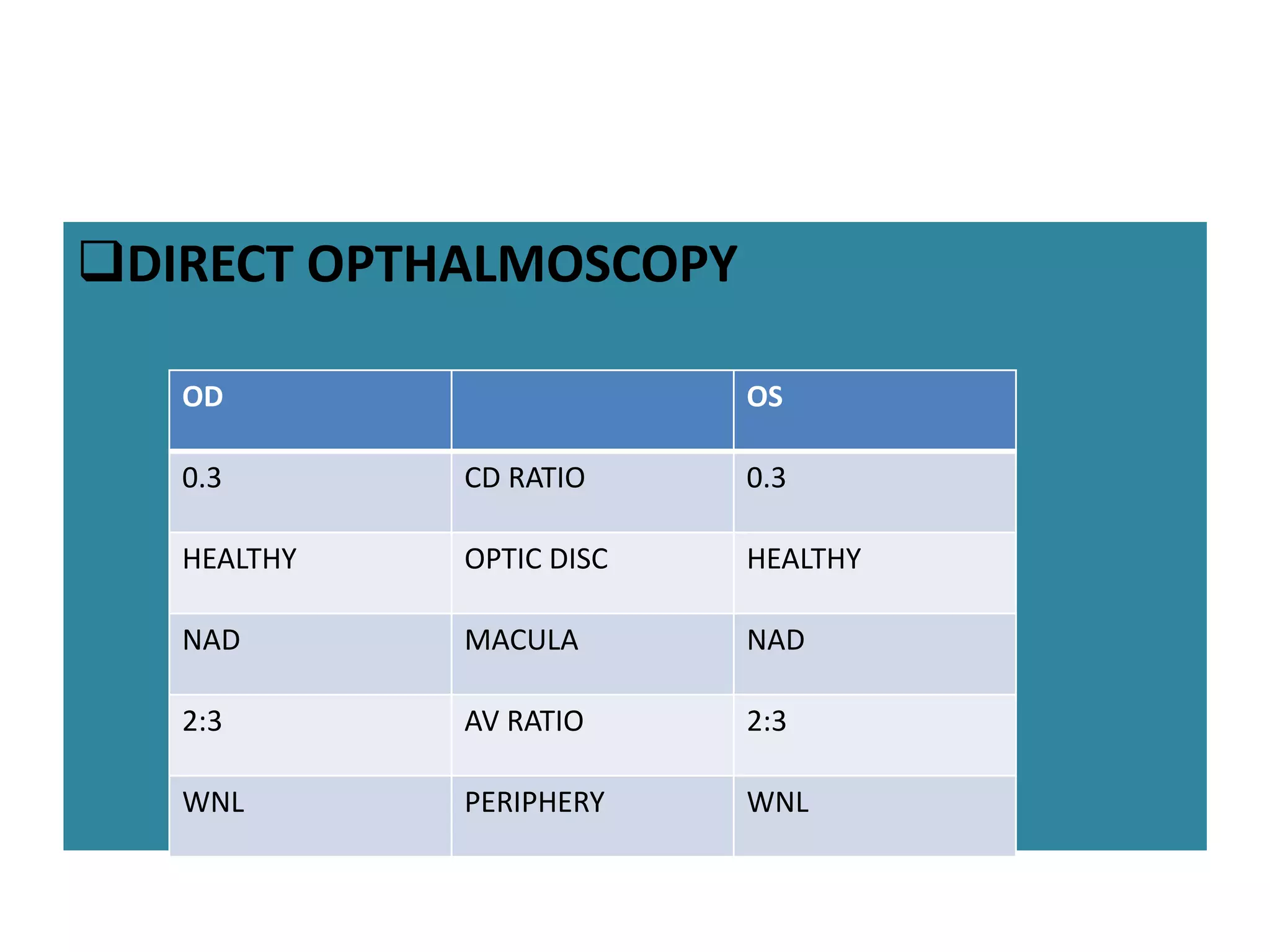
DIRECT OPTHALMOSCOPY
OD OS
0.3 CD RATIO 0.3
HEALTHY OPTIC DISC HEALTHY
NAD MACULA NAD
2:3 AV RATIO 2:3
WNL PERIPHERY WNL
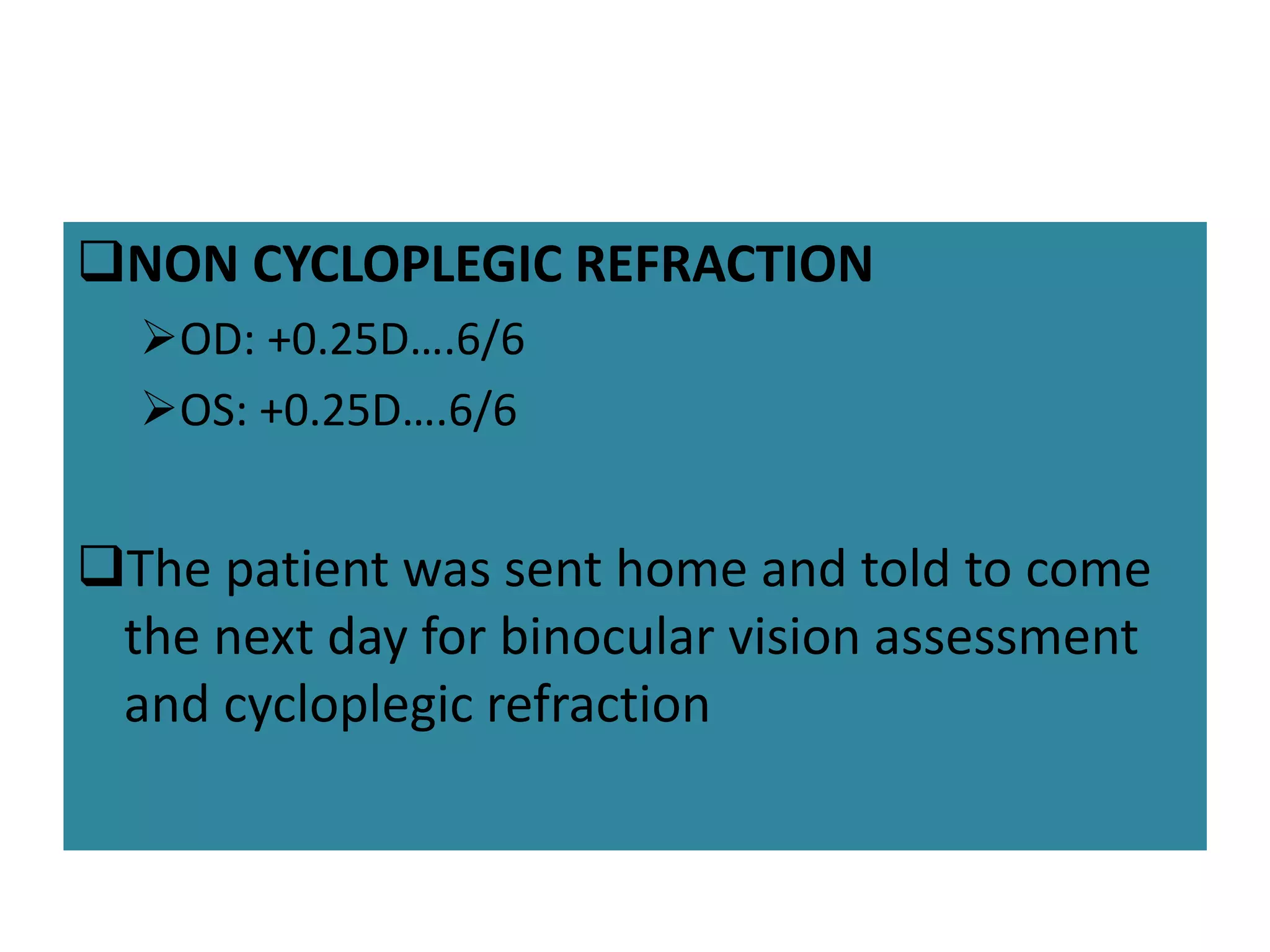
NON CYCLOPLEGIC REFRACTION
OD: +0.25D….6/6
OS: +0.25D….6/6
The patient was sent home and told to come
the next day for binocular vision assessment
and cycloplegic refraction
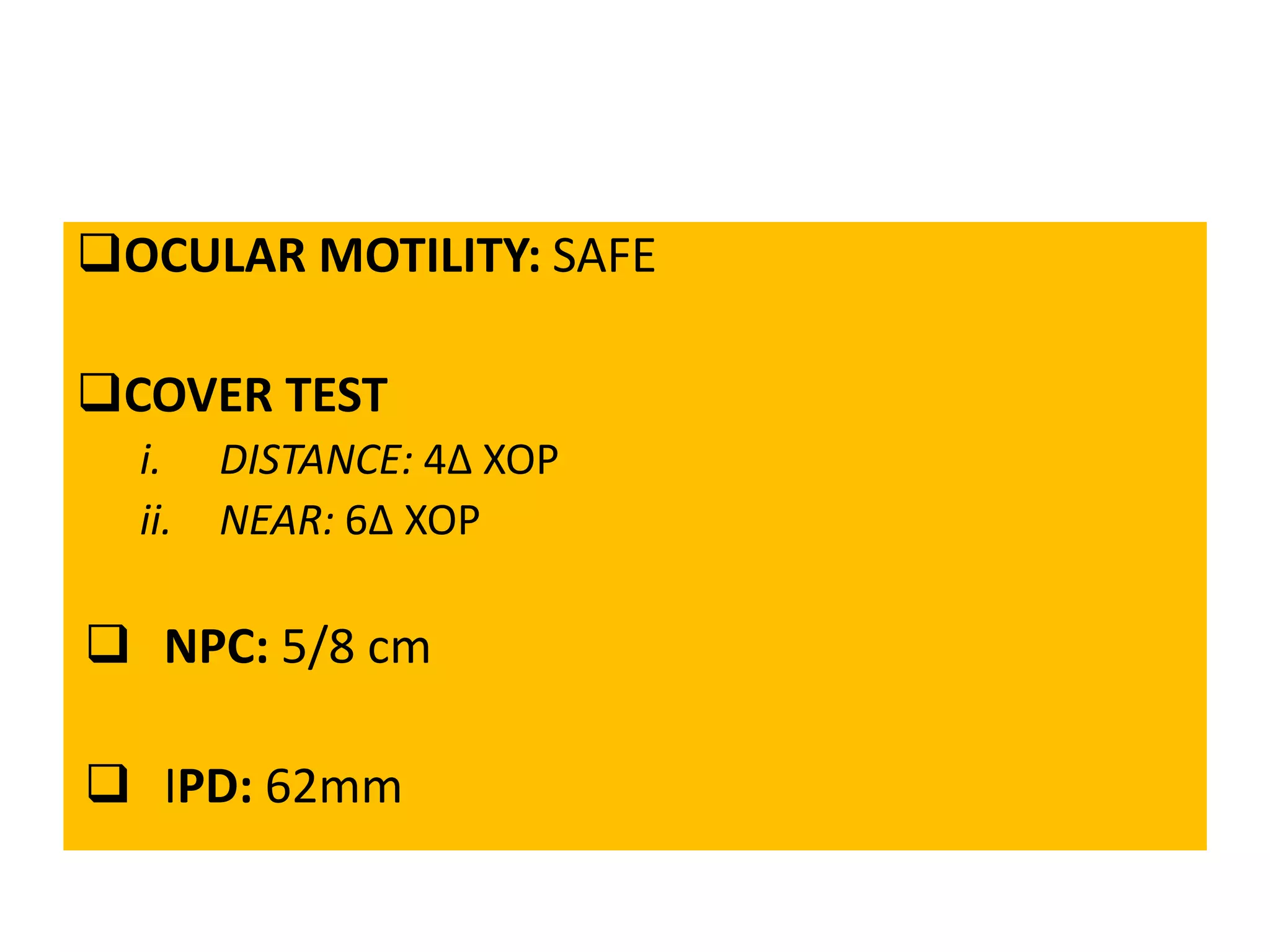
OCULAR MOTILITY: SAFE
COVER TEST
i. DISTANCE: 4∆ XOP
ii. NEAR: 6∆ XOP
 NPC: 5/8 cm
 IPD: 62mm
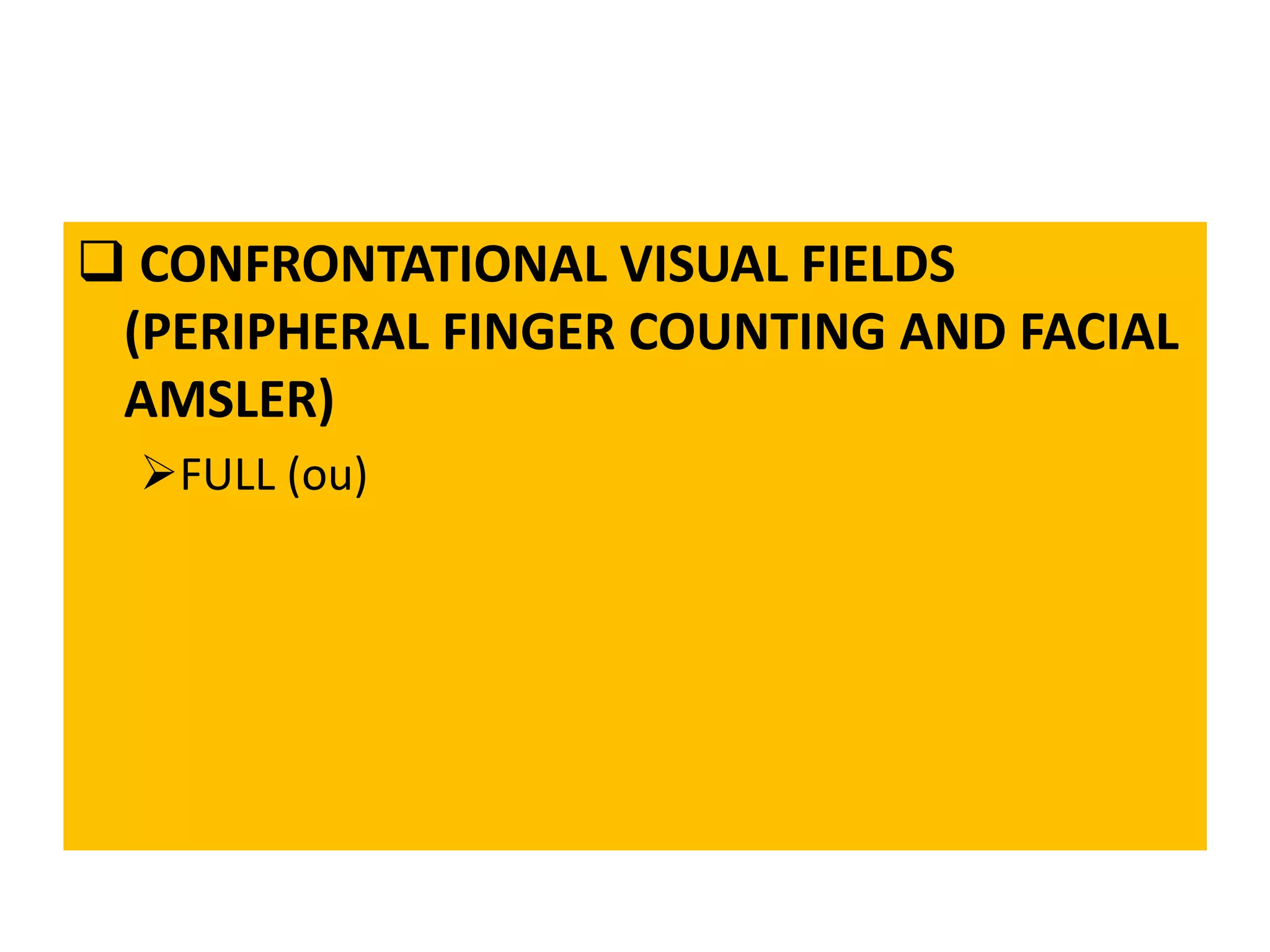
 CONFRONTATIONAL VISUAL FIELDS
(PERIPHERAL FINGER COUNTING AND FACIAL
AMSLER)
FULL (ou)
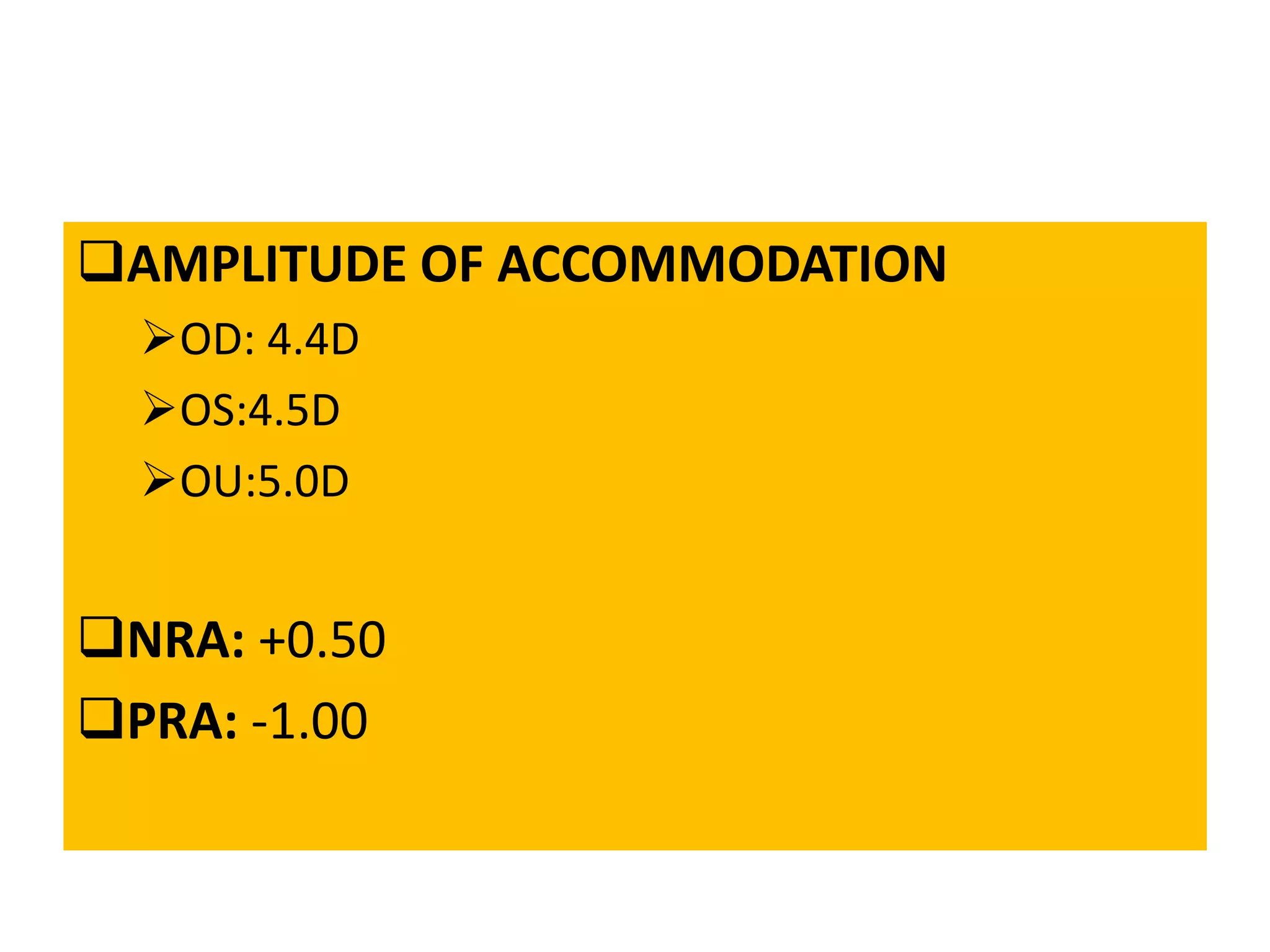
AMPLITUDE OF ACCOMMODATION
OD: 4.4D
OS:4.5D
OU:5.0D
NRA: +0.50
PRA: -1.00
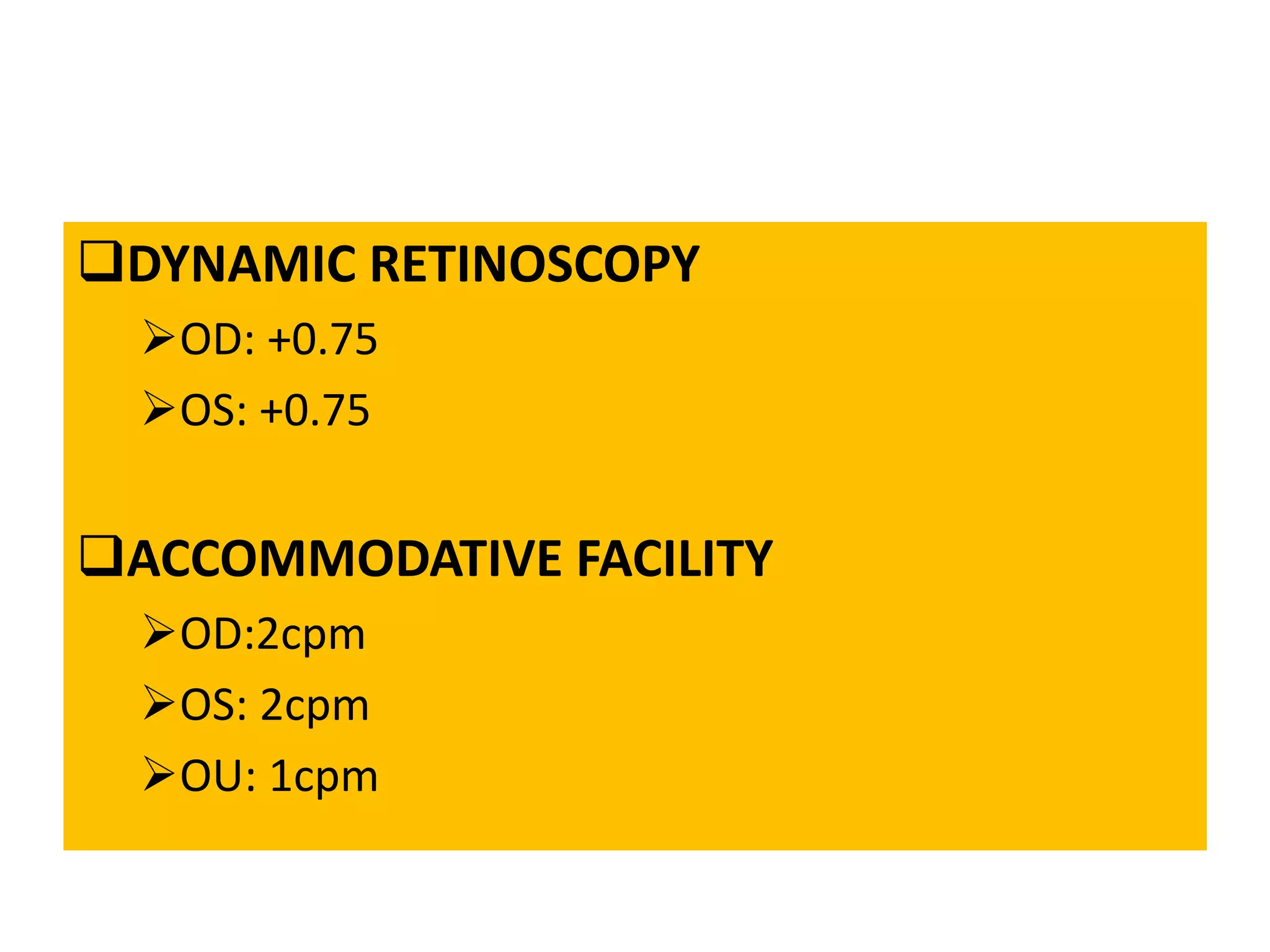
DYNAMIC RETINOSCOPY
OD: +0.75
OS: +0.75
ACCOMMODATIVE FACILITY
OD:2cpm
OS: 2cpm
OU: 1cpm
CYCLOPLEGIC REFRACTION
OD:+0.25…6/6
OS: PLANO…6/6
CALCULATED AC/A RATIO
IPD (cm) + NFD (m) [Hn-Hf]
5.4:1
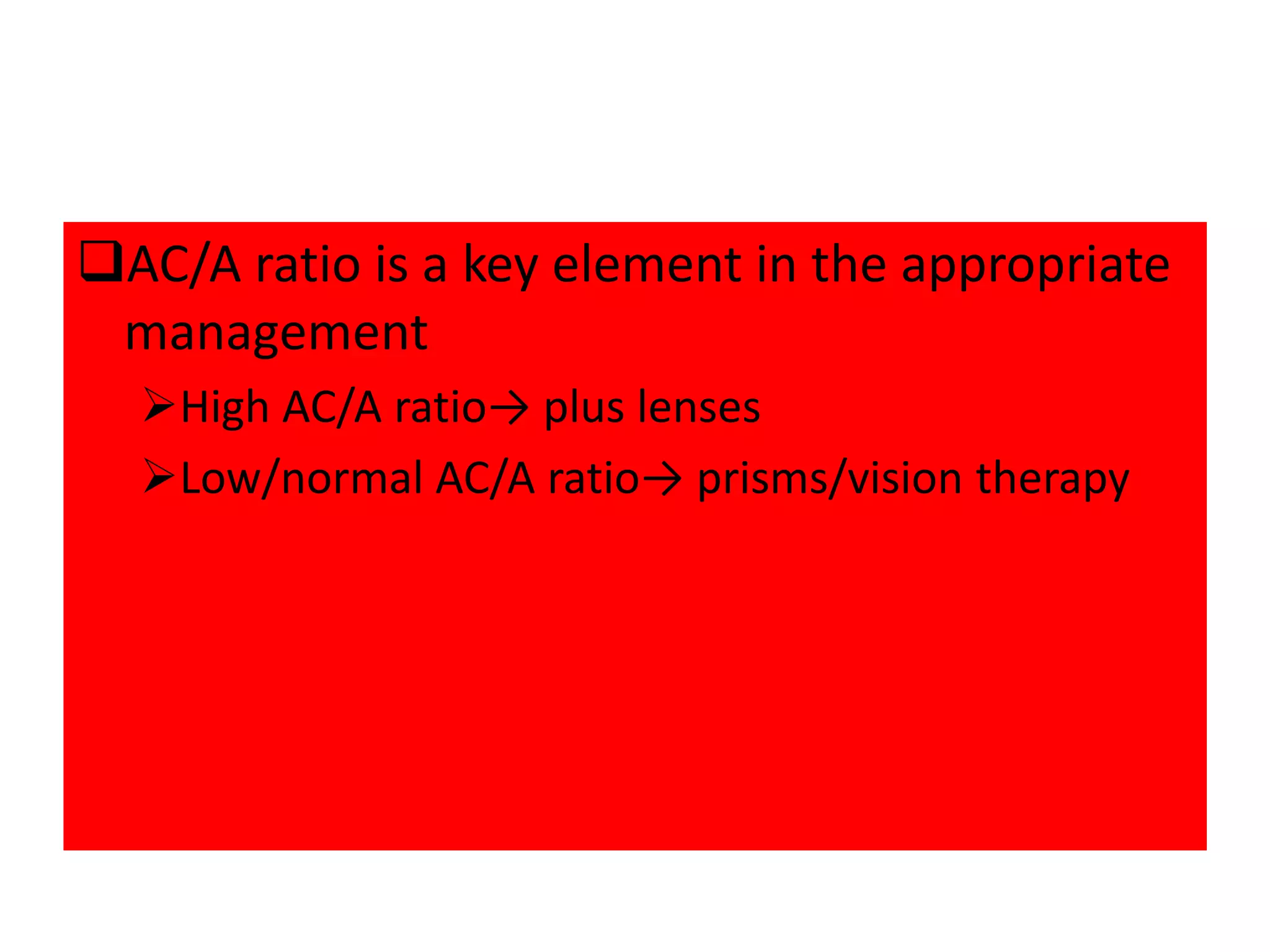
AC/A ratio is a key element in the appropriate
management
High AC/A ratio→ plus lenses
Low/normal AC/A ratio→ prisms/vision therapy
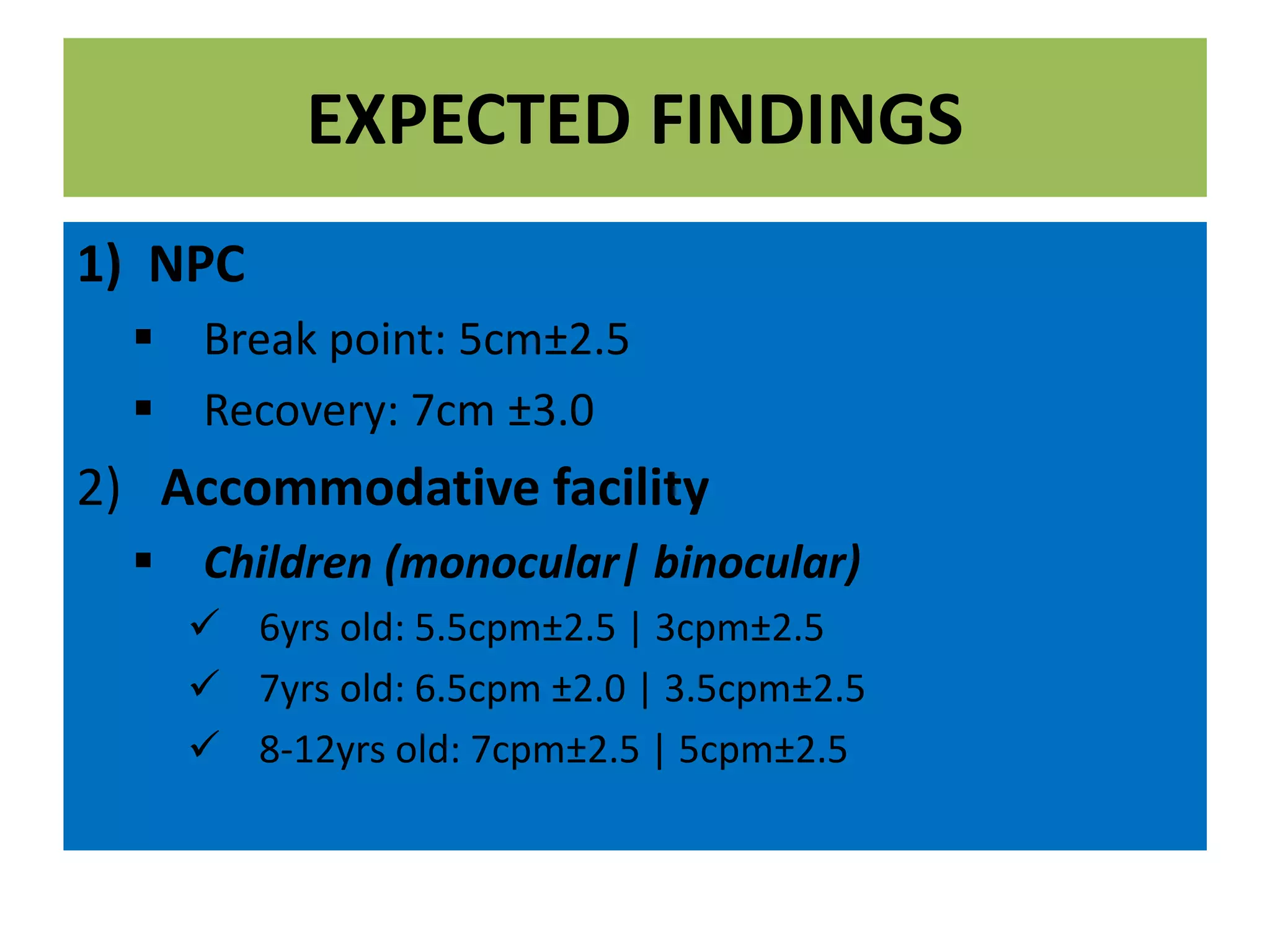
EXPECTED FINDINGS
1) NPC
 Break point: 5cm±2.5
 Recovery: 7cm ±3.0
2) Accommodative facility
 Children (monocular| binocular)
 6yrs old: 5.5cpm±2.5 | 3cpm±2.5
 7yrs old: 6.5cpm ±2.0 | 3.5cpm±2.5
 8-12yrs old: 7cpm±2.5 | 5cpm±2.5
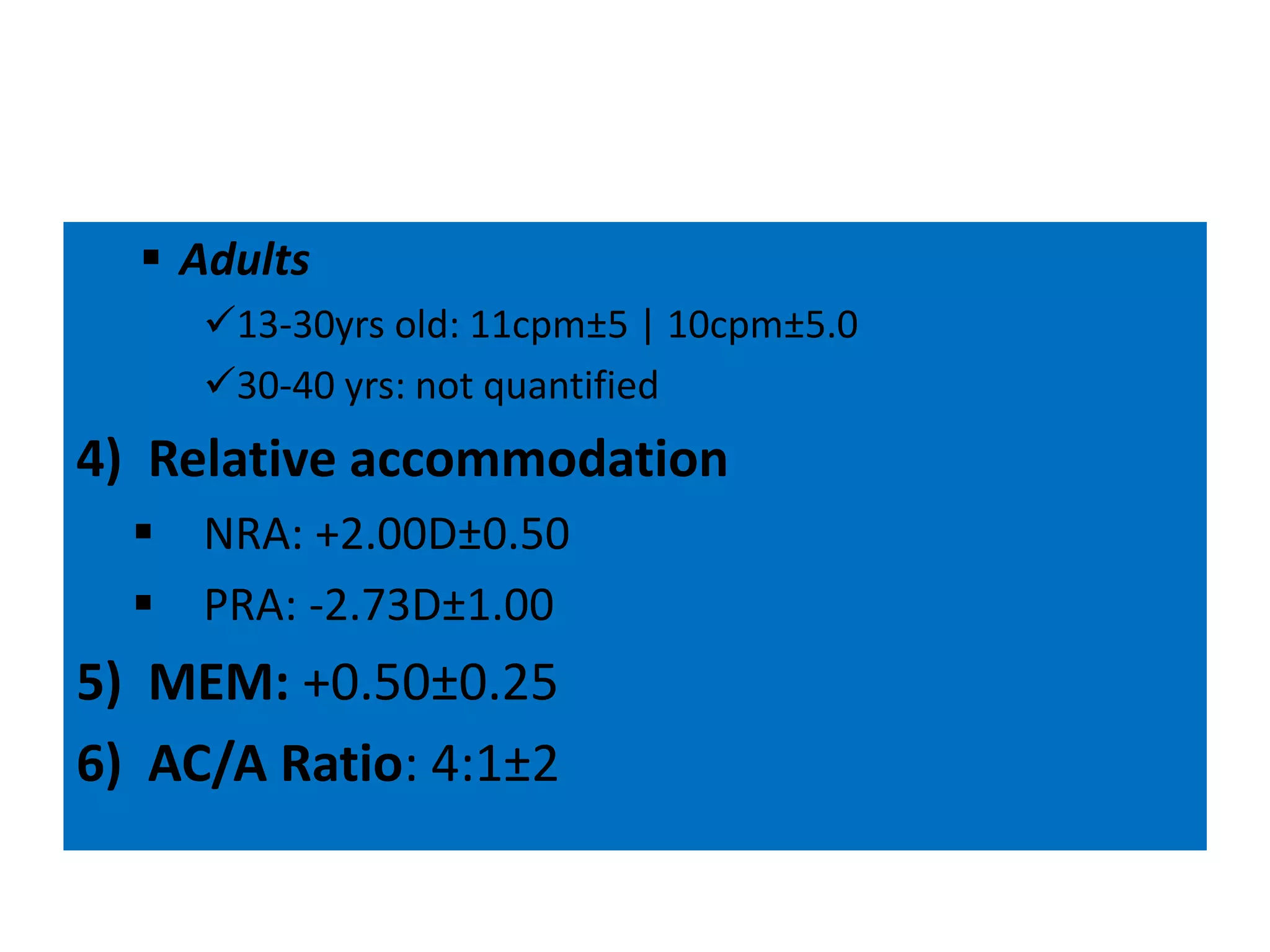
 Adults
13-30yrs old: 11cpm±5 | 10cpm±5.0
30-40 yrs: not quantified
4) Relative accommodation
 NRA: +2.00D±0.50
 PRA: -2.73D±1.00
5) MEM: +0.50±0.25
6) AC/A Ratio: 4:1±2
DIFFERENTIALS
Basic exophoria
Accommodation insufficiency
Fusional Vergence dysfunction
FINAL DIAGNOSIS
FUSIONAL VERGENCE DYSFUNCTION
TREATMENT
Jump exercises 3x/day for 1 month
Review after 1 month
LITERATURE REVIEW
FUSIONAL VERGENCE DYSFUNCTION
SYMPTOMS
Eyestrain and headaches after relatively short periods
of near work
Inability to concentrate
Excessive tearing
Blurred vision
Loss of comprehension over time
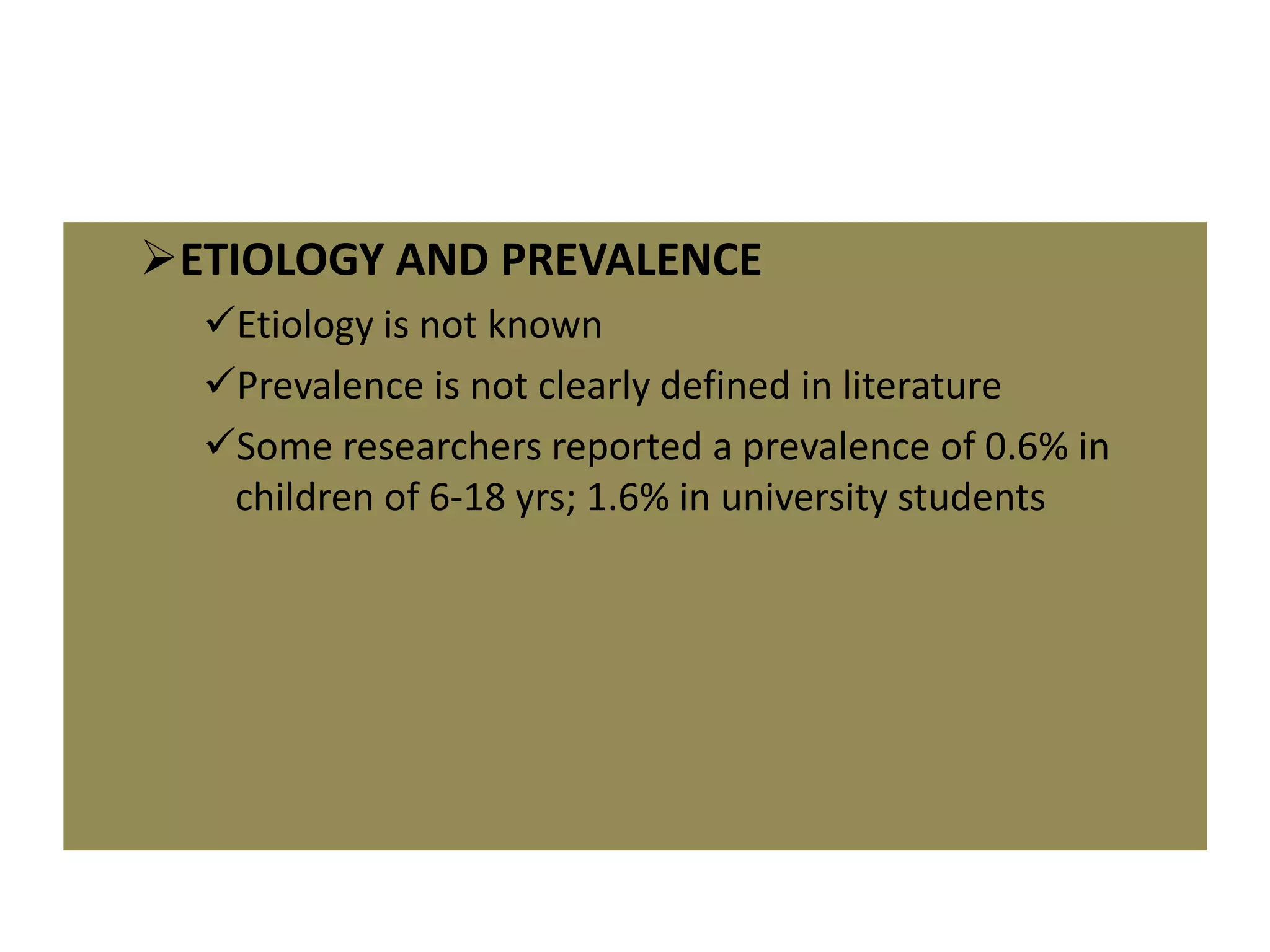
ETIOLOGY AND PREVALENCE
Etiology is not known
Prevalence is not clearly defined in literature
Some researchers reported a prevalence of 0.6% in
children of 6-18 yrs; 1.6% in university students
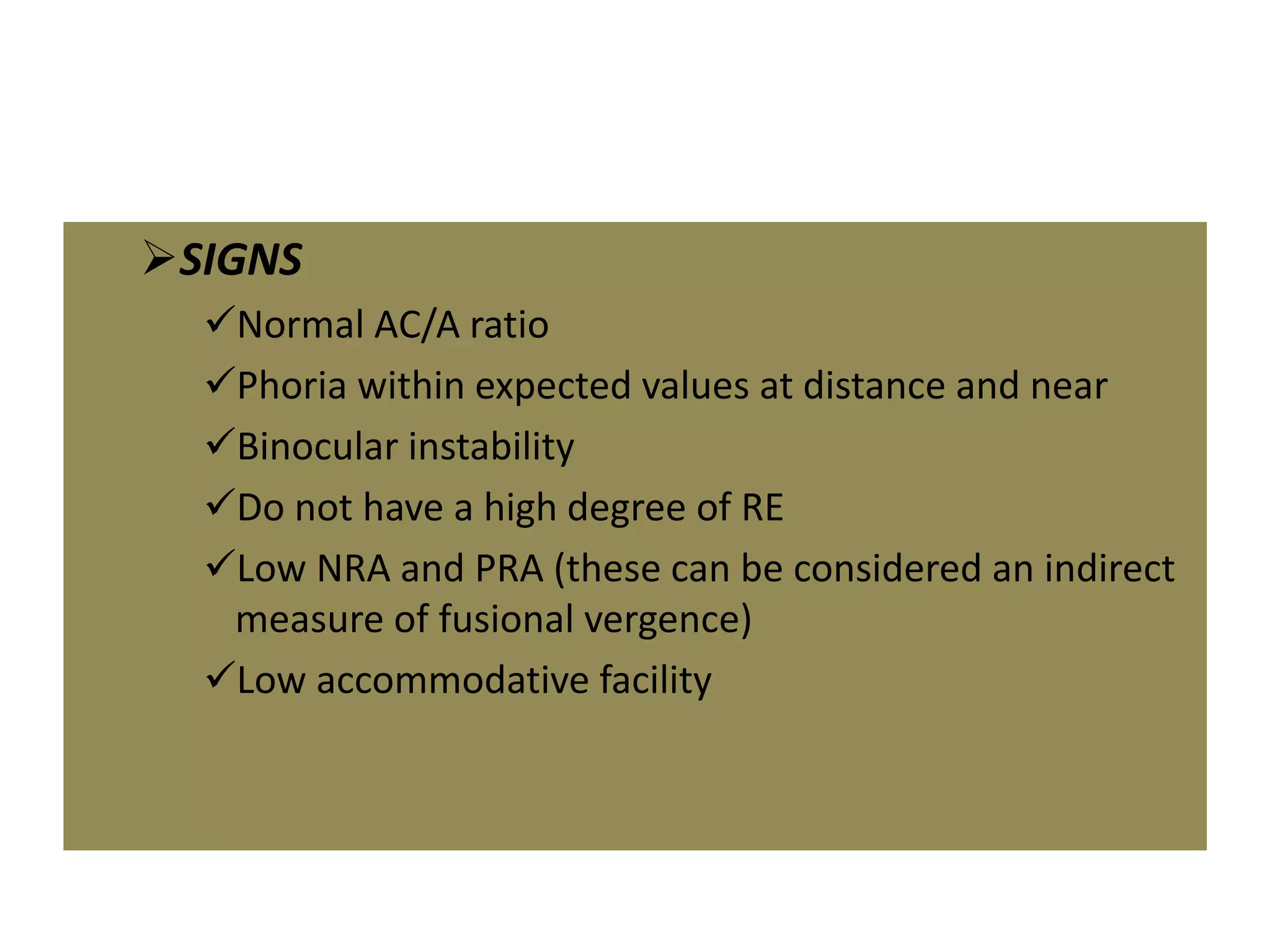
SIGNS
Normal AC/A ratio
Phoria within expected values at distance and near
Binocular instability
Do not have a high degree of RE
Low NRA and PRA (these can be considered an indirect
measure of fusional vergence)
Low accommodative facility
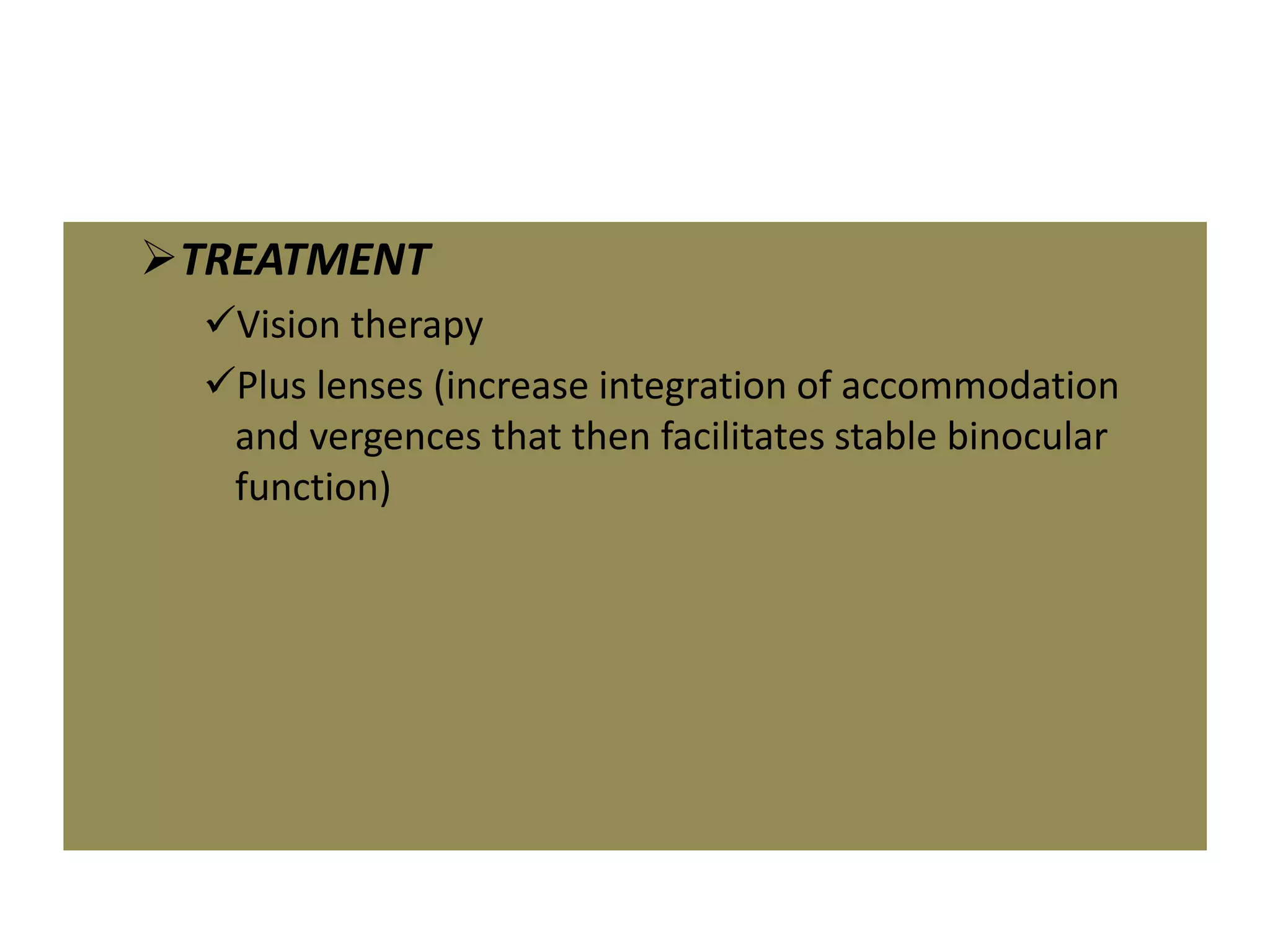
TREATMENT
Vision therapy
Plus lenses (increase integration of accommodation
and vergences that then facilitates stable binocular
function)
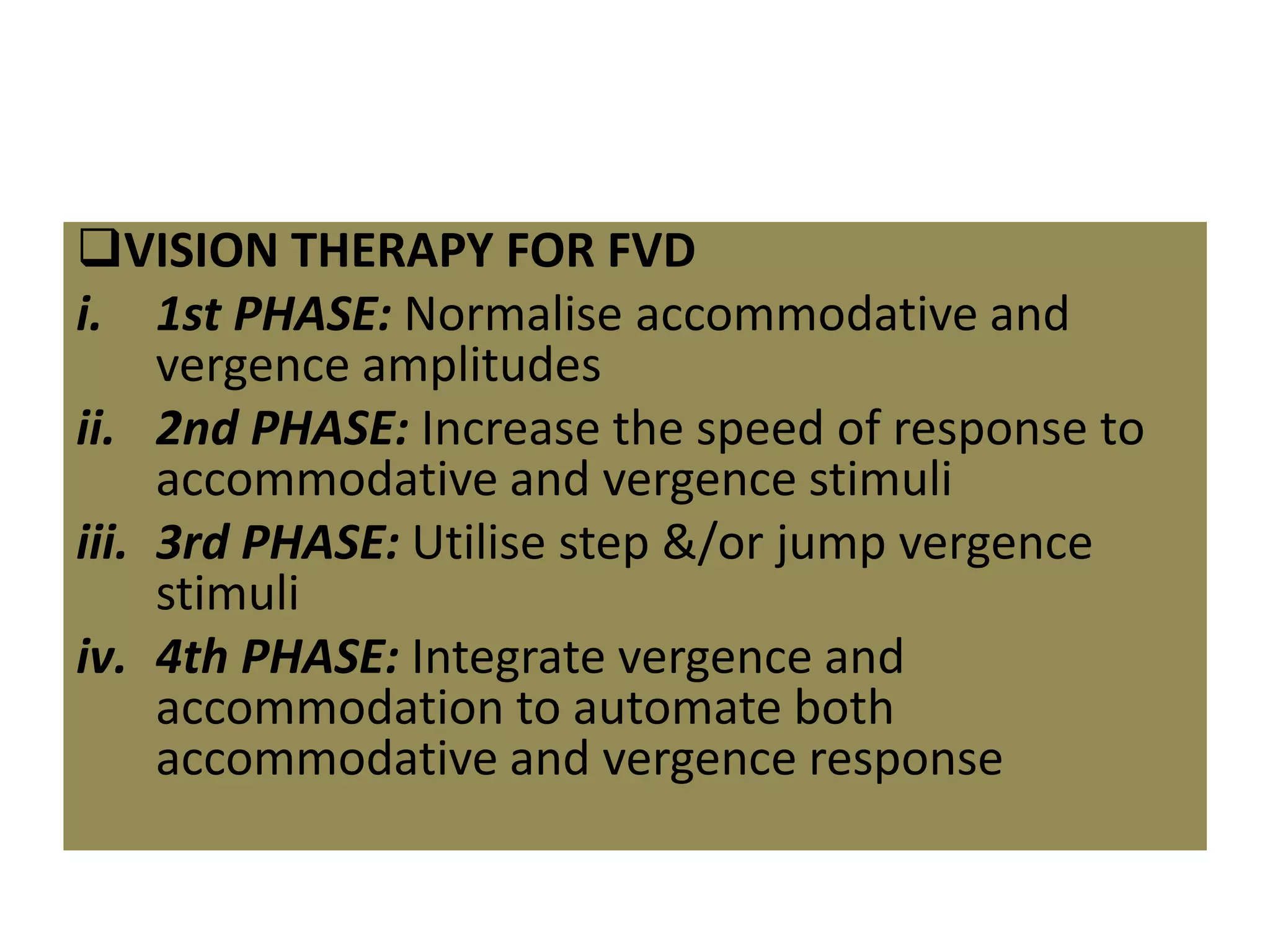
VISION THERAPY FOR FVD
i. 1st PHASE: Normalise accommodative and
vergence amplitudes
ii. 2nd PHASE: Increase the speed of response to
accommodative and vergence stimuli
iii. 3rd PHASE: Utilise step &/or jump vergence
stimuli
iv. 4th PHASE: Integrate vergence and
accommodation to automate both
accommodative and vergence response

CASE PRESENTATION BV