Download to read offline
![International Journal of Engineering and Technical Research (IJETR)
ISSN: 2321-0869, Volume-2, Issue-1, January 2014
48 www.erpublication.org
Abstract— Recently, renewable wind energy is enjoying a rapid
growth globally to become an important green electricity
source to replace polluting and exhausting fossil fuel. However,
Injection of the wind power into an electric grid affects the
power quality [1]. The paper study demonstrates the power
quality problem due to installation of wind turbine with the
grid and also investigations on an induction generator based
wind farm in combination with a STATCOM under
unbalanced load fault on grid is carried out on main line. A
STATCOM control structure with the capability to coordinate
the control between the positive and the negative sequence of
the grid voltage is proposed. The results clarify the effect of the
positive and the negative sequence voltage compensation by a
STATCOM on the operation of the induction generator based
wind farm [2]. The STATCOM control scheme for the grid
connected wind energy generation system for power quality
improvement is simulated using MATLAB/SIMULINK in
power system block set. Finally the proposed scheme is applied
for both balanced and unbalanced loads.
Index Terms — Power Quality, Wind Generating System
(WGS), Induction Generator, Low-Voltage Ride Through,
Statcom
I. INTRODUCTION
TO have sustainable growth and social progress, it is
necessary to meet the energy need by utilizing the renewable
energy resources like wind, biomass, hydro, co-generation,
etc. in sustainable energy system, energy conservation and
the use of renewable source are the key paradigm. The need
to integrate the renewable energy like wind energy into
power system is to make it possible to minimize the
environmental impact on conventional plant The
integration of wind energy into existing power system
presents a technical challenges and that requires
consideration of voltage regulation, stability, power quality
problems. The power quality is an essential customer-
focused measure and is greatly affected by the operation of a
distribution [3]
Permanent-magnet synchronous generator, a
non-negligible percentage of 15% of the operating wind
turbines in Europe in 2010 is still of the fixed-speed
induction generator (FSIG)-type directly connected to the
grid because this generator type cannot provide reactive
Manuscript received January 09, 2014
Balaji.K, Power System Engineering, Valliammai Engineering College,
Chennai, India, 9894341900
Madhusudanan.G, Electrical and Electronics Engineering, Valliammai
Engineering College, Chennai, India.
power control, it cannot fulfill the demanding grid code
requirements without additional devices. During voltage
dips, the induction Generators may consume a large amount
of reactive power as their speed deviates from the
synchronous speed, which can lead to a voltage collapse and
further fault propagation in the network. [2]
Today, more than 28 000 wind generating turbines are
successfully operating all over the world. In the fixed-speed
wind turbine operation, all the fluctuation in the wind speed
are transmitted as fluctuations in the mechanical torque,
electrical power on the grid and leads to large voltage
fluctuations. During the normal operation, wind turbine
produces a continuous variable output power. These power
variations are mainlycaused by the effect of turbulence, wind
shear, and tower-shadow and of control system in the power
system. Thus, the network needs to manage for such
fluctuations. The power quality issues can be viewed with
respect to the wind generation, transmission and distribution
network, such as voltage sag, swells, flickers, harmonic etc.
However the wind generator introduces disturbances into the
distribution network. One of the simple methods of running a
wind generating system is to use the induction generator
connected directly to the grid system. The induction
generator has inherent advantages of cost effectiveness and
robustness. However; induction generators require reactive
power for magnetization. When the generated active power
of an induction generator is varied due to wind, absorbed
reactive power and terminal voltage of an induction
generator can be significantly affected. A proper control
scheme in wind energy generation system is required under
normal operating condition to allow the proper control over
the active power production. In the event of increasing grid
disturbance, a battery energy storage system for wind energy
generating system is generally required to compensate the
fluctuation generated by wind turbine. A STATCOM based
control technology has been proposed for improving the
power qualitywhich can technicallymanages the power level
associates with the commercial wind turbines.
The proposed STATCOM control scheme for grid
connected wind energy generation for power quality
improvement has following objectives.
• Unity power factor at the source side.
• Reactive power support only from STATCOM to wind
Generator and Load.
• Simple bang-bang controller for STATCOM to achieve fast
dynamic response. [3]
Modelling and Performance Analysis of a Statcom
Control for Induction Generator Based Windfarm
under Unbalanced Loads
Balaji K , Madhusudanan G](https://image.slidesharecdn.com/ijetr021123-161122121829/85/Ijetr021123-1-320.jpg)
![International Journal of Engineering and Technical Research (IJETR)
ISSN: 2321-0869, Volume-2, Issue-1, January 2014
48 www.erpublication.org
Abstract— Recently, renewable wind energy is enjoying a rapid
growth globally to become an important green electricity
source to replace polluting and exhausting fossil fuel. However,
Injection of the wind power into an electric grid affects the
power quality [1]. The paper study demonstrates the power
quality problem due to installation of wind turbine with the
grid and also investigations on an induction generator based
wind farm in combination with a STATCOM under
unbalanced load fault on grid is carried out on main line. A
STATCOM control structure with the capability to coordinate
the control between the positive and the negative sequence of
the grid voltage is proposed. The results clarify the effect of the
positive and the negative sequence voltage compensation by a
STATCOM on the operation of the induction generator based
wind farm [2]. The STATCOM control scheme for the grid
connected wind energy generation system for power quality
improvement is simulated using MATLAB/SIMULINK in
power system block set. Finally the proposed scheme is applied
for both balanced and unbalanced loads.
Index Terms — Power Quality, Wind Generating System
(WGS), Induction Generator, Low-Voltage Ride Through,
Statcom
I. INTRODUCTION
TO have sustainable growth and social progress, it is
necessary to meet the energy need by utilizing the renewable
energy resources like wind, biomass, hydro, co-generation,
etc. in sustainable energy system, energy conservation and
the use of renewable source are the key paradigm. The need
to integrate the renewable energy like wind energy into
power system is to make it possible to minimize the
environmental impact on conventional plant The
integration of wind energy into existing power system
presents a technical challenges and that requires
consideration of voltage regulation, stability, power quality
problems. The power quality is an essential customer-
focused measure and is greatly affected by the operation of a
distribution [3]
Permanent-magnet synchronous generator, a
non-negligible percentage of 15% of the operating wind
turbines in Europe in 2010 is still of the fixed-speed
induction generator (FSIG)-type directly connected to the
grid because this generator type cannot provide reactive
Manuscript received January 09, 2014
Balaji.K, Power System Engineering, Valliammai Engineering College,
Chennai, India, 9894341900
Madhusudanan.G, Electrical and Electronics Engineering, Valliammai
Engineering College, Chennai, India.
power control, it cannot fulfill the demanding grid code
requirements without additional devices. During voltage
dips, the induction Generators may consume a large amount
of reactive power as their speed deviates from the
synchronous speed, which can lead to a voltage collapse and
further fault propagation in the network. [2]
Today, more than 28 000 wind generating turbines are
successfully operating all over the world. In the fixed-speed
wind turbine operation, all the fluctuation in the wind speed
are transmitted as fluctuations in the mechanical torque,
electrical power on the grid and leads to large voltage
fluctuations. During the normal operation, wind turbine
produces a continuous variable output power. These power
variations are mainlycaused by the effect of turbulence, wind
shear, and tower-shadow and of control system in the power
system. Thus, the network needs to manage for such
fluctuations. The power quality issues can be viewed with
respect to the wind generation, transmission and distribution
network, such as voltage sag, swells, flickers, harmonic etc.
However the wind generator introduces disturbances into the
distribution network. One of the simple methods of running a
wind generating system is to use the induction generator
connected directly to the grid system. The induction
generator has inherent advantages of cost effectiveness and
robustness. However; induction generators require reactive
power for magnetization. When the generated active power
of an induction generator is varied due to wind, absorbed
reactive power and terminal voltage of an induction
generator can be significantly affected. A proper control
scheme in wind energy generation system is required under
normal operating condition to allow the proper control over
the active power production. In the event of increasing grid
disturbance, a battery energy storage system for wind energy
generating system is generally required to compensate the
fluctuation generated by wind turbine. A STATCOM based
control technology has been proposed for improving the
power qualitywhich can technicallymanages the power level
associates with the commercial wind turbines.
The proposed STATCOM control scheme for grid
connected wind energy generation for power quality
improvement has following objectives.
• Unity power factor at the source side.
• Reactive power support only from STATCOM to wind
Generator and Load.
• Simple bang-bang controller for STATCOM to achieve fast
dynamic response. [3]
Modelling and Performance Analysis of a Statcom
Control for Induction Generator Based Windfarm
under Unbalanced Loads
Balaji K , Madhusudanan G](https://image.slidesharecdn.com/ijetr021123-161122121829/75/Ijetr021123-1-2048.jpg)
![Modelling and Performance Analysis of a Statcom Control for Induction Generator Based Windfarm Under
Unbalanced Loads
49 www.erpublication.org
This paper proposes the application of a statcom that is
connected to an FSIG-based wind farm and used to control
the positive- and the negative-sequence voltage during grid
faults. The novel contribution of this paper lies in the
coordination of the positive- and the negative-sequence
voltage control by the statcom and the related effect on the
wind turbine behavior. While the positive-sequence voltage
compensation leads to an increased voltage stability of the
wind farm, the negative sequence voltage compensation
leads to a reduction of torque ripple, increasing the lifetime
of the generator drive train. [2]
The paper is organized as fallows. The Section II
introduces the, issues and its consequences of wind energy
conversion model. The Section III introduces the induction
generator detailed model. The Section IV describes the
topology for. The Sections IV, V, VI describes the control
scheme, system performance and conclusion respectively.
This paper is structured as follows. The investigated power
system is described in Section II. An analysis of the power
quality issues in Section III is followed by the presentation of
the proposed statcom control structure in Section IV.
Simulation results are given in Section V. Under the
unbalanced grid voltage condition, the statcom is controlled
here to either compensate the positive- or the negative
sequence voltage.
II. WIND ENERGY CONVERSION MODEL
Fig 1. Detailed model of a single wind energy conversion system
A.Blade Model
The torque got from the turbine rotor is shown:
(1)
where ρis the air density:R is the wind turbine radius:
is the ratio of blade tip speed to wind speed
B.Hub Model
(Tae-Tlss ) (2)
Where Tae is the wind turbine torque; Tlss is the turbine
shaft torque; and Ta is the hub constant in [4].
III. POWER QUALITY ISSUES
A.Voltage fluctuation on grid:
The power fluctuation from wind turbine during
continuous operation causes voltage fluctuation on grid. The
amplitude of this fluctuation depends on grid strength,
network impedance, and phase angle and power factor [3].
The voltage fluctuation and flicker are caused due to
switching operation, pitch error, yaw error, fluctuation of
wind speed. Today, the measurement and assessment of
power quality on grid connected wind turbine is defined by
IEC 61400-21 and stated that the 10 minute average of
voltage fluctuation should be within +/- 5% of nominal value
B.Switching operation of wind turbine on the grid.
Switching operations of wind turbine generating system
can cause voltage fluctuations and thus voltage sag, voltage
swell that may cause significant voltage variation. The
acceptances of switching operation depend not only on grid
voltage but also on how often this may occur. The maximum
number of above specified switching operation within 10-
minute period and 2-hr period are defined in IEC 61400-3-7
Standard.
C.Voltage dips on the grid.
It is a sudden reduction of voltage to a value between
1% & 90 % of nominal value after a short period of time,
conventionally 1ms to 1 min.
D.Reactive Power
Traditional wind turbine is equipped with induction
generator. Induction Generator is preferred because they are
inexpensive, rugged and requires little maintenance.
Unfortunately induction generators require reactive power
from the grid to operate. The interactions between wind
turbine and power system network are important aspect of
wind generation system. When wind turbine is equipped with
an induction generator and fixed capacitor are used for
reactive compensation then the risk of self-excitation may
occur during off grid operation.
E.Harmonics
The harmonics distortion caused by non-linear load,
Saturation of magnetization of transformer and a distorted
line current. The current generated by such load interact with
power system impedance and gives rise to harmonics. The
effect of harmonics in the power system can lead to
degradation of power quality at the consumer‘s terminal,
increase of power losses, and malfunction in communication
system [16]
IV. STATCOM CONTROL STRUCTURE](https://image.slidesharecdn.com/ijetr021123-161122121829/85/Ijetr021123-2-320.jpg)
![International Journal of Engineering and Technical Research (IJETR)
ISSN: 2321-0869, Volume-2, Issue-1, January 2014
50 www.erpublication.org
STATCOM is a controlled reactive power source. It
provides the reactive power generation and absorption by
using a Voltage Source Converter (VSC).The active power
absorption or generation capability of the STATCOM is
normally used under special circumstances such as to
enhance the steady state and transient voltage control, and to
improve the sag elimination capability [5].
The Statcom control structure is based on a voltage
oriented vector control as usually applied to three phase grid
connected converters. It is a cascade control structure with
inner PI current controllers in a rotating dq reference frame
with grid voltage orientation. Resonant controllers tuned at
100 Hz in the same positive dq reference frame are added to
realize the negative sequence current control. Note, that the
control of the negative sequence currents can also be
performed in a negative rotating reference frame with PI
controllers, but by using resonant controllers in a positive
rotating reference frame there is no need for a sequence
separation of the currents.
The overall control structure is shown in Fig 2. Note that
a possible Statcom power circuit is shown here as a voltage
source converter connected to the grid byan LCL filter, while
the Statcom is modeled as a three phase controlled voltage
source in the simulations neglecting the switching behavior.
Fig.2 Proposed control structure of the Statcom to control the positive-
and the negative-sequence voltage independently.
The outer control loops are designed to control the DC
voltage and the positive and negative sequence of the voltage
at the connection point of the Statcom. Therefore a precise
sequence separation of the measured voltage into positive
and negative sequence components is necessary, which is
performed based on dual second order generalized
integrators. Using the sequence separation the positive and
negative sequence of the voltage appears as DC values and
can be controlled byPI controllers. To ensure a safe operation
of the Statcom within its current capability the current
references given by the four outer controllers must be limited
to the maximum statcom current. [6]
For the investigations under unbalanced grid fault
different control targets will be compared to clarify the effect
of positive or negative sequence voltage compensation on the
operation of the induction generators. The target of the first
method is to compensate the positive sequence voltage, while
the negative sequence voltage will remain unchanged. The
target of the second method is to eliminate the negative
sequence of the voltage, while the positive sequence voltage
will remain unchanged.
V. SIMULATION AND ANALYSIS
Fig.4 shows the complete MATLAB model of Wind
energy generating system along with STATCOM control
circuit. The power circuit as well as control system are
modeled using Power System Block Set and Simulink. The
grid source is represented by three phase AC source (wind
energy and ac supply are injected through grid by using
linear transformer).Three phase AC loads are connected at
the load end. STATCOM is connected in shunt and it
consists of PWM voltage source inverter circuit and a DC
capacitor connected at its DC bus. The three phase injected
current into the grid from STATCOM will cancel out the
distortion caused by the nonlinear load and wind generator.
The IGBT based three-phase inverter is connected to grid
through the
transformer.
Fig.4 MATLAB/SIMULINK Modeling Of Grid Connected WECS with
STATCOM Controller
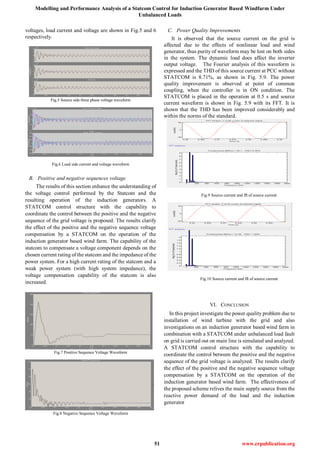
A. STATCOM –Performance Under Voltage Variations
The wind energy generating system is connected with
grid having the nonlinear load. The performance of the
system is measured byswitching the STACOM at time t=0.5s
in the system and how the STATCOM responds to the step
change command for increase in additional load at 1.0 s is
shown in the simulation. When STATCOM controller is
made ON, without change in any other load condition
parameters, it starts to mitigate for reactive demand as well
as harmonic current. The dynamic performance is also
carried out by step change in a load, when applied at 1.0 s.
This additional demand is fulfill by STATCOM
compensator. Thus, STATCOM can regulate the available
real power from source. The result of source side three phase](https://image.slidesharecdn.com/ijetr021123-161122121829/85/Ijetr021123-3-320.jpg)
![International Journal of Engineering and Technical Research (IJETR)
ISSN: 2321-0869, Volume-2, Issue-1, January 2014
52 www.erpublication.org
REFERENCES
[1] Chong Han, Alex Q. Huang, Wayne Litzenberger, Loren
Anderson, and Abdel-Aty Edris (2006), ‗STATCOM Impact
Study on the Integration of a Large Wind Farm into a Weak
Loop Power System,‘
[2] Christian Wessels, Nils Hoffmann, Marta Molinas, and
Friedrich Wilhelm Fuchs (2013), ‗Statcom Control at Wind
Farms With Fixed-Speed Induction Generators under
Asymmetrical Grid Faults, ‘Vol. 60, No. 7.
[3] Sharad W. Mohod (2010),‖ A STATCOM-Control Scheme
for Grid Connected Wind Energy System for Power Quality
Improvement, Vol.4, No. 3.
[4] Fengquan Zhou, Géza Joós, Senior, and Chad Abbey (2005),
‗Voltage Stability in Weak Connection Wind Farms, ‘Vol.05.
[5] Gishin Jacob George, Rakesh R., Dr. M. Kowsalya (2012),
‗Modeling of STATCOM under Different Loading
Conditions,‘Vol.12.
[6] Christian Wessels, Friedrich W.Fuchs and Marta
Molinas(2010), ‗Voltage Control of a Statcom at a Fixed
Speed Wind Farm under Unbalanced Grid Faults,‘
[7] Mahmood.H and Jiang.J, ‗Modeling and control system
design of a grid connected VSC considering the effect of the
interface transformer type,‘ IEEE Trans. Smart Grid, Vol. 3,
No. 1, pp. 122–134.
[8] Liserre.M, Cardenas.R, Molinas.M, and Rodriguez.J (2011),
‗Overview of multi-MW wind turbines and wind parks,‘ IEEE
Trans. Ind. Electron., Vol. 58, No. 4, pp. 1081–1095.
[9] Slepchenkov.M, Smedley.K, and Wen.J (2011),
‗Hexagram-converter-based statcom for voltage support in
fixed-speed wind turbine generation systems,‘IEEE Trans.
Ind. Electron., Vol. 58, No. 4, pp. 1120–1131.
[10] Hook.K.S, Liu.Y, and Atcitty.S (2006), ‗Mitigation of the
wind generation integration related power quality issues by
energy storage,‘EPQU J., Vol. 12, No. 2.
[11] M. Ali and B. Wu, ―Comparison of stabilization methods for
fixed speed wind generator systems,‖ IEEE Trans. Power
Del., vol. 25, no. 1, pp. 323–331, Jan. 2010.
[12] Tsili.M and Papathanassiou.S (2009), ‗A review of grid code
technical requirements for wind farms,‘ IET Renewable
Power Gener., Vol. 3, No. 3, pp. 308–332.
[13] Billinton.R and Gao.Y (2008), ‗Energy conversion system
models for adequacy assessment of generating systems
incorporating wind energy,‘IEEE Trans. on E.Conv. Vol. 23,
No. 1, pp. 163–169.
[14] Van Hulle.F and Fichaux.N (2010), ‗Powering Europe: Wind
energy and the electricity grid,‘ Eur. Wind Energy Assoc.,
Brussels, Belgium.
[15] BhimSingh S.S.Murthy and Sushma Gupta (2006),
‗STATCOM-Based Voltage Regulator for Self-Excited
Induction Generator Feeding Nonlinear Loads, ‘Vol. 53, No.
5.
[16] Sharad W. Mohod and Mohan Aware (2008), ‗Power Quality
Issues &It‘s Mitigation Technique in Wind Energy
Generation,‘Vol.4, No. 3, pp. 978-1-4244-1770-4.
Balaji.K, Power System Engineering, Valliammai Engineering College,
Chennai, India, 9894341900
Madhusudanan.G, Electrical and Electronics Engineering, Valliammai
Engineering College, Chennai, India.](https://image.slidesharecdn.com/ijetr021123-161122121829/85/Ijetr021123-5-320.jpg)

The document discusses the integration of renewable wind energy into the power grid, highlighting the power quality issues associated with the use of induction generators in wind farms under grid faults. It proposes a statcom control scheme aimed at improving power quality by coordinating positive and negative sequence voltage compensation during unbalanced loads. Simulations using MATLAB/Simulink demonstrate the effectiveness of this control structure in mitigating voltage fluctuations and improving overall power system performance.


