International Journal of Engineering and Technical Research (IJETR)
ISSN: 2321-0869 (O) 2454-4698 (P), Volume-5, Issue-3, July 2016
102 www.erpublication.org

Abstract— In all the machining operations, the quality of the
surface finish is one of the most important requirements for
many turned work pieces. Therefore cutting parameters must be
chosen and optimized in such a way that the required surface
quality can be attained. The focus of this experimental study is
to optimize the cutting parameters (feed rate, spindle speed) in
turning of EN8 & EN24 steel. In this, turning operation were
carried out on EN8 & EN24 steel by cemented carbide coated
tool insert in dry condition and the combination of the optimal
levels of the parameters was obtained. In study MRR &
Machining Time is also analyze by using Taguchi approach. In
order to study the performance characteristics in turning
operation the Signal-to-Noise ratio and Analysis of Variance
(ANOVA) were employed. Taguchi method has shown that feed
rate followed by Spindle speed was the combination of the
optimal levels of factors while turning the specimens by
cemented carbide coated tool insert of 0.8mm nose radii in dry
cutting condition. The results obtained by this method will be
useful to other research works for similar type of study for
further research on tool vibrations, cutting forces etc.
Index Terms— Material removal rate (MRR), surface
roughness (SR), Analysis of variance (ANOVA), American Iron
and Steel Institute (AISI), Orthogonal Array (OA)
I. INTRODUCTION
The determination of the machinability of materials is done
by the measure of surface finish. The surface roughness
greatly affects the functional performance of mechanical
parts such as wear resistance, fatigue strength, ability of
distributing and holding a lubricant, heat generation and
transmission, corrosion resistance, etc. Hence, the proper
selection of cutting tools and process parameters is essential
to achieve the desired quality of surface finish. Optimization
seeks to maximize the performance of a system, part or
component, while satisfying design constraints. The
Optimization of machining parameters increases the utility
for machining economics and the product quality increases to
a great extent as well. Since Turning is the primary operation
in most of the production process in the industry, surface
finish of turned components has greater influence on the
quality of the product. Surface finish in turning has been
found to be influenced in varying amounts by a number of
factors such as feed rate, work hardness, spindle speed, depth
of cut, tool insert. The three primary process parameters in
any basic Turning operation are speed, feed, and depth of cut.
Manu Garg, Research Scholar, Universal Institute of Engineering &
Technology, Lalru, Punjab (India)
Munish Kainth, Assistant Professor, Universal Institute of Engineering &
Technology, Lalru, Punjab (India)
Gaurav Grover, Assistant Professor, Universal Institute of Engineering
& Technology, Lalru, Punjab (India)
Speed always refers to the spindle and the work piece. Feed is
the rate at which the tool advances along its cutting path.
Depth of cut is the thickness of the material that is removed
by one pass of the cutting tool over the work piece. These
three variables are also effect the material removal rate and
machining time which are also considerable factors in
manufacturing processes.
So that, the process parameters need to be optimized to
obtain the maximum surface finish & material removal rate at
minimum machining time.
1.1 EN8 Material
EN8 is an unalloyed medium carbon steel with good tensile
strength. It is in cold drawn or as rolled. Tensile properties
can vary but are usually between 500-800 N/mm2.
Chemical composition of EN8
Carbon 0.36-0.44%
Silicon 0.10-0.40%
Manganese 0.60-1.00%
Sulphur 0.050 Max
Phosphorus 0.050 Max
1.2. EN24 Material
EN24 is a high quality, high tensile, alloy steel and combines,
high tensile strength good ductility, shock resistance and
resistance to wear. It is preferred to be applied for heat
treated components having large sections and subject to
exacting requirements EN24 is capable of retaining good
impact values at low temperatures.
Chemical composition of EN24
Carbon 0.36-0.44%
Silicon 0.10-0.35%
Manganese 0.45-0.70%
Sulphur 0.040 Max
Phosphorus 0.035 Max
Chromium 1.00-1.40%
Molybdenum 0.20-0.35%
Nickel 1.30-1.70%
II. LITERATURE REVIEW
Hari Singh et. al. (2006) [1] Optimized setting of turning
process parameters (cutting speed, feed rate and depth of cut)
resulting in an optimal value of the feed force when
Determination of Optimum Process Parameters during
turning on CNC Lathe of EN8 & EN24 Steels usingTaguchi
method andANOVA
Manu Garg, Munish Kainth, Gaurav Grover
Determination of Optimum Process Parameters during turning on CNC Lathe of EN8 & EN24 Steels using
Taguchi method and ANOVA
103 www.erpublication.org
machining EN24 steel with TiC-coated tungsten carbide
inserts. EN24 is a medium-carbon low-alloy steel and finds
its typical applications in the manufacturing of automobile
and machine tool parts. L27orthogonal array used for the
study. They found that the percent contributions of depth of
cut (55·15 %) and feed rate (23·33 %) in affecting the
variation of feed force are significantly larger as compared to
the contribution of the cutting speed (2·63 %).
M. Nalbant et. al. (2007) [2] have studied the performance
characteristics in turning processes of AISI 1030 steel bars
using TiN coated tools by taking into account the
signal-to-noise ratio, orthogonal array, and annova. Three
variables named as nose radius, depth of cut and feed rate
were taken for optimizing the surface roughness. L9
orthogonal array was used by them for the study. They found
the percent of contributions of feed rate, insert radius and
D.O.C. for surface roughness to be 48.54, 46.95 and 3.39,
respectively.
Birhan Isik (2008) [3] Has worked on the turning operation
on reinforced glass fiber plastics (GFRP) on CNC turning
machine with CERMET cutting tool insert. Cutting
parameters (depth of cut, cutting speed and implement
geometry) and the resulting cutting forces have highly
influence on the machinability surface roughness of one
directional glass-fiber reinforced plastic composite. Result
says that the surface roughness reduces with the increase in
cutting speed. The surface roughness reduces with the
increase of implement radius and cutting speed. The surface
finish increases with the increase of rake angle and victual
rate. An increase in cutting depth does not have a
consequential reaction on the surface roughness.
Sahoo et al. (2008) [4] Reviewed for optimization of
machining variables combinations emphasizing on fractal
features of surface profile produced in CNC turning
operation. The method used L27 Taguchi Orthogonal Array
design with machining parameters: feed, spindle speed and
depth of cut on three different materials viz. mild steel,
alluminium and brass. It was opted that feed rate was much
expressive surface finish in all three materials.
Aman Aggarwal et. al. (2008) [5] suggested that there are a
number of parameters like depth of cut, feed rate, cutting
speed, nose radius and cutting environment which effects in
power consumption in CNC turning of AISI P-20 tool steel.
They used L27 orthogonal array and face cantered central
composite design conducting the experiments and utilized
Design of investigation method, response surface
methodology (RSM) and Taguchi’s technique in analyzing
the data. The cryogenic environment emerges to be the most
significant factor in minimizing power consumption followed
by depth of cut and cutting speed as shown by the 3D surface
plots of RSM as well as by Taguchi’s technique.
Anirban Bhattacharya et al. (2009) [6] have carried out the
result of cutting variables on surface finish and power
consumption during high speed machining of steel (AISI
1045) using Taguchi design and ANOVA. The result showed
a remarkable effect of cutting speed on power consumption
and surface roughness, while the other parameters have not
substantially affected the response.
Bhateja et al. (2011) [7] the first aim of this paper is
selection of cutting tool material & geometry & work tool
material, selection of various process and performance
parameters after parameter selection objectives to study
various methods for the investigation for that motive
literature review and industrial survey is obtained. The
machining parameters and process for the performance
characteristics of turning operation on CNC using different
types of grades of Tungsten Carbide tool and with varying
properties & surface roughness testing of work piece material
to be accomplish after machining. After carrying out
optimization and compare the result of cutting variables on
surface roughness of dissimilar chosen geometry on EN-24
alloy steel by applying empirical method i.e. Taguchi
Analysis appling Statistical Software.
Marinkovic Velibor and Madic Milos (2011) [8] presents
the Taguchi robust parameter design for optimization and
modeling of surface roughness single-point turning of cold
rolled alloy steel 42CrMo4/AISI 4140 using TiN-coated
tungsten carbide inserts was introduced. Three cutting
variables, the cutting speed (80, 110, 140 m/min), the depth
of cut (0.5, 1.25, 2 mm) and the feed rate (0.071, 0.196, 0.321
mm/rev), were used in the experiment. Each of the additional
parameters was chosen as constant. The normal surface
roughness (Ra) was taken as a measure of surface quality.
The experiment was planned and accomplished by applying
standard L27 Taguchi orthogonal array. The surface
roughness was extremely influenced by cutting speed. The
effect of feed rate was slightly smaller, whereas the effect of
depth of cut was least marked. On the other hand, in
qualitative terms, the influence of feed rate and depth of cut
on the surface quality was dissimilar in relation to cutting
speed. In fact, whereas the variation of cutting speed results
better surface quality, the rise in feed rate and depth of cut led
to the reduction of surface quality.
Ilhan Asilturk et. al.(2011) [9] investigated the effects of
process parameters like cutting speed, depth of cut and feed
on Surface roughness (Ra and Rz) in turning of AISI 4140
with coated carbide cutting tools. They used L9 orthogonal
array of the Taguchi method for the optimization of surface
roughness and used nine experimental runs. It's been seen
that the feed rate has the most effect on Ra and Rz. A model is
developed that can be used in order to determine the optimum
cutting parameters for minimum surface roughness in the
metal machining industries.
R S Pawade et. al. (2011) [10] has found that analysis of AE
Signal during the machining could help to obtain the quality
of the machined surface finish. Frequency amplitude of the
AE signal is influenced by the cutting speed. The edge
geometry and feed rate are found to affect the number of
count generated during machining deformation.
III. EXPERIMENTATION
To determine the effects of different process variables such
as spindle speed and feed rate on the surface roughness of the
turned specimen (EN8 & EN24). The specimen is turned
International Journal of Engineering and Technical Research (IJETR)
ISSN: 2321-0869 (O) 2454-4698 (P), Volume-5, Issue-3, July 2016
104 www.erpublication.org
according to L9 (OA), and after turning the surface
roughness is tested on MOTUTOYO SURFTEST-4
available at R&D CENTER FOR BICYCLE & SEWING
MACHINE, LUDHIANA. The work piece was turned by
cemented carbide tool insert with 0.8 mm nose radii under
dry cutting condition.
The values of different process parameters are as follow:
(Depth of cut is constant in all sets of parameters as 1mm.
TABLE 2: DETAILS OF THE TURNING OPERATION
Factors Level 1 Level 2 Level 3
Feed (mm/rev) 0.1 0.15 0.20
Spindle Speed (rpm) 1000 1500 1800
In this experiment, the assignment of factors was carried out
using MINITAB 15 Software. Using the L9 orthogonal array
have been conducted on CNC Lathe Machine for turning
operations.
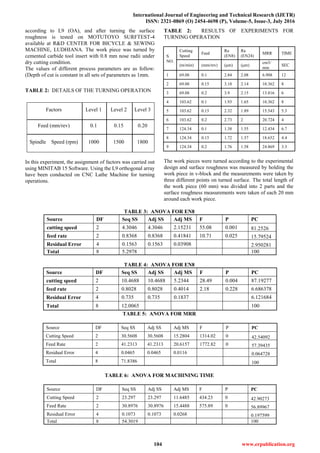
TABLE 2: RESULTS OF EXPERIMENTS FOR
TURNING OPERATION
S.
NO.
Cutting
Speed
Feed
Ra
(EN8)
Ra
(EN24)
MRR TIME
(m/min) (mm/rev) (μm) (μm)
cm3/
min
SEC
1 69.08 0.1 2.84 2.08 6.908 12
2 69.08 0.15 3.18 2.14 10.362 8
3 69.08 0.2 3.9 2.15 13.816 6
4 103.62 0.1 1.93 1.65 10.362 8
5 103.62 0.15 2.32 1.89 15.543 5.3
6 103.62 0.2 2.73 2 20.724 4
7 124.34 0.1 1.38 1.55 12.434 6.7
8 124.34 0.15 1.72 1.57 18.652 4.4
9 124.34 0.2 1.76 1.58 24.869 3.3
The work pieces were turned according to the experimental
design and surface roughness was measured by holding the
work piece in v-block and the measurements were taken by
three different points on turned surface. The total length of
the work piece (60 mm) was divided into 2 parts and the
surface roughness measurements were taken of each 20 mm
around each work piece.
TABLE 3: ANOVA FOR EN8
Source DF Seq SS Adj SS Adj MS F P PC
cutting speed 2 4.3046 4.3046 2.15231 55.08 0.001 81.2526
feed rate 2 0.8368 0.8368 0.41841 10.71 0.025 15.79524
Residual Error 4 0.1563 0.1563 0.03908 2.950281
Total 8 5.2978 100
TABLE 4: ANOVA FOR EN8
Source DF Seq SS Adj SS Adj MS F P PC
cutting speed 2 10.4688 10.4688 5.2344 28.49 0.004 87.19277
feed rate 2 0.8028 0.8028 0.4014 2.18 0.228 6.686378
Residual Error 4 0.735 0.735 0.1837 6.121684
Total 8 12.0065 100
TABLE 5: ANOVA FOR MRR
Source DF Seq SS Adj SS Adj MS F P PC
Cutting Speed 2 30.5608 30.5608 15.2804 1314.02 0 42.54092
Feed Rate 2 41.2313 41.2313 20.6157 1772.82 0 57.39435
Residual Error 4 0.0465 0.0465 0.0116 0.064728
Total 8 71.8386 100
TABLE 6: ANOVA FOR MACHINING TIME
Source DF Seq SS Adj SS Adj MS F P PC
Cutting Speed 2 23.297 23.297 11.6485 434.23 0 42.90273
Feed Rate 2 30.8976 30.8976 15.4488 575.89 0 56.89967
Residual Error 4 0.1073 0.1073 0.0268 0.197599
Total 8 54.3019 100
Determination of Optimum Process Parameters during turning on CNC Lathe of EN8 & EN24 Steels using
Taguchi method and ANOVA
105 www.erpublication.org
The present study used ANOVA to determine the optimum
combination of process parameters more accurately by
investigating the relative importance of process parameters
(Ross, 1996). Table 5.1 & 5.2 presents the results of ANOVA
for surface roughness (Ra). It is observed from the ANOVA
table, the cutting speed (81.25 %) for EN8 & (87.19%) for
EN24 is the most significant parameter followed by feed
(15.79%) for EN8 & (6.68%) for EN24 in controlling the
surface roughness. Statistically, F-test decides whether the
parameters are significantly different. A larger F value shows
the greater impact on the machining performance
characteristics (Ross, 1996). Larger F-values are observed
for feed as 10.71 for EN8 & 2.18 for EN24 and cutting speed
as 55.08 for EN8 & 28.49 for EN24 As seen from the
ANOVA table 5, the influence of the feed rate (57.39%) in
affecting material removal rate (MRR) is significantly large.
However, the cutting speed has optimum effect of (42.54%)
in producing MRR. The influence of the feed rate (56.89%)
in affecting machining time is significantly same as (MRR).
However, the cutting speed has also effect of (42.90%) on
machining time. It is also observed that there is also error
contribution (2.9502% for surface roughness, 0.0647% for
MRR & 0.1975% for machining time). It indicates the
absence of the interaction effects of process parameters. In
other words, interaction effects are not much negligible for
minimizing surface roughness, machining time and
maximizing MRR.
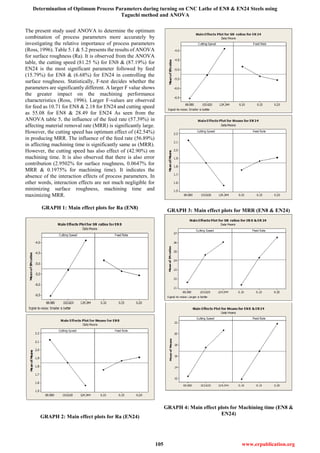
GRAPH 1: Main effect plots for Ra (EN8)
GRAPH 2: Main effect plots for Ra (EN24)
GRAPH 3: Main effect plots for MRR (EN8 & EN24)
GRAPH 4: Main effect plots for Machining time (EN8 &
EN24)
International Journal of Engineering and Technical Research (IJETR)
ISSN: 2321-0869 (O) 2454-4698 (P), Volume-5, Issue-3, July 2016
106 www.erpublication.org
The main effects plot for Ra of EN8 & EN24 (Graph: 1&2)
shows that the surface roughness first decreases sharply with
the increase in cutting speed, the surface roughness value
decreases. With increase in feed rate, the surface roughness
value increases. The surface roughness is “lower the better”
type of quality characteristic. So the optimal factor/level
combination is third level of cutting speed and first level of
feed rate. So it is prescribed that cutting speed (124.344
m/min.) and feed rate of (0.10mm/rev.) produces lower
surface roughness. S/N ratios plot is “larger the better” type
of quality characteristic. So the optimal factor/level
combination is third level of cutting speed and first level of
feed rate. So it is optimized by S/N Ratio plot that cutting
speed (124.344 m/min.) and feed rate of (0.10mm/rev.)
produces lower surface roughness.
Graph: 3 Shows that the MRR first increases sharply with
the increase in cutting speed, the MRR value increases. With
increase in feed rate, the MRR value also increases. The
MRR is “larger the better” type of quality characteristic. So
the optimal factor/level combination is third level of cutting
speed and third level of feed rate. So it is prescribed that
cutting speed (124.344 m/min.) and feed rate of (0.2mm/rev.)
produces higher MRR. S/N ratios plot is always “higher the
better” type of quality characteristic. So the optimal
factor/level combination is third level of cutting speed and
third level of feed rate. So it is optimized that cutting speed
(124.344 m/min.) and feed rate of (0.2mm/rev.) gives
maximum material removal rate.
Graph: 4 shows that the machining time first decreases
sharply with the increase in cutting speed, the machining time
value decreases. With increase in feed rate, the machining
time rate value also decreases. The machining time is “lower
the better” type of quality characteristic. So the optimal
factor/level combination is third level of cutting speed and
third level of feed rate. So it is prescribed that cutting speed
(124.344 m/min.) and feed rate of (0.2mm/rev.) takes lower
machining time. S/N ratios plot is always “higher the better”
type of quality characteristic. So the optimal factor/level
combination is third level of cutting speed and third level of
feed rate. So it is prescribed that cutting speed (124.344
m/min.) and feed rate of (0.2mm/rev.) takes lower machining
time.
IV. CONCLUSION
1. The percentage contribution of input parameters on
Surface Roughness (Ra) for EN8 is: Cutting speed = 81.25%,
Feed rate = 15.79% and RE = 2.950%, signifying the cutting
speed to be the most contributing factor influencing Surface
Roughness.
2. The percentage contribution of input parameters on
Surface Roughness (Ra) for EN8 is: Cutting speed = 87.19%,
Feed rate = 6.68% and RE = 6.121%, signifying the cutting
speed to be the most contributing factor influencing Surface
Roughness.
3. The percentage contribution of input parameters on
Material Removal Rate (MRR) is: Speed = 42.54%, Feed
rate = 57.39% and RE = 0.064%, signifying the feed rate to
be the most contributing factor influencing MRR.
4. The percentage contribution of input parameters on
Machining Time is: Speed = 42.90%, Feed rate = 56.89%
and RE = 0.197%, signifying the feed rate to be the most
contributing factor influencing Machining Time.
5. The optimized machining conditions for minimizing
Surface Roughness from Taguchi analysis are approaching:
cutting speed 125 m/min., feed 0.1 mm/rev.
6. The optimized machining conditions for maximizing
Material Removal rate from Taguchi analysis are
approaching: cutting speed 125 m/min., feed 0.2 mm/rev.
7. The optimized machining conditions for minimizing
Machining Time from Taguchi analysis are approaching:
cutting speed 125 m/min., feed 0.2 mm/rev.
REFERENCES
[1] Hari Singh & Pradeep Kumar, “Optimizing feed force for turned parts
through the Taguchi technique”,SadhanaVol. 31, Part 6, pp.
671–681, 2006
[2] M. Nalbant, H. Go¨kkaya, G. Sur, “Application of Taguchi method in
the investigation of cutting variables for surface finish in turning”,
Elsevier Journal, Materials and Design, 28, 2007, 1379–1385
[3] Birhan Isik,“Experimental optimization of surface roughness in
orthogonal turning of one directional glass-fiber reinforced plastic
composites”, International Journal Advance Manufacturing
Technology, 37:42-48,2008.
[4] Sahoo P, Routara B C and Barman T K , “Taguchi depended Practical
Dimension Modelling and Experimentation in CNC Turning”,
Advance in Manufacturing Engineering and Management, Vol. 3,
No. 4, pp. 205-217, 2008.
[5] A. Aggarwal, H. Singh, M. Singh, , P. Kumar “Optimizing power
consumption for CNC turned parts using response surface
methodology and Taguchi’s method- A comparative analysis”,
Elsevier Journal, Journal of materials processing technology, 2008.
[6] Anirban Bhattacharya, Santanu Das , Ajay Batish and Majumder P,
“Estimating the impact of Cutting variables on power Consumption
and Surface Finish During High Speed Machining of Steel (AISI
1045) Using Taguchi Design and ANOVA”, Prod. Eng. Res. Devel.,
Vol. 3, pp. 31-40, 2009.
[7] Bhateja, A. K., Babbar, R., Singh, S., and Sachdeva, A.,
“Research of green supply chain management in the Indian
manufacturing industries: A literature review cum an analytical
Determination of Optimum Process Parameters during turning on CNC Lathe of EN8 & EN24 Steels using
Taguchi method and ANOVA
107 www.erpublication.org
approach for the measurement of performance”, International
Journal of Computational Engineering & Management, ISSN ,
Online: 2230-7893, 13, 84-99, 2011
[8] Marinkovic Velibor & Madic Milos, “Optimization of surface
roughness in turning alloy steel by using Taguchi method”, Scientific
Research and Essays Vol. 6(16), pp. 3474-3484, 19 August, 2011;
Available online at http://www.academicjournals.org/SRE ISSN
1992-2248 ©2011 Academic Journals.
[9] IlhanAsilturk, &HarunAkkus, “Determining the effect of cutting
parameters on surface oughness in hard turning using the Taguchi
method”, Elsevier Journal, Measurement 44, pp.1697–1704, 2011
[10] R S Pawade, S S Joshi, “Analysis of acoustic emission signals and
surface integrity in the high speed turning of inconel 718” Journal of
Engineering Manufacture Sage Journal. 2011.
[11] Suleiman Abdulkareem, Usman Jibrin Rumah&ApasiAdaokoma,
“Optimizing Machining Parameters during Turning Process”,
International Journal of Integrate"d Engineering, Vol. 3 No. 1, pp.
23-27, 2011.
[12] Poornima, Sukumar, “Optimization of machining variables in CNC
turning of martensitic stainless steel using RSM and GA”,
International journal of modern engineering research (IJMER), 2:
539-542,2012.
[13] Mustafa Gunaya and Emre Yucel “Application of Taguchi Method for
Determining perfect Surface Roughness using Turning of High-Alloy
White Cast Iron”, Elsevier Measurement, 2012
[14] M. Kaladhar, Ch. Shrinivasa Rao, K. Venkata Subbaiah
“Determination of Optimum Process variables during turning of AISI
304 Austenitic Stainless Steels using ANOVA and Taguchi method”,
International Journal of Lean Thinking, 3(1), 2012
[15] JitendraVerma, LokeshBajpai and Pankaj Agrawal, “Turning
variables Optimization for Surface finish of ASTM A242 type-1
Alloys Steel by Taguchi Method”, International Journal of Advances
in Engineering & Technology field, March 2012.
[16] L B Abhang and M Hameedullah, “Investigation of Machining
variables in Steel Turning Process by Taguchi Method”, Procedia
Engineering 38, 2012.
[17] Ashish Kabra, Amit Agarwal, Ajay Bangar, Sanjay Goyal, Vikas
Agarwal, “Parametric Analysis & Modeling for Surface Roughness
(Ra), Feed and Radial Force of EN-19/ANSI-4140 Steel in CNC
Turning Using Taguchi method and Regression Analysis Method”,
International Journal of Engineering Research & Applications
(IJERA) ISSN: 2248-9622” 2012.
[18] Rahul Davis, Jitendra Singh Madhukar, Vikash Singh Rana, Prince
Singh “Optimization of Cutting Parameters in Dry Turning Operation
of EN24 Steel, International Journal of Emerging and Advanced
Technology”, Vol.2, Issue.10, pp.559-563, 2012.
[19] Ishan B Shah, Kishore. R. Gawande,‟Optimization of Cutting Tool
Life on CNC Milling Machine Through Design Of Testing’s-A
Suitable Approach – An overview‟, International Journal of
Engineering and Advanced Technology (IJEAT) Volume-1,
Issue-4,2012.
[20] Tonk, R., and Ratol, J. S. “Investigation of the Effects of the Factor’s
Variations in Turning Process of En31 Alloy” International Journal on
Emerging Technologies,2012.
[21] P. J. Prashant, B. R. Jadhav, “Determination of Surface Roughness
(Ra) of Alloy Steel by Changing cutting variables and Insert Geometry
in The Turning operation”, International Journal of Advanced
Engineering Research & Studies, II/ IV, 2013.
[22] R Ashok Raj, T Parun, K Sivaraj and T T M Kannan “Optimization on
Milling Parameters of EN8 Using Taguchi Methodology‟,
International Journal of Emerging and Robotics Research, Vol. 2, No.
1, January 2013

Ijetr042192

  • 1.
    International Journal ofEngineering and Technical Research (IJETR) ISSN: 2321-0869 (O) 2454-4698 (P), Volume-5, Issue-3, July 2016 102 www.erpublication.org  Abstract— In all the machining operations, the quality of the surface finish is one of the most important requirements for many turned work pieces. Therefore cutting parameters must be chosen and optimized in such a way that the required surface quality can be attained. The focus of this experimental study is to optimize the cutting parameters (feed rate, spindle speed) in turning of EN8 & EN24 steel. In this, turning operation were carried out on EN8 & EN24 steel by cemented carbide coated tool insert in dry condition and the combination of the optimal levels of the parameters was obtained. In study MRR & Machining Time is also analyze by using Taguchi approach. In order to study the performance characteristics in turning operation the Signal-to-Noise ratio and Analysis of Variance (ANOVA) were employed. Taguchi method has shown that feed rate followed by Spindle speed was the combination of the optimal levels of factors while turning the specimens by cemented carbide coated tool insert of 0.8mm nose radii in dry cutting condition. The results obtained by this method will be useful to other research works for similar type of study for further research on tool vibrations, cutting forces etc. Index Terms— Material removal rate (MRR), surface roughness (SR), Analysis of variance (ANOVA), American Iron and Steel Institute (AISI), Orthogonal Array (OA) I. INTRODUCTION The determination of the machinability of materials is done by the measure of surface finish. The surface roughness greatly affects the functional performance of mechanical parts such as wear resistance, fatigue strength, ability of distributing and holding a lubricant, heat generation and transmission, corrosion resistance, etc. Hence, the proper selection of cutting tools and process parameters is essential to achieve the desired quality of surface finish. Optimization seeks to maximize the performance of a system, part or component, while satisfying design constraints. The Optimization of machining parameters increases the utility for machining economics and the product quality increases to a great extent as well. Since Turning is the primary operation in most of the production process in the industry, surface finish of turned components has greater influence on the quality of the product. Surface finish in turning has been found to be influenced in varying amounts by a number of factors such as feed rate, work hardness, spindle speed, depth of cut, tool insert. The three primary process parameters in any basic Turning operation are speed, feed, and depth of cut. Manu Garg, Research Scholar, Universal Institute of Engineering & Technology, Lalru, Punjab (India) Munish Kainth, Assistant Professor, Universal Institute of Engineering & Technology, Lalru, Punjab (India) Gaurav Grover, Assistant Professor, Universal Institute of Engineering & Technology, Lalru, Punjab (India) Speed always refers to the spindle and the work piece. Feed is the rate at which the tool advances along its cutting path. Depth of cut is the thickness of the material that is removed by one pass of the cutting tool over the work piece. These three variables are also effect the material removal rate and machining time which are also considerable factors in manufacturing processes. So that, the process parameters need to be optimized to obtain the maximum surface finish & material removal rate at minimum machining time. 1.1 EN8 Material EN8 is an unalloyed medium carbon steel with good tensile strength. It is in cold drawn or as rolled. Tensile properties can vary but are usually between 500-800 N/mm2. Chemical composition of EN8 Carbon 0.36-0.44% Silicon 0.10-0.40% Manganese 0.60-1.00% Sulphur 0.050 Max Phosphorus 0.050 Max 1.2. EN24 Material EN24 is a high quality, high tensile, alloy steel and combines, high tensile strength good ductility, shock resistance and resistance to wear. It is preferred to be applied for heat treated components having large sections and subject to exacting requirements EN24 is capable of retaining good impact values at low temperatures. Chemical composition of EN24 Carbon 0.36-0.44% Silicon 0.10-0.35% Manganese 0.45-0.70% Sulphur 0.040 Max Phosphorus 0.035 Max Chromium 1.00-1.40% Molybdenum 0.20-0.35% Nickel 1.30-1.70% II. LITERATURE REVIEW Hari Singh et. al. (2006) [1] Optimized setting of turning process parameters (cutting speed, feed rate and depth of cut) resulting in an optimal value of the feed force when Determination of Optimum Process Parameters during turning on CNC Lathe of EN8 & EN24 Steels usingTaguchi method andANOVA Manu Garg, Munish Kainth, Gaurav Grover
  • 2.
    Determination of OptimumProcess Parameters during turning on CNC Lathe of EN8 & EN24 Steels using Taguchi method and ANOVA 103 www.erpublication.org machining EN24 steel with TiC-coated tungsten carbide inserts. EN24 is a medium-carbon low-alloy steel and finds its typical applications in the manufacturing of automobile and machine tool parts. L27orthogonal array used for the study. They found that the percent contributions of depth of cut (55·15 %) and feed rate (23·33 %) in affecting the variation of feed force are significantly larger as compared to the contribution of the cutting speed (2·63 %). M. Nalbant et. al. (2007) [2] have studied the performance characteristics in turning processes of AISI 1030 steel bars using TiN coated tools by taking into account the signal-to-noise ratio, orthogonal array, and annova. Three variables named as nose radius, depth of cut and feed rate were taken for optimizing the surface roughness. L9 orthogonal array was used by them for the study. They found the percent of contributions of feed rate, insert radius and D.O.C. for surface roughness to be 48.54, 46.95 and 3.39, respectively. Birhan Isik (2008) [3] Has worked on the turning operation on reinforced glass fiber plastics (GFRP) on CNC turning machine with CERMET cutting tool insert. Cutting parameters (depth of cut, cutting speed and implement geometry) and the resulting cutting forces have highly influence on the machinability surface roughness of one directional glass-fiber reinforced plastic composite. Result says that the surface roughness reduces with the increase in cutting speed. The surface roughness reduces with the increase of implement radius and cutting speed. The surface finish increases with the increase of rake angle and victual rate. An increase in cutting depth does not have a consequential reaction on the surface roughness. Sahoo et al. (2008) [4] Reviewed for optimization of machining variables combinations emphasizing on fractal features of surface profile produced in CNC turning operation. The method used L27 Taguchi Orthogonal Array design with machining parameters: feed, spindle speed and depth of cut on three different materials viz. mild steel, alluminium and brass. It was opted that feed rate was much expressive surface finish in all three materials. Aman Aggarwal et. al. (2008) [5] suggested that there are a number of parameters like depth of cut, feed rate, cutting speed, nose radius and cutting environment which effects in power consumption in CNC turning of AISI P-20 tool steel. They used L27 orthogonal array and face cantered central composite design conducting the experiments and utilized Design of investigation method, response surface methodology (RSM) and Taguchi’s technique in analyzing the data. The cryogenic environment emerges to be the most significant factor in minimizing power consumption followed by depth of cut and cutting speed as shown by the 3D surface plots of RSM as well as by Taguchi’s technique. Anirban Bhattacharya et al. (2009) [6] have carried out the result of cutting variables on surface finish and power consumption during high speed machining of steel (AISI 1045) using Taguchi design and ANOVA. The result showed a remarkable effect of cutting speed on power consumption and surface roughness, while the other parameters have not substantially affected the response. Bhateja et al. (2011) [7] the first aim of this paper is selection of cutting tool material & geometry & work tool material, selection of various process and performance parameters after parameter selection objectives to study various methods for the investigation for that motive literature review and industrial survey is obtained. The machining parameters and process for the performance characteristics of turning operation on CNC using different types of grades of Tungsten Carbide tool and with varying properties & surface roughness testing of work piece material to be accomplish after machining. After carrying out optimization and compare the result of cutting variables on surface roughness of dissimilar chosen geometry on EN-24 alloy steel by applying empirical method i.e. Taguchi Analysis appling Statistical Software. Marinkovic Velibor and Madic Milos (2011) [8] presents the Taguchi robust parameter design for optimization and modeling of surface roughness single-point turning of cold rolled alloy steel 42CrMo4/AISI 4140 using TiN-coated tungsten carbide inserts was introduced. Three cutting variables, the cutting speed (80, 110, 140 m/min), the depth of cut (0.5, 1.25, 2 mm) and the feed rate (0.071, 0.196, 0.321 mm/rev), were used in the experiment. Each of the additional parameters was chosen as constant. The normal surface roughness (Ra) was taken as a measure of surface quality. The experiment was planned and accomplished by applying standard L27 Taguchi orthogonal array. The surface roughness was extremely influenced by cutting speed. The effect of feed rate was slightly smaller, whereas the effect of depth of cut was least marked. On the other hand, in qualitative terms, the influence of feed rate and depth of cut on the surface quality was dissimilar in relation to cutting speed. In fact, whereas the variation of cutting speed results better surface quality, the rise in feed rate and depth of cut led to the reduction of surface quality. Ilhan Asilturk et. al.(2011) [9] investigated the effects of process parameters like cutting speed, depth of cut and feed on Surface roughness (Ra and Rz) in turning of AISI 4140 with coated carbide cutting tools. They used L9 orthogonal array of the Taguchi method for the optimization of surface roughness and used nine experimental runs. It's been seen that the feed rate has the most effect on Ra and Rz. A model is developed that can be used in order to determine the optimum cutting parameters for minimum surface roughness in the metal machining industries. R S Pawade et. al. (2011) [10] has found that analysis of AE Signal during the machining could help to obtain the quality of the machined surface finish. Frequency amplitude of the AE signal is influenced by the cutting speed. The edge geometry and feed rate are found to affect the number of count generated during machining deformation. III. EXPERIMENTATION To determine the effects of different process variables such as spindle speed and feed rate on the surface roughness of the turned specimen (EN8 & EN24). The specimen is turned
  • 3.
    International Journal ofEngineering and Technical Research (IJETR) ISSN: 2321-0869 (O) 2454-4698 (P), Volume-5, Issue-3, July 2016 104 www.erpublication.org according to L9 (OA), and after turning the surface roughness is tested on MOTUTOYO SURFTEST-4 available at R&D CENTER FOR BICYCLE & SEWING MACHINE, LUDHIANA. The work piece was turned by cemented carbide tool insert with 0.8 mm nose radii under dry cutting condition. The values of different process parameters are as follow: (Depth of cut is constant in all sets of parameters as 1mm. TABLE 2: DETAILS OF THE TURNING OPERATION Factors Level 1 Level 2 Level 3 Feed (mm/rev) 0.1 0.15 0.20 Spindle Speed (rpm) 1000 1500 1800 In this experiment, the assignment of factors was carried out using MINITAB 15 Software. Using the L9 orthogonal array have been conducted on CNC Lathe Machine for turning operations. TABLE 2: RESULTS OF EXPERIMENTS FOR TURNING OPERATION S. NO. Cutting Speed Feed Ra (EN8) Ra (EN24) MRR TIME (m/min) (mm/rev) (μm) (μm) cm3/ min SEC 1 69.08 0.1 2.84 2.08 6.908 12 2 69.08 0.15 3.18 2.14 10.362 8 3 69.08 0.2 3.9 2.15 13.816 6 4 103.62 0.1 1.93 1.65 10.362 8 5 103.62 0.15 2.32 1.89 15.543 5.3 6 103.62 0.2 2.73 2 20.724 4 7 124.34 0.1 1.38 1.55 12.434 6.7 8 124.34 0.15 1.72 1.57 18.652 4.4 9 124.34 0.2 1.76 1.58 24.869 3.3 The work pieces were turned according to the experimental design and surface roughness was measured by holding the work piece in v-block and the measurements were taken by three different points on turned surface. The total length of the work piece (60 mm) was divided into 2 parts and the surface roughness measurements were taken of each 20 mm around each work piece. TABLE 3: ANOVA FOR EN8 Source DF Seq SS Adj SS Adj MS F P PC cutting speed 2 4.3046 4.3046 2.15231 55.08 0.001 81.2526 feed rate 2 0.8368 0.8368 0.41841 10.71 0.025 15.79524 Residual Error 4 0.1563 0.1563 0.03908 2.950281 Total 8 5.2978 100 TABLE 4: ANOVA FOR EN8 Source DF Seq SS Adj SS Adj MS F P PC cutting speed 2 10.4688 10.4688 5.2344 28.49 0.004 87.19277 feed rate 2 0.8028 0.8028 0.4014 2.18 0.228 6.686378 Residual Error 4 0.735 0.735 0.1837 6.121684 Total 8 12.0065 100 TABLE 5: ANOVA FOR MRR Source DF Seq SS Adj SS Adj MS F P PC Cutting Speed 2 30.5608 30.5608 15.2804 1314.02 0 42.54092 Feed Rate 2 41.2313 41.2313 20.6157 1772.82 0 57.39435 Residual Error 4 0.0465 0.0465 0.0116 0.064728 Total 8 71.8386 100 TABLE 6: ANOVA FOR MACHINING TIME Source DF Seq SS Adj SS Adj MS F P PC Cutting Speed 2 23.297 23.297 11.6485 434.23 0 42.90273 Feed Rate 2 30.8976 30.8976 15.4488 575.89 0 56.89967 Residual Error 4 0.1073 0.1073 0.0268 0.197599 Total 8 54.3019 100
  • 4.
    Determination of OptimumProcess Parameters during turning on CNC Lathe of EN8 & EN24 Steels using Taguchi method and ANOVA 105 www.erpublication.org The present study used ANOVA to determine the optimum combination of process parameters more accurately by investigating the relative importance of process parameters (Ross, 1996). Table 5.1 & 5.2 presents the results of ANOVA for surface roughness (Ra). It is observed from the ANOVA table, the cutting speed (81.25 %) for EN8 & (87.19%) for EN24 is the most significant parameter followed by feed (15.79%) for EN8 & (6.68%) for EN24 in controlling the surface roughness. Statistically, F-test decides whether the parameters are significantly different. A larger F value shows the greater impact on the machining performance characteristics (Ross, 1996). Larger F-values are observed for feed as 10.71 for EN8 & 2.18 for EN24 and cutting speed as 55.08 for EN8 & 28.49 for EN24 As seen from the ANOVA table 5, the influence of the feed rate (57.39%) in affecting material removal rate (MRR) is significantly large. However, the cutting speed has optimum effect of (42.54%) in producing MRR. The influence of the feed rate (56.89%) in affecting machining time is significantly same as (MRR). However, the cutting speed has also effect of (42.90%) on machining time. It is also observed that there is also error contribution (2.9502% for surface roughness, 0.0647% for MRR & 0.1975% for machining time). It indicates the absence of the interaction effects of process parameters. In other words, interaction effects are not much negligible for minimizing surface roughness, machining time and maximizing MRR. GRAPH 1: Main effect plots for Ra (EN8) GRAPH 2: Main effect plots for Ra (EN24) GRAPH 3: Main effect plots for MRR (EN8 & EN24) GRAPH 4: Main effect plots for Machining time (EN8 & EN24)
  • 5.
    International Journal ofEngineering and Technical Research (IJETR) ISSN: 2321-0869 (O) 2454-4698 (P), Volume-5, Issue-3, July 2016 106 www.erpublication.org The main effects plot for Ra of EN8 & EN24 (Graph: 1&2) shows that the surface roughness first decreases sharply with the increase in cutting speed, the surface roughness value decreases. With increase in feed rate, the surface roughness value increases. The surface roughness is “lower the better” type of quality characteristic. So the optimal factor/level combination is third level of cutting speed and first level of feed rate. So it is prescribed that cutting speed (124.344 m/min.) and feed rate of (0.10mm/rev.) produces lower surface roughness. S/N ratios plot is “larger the better” type of quality characteristic. So the optimal factor/level combination is third level of cutting speed and first level of feed rate. So it is optimized by S/N Ratio plot that cutting speed (124.344 m/min.) and feed rate of (0.10mm/rev.) produces lower surface roughness. Graph: 3 Shows that the MRR first increases sharply with the increase in cutting speed, the MRR value increases. With increase in feed rate, the MRR value also increases. The MRR is “larger the better” type of quality characteristic. So the optimal factor/level combination is third level of cutting speed and third level of feed rate. So it is prescribed that cutting speed (124.344 m/min.) and feed rate of (0.2mm/rev.) produces higher MRR. S/N ratios plot is always “higher the better” type of quality characteristic. So the optimal factor/level combination is third level of cutting speed and third level of feed rate. So it is optimized that cutting speed (124.344 m/min.) and feed rate of (0.2mm/rev.) gives maximum material removal rate. Graph: 4 shows that the machining time first decreases sharply with the increase in cutting speed, the machining time value decreases. With increase in feed rate, the machining time rate value also decreases. The machining time is “lower the better” type of quality characteristic. So the optimal factor/level combination is third level of cutting speed and third level of feed rate. So it is prescribed that cutting speed (124.344 m/min.) and feed rate of (0.2mm/rev.) takes lower machining time. S/N ratios plot is always “higher the better” type of quality characteristic. So the optimal factor/level combination is third level of cutting speed and third level of feed rate. So it is prescribed that cutting speed (124.344 m/min.) and feed rate of (0.2mm/rev.) takes lower machining time. IV. CONCLUSION 1. The percentage contribution of input parameters on Surface Roughness (Ra) for EN8 is: Cutting speed = 81.25%, Feed rate = 15.79% and RE = 2.950%, signifying the cutting speed to be the most contributing factor influencing Surface Roughness. 2. The percentage contribution of input parameters on Surface Roughness (Ra) for EN8 is: Cutting speed = 87.19%, Feed rate = 6.68% and RE = 6.121%, signifying the cutting speed to be the most contributing factor influencing Surface Roughness. 3. The percentage contribution of input parameters on Material Removal Rate (MRR) is: Speed = 42.54%, Feed rate = 57.39% and RE = 0.064%, signifying the feed rate to be the most contributing factor influencing MRR. 4. The percentage contribution of input parameters on Machining Time is: Speed = 42.90%, Feed rate = 56.89% and RE = 0.197%, signifying the feed rate to be the most contributing factor influencing Machining Time. 5. The optimized machining conditions for minimizing Surface Roughness from Taguchi analysis are approaching: cutting speed 125 m/min., feed 0.1 mm/rev. 6. The optimized machining conditions for maximizing Material Removal rate from Taguchi analysis are approaching: cutting speed 125 m/min., feed 0.2 mm/rev. 7. The optimized machining conditions for minimizing Machining Time from Taguchi analysis are approaching: cutting speed 125 m/min., feed 0.2 mm/rev. REFERENCES [1] Hari Singh & Pradeep Kumar, “Optimizing feed force for turned parts through the Taguchi technique”,SadhanaVol. 31, Part 6, pp. 671–681, 2006 [2] M. Nalbant, H. Go¨kkaya, G. Sur, “Application of Taguchi method in the investigation of cutting variables for surface finish in turning”, Elsevier Journal, Materials and Design, 28, 2007, 1379–1385 [3] Birhan Isik,“Experimental optimization of surface roughness in orthogonal turning of one directional glass-fiber reinforced plastic composites”, International Journal Advance Manufacturing Technology, 37:42-48,2008. [4] Sahoo P, Routara B C and Barman T K , “Taguchi depended Practical Dimension Modelling and Experimentation in CNC Turning”, Advance in Manufacturing Engineering and Management, Vol. 3, No. 4, pp. 205-217, 2008. [5] A. Aggarwal, H. Singh, M. Singh, , P. Kumar “Optimizing power consumption for CNC turned parts using response surface methodology and Taguchi’s method- A comparative analysis”, Elsevier Journal, Journal of materials processing technology, 2008. [6] Anirban Bhattacharya, Santanu Das , Ajay Batish and Majumder P, “Estimating the impact of Cutting variables on power Consumption and Surface Finish During High Speed Machining of Steel (AISI 1045) Using Taguchi Design and ANOVA”, Prod. Eng. Res. Devel., Vol. 3, pp. 31-40, 2009. [7] Bhateja, A. K., Babbar, R., Singh, S., and Sachdeva, A., “Research of green supply chain management in the Indian manufacturing industries: A literature review cum an analytical
  • 6.
    Determination of OptimumProcess Parameters during turning on CNC Lathe of EN8 & EN24 Steels using Taguchi method and ANOVA 107 www.erpublication.org approach for the measurement of performance”, International Journal of Computational Engineering & Management, ISSN , Online: 2230-7893, 13, 84-99, 2011 [8] Marinkovic Velibor & Madic Milos, “Optimization of surface roughness in turning alloy steel by using Taguchi method”, Scientific Research and Essays Vol. 6(16), pp. 3474-3484, 19 August, 2011; Available online at http://www.academicjournals.org/SRE ISSN 1992-2248 ©2011 Academic Journals. [9] IlhanAsilturk, &HarunAkkus, “Determining the effect of cutting parameters on surface oughness in hard turning using the Taguchi method”, Elsevier Journal, Measurement 44, pp.1697–1704, 2011 [10] R S Pawade, S S Joshi, “Analysis of acoustic emission signals and surface integrity in the high speed turning of inconel 718” Journal of Engineering Manufacture Sage Journal. 2011. [11] Suleiman Abdulkareem, Usman Jibrin Rumah&ApasiAdaokoma, “Optimizing Machining Parameters during Turning Process”, International Journal of Integrate"d Engineering, Vol. 3 No. 1, pp. 23-27, 2011. [12] Poornima, Sukumar, “Optimization of machining variables in CNC turning of martensitic stainless steel using RSM and GA”, International journal of modern engineering research (IJMER), 2: 539-542,2012. [13] Mustafa Gunaya and Emre Yucel “Application of Taguchi Method for Determining perfect Surface Roughness using Turning of High-Alloy White Cast Iron”, Elsevier Measurement, 2012 [14] M. Kaladhar, Ch. Shrinivasa Rao, K. Venkata Subbaiah “Determination of Optimum Process variables during turning of AISI 304 Austenitic Stainless Steels using ANOVA and Taguchi method”, International Journal of Lean Thinking, 3(1), 2012 [15] JitendraVerma, LokeshBajpai and Pankaj Agrawal, “Turning variables Optimization for Surface finish of ASTM A242 type-1 Alloys Steel by Taguchi Method”, International Journal of Advances in Engineering & Technology field, March 2012. [16] L B Abhang and M Hameedullah, “Investigation of Machining variables in Steel Turning Process by Taguchi Method”, Procedia Engineering 38, 2012. [17] Ashish Kabra, Amit Agarwal, Ajay Bangar, Sanjay Goyal, Vikas Agarwal, “Parametric Analysis & Modeling for Surface Roughness (Ra), Feed and Radial Force of EN-19/ANSI-4140 Steel in CNC Turning Using Taguchi method and Regression Analysis Method”, International Journal of Engineering Research & Applications (IJERA) ISSN: 2248-9622” 2012. [18] Rahul Davis, Jitendra Singh Madhukar, Vikash Singh Rana, Prince Singh “Optimization of Cutting Parameters in Dry Turning Operation of EN24 Steel, International Journal of Emerging and Advanced Technology”, Vol.2, Issue.10, pp.559-563, 2012. [19] Ishan B Shah, Kishore. R. Gawande,‟Optimization of Cutting Tool Life on CNC Milling Machine Through Design Of Testing’s-A Suitable Approach – An overview‟, International Journal of Engineering and Advanced Technology (IJEAT) Volume-1, Issue-4,2012. [20] Tonk, R., and Ratol, J. S. “Investigation of the Effects of the Factor’s Variations in Turning Process of En31 Alloy” International Journal on Emerging Technologies,2012. [21] P. J. Prashant, B. R. Jadhav, “Determination of Surface Roughness (Ra) of Alloy Steel by Changing cutting variables and Insert Geometry in The Turning operation”, International Journal of Advanced Engineering Research & Studies, II/ IV, 2013. [22] R Ashok Raj, T Parun, K Sivaraj and T T M Kannan “Optimization on Milling Parameters of EN8 Using Taguchi Methodology‟, International Journal of Emerging and Robotics Research, Vol. 2, No. 1, January 2013