The document summarizes research on using a static synchronous compensator (STATCOM) to mitigate voltage flickers caused by wind speed variations in a wind farm. It describes a simulation of a 60MW wind farm connected to the grid through a transformer and transmission line. Simulation results show that without a STATCOM, wind speed variations from 5-13 m/s cause the voltage to vary from 91-103% of the base value. The addition of a 30MVar STATCOM controlled using PI control significantly reduces the voltage variations to 0.99-1.005 pu, improving power quality. The STATCOM supplies or absorbs reactive power according to the voltage level to regulate it.
![International Journal of Advance Engineering and Research
Development
Volume 2,Issue 7, July -2015
@IJAERD-2015, All rights Reserved 121
Scientific Journal of Impact Factor(SJIF): 3.134
e-ISSN(O): 2348-4470
p-ISSN(P): 2348-6406
Voltage Flicker Mitigation of Wind Farm Using a STATCOM
Maneesh Pandey1
, Dr. S. K. Srivastava2
1,2
Department of Electrical Engineering,Madan Mohan Malviya University of Technology,Gorakhpur, UP, India
Abstract—this paper investigates the use of static synchronous compensator (STATCOM) to mitigate the voltage
flickers or voltage fluctuations of wind farm equipped with wind turbine driving squirrel cage induction generators.
60MW wind turbine generator system is connected to grid through step up transformer and transmission line.
Conventional PI control scheme is adopted for controlling of STATCOM. The MATLAB based simulation result shows
that STATCOM significantly reduces the voltage flickers caused by wind speed variation and enhance the power quality
of the system.
Index Terms-- static synchronous compensator (STATCOM); wind farm; induction generator; voltage control; system
stability.
I. INTRODUCTION
Wind energy is indirect form of solar energy. Wind is generated due to unequal heating of earth surface and water,
thus wind is geographically and climatically uncontrollable source of green energy. These days due to technology
advancement and cost reduction, wind energy has become the fastest growing renewable source of energy [1].
Wind turbine produces active power with significant fluctuations due to wind speed variation [3]. The electrical power
output of wind turbine is directly proportional to cube of the wind speed. Thus small change in wind speed causes the
major disturbance in the power output of wind farm. These power fluctuation causes voltage flickers or voltage
fluctuations. Because of power quality requirement from the utilities these voltage flickers must be mitigated as soon as
possible. If voltage flickers increases beyond the prescribe limit, the wind farm is disconnected from the grid.
Voltage flicker mitigation can be achieved by using dynamic reactive compensation. The most co mmonly used
dynamic reactive compensators are STATCOM and static Var compensator (SVC) [3]. The STATCOM has several
advantages over SVC. STATCOM has faster response time (1-2 cycles) and superior voltage support capability.
STATCOM provides systemvoltage support by supplying or absorbing active power into system[6].
In this paper, we studies the use of static synchronous compensator (STATCOM) in wind farm enhancing voltage
regulation, reactive power control and voltage flicker mitigation. PI control scheme is used for controlling purpose of
STATCOM. The simulation results are carried out in MATLAB to examine the performance of wind farm, with and
without use of STATCOM.
II. SYSTEM DESCRIPTION
Single line diagram of wind farm system is shown in fig.1. A 60 MW wind farm is connected to grid through step up
transformer and transmission network of 200 Km. To reduce the voltage fluctuation and improve the power factor of
overall system compensating capacitor is connected near the wind farm at 11 KV bus, it provides 23 MVar reactive
power to the system. However because of slow response time of these devices, do not satisfactorily address the dynamic
issues of wind farm. A 30 MVar STATCOM is used as a dynamic reactive compensator and it is connected at 132 KV
bus.
Figure 1. Single line diagram of wind farm energy systemconnected to grid
The parameters of system components are as follows. Lumped SCIG: rated power = 60 MW, rated stator voltage =
11KV, stator resistance = 0.0108pu, rotor resistance = 0.01214 pu, stator leakage inductance = 0.107 pu, rotor leakage](https://image.slidesharecdn.com/maneeshpandeym-190404113126/85/Voltage-Flicker-Mitigation-of-Wind-Farm-Using-a-STATCOM-1-320.jpg)
![International Journal of Advance Engineering and Research
Development
Volume 2,Issue 7, July -2015
@IJAERD-2015, All rights Reserved 121
Scientific Journal of Impact Factor(SJIF): 3.134
e-ISSN(O): 2348-4470
p-ISSN(P): 2348-6406
Voltage Flicker Mitigation of Wind Farm Using a STATCOM
Maneesh Pandey1
, Dr. S. K. Srivastava2
1,2
Department of Electrical Engineering,Madan Mohan Malviya University of Technology,Gorakhpur, UP, India
Abstract—this paper investigates the use of static synchronous compensator (STATCOM) to mitigate the voltage
flickers or voltage fluctuations of wind farm equipped with wind turbine driving squirrel cage induction generators.
60MW wind turbine generator system is connected to grid through step up transformer and transmission line.
Conventional PI control scheme is adopted for controlling of STATCOM. The MATLAB based simulation result shows
that STATCOM significantly reduces the voltage flickers caused by wind speed variation and enhance the power quality
of the system.
Index Terms-- static synchronous compensator (STATCOM); wind farm; induction generator; voltage control; system
stability.
I. INTRODUCTION
Wind energy is indirect form of solar energy. Wind is generated due to unequal heating of earth surface and water,
thus wind is geographically and climatically uncontrollable source of green energy. These days due to technology
advancement and cost reduction, wind energy has become the fastest growing renewable source of energy [1].
Wind turbine produces active power with significant fluctuations due to wind speed variation [3]. The electrical power
output of wind turbine is directly proportional to cube of the wind speed. Thus small change in wind speed causes the
major disturbance in the power output of wind farm. These power fluctuation causes voltage flickers or voltage
fluctuations. Because of power quality requirement from the utilities these voltage flickers must be mitigated as soon as
possible. If voltage flickers increases beyond the prescribe limit, the wind farm is disconnected from the grid.
Voltage flicker mitigation can be achieved by using dynamic reactive compensation. The most co mmonly used
dynamic reactive compensators are STATCOM and static Var compensator (SVC) [3]. The STATCOM has several
advantages over SVC. STATCOM has faster response time (1-2 cycles) and superior voltage support capability.
STATCOM provides systemvoltage support by supplying or absorbing active power into system[6].
In this paper, we studies the use of static synchronous compensator (STATCOM) in wind farm enhancing voltage
regulation, reactive power control and voltage flicker mitigation. PI control scheme is used for controlling purpose of
STATCOM. The simulation results are carried out in MATLAB to examine the performance of wind farm, with and
without use of STATCOM.
II. SYSTEM DESCRIPTION
Single line diagram of wind farm system is shown in fig.1. A 60 MW wind farm is connected to grid through step up
transformer and transmission network of 200 Km. To reduce the voltage fluctuation and improve the power factor of
overall system compensating capacitor is connected near the wind farm at 11 KV bus, it provides 23 MVar reactive
power to the system. However because of slow response time of these devices, do not satisfactorily address the dynamic
issues of wind farm. A 30 MVar STATCOM is used as a dynamic reactive compensator and it is connected at 132 KV
bus.
Figure 1. Single line diagram of wind farm energy systemconnected to grid
The parameters of system components are as follows. Lumped SCIG: rated power = 60 MW, rated stator voltage =
11KV, stator resistance = 0.0108pu, rotor resistance = 0.01214 pu, stator leakage inductance = 0.107 pu, rotor leakage](https://image.slidesharecdn.com/maneeshpandeym-190404113126/75/Voltage-Flicker-Mitigation-of-Wind-Farm-Using-a-STATCOM-1-2048.jpg)
![International Journal of Advance Engineering and Research Development (IJAERD)
Volume 2,Issue 7, July -2015, e-ISSN: 2348 - 4470 , print-ISSN:2348-6406
@IJAERD-2015, All rights Reserved 122
inductance = 0.1407 pu, mutual inductance = 4.4 pu, lumped inertia constant 3s; Transformer T1: turns ratio = 11/132
KV, equivalent leakage inductance = 0.025 pu; STATCOM: DC link capacitor = 300µF, DC link voltage = 40 KV.
III. WIND FARM MODELING
Wind farm consists of number of wind turbine, SCIG set grouped together at a location to produce the electricity. In
wind turbine energy generation system squirrel cage induction generator driven by a wind turbine through a mechanical
shaft system and operate at a certain wind speed. Gear box connects the low speed wind turbine shaft to the high speed
IGshaft
The mechanical power produced by a wind turbine is given by
𝑃𝑤 =
1
2
𝜌𝐴𝑟 𝑉𝑤
3
𝐶 𝑝(𝜆, 𝛽) (1)
Where 𝜌 is the air density in kg/ 𝑚3
, 𝐴𝑟 is the blade impact area in 𝑚3
, 𝑉𝑤 is the wind velocity in m/s and 𝐶 𝑝 is the power
coefficient of the employed wind turbine [9].
From eq. 1 the relation between power output and wind speed can be easily understood.
IV. STATCOM MODELLING
The STATCOM consists of a VSC and a storage capacitor connected in shunt to a system bus through coupling
transformer. The six pulse PWM IGBT VSC model is shown in fig. 2. The purpose of STATCOM in system to get fast
and smooth voltage control, this is why IGBT based VSC is used in STATCOM model [3]. The inductance connected in
all three branches to eliminate the high frequency harmonics in VSC AC side current.
Figure 2. Six pulse PWM IGBT VSC model
The basic equivalent circuit of STATCOM is shown in fig. 3. Where 𝑉𝑐 is VSC output voltage and V is rms value of
AC system bus. If V and 𝑉𝑐 equal in magnitude and phase no reactive power exchange take place between STATCOM
and line. Due to the disturbances, if magnitude of V become lower than 𝑉𝑐 , reactive power is supplied by STATCOM to
line, until unless it reaches to its normal value. The amount of reactive power supplied is given by-
𝑄 𝑐 =
𝑉(𝑉𝑐 −𝑉)
𝑋 𝑇
(2)
If the magnitude of V become higher than 𝑉𝑐 , reactive power is absorbed by STATCOM from the line. Thus
STATCOM provide better reactive power control to the systemconnected.](https://image.slidesharecdn.com/maneeshpandeym-190404113126/85/Voltage-Flicker-Mitigation-of-Wind-Farm-Using-a-STATCOM-2-320.jpg)
![International Journal of Advance Engineering and Research Development (IJAERD)
Volume 2,Issue 7, July -2015, e-ISSN: 2348 - 4470 , print-ISSN:2348-6406
@IJAERD-2015, All rights Reserved 124
Figure 6. Voltage profile with STATCOM
Figure 7. Reactive power supplied by STATCOM
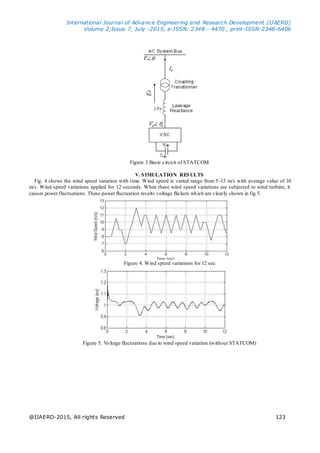
Fig. 5 shows the voltage magnitude wave form (with respect to time) without using any dynamic reactive compensator
(STATCOM). It is clearly visible that voltage fluctuations are significantly high. The magnitude voltage varies from 91
% to 103 % of its base value (ie. 1 pu). These voltage fluctuations do not obey the power quality requirement from
utilities. These fluctuations may have adverse effect on weak power systemnetwork connected.
Voltage fluctuations are significantly reduced with the application of STATCOM in the system, which can be clearly
seen from fig. 6. The voltage fluctuations are mitigated to range of value 0.99-1.005 pu (ie. -1 % to +0.5 %). Thus the
overall power quality of the system has improved. STATCOM supply or absorb the reactive power, according to system
requirement. If voltage goes below base value, STATCOM supplying reactive power and vise versa, it could be clea rly
seen from fig. 7.
VII. CONCLUSIONS
Wind is climatically and geographically uncontrollable source of renewable energy. Wind speed variation causes
voltage flickers or voltage fluctuations. These voltage fluctuations could not be taken care by using fixed capacitive
compensation, alone. To rectify these power quality issues dynamic reactive compensators (STATCOM) are used.
STATCOM has very fast time response characteristics, due to which, voltage fluctuations mitigation can be achieved
effectively. The reactive power supplied by STATCOM varies with the voltage fluctuation level. Thus it can say that,
wind farm power quality can be enhanced by using STATCOM.
VII. REFERENCES
[1] Chong Han, Alex Q. Huang, Wayne Litzenberger, Loren Anderson, Abdel-Aty Edris Mesut Baran, and
Subhashish Bhattacharya “ STATCOM Impact Study on the Integration of a Large Wind Farm into a Weak
Loop Power System” IEEE transactions on energy conversion, vol. 23, NO. 1, march 2008.
[2] T. Ackermann, Wind Power in Power Systems. New York:Wiley, 2005.
[3] Wei Qiao and Ronald G. Harley, “Power Quality and Dynamic Performance Improvement of Wind Farms
Using a STATCOM” 2007 IEEE
[4] Zhu xueling, Zhang Yang, Gao Kun, Li Qiang, Du Xizhou, and Liu Tonghe, "Research on compensation of
reactive power for wind farms", Power Sysetem Protection and Control, vol. 37, pp68-76, 2009.
[5] Lie Xu, Liangzhong Yao, and Christian Sasse “Comparison of Using SVC and STATCOM for Wind Farm
Integration” 2006 International Conference on Power SystemTechnology.
[6] Zengqiang Mi, Yingjin Chen, Liqing Liu, Yang Yu “Dynamic Performance Improvement of Wind Farm with
Doubly Fed Induction Generators Using STATCOM” 2010 International Conference on Power System
Technology.
[7] J. W. Smith, D. L. Brook, “Voltage impacts of distributed wind generation on rural distribution feeders,” IEEE
PES TDCE, vol. 1, pp. 492- 497, 28 Oct.-2 Nov 2001.
[8] A. Kehrli, M. Ross, “Understanding grid integration issues at wind farms and solutions using voltage source
converter FACTS technology,” IEEE PES general meeting, vol. 3, pp. 1822 - 1827, July 2003.](https://image.slidesharecdn.com/maneeshpandeym-190404113126/85/Voltage-Flicker-Mitigation-of-Wind-Farm-Using-a-STATCOM-4-320.jpg)
![International Journal of Advance Engineering and Research Development (IJAERD)
Volume 2,Issue 7, July -2015, e-ISSN: 2348 - 4470 , print-ISSN:2348-6406
@IJAERD-2015, All rights Reserved 125
[9] Chi Yongning, "Studies on the Stability Issues about Large Scale Wind Farm Grid Integration," D.E.
dissertation, Dept. China Electric Power Research Institute, 2006.E. H. Miller, "A note on reflector arrays,"
IEEE Trans. Antennas Propagat., to be published.
[10] Mohammad Ilyas, Mohammad Ubaid Soherwardi “STATCOM for improvement of dynamic performance of
wind farms in power grid” IJMER may 2014.
[11] Pooler M.A., "Doubly-fed induction machine models for stability assessment of wind farms," in Proc. 2003
IEEE Int. Power Tech Conf, Italy
[12] D. Santos-Martin, S. Arnaltes, and J.L. Rodriguez Amenedo, "Reactive power capability of doubly fed
asynchronous generators," Electric Power Systems Research, vol. 78, pp. 1837-1840, Nov. 2008
[13] Yan Gangui, Wang Maochun, and Mugang, "Modeling of GridConnected Doubly-Fed Induction Generator for
Reactive Power Static Regulation Capacity Study," Transactions of China Electrotechnical SOCiety, vol. 23, pp.
98-104, Jul. 2008
[14] Lei Sun, Zengqiang Mi, Yang Yu, Tao Wu, and Haifeng Tian, "Active power and reactive power regulation
capacity study of DFIG wind turbine", in Sustainable Power Generation and Supply, 2009.SUPERGEN '09.
International Conference, ppl-6, 2009
[15] A. Larsson,“Flicker emission of wind turbines during continuous operation,” IEEE Trans. Energy Conversion,
vol. 17, No. 1, pp. 114- 118, Mar. 2002.
[16] S. Sirisukprasert, A. Q. Huang, J. S. Lai “Modeling, analysis and control of cascaded multilevel converter based
STATCOM,” IEEE PES general meeting, vol. 4, pp. 2561 - 2568, July 2003
[17] F. Zhou, G. Joos, C. Abbey,“Voltage stability in weak connection wind farms,” IEEE PES general meeting, pp.
610 - 615, June 2005.
[18] L. T. Ha, T. K. Saha,“Investigation of power loss and voltage stability limits for large wind farm connections to
a subtransmission network,” IEEE PES general meeting, vol.2, pp. 2251 - 2256, June 2004.
VII. BIOGRAPHIES
Maneesh Pandey was born in 1990 in Chitrakoot, Uttar Pradesh, India. He received his
B.Tech (Hons.) degree in Electrical and Electronics Engineering from Vishveshwarya Institute
of Engineering And Technology in 2012. Now he is a Master’s student in Electrical
Engineering department at Madan Mohan Malviya University of Technology. His area of
intertest include power electronics, power system wide area protection and wind energy
generation system.
Dr. S.K Srivastava received his M. Tech. and Ph.D degrees from I.I.T Delhi (India) and U.P
Technical University Lucknow (India) in the year 1993 and 2008 respectively. Presently, he is
working as Associate Professor in the Department of Electrical Engineering of M.M.M
University of Technology Gorakhpur (U.P), India. His research interest includes power system
operation and control, Power Quality, FACTS devices & Controllers, Restructured Electricity
Market, Fuzzy & Neural applications in power systemproblems.](https://image.slidesharecdn.com/maneeshpandeym-190404113126/85/Voltage-Flicker-Mitigation-of-Wind-Farm-Using-a-STATCOM-5-320.jpg)


