International Journal of Engineering and Technical Research (IJETR)
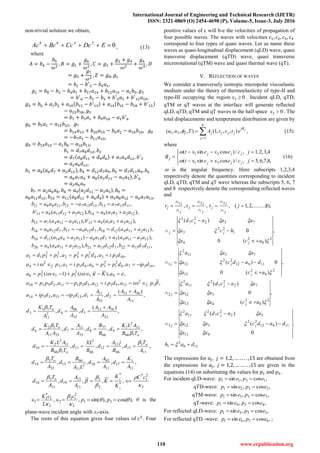
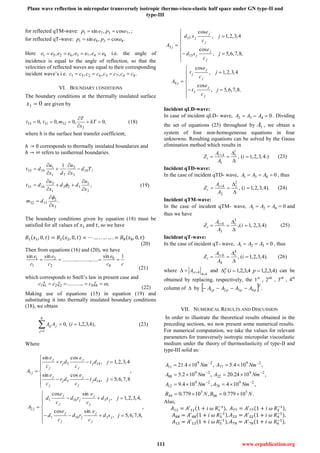
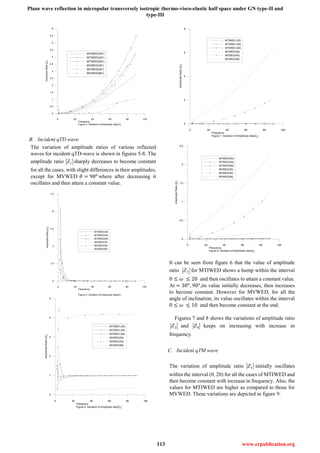
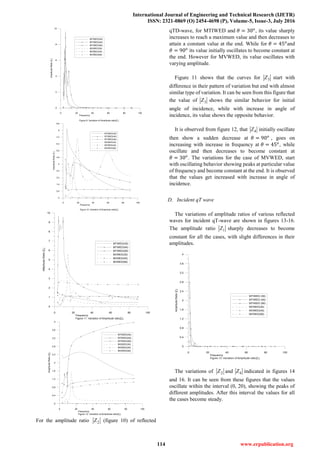
ISSN: 2321-0869 (O) 2454-4698 (P), Volume-5, Issue-3, July 2016
108 www.erpublication.org

Abstract— Present article deals with the reflection of
wave’s incident at the surface of transversely isotropic
micropolar visco elastic medium under the theory of
thermoelasticity of type-II and type-III. The wave equations are
solved by imposing proper conditions on components of
displacement, stresses and temperature distribution. It is found
that there exist four different waves viz., quasi-longitudinal
displacement(qLD)wave, quasi transverse
displacement(qTD)wave, quasi transverse microrotational
(qTM)wave and quasi thermal wave (qT). Amplitude ratio of
these reflected waves are presented, when different waves are
incident. Numerically simulated results have been depicted
graphically for different angle of incidence with respect to
frequency. Some special cases of interest also have been
deduced form the present investigation.
Index Terms—Micropolar, Reflection, Amplitude Ratios,
Viscoelastic.
I. INTRODUCTION
Depending upon the mechanical properties, the materials
of earth have been classified as elastic, viscoelastic, sandy,
granular, microstructure etc. Some parts of earth may
supposed to be composed of material possessing
micropolar/granular structure instead of continuous elastic
materials. To explain the fundamental departure of
microcontinuum theories from the classical continuum
theories, the former is a continuum model embedded with
microstructures to describe the microscopic motion or a
non-local model to describe the long range material
interaction. This extends the application of the continuum
model to microscopic space and short-time scales.
Material is endowed with microstructure, like atoms
and molecules at microscopic scale, grains and fibers or
particulate at mesoscopic scale. Homogenization of a
basically heterogeneous material depends on scale of interest.
When stress fluctuation is small enough compared to
microstructure of material, homogenization can be made
without considering the detailed microstructure of the
material. However, if it is not the case, the microstructure of
material must be considered properly in a homogenized
formulation [1], [2]. The concept of microcontinuum,
proposed by Eringen [1], can take into account the
microstructure of material while the theory itself remains still
Manuscript received June 09, 2016.
Rajani Rani Gupta, Department of Mathematics & Applied Sciences,
Middle East College, Muscat, Oman, (e-mail: dr.rajanigupta@gmail.com).
Raj Rani Gupta, Department of CS & IT, Mazoon College, Muscat,
Oman, (e-mail: raji.mmec@gmail.com).
in a continuum formulation. The first grade microcontinuum
consist a hierarachy of theories, such as, micropolar,
microstretch and micromorphic, depending on how much
micro-degrees of freedom is incorporated. These
microcontinuum theories are believed to be potential tools to
characterize the behavior of material with complicated
microstructures.
The most popular microcontinuum theory is micropolar one,
in this theory, a material point can still be considered as
infinitely small, however, there are microstructures inside of
this point. So there are two sets of variable to describe the
deformation of this material point, one characterizes the
motion of the inertia center of this material point; the other
describes the motion of the microstructure inside of this point.
In micropolar theory, the motion of the microstructure is
supposed to be an independently rigid rotation. Application
of this theory can be found in [1] and [3].
Recently, the theory of thermoelasticity without energy
dissipation, which provides sufficient basic modifications to
the constitutive equation to permit the treatment of a much
wider class of flow problems, has been proposed by Green
and Naghdi [4] (called the GN theory). The discussion
presented in the above reference includes the derivation of a
complete set of governing equations of the linearized version
of the theory for homogeneous and isotropic materials in
terms of displacement and temperature fields and a proof of
the uniqueness of the solution of the corresponding initial
mixed boundary value problem. Chandrasekharaiah and
Srinath [5] investigated one-dimensional wave propagation
in the context of the GN theory.
The aim of the present paper is to study the
reflection of waves in transversely isotropic micropolar
viscoelastic medium under the theory of thermoelasticity of
type-II and type-III. The propagation of waves in micropolar
materials has many applications in various fields of science
and technology, namely, atomic physics, industrial
engineering, thermal power plants, submarine structures,
pressure vessel, aerospace, chemical pipes and metallurgy.
The graphical representation in given for amplitude ratios of
various reflected waves for different incident waves at
different angle of incidence i.e. for 𝜃 = 30 𝑜
, 45 𝑜
𝑎𝑛𝑑 90 𝑜
.
II. BASIC EQUATIONS
The basic equations in dynamic theory of the plain strain of a
homogeneous, transversely isotropic micropolar viscoelastic
Plane wave reflection in micropolar transversely
isotropic thermo-visco-elastic half space under GN
type-II and type-III
Rajani Rani Gupta, Raj Rani Gupta
Plane wave reflection in micropolar transversely isotropic thermo-visco-elastic half space under GN type-II and
type-III
109 www.erpublication.org
medium following Eringen [1] and Green and Naghdi [4] in
the theory of thermoelasticity of type-II and type-III in
absence of body forces, body couples and heat sources are
given by:
Balance laws
ijij ut , (1)
kijijkiik jtm  , , (2)
Heat conduction equation
klklklklklkl u
t
T
t
T
cTTK ,2
2
02
2
*
,,
*






 (3)
The constitutive relations can be given as:
𝑡 𝑘𝑙 = 𝐴 𝑘𝑙𝑚𝑛 𝐸 𝑚𝑛 + 𝐺 𝑘𝑙𝑚𝑛Ψ 𝑚𝑛 − 𝛽𝑘𝑙 𝑇,
𝑚 𝑘𝑙 = 𝐴𝑙𝑘𝑚𝑛 𝐸 𝑚𝑛 + 𝐺 𝑚𝑛𝑙𝑘Ψ 𝑚𝑛 (4)
Where
𝐴𝑖𝑗𝑘𝑙 = 𝐴′𝑖𝑗𝑘𝑙 + 𝐴′′𝑖𝑗𝑘𝑙
𝜕
𝜕𝑡
,
𝐵𝑖𝑗𝑘𝑙 = 𝐵′𝑖𝑗𝑘𝑙 + 𝐵′′𝑖𝑗𝑘𝑙
𝜕
𝜕𝑡
,
𝐺𝑖𝑗𝑘𝑙 = 𝐺′𝑖𝑗𝑘𝑙 + 𝐺′′𝑖𝑗𝑘𝑙
𝜕
𝜕𝑡
,
deformation and wryness tensor are defined by
klklmlkmklkl ue ,, ,  
,
(5)
In these relations, we have used the following notations:  is
the density, lkm permutation symbol, 𝑢𝑖 components of
displacement vector, i components of microrotation vector,
𝑡 𝑘𝑙 components of the stress tensor, 𝑚 𝑘𝑙 components of the
couple stress tensor, kle components of micropolar strain
tensor, kl are the characteristic constants of the theory,
*
c
is specific heat at constant strain, *
klK is the thermal
conductivity, 𝛽𝑘𝑙 = 𝐴 𝑘𝑙𝑚𝑛 𝛼 𝑚𝑛 are the thermal elastic
coupling tensor, 𝛼 𝑚𝑛 are the coefficient of linear thermal
expansion.
III. FORMULATION OF THE PROBLEM
In present case we consider homogeneous, transversely
isotropic micropolar viscoelastic medium under the theory of
thermoelasticity of type-II and type-III, initially in an
undeformed state and at uniform temperature 𝑇𝑜. We take the
origin of coordinate system on the plane surface with 𝑥3 axis
pointing normally into the half-space, which is thus
represented by 𝑥3 > 0. We restricted our analysis to the two
dimensional problem by assuming the displacement vector 𝑢⃗
and microrotation vector 𝜙⃗ as
𝑢⃗ = (𝑢1, 0, 𝑢3), 𝜙⃗ = (0, 𝜙2, 0) (6)
With the aid of equation (6), the field equations (1)-(4)
for transversely isotropic micropolar viscoelastic medium
under the theory of thermoelasticity of type-II and type-III
reduce to:
,
)(
2
1
2
1
1
3
2
1
31
3
2
56132
3
1
2
552
1
1
2
11
t
u
x
T
x
K
xx
u
AA
x
u
A
x
u
A



















(7)
,
)(
2
3
2
3
3
1
2
2
31
1
2
56132
3
3
2
332
1
3
2
66
t
u
x
T
x
K
xx
u
AA
x
u
A
x
u
A



















(8)
,2
2
2
3
3
1
3
1
122
3
2
2
662
1
2
2
77
tx
u
K
x
u
KX
x
B
x
B













 


(9)
),(
3
3
3
1
1
12
2
2
2
*
2
3
2
2
*
32
1
2
2
*
12
3
2
2
32
1
2
2
1
x
u
x
u
t
T
t
T
C
tx
K
tx
K
xx
o




























(10)
where
311256662
5556133313133131111
,,,
,,,


KKXAAK
AAKAAAA


are the coefficients of linear thermal expansion and we have
used the notations 11 → 1, 33 → 3, 12 → 7, 13 → 6, 23 → 4
for the material constants.
For simplification we use the following
non-dimensional variables:
,'
L
x
x i
i  ,'
L
u
u i
i  ,
1
'
o
ij
ij
T
t
t

 ,
1
'
o
ij
ij
TL
m
m

 ,
1
112'
2
oT
A


 
0
'
T
T
T  ,' 1
t
L
c
t  .112
1

A
c 
(11)
where L is a parameter having dimension of length and 𝑐1is
the longitudinal wave velocity of the medium.
IV. SOLUTION OF THE PROBLEM
Let 𝑝(𝑝1, 0, 𝑝3) denote the unit propagation vector of the
plane waves propagating in 𝑥1 𝑥3-plane.
We seek plane wave solution of the equations of motion of
the form
)(
231231
3311
),,,(),,,( ctxpxpi
eTuuTuu 
 

(12)
where  and k are respectively the phase velocity and the
wave number the components ),,,( 231 Tuu  define the
amplitude and polarization of particle displacement,
microrotation and temperature distribution in the medium.
With the help of equations (11) and (12) in equations
(7)-(10), we get four homogeneous equations in four
unknowns. Solving the resultant system of equations for
International Journal of Engineering and Technical Research (IJETR)
ISSN: 2321-0869 (O) 2454-4698 (P), Volume-5, Issue-3, July 2016
110 www.erpublication.org
non-trivial solution we obtain,
02468
 EDcCcBcAc , (13)
where
𝐴 = 𝑏4 −
𝑏5
𝜔2
, 𝐵 = 𝑔1 +
𝑔6
𝜔2
, 𝐶 = 𝑔3 +
𝑔2 + 𝑔4
𝜔2
+
𝑔4
𝜔4
, 𝐷
= 𝑔5 +
𝑔7
𝜔2
, 𝐸 = 𝑔8, 𝑔1
= 𝑏1 − 𝑏′
2 − 𝑏4 𝑎1,
𝑔2 = 𝑏8 − 𝑏2 − 𝑏4 𝑎1 + 𝑏17 𝑎14 + 𝑏12 𝑎15 − 𝑎1 𝑏5, 𝑔3
= 𝑏′
6 − 𝑏1 − 𝑏3 + 𝑏′
2 𝑎1 + 𝑏′
12 𝑎10,
𝑔4 = 𝑏6 + 𝑎1 𝑏2 + 𝑎10(𝑏12 − 𝑏′
13) + 𝑎14(𝑏15 − 𝑏18 + 𝑏′
15)
− 𝑎15 𝑏18, 𝑔5
= 𝑏7 + 𝑏3 𝑎1 + 𝑏9 𝑎10 − 𝑎1 𝑏′
6
𝑔6 = 𝑏5 𝑎1 − 𝑎15 𝑏22, 𝑔7
= 𝑏14 𝑎14 + 𝑏20 𝑎15 − 𝑏6 𝑎1 − 𝑎10 𝑏10, 𝑔8
= −𝑏7 𝑎1 − 𝑏11 𝑎10,
𝑔9 = 𝑏19 𝑎15 − 𝑎1 𝑏8 − 𝑎10 𝑏13,
𝑏1 = 𝑑7 𝑎8 𝑑12, 𝑏2
= 𝑑7(𝑎8 𝑑11 + 𝑑9 𝑑6) + 𝑎7 𝑎4 𝑑12, 𝑏′
2
= 𝑎2 𝑎9 𝑑12,
𝑏3 = 𝑎8(𝑎6 𝑑7 + 𝑎2 𝑑12), 𝑏4 = 𝑑12 𝑑7 𝑎9, 𝑏5 = 𝑑7 𝑑11 𝑎9, 𝑏6
= 𝑎6 𝑎7 𝑎4 + 𝑎8(𝑎2 𝑑11 − 𝑎3 𝑎5), 𝑏′6
= 𝑎2 𝑎6 𝑎9
𝑏7 = 𝑎2 𝑎6 𝑎8, 𝑏8 = 𝑎9(𝑎2 𝑑11 − 𝑎3 𝑎5), 𝑏9 =
𝑎8 𝑎11 𝑑12, 𝑏10 = 𝑎11(𝑎8 𝑑11 + 𝑎6 𝑑9) + 𝑎5 𝑎8 𝑎12 − 𝑎6 𝑎7 𝑎13,
),(),('
,,,
122318141251211913
11137131213712116811
aaaaabaadaab
daabdaabaaab


,,),(
),()(
),(,,
),('),(
11713227121321132114620
133114571361324141119
1321141218712917712816
12231915133124715
ddabddabaaaaab
aaaaadaaaaaadb
aaaadbdaabdaab
aaaaabaaaaab




,,,,
,,,
14378
2
1
2
3661532
2
4
10134
2
1
2
32
2
1
2
311
dipadppadpiapia
dpiadppappda



,,,,
,),()1(
12
2
1393125311123110
91
2
11
2
38


piadpiadppadppa
aKipipa


,
)(
,,
,
)(
,,,
33
5613
5
33
66
42
11
11
3
11
5613
2
55
11
1131153314
A
AA
d
A
A
d
A
TK
d
A
AA
d
A
A
ddipadipa
o 




,,,,
,,,,
11
1
13
66
11
12
66
2
11
166
11
2
2
10
166
11
2
1
9
66
77
8
33
11
7
3311
12
6
A
T
d
B
jA
d
B
XL
d
TB
ALK
d
TB
ALK
d
B
B
d
A
A
d
AA
TK
d
o
o
o
o






3
2
1
*
*
*
3
1
11
13
19
11
3
18
11
1
17
11
65
162
11
66
15
33
3
14
,,,,
,,,,
3
1







cC
K
K
K
A
A
d
A
T
d
A
K
d
A
A
d
LA
B
d
A
T
d
o
o


),cos(),sin(,, 31
3
2
13
2
3
1
*
3
1 



 pp
c
L
cK
θ is the
plane-wave incident angle with x3-axis.
The roots of this equation gives four values of 𝑐2
. Four
positive values of c will b-e the velocities of propagation of
four possible waves. The waves with velocities 𝑐1, 𝑐2, 𝑐3, 𝑐4
correspond to four types of quasi waves. Let us name these
waves as quasi-longitudinal displacement (qLD) wave, quasi
transverse displacement (qTD) wave, quasi transverse
microrotational (qTM) wave and quasi thermal wave (qT).
V. REFLECTION OF WAVES
We consider a transversely isotropic micropolar viscoelastic
medium under the theory of thermoelasticity of type-II and
type-III occupying the region 03 x . Incident qLD, qTD,
qTM or qT waves at the interface will generate reflected
qLD, qTD, qTM and qT waves in the half space 03 x . The
total displacements and temperature distribution are given by
,),,,1(),,,(
8
1
231 

j
iB
jjjj
j
etsrATuu  (15)
where







,8,7,6,5,/)cossin(
4,3,2,1,/)cossin(
31
31
jcexext
jcexext
B
jjj
jjj
j


(16)
 is the angular frequency. Here subscripts 1,2,3,4
respectively denote the quantities corresponding to incident
qLD, qTD, qTM and qT wave whereas the subscripts 5, 6, 7
and 8 respectively denote the corresponding reflected waves
and
),8........,,2,1(,,,
321









 jtsr
j
j
j
j
j
j
j
j
j
,
)(0
0)(
,
)(0
0
)(
2
8
2
13
11612
22
12
7511
2
1
2
8
2
4
1
22
3
752
2
7
2






aca
dadca
aaa
aca
hca
aaacd
j
jj
j
j
j
j






.
0
)(
)(
,
)(
0
)(
413
11612
22
312
52
2
7
2
11
2
3
2
8
2
413
312
72
2
7
2
11
2
2
aa
dadcaa
aacda
acaa
aa
aacda
j
j
j
j
j
j












116
2
1 dah  
The expressions for 𝑎𝑗, 𝑗 = 1,2, … … . . ,15 are obtained from
the expressions for 𝑎𝑗, 𝑗 = 1,2, … … . . ,15 are given in the
equations (14) on substituting the values for 𝑝1 and 𝑝3.
For incident qLD-wave: ,cos,sin 1311 epep 
qTD-wave: ,cos,sin 2321 epep 
qTM-wave: ,cos,sin 3331 epep 
qT-wave: ,cos,sin 4341 epep 
For reflected qLD-wave: ,cos,sin 5351 epep 
For reflected qTD -wave: ,cos,sin 6361 epep  ;
Plane wave reflection in micropolar transversely isotropic thermo-visco-elastic half space under GN type-II and
type-III
111 www.erpublication.org
for reflected qTM-wave: ,cos,sin 7371 epep  ;
for reflected qT-wave: .cos,sin 8381 epep 
Here 84736251 ,,, eeeeeeee  i.e. the angle of
incidence is equal to the angle of reflection, so that the
velocities of reflected waves are equal to their corresponding
incident wave’s i.e. .,,, 84736251 cccccccc 
VI. BOUNDARY CONDITIONS
The boundary conditions at the thermally insulated surface
03 x are given by
,0,0,0,0
3
323133 


 hT
x
T
mtt (18)
where h is the surface heat transfer coefficient;
ℎ → 0 corresponds to thermally insulated boundaries and
ℎ → ∞ refers to isothermal boundaries.
.
,
,
1
3
2
1532
3
1
123
1
3
1631
18
3
3
71
1
1933
x
dm
x
u
dd
x
u
dt
Td
x
u
dx
u
dt

















 (19)
The boundary conditions given by equation (18) must be
satisfied for all values of 𝑥1 and 𝑡, so we have
𝐵1(𝑥1, 0, 𝑡) = 𝐵2(𝑥2, 0, 𝑡) = ⋯ … . . … … . = 𝐵8(𝑥8, 0, 𝑡)
(20)
Then from equations (16) and (20), we have
cc
e
c
e
c
e 1sin
..........................
sinsin
8
8
2
2
1
1

(21)
which corresponds to Snell’s law in present case and
,............ 882211   ccc
(22)
Making use of equations (15) in equation (19) and
substituting it into thermally insulated boundary conditions
(18), we obtain
),4,3,2,1(,0
8
1


j
jij iAA (23)
Where
,
8,7,6,5,
cossin
4,3,2,1,
cossin
145
145
1










jdt
c
e
dr
c
e
jdt
c
e
dr
c
e
A
j
j
j
j
j
j
j
j
j
j
j
j
j
,
,8,7,6,5,
sincos
,4,3,2,1,
sincos
3161
3161
2










jsd
c
e
rd
c
e
d
jsd
c
e
rd
c
e
d
A
j
j
j
j
j
j
j
j
j
j
j
j
j










,8,7,6,5,
cos
4,3,2,1,
cos
15
15
3
j
c
e
sd
j
c
e
sd
A
j
j
j
j
j
j
j










.8,7,6,5,
cos
4,3,2,1,
cos
4
j
c
e
t
j
c
e
t
A
j
j
j
j
j
j
j
Incident qLD-wave:
In case of incident qLD- wave, 0432  AAA . Dividing
the set of equations (23) throughout by 1A , we obtain a
system of four non-homogeneous equations in four
unknowns. Resulting equations can be solved by the Gauss
elimination method which results in
.)4,3,2,1(,
1
1
4



 
i
A
A
Z ii
i (23)
Incident qTD-wave:
In the case of incident qTD- wave, 0431  AAA , thus
).4,3,2,1(,
2
2
4



 
i
A
A
Z ii
i (24)
Incident qTM-wave:
In the case of incident qTM- wave, 0421  AAA and
thus we have
)4,3,2,1(,
3
3
4



 
i
A
A
Z ii
i (25)
Incident qT-wave:
In the case of incident qT- wave, 0321  AAA , thus
).4,3,2,1(,
4
4
4



 
i
A
A
Z ii
i (26)
where
444  iiA and )4,3,2,14,3,2,1(  pip
i can be
obtained by replacing, respectively, the 1st
, 2nd
, 3rd
, 4th
column of  by   .4321
T
pppp AAAA 
VII. NUMERICAL RESULTS AND DISCUSSION
In order to illustrate the theoretical results obtained in the
preceding sections, we now present some numerical results.
For numerical computation, we take the values for relevant
parameters for transversely isotropic micropolar viscoelastic
medium under the theory of thermoelasticity of type-II and
type-III solid as:
,1024.20,102.5
,104.5,104.21
29
22
29
88
29
77
29
11




NmANmA
NmANmA
.10779.0,10779.0
,104,104.9
5
66
5
44
29
78
29
12
NBNB
NmANmA

 
Also,
𝐴11 = 𝐴′
11(1 + 𝑖 𝜔 𝑅1
−1), 𝐴77 = 𝐴′
77(1 + 𝑖 𝜔 𝑅2
−1),
𝐴88 = 𝐴′
88(1 + 𝑖 𝜔 𝑅3
−1), 𝐴22 = 𝐴′
22(1 + 𝑖 𝜔 𝑅4
−1),
𝐴12 = 𝐴′
12(1 + 𝑖 𝜔 𝑅5
−1
), 𝐴78 = 𝐴′
78(1 + 𝑖 𝜔 𝑅6
−1),
International Journal of Engineering and Technical Research (IJETR)
ISSN: 2321-0869 (O) 2454-4698 (P), Volume-5, Issue-3, July 2016
112 www.erpublication.org
𝐵44 = 𝐵′
44(1 + 𝑖 𝜔 𝑅7
−1), 𝐵66 = 𝐵′
66(1 + 𝑖 𝜔 𝑅8
−1),
where
𝑅1
−1
= 8.05, 𝑅2
−1
= 2, 𝑅3
−1
= 1.05, 𝑅4
−1
= 4.05,
𝑅5
−1
= 2.05, 𝑅6
−1
= 7.05, 𝑅7
−1
= 2.05, 𝑅8
−1
= 4.05
Following Gauthier [6] we take, the non-dimensional
values for Aluminium epoxy like composite as
,/1049.1,/1089.1
,/1059.7,/1019.2
2929
2933
mNKmN
mNmKg




,10196.0 24
mj 
 ,sec/107.1 2*
CmJK o

KCalC /04.1*
 , .1063.2 5
N
Graphical representation is given for the variations of
amplitude ratios of reflected qLD, qTD, qTM and qT waves
when four types of waves viz. qLD, qTD, qTM and qT waves
are incident at the free surface to compare the results in two
cases, one for the waves incident from transversely isotropic
micropolar medium under the theory of thermoelasticity of
type-II and type-III (MTIWED) and other from micropolar
transversely isotropic viscoelastic material with energy
dissipation (MVWED). In figures 1-4, the graphical
representation is given for variations of amplitude ratios
21 , ZZ , 3Z and 4Z for incident qLD wave. Figures 5-8,
9-12 and 13-16, respectively show the similar state in case of
incident qTD, qTM, and qT waves. Here 21 , ZZ , 3Z and
4Z are, respectively, the amplitude ratios of reflected qLD,
qTD, qTM and qT wave.
These variations are shown for three different angle of
incidence viz., 𝜃 = 30 𝑜
, 45 𝑜
𝑎𝑛𝑑 90 𝑜
. In these figures the
solid lines corresponds to the case of MTIWED while the
dotted lines corresponds to the case of MVWED. Also, the
solid lines without center symbol, lines with center symbol
(−0 − 0 −), solid lines with center symbol (− × − ×
−), respectively, represent variations for 𝜃 = 30 𝑜
, 𝜃 =
45 𝑜
and 𝜃 = 90 𝑜
in case on MTIWED, whereas the
corresponding broken lines represent the same condition in
the case of MVWED.
A. Incident qLD wave
It is observed from figure 1 that the amplitude ratio 1Z of
reflected qLD-wave first increases sharply to peak value and
then decreases sharply to attain a constant value, when
𝜃 = 45 𝑜
for MTIWED. While, for all the other cases, its
value initially increase and then oscillate to become constant
ultimately.
0 20 40 60 80 100
Frequency
Figure 1. Variation of Amplitude ratio |Z1|
0
0.1
0.2
0.3
0.4
0.5
0.6
0.7
0.8
0.9
1
1.1
1.2
1.3
AmplitudeRatio|Z1|
MTIWED(30o
)
MTIWED(45o)
MTIWED(90o
)
MVWED(30o)
MVWED(45o
)
MVWED(90o)
0 20 40 60 80 100
Frequency
Figure 2. Variation of Amplitude ratio|Z2|
0
10
20
30
40
50
AmplitudeRatio|Z2|
MTIWED(30o
)
MTIWED(45o
)
MTIWED(90o
)
MVWED(30o
)
MVWED(45o
)
MVWED(90o
)
Figure 2, 3 and 4 indicate the variations of amplitude
ratio 2Z , 3Z and 4Z of reflected qTD-wave which
shows that for all the cases, the value of 2Z , 3Z and
4Z initially oscillate with very small amplitude and then
steadily increases with increase in frequency, for all the
three angles of inclination.
0 20 40 60 80 100
Frequency
Figure 3. Variation of Amplitude ratio|Z3|
0
1.5
3
4.5
6
7.5
9
10.5
12
13.5
15
16.5
AmplitudeRation|Z3|
MTIWED(30o)
MTIWED(45o)
MTIWED(90o
)
MVWED(30o)
MVWED(45o
)
MVWED(90o)
Plane wave reflection in micropolar transversely isotropic thermo-visco-elastic half space under GN type-II and
type-III
113 www.erpublication.org
0 20 40 60 80 100
Frequency
Figure 4. Variation of Amplitude ratio|Z4|
0
0.5
1
1.5
2
2.5
3
3.5
4
4.5
5
5.5
6
AmplitudeRatio|Z4|
MTIWED(30o
)
MTIWED(45o
)
MTIWED(90o)
MVWED(30o
)
MVWED(45o
)
MVWED(90o
)
B. Incident qTD wave
The variation of amplitude ratios of various reflected
waves for incident qTD-wave is shown in figures 5-8. The
amplitude ratio 1Z sharply decreases to become constant
for all the cases, with slight differences in their amplitudes,
except for MVWED 𝜃 = 90 𝑜
where after decreasing it
oscillates and then attain a constant value.
0 20 40 60 80 100
Frequency
Figure 5. Variation of Amplitude ratio|Z1|
0
1.5
3
4.5
6
7.5
AmplitudeRatio|Z1|
MTIWED(30)
MTIWED(45)
MTIWED(90)
MVWED(30)
MVWED(45)
MVWED(90)
0 20 40 60 80 100
Frequency
Figure 6. Variation of Amplitude ratio|Z2|
0
1
2
3
4
5
AmplitudeRatio|Z2|
MTIWED (30)
MTIWED (45)
MTIWED (90)
MVWED(30)
MVWED(45)
MVWED(90)
0 20 40 60 80 100
Frequency
Figure 7. Variation of Amplitude ratio|Z3|
0
2
4
6
8
AmplitudeRatio|Z3|
MTIWED (30)
MTIWED (45)
MTIWED (90)
MVWED(30)
MVWED(45)
MVWED(90)
0 20 40 60 80 100
Frequency
Figure 8. Variation of Amplitude ratio|Z4|
0
0.5
1
1.5
2
2.5
AmplitudeRatio|Z4|
MTIWED(30)
MTIWED(45)
MTIWED(90)
MVWED(30)
MVWED(45)
MVWED(90)
It can be seen from figure 6 that the value of amplitude
ratio 2Z for MTIWED shows a hump within the interval
0 ≤ 𝜔 ≤ 20 and then oscillates to attain a constant value.
At = 30 𝑜
, 90 𝑜
,its value initially decreases, then increases
to become constant. However for MVWED, for all the
angle of inclination, its value oscillates within the interval
0 ≤ 𝜔 ≤ 10 and then become constant at the end.
Figures 7 and 8 shows the variations of amplitude ratio
3Z and 4Z keeps on increasing with increase in
frequency.
C. Incident qTM wave
The variation of amplitude ratio 1Z initially oscillates
within the interval (0, 20) for all the cases of MTIWED and
then become constant with increase in frequency. Also, the
values for MTIWED are higher as compared to those for
MVWED. These variations are depicted in figure 9.
International Journal of Engineering and Technical Research (IJETR)
ISSN: 2321-0869 (O) 2454-4698 (P), Volume-5, Issue-3, July 2016
114 www.erpublication.org
0 20 40 60 80 100
Frequency
Figure 9. Variation of Amplitude ratio|Z1|
0
2
4
6
8
10
AmplitudeRatio|Z1|
MTIWED(30)
MTIWED(45)
MTIWED(90)
MVWED(30)
MVWED(45)
MVWED(90)
0 20 40 60 80 100
Frequency
Figure 10. Variation of Amplitude ratio|Z2|
0
0.8
1.6
2.4
3.2
4
4.8
5.6
6.4
7.2
8
8.8
AmplitudeRatio|Z1|
MTIWED(30)
MTIWED(45)
MTIWED(90)
MVWED(30)
MVWED(45)
MVWED(90)
0 20 40 60 80 100
Frequency
Figure 11. Variation of Amplitude ratio|Z3|
0
1
2
3
4
5
6
7
8
9
10
AMplitudeRatio|Z3|
MTIWED(30)
MTIWED(45)
MTIWED(90)
MVWED(30)
MVWED(45)
MVWED(90)
0 20 40 60 80 100
Frequency
Figure 12. Variation of Amplitude ratio|Z4|
0
0.4
0.8
1.2
1.6
2
2.4
2.8
3.2
3.6
4
AmplitudeRatio|Z4|
MTIWED(30)
MTIWED(45)
MTIWED(90)
MVWED(30)
MVWED(45)
MVWED(90)
For the amplitude ratio 2Z (figure 10) of reflected
qTD-wave, for MTIWED and 𝜃 = 30 𝑜
, its value sharply
increases to reach a maximum value and then decreases to
attain a constant value at the end. While for 𝜃 = 45 𝑜
and
𝜃 = 90 𝑜
its value initially oscillates to become constant at
the end. However for MVWED, its value oscillates with
varying amplitude.
Figure 11 shows that the curves for 3Z start with
difference in their pattern of variation but end with almost
similar type of variation. It can be seen from this figure that
the value of 3Z shows the similar behavior for initial
angle of incidence, while with increase in angle of
incidence, its value shows the opposite behavior.
It is observed from figure 12, that 4Z initially oscillate
then show a sudden decrease at 𝜃 = 90 𝑜
, goes on
increasing with increase in frequency at 𝜃 = 45 𝑜
, while
oscillate and then decreases to become constant at
𝜃 = 30 𝑜
. The variations for the case of MVWED, start
with oscillating behavior showing peaks at particular value
of frequency and become constant at the end. It is observed
that the values get increased with increase in angle of
incidence.
D. Incident qT wave
The variations of amplitude ratios of various reflected
waves for incident qT-wave are shown in figures 13-16.
The amplitude ratio 1Z sharply decreases to become
constant for all the cases, with slight differences in their
amplitudes.
0 20 40 60 80 100
Frequency
Figure 13. Variation of Amplitude ratio|Z1|
0
0.4
0.8
1.2
1.6
2
2.4
2.8
3.2
3.6
4
AmplitudeRatio|Z1|
MTIWED (30)
MTIWED (45)
MTIWED (90)
MVWED(30)
MVWED(45)
MVWED(90)
The variations of 2Z and 4Z indicated in figures 14
and 16. It can be seen from these figures that the values
oscillate within the interval (0, 20), showing the peaks of
different amplitudes. After this interval the values for all
the cases become steady.
Plane wave reflection in micropolar transversely isotropic thermo-visco-elastic half space under GN type-II and
type-III
115 www.erpublication.org
0 20 40 60 80 100
Frequency
Figure 14. Variation of Amplitude ratio|Z2|
0
5
10
15
20
25
30
35
AmplitudeRatio|Z2|
MTIWED (30)
MTIWED (45)
MTIWED (90)
MVWED(30)
MVWED(45)
MVWED(90)
0 20 40 60 80 100
Frequency
Figure 15. Variation of Amplitude ratio|Z3|
0
10
20
30
40
50
AmplitudeRatio|Z3|
MTIWED(30)
MTIWED(45)
MTIWED(90)
MVWED(30)
MVWED(45)
MVWED(90)
0 20 40 60 80 100
Frequency
Figure 16. Variation of Amplitude ratio|Z4|
0
0.5
1
1.5
2
2.5
3
3.5
4
AmplitudeRatio|Z4|
MTIWED(30)
MTIWED(45)
MTIWED(90)
MVWED(30)
MVWED(45)
MVWED(90)
Variations in the values of 3Z indicate that viscoelasticity as
well as angle of incidence show a significant impact on it
throughout the whole range (figure 15). The behavior of 3Z
oscillatory, within the range 0 ≤ 𝜔 ≤ 20 . The values of
maximum with amplitude ratio 3Z first increase from small
values to small oscillations and ultimately decrease to
become steady. The values for MVWED are higher as
compared to those for MVWED at 𝜃 = 30 𝑜
𝑎𝑛𝑑 45 𝑜
, but the
behavior is reversed with further increase in the angle of
incidence. Viscoelasticity show a greater impact on iZ ,
i=1,2,3,4 as compared to the angle of incidence.
VIII. CONCLUSION
The analytic expressions of amplitude ratios for various
reflected waves are obtained for the transversely isotropic
micropolar viscoelastic medium under the theory of
thermoelasticity of type-II and type-III. It is concluded
from the graphs that the values of amplitude ratios
21 , ZZ and 3Z show sharp oscillations at initial
frequencies for incident qLD and qTD waves, as compared
to qTM and qT incident waves. An appreciable effect of
viscoelasticity and angle of incidence is observed on
amplitude ratios of various reflected waves.
REFERENCES
[1] Eringen A C. “Microcontinuum fields theories I: Foundations and
Solids”, Springer Verlag, New York, 1999.
[2] Hu G K, Liu X N and Lu T J. “A variational method for nonlinear
micropolar composite”, Mechanics of Materials. 2005 37, pp. 407-425.
[3] Lakes R S. “Size effects and micromechanics of a porous solid”,
Journal of Material Science, 1983, 18(9), pp. 2572-2581.
[4] Green A E and Naghdi P M. “Thermoelasticity without energy
dissipation”, Journal of Elasticity, 1993, 31, pp. 189-208.
[5] Chandrasekharaiah D S and Srinath K S. “One-dimensional waves in a
thermoelastic half-space without energy dissipation”, International
Journal of Engineering Science, 1996, 34(13), pp. 1447-1455.
[6] Gauthier R D. “In Experimental investigations on micropolar media,
Mechanics of micropolar media (eds)” 1982, O. Brulin, RKT Hsieh.
(Singapore: World Scientific) interfaces (Translation Journals style),”
IEEE Transl. J. Magn.Jpn., vol. 2, Aug. 1987, pp. 740–741 [Dig. 9th
Annu. Conf. Magnetics Japan, 1982, p. 301].
Rajani Rani Gupta earned her Bachelors and
master’s degree from University of Pune, India by achieving third and first
positions respectively. She completed her Ph. D. from Kurukshtera
University, India in 2012. She has 28 research papers published in the
Journals of internal repute and also served as a reviewer in many
international journals. Her field of research is based on the theory of
Micropolar Elasticity involving the effects of thermoelasticity,
Viscoelasticity, Initial stress, rotation. She attended various national and
international level workshops and conferences. Presently she’s working in
the field of teaching experiences using technology.
Raj Rani Gupta earned her master’s degree from
University of Pune by achieving overall first position in 2003, M. Phill
degree from Kurukshetra University. She qualified JRF (NET) conducted by
U. G. C. She has more than 16 research papers published in the journals of
international repute. Her area of research work is Continuum Mechanics
(Thermoelasticity, Viscoelasticity, Initial stress, rotation). She also managed
various activities like Member of Grievance Cell, Women Cell,
Convocation, Exam center etc..

Ijetr042201

  • 1.
    International Journal ofEngineering and Technical Research (IJETR) ISSN: 2321-0869 (O) 2454-4698 (P), Volume-5, Issue-3, July 2016 108 www.erpublication.org  Abstract— Present article deals with the reflection of wave’s incident at the surface of transversely isotropic micropolar visco elastic medium under the theory of thermoelasticity of type-II and type-III. The wave equations are solved by imposing proper conditions on components of displacement, stresses and temperature distribution. It is found that there exist four different waves viz., quasi-longitudinal displacement(qLD)wave, quasi transverse displacement(qTD)wave, quasi transverse microrotational (qTM)wave and quasi thermal wave (qT). Amplitude ratio of these reflected waves are presented, when different waves are incident. Numerically simulated results have been depicted graphically for different angle of incidence with respect to frequency. Some special cases of interest also have been deduced form the present investigation. Index Terms—Micropolar, Reflection, Amplitude Ratios, Viscoelastic. I. INTRODUCTION Depending upon the mechanical properties, the materials of earth have been classified as elastic, viscoelastic, sandy, granular, microstructure etc. Some parts of earth may supposed to be composed of material possessing micropolar/granular structure instead of continuous elastic materials. To explain the fundamental departure of microcontinuum theories from the classical continuum theories, the former is a continuum model embedded with microstructures to describe the microscopic motion or a non-local model to describe the long range material interaction. This extends the application of the continuum model to microscopic space and short-time scales. Material is endowed with microstructure, like atoms and molecules at microscopic scale, grains and fibers or particulate at mesoscopic scale. Homogenization of a basically heterogeneous material depends on scale of interest. When stress fluctuation is small enough compared to microstructure of material, homogenization can be made without considering the detailed microstructure of the material. However, if it is not the case, the microstructure of material must be considered properly in a homogenized formulation [1], [2]. The concept of microcontinuum, proposed by Eringen [1], can take into account the microstructure of material while the theory itself remains still Manuscript received June 09, 2016. Rajani Rani Gupta, Department of Mathematics & Applied Sciences, Middle East College, Muscat, Oman, (e-mail: dr.rajanigupta@gmail.com). Raj Rani Gupta, Department of CS & IT, Mazoon College, Muscat, Oman, (e-mail: raji.mmec@gmail.com). in a continuum formulation. The first grade microcontinuum consist a hierarachy of theories, such as, micropolar, microstretch and micromorphic, depending on how much micro-degrees of freedom is incorporated. These microcontinuum theories are believed to be potential tools to characterize the behavior of material with complicated microstructures. The most popular microcontinuum theory is micropolar one, in this theory, a material point can still be considered as infinitely small, however, there are microstructures inside of this point. So there are two sets of variable to describe the deformation of this material point, one characterizes the motion of the inertia center of this material point; the other describes the motion of the microstructure inside of this point. In micropolar theory, the motion of the microstructure is supposed to be an independently rigid rotation. Application of this theory can be found in [1] and [3]. Recently, the theory of thermoelasticity without energy dissipation, which provides sufficient basic modifications to the constitutive equation to permit the treatment of a much wider class of flow problems, has been proposed by Green and Naghdi [4] (called the GN theory). The discussion presented in the above reference includes the derivation of a complete set of governing equations of the linearized version of the theory for homogeneous and isotropic materials in terms of displacement and temperature fields and a proof of the uniqueness of the solution of the corresponding initial mixed boundary value problem. Chandrasekharaiah and Srinath [5] investigated one-dimensional wave propagation in the context of the GN theory. The aim of the present paper is to study the reflection of waves in transversely isotropic micropolar viscoelastic medium under the theory of thermoelasticity of type-II and type-III. The propagation of waves in micropolar materials has many applications in various fields of science and technology, namely, atomic physics, industrial engineering, thermal power plants, submarine structures, pressure vessel, aerospace, chemical pipes and metallurgy. The graphical representation in given for amplitude ratios of various reflected waves for different incident waves at different angle of incidence i.e. for 𝜃 = 30 𝑜 , 45 𝑜 𝑎𝑛𝑑 90 𝑜 . II. BASIC EQUATIONS The basic equations in dynamic theory of the plain strain of a homogeneous, transversely isotropic micropolar viscoelastic Plane wave reflection in micropolar transversely isotropic thermo-visco-elastic half space under GN type-II and type-III Rajani Rani Gupta, Raj Rani Gupta
  • 2.
    Plane wave reflectionin micropolar transversely isotropic thermo-visco-elastic half space under GN type-II and type-III 109 www.erpublication.org medium following Eringen [1] and Green and Naghdi [4] in the theory of thermoelasticity of type-II and type-III in absence of body forces, body couples and heat sources are given by: Balance laws ijij ut , (1) kijijkiik jtm  , , (2) Heat conduction equation klklklklklkl u t T t T cTTK ,2 2 02 2 * ,, *        (3) The constitutive relations can be given as: 𝑡 𝑘𝑙 = 𝐴 𝑘𝑙𝑚𝑛 𝐸 𝑚𝑛 + 𝐺 𝑘𝑙𝑚𝑛Ψ 𝑚𝑛 − 𝛽𝑘𝑙 𝑇, 𝑚 𝑘𝑙 = 𝐴𝑙𝑘𝑚𝑛 𝐸 𝑚𝑛 + 𝐺 𝑚𝑛𝑙𝑘Ψ 𝑚𝑛 (4) Where 𝐴𝑖𝑗𝑘𝑙 = 𝐴′𝑖𝑗𝑘𝑙 + 𝐴′′𝑖𝑗𝑘𝑙 𝜕 𝜕𝑡 , 𝐵𝑖𝑗𝑘𝑙 = 𝐵′𝑖𝑗𝑘𝑙 + 𝐵′′𝑖𝑗𝑘𝑙 𝜕 𝜕𝑡 , 𝐺𝑖𝑗𝑘𝑙 = 𝐺′𝑖𝑗𝑘𝑙 + 𝐺′′𝑖𝑗𝑘𝑙 𝜕 𝜕𝑡 , deformation and wryness tensor are defined by klklmlkmklkl ue ,, ,   , (5) In these relations, we have used the following notations:  is the density, lkm permutation symbol, 𝑢𝑖 components of displacement vector, i components of microrotation vector, 𝑡 𝑘𝑙 components of the stress tensor, 𝑚 𝑘𝑙 components of the couple stress tensor, kle components of micropolar strain tensor, kl are the characteristic constants of the theory, * c is specific heat at constant strain, * klK is the thermal conductivity, 𝛽𝑘𝑙 = 𝐴 𝑘𝑙𝑚𝑛 𝛼 𝑚𝑛 are the thermal elastic coupling tensor, 𝛼 𝑚𝑛 are the coefficient of linear thermal expansion. III. FORMULATION OF THE PROBLEM In present case we consider homogeneous, transversely isotropic micropolar viscoelastic medium under the theory of thermoelasticity of type-II and type-III, initially in an undeformed state and at uniform temperature 𝑇𝑜. We take the origin of coordinate system on the plane surface with 𝑥3 axis pointing normally into the half-space, which is thus represented by 𝑥3 > 0. We restricted our analysis to the two dimensional problem by assuming the displacement vector 𝑢⃗ and microrotation vector 𝜙⃗ as 𝑢⃗ = (𝑢1, 0, 𝑢3), 𝜙⃗ = (0, 𝜙2, 0) (6) With the aid of equation (6), the field equations (1)-(4) for transversely isotropic micropolar viscoelastic medium under the theory of thermoelasticity of type-II and type-III reduce to: , )( 2 1 2 1 1 3 2 1 31 3 2 56132 3 1 2 552 1 1 2 11 t u x T x K xx u AA x u A x u A                    (7) , )( 2 3 2 3 3 1 2 2 31 1 2 56132 3 3 2 332 1 3 2 66 t u x T x K xx u AA x u A x u A                    (8) ,2 2 2 3 3 1 3 1 122 3 2 2 662 1 2 2 77 tx u K x u KX x B x B                  (9) ),( 3 3 3 1 1 12 2 2 2 * 2 3 2 2 * 32 1 2 2 * 12 3 2 2 32 1 2 2 1 x u x u t T t T C tx K tx K xx o                             (10) where 311256662 5556133313133131111 ,,, ,,,   KKXAAK AAKAAAA   are the coefficients of linear thermal expansion and we have used the notations 11 → 1, 33 → 3, 12 → 7, 13 → 6, 23 → 4 for the material constants. For simplification we use the following non-dimensional variables: ,' L x x i i  ,' L u u i i  , 1 ' o ij ij T t t   , 1 ' o ij ij TL m m   , 1 112' 2 oT A     0 ' T T T  ,' 1 t L c t  .112 1  A c  (11) where L is a parameter having dimension of length and 𝑐1is the longitudinal wave velocity of the medium. IV. SOLUTION OF THE PROBLEM Let 𝑝(𝑝1, 0, 𝑝3) denote the unit propagation vector of the plane waves propagating in 𝑥1 𝑥3-plane. We seek plane wave solution of the equations of motion of the form )( 231231 3311 ),,,(),,,( ctxpxpi eTuuTuu     (12) where  and k are respectively the phase velocity and the wave number the components ),,,( 231 Tuu  define the amplitude and polarization of particle displacement, microrotation and temperature distribution in the medium. With the help of equations (11) and (12) in equations (7)-(10), we get four homogeneous equations in four unknowns. Solving the resultant system of equations for
  • 3.
    International Journal ofEngineering and Technical Research (IJETR) ISSN: 2321-0869 (O) 2454-4698 (P), Volume-5, Issue-3, July 2016 110 www.erpublication.org non-trivial solution we obtain, 02468  EDcCcBcAc , (13) where 𝐴 = 𝑏4 − 𝑏5 𝜔2 , 𝐵 = 𝑔1 + 𝑔6 𝜔2 , 𝐶 = 𝑔3 + 𝑔2 + 𝑔4 𝜔2 + 𝑔4 𝜔4 , 𝐷 = 𝑔5 + 𝑔7 𝜔2 , 𝐸 = 𝑔8, 𝑔1 = 𝑏1 − 𝑏′ 2 − 𝑏4 𝑎1, 𝑔2 = 𝑏8 − 𝑏2 − 𝑏4 𝑎1 + 𝑏17 𝑎14 + 𝑏12 𝑎15 − 𝑎1 𝑏5, 𝑔3 = 𝑏′ 6 − 𝑏1 − 𝑏3 + 𝑏′ 2 𝑎1 + 𝑏′ 12 𝑎10, 𝑔4 = 𝑏6 + 𝑎1 𝑏2 + 𝑎10(𝑏12 − 𝑏′ 13) + 𝑎14(𝑏15 − 𝑏18 + 𝑏′ 15) − 𝑎15 𝑏18, 𝑔5 = 𝑏7 + 𝑏3 𝑎1 + 𝑏9 𝑎10 − 𝑎1 𝑏′ 6 𝑔6 = 𝑏5 𝑎1 − 𝑎15 𝑏22, 𝑔7 = 𝑏14 𝑎14 + 𝑏20 𝑎15 − 𝑏6 𝑎1 − 𝑎10 𝑏10, 𝑔8 = −𝑏7 𝑎1 − 𝑏11 𝑎10, 𝑔9 = 𝑏19 𝑎15 − 𝑎1 𝑏8 − 𝑎10 𝑏13, 𝑏1 = 𝑑7 𝑎8 𝑑12, 𝑏2 = 𝑑7(𝑎8 𝑑11 + 𝑑9 𝑑6) + 𝑎7 𝑎4 𝑑12, 𝑏′ 2 = 𝑎2 𝑎9 𝑑12, 𝑏3 = 𝑎8(𝑎6 𝑑7 + 𝑎2 𝑑12), 𝑏4 = 𝑑12 𝑑7 𝑎9, 𝑏5 = 𝑑7 𝑑11 𝑎9, 𝑏6 = 𝑎6 𝑎7 𝑎4 + 𝑎8(𝑎2 𝑑11 − 𝑎3 𝑎5), 𝑏′6 = 𝑎2 𝑎6 𝑎9 𝑏7 = 𝑎2 𝑎6 𝑎8, 𝑏8 = 𝑎9(𝑎2 𝑑11 − 𝑎3 𝑎5), 𝑏9 = 𝑎8 𝑎11 𝑑12, 𝑏10 = 𝑎11(𝑎8 𝑑11 + 𝑎6 𝑑9) + 𝑎5 𝑎8 𝑎12 − 𝑎6 𝑎7 𝑎13, ),(),(' ,,, 122318141251211913 11137131213712116811 aaaaabaadaab daabdaabaaab   ,,),( ),()( ),(,, ),('),( 11713227121321132114620 133114571361324141119 1321141218712917712816 12231915133124715 ddabddabaaaaab aaaaadaaaaaadb aaaadbdaabdaab aaaaabaaaaab     ,,,, ,,, 14378 2 1 2 3661532 2 4 10134 2 1 2 32 2 1 2 311 dipadppadpiapia dpiadppappda    ,,,, ,),()1( 12 2 1393125311123110 91 2 11 2 38   piadpiadppadppa aKipipa   , )( ,, , )( ,,, 33 5613 5 33 66 42 11 11 3 11 5613 2 55 11 1131153314 A AA d A A d A TK d A AA d A A ddipadipa o      ,,,, ,,,, 11 1 13 66 11 12 66 2 11 166 11 2 2 10 166 11 2 1 9 66 77 8 33 11 7 3311 12 6 A T d B jA d B XL d TB ALK d TB ALK d B B d A A d AA TK d o o o o       3 2 1 * * * 3 1 11 13 19 11 3 18 11 1 17 11 65 162 11 66 15 33 3 14 ,,,, ,,,, 3 1        cC K K K A A d A T d A K d A A d LA B d A T d o o   ),cos(),sin(,, 31 3 2 13 2 3 1 * 3 1      pp c L cK θ is the plane-wave incident angle with x3-axis. The roots of this equation gives four values of 𝑐2 . Four positive values of c will b-e the velocities of propagation of four possible waves. The waves with velocities 𝑐1, 𝑐2, 𝑐3, 𝑐4 correspond to four types of quasi waves. Let us name these waves as quasi-longitudinal displacement (qLD) wave, quasi transverse displacement (qTD) wave, quasi transverse microrotational (qTM) wave and quasi thermal wave (qT). V. REFLECTION OF WAVES We consider a transversely isotropic micropolar viscoelastic medium under the theory of thermoelasticity of type-II and type-III occupying the region 03 x . Incident qLD, qTD, qTM or qT waves at the interface will generate reflected qLD, qTD, qTM and qT waves in the half space 03 x . The total displacements and temperature distribution are given by ,),,,1(),,,( 8 1 231   j iB jjjj j etsrATuu  (15) where        ,8,7,6,5,/)cossin( 4,3,2,1,/)cossin( 31 31 jcexext jcexext B jjj jjj j   (16)  is the angular frequency. Here subscripts 1,2,3,4 respectively denote the quantities corresponding to incident qLD, qTD, qTM and qT wave whereas the subscripts 5, 6, 7 and 8 respectively denote the corresponding reflected waves and ),8........,,2,1(,,, 321           jtsr j j j j j j j j j , )(0 0)( , )(0 0 )( 2 8 2 13 11612 22 12 7511 2 1 2 8 2 4 1 22 3 752 2 7 2       aca dadca aaa aca hca aaacd j jj j j j j       . 0 )( )( , )( 0 )( 413 11612 22 312 52 2 7 2 11 2 3 2 8 2 413 312 72 2 7 2 11 2 2 aa dadcaa aacda acaa aa aacda j j j j j j             116 2 1 dah   The expressions for 𝑎𝑗, 𝑗 = 1,2, … … . . ,15 are obtained from the expressions for 𝑎𝑗, 𝑗 = 1,2, … … . . ,15 are given in the equations (14) on substituting the values for 𝑝1 and 𝑝3. For incident qLD-wave: ,cos,sin 1311 epep  qTD-wave: ,cos,sin 2321 epep  qTM-wave: ,cos,sin 3331 epep  qT-wave: ,cos,sin 4341 epep  For reflected qLD-wave: ,cos,sin 5351 epep  For reflected qTD -wave: ,cos,sin 6361 epep  ;
  • 4.
    Plane wave reflectionin micropolar transversely isotropic thermo-visco-elastic half space under GN type-II and type-III 111 www.erpublication.org for reflected qTM-wave: ,cos,sin 7371 epep  ; for reflected qT-wave: .cos,sin 8381 epep  Here 84736251 ,,, eeeeeeee  i.e. the angle of incidence is equal to the angle of reflection, so that the velocities of reflected waves are equal to their corresponding incident wave’s i.e. .,,, 84736251 cccccccc  VI. BOUNDARY CONDITIONS The boundary conditions at the thermally insulated surface 03 x are given by ,0,0,0,0 3 323133     hT x T mtt (18) where h is the surface heat transfer coefficient; ℎ → 0 corresponds to thermally insulated boundaries and ℎ → ∞ refers to isothermal boundaries. . , , 1 3 2 1532 3 1 123 1 3 1631 18 3 3 71 1 1933 x dm x u dd x u dt Td x u dx u dt                   (19) The boundary conditions given by equation (18) must be satisfied for all values of 𝑥1 and 𝑡, so we have 𝐵1(𝑥1, 0, 𝑡) = 𝐵2(𝑥2, 0, 𝑡) = ⋯ … . . … … . = 𝐵8(𝑥8, 0, 𝑡) (20) Then from equations (16) and (20), we have cc e c e c e 1sin .......................... sinsin 8 8 2 2 1 1  (21) which corresponds to Snell’s law in present case and ,............ 882211   ccc (22) Making use of equations (15) in equation (19) and substituting it into thermally insulated boundary conditions (18), we obtain ),4,3,2,1(,0 8 1   j jij iAA (23) Where , 8,7,6,5, cossin 4,3,2,1, cossin 145 145 1           jdt c e dr c e jdt c e dr c e A j j j j j j j j j j j j j , ,8,7,6,5, sincos ,4,3,2,1, sincos 3161 3161 2           jsd c e rd c e d jsd c e rd c e d A j j j j j j j j j j j j j           ,8,7,6,5, cos 4,3,2,1, cos 15 15 3 j c e sd j c e sd A j j j j j j j           .8,7,6,5, cos 4,3,2,1, cos 4 j c e t j c e t A j j j j j j j Incident qLD-wave: In case of incident qLD- wave, 0432  AAA . Dividing the set of equations (23) throughout by 1A , we obtain a system of four non-homogeneous equations in four unknowns. Resulting equations can be solved by the Gauss elimination method which results in .)4,3,2,1(, 1 1 4      i A A Z ii i (23) Incident qTD-wave: In the case of incident qTD- wave, 0431  AAA , thus ).4,3,2,1(, 2 2 4      i A A Z ii i (24) Incident qTM-wave: In the case of incident qTM- wave, 0421  AAA and thus we have )4,3,2,1(, 3 3 4      i A A Z ii i (25) Incident qT-wave: In the case of incident qT- wave, 0321  AAA , thus ).4,3,2,1(, 4 4 4      i A A Z ii i (26) where 444  iiA and )4,3,2,14,3,2,1(  pip i can be obtained by replacing, respectively, the 1st , 2nd , 3rd , 4th column of  by   .4321 T pppp AAAA  VII. NUMERICAL RESULTS AND DISCUSSION In order to illustrate the theoretical results obtained in the preceding sections, we now present some numerical results. For numerical computation, we take the values for relevant parameters for transversely isotropic micropolar viscoelastic medium under the theory of thermoelasticity of type-II and type-III solid as: ,1024.20,102.5 ,104.5,104.21 29 22 29 88 29 77 29 11     NmANmA NmANmA .10779.0,10779.0 ,104,104.9 5 66 5 44 29 78 29 12 NBNB NmANmA    Also, 𝐴11 = 𝐴′ 11(1 + 𝑖 𝜔 𝑅1 −1), 𝐴77 = 𝐴′ 77(1 + 𝑖 𝜔 𝑅2 −1), 𝐴88 = 𝐴′ 88(1 + 𝑖 𝜔 𝑅3 −1), 𝐴22 = 𝐴′ 22(1 + 𝑖 𝜔 𝑅4 −1), 𝐴12 = 𝐴′ 12(1 + 𝑖 𝜔 𝑅5 −1 ), 𝐴78 = 𝐴′ 78(1 + 𝑖 𝜔 𝑅6 −1),
  • 5.
    International Journal ofEngineering and Technical Research (IJETR) ISSN: 2321-0869 (O) 2454-4698 (P), Volume-5, Issue-3, July 2016 112 www.erpublication.org 𝐵44 = 𝐵′ 44(1 + 𝑖 𝜔 𝑅7 −1), 𝐵66 = 𝐵′ 66(1 + 𝑖 𝜔 𝑅8 −1), where 𝑅1 −1 = 8.05, 𝑅2 −1 = 2, 𝑅3 −1 = 1.05, 𝑅4 −1 = 4.05, 𝑅5 −1 = 2.05, 𝑅6 −1 = 7.05, 𝑅7 −1 = 2.05, 𝑅8 −1 = 4.05 Following Gauthier [6] we take, the non-dimensional values for Aluminium epoxy like composite as ,/1049.1,/1089.1 ,/1059.7,/1019.2 2929 2933 mNKmN mNmKg     ,10196.0 24 mj   ,sec/107.1 2* CmJK o  KCalC /04.1*  , .1063.2 5 N Graphical representation is given for the variations of amplitude ratios of reflected qLD, qTD, qTM and qT waves when four types of waves viz. qLD, qTD, qTM and qT waves are incident at the free surface to compare the results in two cases, one for the waves incident from transversely isotropic micropolar medium under the theory of thermoelasticity of type-II and type-III (MTIWED) and other from micropolar transversely isotropic viscoelastic material with energy dissipation (MVWED). In figures 1-4, the graphical representation is given for variations of amplitude ratios 21 , ZZ , 3Z and 4Z for incident qLD wave. Figures 5-8, 9-12 and 13-16, respectively show the similar state in case of incident qTD, qTM, and qT waves. Here 21 , ZZ , 3Z and 4Z are, respectively, the amplitude ratios of reflected qLD, qTD, qTM and qT wave. These variations are shown for three different angle of incidence viz., 𝜃 = 30 𝑜 , 45 𝑜 𝑎𝑛𝑑 90 𝑜 . In these figures the solid lines corresponds to the case of MTIWED while the dotted lines corresponds to the case of MVWED. Also, the solid lines without center symbol, lines with center symbol (−0 − 0 −), solid lines with center symbol (− × − × −), respectively, represent variations for 𝜃 = 30 𝑜 , 𝜃 = 45 𝑜 and 𝜃 = 90 𝑜 in case on MTIWED, whereas the corresponding broken lines represent the same condition in the case of MVWED. A. Incident qLD wave It is observed from figure 1 that the amplitude ratio 1Z of reflected qLD-wave first increases sharply to peak value and then decreases sharply to attain a constant value, when 𝜃 = 45 𝑜 for MTIWED. While, for all the other cases, its value initially increase and then oscillate to become constant ultimately. 0 20 40 60 80 100 Frequency Figure 1. Variation of Amplitude ratio |Z1| 0 0.1 0.2 0.3 0.4 0.5 0.6 0.7 0.8 0.9 1 1.1 1.2 1.3 AmplitudeRatio|Z1| MTIWED(30o ) MTIWED(45o) MTIWED(90o ) MVWED(30o) MVWED(45o ) MVWED(90o) 0 20 40 60 80 100 Frequency Figure 2. Variation of Amplitude ratio|Z2| 0 10 20 30 40 50 AmplitudeRatio|Z2| MTIWED(30o ) MTIWED(45o ) MTIWED(90o ) MVWED(30o ) MVWED(45o ) MVWED(90o ) Figure 2, 3 and 4 indicate the variations of amplitude ratio 2Z , 3Z and 4Z of reflected qTD-wave which shows that for all the cases, the value of 2Z , 3Z and 4Z initially oscillate with very small amplitude and then steadily increases with increase in frequency, for all the three angles of inclination. 0 20 40 60 80 100 Frequency Figure 3. Variation of Amplitude ratio|Z3| 0 1.5 3 4.5 6 7.5 9 10.5 12 13.5 15 16.5 AmplitudeRation|Z3| MTIWED(30o) MTIWED(45o) MTIWED(90o ) MVWED(30o) MVWED(45o ) MVWED(90o)
  • 6.
    Plane wave reflectionin micropolar transversely isotropic thermo-visco-elastic half space under GN type-II and type-III 113 www.erpublication.org 0 20 40 60 80 100 Frequency Figure 4. Variation of Amplitude ratio|Z4| 0 0.5 1 1.5 2 2.5 3 3.5 4 4.5 5 5.5 6 AmplitudeRatio|Z4| MTIWED(30o ) MTIWED(45o ) MTIWED(90o) MVWED(30o ) MVWED(45o ) MVWED(90o ) B. Incident qTD wave The variation of amplitude ratios of various reflected waves for incident qTD-wave is shown in figures 5-8. The amplitude ratio 1Z sharply decreases to become constant for all the cases, with slight differences in their amplitudes, except for MVWED 𝜃 = 90 𝑜 where after decreasing it oscillates and then attain a constant value. 0 20 40 60 80 100 Frequency Figure 5. Variation of Amplitude ratio|Z1| 0 1.5 3 4.5 6 7.5 AmplitudeRatio|Z1| MTIWED(30) MTIWED(45) MTIWED(90) MVWED(30) MVWED(45) MVWED(90) 0 20 40 60 80 100 Frequency Figure 6. Variation of Amplitude ratio|Z2| 0 1 2 3 4 5 AmplitudeRatio|Z2| MTIWED (30) MTIWED (45) MTIWED (90) MVWED(30) MVWED(45) MVWED(90) 0 20 40 60 80 100 Frequency Figure 7. Variation of Amplitude ratio|Z3| 0 2 4 6 8 AmplitudeRatio|Z3| MTIWED (30) MTIWED (45) MTIWED (90) MVWED(30) MVWED(45) MVWED(90) 0 20 40 60 80 100 Frequency Figure 8. Variation of Amplitude ratio|Z4| 0 0.5 1 1.5 2 2.5 AmplitudeRatio|Z4| MTIWED(30) MTIWED(45) MTIWED(90) MVWED(30) MVWED(45) MVWED(90) It can be seen from figure 6 that the value of amplitude ratio 2Z for MTIWED shows a hump within the interval 0 ≤ 𝜔 ≤ 20 and then oscillates to attain a constant value. At = 30 𝑜 , 90 𝑜 ,its value initially decreases, then increases to become constant. However for MVWED, for all the angle of inclination, its value oscillates within the interval 0 ≤ 𝜔 ≤ 10 and then become constant at the end. Figures 7 and 8 shows the variations of amplitude ratio 3Z and 4Z keeps on increasing with increase in frequency. C. Incident qTM wave The variation of amplitude ratio 1Z initially oscillates within the interval (0, 20) for all the cases of MTIWED and then become constant with increase in frequency. Also, the values for MTIWED are higher as compared to those for MVWED. These variations are depicted in figure 9.
  • 7.
    International Journal ofEngineering and Technical Research (IJETR) ISSN: 2321-0869 (O) 2454-4698 (P), Volume-5, Issue-3, July 2016 114 www.erpublication.org 0 20 40 60 80 100 Frequency Figure 9. Variation of Amplitude ratio|Z1| 0 2 4 6 8 10 AmplitudeRatio|Z1| MTIWED(30) MTIWED(45) MTIWED(90) MVWED(30) MVWED(45) MVWED(90) 0 20 40 60 80 100 Frequency Figure 10. Variation of Amplitude ratio|Z2| 0 0.8 1.6 2.4 3.2 4 4.8 5.6 6.4 7.2 8 8.8 AmplitudeRatio|Z1| MTIWED(30) MTIWED(45) MTIWED(90) MVWED(30) MVWED(45) MVWED(90) 0 20 40 60 80 100 Frequency Figure 11. Variation of Amplitude ratio|Z3| 0 1 2 3 4 5 6 7 8 9 10 AMplitudeRatio|Z3| MTIWED(30) MTIWED(45) MTIWED(90) MVWED(30) MVWED(45) MVWED(90) 0 20 40 60 80 100 Frequency Figure 12. Variation of Amplitude ratio|Z4| 0 0.4 0.8 1.2 1.6 2 2.4 2.8 3.2 3.6 4 AmplitudeRatio|Z4| MTIWED(30) MTIWED(45) MTIWED(90) MVWED(30) MVWED(45) MVWED(90) For the amplitude ratio 2Z (figure 10) of reflected qTD-wave, for MTIWED and 𝜃 = 30 𝑜 , its value sharply increases to reach a maximum value and then decreases to attain a constant value at the end. While for 𝜃 = 45 𝑜 and 𝜃 = 90 𝑜 its value initially oscillates to become constant at the end. However for MVWED, its value oscillates with varying amplitude. Figure 11 shows that the curves for 3Z start with difference in their pattern of variation but end with almost similar type of variation. It can be seen from this figure that the value of 3Z shows the similar behavior for initial angle of incidence, while with increase in angle of incidence, its value shows the opposite behavior. It is observed from figure 12, that 4Z initially oscillate then show a sudden decrease at 𝜃 = 90 𝑜 , goes on increasing with increase in frequency at 𝜃 = 45 𝑜 , while oscillate and then decreases to become constant at 𝜃 = 30 𝑜 . The variations for the case of MVWED, start with oscillating behavior showing peaks at particular value of frequency and become constant at the end. It is observed that the values get increased with increase in angle of incidence. D. Incident qT wave The variations of amplitude ratios of various reflected waves for incident qT-wave are shown in figures 13-16. The amplitude ratio 1Z sharply decreases to become constant for all the cases, with slight differences in their amplitudes. 0 20 40 60 80 100 Frequency Figure 13. Variation of Amplitude ratio|Z1| 0 0.4 0.8 1.2 1.6 2 2.4 2.8 3.2 3.6 4 AmplitudeRatio|Z1| MTIWED (30) MTIWED (45) MTIWED (90) MVWED(30) MVWED(45) MVWED(90) The variations of 2Z and 4Z indicated in figures 14 and 16. It can be seen from these figures that the values oscillate within the interval (0, 20), showing the peaks of different amplitudes. After this interval the values for all the cases become steady.
  • 8.
    Plane wave reflectionin micropolar transversely isotropic thermo-visco-elastic half space under GN type-II and type-III 115 www.erpublication.org 0 20 40 60 80 100 Frequency Figure 14. Variation of Amplitude ratio|Z2| 0 5 10 15 20 25 30 35 AmplitudeRatio|Z2| MTIWED (30) MTIWED (45) MTIWED (90) MVWED(30) MVWED(45) MVWED(90) 0 20 40 60 80 100 Frequency Figure 15. Variation of Amplitude ratio|Z3| 0 10 20 30 40 50 AmplitudeRatio|Z3| MTIWED(30) MTIWED(45) MTIWED(90) MVWED(30) MVWED(45) MVWED(90) 0 20 40 60 80 100 Frequency Figure 16. Variation of Amplitude ratio|Z4| 0 0.5 1 1.5 2 2.5 3 3.5 4 AmplitudeRatio|Z4| MTIWED(30) MTIWED(45) MTIWED(90) MVWED(30) MVWED(45) MVWED(90) Variations in the values of 3Z indicate that viscoelasticity as well as angle of incidence show a significant impact on it throughout the whole range (figure 15). The behavior of 3Z oscillatory, within the range 0 ≤ 𝜔 ≤ 20 . The values of maximum with amplitude ratio 3Z first increase from small values to small oscillations and ultimately decrease to become steady. The values for MVWED are higher as compared to those for MVWED at 𝜃 = 30 𝑜 𝑎𝑛𝑑 45 𝑜 , but the behavior is reversed with further increase in the angle of incidence. Viscoelasticity show a greater impact on iZ , i=1,2,3,4 as compared to the angle of incidence. VIII. CONCLUSION The analytic expressions of amplitude ratios for various reflected waves are obtained for the transversely isotropic micropolar viscoelastic medium under the theory of thermoelasticity of type-II and type-III. It is concluded from the graphs that the values of amplitude ratios 21 , ZZ and 3Z show sharp oscillations at initial frequencies for incident qLD and qTD waves, as compared to qTM and qT incident waves. An appreciable effect of viscoelasticity and angle of incidence is observed on amplitude ratios of various reflected waves. REFERENCES [1] Eringen A C. “Microcontinuum fields theories I: Foundations and Solids”, Springer Verlag, New York, 1999. [2] Hu G K, Liu X N and Lu T J. “A variational method for nonlinear micropolar composite”, Mechanics of Materials. 2005 37, pp. 407-425. [3] Lakes R S. “Size effects and micromechanics of a porous solid”, Journal of Material Science, 1983, 18(9), pp. 2572-2581. [4] Green A E and Naghdi P M. “Thermoelasticity without energy dissipation”, Journal of Elasticity, 1993, 31, pp. 189-208. [5] Chandrasekharaiah D S and Srinath K S. “One-dimensional waves in a thermoelastic half-space without energy dissipation”, International Journal of Engineering Science, 1996, 34(13), pp. 1447-1455. [6] Gauthier R D. “In Experimental investigations on micropolar media, Mechanics of micropolar media (eds)” 1982, O. Brulin, RKT Hsieh. (Singapore: World Scientific) interfaces (Translation Journals style),” IEEE Transl. J. Magn.Jpn., vol. 2, Aug. 1987, pp. 740–741 [Dig. 9th Annu. Conf. Magnetics Japan, 1982, p. 301]. Rajani Rani Gupta earned her Bachelors and master’s degree from University of Pune, India by achieving third and first positions respectively. She completed her Ph. D. from Kurukshtera University, India in 2012. She has 28 research papers published in the Journals of internal repute and also served as a reviewer in many international journals. Her field of research is based on the theory of Micropolar Elasticity involving the effects of thermoelasticity, Viscoelasticity, Initial stress, rotation. She attended various national and international level workshops and conferences. Presently she’s working in the field of teaching experiences using technology. Raj Rani Gupta earned her master’s degree from University of Pune by achieving overall first position in 2003, M. Phill degree from Kurukshetra University. She qualified JRF (NET) conducted by U. G. C. She has more than 16 research papers published in the journals of international repute. Her area of research work is Continuum Mechanics (Thermoelasticity, Viscoelasticity, Initial stress, rotation). She also managed various activities like Member of Grievance Cell, Women Cell, Convocation, Exam center etc..