This paper presents a PID controller for frequency regulation and active power control in a wind-diesel hybrid power system, modeling its performance under variable wind speeds and loads. The simulation results demonstrate that the proposed pitch angle controller effectively reduces frequency deviations compared to systems without such control. The study highlights the importance of integrating renewable energy resources for stable power system operation amidst increasing electricity demands.
![International Journal of Trend in Scientific Research and Development (IJTSRD)
Volume 4 Issue 6, September-October 2020 Available Online: www.ijtsrd.com e-ISSN: 2456 – 6470
@ IJTSRD | Unique Paper ID – IJTSRD33303 | Volume – 4 | Issue – 6 | September-October 2020 Page 70
Stabilization and Frequency Regulation in
Microgrid by Controlling Pitch Angle
Aman Malik1, Kavita Sharma2
1M Tech Scholar, 2Assistant Professor,
1,2Electrical Engineering Department, Doon Valley College of Engineering (DVCE), Karnal, Haryana, India
ABSTRACT
PID controller based pitch angle controller for the frequency regulation and
active power control in a wind turbine and diesel engine powered hybrid
power system, is presented in this paper. For testing the prosed controller,
variable wind speed pattern is used for realization of real time wind behavior.
Furthermore, the variable load is also connected to the hybrid power system
to test the efficacy of the prosed controller. The system is modelled and
simulated in MATLAB environment and results obtained are compared with
and without pitch angle controller. The frequency deviations in PID based
pitch angle controller is less than the without controller.
KEYWORDS: Pitch angle controller, active power control, variable wind speed,
frequency regulation
How to cite this paper: Aman Malik |
Kavita Sharma "Stabilization and
Frequency Regulation in Microgrid by
Controlling Pitch
Angle" Published in
International Journal
of Trend in Scientific
Research and
Development
(ijtsrd), ISSN: 2456-
6470, Volume-4 |
Issue-6, October 2020, pp.70-77, URL:
www.ijtsrd.com/papers/ijtsrd33303.pdf
Copyright © 2020 by author(s) and
International Journal of TrendinScientific
Research and Development Journal. This
is an Open Access article distributed
under the terms of
the Creative
Commons Attribution
License (CC BY 4.0)
(http://creativecommons.org/licenses/by
/4.0)
I. INTRODUCTION
As the power demands in all over the world is increasing
exponentially, andincreasingenvironmental pollutiondueto
the fossil fuel burning, led to the attention tilt towards
renewable energy resources based electricity generation.
Wind and solar power generation are major participants in
RERs based power generation. But, increase in RERs in to
power system, as these are unpredictable in nature, cause
more variations in power and frequency [1].
Therefore, operators of the additional power system review
the operatingconditionsand standards provided by the grid
companies and RER based system has to follow those grid
codes. [2]. Theaddition ofwind energyintothepowersystem
means thatwind turbines useconventionalpowerplantsthat
controlandstrengthen the powersystem. Ifthepoweroutput
of thewind exceedsacertain level, thewind engineersshould
take care of these problems by designing new control
schemes [3]. This is a well-known fact that integration of
wind energy conversion system to the grid cause imbalance
to the overall system [4]. A stable power system is also very
important for wind energy conversion systems, as if there is
any difference between the frequency,and thesystemcanget
out from synchronism [5]. Short-term temporary fault is the
most common disruption. Such a temporary error leads to a
sub-synchronoussystem partition thatmustbedrawnbefore
the system becomes unstable. Usually these type of
oscillations are reduced by conventional power plants with
compatible generating systems, which are installed by an
electric power system. Power system consolidation by
synchronization generators is an established technology,
used worldwide [6]. If air traffic controllers are to take over
power operations they must have effective ways of
controlling their power output. A typical type of turbine is a
type of high-speed wind energy conversion system, where
the output of the wind energy conversion system can be
controlled by controlling the pitch angle of the blades of the
wind turbines. If a stalling-like turbine can reduce its power,
it places its angles at the point where the airflow around the
stain converges when caused by spots and becomes
turbulent, e.g. Power-efficient turbines have direct squirrel
cagegenerators connectedand theactive power demandfor
this type of generator is usually compensated by capacitor
banks. Interpretation of the functional concept of stall bona
[8]. The operating system for turbines operating has been
previously tested and implemented in various energy use
scenarios [9]. In this article, a controller is developed that
allows the turbine to operate its pump system to make the
system robust to the same power plants as conventional
power plants. In order to understand the frequency of grid
frequency oscillations must be true, a reasonable grid model
is required. One approach is to consider the model of the
energy system, whichcanbe physically present[10].Oneway
is to use an actual program model. For this project, the
proposed method was chosen to verify the validity of the
findings.
IJTSRD33303](https://image.slidesharecdn.com/11stabilizationandfrequencyregulationinmicrogridbycontrollingpitchangle-201119063655/85/Stabilization-and-Frequency-Regulation-in-Microgrid-by-Controlling-Pitch-Angle-1-320.jpg)
![International Journal of Trend in Scientific Research and Development (IJTSRD)
Volume 4 Issue 6, September-October 2020 Available Online: www.ijtsrd.com e-ISSN: 2456 – 6470
@ IJTSRD | Unique Paper ID – IJTSRD33303 | Volume – 4 | Issue – 6 | September-October 2020 Page 70
Stabilization and Frequency Regulation in
Microgrid by Controlling Pitch Angle
Aman Malik1, Kavita Sharma2
1M Tech Scholar, 2Assistant Professor,
1,2Electrical Engineering Department, Doon Valley College of Engineering (DVCE), Karnal, Haryana, India
ABSTRACT
PID controller based pitch angle controller for the frequency regulation and
active power control in a wind turbine and diesel engine powered hybrid
power system, is presented in this paper. For testing the prosed controller,
variable wind speed pattern is used for realization of real time wind behavior.
Furthermore, the variable load is also connected to the hybrid power system
to test the efficacy of the prosed controller. The system is modelled and
simulated in MATLAB environment and results obtained are compared with
and without pitch angle controller. The frequency deviations in PID based
pitch angle controller is less than the without controller.
KEYWORDS: Pitch angle controller, active power control, variable wind speed,
frequency regulation
How to cite this paper: Aman Malik |
Kavita Sharma "Stabilization and
Frequency Regulation in Microgrid by
Controlling Pitch
Angle" Published in
International Journal
of Trend in Scientific
Research and
Development
(ijtsrd), ISSN: 2456-
6470, Volume-4 |
Issue-6, October 2020, pp.70-77, URL:
www.ijtsrd.com/papers/ijtsrd33303.pdf
Copyright © 2020 by author(s) and
International Journal of TrendinScientific
Research and Development Journal. This
is an Open Access article distributed
under the terms of
the Creative
Commons Attribution
License (CC BY 4.0)
(http://creativecommons.org/licenses/by
/4.0)
I. INTRODUCTION
As the power demands in all over the world is increasing
exponentially, andincreasingenvironmental pollutiondueto
the fossil fuel burning, led to the attention tilt towards
renewable energy resources based electricity generation.
Wind and solar power generation are major participants in
RERs based power generation. But, increase in RERs in to
power system, as these are unpredictable in nature, cause
more variations in power and frequency [1].
Therefore, operators of the additional power system review
the operatingconditionsand standards provided by the grid
companies and RER based system has to follow those grid
codes. [2]. Theaddition ofwind energyintothepowersystem
means thatwind turbines useconventionalpowerplantsthat
controlandstrengthen the powersystem. Ifthepoweroutput
of thewind exceedsacertain level, thewind engineersshould
take care of these problems by designing new control
schemes [3]. This is a well-known fact that integration of
wind energy conversion system to the grid cause imbalance
to the overall system [4]. A stable power system is also very
important for wind energy conversion systems, as if there is
any difference between the frequency,and thesystemcanget
out from synchronism [5]. Short-term temporary fault is the
most common disruption. Such a temporary error leads to a
sub-synchronoussystem partition thatmustbedrawnbefore
the system becomes unstable. Usually these type of
oscillations are reduced by conventional power plants with
compatible generating systems, which are installed by an
electric power system. Power system consolidation by
synchronization generators is an established technology,
used worldwide [6]. If air traffic controllers are to take over
power operations they must have effective ways of
controlling their power output. A typical type of turbine is a
type of high-speed wind energy conversion system, where
the output of the wind energy conversion system can be
controlled by controlling the pitch angle of the blades of the
wind turbines. If a stalling-like turbine can reduce its power,
it places its angles at the point where the airflow around the
stain converges when caused by spots and becomes
turbulent, e.g. Power-efficient turbines have direct squirrel
cagegenerators connectedand theactive power demandfor
this type of generator is usually compensated by capacitor
banks. Interpretation of the functional concept of stall bona
[8]. The operating system for turbines operating has been
previously tested and implemented in various energy use
scenarios [9]. In this article, a controller is developed that
allows the turbine to operate its pump system to make the
system robust to the same power plants as conventional
power plants. In order to understand the frequency of grid
frequency oscillations must be true, a reasonable grid model
is required. One approach is to consider the model of the
energy system, whichcanbe physically present[10].Oneway
is to use an actual program model. For this project, the
proposed method was chosen to verify the validity of the
findings.
IJTSRD33303](https://image.slidesharecdn.com/11stabilizationandfrequencyregulationinmicrogridbycontrollingpitchangle-201119063655/75/Stabilization-and-Frequency-Regulation-in-Microgrid-by-Controlling-Pitch-Angle-1-2048.jpg)
![International Journal of Trend in Scientific Research and Development (IJTSRD) @ www.ijtsrd.com eISSN: 2456-6470
@ IJTSRD | Unique Paper ID – IJTSRD33303 | Volume – 4 | Issue – 6 | September-October 2020 Page 71
Wind-diesel engine model adopted in this paper is an
integrated model. Introducing the problem that should be
addressed with a brief introduction of event of a power
outage and general idea of the strengthening of the power
system is given at the beginning of this article. The transfer
function of the wind turbine is obtained from the step
response ofthe turbine. Forthis,a PIDcontrolfor the normal
grid reinforcementwascreated, using the locusmethod. The
operation of wind turbine with the proposed controller is
evaluated by the models and the results are presented.
II. POWER SYSTEM OSCILLATIONS AND
STABILISATION
The frequency in the AC power system is stable when the
demand for electricity and the electricity loss equals the
generation of electricity in the system. The imbalance
between generation and demand leads to grid frequency
when generation exceeds demand, and a decrease in grid
frequency when demand exceeds generation. The grid
frequency gets a new equilibrium when there is a load that
takes enough frequency from the system, or when the
generators are installed by the converters that convert the
primemover powerso that the producers pull thefrequency
back to the rated value. The governor controller, which
control the mechanical power supplied by the diesel engine
to regulate the frequencyat different operatingconditions.If
the change in generation and demand occurs gradually, the
frequency will gradually deviate. When a change occurs, it
usually receive temporary oscillations before itcan reach its
new equilibrium. An unusual short-term error can be
considered as a step change, as the shorter cycle now
performs the loading step. If a fault happens nearby the
generator, the electrical power of the generator stationswill
be reduced so that the generator can no longer supply
runningpower, whichiswhychangesoccurovergenerations.
In any case, the short cycle proposes a balance between load
and generation by step change. If, as described above, the
associated generator (SG) cannot send electrical power
during a short-term fault it must collect the power of the
machine, when the main conductor drives the generator. A
rotating machine can only accumulate energy faster. The
generatoris therefore accelerated duringthefault,and, after
the faulthasbeen removed, tries to extractasmuchelectrical
energy as possible to hold it back. Because of this, the rotor
speed of the oscillates generates. In AC interconnected
network error the fault in one location and the faster speed
sequence of SGs in this area resulted in a change of power
(local overlap) between different locations throughout the
system. Sincethe rotorin the SG rotates perpendicularto the
statorfield, the rotor speedisthe sameas the electriccurrent.
Therefore, the rotor speed oscillations are grid oscillations,
whichmustbeminimizedbefore the entiresystemisinactive.
In a conventional power plant, SGs equipped with electric
power reduce this inefficiency. If future wind farms replace
some of the conventional power plants, these wind farms
should play a role in reducing grid frequency and spatial
distribution. As described above, the frequency oscillations
are caused by an imbalance between the energy produced
and the energy consumed. Therefore, the regular grid
oscillations (andtheinterarea oscillations)canbesolvedbya
controlled voltage injection into the grid. Since the type of
wind turbineconsideredhere isa turbine-powered,squirrel-
cage induction generator, the only way to control its output
powerisa propulsion systemthatcontrols theaerodynamic,
drive generator.
III. DESCRIPTION OF THE PROPOSED SYSTEM
In this paper a hybrid power system consisting of wind
energy conversion system, assisted by diesel engine
generator and the pitch angle controller for the purpose of
regulating thefrequency of thewindgeneratorarepresented.
The basic block diagram of the proposed system is shown in
the figure 1.
Fig.1 - Hybrid power system diagram
The average electric power is 480 Vrms. Since everything is
connected tothe sameamount of voltage, they donot needto
be changed the voltage level by transformers.
3.1. Diesel generator (DG)
The synchronous generator calls for two inputs to
generate energy: the mechanical input power and the
sector voltage. Mechanical electricity is injected into the
generator from the diesel engine with a seize.
Field winding is energized via the excitation system.
The energy output of the DG is controlled by means
of variants: the engine speed reference and the take hold
of condition. The speed referenceis used by thedieselengine
controller to measure the desired mechanical output. In
addition, the grab controls the combination of the diesel
engine and the synchronization machine. Engine governor
and diesel engine model are described in the following
section.
3.1.1. Diesel Engine
The diesel engine presents mechanical power to the
synchronous machine. Its version is split in 3 parts: engine,
actuator and electronic control container. The electronic
manipulate field and actuator represent the engine's speed
governor. When operated inisochronous mode, the engine's
governor regulates the gasoline consumption inlinewith the
engine's pace;thus keeping theDG paceand device'snominal
frequency. Hence, while in isochronous mode, the engine's
governor offers frequency regulation.
The diesel enginemathematical model is primarilybased on
the work in [11]. This model has been extensively use in
previous electricity device studies[6]-[11].Themathematical
version is formed by means of separate high order transfer
features for the engine, actuator and electronic box, as
depicted in Fig. 2.](https://image.slidesharecdn.com/11stabilizationandfrequencyregulationinmicrogridbycontrollingpitchangle-201119063655/85/Stabilization-and-Frequency-Regulation-in-Microgrid-by-Controlling-Pitch-Angle-2-320.jpg)
![International Journal of Trend in Scientific Research and Development (IJTSRD) @ www.ijtsrd.com eISSN: 2456-6470
@ IJTSRD | Unique Paper ID – IJTSRD33303 | Volume – 4 | Issue – 6 | September-October 2020 Page 72
Fig. 2 - Mathematical model of the diesel engine and
governor
Forincluding the delay timedue to engine mechanics,theuse
of time delays has been implemented. The engine block can
be incorporated from MATLAB Simulink library.
3.1.2. Excitation system
To generate power, the synchronization machine needs a
current field. This system is in charge of providing at field
current. When operating with automatic control, the system
controls the machine and power of the system [9]. When the
synchronous generator with the diesel engine is
disconnected, the synchronous generator acts as a
synchronous condenser [12].
Although the voltage regulation is beyond the scope of the
present study, the electrical power of the system must be
controlled for it to function properly. In the study below,
voltage regulation given by the DG system is quoted. The
mathematical model of the excitation system is based on the
IEEE Recommended Practice [11]. The arousal program
represented by the first order transfer function in Eq as
follows:
Vf = 1
Ef k+sTx (1)
The excitation system model is depicted in Fig. 3.
Fig.3- Simulink built in model for the excitation system type DC1A
As the synchronous machine model required here to be in direct and quadrature axis frame so, a d-q transform is introduced.
3.1.3. Synchronous machine
A special synchronous generator was chosen. The synchronization switch is rated at 480 V and 300 kVA. The mathematical
model is divided into electrical and mechanical components and is based on [10].
Fig. 4- Wye connected stator winding model
vqs= Rsiqs+ dλqs + wλds (2)
dt
vds= Rsids+ dλqs + wλds (3)
dt
0=R'ri'qr + dλ'qr + (w-wm)λ'dr (4)
dt
0=R'ri'qr + dλ'dr + (w-wm)λ'qr (5)
dt](https://image.slidesharecdn.com/11stabilizationandfrequencyregulationinmicrogridbycontrollingpitchangle-201119063655/85/Stabilization-and-Frequency-Regulation-in-Microgrid-by-Controlling-Pitch-Angle-3-320.jpg)
![International Journal of Trend in Scientific Research and Development (IJTSRD) @ www.ijtsrd.com eISSN: 2456-6470
@ IJTSRD | Unique Paper ID – IJTSRD33303 | Volume – 4 | Issue – 6 | September-October 2020 Page 73
And
λqs = Lsiqs + Lmi'qr (6)
λqs = Lsids + Lmi'dr (7)
λ'qr = L’ri’qr + Lmiqs (8)
λ'dr = L’ri’dr + Lmids (9)
Where:
Ls =Lls + Lm
L’r =L’lr + Lm
Where:
vdqs, vdqr are the stator and rotor voltages in the d-q frame
idqs, idqr are the stator and rotor currents in the d-q frame
λdqs, λdqr are the stator and rotor fluxes in the d-q frame
Rs, Rr are the stator and rotor resistances
Lls, Llr are the stator and rotor leakage inductances
Lm is the magnetizing inductance
ω is the arbitrary reference frame
3.2. Wind Generator (WG)
The wind turbi provide power to the induction generator which is rated as 275 kW and rms voltage of 480 volts.
3.2.1. Wind Turbine
Wind power generation is dividedinto two units thatgeneratewind energyi.e. fixed speedgenerationand variable (VSG) [34].
Fixed speed generators operate at constant rotor speed to obtain maximum power. Deviation from a predetermined speed
causes a reduction in efficiency. The VSG at various rates of active rotor speed to keep up with the constant wind of high
efficiency. The VSG hasa large trackingcapacity that emitsthe available energyfromtheair at differentspeedsofairthusleading
to better performance. And VSG reducesmechanical pressure on the turbine thereby increasingthe turbine time. TheVSGsare
therefore highly portable. The power of turbine dynamicshasbeen studied extensively. In both forms ofgenerating energy the
principle of emission remains the same. Theamount of energy producedbythe turbinecanbe related tothetorqueproducedby
the wind. The model base equation represents the mechanical force, Pmech, which is bounded by the wind, Eq. 10
Pa= 1 ρπr2 Cp (λ,β) V3
w (10)
2
Λ = RΩ (11)
Vw
Here Pa is the wind power converted in to electrical power, πr2 is the rotor swept area, Cp is the power co-efficient, λ is the tip
speed ratio, β is the pitchangleand Vw is thewind speed. The tip speed ratio is definedas the ratio between the bladetip speed
and the wind speed Vw
Where Ω is the turbine rotor speed and R is the radius of the wind turbine blade.
IV. SIMULATION RESULTS AND DISCUSSION
In this paper a generic model of the High-Penetration, with and without storage, and micro-grid system is presented. The
optimalwind penetration (installed windcapacity/peak electrical demand) for this system depends onthesitedeliverycostof
fuel and available wind resource.
When the wind speed is not very high, in that case both the wind energy conversion system and the diesel engine driven
synchronous generator provide power to the connected load
In case of wind speed available is high then the diesel engine power is reduced and the whole load is fed by the wind energy
conversion system. If the power generated is more than the load requirement then dump load can be utilized to dump this
power and frequency is retorted by absorbing the wind power exceeding consumer demand. If the power generated by the
wind-diesel system is less than the demand then the diesel engine comes in action and deliver the power to the system to
reduce the mismatch between demand and load and also to enable load frequency control of the microgrid.
The Wind Turbine block uses a 2-D Lookup Table to compute the turbine torque output (Tm) as a function of wind speed
(w_Wind) and turbine speed (w_Turb).](https://image.slidesharecdn.com/11stabilizationandfrequencyregulationinmicrogridbycontrollingpitchangle-201119063655/85/Stabilization-and-Frequency-Regulation-in-Microgrid-by-Controlling-Pitch-Angle-4-320.jpg)
![International Journal of Trend in Scientific Research and Development (IJTSRD) @ www.ijtsrd.com eISSN: 2456-6470
@ IJTSRD | Unique Paper ID – IJTSRD33303 | Volume – 4 | Issue – 6 | September-October 2020 Page 74
The DG provides frequency regulation through a speed governor. The speed governor actuates according to the desiredspeed
reference. Hence, the diesel engine state can becontrolled through the governor's referencespeed.Acontrollerwasdesignedto
regulate the governor reference speed accordingto the system's needs. The DE alongwithitsactuator and speedregulatorare
included in the Diesel Engine block and their modelling is justified in [13]. This block has the current SM speed (pu) as input
and outputs the mechanical power (pu) to take the DG speed to 1 pu speed reference. The DE has been simulatedbymeansofa
gain, relatingfuelling rate to torque, anda dead time, modelling the firing delay between pistons.TheDEtorquehas0/1.1puas
the lower/upper limits respectively and is multiplied by the SM shaftspeed to calculate the DE output mechanical power. The
actuator hasbeen simulated asa second order system and the speed regulator is a PID control. The inertia constant oftheDE+
SM set HDG is 1.75 s.
The SM hasa rated power (PSM-NOM) of 300 kVA, it receives as input the DE mechanical output power from the DE block and
voltage regulator plus an exciter regulates the voltage in the SM terminals its IEEE type 1 electrical part is represented by a
sixth-order model.
The constant speed stall controlled WTG comprises an Induction Generator (IG) of 275kW (WTG rated power PT-NOM =
275kW) directly connected to the autonomous grid and the Wind Turbine (WT) block. The electrical part of the IG is
represented by a fourth-order model. The WT block contains the Wind Turbine power curves which define the mechanical
power in the WT shaftasa function of thewind speed and the WT shaft speed. TheWT mechanical power is divided bytheWT
shaft speed to calculate the input torque applied to the IG. This WTG has no pitch control, so there is no way to control the
power it produces. Normally power system stability studies use reduced order models to increase the maximum integration
step size. Apart fromfaster simulation speed, thisresults in smothered waveformswhen compared to thoseresultingfromfull
order models. Power system stability studies are primarily interested in the electromechanical dynamics of large electric
machines.
The frequency is controlled by the Discrete Frequency Regulator block. This controller uses a standard three-phase Phase
LockedLoop (PLL) system to measure the system frequency. The measured frequency iscompared to the referencefrequency
(60 Hz) to obtain the frequency error. This error is integrated to obtain the phase error. The phase error is then used by a
Proportional-Differential (PD) controller to produce an output signal representing the required secondary load power. This
signalis converted to an 8-bit digital signalcontrolling switching of the eight three-phase secondaryloads.Inordertominimize
voltage disturbances, switching is performed at zero crossing of voltage.
4.1. Without Pitch Angle Controller
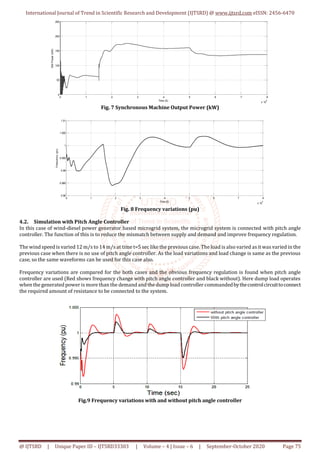
In thiscase the microgridsystem is run for 8 sec. The system contains variable load, whichis varied attimeinterval1.5sec.The
change in load is 175 kW to 350 kW, which causes frequency deviation can be seen from the respective figures. As the load
increases there is a dip in frequency (1 pu to 0.985 pu). Tomeet the demand the synchronous generatordrivenbydieselengine
increases its power, that can be seen in fig. 4.3. TheWTalso contributes momentarily, but WT is runningatthespeed12m/sso
it can not increase output power over a longer period and can be overloaded for shorter duration.
0 1 2 3 4 5 6 7 8
x 10
4
10
10.5
11
11.5
12
12.5
13
13.5
14
14.5
15
Time (s)
WindSpeed(m/s)
Fig.5 Wind Speed variations (m/s)
0 1 2 3 4 5 6 7 8
x 10
4
0
50
100
150
200
250
300
350
400
450
500
Time(s)
Load(kW)
Fig. 6 Variations in Load (kW)](https://image.slidesharecdn.com/11stabilizationandfrequencyregulationinmicrogridbycontrollingpitchangle-201119063655/85/Stabilization-and-Frequency-Regulation-in-Microgrid-by-Controlling-Pitch-Angle-5-320.jpg)
![International Journal of Trend in Scientific Research and Development (IJTSRD) @ www.ijtsrd.com eISSN: 2456-6470
@ IJTSRD | Unique Paper ID – IJTSRD33303 | Volume – 4 | Issue – 6 | September-October 2020 Page 76
0 1 2 3 4 5 6 7 8
x 10
4
0
50
100
150
200
250
Time (S)
SMPower(kW)
Fig.10 Synchronous Generator output power (With and without pitch angle controller)
V. CONCLUSIONS
In this papera wind-diesel based microgrid system is
simulated for the two cases. In first case there is no pitch
angle controller is used. The system is subjected to different
wind speeds and different load and the waveforms of
frequency, synchronous generator power,WTpowerandthe
power across load are shown.
In the second case the microgrid system is employed with
the pitch angle controller. These balancing mechanisms did
their work satisfactorily and help the microgrid system to
restore the frequency in better way when the system is
subjected to wind variations and the load variations.
REFERENCES
[1] N. Mendis, K. M. Muttaqi and S. Perera, "Active power
management of a super capacitor-battery hybrid
energy storage system for standalone operation of
DFIG based wind turbines," in Industry Applications
Society Annual Meeting (IAS), 2012 IEEE,2012,pp.1-8.
[2] Chengshan Wang, Mengxuan Liu and Li Guo,
"Cooperative operationand optimaldesignforislanded
microgrid," in Innovative Smart Grid Technologies
(ISGT), 2012 IEEE PES, 2012, pp. 1-8.
[3] Huang Chao-Hui, Zhang Xiao-Gang and Yao Xin-Li, "A
method for micro-gird automatic generation control,"
in 2011 International Conference on Electronics,
Communications andControl (ICECC), 2011, pp. 1224-
1227
[4] R. Gagnon, B. Saulnier, G. Sybille, P. Giroux; "Modeling
of a Generic High-Penetration No-Storage Wind-Diesel
System Using Matlab/Power SystemBlockset" in 2002
Global Wind power Conference, 2002, pp. 1-6.
[5] G. Mulder et all "Comparison of commercial battery
cells in relation to material properties," Electrochimica
Acta, vol. 87, 2013, pp. 473-488.
[6] S. Kuehl, P. Landsmann and R. M. Kennel,
"Compensating angle estimation errors caused by
magnetic saturation in anisotropy-based sensorless
control schemes," in Sensorless Control for Electrical
Drives (SLED), 2012 IEEE Symposium on, 2012, pp. 1-
6.
[7] Seul-Ki Kim, Eung-Sang Kim and Jong-Bo Ahn,
"Modeling and control of a grid-connected Wind/PV
hybrid generation system," in Transmission and
Distribution Conference and Exhibition, 2005/2006
IEEE PES, 2006, pp. 1202-1207.
[8] O. Krishan and S. Suhag, “An updated review of energy
storage systems: Classification and applications in
distributed generation power systems incorporating
renewable energy resources,” Int. J. Energy Res., no.
October, pp. 1–40, Nov. 2018.
[9] O. Krishan and S. Suhag, “Power management control
strategy for hybrid energy storage system in a grid-
independent hybrid renewable energy system: a
hardware-in-loop real-time verification,” IET Renew.
Power Gener., vol. 14, no. 3, pp. 454–465, Feb. 2020.
[10] O. Krishan and S. Suhag, “Techno-economic analysis of
a hybrid renewable energy system for an energy poor
rural community,” J. Energy Storage, vol. 23, pp. 305–
319, Jun. 2019.
[11] O. Krishan and S. Suhag, “A novel control strategy for a
hybrid energy storage system in a grid‐independent
hybrid renewable energy system,” Int. Trans. Electr.
Energy Syst., Dec. 2019.
[12] O. Krishan and S. Suhag, “Grid-independent PV system
hybridization with fuel cell-battery/supercapacitor:
Optimum sizing and comparative techno-economic
analysis,” Sustain. Energy Technol. Assessments, vol.
37, no. December 2019, p. 100625, Feb. 2020.
[13] O. Krishan and Sathans, “Frequency regulation in a
standalone wind-diesel hybrid power system using
pitch-angle controller,” in 2016 3rd International
Conference on Computing for Sustainable Global
Development (INDIACom), 2016, pp. 1148–1152.
[14] O. Krishanand Sathans,“Design and Techno-Economic
Analysis of a HRES in a Rural Village,” Procedia
Comput. Sci., vol. 125, pp. 321–328, 2018.
[15] O. Krishan and Sathans, “Optimum sizing and
economical assessment of grid integrated hybrid
system for a rural village: A case study,” in 2016 IEEE
1st International Conference on Power Electronics,
Intelligent Control and Energy Systems (ICPEICES),
2016, pp. 1–5.
[16] O. Krishan and Sathans, “Optimum sizing and techno-
economic analysis of grid-independent PV system
under different tracking systems,” in 2018 IEEE 8th
Power India InternationalConference (PIICON), 2018,
pp. 1–6.](https://image.slidesharecdn.com/11stabilizationandfrequencyregulationinmicrogridbycontrollingpitchangle-201119063655/85/Stabilization-and-Frequency-Regulation-in-Microgrid-by-Controlling-Pitch-Angle-7-320.jpg)
![International Journal of Trend in Scientific Research and Development (IJTSRD) @ www.ijtsrd.com eISSN: 2456-6470
@ IJTSRD | Unique Paper ID – IJTSRD33303 | Volume – 4 | Issue – 6 | September-October 2020 Page 77
[17] Siegfried Heier, Grid Integration of Wind Energy
Conversion Systems, 2nd ed., Wiley, 2006.
[18] L. Y. Paoand K. E. Johnson, "Control of Wind Turbines,"
Control Systems, IEEE, vol. 31, 2011, pp. 44-62.
[19] G. Mallesham, S. Mishra and A. N. Jha, "Ziegler-Nichols
based controller parameters tuning for load frequency
control in a microgrid," in Energy, Automation, and
Signal (ICEAS), 2011 InternationalConferenceon,2011,
pp. 1-8.
[20] J. Llanos, D. Saez, R. Palma-Behnke, A. Nunez and G.
Jimenez-Estevez, "Load profile generator and load
forecasting for a renewable based microgrid using self
organizing maps and neural networks," in Neural
Networks (IJCNN), the 2012 International Joint
Conference on, 2012, pp. 1-8.
[21] P. M. Anderson and A. Bose, "Stability Simulation of
Wind Turbine Systems," Power Apparatus and
Systems, IEEE Transactions on, vol. PAS-102, 1983,pp.
3791-3795.
[22] R. Rynkiewicz,"Dischargeand charge modeling oflead
acid batteries," in Applied Power Electronics
Conference and Exposition, 1999. APEC'99.Fourteenth
Annual, vol.2, 1999, pp. 707-710.
[23] MATHWORKSInc. UniversalBridge [Online].Available:
http://www.mathworks.com/help/physmod/powersy
s/ref/universalbridge.html.
[24] N. Mendis, K. M. Muttaqi, S. Sayeef and S. Perera,
"Application of a hybrid energy storage in a remote
area power supply system," in 2010 IEEE International
Energy Conference and Exhibition (EnergyCon), 2010,
pp. 576-581.
[25] MATHWORKS Inc. Excitation system [Online].
Available:
http://www.mathworks.com/help/physmod/powersy
s/ref/excitationsystem.html.
[26] Yeager, K. E.; Willis, J. R.; , "Modeling of emergency
diesel generators in an 800 megawatt nuclear power
plant," IEEE Transactions on Energy Conversion, vol.8,
no.3, Sep. 1993, pp.433-441.](https://image.slidesharecdn.com/11stabilizationandfrequencyregulationinmicrogridbycontrollingpitchangle-201119063655/85/Stabilization-and-Frequency-Regulation-in-Microgrid-by-Controlling-Pitch-Angle-8-320.jpg)


