International Research Journal of Engineering and Technology (IRJET) e-ISSN: 2395-0056
Volume: 06 Issue: 07 | July 2019 www.irjet.net p-ISSN: 2395-0072
© 2019, IRJET | Impact Factor value: 7.211 | ISO 9001:2008 Certified Journal | Page 2829
Image based Approach for Indian Fake Note Detection by Dark
Channel Prior
Revati1, Somashekhar Dhanyal2
1PG Student, Dept of Computer Science, Sharnbasva University, Karnataka, India
2Professor, Dept of Computer Science, Sharnbasva University, Karnataka, India
----------------------------------------------------------------------***---------------------------------------------------------------------
Abstract - In the recent years the currency manufacturing
has been under lot of security measures as it directly provides
the country economy health. Many of the criminal, illegal
activities will be executed from the use of the fake notes. These
fake notes will have same visibility of the original notes.
Normal human in normal conditions can’t detect these
differences hence may go cheated. Thus, the devices has been
designed and developed which has the capacity to detect the
fake notes.
The main objective of the proposed work is to provide an easy
and efficient system for the detection of the fake and the
original note based on the input image features. In this work
by using the digital image processing methods like, image
enhancement, image labelling, x-ray vision by dark channel
prior and feature based Fuzzy classification wehaveproposed
the fake note detection of Indian currencyatanaccuracyof 90
to 95%
Key Words: SVM Classifier, Fuzzy Classifier, Dark
Channel Prior.
1. INTRODUCTION
Currency duplication or the counterfeit of the currency is a
real threat to the national economy. It has been growing as
due to the advanced printing machines and scanning
machines based technology. To get rid many of the fake note
detection system based methods has been developed by
countries around the world which are generally hardware
based and they are costly. We have proposed the system to
detect original Indian currency notes by using the digital
image processing technology.
Fig1: Example of Indian Fake Note
2. RELATED WORK
[1] The author has proposed new method to detect fake
coins by using the images. The image is processed in the
dissimilarity space, a vector space which is initially
constructed by the comparison of the image by the
prototypes. Every individual featurevectordimension which
will measures gap in between the image under the reliable
consideration and based on the available proto type .Author
has used the methods like DOG and SIFT for the detector.
[2] Author has described the Effective Component based
Banknote method for the Recognition of the notes for Blind
people. In the case of the detection of forged notes system
need to identify denomination of every time the devices us
used with the ultraviolet light.
[3] Author has elaborated the technique for the Detection of
the currency by using the method for the Counterfeit
Currency by using the feature set value of the Bit-Plane Slice
Technique. New methodology has been proposed the bit
plane slicing based technique for the extraction of the most
significant data for the analysis of the counterfeit banknote
of the images used for the edge detector algorithm.
[4] Feature based approach for the categorizationofthetext
is the feature selection concentrated in this paper by author,
where only the original features are used in the input for
learning algorithms.
2.1 Proposed System Design
In the proposed work, we will develop a system to detect
fraud currency for Indian Notes. First take the input of the
given image and pre-process the given image. After pre-
processing, apply patternextractionbyclusteringandlaterX
ray vision is applied by dark channel prior window for
extraction of the inner as well as outer edges of the image.
Figure 2.General diagram for the proposed system
International Research Journal of Engineering and Technology (IRJET) e-ISSN: 2395-0056
Volume: 06 Issue: 07 | July 2019 www.irjet.net p-ISSN: 2395-0072
© 2019, IRJET | Impact Factor value: 7.211 | ISO 9001:2008 Certified Journal | Page 2830
3. METHODOLOGY
3.1 Image Acquisition
In Image acquisition, the reorganization of text acquires a
scanned image as associate input image and input image
should be in specific format like JPEG, BMT etc. These
pictures square measure non inheritable through a camera,
scanner or the other applicabledigital data inputdevice. This
command reads the grey scale from the file by the string
computer filename. If the file is not found in existing folder
or within the MATLAB path, then it specifies the total path
name.
3.2 Image Pre-Processing
Initially in proposed system, the given input image is
processed before passing it to the main system. . The output
of the preprocessing will be the lab image which will be
suitable for next processing.Thepreprocessingisa sequence
of operation that performs on scanned input images. It
primarily enhances the image illustration for higher
segmentation. The task of preprocessing is to phase the
required pattern from the imageandperform normalization,
noise filtering and smoothing. The preprocessing also
defines a solid illustration of the segmented model. After
segmentation, binarization procedure is used where it
convert a grey scale to a binary image.
 Image Resizing: If the input image has the
resolution of [1024*1600] then the processing of
the system may be slow due to the higher
resolution. Hence we need to convert it to the
required size. For example 255*255 byusinginbuilt
mat lab functions.
 Image Restoration:
It is a simple process of taking the corrupted pixels of image
and cleaning them. The restoration process allows the user
to adjust image contrast, brightnessandtheotherfeatures of
the image. It is not a de-noising method, but allows the user
to smoothening image by using the simple methodlikepoint
spread function, venar filter and de convolution method etc.
3.3 Image Enhancements
The image enhancement techniqueisdifferentfromonefield
to another field according to its objective. Enhancement of
the image includes the color transformation (if needed),
image contrast enhancement using imadjust ().
Figure 3: Mean Filter
3.4 X-Ray (Dark Channel Prior)
The x-ray vision in dark channel prior is passing if the light
in the image pixels. The processing works is done in the
brightest channel present in pixel cluster images are
considered to be the most pixel cluster opaque.
Hence the scene radiance of a color band can be defined as
follows:
J(x)=r(X)*A (1)
Where r ≤ 1, which is reflectness of the object point hence
pixel cluster image equation is as follows:
I(x)=R(x)*aT(x)+[1-t(x)]*A≤a (2)
When the distance of pixel is infinite within image that is t is
almost equals to 0,then brightest pixel of I is considered to
be most pixel cluster opaque and it is almost equal to A.
J(X) = R(x) [A+S] (3)
And also I(x) can be re written as
I(x) = R(x) st(x) +R(x) At(x) +1-t(x)*a (4)
 In the first step, the elimination of the light
orientation is performed from the available small
patches of I(x).
 In the second stage we considera global imageprior
which is more sensitive over dependencies over
pixel values towards the orientation of the sunlight.
By estimating the atmospheric light orientation,the
light scattering visibility scenes are mainly
dependent on the total distance of digital camera
and surface D(x).
 The grouping of pixel can be achieved in different
patches based on RGB color space with a color of
purple and brown circles. A geometrical relation
between every pair of patches is denoted by A as a
candidate pixel and amount of lightscatteringinthe
given median is denoted by β by considering these
constants a total seen transmission is given by
following equation
International Research Journal of Engineering and Technology (IRJET) e-ISSN: 2395-0056
Volume: 06 Issue: 07 | July 2019 www.irjet.net p-ISSN: 2395-0072
© 2019, IRJET | Impact Factor value: 7.211 | ISO 9001:2008 Certified Journal | Page 2831
T(x) =e Xp-Z d(x) 0 β Rx(S) (5)
Surface of which is a componentofR(x)inheritstheproperty
and hence it provides a constant surface in scene
transmission in many regions of image patches. This is a
assumptions which is used for achieving the de hazing and
we can derive the image patches as follows :
I(x) = Ti I 0(x) ri + (1-ti) (6)
A = i(x) Ri + CI a (7)
3.5 Image Labelling
Image labeling is a process of marking the value of the pixel
deviations based on the features effective. The need of the
labeling is important when they are of prorating has to in
multiple pixel list. The following stated has to be satisfied in
the image labeling.
 Initially Define the rectangular regions of interest
based on the pixel list (ROI) labels
 The pixel labeled ROI are used in these labels
 Later use of the built-in detection algorithms for the
analysis of the truth data.
 Write or import the pixel label and later use the
custom and the automation based algorithmsystemto
label ground truth.
 Later use the CCL for final labeling of the image pixel
as follows.
3.6 Classification Using the Fuzzy Classifier
The fuzzy based classifier is the new technology compare to
the classic neural network where the dataset is manipulated
based on the previous knowledge of the data. The fuzzy
based classifier performs the same operation as the neural
network but in the detailed manner with the number of the
iterations.
Figure 4: General Fuzzy Classifier
Fuzzy classification is the process of the grouping the
elements into the fuzzy set and the true value if proposed by
the surface and the edge values of it.
A fuzzy class: ~C = { i | ~Π(i) } defined as the
 ~C : fuzzy set satisfying each individual i
 ~Π: classification predicate of fuzzy a fuzzy
propositional function.
 ~{ .| .} : it is the domain of the fuzzy class operator.
 V: set of the variables
 ~PF: set of fuzzy propositional functions
 ~P(U):~{.|.}:V*~PF ? ~ P(U) (8)
Fuzzy propositional function ananalogousexpression which
contains more than one value variable the assignment these
variables make the expressiontothefuzzypropositionbased
on the variables.
The fuzzy classification is combining or grouping thesimilar
features variables together known as the fuzzy set.Thefuzzy
classification in the member function μ which will indicates
it whether each of the individual istheuniquememberofthe
given class, in terms only if it is fuzzy classificationpredicate
~П. µ : ~PF * U ? ~ T (9)
~T: set of the fuzzy truth variable of the values (ranging0 to
1).
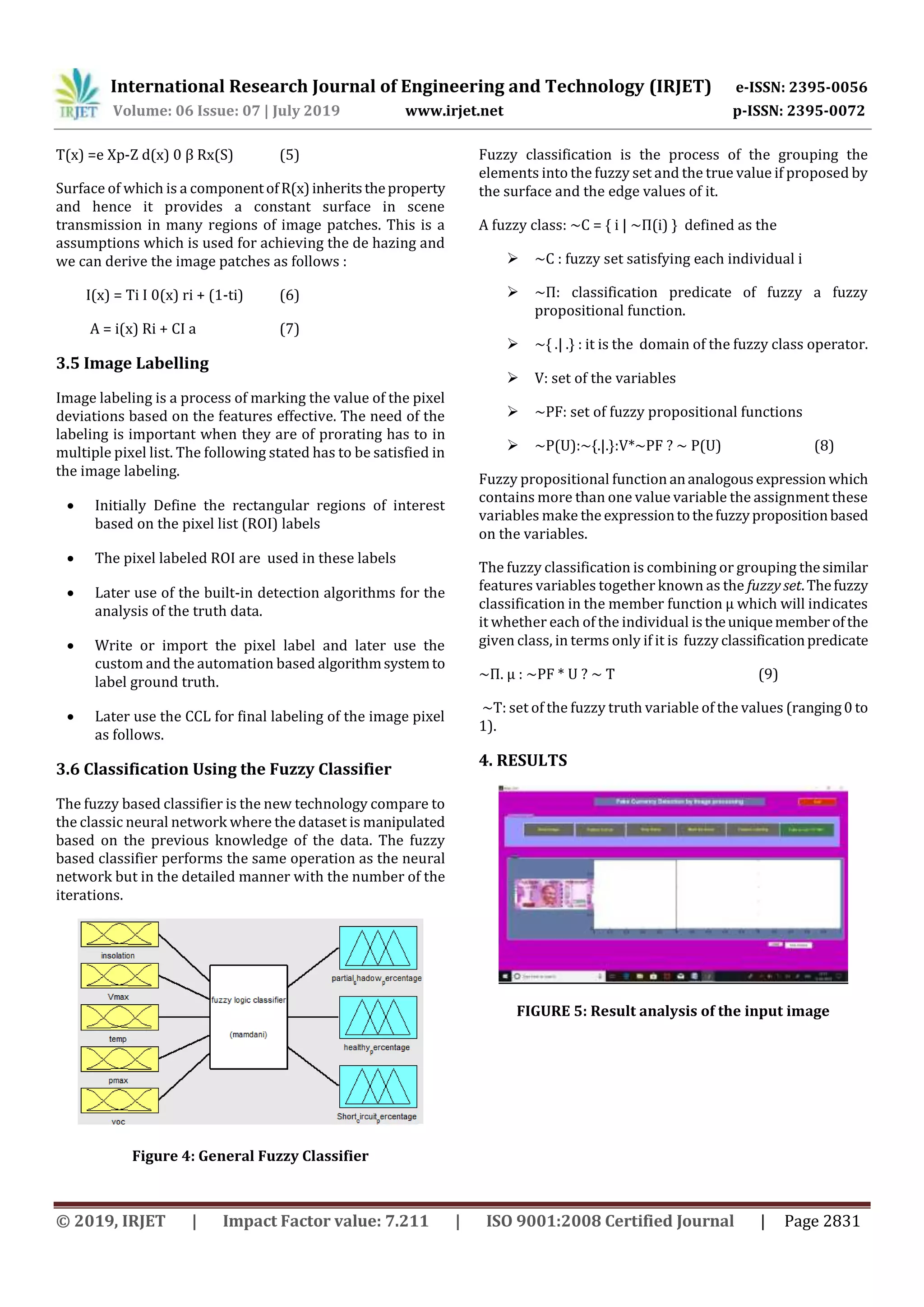
4. RESULTS
FIGURE 5: Result analysis of the input image
International Research Journal of Engineering and Technology (IRJET) e-ISSN: 2395-0056
Volume: 06 Issue: 07 | July 2019 www.irjet.net p-ISSN: 2395-0072
© 2019, IRJET | Impact Factor value: 7.211 | ISO 9001:2008 Certified Journal | Page 2832
FIGURE 6: After pattern extract passing to X-Ray vision
FIGURE 7: Feature Labeling of the extracted pixels
FIGURE 8: RESULT
5. CONCLUSION AND FUTURE SCOPE
By using digital image processing, analysis of Currency
image is more accurate as well as this method is efficient in
terms of cost and time consuming compared to existing
techniques. MATLAB Software is used for this analysis.
The proposed work for the Indian fake note detection has
been a success as it able to classify the images based on the
feature vector generated. These imageshasbeencollectedin
the real time environment and processed in the Matlab
simulation. The methods such as clustering, pixel labeling,
dark channel prior and fuzzy classifier has been used to get
the result as effective as possible. The system is worked
effectively for extracting features of Indian currencyimages.
Extracted features of currency image will be using for
currency value recognition as well as for its verification.
Future work includes the detection of the multiple types of
currency like dollar, ponds, Euros etc by using the standard
dataset.
6. REFERENCES
[1] Li Liu, Yue Lu - “An image based approach to detection of
fake coins” in IEEE Transactions on Information forensics
and security.June 2017.
[2] A. Roy - “Machine assisted authentication of paper
currency. An experiment on Indian Bank notes”.
International Journal onDocumentAnalysisandRecognition
18(3): 271-285.
[3] un ke – “Detection of Counterfeit Coins and Assessment
of Coin Qualities. IEEE Conference 2015.
[4] Li Liu –“Variable length signature for near duplicate
image matching “.IEEE Conference 2015.
[5] Jongpil Kim-“Ancient coin recognition based on spatial
coding”. IEEE conference 2015.
[6] R.C.Gonzalez and R.E.Woods , Digital Image Processing
second edition,Prentice Hall India. M.Young –“ The technical
writers hand book” Mill Valley CA: university science 1989.
[7] Ms.Rumi Ghosh, Mr.Rakesh Khare-“a study on Diverse
recognition techniques for Indian Currency Note”.
IJSERT.vol.2, Issue 6, 2013.
[8] Amol.A, Shrishant , S.D.Bharkad – “Survey on currency
recognitionsystemusingimageprocessing”.IJCERvol 3,Issue
7, July 2013.
[9] M.Deborah and Soniya Pratap –“Detection of fake
currency usingimageprocessing”,IJISET,vol 1,issue10-2014.
[10] Faiz M Huzzman , Xiadong Yang and Yang li Tan, Senior
Member , IEEE “Robust and Effetive Component based bank
note detection for blind”,.IEEE 2012.

IRJET- Image based Approach for Indian Fake Note Detection by Dark Channel Prior

  • 1.
    International Research Journalof Engineering and Technology (IRJET) e-ISSN: 2395-0056 Volume: 06 Issue: 07 | July 2019 www.irjet.net p-ISSN: 2395-0072 © 2019, IRJET | Impact Factor value: 7.211 | ISO 9001:2008 Certified Journal | Page 2829 Image based Approach for Indian Fake Note Detection by Dark Channel Prior Revati1, Somashekhar Dhanyal2 1PG Student, Dept of Computer Science, Sharnbasva University, Karnataka, India 2Professor, Dept of Computer Science, Sharnbasva University, Karnataka, India ----------------------------------------------------------------------***--------------------------------------------------------------------- Abstract - In the recent years the currency manufacturing has been under lot of security measures as it directly provides the country economy health. Many of the criminal, illegal activities will be executed from the use of the fake notes. These fake notes will have same visibility of the original notes. Normal human in normal conditions can’t detect these differences hence may go cheated. Thus, the devices has been designed and developed which has the capacity to detect the fake notes. The main objective of the proposed work is to provide an easy and efficient system for the detection of the fake and the original note based on the input image features. In this work by using the digital image processing methods like, image enhancement, image labelling, x-ray vision by dark channel prior and feature based Fuzzy classification wehaveproposed the fake note detection of Indian currencyatanaccuracyof 90 to 95% Key Words: SVM Classifier, Fuzzy Classifier, Dark Channel Prior. 1. INTRODUCTION Currency duplication or the counterfeit of the currency is a real threat to the national economy. It has been growing as due to the advanced printing machines and scanning machines based technology. To get rid many of the fake note detection system based methods has been developed by countries around the world which are generally hardware based and they are costly. We have proposed the system to detect original Indian currency notes by using the digital image processing technology. Fig1: Example of Indian Fake Note 2. RELATED WORK [1] The author has proposed new method to detect fake coins by using the images. The image is processed in the dissimilarity space, a vector space which is initially constructed by the comparison of the image by the prototypes. Every individual featurevectordimension which will measures gap in between the image under the reliable consideration and based on the available proto type .Author has used the methods like DOG and SIFT for the detector. [2] Author has described the Effective Component based Banknote method for the Recognition of the notes for Blind people. In the case of the detection of forged notes system need to identify denomination of every time the devices us used with the ultraviolet light. [3] Author has elaborated the technique for the Detection of the currency by using the method for the Counterfeit Currency by using the feature set value of the Bit-Plane Slice Technique. New methodology has been proposed the bit plane slicing based technique for the extraction of the most significant data for the analysis of the counterfeit banknote of the images used for the edge detector algorithm. [4] Feature based approach for the categorizationofthetext is the feature selection concentrated in this paper by author, where only the original features are used in the input for learning algorithms. 2.1 Proposed System Design In the proposed work, we will develop a system to detect fraud currency for Indian Notes. First take the input of the given image and pre-process the given image. After pre- processing, apply patternextractionbyclusteringandlaterX ray vision is applied by dark channel prior window for extraction of the inner as well as outer edges of the image. Figure 2.General diagram for the proposed system
  • 2.
    International Research Journalof Engineering and Technology (IRJET) e-ISSN: 2395-0056 Volume: 06 Issue: 07 | July 2019 www.irjet.net p-ISSN: 2395-0072 © 2019, IRJET | Impact Factor value: 7.211 | ISO 9001:2008 Certified Journal | Page 2830 3. METHODOLOGY 3.1 Image Acquisition In Image acquisition, the reorganization of text acquires a scanned image as associate input image and input image should be in specific format like JPEG, BMT etc. These pictures square measure non inheritable through a camera, scanner or the other applicabledigital data inputdevice. This command reads the grey scale from the file by the string computer filename. If the file is not found in existing folder or within the MATLAB path, then it specifies the total path name. 3.2 Image Pre-Processing Initially in proposed system, the given input image is processed before passing it to the main system. . The output of the preprocessing will be the lab image which will be suitable for next processing.Thepreprocessingisa sequence of operation that performs on scanned input images. It primarily enhances the image illustration for higher segmentation. The task of preprocessing is to phase the required pattern from the imageandperform normalization, noise filtering and smoothing. The preprocessing also defines a solid illustration of the segmented model. After segmentation, binarization procedure is used where it convert a grey scale to a binary image.  Image Resizing: If the input image has the resolution of [1024*1600] then the processing of the system may be slow due to the higher resolution. Hence we need to convert it to the required size. For example 255*255 byusinginbuilt mat lab functions.  Image Restoration: It is a simple process of taking the corrupted pixels of image and cleaning them. The restoration process allows the user to adjust image contrast, brightnessandtheotherfeatures of the image. It is not a de-noising method, but allows the user to smoothening image by using the simple methodlikepoint spread function, venar filter and de convolution method etc. 3.3 Image Enhancements The image enhancement techniqueisdifferentfromonefield to another field according to its objective. Enhancement of the image includes the color transformation (if needed), image contrast enhancement using imadjust (). Figure 3: Mean Filter 3.4 X-Ray (Dark Channel Prior) The x-ray vision in dark channel prior is passing if the light in the image pixels. The processing works is done in the brightest channel present in pixel cluster images are considered to be the most pixel cluster opaque. Hence the scene radiance of a color band can be defined as follows: J(x)=r(X)*A (1) Where r ≤ 1, which is reflectness of the object point hence pixel cluster image equation is as follows: I(x)=R(x)*aT(x)+[1-t(x)]*A≤a (2) When the distance of pixel is infinite within image that is t is almost equals to 0,then brightest pixel of I is considered to be most pixel cluster opaque and it is almost equal to A. J(X) = R(x) [A+S] (3) And also I(x) can be re written as I(x) = R(x) st(x) +R(x) At(x) +1-t(x)*a (4)  In the first step, the elimination of the light orientation is performed from the available small patches of I(x).  In the second stage we considera global imageprior which is more sensitive over dependencies over pixel values towards the orientation of the sunlight. By estimating the atmospheric light orientation,the light scattering visibility scenes are mainly dependent on the total distance of digital camera and surface D(x).  The grouping of pixel can be achieved in different patches based on RGB color space with a color of purple and brown circles. A geometrical relation between every pair of patches is denoted by A as a candidate pixel and amount of lightscatteringinthe given median is denoted by β by considering these constants a total seen transmission is given by following equation
  • 3.
    International Research Journalof Engineering and Technology (IRJET) e-ISSN: 2395-0056 Volume: 06 Issue: 07 | July 2019 www.irjet.net p-ISSN: 2395-0072 © 2019, IRJET | Impact Factor value: 7.211 | ISO 9001:2008 Certified Journal | Page 2831 T(x) =e Xp-Z d(x) 0 β Rx(S) (5) Surface of which is a componentofR(x)inheritstheproperty and hence it provides a constant surface in scene transmission in many regions of image patches. This is a assumptions which is used for achieving the de hazing and we can derive the image patches as follows : I(x) = Ti I 0(x) ri + (1-ti) (6) A = i(x) Ri + CI a (7) 3.5 Image Labelling Image labeling is a process of marking the value of the pixel deviations based on the features effective. The need of the labeling is important when they are of prorating has to in multiple pixel list. The following stated has to be satisfied in the image labeling.  Initially Define the rectangular regions of interest based on the pixel list (ROI) labels  The pixel labeled ROI are used in these labels  Later use of the built-in detection algorithms for the analysis of the truth data.  Write or import the pixel label and later use the custom and the automation based algorithmsystemto label ground truth.  Later use the CCL for final labeling of the image pixel as follows. 3.6 Classification Using the Fuzzy Classifier The fuzzy based classifier is the new technology compare to the classic neural network where the dataset is manipulated based on the previous knowledge of the data. The fuzzy based classifier performs the same operation as the neural network but in the detailed manner with the number of the iterations. Figure 4: General Fuzzy Classifier Fuzzy classification is the process of the grouping the elements into the fuzzy set and the true value if proposed by the surface and the edge values of it. A fuzzy class: ~C = { i | ~Π(i) } defined as the  ~C : fuzzy set satisfying each individual i  ~Π: classification predicate of fuzzy a fuzzy propositional function.  ~{ .| .} : it is the domain of the fuzzy class operator.  V: set of the variables  ~PF: set of fuzzy propositional functions  ~P(U):~{.|.}:V*~PF ? ~ P(U) (8) Fuzzy propositional function ananalogousexpression which contains more than one value variable the assignment these variables make the expressiontothefuzzypropositionbased on the variables. The fuzzy classification is combining or grouping thesimilar features variables together known as the fuzzy set.Thefuzzy classification in the member function μ which will indicates it whether each of the individual istheuniquememberofthe given class, in terms only if it is fuzzy classificationpredicate ~П. µ : ~PF * U ? ~ T (9) ~T: set of the fuzzy truth variable of the values (ranging0 to 1). 4. RESULTS FIGURE 5: Result analysis of the input image
  • 4.
    International Research Journalof Engineering and Technology (IRJET) e-ISSN: 2395-0056 Volume: 06 Issue: 07 | July 2019 www.irjet.net p-ISSN: 2395-0072 © 2019, IRJET | Impact Factor value: 7.211 | ISO 9001:2008 Certified Journal | Page 2832 FIGURE 6: After pattern extract passing to X-Ray vision FIGURE 7: Feature Labeling of the extracted pixels FIGURE 8: RESULT 5. CONCLUSION AND FUTURE SCOPE By using digital image processing, analysis of Currency image is more accurate as well as this method is efficient in terms of cost and time consuming compared to existing techniques. MATLAB Software is used for this analysis. The proposed work for the Indian fake note detection has been a success as it able to classify the images based on the feature vector generated. These imageshasbeencollectedin the real time environment and processed in the Matlab simulation. The methods such as clustering, pixel labeling, dark channel prior and fuzzy classifier has been used to get the result as effective as possible. The system is worked effectively for extracting features of Indian currencyimages. Extracted features of currency image will be using for currency value recognition as well as for its verification. Future work includes the detection of the multiple types of currency like dollar, ponds, Euros etc by using the standard dataset. 6. REFERENCES [1] Li Liu, Yue Lu - “An image based approach to detection of fake coins” in IEEE Transactions on Information forensics and security.June 2017. [2] A. Roy - “Machine assisted authentication of paper currency. An experiment on Indian Bank notes”. International Journal onDocumentAnalysisandRecognition 18(3): 271-285. [3] un ke – “Detection of Counterfeit Coins and Assessment of Coin Qualities. IEEE Conference 2015. [4] Li Liu –“Variable length signature for near duplicate image matching “.IEEE Conference 2015. [5] Jongpil Kim-“Ancient coin recognition based on spatial coding”. IEEE conference 2015. [6] R.C.Gonzalez and R.E.Woods , Digital Image Processing second edition,Prentice Hall India. M.Young –“ The technical writers hand book” Mill Valley CA: university science 1989. [7] Ms.Rumi Ghosh, Mr.Rakesh Khare-“a study on Diverse recognition techniques for Indian Currency Note”. IJSERT.vol.2, Issue 6, 2013. [8] Amol.A, Shrishant , S.D.Bharkad – “Survey on currency recognitionsystemusingimageprocessing”.IJCERvol 3,Issue 7, July 2013. [9] M.Deborah and Soniya Pratap –“Detection of fake currency usingimageprocessing”,IJISET,vol 1,issue10-2014. [10] Faiz M Huzzman , Xiadong Yang and Yang li Tan, Senior Member , IEEE “Robust and Effetive Component based bank note detection for blind”,.IEEE 2012.