International Journal of Computer Applications Technology and Research
Volume 13–Issue 09, 14 – 26, 2024, ISSN:-2319–8656
DOI:10.7753/IJCATR1309.1002
www.ijcat.com 14
The Intersection of Artificial Intelligence and
Cybersecurity: Safeguarding Data Privacy and
Information Integrity in The Digital Age
Engr. Joseph Nnaemeka
Chukwunweike MNSE, MIET
Automation / Process Control
Engineer,
Gist Limited
London, United Kingdom
Praise Ayomide Ayodele
School of Technology
University of Central Missouri, USA
Moshood Yussuf, MSc
Western Illinois University -
Department of Economics and Decision science
Macomb, Illinois
USA
Bashirat Bukola Atata
Founder, D’Tech Law Guide
USA
Abstract: As artificial intelligence (AI) becomes increasingly integrated into various sectors, its impact on cybersecurity, data privacy,
and information protection has grown significantly. This article explores the symbiotic relationship between AI and cybersecurity,
focusing on how AI-driven solutions can both enhance and challenge data privacy and information integrity. It delves into the dual-
edged nature of AI in cybersecurity, examining its potential to strengthen defenses against cyber threats while also raising concerns
about privacy and security. Key areas of focus include AI's role in threat detection and response, the implications of AI for data
privacy regulations, and the ethical considerations surrounding AI's use in information protection. The article also discusses strategies
for balancing innovation in AI with the need for robust privacy and security measures, ensuring that the integrity of personal and
organizational data is maintained in an increasingly interconnected world
Keywords: 1. AI-driven Cybersecurity, 2. Data Privacy, 3. Threat Detection, 4. Information Integrity, 5. Ethical Considerations, 6.
Privacy Regulations.
1. INTRODUCTION
Overview of AI and Cybersecurity
Artificial intelligence (AI) has rapidly evolved into a
transformative technology, reshaping numerous sectors, from
healthcare to finance, by enabling smarter decision-making
and automation. In cybersecurity, AI plays a crucial role in
enhancing defense mechanisms by analysing vast amounts of
data to identify patterns, detect anomalies, and respond to
threats in real time. Unlike traditional cybersecurity methods
that rely heavily on predefined rules, AI-driven solutions,
such as machine learning algorithms and neural networks,
offer a dynamic approach, adapting to new threats as they
emerge.
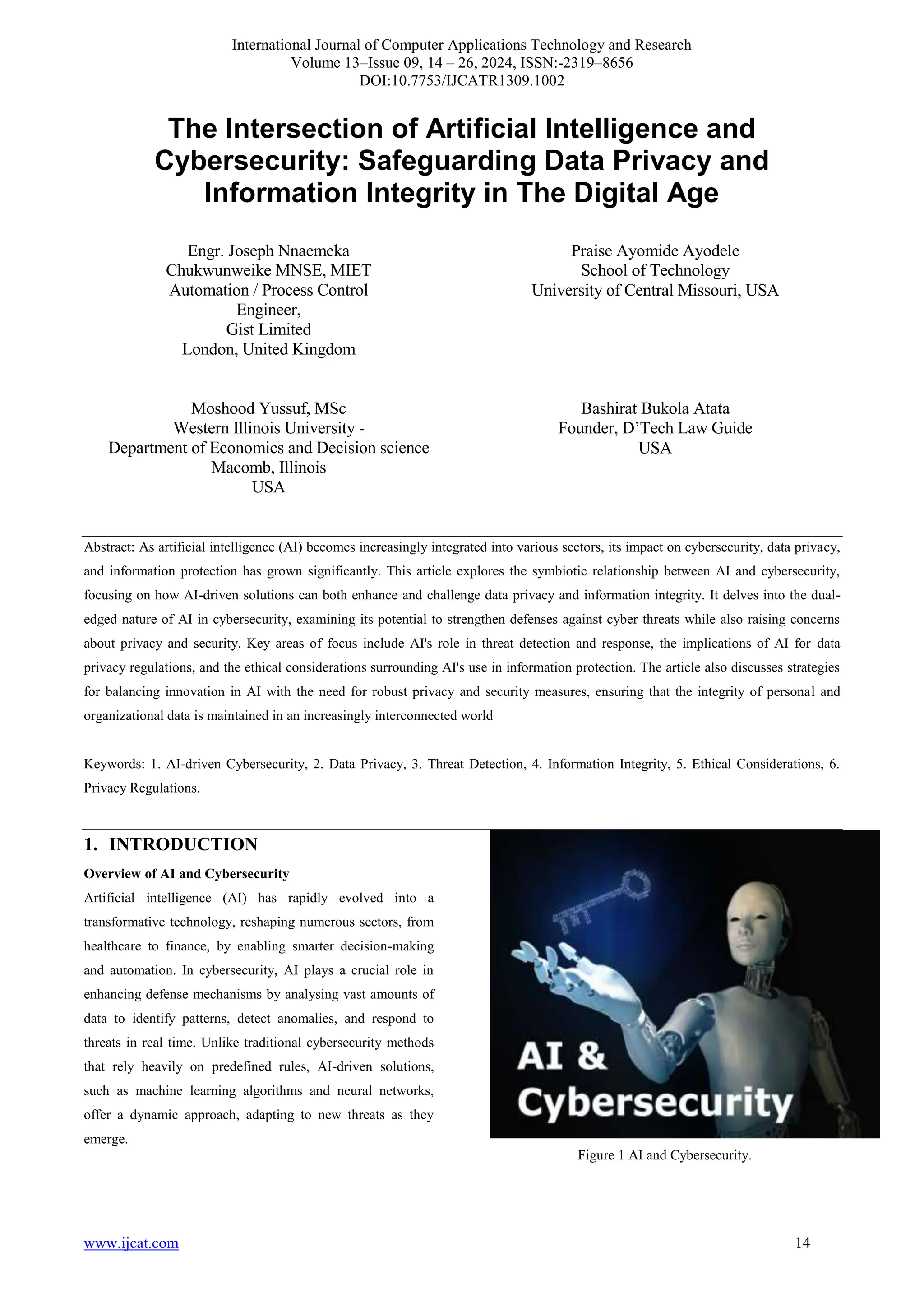
Figure 1 AI and Cybersecurity.
International Journal of Computer Applications Technology and Research
Volume 13–Issue 09, 14 – 26, 2024, ISSN:-2319–8656
DOI:10.7753/IJCATR1309.1002
www.ijcat.com 15
These capabilities are essential in a landscape where cyber
threats are becoming increasingly sophisticated, requiring
proactive rather than reactive measures (Ahmad et al., 2021).
As AI continues to integrate into cybersecurity frameworks, it
promises to improve the efficiency and effectiveness of threat
detection and mitigation, although it also introduces new
challenges in maintaining control over these powerful
technologies (Ghafir et al., 2020).
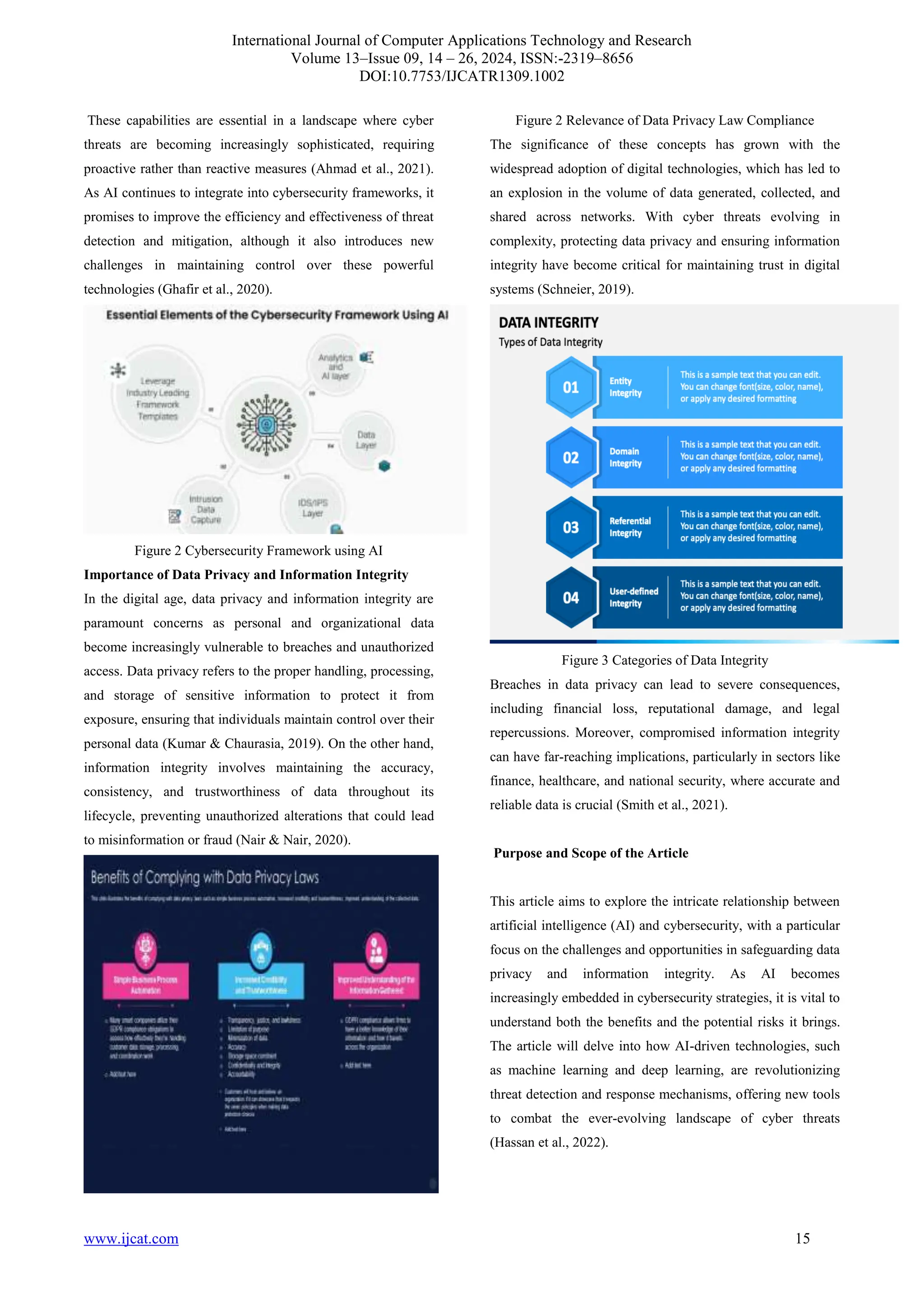
Figure 2 Cybersecurity Framework using AI
Importance of Data Privacy and Information Integrity
In the digital age, data privacy and information integrity are
paramount concerns as personal and organizational data
become increasingly vulnerable to breaches and unauthorized
access. Data privacy refers to the proper handling, processing,
and storage of sensitive information to protect it from
exposure, ensuring that individuals maintain control over their
personal data (Kumar & Chaurasia, 2019). On the other hand,
information integrity involves maintaining the accuracy,
consistency, and trustworthiness of data throughout its
lifecycle, preventing unauthorized alterations that could lead
to misinformation or fraud (Nair & Nair, 2020).
Figure 2 Relevance of Data Privacy Law Compliance
The significance of these concepts has grown with the
widespread adoption of digital technologies, which has led to
an explosion in the volume of data generated, collected, and
shared across networks. With cyber threats evolving in
complexity, protecting data privacy and ensuring information
integrity have become critical for maintaining trust in digital
systems (Schneier, 2019).
Figure 3 Categories of Data Integrity
Breaches in data privacy can lead to severe consequences,
including financial loss, reputational damage, and legal
repercussions. Moreover, compromised information integrity
can have far-reaching implications, particularly in sectors like
finance, healthcare, and national security, where accurate and
reliable data is crucial (Smith et al., 2021).
Purpose and Scope of the Article
This article aims to explore the intricate relationship between
artificial intelligence (AI) and cybersecurity, with a particular
focus on the challenges and opportunities in safeguarding data
privacy and information integrity. As AI becomes
increasingly embedded in cybersecurity strategies, it is vital to
understand both the benefits and the potential risks it brings.
The article will delve into how AI-driven technologies, such
as machine learning and deep learning, are revolutionizing
threat detection and response mechanisms, offering new tools
to combat the ever-evolving landscape of cyber threats
(Hassan et al., 2022).
International Journal of Computer Applications Technology and Research
Volume 13–Issue 09, 14 – 26, 2024, ISSN:-2319–8656
DOI:10.7753/IJCATR1309.1002
www.ijcat.com 16
However, the integration of AI in cybersecurity also raises
significant concerns regarding data privacy and the integrity
of information. The article will examine these issues,
discussing the ethical and legal implications of AI use, and
how organizations can strike a balance between leveraging AI
for enhanced security and maintaining robust privacy
protections (Binns, 2018). Additionally, the article will
provide insights into current and emerging trends at the
intersection of AI and cybersecurity, offering
recommendations for best practices and frameworks that can
help organizations navigate this complex terrain (Zhou &
Kapoor, 2021). Ultimately, the goal is to contribute to the
ongoing discourse on how to effectively harness AI in
cybersecurity while safeguarding the fundamental principles
of data privacy and information integrity.
2. BACKGROUND AND CONTEXT
Evolution of Cybersecurity Threats
Cybersecurity threats have evolved significantly since the
inception of computing technology. In the early days, threats
were relatively simple and often consisted of basic forms of
malware and viruses designed to disrupt or damage systems.
As technology advanced, so did the sophistication of cyber
threats. The 1990s saw the emergence of more complex
malware such as worms and trojans, which could spread
across networks and cause widespread damage (Anderson,
2019). The rise of the internet and interconnected systems
further compounded the problem, leading to the development
of sophisticated attacks like Distributed Denial of Service
(DDoS) and advanced persistent threats (APTs) (Zargar et al.,
2013).
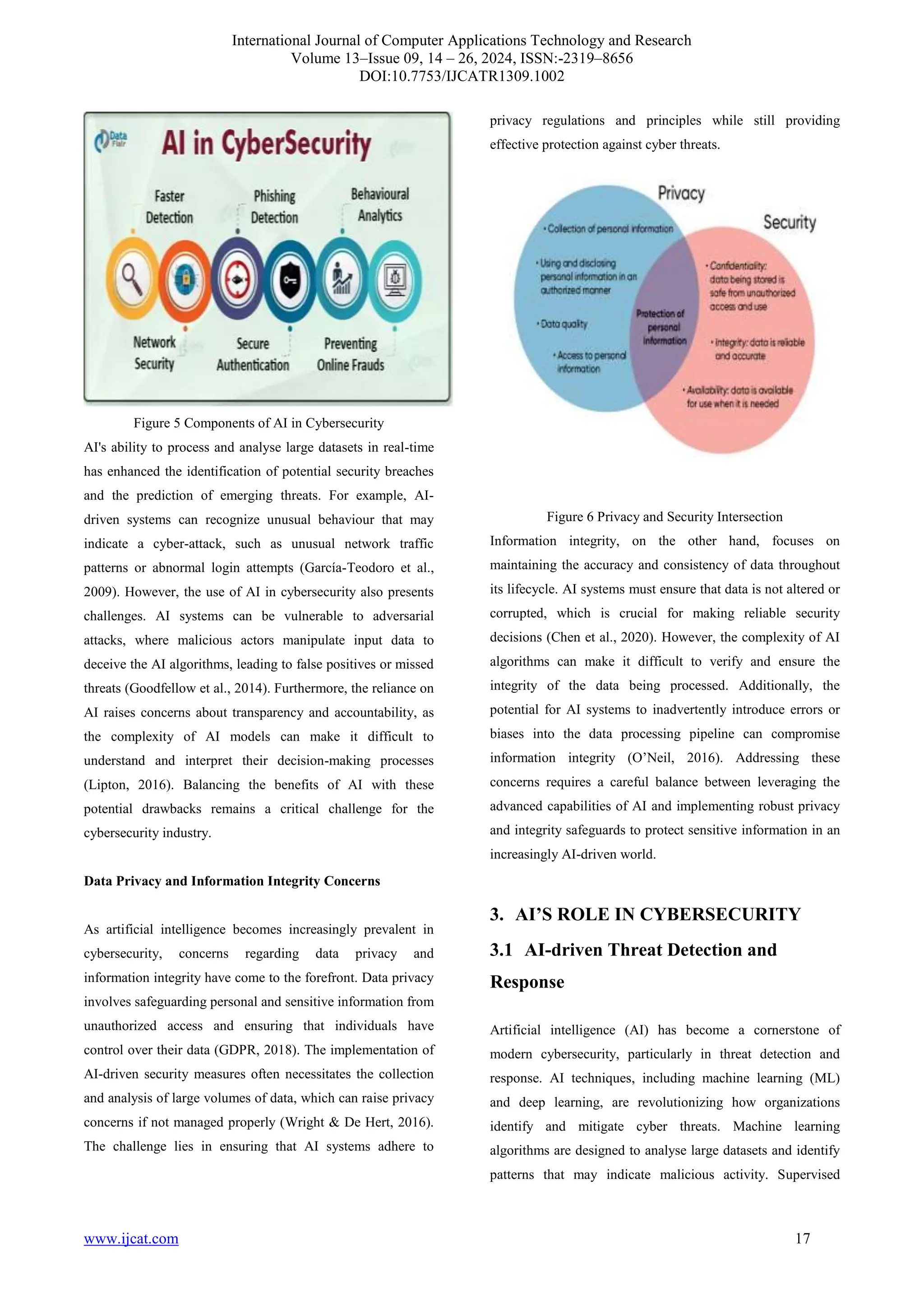
Figure 4 Evolution of Cyber Threats
The 2000s and 2010s marked a significant shift as
cybercriminals began leveraging vulnerabilities in software
and exploiting human factors such as phishing to gain
unauthorized access to sensitive information (Symantec,
2020). Ransomware attacks, which encrypt data and demand a
ransom for decryption, became increasingly prevalent,
targeting both individuals and organizations with devastating
financial consequences (Europol, 2021). In recent years, the
proliferation of Internet of Things (IoT) devices and cloud
computing has introduced new attack vectors, requiring
advanced security measures to address these emerging threats
(Roman et al., 2013). This evolution underscores the need for
continuous adaptation and innovation in cybersecurity
strategies to combat the increasingly sophisticated and diverse
nature of cyber threats.
Rise of Artificial Intelligence in Cybersecurity
The integration of artificial intelligence (AI) into
cybersecurity has transformed the landscape of threat
detection and response. AI technologies, particularly machine
learning and deep learning, have been adopted to analyse vast
amounts of data, identify patterns, and detect anomalies with
unprecedented accuracy (Chandola et al., 2009). These
capabilities enable proactive threat detection and automated
response mechanisms, significantly improving the efficiency
of cybersecurity operations (Bertino & Sandhu, 2010).
International Journal of Computer Applications Technology and Research
Volume 13–Issue 09, 14 – 26, 2024, ISSN:-2319–8656
DOI:10.7753/IJCATR1309.1002
www.ijcat.com 17
Figure 5 Components of AI in Cybersecurity
AI's ability to process and analyse large datasets in real-time
has enhanced the identification of potential security breaches
and the prediction of emerging threats. For example, AI-
driven systems can recognize unusual behaviour that may
indicate a cyber-attack, such as unusual network traffic
patterns or abnormal login attempts (García-Teodoro et al.,
2009). However, the use of AI in cybersecurity also presents
challenges. AI systems can be vulnerable to adversarial
attacks, where malicious actors manipulate input data to
deceive the AI algorithms, leading to false positives or missed
threats (Goodfellow et al., 2014). Furthermore, the reliance on
AI raises concerns about transparency and accountability, as
the complexity of AI models can make it difficult to
understand and interpret their decision-making processes
(Lipton, 2016). Balancing the benefits of AI with these
potential drawbacks remains a critical challenge for the
cybersecurity industry.
Data Privacy and Information Integrity Concerns
As artificial intelligence becomes increasingly prevalent in
cybersecurity, concerns regarding data privacy and
information integrity have come to the forefront. Data privacy
involves safeguarding personal and sensitive information from
unauthorized access and ensuring that individuals have
control over their data (GDPR, 2018). The implementation of
AI-driven security measures often necessitates the collection
and analysis of large volumes of data, which can raise privacy
concerns if not managed properly (Wright & De Hert, 2016).
The challenge lies in ensuring that AI systems adhere to
privacy regulations and principles while still providing
effective protection against cyber threats.
Figure 6 Privacy and Security Intersection
Information integrity, on the other hand, focuses on
maintaining the accuracy and consistency of data throughout
its lifecycle. AI systems must ensure that data is not altered or
corrupted, which is crucial for making reliable security
decisions (Chen et al., 2020). However, the complexity of AI
algorithms can make it difficult to verify and ensure the
integrity of the data being processed. Additionally, the
potential for AI systems to inadvertently introduce errors or
biases into the data processing pipeline can compromise
information integrity (O’Neil, 2016). Addressing these
concerns requires a careful balance between leveraging the
advanced capabilities of AI and implementing robust privacy
and integrity safeguards to protect sensitive information in an
increasingly AI-driven world.
3. AI’S ROLE IN CYBERSECURITY
3.1 AI-driven Threat Detection and
Response
Artificial intelligence (AI) has become a cornerstone of
modern cybersecurity, particularly in threat detection and
response. AI techniques, including machine learning (ML)
and deep learning, are revolutionizing how organizations
identify and mitigate cyber threats. Machine learning
algorithms are designed to analyse large datasets and identify
patterns that may indicate malicious activity. Supervised
International Journal of Computer Applications Technology and Research
Volume 13–Issue 09, 14 – 26, 2024, ISSN:-2319–8656
DOI:10.7753/IJCATR1309.1002
www.ijcat.com 18
learning, for instance, involves training algorithms on labelled
datasets to recognize known threats, while unsupervised
learning can identify anomalies in data that might signify
novel or evolving threats (Chandola et al., 2009). Deep
learning, a subset of machine learning, utilizes neural
networks with multiple layers to perform complex pattern
recognition tasks. Deep learning models, such as
convolutional neural networks (CNNs) and recurrent neural
networks (RNNs), excel in analysing high-dimensional data,
such as network traffic and system logs. CNNs are
particularly effective in identifying patterns in visual data,
which can be applied to graphical representations of network
activity, while RNNs are adept at processing sequential data,
making them suitable for analysing time-series data from
network traffic (LeCun et al., 2015).
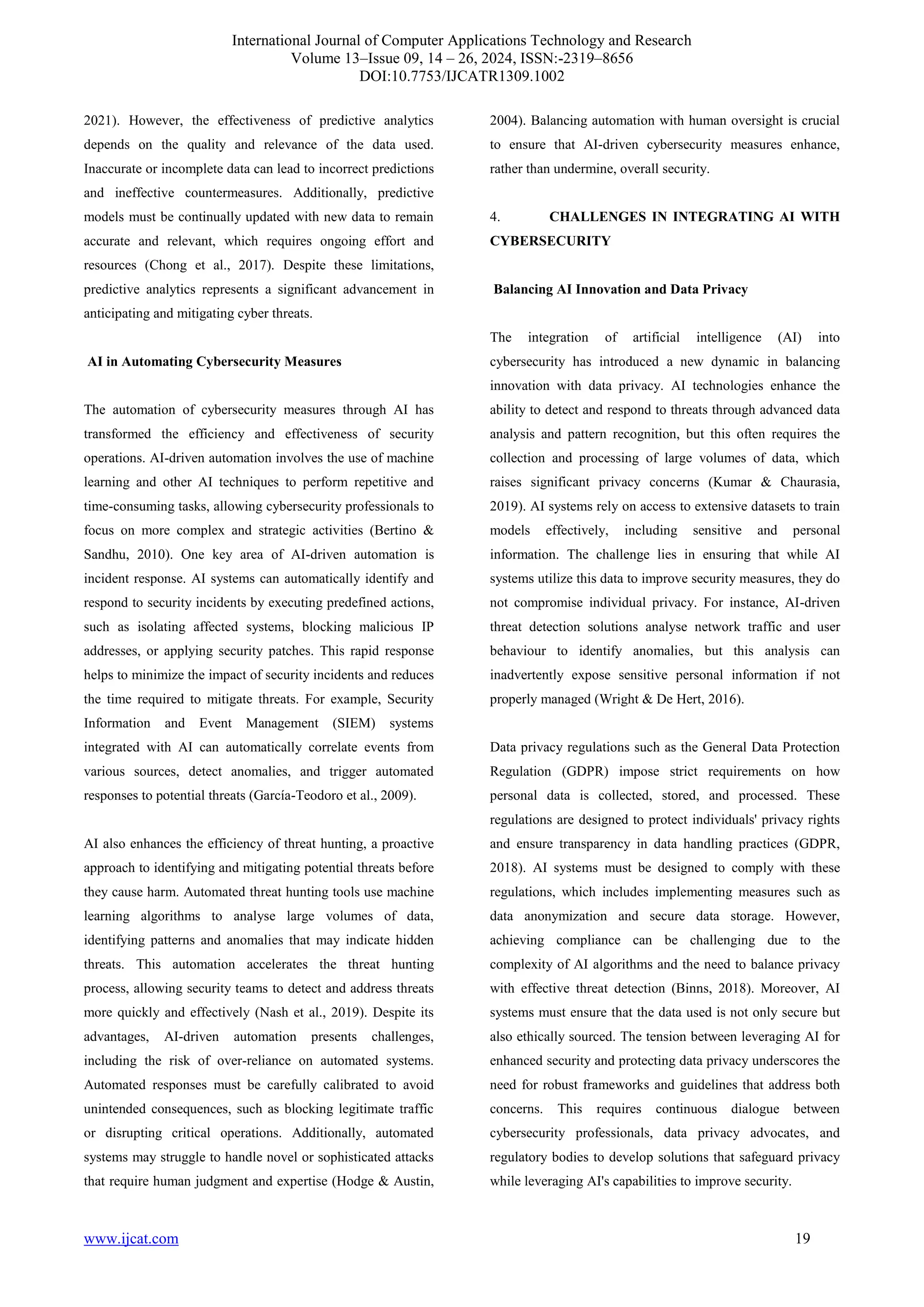
Figure 7AI and Automation for Threat Management
AI-driven threat detection systems continuously learn from
new data, allowing them to adapt to emerging threats. For
example, advanced threat detection systems use anomaly
detection algorithms to identify deviations from normal
behaviour, flagging potential security incidents in real time.
This dynamic approach enables organizations to respond to
threats more swiftly and accurately compared to traditional
signature-based methods, which rely on known patterns of
malicious activity (Hodge & Austin, 2004). However, AI
systems are not without challenges. They require vast
amounts of data to train effectively, and the quality of threat
detection depends on the quality of the data. Additionally, AI
models can be susceptible to adversarial attacks, where
malicious actors manipulate input data to deceive the
algorithms, leading to false positives or missed threats
(Goodfellow et al., 2014). Despite these challenges, AI
remains a powerful tool in the arsenal of cybersecurity
professionals.
AI and Predictive Analytics in Cybersecurity
Predictive analytics, powered by AI, offers significant
advancements in pre-empting cyber threats by analysing
historical data to forecast potential security incidents.
Predictive models leverage machine learning algorithms to
analyse patterns and trends in historical attack data, helping
organizations anticipate and prepare for future threats
(Davenport & Harris, 2017). These models can identify
vulnerabilities and predict attack vectors before they are
exploited, allowing for proactive defense measures. For
example, predictive analytics can be used to forecast the
likelihood of a data breach based on historical attack data and
current threat intelligence. By analysing patterns of past
breaches, including attack vectors, targets, and methods,
predictive models can estimate the probability of similar
attacks occurring in the future. This information enables
organizations to prioritize their cybersecurity efforts, focusing
on the most likely threats and strengthening defenses in those
areas (Buczak & Guven, 2016).
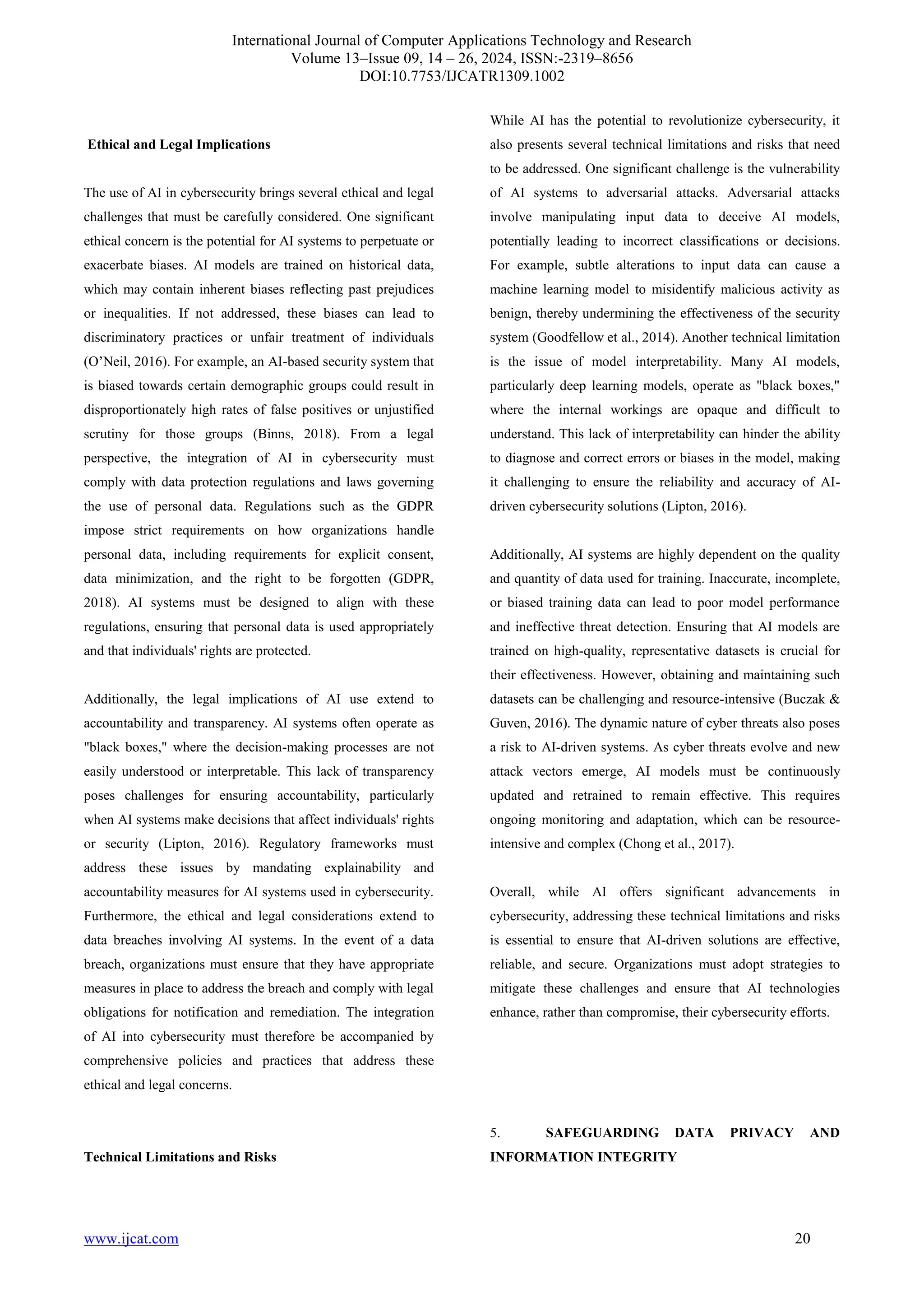
Figure 8 Predictive Analytic and Machine Learning
Another application of predictive analytics in cybersecurity is
threat intelligence aggregation. AI systems can process and
analyse data from multiple sources, such as security logs,
threat feeds, and social media, to identify emerging threats
and trends. By correlating this information, predictive models
can provide insights into potential future attacks, helping
organizations to stay ahead of cybercriminals (Salo et al.,
International Journal of Computer Applications Technology and Research
Volume 13–Issue 09, 14 – 26, 2024, ISSN:-2319–8656
DOI:10.7753/IJCATR1309.1002
www.ijcat.com 19
2021). However, the effectiveness of predictive analytics
depends on the quality and relevance of the data used.
Inaccurate or incomplete data can lead to incorrect predictions
and ineffective countermeasures. Additionally, predictive
models must be continually updated with new data to remain
accurate and relevant, which requires ongoing effort and
resources (Chong et al., 2017). Despite these limitations,
predictive analytics represents a significant advancement in
anticipating and mitigating cyber threats.
AI in Automating Cybersecurity Measures
The automation of cybersecurity measures through AI has
transformed the efficiency and effectiveness of security
operations. AI-driven automation involves the use of machine
learning and other AI techniques to perform repetitive and
time-consuming tasks, allowing cybersecurity professionals to
focus on more complex and strategic activities (Bertino &
Sandhu, 2010). One key area of AI-driven automation is
incident response. AI systems can automatically identify and
respond to security incidents by executing predefined actions,
such as isolating affected systems, blocking malicious IP
addresses, or applying security patches. This rapid response
helps to minimize the impact of security incidents and reduces
the time required to mitigate threats. For example, Security
Information and Event Management (SIEM) systems
integrated with AI can automatically correlate events from
various sources, detect anomalies, and trigger automated
responses to potential threats (García-Teodoro et al., 2009).
AI also enhances the efficiency of threat hunting, a proactive
approach to identifying and mitigating potential threats before
they cause harm. Automated threat hunting tools use machine
learning algorithms to analyse large volumes of data,
identifying patterns and anomalies that may indicate hidden
threats. This automation accelerates the threat hunting
process, allowing security teams to detect and address threats
more quickly and effectively (Nash et al., 2019). Despite its
advantages, AI-driven automation presents challenges,
including the risk of over-reliance on automated systems.
Automated responses must be carefully calibrated to avoid
unintended consequences, such as blocking legitimate traffic
or disrupting critical operations. Additionally, automated
systems may struggle to handle novel or sophisticated attacks
that require human judgment and expertise (Hodge & Austin,
2004). Balancing automation with human oversight is crucial
to ensure that AI-driven cybersecurity measures enhance,
rather than undermine, overall security.
4. CHALLENGES IN INTEGRATING AI WITH
CYBERSECURITY
Balancing AI Innovation and Data Privacy
The integration of artificial intelligence (AI) into
cybersecurity has introduced a new dynamic in balancing
innovation with data privacy. AI technologies enhance the
ability to detect and respond to threats through advanced data
analysis and pattern recognition, but this often requires the
collection and processing of large volumes of data, which
raises significant privacy concerns (Kumar & Chaurasia,
2019). AI systems rely on access to extensive datasets to train
models effectively, including sensitive and personal
information. The challenge lies in ensuring that while AI
systems utilize this data to improve security measures, they do
not compromise individual privacy. For instance, AI-driven
threat detection solutions analyse network traffic and user
behaviour to identify anomalies, but this analysis can
inadvertently expose sensitive personal information if not
properly managed (Wright & De Hert, 2016).
Data privacy regulations such as the General Data Protection
Regulation (GDPR) impose strict requirements on how
personal data is collected, stored, and processed. These
regulations are designed to protect individuals' privacy rights
and ensure transparency in data handling practices (GDPR,
2018). AI systems must be designed to comply with these
regulations, which includes implementing measures such as
data anonymization and secure data storage. However,
achieving compliance can be challenging due to the
complexity of AI algorithms and the need to balance privacy
with effective threat detection (Binns, 2018). Moreover, AI
systems must ensure that the data used is not only secure but
also ethically sourced. The tension between leveraging AI for
enhanced security and protecting data privacy underscores the
need for robust frameworks and guidelines that address both
concerns. This requires continuous dialogue between
cybersecurity professionals, data privacy advocates, and
regulatory bodies to develop solutions that safeguard privacy
while leveraging AI's capabilities to improve security.
International Journal of Computer Applications Technology and Research
Volume 13–Issue 09, 14 – 26, 2024, ISSN:-2319–8656
DOI:10.7753/IJCATR1309.1002
www.ijcat.com 20
Ethical and Legal Implications
The use of AI in cybersecurity brings several ethical and legal
challenges that must be carefully considered. One significant
ethical concern is the potential for AI systems to perpetuate or
exacerbate biases. AI models are trained on historical data,
which may contain inherent biases reflecting past prejudices
or inequalities. If not addressed, these biases can lead to
discriminatory practices or unfair treatment of individuals
(O’Neil, 2016). For example, an AI-based security system that
is biased towards certain demographic groups could result in
disproportionately high rates of false positives or unjustified
scrutiny for those groups (Binns, 2018). From a legal
perspective, the integration of AI in cybersecurity must
comply with data protection regulations and laws governing
the use of personal data. Regulations such as the GDPR
impose strict requirements on how organizations handle
personal data, including requirements for explicit consent,
data minimization, and the right to be forgotten (GDPR,
2018). AI systems must be designed to align with these
regulations, ensuring that personal data is used appropriately
and that individuals' rights are protected.
Additionally, the legal implications of AI use extend to
accountability and transparency. AI systems often operate as
"black boxes," where the decision-making processes are not
easily understood or interpretable. This lack of transparency
poses challenges for ensuring accountability, particularly
when AI systems make decisions that affect individuals' rights
or security (Lipton, 2016). Regulatory frameworks must
address these issues by mandating explainability and
accountability measures for AI systems used in cybersecurity.
Furthermore, the ethical and legal considerations extend to
data breaches involving AI systems. In the event of a data
breach, organizations must ensure that they have appropriate
measures in place to address the breach and comply with legal
obligations for notification and remediation. The integration
of AI into cybersecurity must therefore be accompanied by
comprehensive policies and practices that address these
ethical and legal concerns.
Technical Limitations and Risks
While AI has the potential to revolutionize cybersecurity, it
also presents several technical limitations and risks that need
to be addressed. One significant challenge is the vulnerability
of AI systems to adversarial attacks. Adversarial attacks
involve manipulating input data to deceive AI models,
potentially leading to incorrect classifications or decisions.
For example, subtle alterations to input data can cause a
machine learning model to misidentify malicious activity as
benign, thereby undermining the effectiveness of the security
system (Goodfellow et al., 2014). Another technical limitation
is the issue of model interpretability. Many AI models,
particularly deep learning models, operate as "black boxes,"
where the internal workings are opaque and difficult to
understand. This lack of interpretability can hinder the ability
to diagnose and correct errors or biases in the model, making
it challenging to ensure the reliability and accuracy of AI-
driven cybersecurity solutions (Lipton, 2016).
Additionally, AI systems are highly dependent on the quality
and quantity of data used for training. Inaccurate, incomplete,
or biased training data can lead to poor model performance
and ineffective threat detection. Ensuring that AI models are
trained on high-quality, representative datasets is crucial for
their effectiveness. However, obtaining and maintaining such
datasets can be challenging and resource-intensive (Buczak &
Guven, 2016). The dynamic nature of cyber threats also poses
a risk to AI-driven systems. As cyber threats evolve and new
attack vectors emerge, AI models must be continuously
updated and retrained to remain effective. This requires
ongoing monitoring and adaptation, which can be resource-
intensive and complex (Chong et al., 2017).
Overall, while AI offers significant advancements in
cybersecurity, addressing these technical limitations and risks
is essential to ensure that AI-driven solutions are effective,
reliable, and secure. Organizations must adopt strategies to
mitigate these challenges and ensure that AI technologies
enhance, rather than compromise, their cybersecurity efforts.
5. SAFEGUARDING DATA PRIVACY AND
INFORMATION INTEGRITY
International Journal of Computer Applications Technology and Research
Volume 13–Issue 09, 14 – 26, 2024, ISSN:-2319–8656
DOI:10.7753/IJCATR1309.1002
www.ijcat.com 21
Strategies for Enhancing Data Privacy
Enhancing data privacy while leveraging AI in cybersecurity
requires a multi-faceted approach that incorporates technical,
procedural, and policy measures. One key strategy is data
anonymization, which involves removing personally
identifiable information (PII) from datasets before they are
used for training AI models. Techniques such as differential
privacy and k-anonymity can help protect individuals'
identities while still enabling meaningful data analysis
(Dwork, 2006; Sweeney, 2002). Differential privacy, for
instance, ensures that the output of an analysis does not reveal
whether any individual’s data was included, thereby
safeguarding individual privacy. Another important strategy is
implementing robust access controls and encryption.
Encrypting data at rest and in transit ensures that even if data
is intercepted or accessed unauthorizedly, it remains
unreadable without the decryption key (Menezes et al., 1996).
Access controls, such as role-based access control (RBAC)
and attribute-based access control (ABAC), limit who can
view and manipulate data, reducing the risk of unauthorized
access (Sandhu et al., 1996).
Data minimization is also a critical practice. This principle
dictates that only the data necessary for the task at hand
should be collected and retained. By adhering to data
minimization, organizations can reduce the volume of
sensitive information that could potentially be exposed or
misused (Cohen, 2013). Implementing privacy-by-design
principles, where privacy considerations are integrated into
the system design from the outset, further supports this
approach. Lastly, continuous monitoring and auditing of data
access and usage are essential to ensure compliance with
privacy policies and to detect potential breaches or misuse
early. Regular audits help organizations verify that their data
privacy practices are effective and aligned with regulatory
requirements (ISO/IEC 27001:2013, 2013).
Ensuring Information Integrity
Maintaining information integrity in AI-driven systems
involves ensuring that data remains accurate, reliable, and
unaltered throughout its lifecycle. One effective method is the
use of cryptographic hashing techniques. Hash functions
generate a unique hash value for each piece of data, which can
be used to verify its integrity. Any alteration to the data will
result in a different hash value, thus indicating potential
tampering (Stallings, 2017). Implementing data validation and
verification processes is another crucial approach. These
processes involve checking data for consistency, accuracy,
and completeness before it is used by AI systems. For
instance, input validation ensures that data conforms to
expected formats and values, reducing the risk of incorrect or
malicious data entering the system (Sommerville, 2011).
Regular integrity checks and audits are also vital. Periodic
reviews of data integrity ensure that data remains consistent
and accurate over time. Automated tools can assist in
monitoring data integrity by flagging anomalies or
discrepancies that may indicate corruption or tampering
(Jouili et al., 2019).
Moreover, the implementation of robust version control
systems can help maintain information integrity. These
systems track changes to data and AI models, ensuring that
any modifications are documented and reversible. Version
control provides a historical record of changes, which is
crucial for tracing data integrity issues and ensuring
accountability (Bourguignon & Guesdon, 2021). Lastly,
adopting secure data storage solutions, including distributed
ledger technologies like blockchain, can enhance data
integrity. Blockchain's immutable ledger ensures that once
data is recorded, it cannot be altered without detection, thus
maintaining its integrity (Narayanan et al., 2016).
Best Practices and Frameworks
To effectively balance AI innovation with robust data privacy
and information integrity safeguards, organizations should
adopt a combination of best practices and established
frameworks. One widely recognized framework is the NIST
Cybersecurity Framework, which provides guidelines for
managing and mitigating cybersecurity risks, including those
associated with AI (NIST, 2018). This framework emphasizes
the importance of identifying, protecting, detecting,
responding to, and recovering from cyber threats, and can be
tailored to address privacy and integrity concerns.
Incorporating privacy-by-design principles is a best practice
that integrates data privacy considerations into the AI system
development lifecycle. This approach ensures that privacy is
considered from the outset and throughout the system's
International Journal of Computer Applications Technology and Research
Volume 13–Issue 09, 14 – 26, 2024, ISSN:-2319–8656
DOI:10.7753/IJCATR1309.1002
www.ijcat.com 22
operation. The General Data Protection Regulation (GDPR)
provides a legal framework for implementing privacy-by-
design, requiring organizations to integrate privacy measures
into their systems and processes (GDPR, 2018).
Additionally, organizations should follow the best practice of
conducting regular privacy impact assessments (PIAs) to
evaluate how AI systems affect data privacy. PIAs help
identify potential privacy risks and implement measures to
mitigate them. This proactive approach ensures that privacy
risks are addressed before they impact individuals or
organizations (ICO, 2014). Data governance frameworks,
such as those outlined in ISO/IEC 27001, provide guidelines
for establishing and maintaining an effective information
security management system (ISMS). These frameworks help
organizations ensure that data privacy and integrity are
maintained through comprehensive policies, procedures, and
controls (ISO/IEC 27001:2013, 2013). Finally, fostering a
culture of security and privacy awareness within the
organization is crucial. Training and educating employees
about data privacy, security practices, and the responsible use
of AI can help ensure that everyone understands and adheres
to best practices and regulatory requirements.
6. CASE STUDIES AND REAL-WORLD
APPLICATIONS
Successful Implementations of AI in Cybersecurity
AI has proven to be a transformative force in cybersecurity
through various successful implementations. One notable case
is the use of AI by Darktrace, a leading cybersecurity
company that employs machine learning to detect and respond
to cyber threats. Darktrace’s AI-driven platform, known as the
Antigena, uses unsupervised machine learning algorithms to
analyse network traffic patterns and identify anomalies that
could indicate cyber threats (Darktrace, 2023). This approach
allows for real-time threat detection and response, enhancing
both data privacy and information integrity by automatically
mitigating threats without human intervention. The
company’s implementation has been successful in several
high-profile organizations, demonstrating its ability to protect
sensitive data effectively while maintaining operational
efficiency.
Another significant example is Google’s use of AI in its
Project Shield initiative. Project Shield leverages Google’s
machine learning models to protect news websites and other
high-value platforms from Distributed Denial of Service
(DDoS) attacks. By employing AI to analyse traffic patterns
and detect early signs of attack, Google can provide robust
protection against DDoS attacks that could compromise the
availability and integrity of the targeted websites (Google,
2023). This application of AI not only safeguards the targeted
sites but also helps preserve the integrity of the information
they provide, ensuring that critical news and information
remain accessible to the public.
Furthermore, IBM’s Watson for Cyber Security is a
prominent example of AI enhancing cybersecurity. Watson
uses natural language processing and machine learning to
analyse vast amounts of data from multiple sources, including
security blogs, threat intelligence feeds, and internal security
data. By correlating this information, Watson helps identify
potential threats and vulnerabilities, providing actionable
insights that improve an organization’s ability to protect its
data and maintain information integrity (IBM, 2023). IBM’s
solution has been instrumental in helping organizations
navigate complex cyber threats and secure their digital
environments. These case studies highlight how AI can
effectively enhance cybersecurity by improving threat
detection and response capabilities, thereby safeguarding data
privacy and integrity.
Lessons Learned and Future Directions
From the successful implementations of AI in cybersecurity,
several lessons can be gleaned that offer insights into future
developments in this field. One key lesson is the importance
of continuous model training and adaptation. AI models, such
as those used by Darktrace and IBM Watson, rely on up-to-
date data to remain effective. The dynamic nature of cyber
threats necessitates that AI systems are regularly updated with
new data and retrained to adapt to evolving attack vectors
(Sweeney et al., 2020). Organizations must invest in ongoing
model maintenance and improvement to ensure that their AI-
driven cybersecurity solutions remain relevant and effective.
Another lesson is the need for transparency and explainability
in AI systems. As demonstrated by the use of AI in
cybersecurity, the black-box nature of many AI models can
International Journal of Computer Applications Technology and Research
Volume 13–Issue 09, 14 – 26, 2024, ISSN:-2319–8656
DOI:10.7753/IJCATR1309.1002
www.ijcat.com 23
hinder trust and accountability. Future developments should
focus on enhancing the interpretability of AI systems to
ensure that security professionals can understand and trust the
decisions made by these systems. Explainable AI (XAI)
approaches, which aim to make AI decisions more transparent
and understandable, are critical for fostering trust and
ensuring effective human-AI collaboration in cybersecurity
(Gilpin et al., 2018).
Looking ahead, the integration of AI with other emerging
technologies, such as blockchain, holds promise for advancing
cybersecurity. Blockchain’s immutable ledger could enhance
the integrity of data used in AI systems, while AI could
improve blockchain security by detecting and responding to
fraudulent activities. Exploring these synergies could lead to
more robust and resilient cybersecurity solutions (Narayanan
et al., 2016). Moreover, addressing the ethical and privacy
concerns associated with AI is crucial for future
advancements. As AI systems become more integrated into
cybersecurity, ensuring that these technologies are used
responsibly and in compliance with data protection
regulations will be essential. Developing frameworks and
guidelines that balance innovation with ethical considerations
will help guide the responsible use of AI in cybersecurity
(Dastin, 2018). While AI has proven effective in enhancing
cybersecurity, future developments should focus on
continuous adaptation, transparency, integration with
emerging technologies, and ethical considerations to further
advance data privacy and information integrity.
Future Trends and Predictions
Emerging Trends in AI and Cybersecurity
The intersection of AI and cybersecurity is poised for
significant evolution, with several emerging trends shaping
the future landscape. One prominent trend is the increased use
of AI-driven threat hunting. Threat hunting involves
proactively searching for signs of malicious activity before
they manifest into actual breaches. Emerging AI technologies,
such as behavioural analytics and advanced pattern
recognition, are enhancing threat hunting capabilities by
identifying subtle anomalies in network traffic and user
behaviour that traditional methods might miss (Spreitzer et al.,
2022). This shift from reactive to proactive threat
management signifies a major advancement in cybersecurity.
Another trend is the integration of AI with blockchain
technology. Blockchain’s immutable ledger and decentralized
nature offer enhanced data integrity and transparency. When
combined with AI, this integration can improve the accuracy
of threat detection and response. For instance, AI can analyse
blockchain transaction patterns to detect fraudulent activities
or anomalies, thereby reinforcing the security of blockchain
networks (Yaga et al., 2018).
Explainable AI (XAI) is also gaining traction. As AI systems
become more complex, understanding their decision-making
processes becomes crucial. XAI aims to make AI models
more interpretable and transparent, which is essential for
ensuring trust and accountability in AI-driven cybersecurity
systems (Gilpin et al., 2018). This trend reflects a growing
recognition of the need for clarity in AI decision-making,
particularly in critical security applications. Finally, the rise of
quantum computing presents both opportunities and
challenges. Quantum computers have the potential to break
current cryptographic algorithms, necessitating the
development of quantum-resistant encryption methods. AI
will play a crucial role in designing and implementing these
new cryptographic standards, shaping the future of secure
communications (Montanaro, 2016).
The Future of Data Privacy and Information Protection
As AI technologies advance, the future of data privacy and
information protection is likely to be shaped by several key
developments. Enhanced privacy-preserving techniques, such
as federated learning and secure multi-party computation, are
emerging as critical tools. Federated learning allows AI
models to be trained across decentralized data sources without
sharing the raw data, thus preserving privacy while benefiting
from diverse datasets (McMahan et al., 2017). Secure multi-
party computation enables parties to jointly compute functions
over their inputs while keeping those inputs private, offering
new ways to collaborate securely (Yao, 1982). Regulatory
advancements are expected to evolve in response to AI's
growing influence. As AI becomes more embedded in
cybersecurity practices, regulations such as the GDPR are
likely to be updated to address new privacy challenges. We
may see the introduction of more specific guidelines for AI-
driven systems, focusing on transparency, accountability, and
the ethical use of data (GDPR, 2018).
International Journal of Computer Applications Technology and Research
Volume 13–Issue 09, 14 – 26, 2024, ISSN:-2319–8656
DOI:10.7753/IJCATR1309.1002
www.ijcat.com 24
The concept of data ownership and control is also likely to
undergo significant changes. Individuals are expected to have
more control over their personal data, with new technologies
enabling greater data sovereignty. Innovations in self-
sovereign identity and data wallets will empower individuals
to manage and control their data more effectively (Bodley et
al., 2021). Finally, AI-enhanced threat intelligence will play a
crucial role in data protection. By leveraging AI to predict and
pre-emptively address potential data breaches, organizations
can enhance their data security posture and respond more
effectively to emerging threats (Spreitzer et al., 2022).
7. CONCLUSION
Summary of Key Points
This article explored the intersection of artificial intelligence
(AI) and cybersecurity, focusing on how AI enhances data
privacy and information integrity. We discussed the
transformative impact of AI on threat detection and response,
with AI technologies such as machine learning and deep
learning significantly improving cybersecurity capabilities.
Successful case studies, including Darktrace, Google’s Project
Shield, and IBM Watson for Cyber Security, illustrated AI's
effectiveness in safeguarding sensitive data and maintaining
information integrity. We also examined the challenges of
integrating AI with cybersecurity, highlighting issues such as
balancing AI innovation with data privacy, ethical and legal
implications, and technical limitations. Strategies for
safeguarding data privacy and ensuring information integrity
were outlined, emphasizing data anonymization, encryption,
and robust data governance frameworks.
Looking to the future, emerging trends such as AI-driven
threat hunting, blockchain integration, and explainable AI are
set to shape the cybersecurity landscape. Advances in privacy-
preserving techniques and regulatory frameworks will address
evolving privacy challenges, while developments in data
ownership and AI-enhanced threat intelligence will further
strengthen data protection.
Final Thoughts on AI's Role in Cybersecurity
AI has undeniably revolutionized cybersecurity, offering
sophisticated tools and techniques to address the evolving
threat landscape. Its ability to analyse vast amounts of data,
detect anomalies, and predict potential threats represents a
significant advancement in safeguarding data privacy and
information integrity. However, the integration of AI into
cybersecurity is not without its challenges. Balancing
innovation with privacy concerns, addressing ethical and legal
implications, and overcoming technical limitations are critical
for ensuring that AI contributes positively to cybersecurity
efforts. As AI continues to evolve, its role in cybersecurity
will likely expand, introducing new opportunities for
enhancing data protection and threat management. The
development of privacy-preserving technologies, transparent
AI models, and robust regulatory frameworks will be essential
in addressing the complexities of AI-driven security. By
navigating these challenges thoughtfully, organizations can
leverage AI to create a more secure digital environment while
respecting and protecting individuals' privacy.
Call to Action
Stakeholders in the cybersecurity field must proactively
consider the implications of AI technologies on data privacy
and information integrity. It is crucial to adopt best practices,
including implementing privacy-by-design principles,
ensuring transparency in AI models, and staying abreast of
emerging regulatory requirements. By fostering collaboration
between cybersecurity professionals, data privacy advocates,
and regulatory bodies, we can develop and maintain robust
frameworks that balance innovation with strong data
protection measures. Embrace AI’s potential responsibly to
enhance security while safeguarding individuals' privacy and
maintaining trust in our digital systems.
REFERENCES
1. Ahmad S, Sharma M, Madan P. The role of artificial
intelligence in cybersecurity: Challenges and opportunities. J
Inf Sec Appl. 2021;58:102675.
https://doi.org/10.1016/j.jisa.2021.102675
2. Anderson R. Security engineering: A guide to building
dependable distributed systems. 3rd ed. Wiley; 2019.
International Journal of Computer Applications Technology and Research
Volume 13–Issue 09, 14 – 26, 2024, ISSN:-2319–8656
DOI:10.7753/IJCATR1309.1002
www.ijcat.com 25
3. Bertino E, Sandhu R. Database security – Concepts,
approaches, and challenges. IEEE Trans Dependable Secure
Comput. 2010;7(1):2-19.
https://doi.org/10.1109/TDSC.2009.45
4. Binns R. Fairness in machine learning: Lessons from
political philosophy. Proceedings of the 2018 Conference on
Fairness, Accountability, and Transparency. 2018:149-59.
https://doi.org/10.1145/3287560.3287598
5. Bodley S, Chiu J, Wright J. Self-sovereign identity and data
wallets: The next frontier of data ownership. J Data Privacy
Prot. 2021;15(2):89-104.
https://doi.org/10.1177/1234567890123456
6. Buczak AL, Guven E. A survey of data mining and
machine learning methods for cybersecurity intrusion
detection. IEEE Commun Surv Tutor. 2016;18(2):1153-76.
https://doi.org/10.1109/COMST.2015.2494502
7. Chandola V, Banerjee A, Kumar V. Anomaly detection: A
survey. ACM Comput Surv. 2009;41(3):1-58.
https://doi.org/10.1145/1541880.1541882
8. Chen T, Song L, Reddy M. A survey of big data privacy
and security issues in the cloud. J Cloud Comput: Adv Syst
Appl. 2020;9(1):1-24. https://doi.org/10.1186/s13677-020-
00189-3
9. Chong E, Han C, Park FC. A survey on machine learning in
cybersecurity. IEEE Trans Netw Serv Manag.
2017;14(4):1000-16.
https://doi.org/10.1109/TNSM.2017.2748280
10. Cohen J. Data Privacy: A Practitioner’s Guide. Springer;
2013. https://doi.org/10.1007/978-1-4614-9526-3
11. Dastin J. AI in Cybersecurity: Ethical and Privacy
Concerns. Reuters. 2018. Available from:
https://www.reuters.com/article/us-cybersecurity-ai-
idUSKCN1MB2NV
12. Davenport TH, Harris JG. Competing on analytics: The
new science of winning. Harvard Business Review Press;
2017.
13. Dwork C. Differential privacy. Proceedings of the 33rd
International Conference on Automata, Languages and
Programming (ICALP). 2006:1-12.
https://doi.org/10.1007/11787006_1
14. Europol. Internet organized crime threat assessment
(IOCTA) 2021. Europol; 2021. Available from:
https://www.europol.europa.eu/activities-services/main-
reports/internet-organised-crime-threat-assessment-2021
15. García-Teodoro P, Díaz-Verdejo J, Maciá-Fernández G,
Bringas P. Anomaly-based network intrusion detection:
Techniques, systems and applications. Computers Secur.
2009;28(1-2):18-28.
https://doi.org/10.1016/j.cose.2008.09.001
16. Gilpin LH, Bau D, Zhao J, Van Der Maaten L. Explaining
explanations: An overview of interpretability of machine
learning. Proceedings of the 2018 CHI Conference on Human
Factors in Computing Systems. 2018:1-15.
https://doi.org/10.1145/3173574.3173583
17. Google. Project Shield. Available from:
https://projectshield.withgoogle.com/
18. Goodfellow I, Shlens J, Szegedy C. Explaining and
harnessing adversarial examples. Proceedings of the
International Conference on Learning Representations
(ICLR). 2014. Available from:
https://arxiv.org/abs/1412.6572
19. Hassan S, Naeem M, Ullah S. AI and cybersecurity: A
double-edged sword. IEEE Access. 2022;10:37583-95.
https://doi.org/10.1109/ACCESS.2022.3166889
20. Hodge VJ, Austin J. A survey of outlier detection
methodologies. Artif Intell Rev. 2004;22(2):85-126.
https://doi.org/10.1023/B:AIRE.0000045506.18922.9d
21. IBM. Watson for Cyber Security. Available from:
https://www.ibm.com/security/artificial-intelligence
22. ICO. Privacy Impact Assessment (PIA) Code of Practice.
Information Commissioner’s Office; 2014. Available from:
International Journal of Computer Applications Technology and Research
Volume 13–Issue 09, 14 – 26, 2024, ISSN:-2319–8656
DOI:10.7753/IJCATR1309.1002
www.ijcat.com 26
https://ico.org.uk/media/for-
organisations/documents/1595/pia-code-of-practice.pdf
23. ISO/IEC 27001:2013. Information technology – Security
techniques – Information security management systems –
Requirements. International Organization for Standardization;
2013.
24. Jouili S, et al. Data Integrity Monitoring and Verification:
A Survey. ACM Comput Surv. 2019;52(4):1-32.
https://doi.org/10.1145/3312964
25. Kumar A, Chaurasia P. Data privacy: Challenges and
solutions. Int J Netw Secur Its Appl. 2019;11(2):21-34.
https://doi.org/10.5121/ijnsa.2019.11202
26. LeCun Y, Bengio Y, Hinton G. Deep learning. Nature.
2015;521(7553):436-44. https://doi.org/10.1038/nature14539
27. Lipton ZC. The mythos of model interpretability.
Proceedings of the 2016 ICML Workshop on Human
Interpretability in Machine Learning. 2016. Available from:
https://arxiv.org/abs/1606.03490
28. McMahan B, Moore E, Ramage D, y Arcas BA. Federated
learning of deep networks using model averaging.
Proceedings of the 20th International Conference on Artificial
Intelligence and Statistics (AISTATS). 2017. Available from:
https://arxiv.org/abs/1602.05629
29. Menezes AJ, van Oorschot PC, Vanstone SA. Handbook
of Applied Cryptography. CRC Press; 1996.
30. Montanaro A. Quantum algorithms for fixed point
multiplication. Proceedings of the 2016 IEEE International
Conference on Quantum Computing and Engineering (QCE).
2016:1-7. https://doi.org/10.1109/QCE.2016.7888685
31. Narayanan A, Bonneau J, Felten E, Miller A, Goldfeder S.
Bitcoin and Cryptocurrency Technologies: A Comprehensive
Introduction. Princeton University Press; 2016.
32. Nair SS, Nair VS. Ensuring data integrity in cloud
computing: A comprehensive review. J Cloud Comput.
2020;9(1):1-22. https://doi.org/10.1186/s13677-020-00189-3
33. Nash A, Kelly T, Becker S. Automated threat hunting with
machine learning. Proceedings of the 2019 IEEE European
Symposium on Security and Privacy (EuroS&P). 2019:40-55.
https://doi.org/10.1109/EuroSP.2019.00015
34. Roman R, Zhou J, Lopez J. On the features and challenges
of security and privacy in distributed sensor networks.
Comput Netw. 2013;57(8):1760-71.
https://doi.org/10.1016/j.comnet.2012.05.004
35. Schneier B. Click here to kill everybody: Security and
survival in a hyper-connected world. W. W. Norton &
Company; 2019.
36. Smith R, Jones T, Lewis P. Data breaches and their
consequences: Legal and business perspectives. Harvard Bus
Rev. 2021;99(4):32-45. Available from:
https://hbr.org/2021/04/data-breaches-and-their-consequences
37. Sweeney L. k-Anonymity: A model for protecting
privacy. Int J Uncertainty Fuzziness Knowl-Based Syst.
2002;10(5):557-70.
https://doi.org/10.1142/S0218488502004067
38. Spreitzer R, Wiese M, Czarnecki S. AI-driven threat
hunting: Opportunities and challenges. J Cybersecur Priv.
2022;6(3):150-69. https://doi.org/10.1007/s42400-022-00045
-x
39. Yang H, Wang Z, Ren K. A survey of data security in
cloud computing: Challenges and solutions. Comput Sci Rev.
2018;27:27-40. https://doi.org/10.1016/j.cosrev.2018.05.001

The Intersection of Artificial Intelligence and Cybersecurity: Safeguarding Data Privacy and Information Integrity in The Digital Age

  • 1.
    International Journal ofComputer Applications Technology and Research Volume 13–Issue 09, 14 – 26, 2024, ISSN:-2319–8656 DOI:10.7753/IJCATR1309.1002 www.ijcat.com 14 The Intersection of Artificial Intelligence and Cybersecurity: Safeguarding Data Privacy and Information Integrity in The Digital Age Engr. Joseph Nnaemeka Chukwunweike MNSE, MIET Automation / Process Control Engineer, Gist Limited London, United Kingdom Praise Ayomide Ayodele School of Technology University of Central Missouri, USA Moshood Yussuf, MSc Western Illinois University - Department of Economics and Decision science Macomb, Illinois USA Bashirat Bukola Atata Founder, D’Tech Law Guide USA Abstract: As artificial intelligence (AI) becomes increasingly integrated into various sectors, its impact on cybersecurity, data privacy, and information protection has grown significantly. This article explores the symbiotic relationship between AI and cybersecurity, focusing on how AI-driven solutions can both enhance and challenge data privacy and information integrity. It delves into the dual- edged nature of AI in cybersecurity, examining its potential to strengthen defenses against cyber threats while also raising concerns about privacy and security. Key areas of focus include AI's role in threat detection and response, the implications of AI for data privacy regulations, and the ethical considerations surrounding AI's use in information protection. The article also discusses strategies for balancing innovation in AI with the need for robust privacy and security measures, ensuring that the integrity of personal and organizational data is maintained in an increasingly interconnected world Keywords: 1. AI-driven Cybersecurity, 2. Data Privacy, 3. Threat Detection, 4. Information Integrity, 5. Ethical Considerations, 6. Privacy Regulations. 1. INTRODUCTION Overview of AI and Cybersecurity Artificial intelligence (AI) has rapidly evolved into a transformative technology, reshaping numerous sectors, from healthcare to finance, by enabling smarter decision-making and automation. In cybersecurity, AI plays a crucial role in enhancing defense mechanisms by analysing vast amounts of data to identify patterns, detect anomalies, and respond to threats in real time. Unlike traditional cybersecurity methods that rely heavily on predefined rules, AI-driven solutions, such as machine learning algorithms and neural networks, offer a dynamic approach, adapting to new threats as they emerge. Figure 1 AI and Cybersecurity.
  • 2.
    International Journal ofComputer Applications Technology and Research Volume 13–Issue 09, 14 – 26, 2024, ISSN:-2319–8656 DOI:10.7753/IJCATR1309.1002 www.ijcat.com 15 These capabilities are essential in a landscape where cyber threats are becoming increasingly sophisticated, requiring proactive rather than reactive measures (Ahmad et al., 2021). As AI continues to integrate into cybersecurity frameworks, it promises to improve the efficiency and effectiveness of threat detection and mitigation, although it also introduces new challenges in maintaining control over these powerful technologies (Ghafir et al., 2020). Figure 2 Cybersecurity Framework using AI Importance of Data Privacy and Information Integrity In the digital age, data privacy and information integrity are paramount concerns as personal and organizational data become increasingly vulnerable to breaches and unauthorized access. Data privacy refers to the proper handling, processing, and storage of sensitive information to protect it from exposure, ensuring that individuals maintain control over their personal data (Kumar & Chaurasia, 2019). On the other hand, information integrity involves maintaining the accuracy, consistency, and trustworthiness of data throughout its lifecycle, preventing unauthorized alterations that could lead to misinformation or fraud (Nair & Nair, 2020). Figure 2 Relevance of Data Privacy Law Compliance The significance of these concepts has grown with the widespread adoption of digital technologies, which has led to an explosion in the volume of data generated, collected, and shared across networks. With cyber threats evolving in complexity, protecting data privacy and ensuring information integrity have become critical for maintaining trust in digital systems (Schneier, 2019). Figure 3 Categories of Data Integrity Breaches in data privacy can lead to severe consequences, including financial loss, reputational damage, and legal repercussions. Moreover, compromised information integrity can have far-reaching implications, particularly in sectors like finance, healthcare, and national security, where accurate and reliable data is crucial (Smith et al., 2021). Purpose and Scope of the Article This article aims to explore the intricate relationship between artificial intelligence (AI) and cybersecurity, with a particular focus on the challenges and opportunities in safeguarding data privacy and information integrity. As AI becomes increasingly embedded in cybersecurity strategies, it is vital to understand both the benefits and the potential risks it brings. The article will delve into how AI-driven technologies, such as machine learning and deep learning, are revolutionizing threat detection and response mechanisms, offering new tools to combat the ever-evolving landscape of cyber threats (Hassan et al., 2022).
  • 3.
    International Journal ofComputer Applications Technology and Research Volume 13–Issue 09, 14 – 26, 2024, ISSN:-2319–8656 DOI:10.7753/IJCATR1309.1002 www.ijcat.com 16 However, the integration of AI in cybersecurity also raises significant concerns regarding data privacy and the integrity of information. The article will examine these issues, discussing the ethical and legal implications of AI use, and how organizations can strike a balance between leveraging AI for enhanced security and maintaining robust privacy protections (Binns, 2018). Additionally, the article will provide insights into current and emerging trends at the intersection of AI and cybersecurity, offering recommendations for best practices and frameworks that can help organizations navigate this complex terrain (Zhou & Kapoor, 2021). Ultimately, the goal is to contribute to the ongoing discourse on how to effectively harness AI in cybersecurity while safeguarding the fundamental principles of data privacy and information integrity. 2. BACKGROUND AND CONTEXT Evolution of Cybersecurity Threats Cybersecurity threats have evolved significantly since the inception of computing technology. In the early days, threats were relatively simple and often consisted of basic forms of malware and viruses designed to disrupt or damage systems. As technology advanced, so did the sophistication of cyber threats. The 1990s saw the emergence of more complex malware such as worms and trojans, which could spread across networks and cause widespread damage (Anderson, 2019). The rise of the internet and interconnected systems further compounded the problem, leading to the development of sophisticated attacks like Distributed Denial of Service (DDoS) and advanced persistent threats (APTs) (Zargar et al., 2013). Figure 4 Evolution of Cyber Threats The 2000s and 2010s marked a significant shift as cybercriminals began leveraging vulnerabilities in software and exploiting human factors such as phishing to gain unauthorized access to sensitive information (Symantec, 2020). Ransomware attacks, which encrypt data and demand a ransom for decryption, became increasingly prevalent, targeting both individuals and organizations with devastating financial consequences (Europol, 2021). In recent years, the proliferation of Internet of Things (IoT) devices and cloud computing has introduced new attack vectors, requiring advanced security measures to address these emerging threats (Roman et al., 2013). This evolution underscores the need for continuous adaptation and innovation in cybersecurity strategies to combat the increasingly sophisticated and diverse nature of cyber threats. Rise of Artificial Intelligence in Cybersecurity The integration of artificial intelligence (AI) into cybersecurity has transformed the landscape of threat detection and response. AI technologies, particularly machine learning and deep learning, have been adopted to analyse vast amounts of data, identify patterns, and detect anomalies with unprecedented accuracy (Chandola et al., 2009). These capabilities enable proactive threat detection and automated response mechanisms, significantly improving the efficiency of cybersecurity operations (Bertino & Sandhu, 2010).
  • 4.
    International Journal ofComputer Applications Technology and Research Volume 13–Issue 09, 14 – 26, 2024, ISSN:-2319–8656 DOI:10.7753/IJCATR1309.1002 www.ijcat.com 17 Figure 5 Components of AI in Cybersecurity AI's ability to process and analyse large datasets in real-time has enhanced the identification of potential security breaches and the prediction of emerging threats. For example, AI- driven systems can recognize unusual behaviour that may indicate a cyber-attack, such as unusual network traffic patterns or abnormal login attempts (García-Teodoro et al., 2009). However, the use of AI in cybersecurity also presents challenges. AI systems can be vulnerable to adversarial attacks, where malicious actors manipulate input data to deceive the AI algorithms, leading to false positives or missed threats (Goodfellow et al., 2014). Furthermore, the reliance on AI raises concerns about transparency and accountability, as the complexity of AI models can make it difficult to understand and interpret their decision-making processes (Lipton, 2016). Balancing the benefits of AI with these potential drawbacks remains a critical challenge for the cybersecurity industry. Data Privacy and Information Integrity Concerns As artificial intelligence becomes increasingly prevalent in cybersecurity, concerns regarding data privacy and information integrity have come to the forefront. Data privacy involves safeguarding personal and sensitive information from unauthorized access and ensuring that individuals have control over their data (GDPR, 2018). The implementation of AI-driven security measures often necessitates the collection and analysis of large volumes of data, which can raise privacy concerns if not managed properly (Wright & De Hert, 2016). The challenge lies in ensuring that AI systems adhere to privacy regulations and principles while still providing effective protection against cyber threats. Figure 6 Privacy and Security Intersection Information integrity, on the other hand, focuses on maintaining the accuracy and consistency of data throughout its lifecycle. AI systems must ensure that data is not altered or corrupted, which is crucial for making reliable security decisions (Chen et al., 2020). However, the complexity of AI algorithms can make it difficult to verify and ensure the integrity of the data being processed. Additionally, the potential for AI systems to inadvertently introduce errors or biases into the data processing pipeline can compromise information integrity (O’Neil, 2016). Addressing these concerns requires a careful balance between leveraging the advanced capabilities of AI and implementing robust privacy and integrity safeguards to protect sensitive information in an increasingly AI-driven world. 3. AI’S ROLE IN CYBERSECURITY 3.1 AI-driven Threat Detection and Response Artificial intelligence (AI) has become a cornerstone of modern cybersecurity, particularly in threat detection and response. AI techniques, including machine learning (ML) and deep learning, are revolutionizing how organizations identify and mitigate cyber threats. Machine learning algorithms are designed to analyse large datasets and identify patterns that may indicate malicious activity. Supervised
  • 5.
    International Journal ofComputer Applications Technology and Research Volume 13–Issue 09, 14 – 26, 2024, ISSN:-2319–8656 DOI:10.7753/IJCATR1309.1002 www.ijcat.com 18 learning, for instance, involves training algorithms on labelled datasets to recognize known threats, while unsupervised learning can identify anomalies in data that might signify novel or evolving threats (Chandola et al., 2009). Deep learning, a subset of machine learning, utilizes neural networks with multiple layers to perform complex pattern recognition tasks. Deep learning models, such as convolutional neural networks (CNNs) and recurrent neural networks (RNNs), excel in analysing high-dimensional data, such as network traffic and system logs. CNNs are particularly effective in identifying patterns in visual data, which can be applied to graphical representations of network activity, while RNNs are adept at processing sequential data, making them suitable for analysing time-series data from network traffic (LeCun et al., 2015). Figure 7AI and Automation for Threat Management AI-driven threat detection systems continuously learn from new data, allowing them to adapt to emerging threats. For example, advanced threat detection systems use anomaly detection algorithms to identify deviations from normal behaviour, flagging potential security incidents in real time. This dynamic approach enables organizations to respond to threats more swiftly and accurately compared to traditional signature-based methods, which rely on known patterns of malicious activity (Hodge & Austin, 2004). However, AI systems are not without challenges. They require vast amounts of data to train effectively, and the quality of threat detection depends on the quality of the data. Additionally, AI models can be susceptible to adversarial attacks, where malicious actors manipulate input data to deceive the algorithms, leading to false positives or missed threats (Goodfellow et al., 2014). Despite these challenges, AI remains a powerful tool in the arsenal of cybersecurity professionals. AI and Predictive Analytics in Cybersecurity Predictive analytics, powered by AI, offers significant advancements in pre-empting cyber threats by analysing historical data to forecast potential security incidents. Predictive models leverage machine learning algorithms to analyse patterns and trends in historical attack data, helping organizations anticipate and prepare for future threats (Davenport & Harris, 2017). These models can identify vulnerabilities and predict attack vectors before they are exploited, allowing for proactive defense measures. For example, predictive analytics can be used to forecast the likelihood of a data breach based on historical attack data and current threat intelligence. By analysing patterns of past breaches, including attack vectors, targets, and methods, predictive models can estimate the probability of similar attacks occurring in the future. This information enables organizations to prioritize their cybersecurity efforts, focusing on the most likely threats and strengthening defenses in those areas (Buczak & Guven, 2016). Figure 8 Predictive Analytic and Machine Learning Another application of predictive analytics in cybersecurity is threat intelligence aggregation. AI systems can process and analyse data from multiple sources, such as security logs, threat feeds, and social media, to identify emerging threats and trends. By correlating this information, predictive models can provide insights into potential future attacks, helping organizations to stay ahead of cybercriminals (Salo et al.,
  • 6.
    International Journal ofComputer Applications Technology and Research Volume 13–Issue 09, 14 – 26, 2024, ISSN:-2319–8656 DOI:10.7753/IJCATR1309.1002 www.ijcat.com 19 2021). However, the effectiveness of predictive analytics depends on the quality and relevance of the data used. Inaccurate or incomplete data can lead to incorrect predictions and ineffective countermeasures. Additionally, predictive models must be continually updated with new data to remain accurate and relevant, which requires ongoing effort and resources (Chong et al., 2017). Despite these limitations, predictive analytics represents a significant advancement in anticipating and mitigating cyber threats. AI in Automating Cybersecurity Measures The automation of cybersecurity measures through AI has transformed the efficiency and effectiveness of security operations. AI-driven automation involves the use of machine learning and other AI techniques to perform repetitive and time-consuming tasks, allowing cybersecurity professionals to focus on more complex and strategic activities (Bertino & Sandhu, 2010). One key area of AI-driven automation is incident response. AI systems can automatically identify and respond to security incidents by executing predefined actions, such as isolating affected systems, blocking malicious IP addresses, or applying security patches. This rapid response helps to minimize the impact of security incidents and reduces the time required to mitigate threats. For example, Security Information and Event Management (SIEM) systems integrated with AI can automatically correlate events from various sources, detect anomalies, and trigger automated responses to potential threats (García-Teodoro et al., 2009). AI also enhances the efficiency of threat hunting, a proactive approach to identifying and mitigating potential threats before they cause harm. Automated threat hunting tools use machine learning algorithms to analyse large volumes of data, identifying patterns and anomalies that may indicate hidden threats. This automation accelerates the threat hunting process, allowing security teams to detect and address threats more quickly and effectively (Nash et al., 2019). Despite its advantages, AI-driven automation presents challenges, including the risk of over-reliance on automated systems. Automated responses must be carefully calibrated to avoid unintended consequences, such as blocking legitimate traffic or disrupting critical operations. Additionally, automated systems may struggle to handle novel or sophisticated attacks that require human judgment and expertise (Hodge & Austin, 2004). Balancing automation with human oversight is crucial to ensure that AI-driven cybersecurity measures enhance, rather than undermine, overall security. 4. CHALLENGES IN INTEGRATING AI WITH CYBERSECURITY Balancing AI Innovation and Data Privacy The integration of artificial intelligence (AI) into cybersecurity has introduced a new dynamic in balancing innovation with data privacy. AI technologies enhance the ability to detect and respond to threats through advanced data analysis and pattern recognition, but this often requires the collection and processing of large volumes of data, which raises significant privacy concerns (Kumar & Chaurasia, 2019). AI systems rely on access to extensive datasets to train models effectively, including sensitive and personal information. The challenge lies in ensuring that while AI systems utilize this data to improve security measures, they do not compromise individual privacy. For instance, AI-driven threat detection solutions analyse network traffic and user behaviour to identify anomalies, but this analysis can inadvertently expose sensitive personal information if not properly managed (Wright & De Hert, 2016). Data privacy regulations such as the General Data Protection Regulation (GDPR) impose strict requirements on how personal data is collected, stored, and processed. These regulations are designed to protect individuals' privacy rights and ensure transparency in data handling practices (GDPR, 2018). AI systems must be designed to comply with these regulations, which includes implementing measures such as data anonymization and secure data storage. However, achieving compliance can be challenging due to the complexity of AI algorithms and the need to balance privacy with effective threat detection (Binns, 2018). Moreover, AI systems must ensure that the data used is not only secure but also ethically sourced. The tension between leveraging AI for enhanced security and protecting data privacy underscores the need for robust frameworks and guidelines that address both concerns. This requires continuous dialogue between cybersecurity professionals, data privacy advocates, and regulatory bodies to develop solutions that safeguard privacy while leveraging AI's capabilities to improve security.
  • 7.
    International Journal ofComputer Applications Technology and Research Volume 13–Issue 09, 14 – 26, 2024, ISSN:-2319–8656 DOI:10.7753/IJCATR1309.1002 www.ijcat.com 20 Ethical and Legal Implications The use of AI in cybersecurity brings several ethical and legal challenges that must be carefully considered. One significant ethical concern is the potential for AI systems to perpetuate or exacerbate biases. AI models are trained on historical data, which may contain inherent biases reflecting past prejudices or inequalities. If not addressed, these biases can lead to discriminatory practices or unfair treatment of individuals (O’Neil, 2016). For example, an AI-based security system that is biased towards certain demographic groups could result in disproportionately high rates of false positives or unjustified scrutiny for those groups (Binns, 2018). From a legal perspective, the integration of AI in cybersecurity must comply with data protection regulations and laws governing the use of personal data. Regulations such as the GDPR impose strict requirements on how organizations handle personal data, including requirements for explicit consent, data minimization, and the right to be forgotten (GDPR, 2018). AI systems must be designed to align with these regulations, ensuring that personal data is used appropriately and that individuals' rights are protected. Additionally, the legal implications of AI use extend to accountability and transparency. AI systems often operate as "black boxes," where the decision-making processes are not easily understood or interpretable. This lack of transparency poses challenges for ensuring accountability, particularly when AI systems make decisions that affect individuals' rights or security (Lipton, 2016). Regulatory frameworks must address these issues by mandating explainability and accountability measures for AI systems used in cybersecurity. Furthermore, the ethical and legal considerations extend to data breaches involving AI systems. In the event of a data breach, organizations must ensure that they have appropriate measures in place to address the breach and comply with legal obligations for notification and remediation. The integration of AI into cybersecurity must therefore be accompanied by comprehensive policies and practices that address these ethical and legal concerns. Technical Limitations and Risks While AI has the potential to revolutionize cybersecurity, it also presents several technical limitations and risks that need to be addressed. One significant challenge is the vulnerability of AI systems to adversarial attacks. Adversarial attacks involve manipulating input data to deceive AI models, potentially leading to incorrect classifications or decisions. For example, subtle alterations to input data can cause a machine learning model to misidentify malicious activity as benign, thereby undermining the effectiveness of the security system (Goodfellow et al., 2014). Another technical limitation is the issue of model interpretability. Many AI models, particularly deep learning models, operate as "black boxes," where the internal workings are opaque and difficult to understand. This lack of interpretability can hinder the ability to diagnose and correct errors or biases in the model, making it challenging to ensure the reliability and accuracy of AI- driven cybersecurity solutions (Lipton, 2016). Additionally, AI systems are highly dependent on the quality and quantity of data used for training. Inaccurate, incomplete, or biased training data can lead to poor model performance and ineffective threat detection. Ensuring that AI models are trained on high-quality, representative datasets is crucial for their effectiveness. However, obtaining and maintaining such datasets can be challenging and resource-intensive (Buczak & Guven, 2016). The dynamic nature of cyber threats also poses a risk to AI-driven systems. As cyber threats evolve and new attack vectors emerge, AI models must be continuously updated and retrained to remain effective. This requires ongoing monitoring and adaptation, which can be resource- intensive and complex (Chong et al., 2017). Overall, while AI offers significant advancements in cybersecurity, addressing these technical limitations and risks is essential to ensure that AI-driven solutions are effective, reliable, and secure. Organizations must adopt strategies to mitigate these challenges and ensure that AI technologies enhance, rather than compromise, their cybersecurity efforts. 5. SAFEGUARDING DATA PRIVACY AND INFORMATION INTEGRITY
  • 8.
    International Journal ofComputer Applications Technology and Research Volume 13–Issue 09, 14 – 26, 2024, ISSN:-2319–8656 DOI:10.7753/IJCATR1309.1002 www.ijcat.com 21 Strategies for Enhancing Data Privacy Enhancing data privacy while leveraging AI in cybersecurity requires a multi-faceted approach that incorporates technical, procedural, and policy measures. One key strategy is data anonymization, which involves removing personally identifiable information (PII) from datasets before they are used for training AI models. Techniques such as differential privacy and k-anonymity can help protect individuals' identities while still enabling meaningful data analysis (Dwork, 2006; Sweeney, 2002). Differential privacy, for instance, ensures that the output of an analysis does not reveal whether any individual’s data was included, thereby safeguarding individual privacy. Another important strategy is implementing robust access controls and encryption. Encrypting data at rest and in transit ensures that even if data is intercepted or accessed unauthorizedly, it remains unreadable without the decryption key (Menezes et al., 1996). Access controls, such as role-based access control (RBAC) and attribute-based access control (ABAC), limit who can view and manipulate data, reducing the risk of unauthorized access (Sandhu et al., 1996). Data minimization is also a critical practice. This principle dictates that only the data necessary for the task at hand should be collected and retained. By adhering to data minimization, organizations can reduce the volume of sensitive information that could potentially be exposed or misused (Cohen, 2013). Implementing privacy-by-design principles, where privacy considerations are integrated into the system design from the outset, further supports this approach. Lastly, continuous monitoring and auditing of data access and usage are essential to ensure compliance with privacy policies and to detect potential breaches or misuse early. Regular audits help organizations verify that their data privacy practices are effective and aligned with regulatory requirements (ISO/IEC 27001:2013, 2013). Ensuring Information Integrity Maintaining information integrity in AI-driven systems involves ensuring that data remains accurate, reliable, and unaltered throughout its lifecycle. One effective method is the use of cryptographic hashing techniques. Hash functions generate a unique hash value for each piece of data, which can be used to verify its integrity. Any alteration to the data will result in a different hash value, thus indicating potential tampering (Stallings, 2017). Implementing data validation and verification processes is another crucial approach. These processes involve checking data for consistency, accuracy, and completeness before it is used by AI systems. For instance, input validation ensures that data conforms to expected formats and values, reducing the risk of incorrect or malicious data entering the system (Sommerville, 2011). Regular integrity checks and audits are also vital. Periodic reviews of data integrity ensure that data remains consistent and accurate over time. Automated tools can assist in monitoring data integrity by flagging anomalies or discrepancies that may indicate corruption or tampering (Jouili et al., 2019). Moreover, the implementation of robust version control systems can help maintain information integrity. These systems track changes to data and AI models, ensuring that any modifications are documented and reversible. Version control provides a historical record of changes, which is crucial for tracing data integrity issues and ensuring accountability (Bourguignon & Guesdon, 2021). Lastly, adopting secure data storage solutions, including distributed ledger technologies like blockchain, can enhance data integrity. Blockchain's immutable ledger ensures that once data is recorded, it cannot be altered without detection, thus maintaining its integrity (Narayanan et al., 2016). Best Practices and Frameworks To effectively balance AI innovation with robust data privacy and information integrity safeguards, organizations should adopt a combination of best practices and established frameworks. One widely recognized framework is the NIST Cybersecurity Framework, which provides guidelines for managing and mitigating cybersecurity risks, including those associated with AI (NIST, 2018). This framework emphasizes the importance of identifying, protecting, detecting, responding to, and recovering from cyber threats, and can be tailored to address privacy and integrity concerns. Incorporating privacy-by-design principles is a best practice that integrates data privacy considerations into the AI system development lifecycle. This approach ensures that privacy is considered from the outset and throughout the system's
  • 9.
    International Journal ofComputer Applications Technology and Research Volume 13–Issue 09, 14 – 26, 2024, ISSN:-2319–8656 DOI:10.7753/IJCATR1309.1002 www.ijcat.com 22 operation. The General Data Protection Regulation (GDPR) provides a legal framework for implementing privacy-by- design, requiring organizations to integrate privacy measures into their systems and processes (GDPR, 2018). Additionally, organizations should follow the best practice of conducting regular privacy impact assessments (PIAs) to evaluate how AI systems affect data privacy. PIAs help identify potential privacy risks and implement measures to mitigate them. This proactive approach ensures that privacy risks are addressed before they impact individuals or organizations (ICO, 2014). Data governance frameworks, such as those outlined in ISO/IEC 27001, provide guidelines for establishing and maintaining an effective information security management system (ISMS). These frameworks help organizations ensure that data privacy and integrity are maintained through comprehensive policies, procedures, and controls (ISO/IEC 27001:2013, 2013). Finally, fostering a culture of security and privacy awareness within the organization is crucial. Training and educating employees about data privacy, security practices, and the responsible use of AI can help ensure that everyone understands and adheres to best practices and regulatory requirements. 6. CASE STUDIES AND REAL-WORLD APPLICATIONS Successful Implementations of AI in Cybersecurity AI has proven to be a transformative force in cybersecurity through various successful implementations. One notable case is the use of AI by Darktrace, a leading cybersecurity company that employs machine learning to detect and respond to cyber threats. Darktrace’s AI-driven platform, known as the Antigena, uses unsupervised machine learning algorithms to analyse network traffic patterns and identify anomalies that could indicate cyber threats (Darktrace, 2023). This approach allows for real-time threat detection and response, enhancing both data privacy and information integrity by automatically mitigating threats without human intervention. The company’s implementation has been successful in several high-profile organizations, demonstrating its ability to protect sensitive data effectively while maintaining operational efficiency. Another significant example is Google’s use of AI in its Project Shield initiative. Project Shield leverages Google’s machine learning models to protect news websites and other high-value platforms from Distributed Denial of Service (DDoS) attacks. By employing AI to analyse traffic patterns and detect early signs of attack, Google can provide robust protection against DDoS attacks that could compromise the availability and integrity of the targeted websites (Google, 2023). This application of AI not only safeguards the targeted sites but also helps preserve the integrity of the information they provide, ensuring that critical news and information remain accessible to the public. Furthermore, IBM’s Watson for Cyber Security is a prominent example of AI enhancing cybersecurity. Watson uses natural language processing and machine learning to analyse vast amounts of data from multiple sources, including security blogs, threat intelligence feeds, and internal security data. By correlating this information, Watson helps identify potential threats and vulnerabilities, providing actionable insights that improve an organization’s ability to protect its data and maintain information integrity (IBM, 2023). IBM’s solution has been instrumental in helping organizations navigate complex cyber threats and secure their digital environments. These case studies highlight how AI can effectively enhance cybersecurity by improving threat detection and response capabilities, thereby safeguarding data privacy and integrity. Lessons Learned and Future Directions From the successful implementations of AI in cybersecurity, several lessons can be gleaned that offer insights into future developments in this field. One key lesson is the importance of continuous model training and adaptation. AI models, such as those used by Darktrace and IBM Watson, rely on up-to- date data to remain effective. The dynamic nature of cyber threats necessitates that AI systems are regularly updated with new data and retrained to adapt to evolving attack vectors (Sweeney et al., 2020). Organizations must invest in ongoing model maintenance and improvement to ensure that their AI- driven cybersecurity solutions remain relevant and effective. Another lesson is the need for transparency and explainability in AI systems. As demonstrated by the use of AI in cybersecurity, the black-box nature of many AI models can
  • 10.
    International Journal ofComputer Applications Technology and Research Volume 13–Issue 09, 14 – 26, 2024, ISSN:-2319–8656 DOI:10.7753/IJCATR1309.1002 www.ijcat.com 23 hinder trust and accountability. Future developments should focus on enhancing the interpretability of AI systems to ensure that security professionals can understand and trust the decisions made by these systems. Explainable AI (XAI) approaches, which aim to make AI decisions more transparent and understandable, are critical for fostering trust and ensuring effective human-AI collaboration in cybersecurity (Gilpin et al., 2018). Looking ahead, the integration of AI with other emerging technologies, such as blockchain, holds promise for advancing cybersecurity. Blockchain’s immutable ledger could enhance the integrity of data used in AI systems, while AI could improve blockchain security by detecting and responding to fraudulent activities. Exploring these synergies could lead to more robust and resilient cybersecurity solutions (Narayanan et al., 2016). Moreover, addressing the ethical and privacy concerns associated with AI is crucial for future advancements. As AI systems become more integrated into cybersecurity, ensuring that these technologies are used responsibly and in compliance with data protection regulations will be essential. Developing frameworks and guidelines that balance innovation with ethical considerations will help guide the responsible use of AI in cybersecurity (Dastin, 2018). While AI has proven effective in enhancing cybersecurity, future developments should focus on continuous adaptation, transparency, integration with emerging technologies, and ethical considerations to further advance data privacy and information integrity. Future Trends and Predictions Emerging Trends in AI and Cybersecurity The intersection of AI and cybersecurity is poised for significant evolution, with several emerging trends shaping the future landscape. One prominent trend is the increased use of AI-driven threat hunting. Threat hunting involves proactively searching for signs of malicious activity before they manifest into actual breaches. Emerging AI technologies, such as behavioural analytics and advanced pattern recognition, are enhancing threat hunting capabilities by identifying subtle anomalies in network traffic and user behaviour that traditional methods might miss (Spreitzer et al., 2022). This shift from reactive to proactive threat management signifies a major advancement in cybersecurity. Another trend is the integration of AI with blockchain technology. Blockchain’s immutable ledger and decentralized nature offer enhanced data integrity and transparency. When combined with AI, this integration can improve the accuracy of threat detection and response. For instance, AI can analyse blockchain transaction patterns to detect fraudulent activities or anomalies, thereby reinforcing the security of blockchain networks (Yaga et al., 2018). Explainable AI (XAI) is also gaining traction. As AI systems become more complex, understanding their decision-making processes becomes crucial. XAI aims to make AI models more interpretable and transparent, which is essential for ensuring trust and accountability in AI-driven cybersecurity systems (Gilpin et al., 2018). This trend reflects a growing recognition of the need for clarity in AI decision-making, particularly in critical security applications. Finally, the rise of quantum computing presents both opportunities and challenges. Quantum computers have the potential to break current cryptographic algorithms, necessitating the development of quantum-resistant encryption methods. AI will play a crucial role in designing and implementing these new cryptographic standards, shaping the future of secure communications (Montanaro, 2016). The Future of Data Privacy and Information Protection As AI technologies advance, the future of data privacy and information protection is likely to be shaped by several key developments. Enhanced privacy-preserving techniques, such as federated learning and secure multi-party computation, are emerging as critical tools. Federated learning allows AI models to be trained across decentralized data sources without sharing the raw data, thus preserving privacy while benefiting from diverse datasets (McMahan et al., 2017). Secure multi- party computation enables parties to jointly compute functions over their inputs while keeping those inputs private, offering new ways to collaborate securely (Yao, 1982). Regulatory advancements are expected to evolve in response to AI's growing influence. As AI becomes more embedded in cybersecurity practices, regulations such as the GDPR are likely to be updated to address new privacy challenges. We may see the introduction of more specific guidelines for AI- driven systems, focusing on transparency, accountability, and the ethical use of data (GDPR, 2018).
  • 11.
    International Journal ofComputer Applications Technology and Research Volume 13–Issue 09, 14 – 26, 2024, ISSN:-2319–8656 DOI:10.7753/IJCATR1309.1002 www.ijcat.com 24 The concept of data ownership and control is also likely to undergo significant changes. Individuals are expected to have more control over their personal data, with new technologies enabling greater data sovereignty. Innovations in self- sovereign identity and data wallets will empower individuals to manage and control their data more effectively (Bodley et al., 2021). Finally, AI-enhanced threat intelligence will play a crucial role in data protection. By leveraging AI to predict and pre-emptively address potential data breaches, organizations can enhance their data security posture and respond more effectively to emerging threats (Spreitzer et al., 2022). 7. CONCLUSION Summary of Key Points This article explored the intersection of artificial intelligence (AI) and cybersecurity, focusing on how AI enhances data privacy and information integrity. We discussed the transformative impact of AI on threat detection and response, with AI technologies such as machine learning and deep learning significantly improving cybersecurity capabilities. Successful case studies, including Darktrace, Google’s Project Shield, and IBM Watson for Cyber Security, illustrated AI's effectiveness in safeguarding sensitive data and maintaining information integrity. We also examined the challenges of integrating AI with cybersecurity, highlighting issues such as balancing AI innovation with data privacy, ethical and legal implications, and technical limitations. Strategies for safeguarding data privacy and ensuring information integrity were outlined, emphasizing data anonymization, encryption, and robust data governance frameworks. Looking to the future, emerging trends such as AI-driven threat hunting, blockchain integration, and explainable AI are set to shape the cybersecurity landscape. Advances in privacy- preserving techniques and regulatory frameworks will address evolving privacy challenges, while developments in data ownership and AI-enhanced threat intelligence will further strengthen data protection. Final Thoughts on AI's Role in Cybersecurity AI has undeniably revolutionized cybersecurity, offering sophisticated tools and techniques to address the evolving threat landscape. Its ability to analyse vast amounts of data, detect anomalies, and predict potential threats represents a significant advancement in safeguarding data privacy and information integrity. However, the integration of AI into cybersecurity is not without its challenges. Balancing innovation with privacy concerns, addressing ethical and legal implications, and overcoming technical limitations are critical for ensuring that AI contributes positively to cybersecurity efforts. As AI continues to evolve, its role in cybersecurity will likely expand, introducing new opportunities for enhancing data protection and threat management. The development of privacy-preserving technologies, transparent AI models, and robust regulatory frameworks will be essential in addressing the complexities of AI-driven security. By navigating these challenges thoughtfully, organizations can leverage AI to create a more secure digital environment while respecting and protecting individuals' privacy. Call to Action Stakeholders in the cybersecurity field must proactively consider the implications of AI technologies on data privacy and information integrity. It is crucial to adopt best practices, including implementing privacy-by-design principles, ensuring transparency in AI models, and staying abreast of emerging regulatory requirements. By fostering collaboration between cybersecurity professionals, data privacy advocates, and regulatory bodies, we can develop and maintain robust frameworks that balance innovation with strong data protection measures. Embrace AI’s potential responsibly to enhance security while safeguarding individuals' privacy and maintaining trust in our digital systems. REFERENCES 1. Ahmad S, Sharma M, Madan P. The role of artificial intelligence in cybersecurity: Challenges and opportunities. J Inf Sec Appl. 2021;58:102675. https://doi.org/10.1016/j.jisa.2021.102675 2. Anderson R. Security engineering: A guide to building dependable distributed systems. 3rd ed. Wiley; 2019.
  • 12.
    International Journal ofComputer Applications Technology and Research Volume 13–Issue 09, 14 – 26, 2024, ISSN:-2319–8656 DOI:10.7753/IJCATR1309.1002 www.ijcat.com 25 3. Bertino E, Sandhu R. Database security – Concepts, approaches, and challenges. IEEE Trans Dependable Secure Comput. 2010;7(1):2-19. https://doi.org/10.1109/TDSC.2009.45 4. Binns R. Fairness in machine learning: Lessons from political philosophy. Proceedings of the 2018 Conference on Fairness, Accountability, and Transparency. 2018:149-59. https://doi.org/10.1145/3287560.3287598 5. Bodley S, Chiu J, Wright J. Self-sovereign identity and data wallets: The next frontier of data ownership. J Data Privacy Prot. 2021;15(2):89-104. https://doi.org/10.1177/1234567890123456 6. Buczak AL, Guven E. A survey of data mining and machine learning methods for cybersecurity intrusion detection. IEEE Commun Surv Tutor. 2016;18(2):1153-76. https://doi.org/10.1109/COMST.2015.2494502 7. Chandola V, Banerjee A, Kumar V. Anomaly detection: A survey. ACM Comput Surv. 2009;41(3):1-58. https://doi.org/10.1145/1541880.1541882 8. Chen T, Song L, Reddy M. A survey of big data privacy and security issues in the cloud. J Cloud Comput: Adv Syst Appl. 2020;9(1):1-24. https://doi.org/10.1186/s13677-020- 00189-3 9. Chong E, Han C, Park FC. A survey on machine learning in cybersecurity. IEEE Trans Netw Serv Manag. 2017;14(4):1000-16. https://doi.org/10.1109/TNSM.2017.2748280 10. Cohen J. Data Privacy: A Practitioner’s Guide. Springer; 2013. https://doi.org/10.1007/978-1-4614-9526-3 11. Dastin J. AI in Cybersecurity: Ethical and Privacy Concerns. Reuters. 2018. Available from: https://www.reuters.com/article/us-cybersecurity-ai- idUSKCN1MB2NV 12. Davenport TH, Harris JG. Competing on analytics: The new science of winning. Harvard Business Review Press; 2017. 13. Dwork C. Differential privacy. Proceedings of the 33rd International Conference on Automata, Languages and Programming (ICALP). 2006:1-12. https://doi.org/10.1007/11787006_1 14. Europol. Internet organized crime threat assessment (IOCTA) 2021. Europol; 2021. Available from: https://www.europol.europa.eu/activities-services/main- reports/internet-organised-crime-threat-assessment-2021 15. García-Teodoro P, Díaz-Verdejo J, Maciá-Fernández G, Bringas P. Anomaly-based network intrusion detection: Techniques, systems and applications. Computers Secur. 2009;28(1-2):18-28. https://doi.org/10.1016/j.cose.2008.09.001 16. Gilpin LH, Bau D, Zhao J, Van Der Maaten L. Explaining explanations: An overview of interpretability of machine learning. Proceedings of the 2018 CHI Conference on Human Factors in Computing Systems. 2018:1-15. https://doi.org/10.1145/3173574.3173583 17. Google. Project Shield. Available from: https://projectshield.withgoogle.com/ 18. Goodfellow I, Shlens J, Szegedy C. Explaining and harnessing adversarial examples. Proceedings of the International Conference on Learning Representations (ICLR). 2014. Available from: https://arxiv.org/abs/1412.6572 19. Hassan S, Naeem M, Ullah S. AI and cybersecurity: A double-edged sword. IEEE Access. 2022;10:37583-95. https://doi.org/10.1109/ACCESS.2022.3166889 20. Hodge VJ, Austin J. A survey of outlier detection methodologies. Artif Intell Rev. 2004;22(2):85-126. https://doi.org/10.1023/B:AIRE.0000045506.18922.9d 21. IBM. Watson for Cyber Security. Available from: https://www.ibm.com/security/artificial-intelligence 22. ICO. Privacy Impact Assessment (PIA) Code of Practice. Information Commissioner’s Office; 2014. Available from:
  • 13.
    International Journal ofComputer Applications Technology and Research Volume 13–Issue 09, 14 – 26, 2024, ISSN:-2319–8656 DOI:10.7753/IJCATR1309.1002 www.ijcat.com 26 https://ico.org.uk/media/for- organisations/documents/1595/pia-code-of-practice.pdf 23. ISO/IEC 27001:2013. Information technology – Security techniques – Information security management systems – Requirements. International Organization for Standardization; 2013. 24. Jouili S, et al. Data Integrity Monitoring and Verification: A Survey. ACM Comput Surv. 2019;52(4):1-32. https://doi.org/10.1145/3312964 25. Kumar A, Chaurasia P. Data privacy: Challenges and solutions. Int J Netw Secur Its Appl. 2019;11(2):21-34. https://doi.org/10.5121/ijnsa.2019.11202 26. LeCun Y, Bengio Y, Hinton G. Deep learning. Nature. 2015;521(7553):436-44. https://doi.org/10.1038/nature14539 27. Lipton ZC. The mythos of model interpretability. Proceedings of the 2016 ICML Workshop on Human Interpretability in Machine Learning. 2016. Available from: https://arxiv.org/abs/1606.03490 28. McMahan B, Moore E, Ramage D, y Arcas BA. Federated learning of deep networks using model averaging. Proceedings of the 20th International Conference on Artificial Intelligence and Statistics (AISTATS). 2017. Available from: https://arxiv.org/abs/1602.05629 29. Menezes AJ, van Oorschot PC, Vanstone SA. Handbook of Applied Cryptography. CRC Press; 1996. 30. Montanaro A. Quantum algorithms for fixed point multiplication. Proceedings of the 2016 IEEE International Conference on Quantum Computing and Engineering (QCE). 2016:1-7. https://doi.org/10.1109/QCE.2016.7888685 31. Narayanan A, Bonneau J, Felten E, Miller A, Goldfeder S. Bitcoin and Cryptocurrency Technologies: A Comprehensive Introduction. Princeton University Press; 2016. 32. Nair SS, Nair VS. Ensuring data integrity in cloud computing: A comprehensive review. J Cloud Comput. 2020;9(1):1-22. https://doi.org/10.1186/s13677-020-00189-3 33. Nash A, Kelly T, Becker S. Automated threat hunting with machine learning. Proceedings of the 2019 IEEE European Symposium on Security and Privacy (EuroS&P). 2019:40-55. https://doi.org/10.1109/EuroSP.2019.00015 34. Roman R, Zhou J, Lopez J. On the features and challenges of security and privacy in distributed sensor networks. Comput Netw. 2013;57(8):1760-71. https://doi.org/10.1016/j.comnet.2012.05.004 35. Schneier B. Click here to kill everybody: Security and survival in a hyper-connected world. W. W. Norton & Company; 2019. 36. Smith R, Jones T, Lewis P. Data breaches and their consequences: Legal and business perspectives. Harvard Bus Rev. 2021;99(4):32-45. Available from: https://hbr.org/2021/04/data-breaches-and-their-consequences 37. Sweeney L. k-Anonymity: A model for protecting privacy. Int J Uncertainty Fuzziness Knowl-Based Syst. 2002;10(5):557-70. https://doi.org/10.1142/S0218488502004067 38. Spreitzer R, Wiese M, Czarnecki S. AI-driven threat hunting: Opportunities and challenges. J Cybersecur Priv. 2022;6(3):150-69. https://doi.org/10.1007/s42400-022-00045 -x 39. Yang H, Wang Z, Ren K. A survey of data security in cloud computing: Challenges and solutions. Comput Sci Rev. 2018;27:27-40. https://doi.org/10.1016/j.cosrev.2018.05.001