International Journal of Computer Applications Technology and Research
Volume 3– Issue 12, 785 - 790, 2014, ISSN:- 2319–8656
www.ijcat.com 785
Reverse Engineering for Documenting Software
Architectures, a Literature Review
Hind Alamin Mohamed
College of Computer Science and
Information Technology,
Sudan University of Science and
Technology,
SUST University, SUDAN
Hany H Ammar
Lane Computer Science and
Electrical Engineering Department,
College of Engineering and Mineral
Resources,
West Virginia University, USA
Abstract: Recently, much research in software engineering focused on reverse engineering of software systems which has become one
of the major engineering trends for software evolution. The objective of this survey paper is to provide a literature review on the
existing reverse engineering methodologies and approaches for documenting the architecture of software systems. The survey process
was based on selecting the most common approaches that form the current state of the art in documenting software architectures. We
discuss the limitations of these approaches and highlight the main directions for future research and describe specific open issues for
research.
Keywords: Reveres Engineering; Software Architecture; Documenting Software Architectures; Architectural Design Decisions.
1. INTRODUCTION
Reverse engineering has become one of the major
engineering trends for software evolution. Reverse
engineering is defines as the process of analyzing an existing
system to determine its current components and the
relationship between them. This process extracts and creates
the design information and new forms of system
representations at a higher level of abstraction [1, 2]. Garg et
al. categorized engineering into forward engineering and
reverse engineering. Both of these types are essential in the
software development life cycle. The forward engineering
refers to the traditional process for developing software which
includes: gathering requirements, designing and coding
process till reach the testing phase to ensure that the
developed software satisfied the required needs [1]. While
reverse engineering defined as the way of analyzing an
existing system to identify its current components and the
dependencies between these components to recover the design
information, and it creates other forms of system
representations [1, 2].
Legacy systems are old existing systems which are important
for business process. Companies rely on these legacy systems
and keep them in operations [2]. Therefore, reverse
engineering is used to support the software engineers in the
process of analyzing and recapturing the design information
of complex and legacy systems during the maintenance phase
[2, 3].
In addition, the main objectives of reverse engineering are
focused on generating alternative views of system's
architecture, recover the design information, re-
documentation, detect limitations, represent the system at
higher abstractions and facilitate reuse [1, 2, 4].
The main purpose of this survey paper is to achieve the
following objectives: provide a literature review on the
existing reverse engineering methodologies for documenting
the architecture of software systems, and highlights the open
issues and the directions for future research.
The rest of the paper is organized as follows: Section 2;
presents a literature review of the common existing researches
on reverse engineering from different perspectives. Section 3;
highlights the new research areas as open issues for future
works. Finally, concludes with summarizing the main
contribution and the future research.
2. LITERATURE REVIEW
Program understanding plays a vital role in most of software
engineering tasks. In fact; the developers use the software
documentation to understand the structure and behavior of
existing systems [4, 5]. However, the main problem that
developers face is that the design document or others software
artifacts were out-of-date to reflect the system's changes. As a
result, more effort and time needed for understanding the
software rather that modifying it [4, 5]. The following
sections will introduce the most common reverse engineering
approaches that focused in documenting the architecture of
software from different perspectives.
2.1 Reverse Engineering for
Understanding Software Artifacts
Kumar explained that developers should understand the
source code based on the static information and dynamic
information [5]. The static information explained the
structural characteristic of the system. While dynamic
information explained the dynamic characteristics or
behaviors of the system. Hence, these details help the
developers on understanding the source code in order to
maintain or evaluate the system. However, Kumar clarified
that few reverse engineering tools supported both of dynamic
and static information [5]. Therefore, he presented alternative
methodology to extract the static and dynamic information
from existing source code. This methodology focused on
using one of the reverse engineering tools; namely, Enterprise
Architect (EA) to extract the static and dynamic views.
International Journal of Computer Applications Technology and Research
Volume 3* Issue 12, December 2014
www.ijcat.com 786
Additionally, all of the extracted information was represented
in form of Unified Modeling Language (UML) models. The
main purpose was to get the complementary views of software
in the form of state diagrams and communication diagrams.
The stages of this methodology are summarized as it shown in
Figure 1.
Figure 1. Reverse Engineering thorough Complementary
Software Views [5]
This proposed methodology was very useful for supporting
developers to understand the software artifacts of existing
software systems. However, the methodology needs to
support additional stakeholder beside the developers in order
to identify the stakeholders' concerns and their decisions
about the whole system.
2.2 Model Driven Reverse Engineering
Model driven reverse engineering (MDRE) was proposed as
described in [6] to improve the traditional reverse engineering
activities and legacy technologies. It is used to describe the
representation of derived models from legacy systems to
understand their contents. However, most of MDRE solutions
focused on addressing several types of legacy system
scenarios, but these solutions are not complete and they do not
cover the full range of legacy systems. The work also
introduced several reverse engineering processes such as: the
technical/functional migration, processes of MDRE [6].
Recently, Hugo et al. presented a generic and extensible
MDRE framework called "MoDisco". This framework is
applicable to different refactoring and re-documentation
techniques [6]. The architecture of MoDisco is represented in
three layers, each layer is comprised of one or more
components (see Figure 2). The components of each layers
provided high adaptability because they are based on the
nature of legacy system technologies and the scenario based
on reverse engineering.
However, the MoDisco framework was limited to traditional
technologies such as: JAVA, JEE (including JSP) and XML.
This framework needs to be extended to support additional
technologies and to add more advanced components to
improve the system comprehension, and expose the key
architecture design decisions.
Figure 2. MoDisco Framework’s Architecture [6, p9]
2.3 Documenting of Architectural Design
Decisions (ADDs)
Historically, Shaw and Garlan introduced the concepts of
software architecture and defined the system in terms of
computational components and interactions between these
components as indicated in [7]. Moreover, Perry and Wolf
defined software architecture in terms of elements, their
properties, and the relationships among these elements. They
suggested that the software architecture description is the
consequence of early design decisions [7].
Software architecture is defined by the recommended practice
(ANSI/IEEE Std 1471-2000) as: the fundamental organization
of a system, embodied in its components, their relationships to
each other and the environment, and the principles governing
its design and evolution. Software architecture development is
based on a set of architectural design decisions (ADDs). This
is considered as one of the important factors in achieving the
functional and non-functional requirements of the system [8].
Che explained that the process of capturing and representing
ADDs is very useful for organizing the architecture
knowledge and reducing the possibility of missing this
knowledge [8]. Furthermore, the previous research focused on
developing tools and approaches for capturing, representing
and sharing of the ADDs.
However, Che clarified that most of the previous research
proposed different methods for documenting ADDs, and these
methods rarely support architecture evaluation and knowledge
evaluation in practice [8]. Accordingly, Che et al. presented
an alternative approach for documenting and evaluating
ADDs. This approach proposed solutions described in the
following subsections [8, 9]:
2.3.1 Collecting of Architectural Design
Decisions
The first solution focused on creating a general architectural
framework for documenting ADDs called the Triple View
Model (TVM). The framework includes three different views
for describing the notation of ADDs as shown in Figure 3. It
also covers the features of the architecture development
process [8, 9].
International Journal of Computer Applications Technology and Research
Volume 3* Issue 12, December 2014
www.ijcat.com 787
Figure 3. Triple View Model Framework [8, p1374]
As it shown in Figure 3; the Element View describes the
elements that should be defined to develop the architecture;
such as: Computation elements, Data elements, and Connector
elements. The Constraint View explains how the elements
interact with each other by defining what the system should
do and not to do, the constraint(s) on each element of the
element view. Additionally, define the constraints on the
interaction and configuration among the elements.
Finally, the Intent View includes the rationale decision that
made after analyzing all the available decisions, Moreover,
the selection of styles and patterns for the architecture and the
design of the system.
2.3.2 Scenario-Based Documentation and
Evaluation Method
The second solution called SceMethod is based on the TVM
framework. The main purpose is to apply the TVM
framework by specifying its views through the end-user
scenarios; then manage the documentation and the evaluation
needs for ADDs [8, 10].
2.3.3 UML Metamodel
The third solution is focused on developing the UML
Metamodel for the TVM framework. The main purpose was
to make each view of TVM specified by classes and a set of
attributes for describing ADD information. Accordingly, this
solution provided the following features [8]: a) establish
traceable evaluation of ADDs, b) apply the evaluation related
to the specified attributes, c) support multiple ways on
documenting during the architecture process and allow
explicit evaluation knowledge of ADDs.
Furthermore, TVM and SceMethod solution was validated in
using a case study to ensure the applicability and the
effectiveness. Supporting the ADD documentation and
evaluation in geographically separated software development
(GSD) is currently work in progress.
2.4 Comparison of Existing Architectural
Design Decisions Models
Researchers made a great of effort to present related tools and
models for capturing, managing, and sharing the ADDs.
These proposed models were based on the concept of
architectural knowledge to promote the interaction between
the stakeholders and improve the architecture of the system
[8, 11].
Accordingly in [11], Shahin et al. presented a comparison
study that is based on surveying and comparing the existing
architectural design decisions models. Their comparison
included nine ADD models and used six criteria based on
desired features [11, 12]. The main reason was to investigate
the ADD models to decide if there are similarities and
differences in capturing the ADDs. Moreover, the study aimed
at finding the desired features that were missed according to
the architecture needs [11]. The authors in [11] classified the
ADD elements into two categories: major elements and
minor elements. The major elements refer to the consensus on
capturing and documenting ADDs based on the constraints,
rationale, and alternative decisions. While the minor elements
refer to the elements that used without consensus on capturing
and documenting the ADDs, such as: stakeholders, problem,
group, status, dependency, artifacts, and phase/iteration.
The main observations of this comparison study are
highlighted as follow: 1) all of the selected ADD models
included the major elements and used different terms to
express similar concepts of the architecture design. 2) Most
ADD models used different minor elements for capturing and
documenting ADDs. 3) All the selected ADD models deal
with the architecture design as a decision making process. 4)
While not all of them are supported by tools, some were based
on only textual templates for capturing and documenting
ADDs. 5) The most important observation was that most of
existing ADD tools do not provide support for ADD
personalization which refers to the ability of stakeholders to
communicate with the stored knowledge of ADD [11, 12]
based on their own profile.
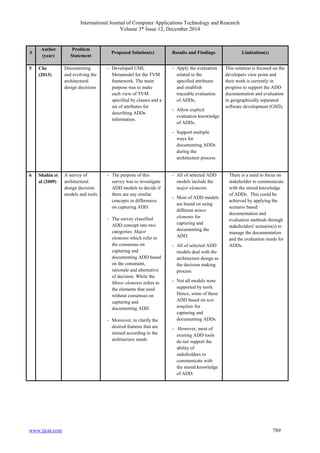
We summarize the approaches and methodologies described
in this section in Table 1. The main observation is that
existing methods are focused on the developer’s concerns and
viewpoints as the main stakeholder. Recent approaches such
as: Triple View Model (TVM) [8], scenario-based method
(SceMethod) [9], and managing ADDs [10] suggested the
need for alternative solutions for supporting ADDs
personalization for different stakeholders.
3. OPEN ISSUES
We describe in this section the open issues that require further
research based on the research work described in the previous
section. These issues are listed as follows:
 There is a significant need to develop alternative
approaches of reverse engineering for documenting the
architectures that should simplify and classify all of the
available information based on identifying the
stakeholders' concerns and their decisions about the
system.
 Improve the system's comprehension by establishing
more advanced approaches for understanding the
software artifacts. These approaches should help in
documenting the architecture at different levels of
abstractions and granularities based on the stakeholders
concerns.
 Finally, it's important to support multiple methods and
guidelines on how to use the general ADDs framework
in the architecting process. These methods should be
base on the architecture needs, context and challenges in
order to evaluate the ADDs in the architecture
development and evolution processes.
International Journal of Computer Applications Technology and Research
Volume 3* Issue 12, December 2014
www.ijcat.com 788
Table 1. Examples of some Methodologies and
Approaches for Documenting Software Architecture
#
Author
(year)
Problem
Statement
Proposed Solution(s) Results and Findings Limitation(s)
1 Kumar
(2013)
Reverse
engineering for
understanding the
software artifacts
- Alternative
methodology to
extract the static and
dynamic information
from the source code.
- The main purpose is
to get complementary
views of software
systems.
- This methodology
support developers to
achieve the reverse
engineering goals in
order to understand
the artifacts of
software systems.
This methodology needs to
support additional stakeholder
beside the developers in order
to identify the stakeholders'
concerns and their decisions
about the whole system.
2 Hugo et al
(2014)
Understanding the
contents of the
legacy systems
using model
driven reverse
engineering
(MDRE)
- Generic and extensible
MDRE framework
called "MoDisco".
- This framework is
applicable to different
types of legacy
systems.
- MoDisco provided
high adaptability
because it is based on
the nature of legacy
system technologies
and the scenario(s)
based on reverse
engineering.
MoDisco should extend to
support additional technologies
and include more advanced
components to improve the
system comprehension.
3 Che et al
(2011)
Collecting
architectural
design decisions
(ADDs)
- Triple View Model
(TVM) an architecture
framework for
documenting ADDs.
- TVM framework
includes three
different views for
describing the
notation of ADDs.
- TVM covers the main
features of the
architecture process.
TVM framework should extend
to manage the evaluation and
documentation of ADDs by
specifying its views through the
stakeholders' scenarios.
4 Che et al
(2012)
Managing the
documentation
and evolution of
the architectural
design decisions
- Scenario based
method (SceMethod)
for documenting and
evaluating ADDs.
- This solution is based
on TVM. The main
purpose is to apply
TVM for specifying
its views through end-
user scenario(s).
- Manage the
documentation and
the evaluation needs
for ADDs through
stakeholders'
scenario(s).
There is a need to support
multiple ways on managing and
documenting the ADDs during
the architecture process.
International Journal of Computer Applications Technology and Research
Volume 3* Issue 12, December 2014
www.ijcat.com 789
#
Author
(year)
Problem
Statement
Proposed Solution(s) Results and Findings Limitation(s)
5 Che
(2013)
Documenting
and evolving the
architectural
design decisions
- Developed UML
Metamodel for the TVM
framework. The main
purpose was to make
each view of TVM
specified by classes and a
set of attributes for
describing ADDs
information.
- Apply the evaluation
related to the
specified attributes
and establish
traceable evaluation
of ADDs,
- Allow explicit
evaluation knowledge
of ADDs.
- Support multiple
ways for
documenting ADDs
during the
architecture process.
This solution is focused on the
developers view point and
their work is currently in
progress to support the ADD
documentation and evaluation
in geographically separated
software development (GSD).
6 Shahin et
al (2009)
A survey of
architectural
design decision
models and tools
- The purpose of this
survey was to investigate
ADD models to decide if
there are any similar
concepts or differences
on capturing ADD.
- The survey classified
ADD concept into two
categories: Major
elements which refer to
the consensus on
capturing and
documenting ADD based
on the constraint,
rationale and alternative
of decision. While the
Minor elements refers to
the elements that used
without consensus on
capturing and
documenting ADD.
- Moreover, to clarify the
desired features that are
missed according to the
architecture needs
- All of selected ADD
models include the
major elements.
- Most of ADD models
are based on using
different minor
elements for
capturing and
documenting the
ADD.
- All of selected ADD
models deal with the
architecture design as
the decision making
process.
- Not all models were
supported by tools.
Hence, some of these
ADD based on text
template for
capturing and
documenting ADDs.
- However, most of
existing ADD tools
do not support the
ability of
stakeholders to
communicate with
the stored knowledge
of ADD.
There is a need to focus on
stakeholder to communicate
with the stored knowledge
of ADDs. This could be
achieved by applying the
scenario based
documentation and
evaluation methods through
stakeholders' scenario(s) to
manage the documentation
and the evaluation needs for
ADDs.
International Journal of Computer Applications Technology and Research
Volume 3* Issue 12, December 2014
www.ijcat.com 790
4. CONCLUSIONS
This paper presented a survey on the current state of the art in
documenting the architectures of existing software systems
using reverse engineering techniques. We compared existing
methods based on their findings and limitations. The main
observation is that existing methods are focused on the
developer’s concerns and viewpoints as the main stakeholder.
We outlined several open issues for further research to
develop alternative approaches of reverse engineering for
documenting the architectures for development and evolution.
These issues show the need to simplify and classify available
information based on identifying the stakeholders' concerns
and viewpoints about the system, improve comprehension by
documenting the architecture at different levels of abstractions
and granularities based on the stakeholders concerns, and
support multiple methods and guidelines on how to use the
ADDs framework based on the architecture needs, context
and challenges in order to evaluate these ADDs during the
architecture development and evolution processes.
5. ACKNOWLEDGMENTS
This research work was funded in part by Qatar National
Research Fund (QNRF) under the National Priorities
Research Program (NPRP) Grant No.: 7 - 662 - 2 - 247
6. REFERENCES
[1] Mamta Gar and Manoj Kumar Jindal. 2009. Reverse
Engineering – Roadmap to Effective software Design. In
Proceedings of 2th International Journal of Recent
Trends in Engineering. Information Paper, vol.1, (May
2009).
[2] Rosenberg, Linda H. and Lawrence E. Hyatt, Software
re-engineering. Software Assurance Technology Center,
1996. http://www.scribd.com/doc/168304435/ Software-
Re-Engineering1, visited on 26 April 2014.
[3] M. Harman, W. B. Langdon and W. Weimer.2013.
Genetic Programming for Reverse Engineering, In R.
Oliveto and R. Robbes, editors, In Proceedings of 20th
Working Conference on Reverse Engineering
(WCRE'13). Koblenz, Germany (14-17 October 2013),
IEEE, 2013.
[4] M. Harman, Yue Jia, W. B. Langdon, Justyna Petke,
Iman H. Moghadam, Shin Yoo and Fan Wu. 2014.
Genetic Improvement for Adaptive Software
Engineering. In Proceedings of 9th International
Symposium on Software Engineering for Adaptive and
Self-Managing Systems (SEAMS'14). Hyderabad, India
(2-3 June 2014), ACM, 2014.
[5] Niranjan Kumar. 2013. An Approach for Reverse
Engineering thorough Complementary Software Views.
In Proceedings of International Conference on Emerging
Research in Computing, Information, Communication
and Applications (ERCICA'13), 2013, 229-234.
[6] Hugo Brunelière, Jordi Cabot, Grégoire Dupé and
Frédéric Madiot. 2014. MoDisco: A Model Driven
Reverse Engineering Framework. Information and
Software Technology 56, no. 8, 2014, 1012-1032.
[7] May Nicholas. 2005. A survey of software architecture
viewpoint models. In Proceedings of 6th Australasian
Workshop on Software and System Architectures, 2005,
13-24.
[8] Meiru Che. 2013. An Approach to Documenting and
Evolving Architectural Design Decisions. In Proceedings
of International Conference on Software Engineering
(ICSE'13), San Francisco, CA, USA, IEEE, 2013.
1373-1376.
[9] Meiru Che and Dewayne E. Perry. 2011. Scenario-based
architectural design decisions documentation and
evolution. In Proceedings of Engineering of Computer
Based Systems (ECBS'11), Las Vegas, NV, ( 27-29 April
2011), IEEE, 2011, 216-225.
[10] Meiru Che and Dewayne E. Perry. 2012. Managing
architectural design decisions documentation and
evolution. In Proceedings of 6th International Journal of
Computers, 2012, 137-148.
[11] M. Shahin, P. Liang and M.R. Khayyambashi. 2009.
Architectural design decision: Existing models and
tools. In Proceedings of Software Architecture, 2009 &
European Conference on Software Architecture.
WICSA/ECSA 2009. Joint Working IEEE/IFIP
Conference, IEEE, 2009, 293-296.
[12] M. Shahin, P. Liang, and M.R. Khayyambashi. 2009. A
Survey of Architectural Design Decision Models and
Tools. Technical Report SBU-RUG-2009-SL-01.
http://www.cs.rug.nl/search/uploads/Publications/shahin
2009sad.pdf, visited on 8 July 2014.
7. AUTHORS BIOGRAPHIES
Hind Alamin Mohamed BSIT and MSCS, is a lecturer in
Software Engineering department, College of Computer
Science and Information Technology at Sudan University of
Science and Technology (SUST). She has participated in the
Scientific Forum for Engineering and Computer Students
(December 2005) in SUDAN, and had the first prize of the
Innovation and Scientific Excellence for the best graduated
project on computer science in 2005. She has been teaching in
the areas of Software Engineering and Computer Science
since 2006. In 2010 she was the head of Software
Engineering Department till December 2012. She is currently
a PhD candidate in Software Engineering since 2013.
Hany H. Ammar BSEE, BSPhysics, MSEE, and PhD EE, is
a Professor of Computer Engineering in the Lane Computer
Science and Electrical Engineering department at West
Virginia University. He has published over 170 articles in
prestigious international journals and conference proceedings.
He is currently the Editor in Chief of the Communications of
the Arab Computer Society On-Line Magazine. He is serving
and has served as the Lead Principal Investigator in the
projects funded by the Qatar National Research Fund under
the National Priorities Research Program. In 2010 he was
awarded a Fulbright Specialist Scholar Award in Information
Technology funded by the US State Department - Bureau of
Education and Cultural Affairs. He has been the Principal
Investigator on a number of research projects on Software
Risk Assessment and Software Architecture Metrics funded
by NASA and NSF, and projects on Automated Identification
Systems funded by NIJ and NSF. He has been teaching in the
areas of Software Engineering and Computer Architecture
since 1987. In 2004, he co-authored a book entitled Pattern-
Oriented Analysis and Design: Composing Patterns to Design
Software Systems, Addison-Wesley. In 2006, he co-authored
a book entitled Software Engineering: Technical,
Organizational and Economic Aspects, an Arabic Textbook

Reverse Engineering for Documenting Software Architectures, a Literature Review

  • 1.
    International Journal ofComputer Applications Technology and Research Volume 3– Issue 12, 785 - 790, 2014, ISSN:- 2319–8656 www.ijcat.com 785 Reverse Engineering for Documenting Software Architectures, a Literature Review Hind Alamin Mohamed College of Computer Science and Information Technology, Sudan University of Science and Technology, SUST University, SUDAN Hany H Ammar Lane Computer Science and Electrical Engineering Department, College of Engineering and Mineral Resources, West Virginia University, USA Abstract: Recently, much research in software engineering focused on reverse engineering of software systems which has become one of the major engineering trends for software evolution. The objective of this survey paper is to provide a literature review on the existing reverse engineering methodologies and approaches for documenting the architecture of software systems. The survey process was based on selecting the most common approaches that form the current state of the art in documenting software architectures. We discuss the limitations of these approaches and highlight the main directions for future research and describe specific open issues for research. Keywords: Reveres Engineering; Software Architecture; Documenting Software Architectures; Architectural Design Decisions. 1. INTRODUCTION Reverse engineering has become one of the major engineering trends for software evolution. Reverse engineering is defines as the process of analyzing an existing system to determine its current components and the relationship between them. This process extracts and creates the design information and new forms of system representations at a higher level of abstraction [1, 2]. Garg et al. categorized engineering into forward engineering and reverse engineering. Both of these types are essential in the software development life cycle. The forward engineering refers to the traditional process for developing software which includes: gathering requirements, designing and coding process till reach the testing phase to ensure that the developed software satisfied the required needs [1]. While reverse engineering defined as the way of analyzing an existing system to identify its current components and the dependencies between these components to recover the design information, and it creates other forms of system representations [1, 2]. Legacy systems are old existing systems which are important for business process. Companies rely on these legacy systems and keep them in operations [2]. Therefore, reverse engineering is used to support the software engineers in the process of analyzing and recapturing the design information of complex and legacy systems during the maintenance phase [2, 3]. In addition, the main objectives of reverse engineering are focused on generating alternative views of system's architecture, recover the design information, re- documentation, detect limitations, represent the system at higher abstractions and facilitate reuse [1, 2, 4]. The main purpose of this survey paper is to achieve the following objectives: provide a literature review on the existing reverse engineering methodologies for documenting the architecture of software systems, and highlights the open issues and the directions for future research. The rest of the paper is organized as follows: Section 2; presents a literature review of the common existing researches on reverse engineering from different perspectives. Section 3; highlights the new research areas as open issues for future works. Finally, concludes with summarizing the main contribution and the future research. 2. LITERATURE REVIEW Program understanding plays a vital role in most of software engineering tasks. In fact; the developers use the software documentation to understand the structure and behavior of existing systems [4, 5]. However, the main problem that developers face is that the design document or others software artifacts were out-of-date to reflect the system's changes. As a result, more effort and time needed for understanding the software rather that modifying it [4, 5]. The following sections will introduce the most common reverse engineering approaches that focused in documenting the architecture of software from different perspectives. 2.1 Reverse Engineering for Understanding Software Artifacts Kumar explained that developers should understand the source code based on the static information and dynamic information [5]. The static information explained the structural characteristic of the system. While dynamic information explained the dynamic characteristics or behaviors of the system. Hence, these details help the developers on understanding the source code in order to maintain or evaluate the system. However, Kumar clarified that few reverse engineering tools supported both of dynamic and static information [5]. Therefore, he presented alternative methodology to extract the static and dynamic information from existing source code. This methodology focused on using one of the reverse engineering tools; namely, Enterprise Architect (EA) to extract the static and dynamic views.
  • 2.
    International Journal ofComputer Applications Technology and Research Volume 3* Issue 12, December 2014 www.ijcat.com 786 Additionally, all of the extracted information was represented in form of Unified Modeling Language (UML) models. The main purpose was to get the complementary views of software in the form of state diagrams and communication diagrams. The stages of this methodology are summarized as it shown in Figure 1. Figure 1. Reverse Engineering thorough Complementary Software Views [5] This proposed methodology was very useful for supporting developers to understand the software artifacts of existing software systems. However, the methodology needs to support additional stakeholder beside the developers in order to identify the stakeholders' concerns and their decisions about the whole system. 2.2 Model Driven Reverse Engineering Model driven reverse engineering (MDRE) was proposed as described in [6] to improve the traditional reverse engineering activities and legacy technologies. It is used to describe the representation of derived models from legacy systems to understand their contents. However, most of MDRE solutions focused on addressing several types of legacy system scenarios, but these solutions are not complete and they do not cover the full range of legacy systems. The work also introduced several reverse engineering processes such as: the technical/functional migration, processes of MDRE [6]. Recently, Hugo et al. presented a generic and extensible MDRE framework called "MoDisco". This framework is applicable to different refactoring and re-documentation techniques [6]. The architecture of MoDisco is represented in three layers, each layer is comprised of one or more components (see Figure 2). The components of each layers provided high adaptability because they are based on the nature of legacy system technologies and the scenario based on reverse engineering. However, the MoDisco framework was limited to traditional technologies such as: JAVA, JEE (including JSP) and XML. This framework needs to be extended to support additional technologies and to add more advanced components to improve the system comprehension, and expose the key architecture design decisions. Figure 2. MoDisco Framework’s Architecture [6, p9] 2.3 Documenting of Architectural Design Decisions (ADDs) Historically, Shaw and Garlan introduced the concepts of software architecture and defined the system in terms of computational components and interactions between these components as indicated in [7]. Moreover, Perry and Wolf defined software architecture in terms of elements, their properties, and the relationships among these elements. They suggested that the software architecture description is the consequence of early design decisions [7]. Software architecture is defined by the recommended practice (ANSI/IEEE Std 1471-2000) as: the fundamental organization of a system, embodied in its components, their relationships to each other and the environment, and the principles governing its design and evolution. Software architecture development is based on a set of architectural design decisions (ADDs). This is considered as one of the important factors in achieving the functional and non-functional requirements of the system [8]. Che explained that the process of capturing and representing ADDs is very useful for organizing the architecture knowledge and reducing the possibility of missing this knowledge [8]. Furthermore, the previous research focused on developing tools and approaches for capturing, representing and sharing of the ADDs. However, Che clarified that most of the previous research proposed different methods for documenting ADDs, and these methods rarely support architecture evaluation and knowledge evaluation in practice [8]. Accordingly, Che et al. presented an alternative approach for documenting and evaluating ADDs. This approach proposed solutions described in the following subsections [8, 9]: 2.3.1 Collecting of Architectural Design Decisions The first solution focused on creating a general architectural framework for documenting ADDs called the Triple View Model (TVM). The framework includes three different views for describing the notation of ADDs as shown in Figure 3. It also covers the features of the architecture development process [8, 9].
  • 3.
    International Journal ofComputer Applications Technology and Research Volume 3* Issue 12, December 2014 www.ijcat.com 787 Figure 3. Triple View Model Framework [8, p1374] As it shown in Figure 3; the Element View describes the elements that should be defined to develop the architecture; such as: Computation elements, Data elements, and Connector elements. The Constraint View explains how the elements interact with each other by defining what the system should do and not to do, the constraint(s) on each element of the element view. Additionally, define the constraints on the interaction and configuration among the elements. Finally, the Intent View includes the rationale decision that made after analyzing all the available decisions, Moreover, the selection of styles and patterns for the architecture and the design of the system. 2.3.2 Scenario-Based Documentation and Evaluation Method The second solution called SceMethod is based on the TVM framework. The main purpose is to apply the TVM framework by specifying its views through the end-user scenarios; then manage the documentation and the evaluation needs for ADDs [8, 10]. 2.3.3 UML Metamodel The third solution is focused on developing the UML Metamodel for the TVM framework. The main purpose was to make each view of TVM specified by classes and a set of attributes for describing ADD information. Accordingly, this solution provided the following features [8]: a) establish traceable evaluation of ADDs, b) apply the evaluation related to the specified attributes, c) support multiple ways on documenting during the architecture process and allow explicit evaluation knowledge of ADDs. Furthermore, TVM and SceMethod solution was validated in using a case study to ensure the applicability and the effectiveness. Supporting the ADD documentation and evaluation in geographically separated software development (GSD) is currently work in progress. 2.4 Comparison of Existing Architectural Design Decisions Models Researchers made a great of effort to present related tools and models for capturing, managing, and sharing the ADDs. These proposed models were based on the concept of architectural knowledge to promote the interaction between the stakeholders and improve the architecture of the system [8, 11]. Accordingly in [11], Shahin et al. presented a comparison study that is based on surveying and comparing the existing architectural design decisions models. Their comparison included nine ADD models and used six criteria based on desired features [11, 12]. The main reason was to investigate the ADD models to decide if there are similarities and differences in capturing the ADDs. Moreover, the study aimed at finding the desired features that were missed according to the architecture needs [11]. The authors in [11] classified the ADD elements into two categories: major elements and minor elements. The major elements refer to the consensus on capturing and documenting ADDs based on the constraints, rationale, and alternative decisions. While the minor elements refer to the elements that used without consensus on capturing and documenting the ADDs, such as: stakeholders, problem, group, status, dependency, artifacts, and phase/iteration. The main observations of this comparison study are highlighted as follow: 1) all of the selected ADD models included the major elements and used different terms to express similar concepts of the architecture design. 2) Most ADD models used different minor elements for capturing and documenting ADDs. 3) All the selected ADD models deal with the architecture design as a decision making process. 4) While not all of them are supported by tools, some were based on only textual templates for capturing and documenting ADDs. 5) The most important observation was that most of existing ADD tools do not provide support for ADD personalization which refers to the ability of stakeholders to communicate with the stored knowledge of ADD [11, 12] based on their own profile. We summarize the approaches and methodologies described in this section in Table 1. The main observation is that existing methods are focused on the developer’s concerns and viewpoints as the main stakeholder. Recent approaches such as: Triple View Model (TVM) [8], scenario-based method (SceMethod) [9], and managing ADDs [10] suggested the need for alternative solutions for supporting ADDs personalization for different stakeholders. 3. OPEN ISSUES We describe in this section the open issues that require further research based on the research work described in the previous section. These issues are listed as follows:  There is a significant need to develop alternative approaches of reverse engineering for documenting the architectures that should simplify and classify all of the available information based on identifying the stakeholders' concerns and their decisions about the system.  Improve the system's comprehension by establishing more advanced approaches for understanding the software artifacts. These approaches should help in documenting the architecture at different levels of abstractions and granularities based on the stakeholders concerns.  Finally, it's important to support multiple methods and guidelines on how to use the general ADDs framework in the architecting process. These methods should be base on the architecture needs, context and challenges in order to evaluate the ADDs in the architecture development and evolution processes.
  • 4.
    International Journal ofComputer Applications Technology and Research Volume 3* Issue 12, December 2014 www.ijcat.com 788 Table 1. Examples of some Methodologies and Approaches for Documenting Software Architecture # Author (year) Problem Statement Proposed Solution(s) Results and Findings Limitation(s) 1 Kumar (2013) Reverse engineering for understanding the software artifacts - Alternative methodology to extract the static and dynamic information from the source code. - The main purpose is to get complementary views of software systems. - This methodology support developers to achieve the reverse engineering goals in order to understand the artifacts of software systems. This methodology needs to support additional stakeholder beside the developers in order to identify the stakeholders' concerns and their decisions about the whole system. 2 Hugo et al (2014) Understanding the contents of the legacy systems using model driven reverse engineering (MDRE) - Generic and extensible MDRE framework called "MoDisco". - This framework is applicable to different types of legacy systems. - MoDisco provided high adaptability because it is based on the nature of legacy system technologies and the scenario(s) based on reverse engineering. MoDisco should extend to support additional technologies and include more advanced components to improve the system comprehension. 3 Che et al (2011) Collecting architectural design decisions (ADDs) - Triple View Model (TVM) an architecture framework for documenting ADDs. - TVM framework includes three different views for describing the notation of ADDs. - TVM covers the main features of the architecture process. TVM framework should extend to manage the evaluation and documentation of ADDs by specifying its views through the stakeholders' scenarios. 4 Che et al (2012) Managing the documentation and evolution of the architectural design decisions - Scenario based method (SceMethod) for documenting and evaluating ADDs. - This solution is based on TVM. The main purpose is to apply TVM for specifying its views through end- user scenario(s). - Manage the documentation and the evaluation needs for ADDs through stakeholders' scenario(s). There is a need to support multiple ways on managing and documenting the ADDs during the architecture process.
  • 5.
    International Journal ofComputer Applications Technology and Research Volume 3* Issue 12, December 2014 www.ijcat.com 789 # Author (year) Problem Statement Proposed Solution(s) Results and Findings Limitation(s) 5 Che (2013) Documenting and evolving the architectural design decisions - Developed UML Metamodel for the TVM framework. The main purpose was to make each view of TVM specified by classes and a set of attributes for describing ADDs information. - Apply the evaluation related to the specified attributes and establish traceable evaluation of ADDs, - Allow explicit evaluation knowledge of ADDs. - Support multiple ways for documenting ADDs during the architecture process. This solution is focused on the developers view point and their work is currently in progress to support the ADD documentation and evaluation in geographically separated software development (GSD). 6 Shahin et al (2009) A survey of architectural design decision models and tools - The purpose of this survey was to investigate ADD models to decide if there are any similar concepts or differences on capturing ADD. - The survey classified ADD concept into two categories: Major elements which refer to the consensus on capturing and documenting ADD based on the constraint, rationale and alternative of decision. While the Minor elements refers to the elements that used without consensus on capturing and documenting ADD. - Moreover, to clarify the desired features that are missed according to the architecture needs - All of selected ADD models include the major elements. - Most of ADD models are based on using different minor elements for capturing and documenting the ADD. - All of selected ADD models deal with the architecture design as the decision making process. - Not all models were supported by tools. Hence, some of these ADD based on text template for capturing and documenting ADDs. - However, most of existing ADD tools do not support the ability of stakeholders to communicate with the stored knowledge of ADD. There is a need to focus on stakeholder to communicate with the stored knowledge of ADDs. This could be achieved by applying the scenario based documentation and evaluation methods through stakeholders' scenario(s) to manage the documentation and the evaluation needs for ADDs.
  • 6.
    International Journal ofComputer Applications Technology and Research Volume 3* Issue 12, December 2014 www.ijcat.com 790 4. CONCLUSIONS This paper presented a survey on the current state of the art in documenting the architectures of existing software systems using reverse engineering techniques. We compared existing methods based on their findings and limitations. The main observation is that existing methods are focused on the developer’s concerns and viewpoints as the main stakeholder. We outlined several open issues for further research to develop alternative approaches of reverse engineering for documenting the architectures for development and evolution. These issues show the need to simplify and classify available information based on identifying the stakeholders' concerns and viewpoints about the system, improve comprehension by documenting the architecture at different levels of abstractions and granularities based on the stakeholders concerns, and support multiple methods and guidelines on how to use the ADDs framework based on the architecture needs, context and challenges in order to evaluate these ADDs during the architecture development and evolution processes. 5. ACKNOWLEDGMENTS This research work was funded in part by Qatar National Research Fund (QNRF) under the National Priorities Research Program (NPRP) Grant No.: 7 - 662 - 2 - 247 6. REFERENCES [1] Mamta Gar and Manoj Kumar Jindal. 2009. Reverse Engineering – Roadmap to Effective software Design. In Proceedings of 2th International Journal of Recent Trends in Engineering. Information Paper, vol.1, (May 2009). [2] Rosenberg, Linda H. and Lawrence E. Hyatt, Software re-engineering. Software Assurance Technology Center, 1996. http://www.scribd.com/doc/168304435/ Software- Re-Engineering1, visited on 26 April 2014. [3] M. Harman, W. B. Langdon and W. Weimer.2013. Genetic Programming for Reverse Engineering, In R. Oliveto and R. Robbes, editors, In Proceedings of 20th Working Conference on Reverse Engineering (WCRE'13). Koblenz, Germany (14-17 October 2013), IEEE, 2013. [4] M. Harman, Yue Jia, W. B. Langdon, Justyna Petke, Iman H. Moghadam, Shin Yoo and Fan Wu. 2014. Genetic Improvement for Adaptive Software Engineering. In Proceedings of 9th International Symposium on Software Engineering for Adaptive and Self-Managing Systems (SEAMS'14). Hyderabad, India (2-3 June 2014), ACM, 2014. [5] Niranjan Kumar. 2013. An Approach for Reverse Engineering thorough Complementary Software Views. In Proceedings of International Conference on Emerging Research in Computing, Information, Communication and Applications (ERCICA'13), 2013, 229-234. [6] Hugo Brunelière, Jordi Cabot, Grégoire Dupé and Frédéric Madiot. 2014. MoDisco: A Model Driven Reverse Engineering Framework. Information and Software Technology 56, no. 8, 2014, 1012-1032. [7] May Nicholas. 2005. A survey of software architecture viewpoint models. In Proceedings of 6th Australasian Workshop on Software and System Architectures, 2005, 13-24. [8] Meiru Che. 2013. An Approach to Documenting and Evolving Architectural Design Decisions. In Proceedings of International Conference on Software Engineering (ICSE'13), San Francisco, CA, USA, IEEE, 2013. 1373-1376. [9] Meiru Che and Dewayne E. Perry. 2011. Scenario-based architectural design decisions documentation and evolution. In Proceedings of Engineering of Computer Based Systems (ECBS'11), Las Vegas, NV, ( 27-29 April 2011), IEEE, 2011, 216-225. [10] Meiru Che and Dewayne E. Perry. 2012. Managing architectural design decisions documentation and evolution. In Proceedings of 6th International Journal of Computers, 2012, 137-148. [11] M. Shahin, P. Liang and M.R. Khayyambashi. 2009. Architectural design decision: Existing models and tools. In Proceedings of Software Architecture, 2009 & European Conference on Software Architecture. WICSA/ECSA 2009. Joint Working IEEE/IFIP Conference, IEEE, 2009, 293-296. [12] M. Shahin, P. Liang, and M.R. Khayyambashi. 2009. A Survey of Architectural Design Decision Models and Tools. Technical Report SBU-RUG-2009-SL-01. http://www.cs.rug.nl/search/uploads/Publications/shahin 2009sad.pdf, visited on 8 July 2014. 7. AUTHORS BIOGRAPHIES Hind Alamin Mohamed BSIT and MSCS, is a lecturer in Software Engineering department, College of Computer Science and Information Technology at Sudan University of Science and Technology (SUST). She has participated in the Scientific Forum for Engineering and Computer Students (December 2005) in SUDAN, and had the first prize of the Innovation and Scientific Excellence for the best graduated project on computer science in 2005. She has been teaching in the areas of Software Engineering and Computer Science since 2006. In 2010 she was the head of Software Engineering Department till December 2012. She is currently a PhD candidate in Software Engineering since 2013. Hany H. Ammar BSEE, BSPhysics, MSEE, and PhD EE, is a Professor of Computer Engineering in the Lane Computer Science and Electrical Engineering department at West Virginia University. He has published over 170 articles in prestigious international journals and conference proceedings. He is currently the Editor in Chief of the Communications of the Arab Computer Society On-Line Magazine. He is serving and has served as the Lead Principal Investigator in the projects funded by the Qatar National Research Fund under the National Priorities Research Program. In 2010 he was awarded a Fulbright Specialist Scholar Award in Information Technology funded by the US State Department - Bureau of Education and Cultural Affairs. He has been the Principal Investigator on a number of research projects on Software Risk Assessment and Software Architecture Metrics funded by NASA and NSF, and projects on Automated Identification Systems funded by NIJ and NSF. He has been teaching in the areas of Software Engineering and Computer Architecture since 1987. In 2004, he co-authored a book entitled Pattern- Oriented Analysis and Design: Composing Patterns to Design Software Systems, Addison-Wesley. In 2006, he co-authored a book entitled Software Engineering: Technical, Organizational and Economic Aspects, an Arabic Textbook