International Journal of Computer Applications Technology and Research
Volume 4– Issue 2, 149 - 152, 2015, ISSN:- 2319–8656
www.ijcat.com 149
Design and Analysis of Robotic Rover with Gripper Arm
using Embedded C
Harmeet Singh, Sangeeta
Department of Computer Science
Punjab College of Technical Education (PCTE)
Baddowal, Punjab, India
Harpreet Kaur
Department of Electronics and Communication
Engineering
Sant Longowal Institute of Engineering and Technology
(SLIET) Longowal, Punjab, India
Abstract: This paper confers the development and working of robotic rover performing various autonomous tasks to identify, pick and
drop an object at an appropriate position using microcontroller 8051 in conjunction with embedded C programming. The system
employs infrared proximity sensors, DC geared motors, microcontroller board, etc. Robotic rover technology offers many applications
in space explorations, military operations, etc. The motive of this research work is to design a wireless robotic rover being autonomous
controlled that is capable of completing tasks with proliferated accuracy in smooth terrain.
Keywords: Robotic Rover; Embedded C; Microcontroller; Programming; Sensor
1. INTRODUCTION
Robotics technology is emanating at an expeditious pace,
contributing new possibilities for automating tasks in many
demanding applications, peculiarly in space explorations,
military operations, underwater missions, etc. Especially, in
space exploration, robotic devices are known as planetary
rovers or simply rovers who aim at administering physical
analysis of planetary terrains and astronomical bodies. The
supervision of data about air pressure, climate, temperature,
and other atmospheric aspects can be done by this advanced
technology [1,5,9]. It is a space exploration vehicle designed
to move across the surface of a planet or other heavenly body.
Primarily, rovers can be self-governing or can be remotely
controlled from the ground stations called as Remote
Collaboration Center having very definite scientific
objectives. Some rovers have been devised in the
transportation of members of a human spaceflight crew;
others have been partially or fully autonomous robots. Rovers
or Unmanned Ground Vehicles (UGV) usually arrive at the
planetary surface on a lander-style spacecraft [2,7-8]. The
investigation of territories at the microscopic level,
investigating the biological aspects of planetary surfaces,
analyzing the composition of minerals, rocks, and soils,
searching for liquid water in minerals, and measuring the
ambient temperature, air pressure, and amount of dust in the
landing site are some of its imperative appositeness [3].
Therefore, rovers are eminently computing systems that use
complicated embedded software and algorithms to handle
computational and processing functionalities.
Figure.1 Schematic of Curiosity Rover on Mars
An autonomous robot has the competence to:
 Collect information about the environment, such as
building maps of building interiors.
 Detect objects of interest such as people and
vehicles.
 Travel between targets without human navigation
and intervention.
 Disarm, or remove explosives.
 Repair itself without outside assistance.
The ongoing Mars exploration focuses around surface
exploration using satellites and small, autonomous land-
exploration rovers which are used in predilection to manned
missions as the cost is substantially lower and the rovers are
more suited to the harsh planetary environment. Manned
missions are still regarded as the „holy grail‟ of topographical
exploration; a current rover mission is aiming to scrutinize
Mars with a pair of rovers, providing scope for coordination
which was hitherto only possible with human exploration
[1,3-4,6]. This paper is intended to study and discuss the
design and development of robotic rover, its fully autonomous
functionalities with various other capabilities.
2. ROBOTIC ROVER DESIGN
The structural part involves use of frames, beams, linkages,
axles, etc. The mechanical parts/accessories comprise various
types of gears (spurs, crowns, bevels, worms and differential
gear systems), pulleys and belts, drive systems (differentials,
castors, wheels and steering), etc. Pneumatics plays a vital
role in generating specific pushing and pulling movements
such as those simulating arms or leg movements. Pneumatic
grippers are also used with advantage in robotics because of
their simplicity and cost-effectiveness. The electrical items
include DC and stepper motors, actuators, electrical grips,
clutches and their control. The electronics part involves
remote control, sensors (touch sensor, light sensor, collision
sensor, etc), their interface circuitry and a microcontroller for
overall control function.
The main objectives of the robotic rover project are given
below:
International Journal of Computer Applications Technology and Research
Volume 4– Issue 2, 149 - 152, 2015, ISSN:- 2319–8656
www.ijcat.com 150
 It automatically senses the object of interest using
infrared sensor.
 It picks up the object.
 It places the object at proper position.
 It moves forward in search of another object
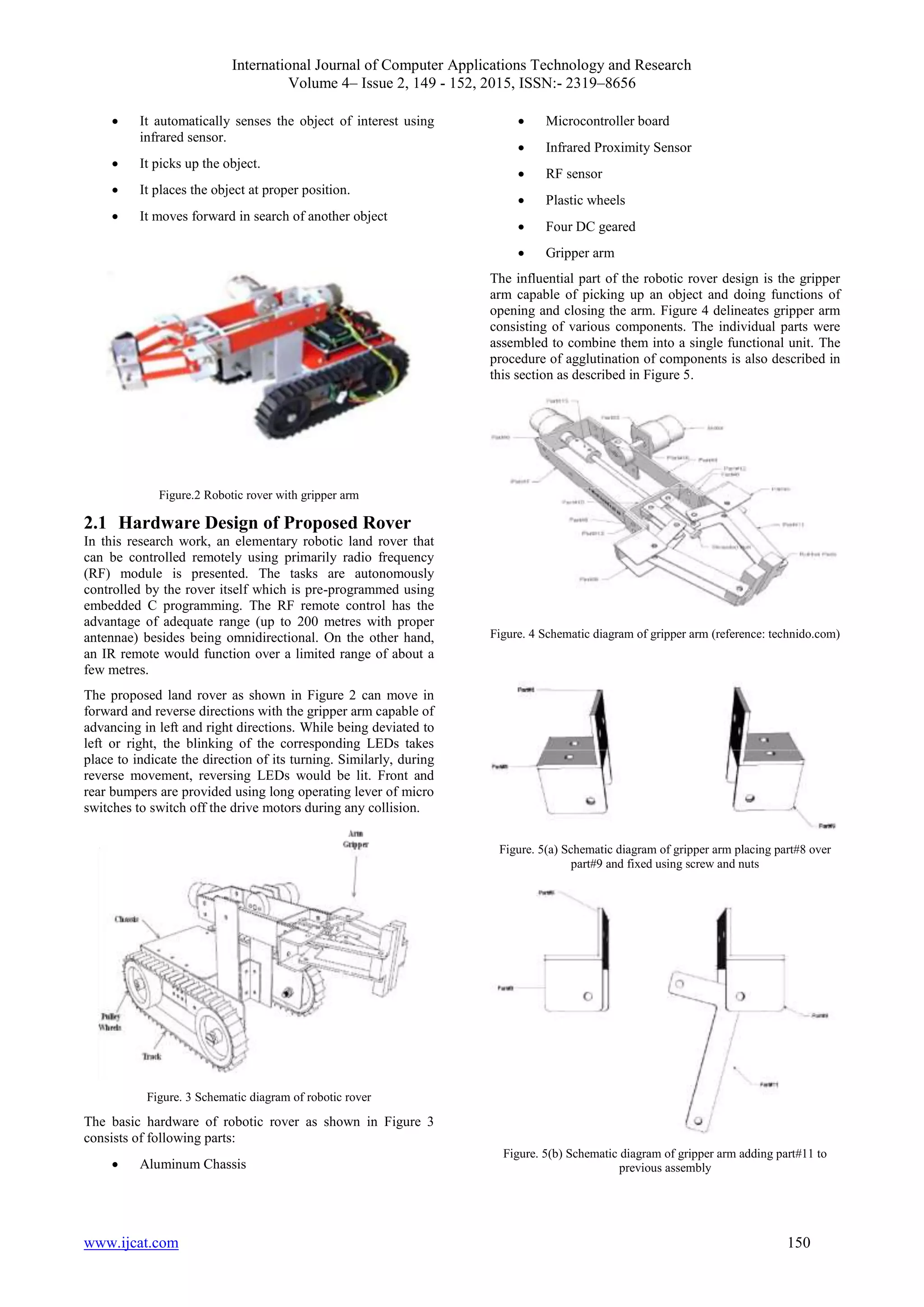
Figure.2 Robotic rover with gripper arm
2.1 Hardware Design of Proposed Rover
In this research work, an elementary robotic land rover that
can be controlled remotely using primarily radio frequency
(RF) module is presented. The tasks are autonomously
controlled by the rover itself which is pre-programmed using
embedded C programming. The RF remote control has the
advantage of adequate range (up to 200 metres with proper
antennae) besides being omnidirectional. On the other hand,
an IR remote would function over a limited range of about a
few metres.
The proposed land rover as shown in Figure 2 can move in
forward and reverse directions with the gripper arm capable of
advancing in left and right directions. While being deviated to
left or right, the blinking of the corresponding LEDs takes
place to indicate the direction of its turning. Similarly, during
reverse movement, reversing LEDs would be lit. Front and
rear bumpers are provided using long operating lever of micro
switches to switch off the drive motors during any collision.
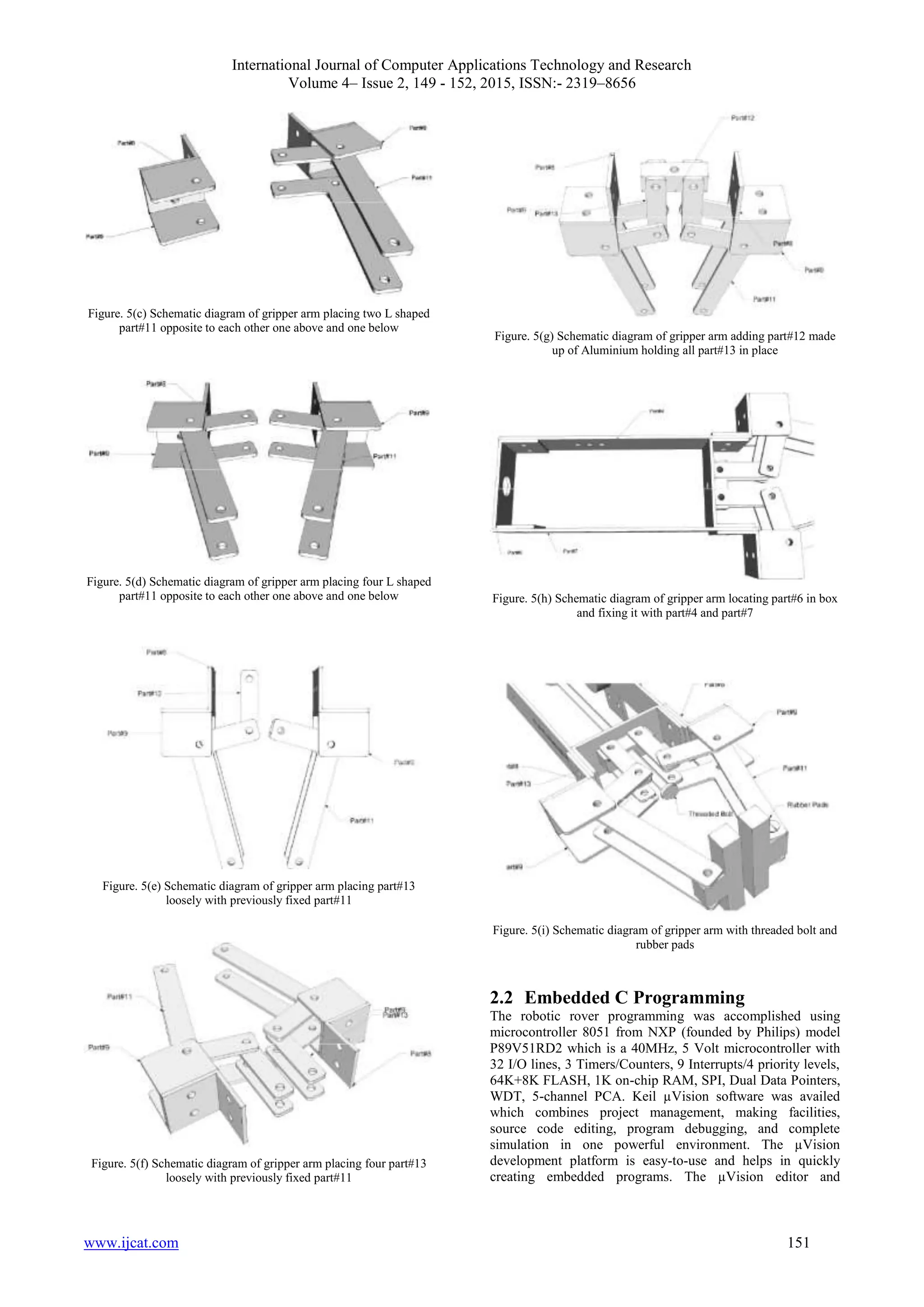
Figure. 3 Schematic diagram of robotic rover
The basic hardware of robotic rover as shown in Figure 3
consists of following parts:
 Aluminum Chassis
 Microcontroller board
 Infrared Proximity Sensor
 RF sensor
 Plastic wheels
 Four DC geared
 Gripper arm
The influential part of the robotic rover design is the gripper
arm capable of picking up an object and doing functions of
opening and closing the arm. Figure 4 delineates gripper arm
consisting of various components. The individual parts were
assembled to combine them into a single functional unit. The
procedure of agglutination of components is also described in
this section as described in Figure 5.
Figure. 4 Schematic diagram of gripper arm (reference: technido.com)
Figure. 5(a) Schematic diagram of gripper arm placing part#8 over
part#9 and fixed using screw and nuts
Figure. 5(b) Schematic diagram of gripper arm adding part#11 to
previous assembly
International Journal of Computer Applications Technology and Research
Volume 4– Issue 2, 149 - 152, 2015, ISSN:- 2319–8656
www.ijcat.com 151
Figure. 5(c) Schematic diagram of gripper arm placing two L shaped
part#11 opposite to each other one above and one below
Figure. 5(d) Schematic diagram of gripper arm placing four L shaped
part#11 opposite to each other one above and one below
Figure. 5(e) Schematic diagram of gripper arm placing part#13
loosely with previously fixed part#11
Figure. 5(f) Schematic diagram of gripper arm placing four part#13
loosely with previously fixed part#11
Figure. 5(g) Schematic diagram of gripper arm adding part#12 made
up of Aluminium holding all part#13 in place
Figure. 5(h) Schematic diagram of gripper arm locating part#6 in box
and fixing it with part#4 and part#7
Figure. 5(i) Schematic diagram of gripper arm with threaded bolt and
rubber pads
2.2 Embedded C Programming
The robotic rover programming was accomplished using
microcontroller 8051 from NXP (founded by Philips) model
P89V51RD2 which is a 40MHz, 5 Volt microcontroller with
32 I/O lines, 3 Timers/Counters, 9 Interrupts/4 priority levels,
64K+8K FLASH, 1K on-chip RAM, SPI, Dual Data Pointers,
WDT, 5-channel PCA. Keil µVision software was availed
which combines project management, making facilities,
source code editing, program debugging, and complete
simulation in one powerful environment. The µVision
development platform is easy-to-use and helps in quickly
creating embedded programs. The µVision editor and
International Journal of Computer Applications Technology and Research
Volume 4– Issue 2, 149 - 152, 2015, ISSN:- 2319–8656
www.ijcat.com 152
debugger are assimilated in a single application that provides
a seamless embedded project development environment. Flash
magic software was used as program burner which is a PC
tool for programming flash based microcontrollers from NXP
using a serial or Ethernet protocol while in the target
hardware.
Figure. 6 Flow chart depicting working of proposed robotic rover
2.3 Working of Robotic Rover
Figure 6 illustrates the dynamics of robotic rover with gripper
arm facility. This robot firstly moves in forward direction in
search of an object. Here, the IR sensor plays a crucial role.
The object is detected when the distance between the IR
sensor and the object of interest is approximately 12 cm (the
range can be further increased). If the object is encountered,
its arm grip is released and moved in downward direction.
Then the arm grip grasps again and picks up the object. It is
placed in right direction where the arm gripper releases the
object. It maneuvers in upward direction and robotic rover
proceeds in forward direction. The programming of the whole
operation is done in embedded C language using Keil µVision
3 tool from ARM Ltd.
3. RESULTS
Table 1. Table captions should be placed above the table
Steps Operations
Time taken to
complete (sec)
Step 1 Release of Gripper arm 15
Step 2 Down 4
Step 3 Grip (object) 11
Step 4 Up 5
Step 5 Right/left 5
Step 6 Down 3
Step 7 Release 12
Step 8 Up 5
Step 9 Grip (empty) 15
Step 10 Left/right 5
The robotic rover functionality comprises of some basic steps
which were made fully autonomous using embedded C
programming. The RF module was used to switch on/off the
rover. Firstly, the release of empty gripper arm has taken a
considerable time of 15 sec followed by down movement of 4
sec. Due to presence of gravity of earth, down movement took
minimum time among all other operations. Thenceforth, the
object was grasped by the gripper arm covering a total of 11
sec. The gripping and releasing operations done by gripper
arm clutched substantial seconds as shown in table 1.
Hereafter, the up movement of gripper arm took place with 5
seconds and positioning the object left/right. The object was
then placed by a down release of 3 seconds since both the law
of gravity and the weight of object exerted a downward force.
Placing the object at proper place was the most momentous
task. It took a second highest time of 12 sec with release
operation of the arm. Consequently, the arm was moved in
upward direction with gripping of the arm. These operations
were continued until and unless an object of interest was
discovered.
4. CONCLUSIONS
This paper has bestowed an overview of the proposed robotic
rover which can be used for sensing and navigation. It can be
made fully autonomous with in-built camera, high
performance controller, ultrasound sensors for future work.
These enhancements will foster its capability for long range
navigation. Being a latest technology in India, it would be
benefaction for our space and defense applications.
5. ACKNOWLEDGMENTS
The authors are indebted to Kits„n‟Spares, New Delhi and
Technido Indore, India for providing Robotic Rover parts and
technical help for making this work successful.
6. REFERENCES
[1] Zerigui A., WU X., Deng Z., “A Survey of Rover
Control Systems”, International Journal of Computer
Sciences and Engineering Systems, Vol. 1, No. 4, pp.
105-109, 2007.
[2] Siegwart R., Nourbakhsh I., Scaramuzza D.,
Introduction to Autonomous Mobile Robots, 2nd edition,
The MIT Press, 2011.
[3] Young A., Lunar and Planetary Rovers: The Wheels of
Apollo and the Quest for Mars, Springer, 2006.
[4] Svitak, Amy, Cost of NASA's Next Mars Rover Hits
Nearly $2.5 Billion, http://www.space.com/10762-nasa-
mars-rover-overbudget.html, retrieved 2011-02-03.
[5] Wesley T. Huntress JR., Mikhail Ya Marov, Soviet
Robots in the Solar System: Mission Technologies and
Discoveries, Springer, 2011.
[6] E. Colon, H. Sahli, and Y. Baudoin, ―CoRoBa, a multi
mobile robot control and simulation framework,
International Journal of Advanced Robotic Systems, Vol.
3, No. 1, pp. 073-078, 2006.
[7] iRobot, Mobility Integration Software User's Guide,
2002.
[8] Cherry S., Robots, IEEE Spectrum, 2007.
[9] B. Gerkey, R. Vaughan, K. Sty, A. Howard, G.
Sukhatme, and M. Mataric, ―Most valuable player: A
robot device server for distributed control‖, In
Proceedings of the IEEE/RSJ International Conference
on Intelligent Robots and Systems (IROS), 2001.

Design and Analysis of Robotic Rover with Gripper Arm using Embedded C

  • 1.
    International Journal ofComputer Applications Technology and Research Volume 4– Issue 2, 149 - 152, 2015, ISSN:- 2319–8656 www.ijcat.com 149 Design and Analysis of Robotic Rover with Gripper Arm using Embedded C Harmeet Singh, Sangeeta Department of Computer Science Punjab College of Technical Education (PCTE) Baddowal, Punjab, India Harpreet Kaur Department of Electronics and Communication Engineering Sant Longowal Institute of Engineering and Technology (SLIET) Longowal, Punjab, India Abstract: This paper confers the development and working of robotic rover performing various autonomous tasks to identify, pick and drop an object at an appropriate position using microcontroller 8051 in conjunction with embedded C programming. The system employs infrared proximity sensors, DC geared motors, microcontroller board, etc. Robotic rover technology offers many applications in space explorations, military operations, etc. The motive of this research work is to design a wireless robotic rover being autonomous controlled that is capable of completing tasks with proliferated accuracy in smooth terrain. Keywords: Robotic Rover; Embedded C; Microcontroller; Programming; Sensor 1. INTRODUCTION Robotics technology is emanating at an expeditious pace, contributing new possibilities for automating tasks in many demanding applications, peculiarly in space explorations, military operations, underwater missions, etc. Especially, in space exploration, robotic devices are known as planetary rovers or simply rovers who aim at administering physical analysis of planetary terrains and astronomical bodies. The supervision of data about air pressure, climate, temperature, and other atmospheric aspects can be done by this advanced technology [1,5,9]. It is a space exploration vehicle designed to move across the surface of a planet or other heavenly body. Primarily, rovers can be self-governing or can be remotely controlled from the ground stations called as Remote Collaboration Center having very definite scientific objectives. Some rovers have been devised in the transportation of members of a human spaceflight crew; others have been partially or fully autonomous robots. Rovers or Unmanned Ground Vehicles (UGV) usually arrive at the planetary surface on a lander-style spacecraft [2,7-8]. The investigation of territories at the microscopic level, investigating the biological aspects of planetary surfaces, analyzing the composition of minerals, rocks, and soils, searching for liquid water in minerals, and measuring the ambient temperature, air pressure, and amount of dust in the landing site are some of its imperative appositeness [3]. Therefore, rovers are eminently computing systems that use complicated embedded software and algorithms to handle computational and processing functionalities. Figure.1 Schematic of Curiosity Rover on Mars An autonomous robot has the competence to:  Collect information about the environment, such as building maps of building interiors.  Detect objects of interest such as people and vehicles.  Travel between targets without human navigation and intervention.  Disarm, or remove explosives.  Repair itself without outside assistance. The ongoing Mars exploration focuses around surface exploration using satellites and small, autonomous land- exploration rovers which are used in predilection to manned missions as the cost is substantially lower and the rovers are more suited to the harsh planetary environment. Manned missions are still regarded as the „holy grail‟ of topographical exploration; a current rover mission is aiming to scrutinize Mars with a pair of rovers, providing scope for coordination which was hitherto only possible with human exploration [1,3-4,6]. This paper is intended to study and discuss the design and development of robotic rover, its fully autonomous functionalities with various other capabilities. 2. ROBOTIC ROVER DESIGN The structural part involves use of frames, beams, linkages, axles, etc. The mechanical parts/accessories comprise various types of gears (spurs, crowns, bevels, worms and differential gear systems), pulleys and belts, drive systems (differentials, castors, wheels and steering), etc. Pneumatics plays a vital role in generating specific pushing and pulling movements such as those simulating arms or leg movements. Pneumatic grippers are also used with advantage in robotics because of their simplicity and cost-effectiveness. The electrical items include DC and stepper motors, actuators, electrical grips, clutches and their control. The electronics part involves remote control, sensors (touch sensor, light sensor, collision sensor, etc), their interface circuitry and a microcontroller for overall control function. The main objectives of the robotic rover project are given below:
  • 2.
    International Journal ofComputer Applications Technology and Research Volume 4– Issue 2, 149 - 152, 2015, ISSN:- 2319–8656 www.ijcat.com 150  It automatically senses the object of interest using infrared sensor.  It picks up the object.  It places the object at proper position.  It moves forward in search of another object Figure.2 Robotic rover with gripper arm 2.1 Hardware Design of Proposed Rover In this research work, an elementary robotic land rover that can be controlled remotely using primarily radio frequency (RF) module is presented. The tasks are autonomously controlled by the rover itself which is pre-programmed using embedded C programming. The RF remote control has the advantage of adequate range (up to 200 metres with proper antennae) besides being omnidirectional. On the other hand, an IR remote would function over a limited range of about a few metres. The proposed land rover as shown in Figure 2 can move in forward and reverse directions with the gripper arm capable of advancing in left and right directions. While being deviated to left or right, the blinking of the corresponding LEDs takes place to indicate the direction of its turning. Similarly, during reverse movement, reversing LEDs would be lit. Front and rear bumpers are provided using long operating lever of micro switches to switch off the drive motors during any collision. Figure. 3 Schematic diagram of robotic rover The basic hardware of robotic rover as shown in Figure 3 consists of following parts:  Aluminum Chassis  Microcontroller board  Infrared Proximity Sensor  RF sensor  Plastic wheels  Four DC geared  Gripper arm The influential part of the robotic rover design is the gripper arm capable of picking up an object and doing functions of opening and closing the arm. Figure 4 delineates gripper arm consisting of various components. The individual parts were assembled to combine them into a single functional unit. The procedure of agglutination of components is also described in this section as described in Figure 5. Figure. 4 Schematic diagram of gripper arm (reference: technido.com) Figure. 5(a) Schematic diagram of gripper arm placing part#8 over part#9 and fixed using screw and nuts Figure. 5(b) Schematic diagram of gripper arm adding part#11 to previous assembly
  • 3.
    International Journal ofComputer Applications Technology and Research Volume 4– Issue 2, 149 - 152, 2015, ISSN:- 2319–8656 www.ijcat.com 151 Figure. 5(c) Schematic diagram of gripper arm placing two L shaped part#11 opposite to each other one above and one below Figure. 5(d) Schematic diagram of gripper arm placing four L shaped part#11 opposite to each other one above and one below Figure. 5(e) Schematic diagram of gripper arm placing part#13 loosely with previously fixed part#11 Figure. 5(f) Schematic diagram of gripper arm placing four part#13 loosely with previously fixed part#11 Figure. 5(g) Schematic diagram of gripper arm adding part#12 made up of Aluminium holding all part#13 in place Figure. 5(h) Schematic diagram of gripper arm locating part#6 in box and fixing it with part#4 and part#7 Figure. 5(i) Schematic diagram of gripper arm with threaded bolt and rubber pads 2.2 Embedded C Programming The robotic rover programming was accomplished using microcontroller 8051 from NXP (founded by Philips) model P89V51RD2 which is a 40MHz, 5 Volt microcontroller with 32 I/O lines, 3 Timers/Counters, 9 Interrupts/4 priority levels, 64K+8K FLASH, 1K on-chip RAM, SPI, Dual Data Pointers, WDT, 5-channel PCA. Keil µVision software was availed which combines project management, making facilities, source code editing, program debugging, and complete simulation in one powerful environment. The µVision development platform is easy-to-use and helps in quickly creating embedded programs. The µVision editor and
  • 4.
    International Journal ofComputer Applications Technology and Research Volume 4– Issue 2, 149 - 152, 2015, ISSN:- 2319–8656 www.ijcat.com 152 debugger are assimilated in a single application that provides a seamless embedded project development environment. Flash magic software was used as program burner which is a PC tool for programming flash based microcontrollers from NXP using a serial or Ethernet protocol while in the target hardware. Figure. 6 Flow chart depicting working of proposed robotic rover 2.3 Working of Robotic Rover Figure 6 illustrates the dynamics of robotic rover with gripper arm facility. This robot firstly moves in forward direction in search of an object. Here, the IR sensor plays a crucial role. The object is detected when the distance between the IR sensor and the object of interest is approximately 12 cm (the range can be further increased). If the object is encountered, its arm grip is released and moved in downward direction. Then the arm grip grasps again and picks up the object. It is placed in right direction where the arm gripper releases the object. It maneuvers in upward direction and robotic rover proceeds in forward direction. The programming of the whole operation is done in embedded C language using Keil µVision 3 tool from ARM Ltd. 3. RESULTS Table 1. Table captions should be placed above the table Steps Operations Time taken to complete (sec) Step 1 Release of Gripper arm 15 Step 2 Down 4 Step 3 Grip (object) 11 Step 4 Up 5 Step 5 Right/left 5 Step 6 Down 3 Step 7 Release 12 Step 8 Up 5 Step 9 Grip (empty) 15 Step 10 Left/right 5 The robotic rover functionality comprises of some basic steps which were made fully autonomous using embedded C programming. The RF module was used to switch on/off the rover. Firstly, the release of empty gripper arm has taken a considerable time of 15 sec followed by down movement of 4 sec. Due to presence of gravity of earth, down movement took minimum time among all other operations. Thenceforth, the object was grasped by the gripper arm covering a total of 11 sec. The gripping and releasing operations done by gripper arm clutched substantial seconds as shown in table 1. Hereafter, the up movement of gripper arm took place with 5 seconds and positioning the object left/right. The object was then placed by a down release of 3 seconds since both the law of gravity and the weight of object exerted a downward force. Placing the object at proper place was the most momentous task. It took a second highest time of 12 sec with release operation of the arm. Consequently, the arm was moved in upward direction with gripping of the arm. These operations were continued until and unless an object of interest was discovered. 4. CONCLUSIONS This paper has bestowed an overview of the proposed robotic rover which can be used for sensing and navigation. It can be made fully autonomous with in-built camera, high performance controller, ultrasound sensors for future work. These enhancements will foster its capability for long range navigation. Being a latest technology in India, it would be benefaction for our space and defense applications. 5. ACKNOWLEDGMENTS The authors are indebted to Kits„n‟Spares, New Delhi and Technido Indore, India for providing Robotic Rover parts and technical help for making this work successful. 6. REFERENCES [1] Zerigui A., WU X., Deng Z., “A Survey of Rover Control Systems”, International Journal of Computer Sciences and Engineering Systems, Vol. 1, No. 4, pp. 105-109, 2007. [2] Siegwart R., Nourbakhsh I., Scaramuzza D., Introduction to Autonomous Mobile Robots, 2nd edition, The MIT Press, 2011. [3] Young A., Lunar and Planetary Rovers: The Wheels of Apollo and the Quest for Mars, Springer, 2006. [4] Svitak, Amy, Cost of NASA's Next Mars Rover Hits Nearly $2.5 Billion, http://www.space.com/10762-nasa- mars-rover-overbudget.html, retrieved 2011-02-03. [5] Wesley T. Huntress JR., Mikhail Ya Marov, Soviet Robots in the Solar System: Mission Technologies and Discoveries, Springer, 2011. [6] E. Colon, H. Sahli, and Y. Baudoin, ―CoRoBa, a multi mobile robot control and simulation framework, International Journal of Advanced Robotic Systems, Vol. 3, No. 1, pp. 073-078, 2006. [7] iRobot, Mobility Integration Software User's Guide, 2002. [8] Cherry S., Robots, IEEE Spectrum, 2007. [9] B. Gerkey, R. Vaughan, K. Sty, A. Howard, G. Sukhatme, and M. Mataric, ―Most valuable player: A robot device server for distributed control‖, In Proceedings of the IEEE/RSJ International Conference on Intelligent Robots and Systems (IROS), 2001.