Derivative
    s
   P.Harika
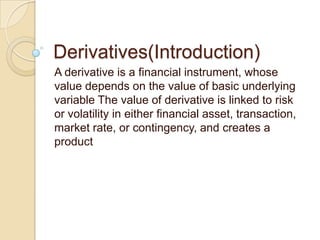
Derivatives(Introduction)
A derivative is a financial instrument, whose
value depends on the value of basic underlying
variable The value of derivative is linked to risk
or volatility in either financial asset, transaction,
market rate, or contingency, and creates a
product
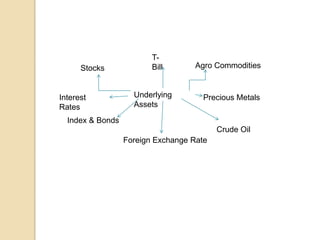
T-
      Stocks             Bill       Agro Commodities


Interest            Underlying        Precious Metals
Rates               Assets
  Index & Bonds
                                          Crude Oil
                  Foreign Exchange Rate
Features of Derivatives
•Traded on exchange
• No compulsory physical trading of underlying assets All
transactions in derivatives take place in future specific date
•Hedging Device-Reduces risk
• Derivatives has low transaction cost
•Derivatives are often leveraged, such that a small movement in
the underlying value can cause a large difference in the value of
the derivative.
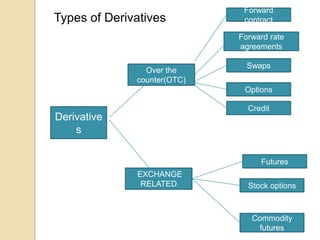
Forward
Types of Derivatives          contract

                             Forward rate
                             agreements

                               Swaps
                Over the
              counter(OTC)
                              Options

                               Credit
Derivative
    s

                                  Futures
              EXCHANGE
               RELATED         Stock options


                                Commodity
                                 futures
Over-the-Counter Contracts:
OTC derivatives are contracts that are traded (and
privately negotiated) directly between two parties,
without going through an exchange or other
intermediary. Products such as swaps, forward rate
agreements and exotic options are almost always
traded in this way. The OTC derivatives market is
huge. According to the Bank for International
Settlements, the total outstanding notional amount is
USD 516 trillion (as of June 2007)
Forwards
 A forward contract is a customized contract
  between two entities, where settlement takes
  place as a specific date in the future at
  predetermined price.
 Ex: On 10th Novem, Ram enters into an
  agreement to buy 100 kgs of wheat on 1st
  May at Rs.10000 from Shyam, a farmer. It is
  a case of a forward contract where Ram has
  to pay Rs.10000 on 1st May to Shyam and
  Shyam has to supply 100 kgs of wheat. Ram
  has taken a long position assuming the price
  of the wheat will rise in the future six months .
  Normally traded outside exchange.
Forward Pricing:
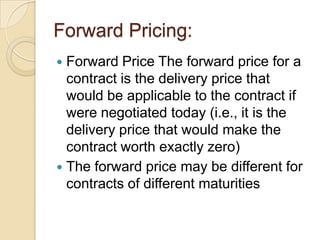
 Forward Price The forward price for a
  contract is the delivery price that
  would be applicable to the contract if
  were negotiated today (i.e., it is the
  delivery price that would make the
  contract worth exactly zero)
 The forward price may be different for
  contracts of different maturities
Forward Pricing:
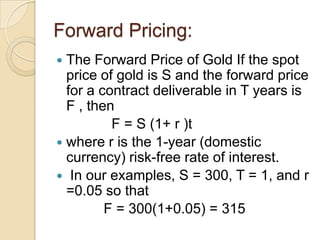
 The Forward Price of Gold If the spot
  price of gold is S and the forward price
  for a contract deliverable in T years is
  F , then
          F = S (1+ r )t
 where r is the 1-year (domestic
  currency) risk-free rate of interest.
 In our examples, S = 300, T = 1, and r
  =0.05 so that
         F = 300(1+0.05) = 315
Futures
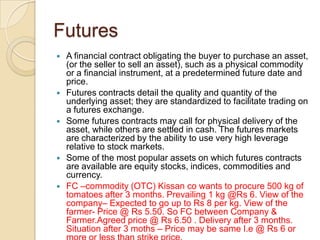
   A financial contract obligating the buyer to purchase an asset,
    (or the seller to sell an asset), such as a physical commodity
    or a financial instrument, at a predetermined future date and
    price.
   Futures contracts detail the quality and quantity of the
    underlying asset; they are standardized to facilitate trading on
    a futures exchange.
   Some futures contracts may call for physical delivery of the
    asset, while others are settled in cash. The futures markets
    are characterized by the ability to use very high leverage
    relative to stock markets.
   Some of the most popular assets on which futures contracts
    are available are equity stocks, indices, commodities and
    currency.
   FC –commodity (OTC) Kissan co wants to procure 500 kg of
    tomatoes after 3 months. Prevailing 1 kg @Rs 6. View of the
    company– Expected to go up to Rs 8 per kg. View of the
    farmer- Price @ Rs 5.50. So FC between Company &
    Farmer.Agreed price @ Rs 6.50 . Delivery after 3 months.
    Situation after 3 moths – Price may be same I.e @ Rs 6 or
Swaps
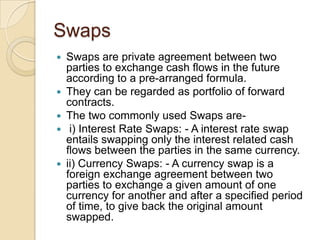
   Swaps are private agreement between two
    parties to exchange cash flows in the future
    according to a pre-arranged formula.
   They can be regarded as portfolio of forward
    contracts.
   The two commonly used Swaps are-
    i) Interest Rate Swaps: - A interest rate swap
    entails swapping only the interest related cash
    flows between the parties in the same currency.
   ii) Currency Swaps: - A currency swap is a
    foreign exchange agreement between two
    parties to exchange a given amount of one
    currency for another and after a specified period
    of time, to give back the original amount
    swapped.
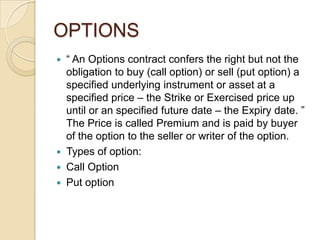
OPTIONS
   “ An Options contract confers the right but not the
    obligation to buy (call option) or sell (put option) a
    specified underlying instrument or asset at a
    specified price – the Strike or Exercised price up
    until or an specified future date – the Expiry date. ”
    The Price is called Premium and is paid by buyer
    of the option to the seller or writer of the option.
   Types of option:
   Call Option
   Put option
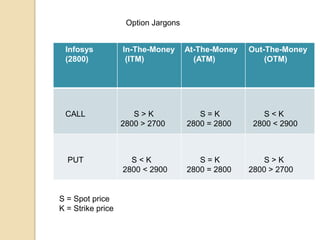
Option Jargons


 Infosys           In-The-Money      At-The-Money   Out-The-Money
 (2800)             (ITM)              (ATM)            (OTM)


 CALL                 S>K               S=K             S<K
                   2800 > 2700       2800 = 2800     2800 < 2900


  PUT                S<K                S=K            S>K
                   2800 < 2900       2800 = 2800    2800 > 2700


S = Spot price
K = Strike price
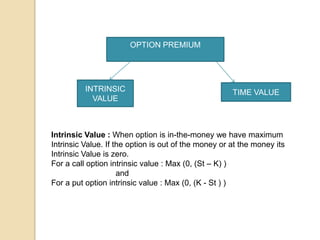
OPTION PREMIUM


          INTRINSIC                                   TIME VALUE
            VALUE


Intrinsic Value : When option is in-the-money we have maximum
Intrinsic Value. If the option is out of the money or at the money its
Intrinsic Value is zero.
For a call option intrinsic value : Max (0, (St – K) )
                     and
For a put option intrinsic value : Max (0, (K - St ) )
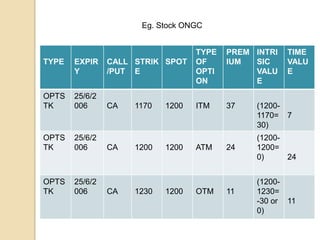
Eg. Stock ONGC


                                   TYPE   PREM INTRI   TIME
TYPE   EXPIR    CALL STRIK SPOT    OF     IUM  SIC     VALU
       Y        /PUT E             OPTI        VALU    E
                                   ON          E
OPTS   25/6/2
TK     006      CA   1170   1200   ITM    37   (1200-
                                               1170= 7
                                               30)
OPTS   25/6/2                                  (1200-
TK     006      CA   1200   1200   ATM    24   1200=
                                               0)     24


OPTS   25/6/2                                  (1200-
TK     006      CA   1230   1200   OTM    11   1230=
                                               -30 or 11
                                               0)
Terminology:
• Spot price- the price at which an assets trades in a spot
markets.
•Future price- the price at which the future contracts
trades in future markets.
•Strike price- the price specified in the option contract
•Expiry date- the date specified in future and option
contracts.
•Contract size- the amount of assets that has to be
delivered under one contract.
•Basis= Future price- Spot Price
•Initial Margin- the amount that must be deposited at the
future contract is first entered into.
•Marking to market
•Maintenance Margin- A set minimum margin per
outstanding future contract that a customer must maintain
in his margin account .
PARTICIPANTS
 Speculators - willing to take on risk in
  pursuit of profit.
 Hedgers - transfer risk by taking a
  position in the Derivatives Market.
 Arbitrageurs - aim to make a risk less
  profit by taking advantage of price
  differentials and thus bring about an
  alignment in prices by participating in
  two markets simultaneously.
Stock Index futures
   Stock Index futures have
    revolutionized the art and science of
    equity portfolio management as
    practiced by:

    ◦   mutual funds
    ◦   pension plans
    ◦   endowments
    ◦   insurance company
    ◦   other money managers.
•A futures contract on a stock market index
represents the right and obligation to buy or
to sell a portfolio of stocks characterized by
the index.

Stock index futures are cash settled.
That is, there is no delivery of the underlying
stocks.
The contracts are marked to market daily.
On the last trading day, the futures price is set
equal to the spot index level and there is a
final mark to market cash flow.
An interest rate future is a financial derivative (a
futures contract) with an interest-bearing instrument
as the underlying asset.
Examples include Treasury-bill futures, Treasury-
bond futures and Eurodollar futures.
Interest rate futures are used to hedge against the
risk of that interest rates will move in an adverse
direction, causing a cost to the company.
For example, borrowers face the risk of interest rates
rising. Futures use the inverse relationship between
interest rates and bond prices to hedge against the
risk of rising interest rates. A borrower will enter to
sell a future today. Then if interest rates rise in the
future, the value of the future will fall (as it is linked to
the underlying asset, bond prices), and hence a profit
can be made when closing out of the future (i.e.
buying the future).
Derivatives

Derivatives

  • 1.
    Derivative s P.Harika
  • 2.
    Derivatives(Introduction) A derivative isa financial instrument, whose value depends on the value of basic underlying variable The value of derivative is linked to risk or volatility in either financial asset, transaction, market rate, or contingency, and creates a product
  • 3.
    T- Stocks Bill Agro Commodities Interest Underlying Precious Metals Rates Assets Index & Bonds Crude Oil Foreign Exchange Rate
  • 4.
    Features of Derivatives •Tradedon exchange • No compulsory physical trading of underlying assets All transactions in derivatives take place in future specific date •Hedging Device-Reduces risk • Derivatives has low transaction cost •Derivatives are often leveraged, such that a small movement in the underlying value can cause a large difference in the value of the derivative.
  • 5.
    Forward Types of Derivatives contract Forward rate agreements Swaps Over the counter(OTC) Options Credit Derivative s Futures EXCHANGE RELATED Stock options Commodity futures
  • 6.
    Over-the-Counter Contracts: OTC derivativesare contracts that are traded (and privately negotiated) directly between two parties, without going through an exchange or other intermediary. Products such as swaps, forward rate agreements and exotic options are almost always traded in this way. The OTC derivatives market is huge. According to the Bank for International Settlements, the total outstanding notional amount is USD 516 trillion (as of June 2007)
  • 7.
    Forwards  A forwardcontract is a customized contract between two entities, where settlement takes place as a specific date in the future at predetermined price.  Ex: On 10th Novem, Ram enters into an agreement to buy 100 kgs of wheat on 1st May at Rs.10000 from Shyam, a farmer. It is a case of a forward contract where Ram has to pay Rs.10000 on 1st May to Shyam and Shyam has to supply 100 kgs of wheat. Ram has taken a long position assuming the price of the wheat will rise in the future six months . Normally traded outside exchange.
  • 8.
    Forward Pricing:  ForwardPrice The forward price for a contract is the delivery price that would be applicable to the contract if were negotiated today (i.e., it is the delivery price that would make the contract worth exactly zero)  The forward price may be different for contracts of different maturities
  • 9.
    Forward Pricing:  TheForward Price of Gold If the spot price of gold is S and the forward price for a contract deliverable in T years is F , then F = S (1+ r )t  where r is the 1-year (domestic currency) risk-free rate of interest.  In our examples, S = 300, T = 1, and r =0.05 so that F = 300(1+0.05) = 315
  • 10.
    Futures  A financial contract obligating the buyer to purchase an asset, (or the seller to sell an asset), such as a physical commodity or a financial instrument, at a predetermined future date and price.  Futures contracts detail the quality and quantity of the underlying asset; they are standardized to facilitate trading on a futures exchange.  Some futures contracts may call for physical delivery of the asset, while others are settled in cash. The futures markets are characterized by the ability to use very high leverage relative to stock markets.  Some of the most popular assets on which futures contracts are available are equity stocks, indices, commodities and currency.  FC –commodity (OTC) Kissan co wants to procure 500 kg of tomatoes after 3 months. Prevailing 1 kg @Rs 6. View of the company– Expected to go up to Rs 8 per kg. View of the farmer- Price @ Rs 5.50. So FC between Company & Farmer.Agreed price @ Rs 6.50 . Delivery after 3 months. Situation after 3 moths – Price may be same I.e @ Rs 6 or
  • 11.
    Swaps  Swaps are private agreement between two parties to exchange cash flows in the future according to a pre-arranged formula.  They can be regarded as portfolio of forward contracts.  The two commonly used Swaps are-  i) Interest Rate Swaps: - A interest rate swap entails swapping only the interest related cash flows between the parties in the same currency.  ii) Currency Swaps: - A currency swap is a foreign exchange agreement between two parties to exchange a given amount of one currency for another and after a specified period of time, to give back the original amount swapped.
  • 12.
    OPTIONS  “ An Options contract confers the right but not the obligation to buy (call option) or sell (put option) a specified underlying instrument or asset at a specified price – the Strike or Exercised price up until or an specified future date – the Expiry date. ” The Price is called Premium and is paid by buyer of the option to the seller or writer of the option.  Types of option:  Call Option  Put option
  • 13.
    Option Jargons Infosys In-The-Money At-The-Money Out-The-Money (2800) (ITM) (ATM) (OTM) CALL S>K S=K S<K 2800 > 2700 2800 = 2800 2800 < 2900 PUT S<K S=K S>K 2800 < 2900 2800 = 2800 2800 > 2700 S = Spot price K = Strike price
  • 14.
    OPTION PREMIUM INTRINSIC TIME VALUE VALUE Intrinsic Value : When option is in-the-money we have maximum Intrinsic Value. If the option is out of the money or at the money its Intrinsic Value is zero. For a call option intrinsic value : Max (0, (St – K) ) and For a put option intrinsic value : Max (0, (K - St ) )
  • 15.
    Eg. Stock ONGC TYPE PREM INTRI TIME TYPE EXPIR CALL STRIK SPOT OF IUM SIC VALU Y /PUT E OPTI VALU E ON E OPTS 25/6/2 TK 006 CA 1170 1200 ITM 37 (1200- 1170= 7 30) OPTS 25/6/2 (1200- TK 006 CA 1200 1200 ATM 24 1200= 0) 24 OPTS 25/6/2 (1200- TK 006 CA 1230 1200 OTM 11 1230= -30 or 11 0)
  • 16.
    Terminology: • Spot price-the price at which an assets trades in a spot markets. •Future price- the price at which the future contracts trades in future markets. •Strike price- the price specified in the option contract •Expiry date- the date specified in future and option contracts. •Contract size- the amount of assets that has to be delivered under one contract. •Basis= Future price- Spot Price •Initial Margin- the amount that must be deposited at the future contract is first entered into. •Marking to market •Maintenance Margin- A set minimum margin per outstanding future contract that a customer must maintain in his margin account .
  • 17.
    PARTICIPANTS  Speculators -willing to take on risk in pursuit of profit.  Hedgers - transfer risk by taking a position in the Derivatives Market.  Arbitrageurs - aim to make a risk less profit by taking advantage of price differentials and thus bring about an alignment in prices by participating in two markets simultaneously.
  • 18.
    Stock Index futures  Stock Index futures have revolutionized the art and science of equity portfolio management as practiced by: ◦ mutual funds ◦ pension plans ◦ endowments ◦ insurance company ◦ other money managers.
  • 19.
    •A futures contracton a stock market index represents the right and obligation to buy or to sell a portfolio of stocks characterized by the index. Stock index futures are cash settled. That is, there is no delivery of the underlying stocks. The contracts are marked to market daily. On the last trading day, the futures price is set equal to the spot index level and there is a final mark to market cash flow.
  • 20.
    An interest ratefuture is a financial derivative (a futures contract) with an interest-bearing instrument as the underlying asset. Examples include Treasury-bill futures, Treasury- bond futures and Eurodollar futures. Interest rate futures are used to hedge against the risk of that interest rates will move in an adverse direction, causing a cost to the company. For example, borrowers face the risk of interest rates rising. Futures use the inverse relationship between interest rates and bond prices to hedge against the risk of rising interest rates. A borrower will enter to sell a future today. Then if interest rates rise in the future, the value of the future will fall (as it is linked to the underlying asset, bond prices), and hence a profit can be made when closing out of the future (i.e. buying the future).