A
Presentation
On
Futures and Options
Submitted in Partial Fulfillment of Degree
of
M.B.A. INSURANCE
(Asset Management)
Submitted By: SubmittedTo:
Abhishek Bora(448) Prof. Dr. Rituparna Das
Rimzim Kachhawaha(459) National Law University, Jodhpur
Surendra Sharma (461)
1
FUTURES AND OPTIONS
2
Derivative
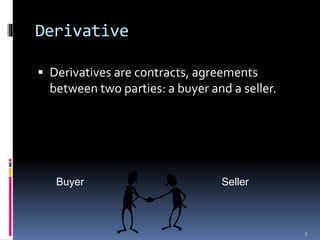
 Derivatives are contracts, agreements
between two parties: a buyer and a seller.
Buyer Seller
3
Derivative
 A derivative is an instrument whose value is
derived from the value of one or more
underlying, which can be commodities,
precious metals, currency, bonds, stocks,
stocks indices, etc.
 Four most common examples of derivative
instruments are Forwards, Futures, Options
and Swaps.
 The instrument requires little or no
investment at the inception of the contract.
4
Derivative Markets
The over-the-counter (OTC) market
The exchanges
5
OTC advantage
 the terms of a contract do not have to be those
specified by an exchange.
 Market participants are free to negotiate any
mutually attractive deal.
OTC disadvantage
 there is usually some credit risk in an over-the-
counter trade.
 Less controlled.
6
Futures Contract
 A futures contract is an agreement between
two parties, a buyer and a seller, to exchange
an asset at a later date for a price agreed to in
advance, when the contract is first entered
into.
 We call this price the futures price.
 Trades on a futures exchange.
 To make trading possible, the exchange
specifies certain standardized features of the
contract.
7
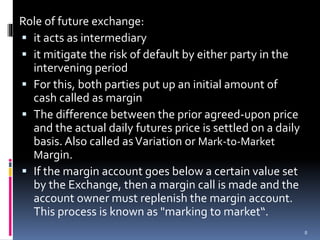
Role of future exchange:
 it acts as intermediary
 it mitigate the risk of default by either party in the
intervening period
 For this, both parties put up an initial amount of
cash called as margin
 The difference between the prior agreed-upon price
and the actual daily futures price is settled on a daily
basis. Also called asVariation or Mark-to-Market
Margin.
 If the margin account goes below a certain value set
by the Exchange, then a margin call is made and the
account owner must replenish the margin account.
This process is known as "marking to market“.
8
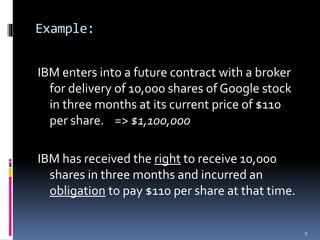
Example:
IBM enters into a future contract with a broker
for delivery of 10,000 shares of Google stock
in three months at its current price of $110
per share. => $1,100,000
IBM has received the right to receive 10,000
shares in three months and incurred an
obligation to pay $110 per share at that time.
9
Options
 An option gives the buyer the right, but not
the obligation, to buy/sell the underlying at a
later date for a price agreed to in advance,
when the contract is first entered into.
 We call this price the strike/exercise price.
 The option buyer pays the seller a sum of
money called the option price or premium.
 Trades OTC or on an exchange.
10
Example:
IBM enters into a contract with a broker for an
option (right) to purchase 10,000 shares of
Google shares at its current price of $110 per
share.
The broker charges $3,000 for holding the
contract open for two weeks at a set price.
IBM has received the right, but not the
obligation to purchase this stock at $110
within the next two weeks.
11
Types of options
 Call option: an option to buy the underlying
at the strike price
 Put option: an option to sell the underlying at
the strike price
12
Example: (Call Option)
A company enters into a call option contract on
January 2, 2007, with Baird Investment Co., which
gives it the option to purchase 1,000 shares of
Google stock at $100 per share. On January 2nd, the
Google shares are trading at $100 per share.The
option expires on April 30, 2007.The company
purchases the call option for $400.
If the price of Google stock increases above $100, the
company can exercise this option and purchase the
shares for $100 per share.
If Google’s stock never increases above $100 per
share, the call option is worthless.
13
Example: (Put Option)
 An investor buys one Put option on Stock 'B' at the strike price
of Rs. 300, at a premium of Rs. 25.
 If the market price of Stock 'B', on the day of expiry is less than
Rs. 300, the option can be exercised.The investor's Break-even
point is Rs. 275 (Strike Price - premium paid) i.e., investor will
earn profits if the market falls below 275.
 Suppose stock price is Rs. 260, the buyer of the Put option
immediately buys Stock 'B' from the market @ Rs. 260 &
exercises his option selling the Stock 'B' at Rs 300 to the option
writer thus making a net profit of Rs. 15 {(Strike price - Spot
Price) - Premium paid}.
In another scenario, if at the time of expiry, market price of
Stock 'B' is Rs 320; the buyer of the Put option will choose not
to exercise his option to sell as he can sell in the market at a
higher rate. In this case the investor loses the premium paid
(i.e. Rs 25), which shall be the profit earned by the seller of the
Put option
14
Uses of derivatives
 Derivatives can be used by individuals,
corporations, financial institutions, and
governments to reduce a risk exposure or to
increase a risk exposure.
15
Traders of derivatives
 Hedgers
 Speculators
 Arbitrageurs
16
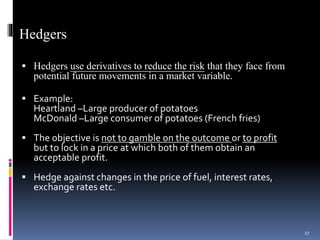
Hedgers
 Hedgers use derivatives to reduce the risk that they face from
potential future movements in a market variable.
 Example:
Heartland –Large producer of potatoes
McDonald –Large consumer of potatoes (French fries)
 The objective is not to gamble on the outcome or to profit
but to lock in a price at which both of them obtain an
acceptable profit.
 Hedge against changes in the price of fuel, interest rates,
exchange rates etc.
17
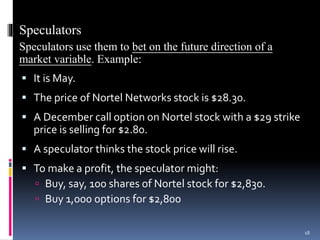
Speculators
Speculators use them to bet on the future direction of a
market variable. Example:
 It is May.
 The price of Nortel Networks stock is $28.30.
 A December call option on Nortel stock with a $29 strike
price is selling for $2.80.
 A speculator thinks the stock price will rise.
 To make a profit, the speculator might:
 Buy, say, 100 shares of Nortel stock for $2,830.
 Buy 1,000 options for $2,800
18
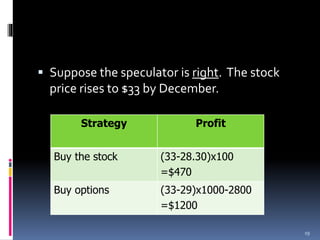
 Suppose the speculator is right. The stock
price rises to $33 by December.
Strategy Profit
Buy the stock (33-28.30)x100
=$470
Buy options (33-29)x1000-2800
=$1200
19
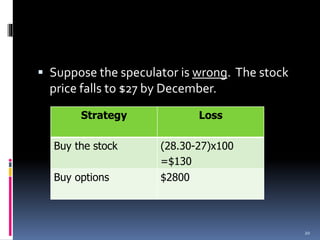
 Suppose the speculator is wrong. The stock
price falls to $27 by December.
Strategy Loss
Buy the stock (28.30-27)x100
=$130
Buy options $2800
20
Conclusion:
Over the years, derivatives have attracted the
investors as an important instrument whether it be
for purpose of hedging or speculation and there
has been a significant increase in investments in
them.
21
THANKYOU
22

Futures_and_option

  • 1.
    A Presentation On Futures and Options Submittedin Partial Fulfillment of Degree of M.B.A. INSURANCE (Asset Management) Submitted By: SubmittedTo: Abhishek Bora(448) Prof. Dr. Rituparna Das Rimzim Kachhawaha(459) National Law University, Jodhpur Surendra Sharma (461) 1
  • 2.
  • 3.
    Derivative  Derivatives arecontracts, agreements between two parties: a buyer and a seller. Buyer Seller 3
  • 4.
    Derivative  A derivativeis an instrument whose value is derived from the value of one or more underlying, which can be commodities, precious metals, currency, bonds, stocks, stocks indices, etc.  Four most common examples of derivative instruments are Forwards, Futures, Options and Swaps.  The instrument requires little or no investment at the inception of the contract. 4
  • 5.
    Derivative Markets The over-the-counter(OTC) market The exchanges 5
  • 6.
    OTC advantage  theterms of a contract do not have to be those specified by an exchange.  Market participants are free to negotiate any mutually attractive deal. OTC disadvantage  there is usually some credit risk in an over-the- counter trade.  Less controlled. 6
  • 7.
    Futures Contract  Afutures contract is an agreement between two parties, a buyer and a seller, to exchange an asset at a later date for a price agreed to in advance, when the contract is first entered into.  We call this price the futures price.  Trades on a futures exchange.  To make trading possible, the exchange specifies certain standardized features of the contract. 7
  • 8.
    Role of futureexchange:  it acts as intermediary  it mitigate the risk of default by either party in the intervening period  For this, both parties put up an initial amount of cash called as margin  The difference between the prior agreed-upon price and the actual daily futures price is settled on a daily basis. Also called asVariation or Mark-to-Market Margin.  If the margin account goes below a certain value set by the Exchange, then a margin call is made and the account owner must replenish the margin account. This process is known as "marking to market“. 8
  • 9.
    Example: IBM enters intoa future contract with a broker for delivery of 10,000 shares of Google stock in three months at its current price of $110 per share. => $1,100,000 IBM has received the right to receive 10,000 shares in three months and incurred an obligation to pay $110 per share at that time. 9
  • 10.
    Options  An optiongives the buyer the right, but not the obligation, to buy/sell the underlying at a later date for a price agreed to in advance, when the contract is first entered into.  We call this price the strike/exercise price.  The option buyer pays the seller a sum of money called the option price or premium.  Trades OTC or on an exchange. 10
  • 11.
    Example: IBM enters intoa contract with a broker for an option (right) to purchase 10,000 shares of Google shares at its current price of $110 per share. The broker charges $3,000 for holding the contract open for two weeks at a set price. IBM has received the right, but not the obligation to purchase this stock at $110 within the next two weeks. 11
  • 12.
    Types of options Call option: an option to buy the underlying at the strike price  Put option: an option to sell the underlying at the strike price 12
  • 13.
    Example: (Call Option) Acompany enters into a call option contract on January 2, 2007, with Baird Investment Co., which gives it the option to purchase 1,000 shares of Google stock at $100 per share. On January 2nd, the Google shares are trading at $100 per share.The option expires on April 30, 2007.The company purchases the call option for $400. If the price of Google stock increases above $100, the company can exercise this option and purchase the shares for $100 per share. If Google’s stock never increases above $100 per share, the call option is worthless. 13
  • 14.
    Example: (Put Option) An investor buys one Put option on Stock 'B' at the strike price of Rs. 300, at a premium of Rs. 25.  If the market price of Stock 'B', on the day of expiry is less than Rs. 300, the option can be exercised.The investor's Break-even point is Rs. 275 (Strike Price - premium paid) i.e., investor will earn profits if the market falls below 275.  Suppose stock price is Rs. 260, the buyer of the Put option immediately buys Stock 'B' from the market @ Rs. 260 & exercises his option selling the Stock 'B' at Rs 300 to the option writer thus making a net profit of Rs. 15 {(Strike price - Spot Price) - Premium paid}. In another scenario, if at the time of expiry, market price of Stock 'B' is Rs 320; the buyer of the Put option will choose not to exercise his option to sell as he can sell in the market at a higher rate. In this case the investor loses the premium paid (i.e. Rs 25), which shall be the profit earned by the seller of the Put option 14
  • 15.
    Uses of derivatives Derivatives can be used by individuals, corporations, financial institutions, and governments to reduce a risk exposure or to increase a risk exposure. 15
  • 16.
    Traders of derivatives Hedgers  Speculators  Arbitrageurs 16
  • 17.
    Hedgers  Hedgers usederivatives to reduce the risk that they face from potential future movements in a market variable.  Example: Heartland –Large producer of potatoes McDonald –Large consumer of potatoes (French fries)  The objective is not to gamble on the outcome or to profit but to lock in a price at which both of them obtain an acceptable profit.  Hedge against changes in the price of fuel, interest rates, exchange rates etc. 17
  • 18.
    Speculators Speculators use themto bet on the future direction of a market variable. Example:  It is May.  The price of Nortel Networks stock is $28.30.  A December call option on Nortel stock with a $29 strike price is selling for $2.80.  A speculator thinks the stock price will rise.  To make a profit, the speculator might:  Buy, say, 100 shares of Nortel stock for $2,830.  Buy 1,000 options for $2,800 18
  • 19.
     Suppose thespeculator is right. The stock price rises to $33 by December. Strategy Profit Buy the stock (33-28.30)x100 =$470 Buy options (33-29)x1000-2800 =$1200 19
  • 20.
     Suppose thespeculator is wrong. The stock price falls to $27 by December. Strategy Loss Buy the stock (28.30-27)x100 =$130 Buy options $2800 20
  • 21.
    Conclusion: Over the years,derivatives have attracted the investors as an important instrument whether it be for purpose of hedging or speculation and there has been a significant increase in investments in them. 21
  • 22.