SUBMITTED BY: Ajay pandey
roll no 23081
A STUDY OF DERIVATIVES
&
ITS VARIOUS STRATEGIES
SUBMITTED TO: Dr. Divya
Jindal
 Smart Equity Brokers Pvt. Ltd. Pvt. Ltd. Brokers Pvt. Ltd.
& Smart Commodity Brokers Pvt. Ltd. was established
on 1st May 2006.
 A young Chartered Accountant, Mr. Arun Khera having
a rich experience & exposure to capital, derivative &
commodity market started it. The Company acquired the
membership of:
 Bombay Stock Exchange (BSE) in 2006
 National Stock Exchange [NSE] in 2006
 National Commodity & Derivative Exchange [NCDEX] in
2003
 Multi Commodity Exchange [MCX] in 2006
About the company
 To track some shares, based on our analysis check verify
the results whether a share will go up or down.
 P/E Ratio P/B Ratio and Dividend Yield Ratio of nifty
companies
 To do the telecalling and take appointments
 To collect the data of the doctors, CA’S, Property dealers.
 To convince the clients for the attending the seminar
related to stock markets.
 To tell the client about the company and its products.
 To tell the client about the advantages of opening a demat
account with Smart Equity.
 To calculate the pivot point, support and resistance level of
a particular stock.
 To explain him the terms and conditions of the product.
 To fill up the KYC form for the customer.
 To make the client trade.
TASK ASSIGNED
 PE Ratio, PB Ratio, Dividend Yield to predict market ie
buy sell position of shares.
 Pivot Points( Support and Resistance)
 Derivatives and Some Option strategies
 How to do tele-marketing as well as door to door
marketing
LEARNINGS
MEANING
A derivative is a security with a price that is
derived from one or more underlying assets. The derivative
itself is a contract between two or more parties based upon
the asset to assets. Its value is determined by fluctuations
in the underlying asset. The most common underlying
assets include stocks, bonds, commodities, currencies,
interest rates and market indexes
INTRODUCTION
 To properly hedge the investment using derivative
tools.
 To study in detail the role of the future and options
 To study the role of derivatives in Indian financial
market
 To study how to invest in stock market.
OBJECTIVE
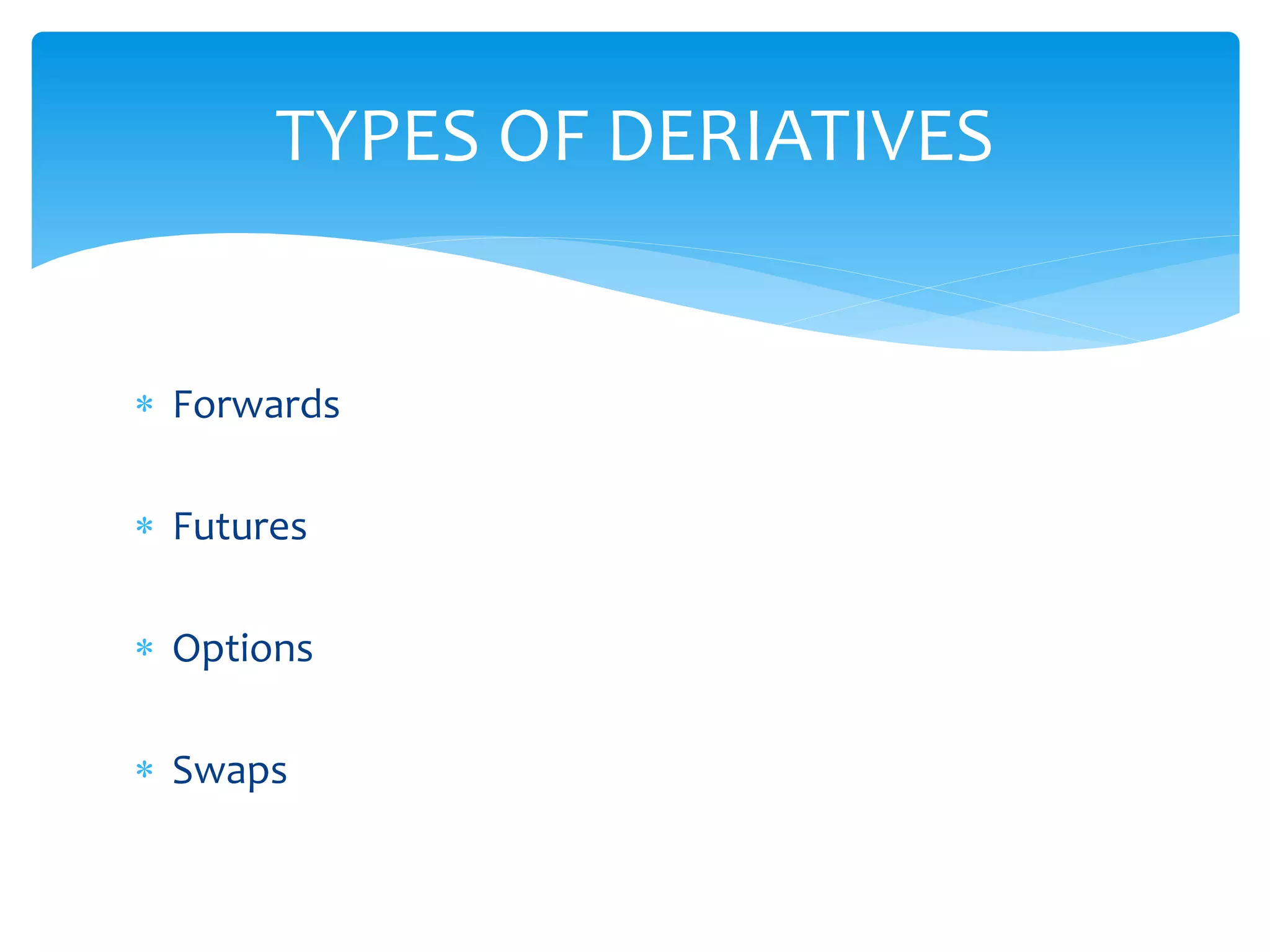
 Forwards
 Futures
 Options
 Swaps
TYPES OF DERIATIVES
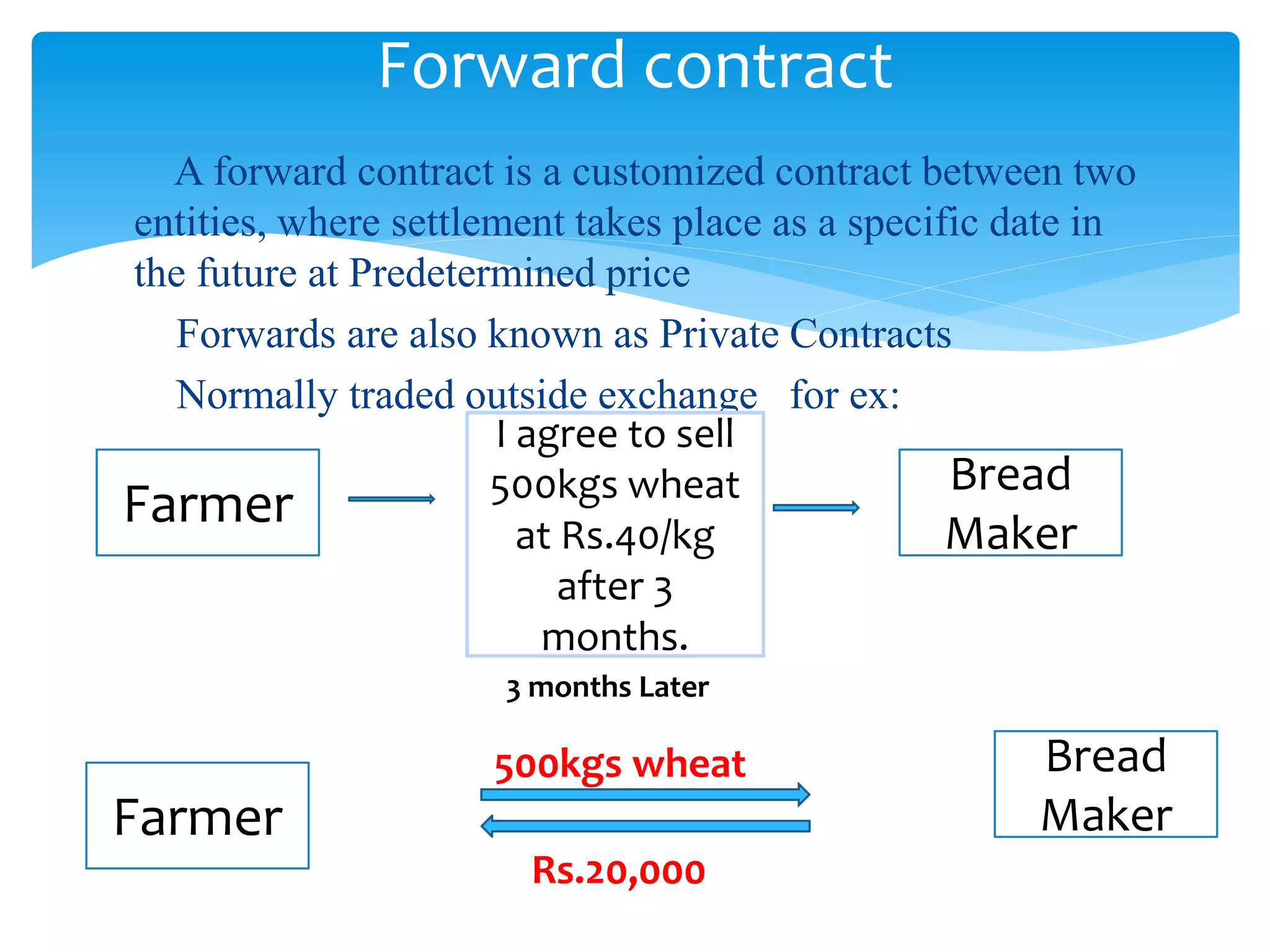
A forward contract is a customized contract between two
entities, where settlement takes place as a specific date in
the future at Predetermined price
Forwards are also known as Private Contracts
Normally traded outside exchange for ex:
Forward contract
A STUDY OF DERIVATIVES
&
ITS VARIOUS STRATEGIES
Farmer
I agree to sell
500kgs wheat
at Rs.40/kg
after 3
months.
Bread
Maker
Farmer
500kgs wheat Bread
Maker
Rs.20,000
3 months Later
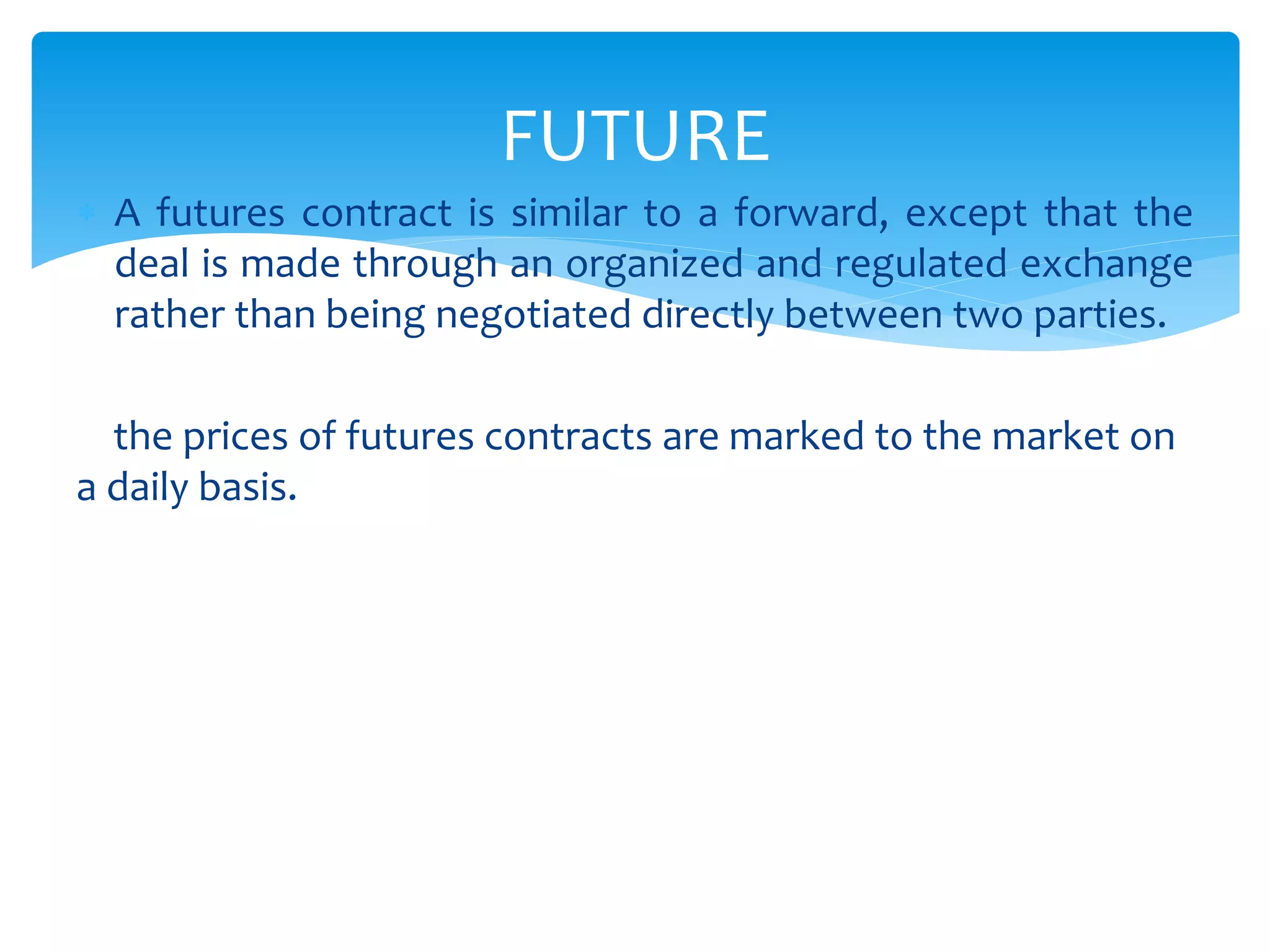
 A futures contract is similar to a forward, except that the
deal is made through an organized and regulated exchange
rather than being negotiated directly between two parties.
the prices of futures contracts are marked to the market on
a daily basis.
FUTURE
 An Option is a contract that gives the right, but not an
obligation, to buy or sell the underlying on or before a
stated date and at a stated price.
 While buyer of option pays the premium and buys the
right, writer/seller of option receives the premium
with obligation to sell/ buy the underlying asset, if the
buyer exercises his right.
Two types of options contract
 Call option
 Put option
OPTION
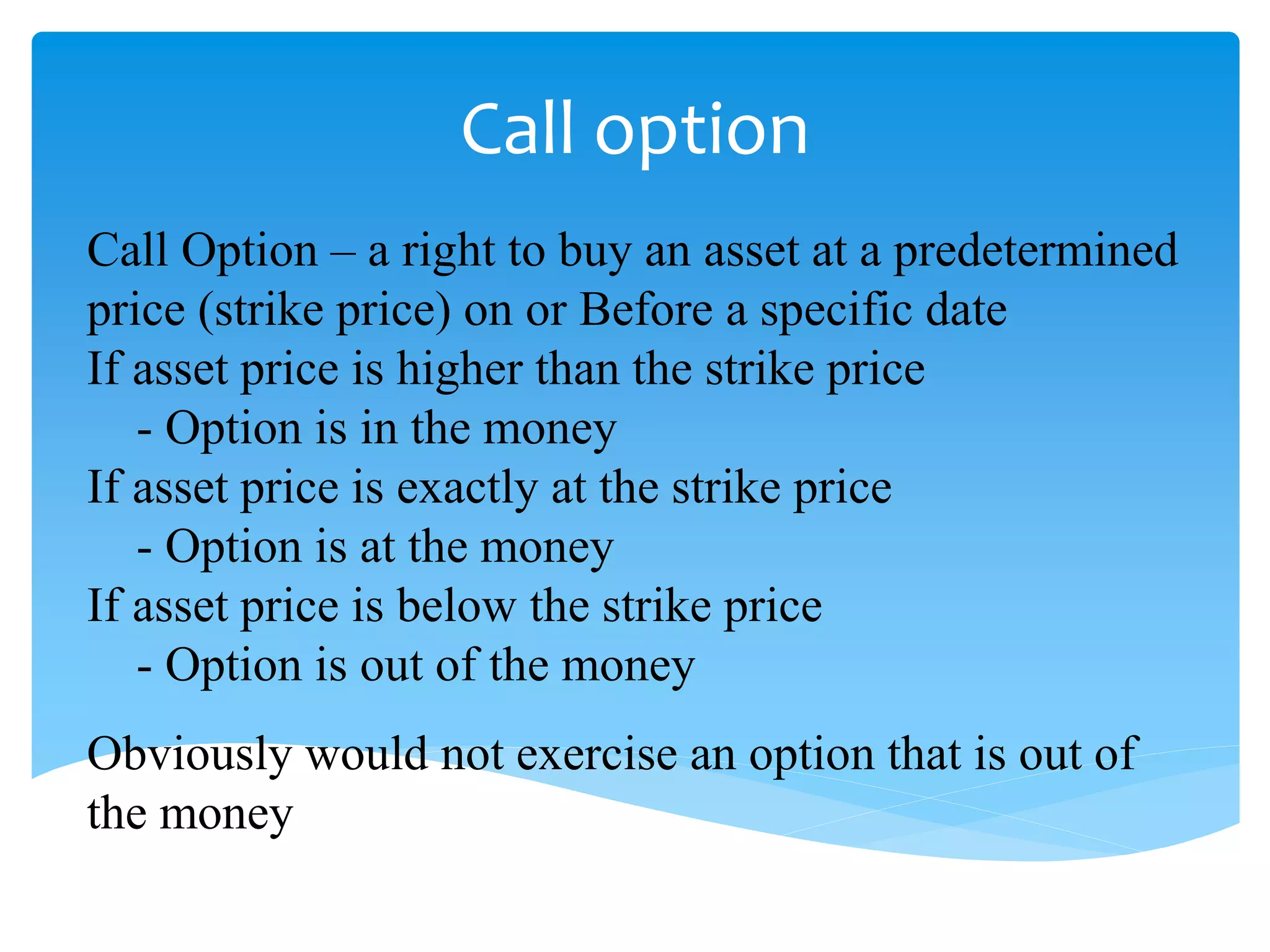
Call option
Call Option – a right to buy an asset at a predetermined
price (strike price) on or Before a specific date
If asset price is higher than the strike price
- Option is in the money
If asset price is exactly at the strike price
- Option is at the money
If asset price is below the strike price
- Option is out of the money
Obviously would not exercise an option that is out of
the money
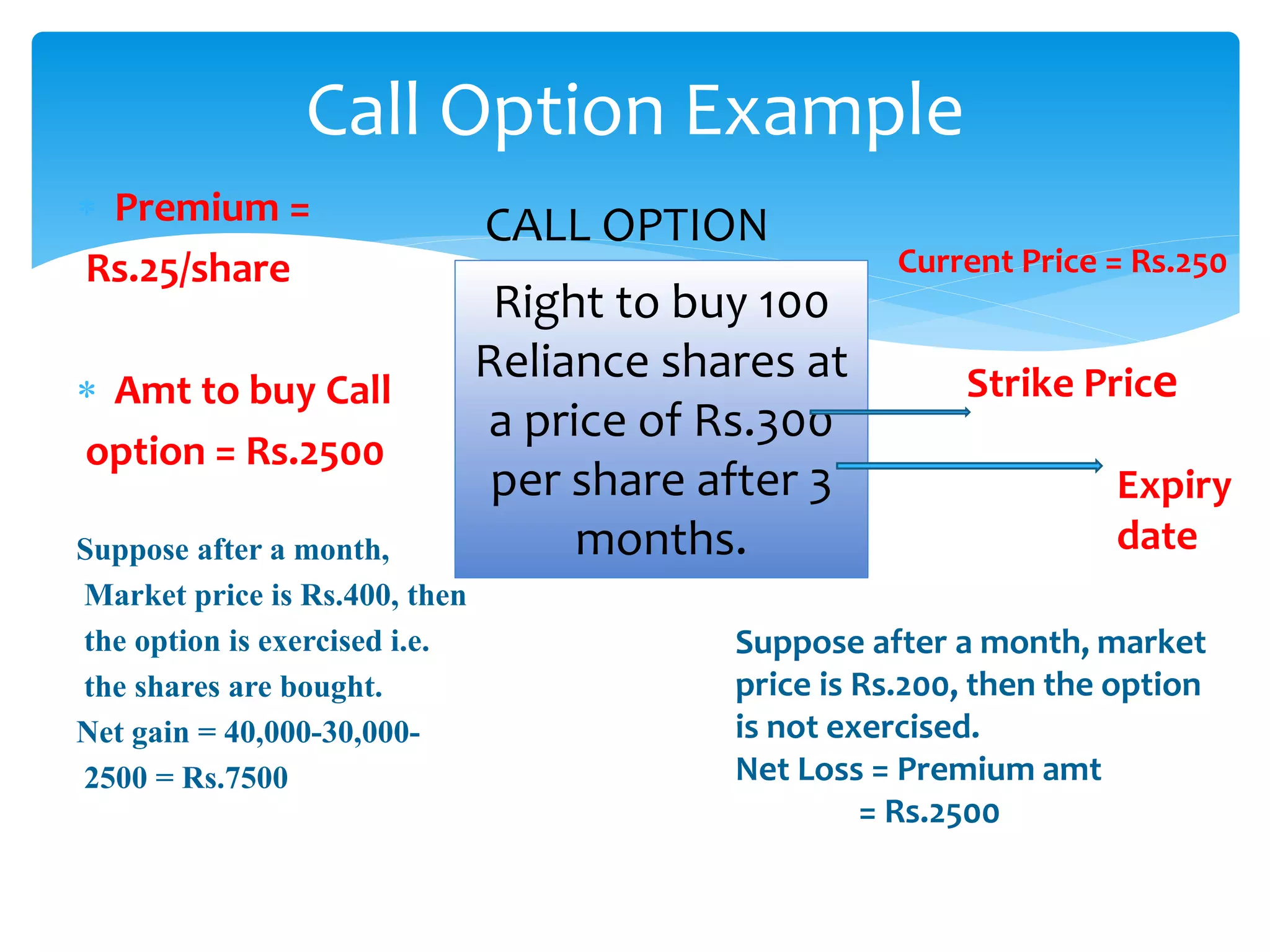
 Premium =
Rs.25/share
 Amt to buy Call
option = Rs.2500
Suppose after a month,
Market price is Rs.400, then
the option is exercised i.e.
the shares are bought.
Net gain = 40,000-30,000-
2500 = Rs.7500
Call Option Example
Right to buy 100
Reliance shares at
a price of Rs.300
per share after 3
months.
Suppose after a month, market
price is Rs.200, then the option
is not exercised.
Net Loss = Premium amt
= Rs.2500
Current Price = Rs.250
Strike Price
Expiry
date
CALL OPTION
 Put Option – a right to sell and asset at a predetermined
Price on or before a specific date
 If spot price is lower than the strike price
- Option is in the money
 If spot price is exactly at the strike price
- Option is at the money
 If spot price is higher than the strike price
- Option is out of the money
PUT OPTION
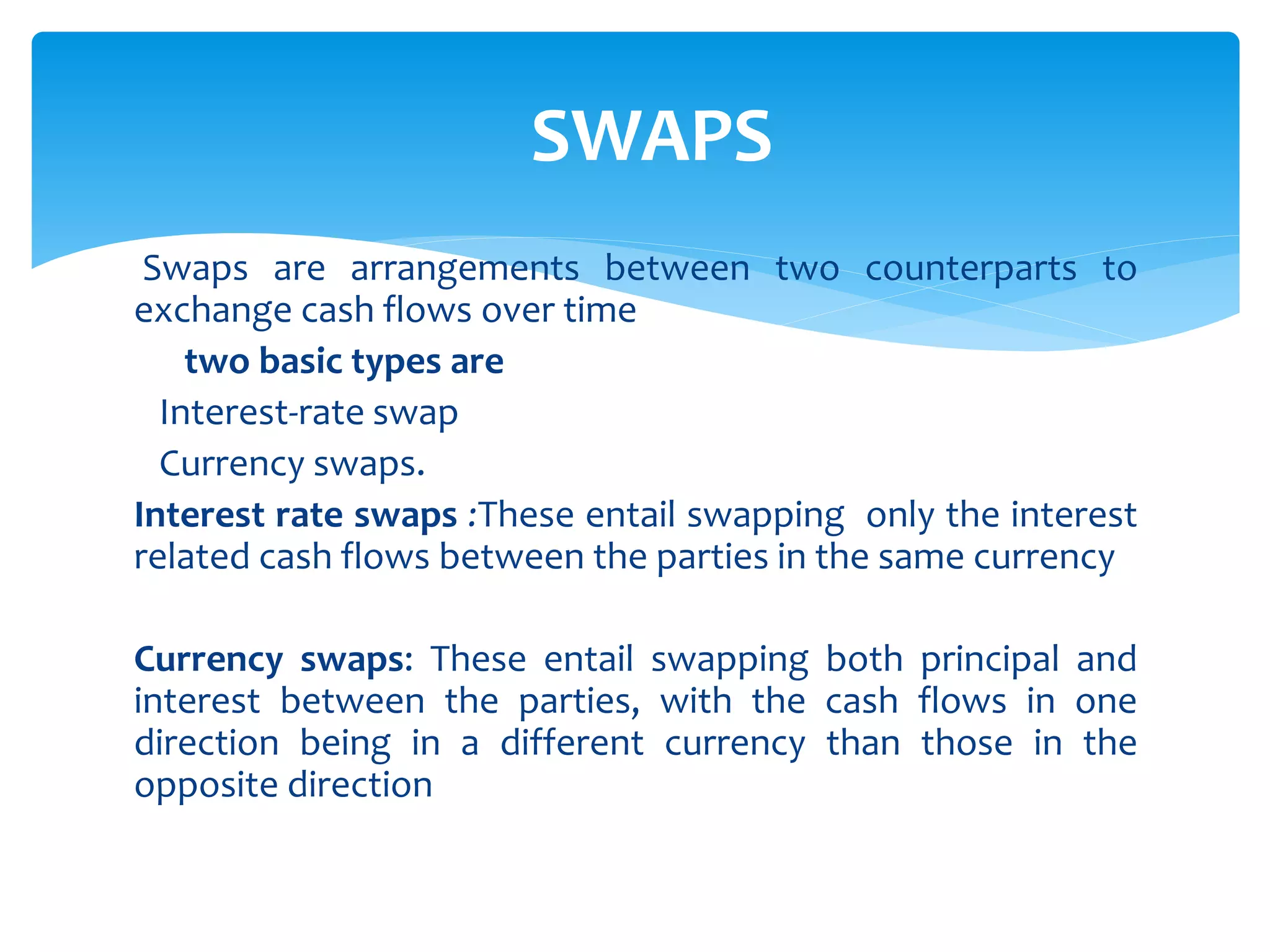
Swaps are arrangements between two counterparts to
exchange cash flows over time
two basic types are
Interest-rate swap
Currency swaps.
Interest rate swaps :These entail swapping only the interest
related cash flows between the parties in the same currency
Currency swaps: These entail swapping both principal and
interest between the parties, with the cash flows in one
direction being in a different currency than those in the
opposite direction
SWAPS
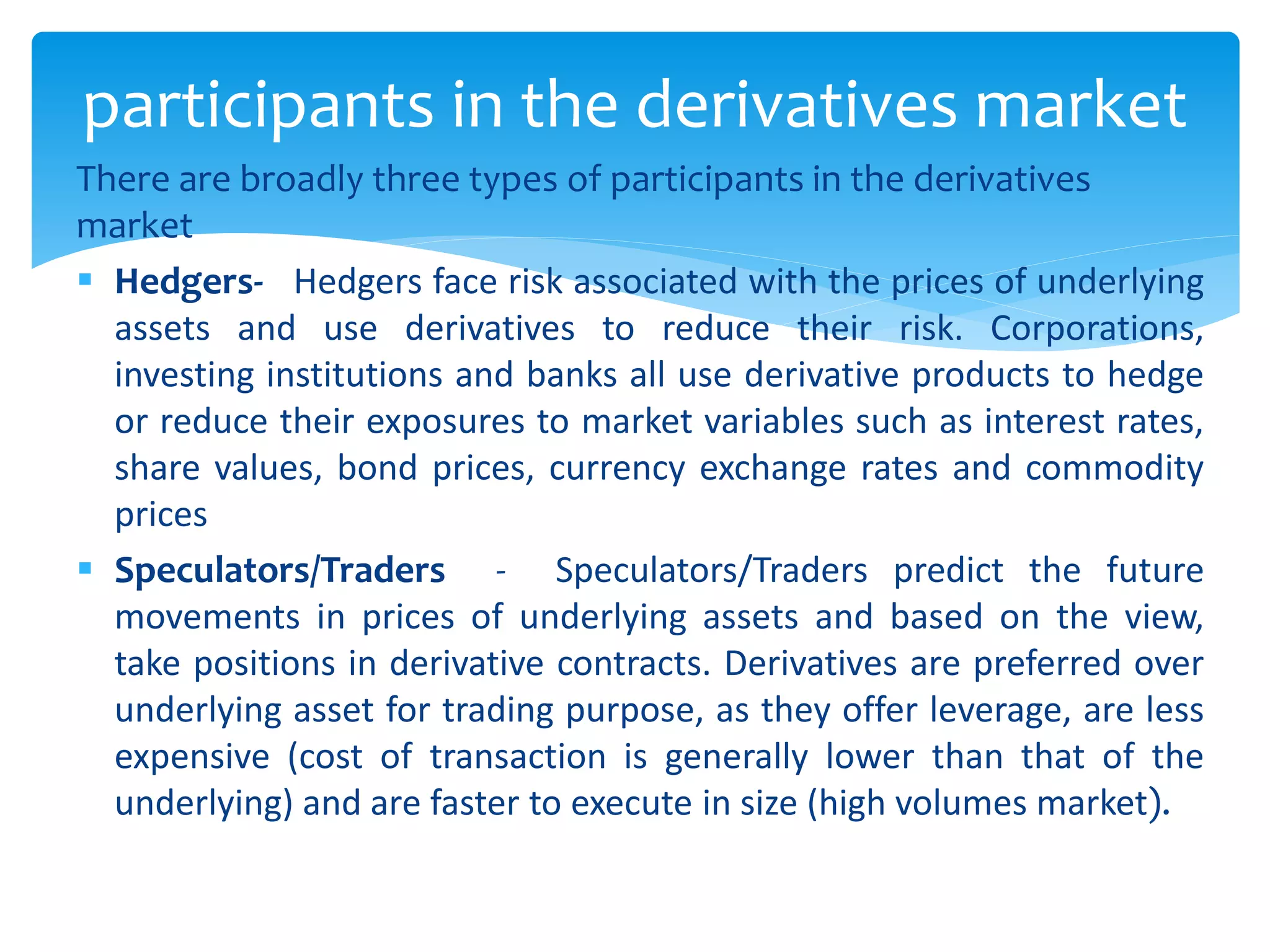
There are broadly three types of participants in the derivatives
market
ď‚§ Hedgers- Hedgers face risk associated with the prices of underlying
assets and use derivatives to reduce their risk. Corporations,
investing institutions and banks all use derivative products to hedge
or reduce their exposures to market variables such as interest rates,
share values, bond prices, currency exchange rates and commodity
prices
ď‚§ Speculators/Traders - Speculators/Traders predict the future
movements in prices of underlying assets and based on the view,
take positions in derivative contracts. Derivatives are preferred over
underlying asset for trading purpose, as they offer leverage, are less
expensive (cost of transaction is generally lower than that of the
underlying) and are faster to execute in size (high volumes market).
participants in the derivatives market
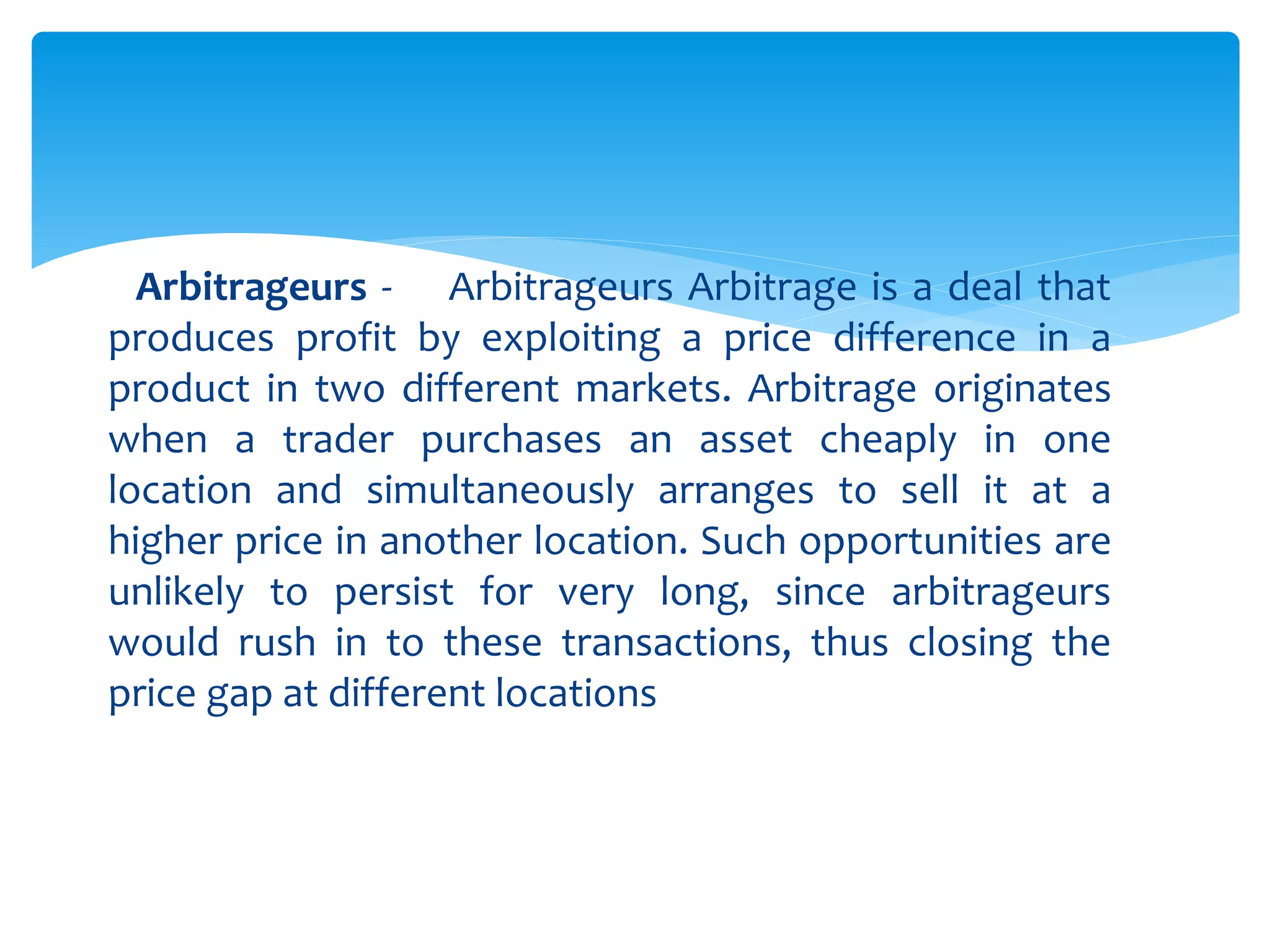
Arbitrageurs - Arbitrageurs Arbitrage is a deal that
produces profit by exploiting a price difference in a
product in two different markets. Arbitrage originates
when a trader purchases an asset cheaply in one
location and simultaneously arranges to sell it at a
higher price in another location. Such opportunities are
unlikely to persist for very long, since arbitrageurs
would rush in to these transactions, thus closing the
price gap at different locations
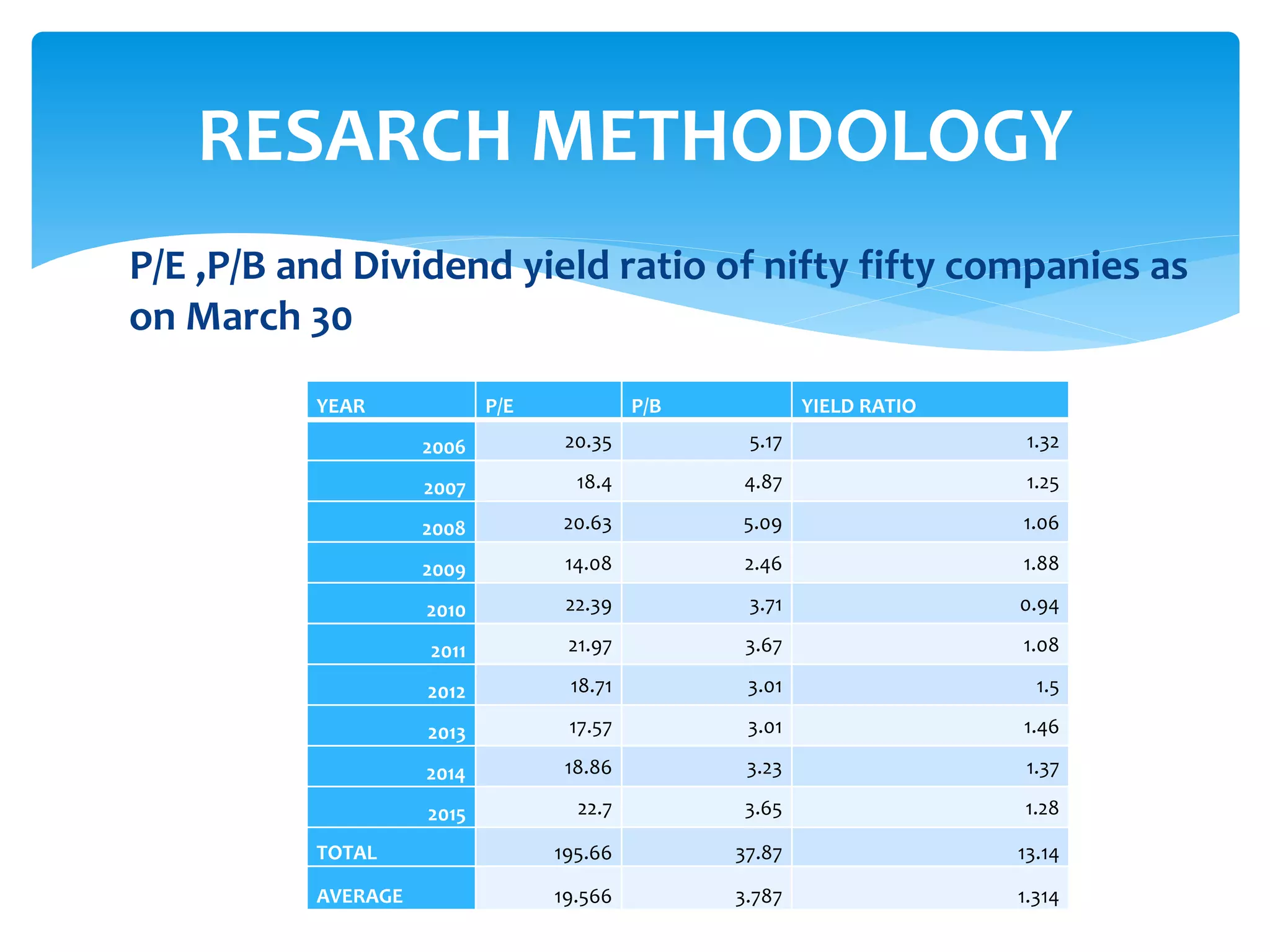
P/E ,P/B and Dividend yield ratio of nifty fifty companies as
on March 30
RESARCH METHODOLOGY
YEAR P/E P/B YIELD RATIO
2006 20.35 5.17 1.32
2007 18.4 4.87 1.25
2008 20.63 5.09 1.06
2009 14.08 2.46 1.88
2010 22.39 3.71 0.94
2011 21.97 3.67 1.08
2012 18.71 3.01 1.5
2013 17.57 3.01 1.46
2014 18.86 3.23 1.37
2015 22.7 3.65 1.28
TOTAL 195.66 37.87 13.14
AVERAGE 19.566 3.787 1.314
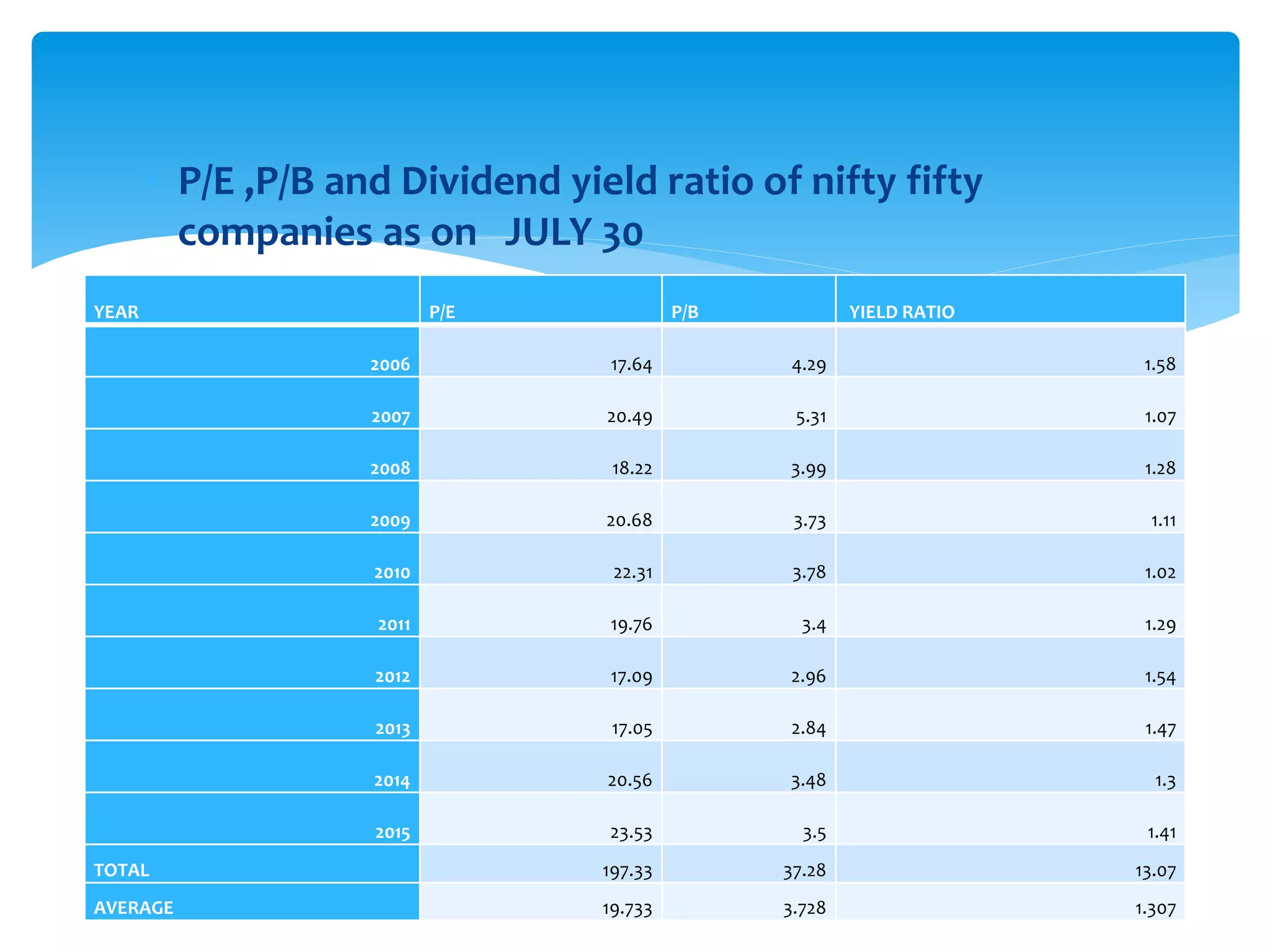
 P/E ,P/B and Dividend yield ratio of nifty fifty
companies as on JULY 30
YEAR P/E P/B YIELD RATIO
2006 17.64 4.29 1.58
2007 20.49 5.31 1.07
2008 18.22 3.99 1.28
2009 20.68 3.73 1.11
2010 22.31 3.78 1.02
2011 19.76 3.4 1.29
2012 17.09 2.96 1.54
2013 17.05 2.84 1.47
2014 20.56 3.48 1.3
2015 23.53 3.5 1.41
TOTAL 197.33 37.28 13.07
AVERAGE 19.733 3.728 1.307
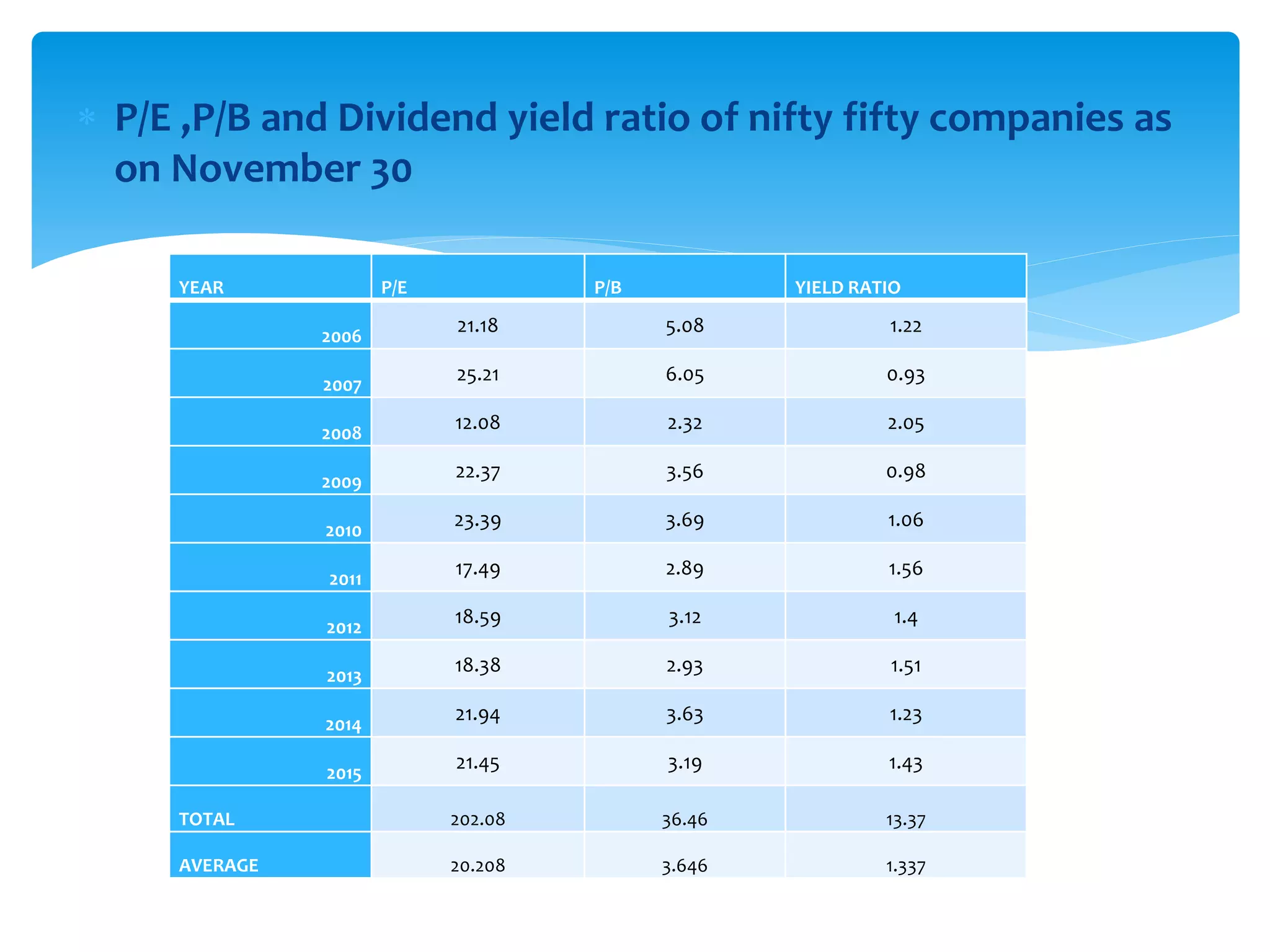
 P/E ,P/B and Dividend yield ratio of nifty fifty companies as
on November 30
YEAR P/E P/B YIELD RATIO
2006
21.18 5.08 1.22
2007
25.21 6.05 0.93
2008
12.08 2.32 2.05
2009
22.37 3.56 0.98
2010
23.39 3.69 1.06
2011
17.49 2.89 1.56
2012
18.59 3.12 1.4
2013
18.38 2.93 1.51
2014
21.94 3.63 1.23
2015
21.45 3.19 1.43
TOTAL 202.08 36.46 13.37
AVERAGE 20.208 3.646 1.337
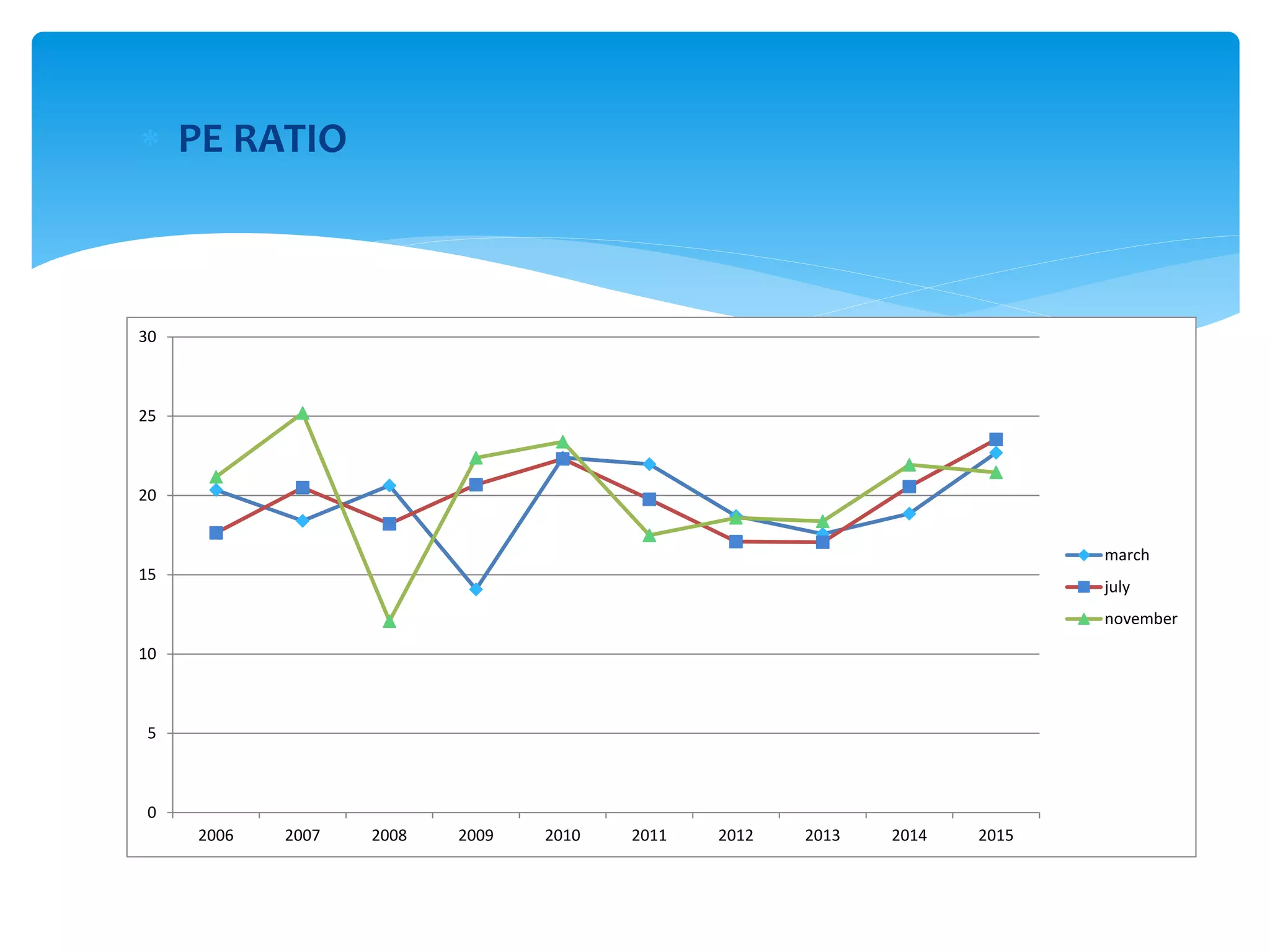
 PE RATIO
2006 2007 2008 2009 2010 2011 2012 2013 2014 2015
0
5
10
15
20
25
30
march
july
november
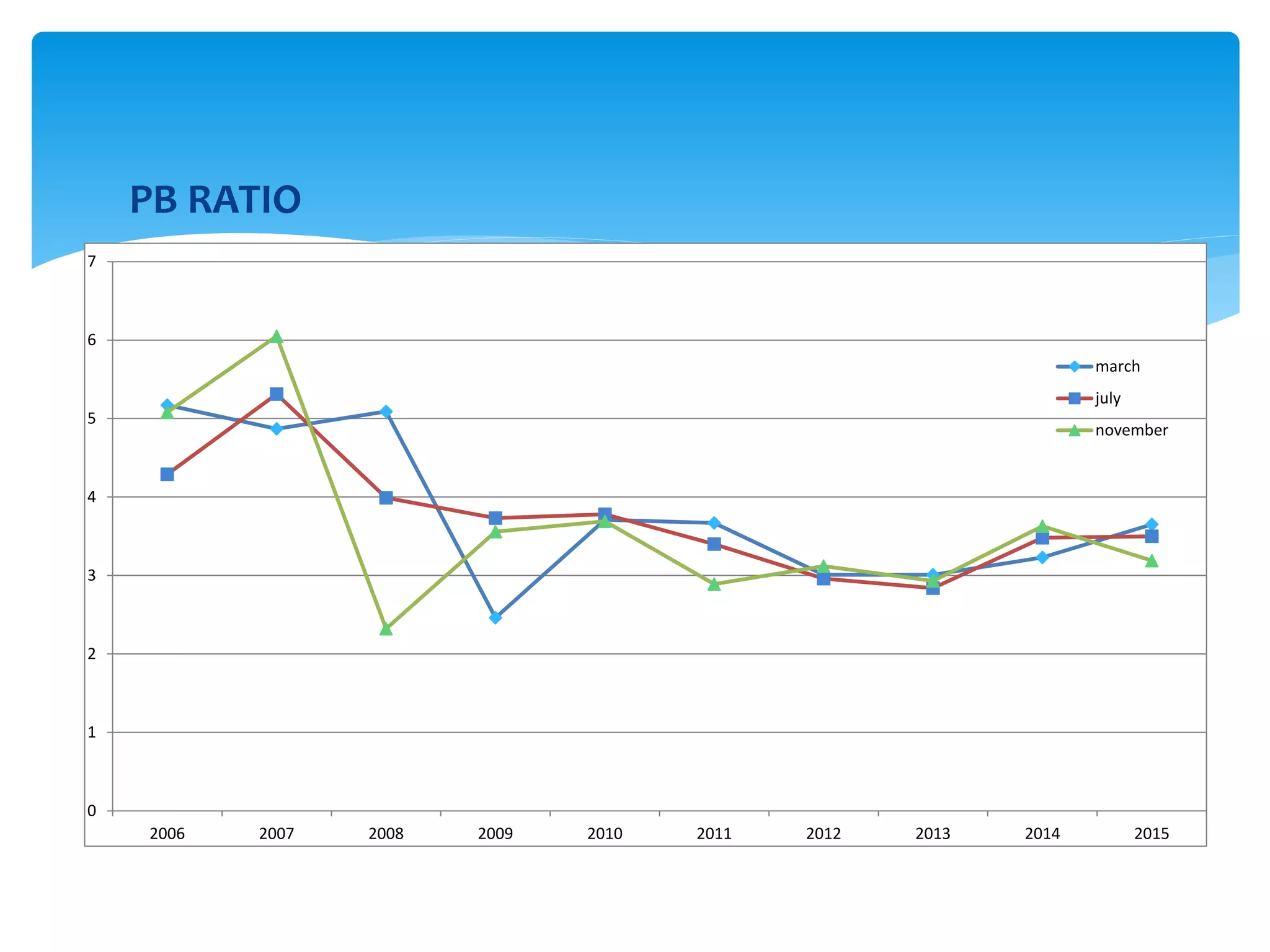
PB RATIO
2006 2007 2008 2009 2010 2011 2012 2013 2014 2015
0
1
2
3
4
5
6
7
march
july
november
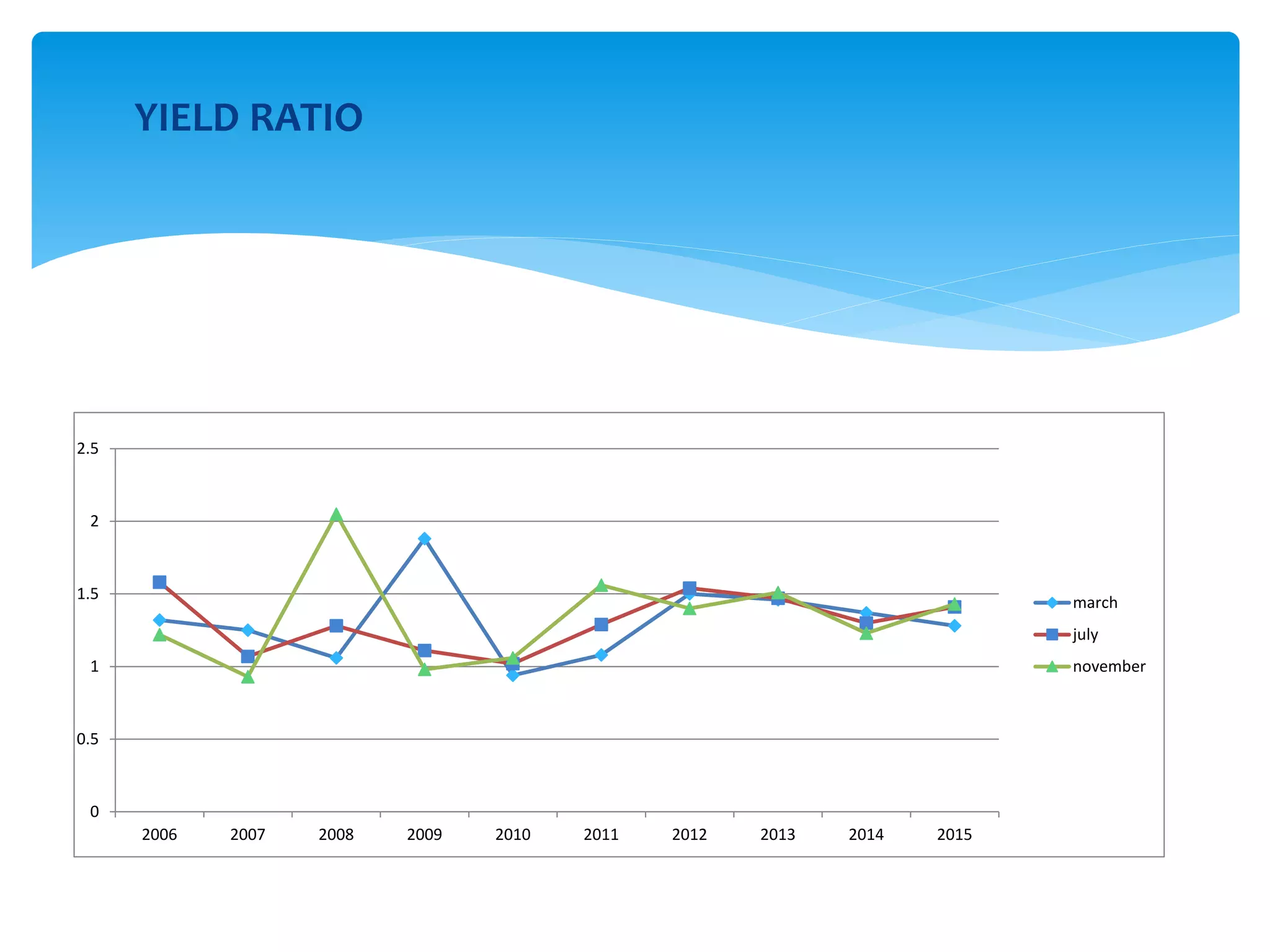
YIELD RATIO
2006 2007 2008 2009 2010 2011 2012 2013 2014 2015
0
0.5
1
1.5
2
2.5
march
july
november

A study of derivatives ppt

  • 1.
    SUBMITTED BY: Ajaypandey roll no 23081 A STUDY OF DERIVATIVES & ITS VARIOUS STRATEGIES SUBMITTED TO: Dr. Divya Jindal
  • 2.
     Smart EquityBrokers Pvt. Ltd. Pvt. Ltd. Brokers Pvt. Ltd. & Smart Commodity Brokers Pvt. Ltd. was established on 1st May 2006.  A young Chartered Accountant, Mr. Arun Khera having a rich experience & exposure to capital, derivative & commodity market started it. The Company acquired the membership of:  Bombay Stock Exchange (BSE) in 2006  National Stock Exchange [NSE] in 2006  National Commodity & Derivative Exchange [NCDEX] in 2003  Multi Commodity Exchange [MCX] in 2006 About the company
  • 3.
     To tracksome shares, based on our analysis check verify the results whether a share will go up or down.  P/E Ratio P/B Ratio and Dividend Yield Ratio of nifty companies  To do the telecalling and take appointments  To collect the data of the doctors, CA’S, Property dealers.  To convince the clients for the attending the seminar related to stock markets.  To tell the client about the company and its products.  To tell the client about the advantages of opening a demat account with Smart Equity.  To calculate the pivot point, support and resistance level of a particular stock.  To explain him the terms and conditions of the product.  To fill up the KYC form for the customer.  To make the client trade. TASK ASSIGNED
  • 4.
     PE Ratio,PB Ratio, Dividend Yield to predict market ie buy sell position of shares.  Pivot Points( Support and Resistance)  Derivatives and Some Option strategies  How to do tele-marketing as well as door to door marketing LEARNINGS
  • 5.
    MEANING A derivative isa security with a price that is derived from one or more underlying assets. The derivative itself is a contract between two or more parties based upon the asset to assets. Its value is determined by fluctuations in the underlying asset. The most common underlying assets include stocks, bonds, commodities, currencies, interest rates and market indexes INTRODUCTION
  • 6.
     To properlyhedge the investment using derivative tools.  To study in detail the role of the future and options  To study the role of derivatives in Indian financial market  To study how to invest in stock market. OBJECTIVE
  • 7.
     Forwards  Futures Options  Swaps TYPES OF DERIATIVES
  • 8.
    A forward contractis a customized contract between two entities, where settlement takes place as a specific date in the future at Predetermined price Forwards are also known as Private Contracts Normally traded outside exchange for ex: Forward contract A STUDY OF DERIVATIVES & ITS VARIOUS STRATEGIES Farmer I agree to sell 500kgs wheat at Rs.40/kg after 3 months. Bread Maker Farmer 500kgs wheat Bread Maker Rs.20,000 3 months Later
  • 9.
     A futurescontract is similar to a forward, except that the deal is made through an organized and regulated exchange rather than being negotiated directly between two parties. the prices of futures contracts are marked to the market on a daily basis. FUTURE
  • 10.
     An Optionis a contract that gives the right, but not an obligation, to buy or sell the underlying on or before a stated date and at a stated price.  While buyer of option pays the premium and buys the right, writer/seller of option receives the premium with obligation to sell/ buy the underlying asset, if the buyer exercises his right. Two types of options contract  Call option  Put option OPTION
  • 11.
    Call option Call Option– a right to buy an asset at a predetermined price (strike price) on or Before a specific date If asset price is higher than the strike price - Option is in the money If asset price is exactly at the strike price - Option is at the money If asset price is below the strike price - Option is out of the money Obviously would not exercise an option that is out of the money
  • 12.
     Premium = Rs.25/share Amt to buy Call option = Rs.2500 Suppose after a month, Market price is Rs.400, then the option is exercised i.e. the shares are bought. Net gain = 40,000-30,000- 2500 = Rs.7500 Call Option Example Right to buy 100 Reliance shares at a price of Rs.300 per share after 3 months. Suppose after a month, market price is Rs.200, then the option is not exercised. Net Loss = Premium amt = Rs.2500 Current Price = Rs.250 Strike Price Expiry date CALL OPTION
  • 13.
     Put Option– a right to sell and asset at a predetermined Price on or before a specific date  If spot price is lower than the strike price - Option is in the money  If spot price is exactly at the strike price - Option is at the money  If spot price is higher than the strike price - Option is out of the money PUT OPTION
  • 14.
    Swaps are arrangementsbetween two counterparts to exchange cash flows over time two basic types are Interest-rate swap Currency swaps. Interest rate swaps :These entail swapping only the interest related cash flows between the parties in the same currency Currency swaps: These entail swapping both principal and interest between the parties, with the cash flows in one direction being in a different currency than those in the opposite direction SWAPS
  • 15.
    There are broadlythree types of participants in the derivatives market ď‚§ Hedgers- Hedgers face risk associated with the prices of underlying assets and use derivatives to reduce their risk. Corporations, investing institutions and banks all use derivative products to hedge or reduce their exposures to market variables such as interest rates, share values, bond prices, currency exchange rates and commodity prices ď‚§ Speculators/Traders - Speculators/Traders predict the future movements in prices of underlying assets and based on the view, take positions in derivative contracts. Derivatives are preferred over underlying asset for trading purpose, as they offer leverage, are less expensive (cost of transaction is generally lower than that of the underlying) and are faster to execute in size (high volumes market). participants in the derivatives market
  • 16.
    Arbitrageurs - ArbitrageursArbitrage is a deal that produces profit by exploiting a price difference in a product in two different markets. Arbitrage originates when a trader purchases an asset cheaply in one location and simultaneously arranges to sell it at a higher price in another location. Such opportunities are unlikely to persist for very long, since arbitrageurs would rush in to these transactions, thus closing the price gap at different locations
  • 17.
    P/E ,P/B andDividend yield ratio of nifty fifty companies as on March 30 RESARCH METHODOLOGY YEAR P/E P/B YIELD RATIO 2006 20.35 5.17 1.32 2007 18.4 4.87 1.25 2008 20.63 5.09 1.06 2009 14.08 2.46 1.88 2010 22.39 3.71 0.94 2011 21.97 3.67 1.08 2012 18.71 3.01 1.5 2013 17.57 3.01 1.46 2014 18.86 3.23 1.37 2015 22.7 3.65 1.28 TOTAL 195.66 37.87 13.14 AVERAGE 19.566 3.787 1.314
  • 18.
     P/E ,P/Band Dividend yield ratio of nifty fifty companies as on JULY 30 YEAR P/E P/B YIELD RATIO 2006 17.64 4.29 1.58 2007 20.49 5.31 1.07 2008 18.22 3.99 1.28 2009 20.68 3.73 1.11 2010 22.31 3.78 1.02 2011 19.76 3.4 1.29 2012 17.09 2.96 1.54 2013 17.05 2.84 1.47 2014 20.56 3.48 1.3 2015 23.53 3.5 1.41 TOTAL 197.33 37.28 13.07 AVERAGE 19.733 3.728 1.307
  • 19.
     P/E ,P/Band Dividend yield ratio of nifty fifty companies as on November 30 YEAR P/E P/B YIELD RATIO 2006 21.18 5.08 1.22 2007 25.21 6.05 0.93 2008 12.08 2.32 2.05 2009 22.37 3.56 0.98 2010 23.39 3.69 1.06 2011 17.49 2.89 1.56 2012 18.59 3.12 1.4 2013 18.38 2.93 1.51 2014 21.94 3.63 1.23 2015 21.45 3.19 1.43 TOTAL 202.08 36.46 13.37 AVERAGE 20.208 3.646 1.337
  • 20.
     PE RATIO 20062007 2008 2009 2010 2011 2012 2013 2014 2015 0 5 10 15 20 25 30 march july november
  • 21.
    PB RATIO 2006 20072008 2009 2010 2011 2012 2013 2014 2015 0 1 2 3 4 5 6 7 march july november
  • 22.
    YIELD RATIO 2006 20072008 2009 2010 2011 2012 2013 2014 2015 0 0.5 1 1.5 2 2.5 march july november