OPTIONS CONTRACTS
By
Shamsudeen Tukur
Exchanges Division
1
Definition of Options Contract
An options contract is an agreement
between a buyer and seller that gives the
purchaser of the option a right but not an
obligation to buy or sell a particular asset at a
later date at an agreed upon price. The two
most common types of options contracts are
put and call options.
With any options strategy, one can make the
holding as big or small as he likes.
Features
• Underlying instrument
• Contract size
• Down Payment-Premium
• Strike price-exercise price, fixed price
• Expiration day
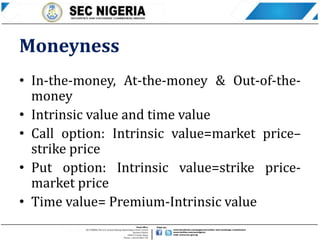
Moneyness
• In-the-money, At-the-money & Out-of-the-
money
• Intrinsic value and time value
• Call option: Intrinsic value=market price–
strike price
• Put option: Intrinsic value=strike price-
market price
• Time value= Premium-Intrinsic value
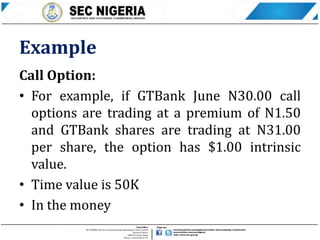
Example
Call Option:
• For example, if GTBank June N30.00 call
options are trading at a premium of N1.50
and GTBank shares are trading at N31.00
per share, the option has $1.00 intrinsic
value.
• Time value is 50K
• In the money
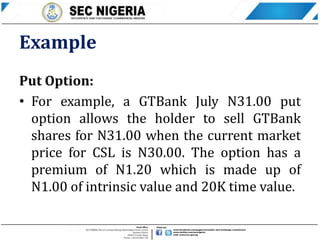
Example
Put Option:
• For example, a GTBank July N31.00 put
option allows the holder to sell GTBank
shares for N31.00 when the current market
price for CSL is N30.00. The option has a
premium of N1.20 which is made up of
N1.00 of intrinsic value and 20K time value.
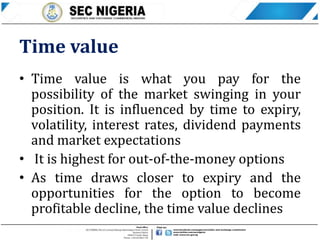
Time value
• Time value is what you pay for the
possibility of the market swinging in your
position. It is influenced by time to expiry,
volatility, interest rates, dividend payments
and market expectations
• It is highest for out-of-the-money options
• As time draws closer to expiry and the
opportunities for the option to become
profitable decline, the time value declines
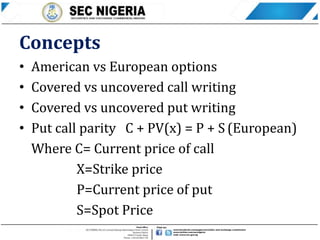
Concepts
• American vs European options
• Covered vs uncovered call writing
• Covered vs uncovered put writing
• Put call parity C + PV(x) = P + S (European)
Where C= Current price of call
X=Strike price
P=Current price of put
S=Spot Price
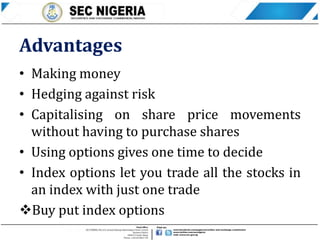
Advantages
• Making money
• Hedging against risk
• Capitalising on share price movements
without having to purchase shares
• Using options gives one time to decide
• Index options let you trade all the stocks in
an index with just one trade
Buy put index options
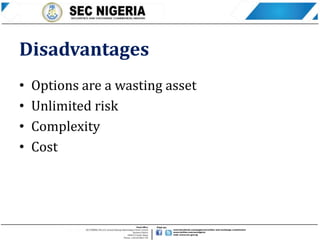
Disadvantages
• Options are a wasting asset
• Unlimited risk
• Complexity
• Cost
THANK YOU!
11

Options contract

  • 1.
  • 2.
    Definition of OptionsContract An options contract is an agreement between a buyer and seller that gives the purchaser of the option a right but not an obligation to buy or sell a particular asset at a later date at an agreed upon price. The two most common types of options contracts are put and call options. With any options strategy, one can make the holding as big or small as he likes.
  • 3.
    Features • Underlying instrument •Contract size • Down Payment-Premium • Strike price-exercise price, fixed price • Expiration day
  • 4.
    Moneyness • In-the-money, At-the-money& Out-of-the- money • Intrinsic value and time value • Call option: Intrinsic value=market price– strike price • Put option: Intrinsic value=strike price- market price • Time value= Premium-Intrinsic value
  • 5.
    Example Call Option: • Forexample, if GTBank June N30.00 call options are trading at a premium of N1.50 and GTBank shares are trading at N31.00 per share, the option has $1.00 intrinsic value. • Time value is 50K • In the money
  • 6.
    Example Put Option: • Forexample, a GTBank July N31.00 put option allows the holder to sell GTBank shares for N31.00 when the current market price for CSL is N30.00. The option has a premium of N1.20 which is made up of N1.00 of intrinsic value and 20K time value.
  • 7.
    Time value • Timevalue is what you pay for the possibility of the market swinging in your position. It is influenced by time to expiry, volatility, interest rates, dividend payments and market expectations • It is highest for out-of-the-money options • As time draws closer to expiry and the opportunities for the option to become profitable decline, the time value declines
  • 8.
    Concepts • American vsEuropean options • Covered vs uncovered call writing • Covered vs uncovered put writing • Put call parity C + PV(x) = P + S (European) Where C= Current price of call X=Strike price P=Current price of put S=Spot Price
  • 9.
    Advantages • Making money •Hedging against risk • Capitalising on share price movements without having to purchase shares • Using options gives one time to decide • Index options let you trade all the stocks in an index with just one trade Buy put index options
  • 10.
    Disadvantages • Options area wasting asset • Unlimited risk • Complexity • Cost
  • 11.