Global Public Health Intelligence Network (GPHIN) Reseau Mondial d’Information en Santé Publique (RMISP)  Michael Blench GPHIN Technical Advisor & Project Coordinator
Presentation Outline Overview of GPHIN Information Workflow Successes Users
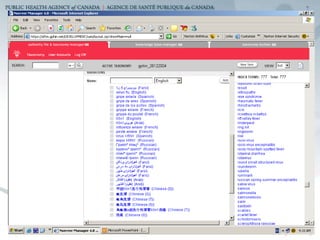
GP HIN - Background An early-warning system for potential public health threats worldwide Monitors global media sources in nine languages (Arabic, Chinese Simplified and Traditional, English, Farsi, French, Portuguese, Russian and Spanish) Gathers relevant information in near real-time and on a 24/7 basis; sends GPHIN  alerts  to users   when appropriate Web based (‘thin client’) Encrypted authentication
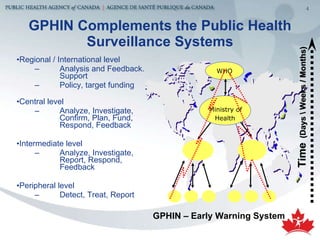
GPHIN Complements the Public Health Surveillance Systems Regional / International level Analysis and Feedback. Support Policy, target funding Central level Analyze, Investigate,  Confirm, Plan, Fund,  Respond, Feedback Intermediate level Analyze, Investigate, Report, Respond, Feedback Peripheral level Detect, Treat, Report Time   (Days \ Weeks / Months) Ministry of  Health WHO GPHIN – Early Warning System Time   (Days \ Weeks / Months) Time   (Days \ Weeks / Months)
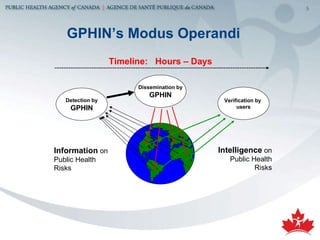
GPHIN’s Modus Operandi Information  on Public Health Risks Intelligence  on Public Health Risks Detection by GPHIN Dissemination by GPHIN Verification by  users Timeline:  Hours – Days
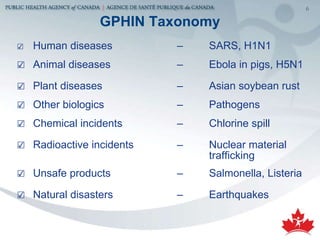
GPHIN Taxonomy ☑   Human diseases  – SARS, H1N1 ☑  Animal diseases  – Ebola in pigs, H5N1 ☑  Plant diseases  – Asian soybean rust ☑  Other biologics  – Pathogens ☑  Chemical incidents – Chlorine spill ☑  Radioactive incidents  – Nuclear material  trafficking ☑  Unsafe products  – Salmonella, Listeria  ☑  Natural disasters  – Earthquakes
GPHIN's Versatility : Information for Action Detect  potential public health threats Estimate  magnitude of the public health threat Determine  geographic distribution of public  health threat Analysis  of risks possibly associated Identify  control and preventative measures considered / implemented Monitor  concerns of general public  Observe  situational politics
Components of the  GPHIN System Automated Processes Human Analysis
Analyst’s Responsibilities Review reports for public health relevance and disseminate alerts Monitor events of concern Maintain:  Search syntaxes taxonomy and data dictionaries Ministry of Health Website links Prepare reports Respond to inquiries / requests from GPHIN Users Identify any technical difficulties to be addressed Duty Officer
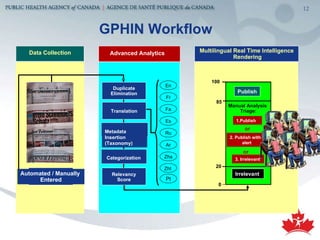
Multilingual Real Time Intelligence Rendering Multilingual Sources News Media Translation Data Collection Advanced Analytics Automated / Manually  Entered En Fr Es Ru Ar Zhs Zht Pt Fa 0 20 85 100 3. Irrelevant Manual  A nalysis  Triage: 2. Publish with alert 1.Publish or or Irrelevant Publish GPHIN   Workflow Duplicate Elimination Metadata Insertion (Taxonomy) Categorization Relevancy Score
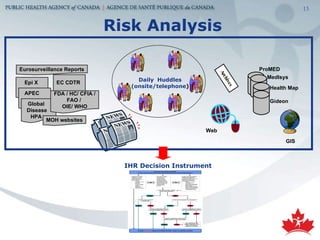
Epi X Risk Analysis APEC Global Disease  HPA EC CDTR IHR Decision Instrument Daily  Huddles (onsite/telephone ) GIS MOH websites FDA / HC/ CFIA / FAO /  OIE/ WHO Eurosurveillance Reports ProMED MedIsys Health Map Gideon Web Archives
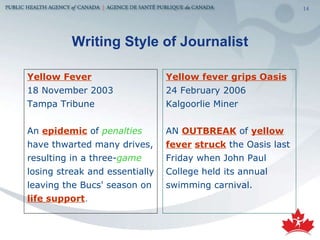
Writing Style of Journalist Yellow Fever   18 November 2003 Tampa Tribune An  epidemic   of  penalties   have thwarted many drives, resulting in a three- game   losing streak and essentially leaving the Bucs' season on  life support .   Yellow fever grips Oasis   24 February 2006 Kalgoorlie Miner AN  OUTBREAK  of  yellow fever   struck   the Oasis last Friday when John Paul College held its annual swimming carnival.
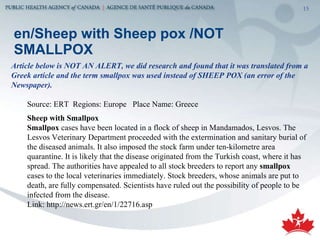
en/Sheep with Sheep pox /NOT SMALLPOX Article below is NOT AN ALERT, we did research and found that it was translated from a Greek article and the term smallpox was used instead of SHEEP POX (an error of the Newspaper). Source: ERT  Regions: Europe  Place Name: Greece Sheep with Smallpox  Smallpox  cases have been located in a flock of sheep in Mandamados, Lesvos. The Lesvos Veterinary Department proceeded with the extermination and sanitary burial of the diseased animals. It also imposed the stock farm under ten-kilometre area quarantine. It is likely that the disease originated from the Turkish coast, where it has spread. The authorities have appealed to all stock breeders to report any  smallpox  cases to the local veterinaries immediately. Stock breeders, whose animals are put to death, are fully compensated. Scientists have ruled out the possibility of people to be infected from the disease.  Link: http://news.ert.gr/en/1/22716.asp
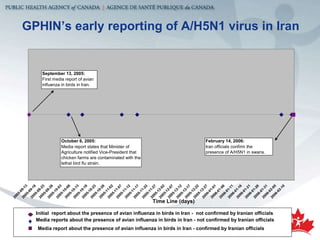
GPHIN’s early reporting of A/H5N1 virus in Iran
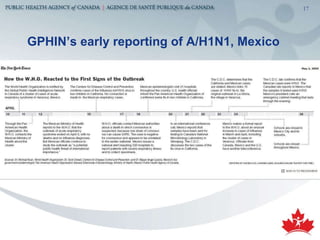
GPHIN’s early reporting of A/H1N1, Mexico
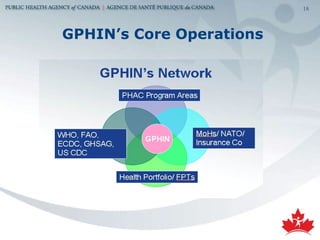
GPHIN’s Core Operations
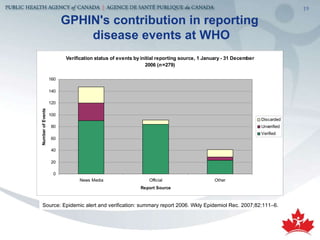
Source: Epidemic alert and verification: summary report 2006. Wkly Epidemiol Rec. 2007;82:111–6.  GPHIN's contribution in reporting  disease events at WHO
Contact information: Michael Blench Phone: (613) 957-3567 Email :   [email_address] or   [email_address]   Merci / Thank You

BLENCH Michael - Global Public Health Intelligence Network (GPHIN)

  • 1.
    Global Public HealthIntelligence Network (GPHIN) Reseau Mondial d’Information en Santé Publique (RMISP) Michael Blench GPHIN Technical Advisor & Project Coordinator
  • 2.
    Presentation Outline Overviewof GPHIN Information Workflow Successes Users
  • 3.
    GP HIN -Background An early-warning system for potential public health threats worldwide Monitors global media sources in nine languages (Arabic, Chinese Simplified and Traditional, English, Farsi, French, Portuguese, Russian and Spanish) Gathers relevant information in near real-time and on a 24/7 basis; sends GPHIN alerts to users when appropriate Web based (‘thin client’) Encrypted authentication
  • 4.
    GPHIN Complements thePublic Health Surveillance Systems Regional / International level Analysis and Feedback. Support Policy, target funding Central level Analyze, Investigate, Confirm, Plan, Fund, Respond, Feedback Intermediate level Analyze, Investigate, Report, Respond, Feedback Peripheral level Detect, Treat, Report Time (Days \ Weeks / Months) Ministry of Health WHO GPHIN – Early Warning System Time (Days \ Weeks / Months) Time (Days \ Weeks / Months)
  • 5.
    GPHIN’s Modus OperandiInformation on Public Health Risks Intelligence on Public Health Risks Detection by GPHIN Dissemination by GPHIN Verification by users Timeline: Hours – Days
  • 6.
    GPHIN Taxonomy ☑ Human diseases – SARS, H1N1 ☑ Animal diseases – Ebola in pigs, H5N1 ☑ Plant diseases – Asian soybean rust ☑ Other biologics – Pathogens ☑ Chemical incidents – Chlorine spill ☑ Radioactive incidents – Nuclear material trafficking ☑ Unsafe products – Salmonella, Listeria ☑ Natural disasters – Earthquakes
  • 8.
    GPHIN's Versatility :Information for Action Detect potential public health threats Estimate magnitude of the public health threat Determine geographic distribution of public health threat Analysis of risks possibly associated Identify control and preventative measures considered / implemented Monitor concerns of general public Observe situational politics
  • 9.
    Components of the GPHIN System Automated Processes Human Analysis
  • 11.
    Analyst’s Responsibilities Reviewreports for public health relevance and disseminate alerts Monitor events of concern Maintain: Search syntaxes taxonomy and data dictionaries Ministry of Health Website links Prepare reports Respond to inquiries / requests from GPHIN Users Identify any technical difficulties to be addressed Duty Officer
  • 12.
    Multilingual Real TimeIntelligence Rendering Multilingual Sources News Media Translation Data Collection Advanced Analytics Automated / Manually Entered En Fr Es Ru Ar Zhs Zht Pt Fa 0 20 85 100 3. Irrelevant Manual A nalysis Triage: 2. Publish with alert 1.Publish or or Irrelevant Publish GPHIN Workflow Duplicate Elimination Metadata Insertion (Taxonomy) Categorization Relevancy Score
  • 13.
    Epi X RiskAnalysis APEC Global Disease HPA EC CDTR IHR Decision Instrument Daily Huddles (onsite/telephone ) GIS MOH websites FDA / HC/ CFIA / FAO / OIE/ WHO Eurosurveillance Reports ProMED MedIsys Health Map Gideon Web Archives
  • 14.
    Writing Style ofJournalist Yellow Fever 18 November 2003 Tampa Tribune An epidemic of penalties have thwarted many drives, resulting in a three- game losing streak and essentially leaving the Bucs' season on life support . Yellow fever grips Oasis 24 February 2006 Kalgoorlie Miner AN OUTBREAK of yellow fever struck the Oasis last Friday when John Paul College held its annual swimming carnival.
  • 15.
    en/Sheep with Sheeppox /NOT SMALLPOX Article below is NOT AN ALERT, we did research and found that it was translated from a Greek article and the term smallpox was used instead of SHEEP POX (an error of the Newspaper). Source: ERT Regions: Europe Place Name: Greece Sheep with Smallpox Smallpox cases have been located in a flock of sheep in Mandamados, Lesvos. The Lesvos Veterinary Department proceeded with the extermination and sanitary burial of the diseased animals. It also imposed the stock farm under ten-kilometre area quarantine. It is likely that the disease originated from the Turkish coast, where it has spread. The authorities have appealed to all stock breeders to report any smallpox cases to the local veterinaries immediately. Stock breeders, whose animals are put to death, are fully compensated. Scientists have ruled out the possibility of people to be infected from the disease. Link: http://news.ert.gr/en/1/22716.asp
  • 16.
    GPHIN’s early reportingof A/H5N1 virus in Iran
  • 17.
    GPHIN’s early reportingof A/H1N1, Mexico
  • 18.
  • 19.
    Source: Epidemic alertand verification: summary report 2006. Wkly Epidemiol Rec. 2007;82:111–6. GPHIN's contribution in reporting disease events at WHO
  • 21.
    Contact information: MichaelBlench Phone: (613) 957-3567 Email : [email_address] or [email_address] Merci / Thank You

Editor's Notes

  • #4 GPHIN is an early-warning system for potential public health threats worldwide. This includes CBRN&E related issues. GPHIN monitors over 10,000 global media sources in Arabic, Chinese (Simplified & Traditional), English, Farsi, French, Russian and Spanish. Monitoring in Portuguese is scheduled to begin in the next few months. News sources include national and local newspapers, newsletters, and journal abstracts. Relevant information is gathered and available to users in near-real-time and on a 24/7 basis. Non-English information is machine-translated to English and vice versa. The translation gives the essence of the subject being covered in the article. Using a password, GPHIN can be accessed anywhere there is internet access.
  • #5 Traditional Hierarchical Paradigm: Events at the local level e.g. town or municipality are reported to the provincial level who then report to the federal level who then may or may not report it to the WHO. Time consuming and fraught with pitfalls .
  • #7 GPHIN covers a broad range of public health issues as demonstrated by the examples listed on the right.
  • #9 GPHIN also provides other types of information that is useful especially during a crisis. For example, during the SARS outbreak, GPHIN was able to provide information about the type of airport screening measures that were being implemented in countries around the world. We were able to give information about how the general public was feeling during the outbreak and what their concerns were which was important for our Minister’s office.
  • #20 This graph shows the contribution of media as the most important initial source of information about disease events, providing 147/279 (53%) initial reports (Fig. 2). More than one third (91/279) were provided by official sources (national public health authorities or WHO networks), while the remaining 41 (15%) were provided by organizations of the United Nations, other governmental institutions, nongovernmental organizations and personal communications; these are designated as “Other” in Fig. 2.