Climate Change Vulnerability
Ramanand Pandit,
PhD Scholar
Occupational Health
1
2
Climate change vulnerability
3
Vulnerability to climate change
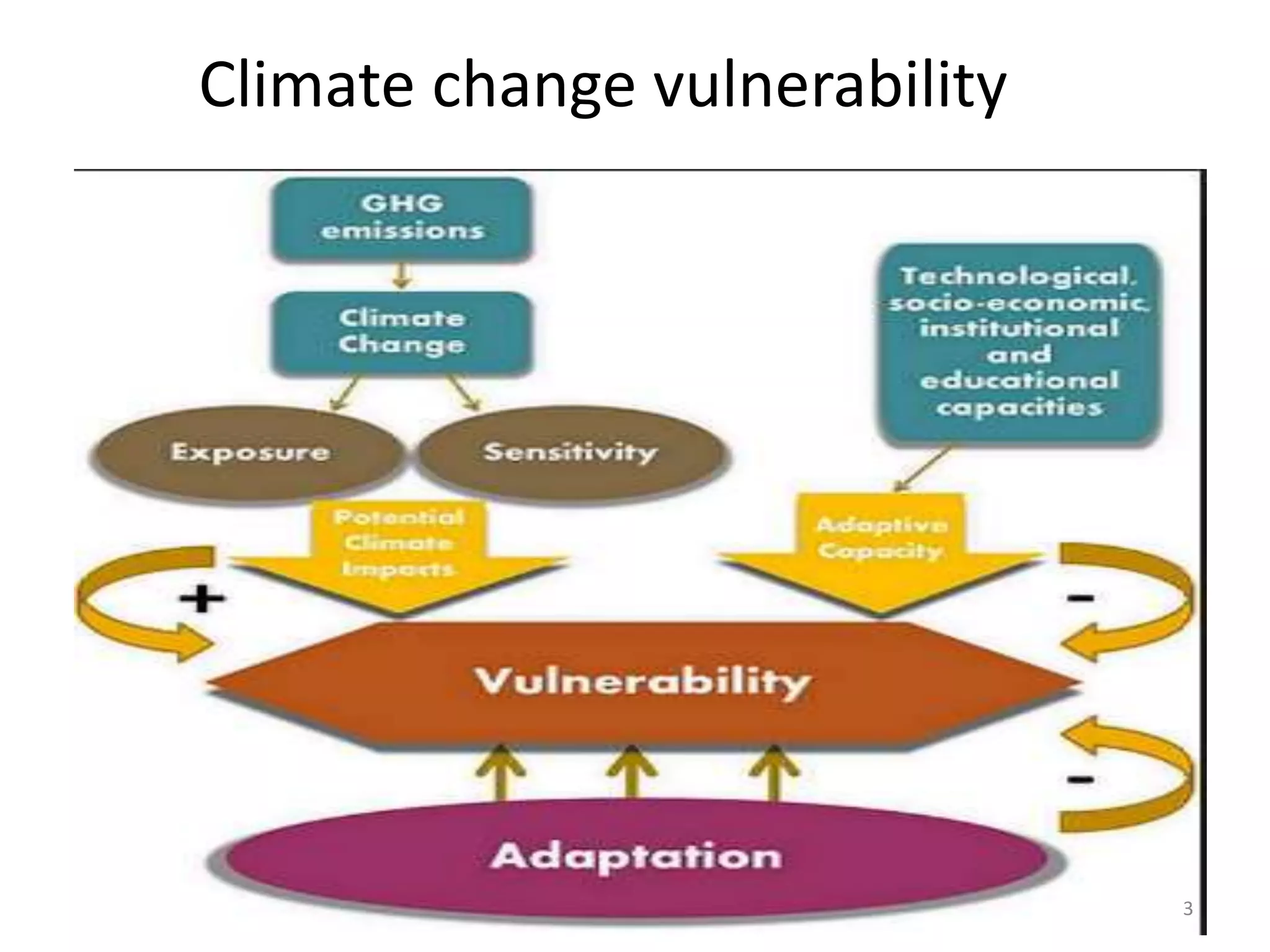
When focusing on climate change,
vulnerability could be described as the
degree to which a system is susceptible to, or
unable to cope with, the adverse effects of
climate change, including climate variability
and extremes ( as shown in the figure).
4
Vulnerability Assessment
Examples of indicators that could be used to
assess vulnerability:
- Frequency of natural events (floods, droughts and
cyclones)
- Location and intensity of wild fires
- Infrastructure (road network, coastal defense
etc.)
- Land use ,Assets, land value, house value
- Household size, female-headed households
- Food sufficiency (amount of available food
storage) 5
- Population affected by natural disasters
- Crop types, cropping systems (mono-cropping,
multiple cropping), fertilizer consumption or
input use
- Irrigation rate, irrigation source
- Percentage of households below poverty
- Level of education or literacy
- Health care delivery
6
Vulnerability Assessment
Vulnerability varies widely across peoples,
sectors and regions. This diversity of the ‘real
world’ is the starting place for vulnerability
assessment.
The choice of the target of the vulnerability
assessment should be related to the problems
identified in scoping the project
7
Vulnerability Assessment
Distinguishing between scales helps simplify
the conceptual and analytical issues:
• International comparisons of vulnerability
tend to focus on national indicators, for
example to group less developed countries or
compare progress in human development
among countries with similar economic
conditions.
8
Vulnerability Assessment
• At a national level, vulnerability assessments
contribute to setting development priorities
and monitoring progress. Sectoral
assessments provide more detail and targets
for strategic development plans.
• At a local or community level, vulnerable
groups can be identified and coping strategies
implemented, often employing participatory
methods.
9
Vulnerability Assessment
Vulnerability assessment for climate adaptation
includes five tasks to be done:
• Task I: Vulnerability frameworks
• Task II: Constructing a development baseline and
targeting vulnerable groups
• Task III: Linking the development baseline to
climate impacts and risks
• Task IV: Drivers of vulnerability: linking the
present and future
• Task V: Outputs of the vulnerability assessment
10
Vulnerability Assessment
Task I: Vulnerability frameworks
An initial task of an interdisciplinary team is to
clarify the conceptual framework and the
analytical definitions that form the core of the
assessment.
This task has close links with the overall
scoping of the project
11
12
Vulnerability Assessment
• The starting point should be to review existing
regional or national assessments that relate to
vulnerability, for instance national development
plans, Poverty Reduction Strategy Papers,
environmental sustainability plans and natural
hazards assessments.
• If there is a common approach already in use—
for instance in development planning or
mapping hazards—then it makes sense to begin
with that framework. 13
Vulnerability Assessment
If existing reviews and plans are not available or
suitable, then the team will need to develop its
own conceptual and analytical framework
Revisit the working framework throughout the
project to ensure that the links between the
analyses are clear and relevant to the overall
objectives. The outputs of this task are a core
framework for the vulnerability assessment.
14
Vulnerability Assessment
Task II: Constructing a development baseline
and targeting vulnerable groups
The second task is to review present conditions in
order to target vulnerable groups and establish a
development baseline.
The development baseline should incorporate
two levels of analysis:
• A comprehensive set of spatial indicators of
vulnerability
• Identification of target vulnerable groups that
are a priority for adaptation policy
15
Vulnerability Assessment
• Developing and using indicators requires
awareness of several technical issues, including
their sensitivity to change, standardizing
indicators for comparison, reliability of the data,
mapping of indicators, co-linearity between
indicators, coverage of relevant dimensions of
vulnerability, etc.
• However, if existing inventories are available,
many of these issues will have already been
addressed and the literature on indicators
provides examples of good practice. 16
Vulnerability Assessment
• The choice of the target of the vulnerability
assessment should be related to the
problems identified in scoping the project.
• The collation of vulnerability indicators
underpins the analyses and identification of
priorities for adaptation.
17
Vulnerability Assessment
Task III: Linking the development baseline to
climate impacts and risks
The first two tasks establish present conditions of
development; the next step is to refine the
analysis and link the development baseline
explicitly to climate impacts and risks.
In the vulnerability assessment, this might be
relatively simple, or more formal and quantitative
approaches may be developed through the
guidelines.
18
Vulnerability Assessment
It may well be that risk maps of present climatic
variations are already available. Certainly, almost
all countries will have national models of
agricultural production and hydrological
sensitivity to climatic variations, for example. If
so, these can be added to the indicator data set.
If quantitative impacts assessments are not
available, it should be possible to develop
indicators of present climatic risks.
19
Vulnerability Assessment
These might be relatively simple climatic
thresholds (e.g., probability of drought).
Historical episodes, such as the drought of record
or extreme rainfall during historical storms can
help define at-risk regions.
If formal models of (present) climate impacts and
data on climatic risks are not available, expert
opinion and case examples from similar countries
can be used to develop a suite of plausible
impacts scenarios.
20
Vulnerability Assessment
Such scenarios are exploratory—they are difficult
to translate into probabilities—but are often
useful in revealing potential vulnerabilities and
policy responses.
For instance, worst case scenarios are commonly
used in disaster planning.
The output from this task is an understanding of
the present probability of a range of climatic
conditions and hazards. The conjunction of the
climatic hazards and development baseline
comprises the present climate vulnerability
21
Vulnerability Assessment
Task IV: Drivers of vulnerability: linking the
present and future
This analysis links the present (snapshot) with
pathways of the future--that may lead to
sustainable development or further
vulnerabilities.
The techniques for ‘mapping’ the structure of
present vulnerability and how it might change in
the future are likely to be qualitative in the first
instance.
22
Vulnerability Assessment
Two technical issues need to be clarified in the VA
at this stage:
a. Most indicators are snapshots of present status,
for example GDP per capita. However,
vulnerability is dynamic and indicators that
foreshadow future vulnerability may be useful.
For example, future wealth may be correlated
with literacy and governance and only weakly
correlated with present rates of growth in GDP
per capita.
23
Vulnerability Assessment
b. The common drivers of development need to be
related to the target vulnerable groups. National
and international trends, for example in
population and income, may not map directly
onto the nuances of marginalization, local land
tenure, markets and poverty that characterize
vulnerability.
Shocks and surprises have disproportionate
effects for the vulnerable—as in the macro-
economic failure in Argentina.
24
Vulnerability Assessment
Task V: Outputs of the vulnerability assessment
The outputs of a vulnerability assessment include:
• A description and analysis of present vulnerability,
including representative vulnerable groups (for
instance specific livelihoods at-risk of climatic hazards).
• Descriptions of potential vulnerabilities in the future,
including an analysis of pathways that relate the
present to the future.
• Comparison of vulnerability under different socio-
economic conditions, climatic changes and adaptive
responses.
25
26

7.climate change vulnerability.pptx

  • 1.
    Climate Change Vulnerability RamanandPandit, PhD Scholar Occupational Health 1
  • 2.
  • 3.
  • 4.
    Vulnerability to climatechange When focusing on climate change, vulnerability could be described as the degree to which a system is susceptible to, or unable to cope with, the adverse effects of climate change, including climate variability and extremes ( as shown in the figure). 4
  • 5.
    Vulnerability Assessment Examples ofindicators that could be used to assess vulnerability: - Frequency of natural events (floods, droughts and cyclones) - Location and intensity of wild fires - Infrastructure (road network, coastal defense etc.) - Land use ,Assets, land value, house value - Household size, female-headed households - Food sufficiency (amount of available food storage) 5
  • 6.
    - Population affectedby natural disasters - Crop types, cropping systems (mono-cropping, multiple cropping), fertilizer consumption or input use - Irrigation rate, irrigation source - Percentage of households below poverty - Level of education or literacy - Health care delivery 6
  • 7.
    Vulnerability Assessment Vulnerability varieswidely across peoples, sectors and regions. This diversity of the ‘real world’ is the starting place for vulnerability assessment. The choice of the target of the vulnerability assessment should be related to the problems identified in scoping the project 7
  • 8.
    Vulnerability Assessment Distinguishing betweenscales helps simplify the conceptual and analytical issues: • International comparisons of vulnerability tend to focus on national indicators, for example to group less developed countries or compare progress in human development among countries with similar economic conditions. 8
  • 9.
    Vulnerability Assessment • Ata national level, vulnerability assessments contribute to setting development priorities and monitoring progress. Sectoral assessments provide more detail and targets for strategic development plans. • At a local or community level, vulnerable groups can be identified and coping strategies implemented, often employing participatory methods. 9
  • 10.
    Vulnerability Assessment Vulnerability assessmentfor climate adaptation includes five tasks to be done: • Task I: Vulnerability frameworks • Task II: Constructing a development baseline and targeting vulnerable groups • Task III: Linking the development baseline to climate impacts and risks • Task IV: Drivers of vulnerability: linking the present and future • Task V: Outputs of the vulnerability assessment 10
  • 11.
    Vulnerability Assessment Task I:Vulnerability frameworks An initial task of an interdisciplinary team is to clarify the conceptual framework and the analytical definitions that form the core of the assessment. This task has close links with the overall scoping of the project 11
  • 12.
  • 13.
    Vulnerability Assessment • Thestarting point should be to review existing regional or national assessments that relate to vulnerability, for instance national development plans, Poverty Reduction Strategy Papers, environmental sustainability plans and natural hazards assessments. • If there is a common approach already in use— for instance in development planning or mapping hazards—then it makes sense to begin with that framework. 13
  • 14.
    Vulnerability Assessment If existingreviews and plans are not available or suitable, then the team will need to develop its own conceptual and analytical framework Revisit the working framework throughout the project to ensure that the links between the analyses are clear and relevant to the overall objectives. The outputs of this task are a core framework for the vulnerability assessment. 14
  • 15.
    Vulnerability Assessment Task II:Constructing a development baseline and targeting vulnerable groups The second task is to review present conditions in order to target vulnerable groups and establish a development baseline. The development baseline should incorporate two levels of analysis: • A comprehensive set of spatial indicators of vulnerability • Identification of target vulnerable groups that are a priority for adaptation policy 15
  • 16.
    Vulnerability Assessment • Developingand using indicators requires awareness of several technical issues, including their sensitivity to change, standardizing indicators for comparison, reliability of the data, mapping of indicators, co-linearity between indicators, coverage of relevant dimensions of vulnerability, etc. • However, if existing inventories are available, many of these issues will have already been addressed and the literature on indicators provides examples of good practice. 16
  • 17.
    Vulnerability Assessment • Thechoice of the target of the vulnerability assessment should be related to the problems identified in scoping the project. • The collation of vulnerability indicators underpins the analyses and identification of priorities for adaptation. 17
  • 18.
    Vulnerability Assessment Task III:Linking the development baseline to climate impacts and risks The first two tasks establish present conditions of development; the next step is to refine the analysis and link the development baseline explicitly to climate impacts and risks. In the vulnerability assessment, this might be relatively simple, or more formal and quantitative approaches may be developed through the guidelines. 18
  • 19.
    Vulnerability Assessment It maywell be that risk maps of present climatic variations are already available. Certainly, almost all countries will have national models of agricultural production and hydrological sensitivity to climatic variations, for example. If so, these can be added to the indicator data set. If quantitative impacts assessments are not available, it should be possible to develop indicators of present climatic risks. 19
  • 20.
    Vulnerability Assessment These mightbe relatively simple climatic thresholds (e.g., probability of drought). Historical episodes, such as the drought of record or extreme rainfall during historical storms can help define at-risk regions. If formal models of (present) climate impacts and data on climatic risks are not available, expert opinion and case examples from similar countries can be used to develop a suite of plausible impacts scenarios. 20
  • 21.
    Vulnerability Assessment Such scenariosare exploratory—they are difficult to translate into probabilities—but are often useful in revealing potential vulnerabilities and policy responses. For instance, worst case scenarios are commonly used in disaster planning. The output from this task is an understanding of the present probability of a range of climatic conditions and hazards. The conjunction of the climatic hazards and development baseline comprises the present climate vulnerability 21
  • 22.
    Vulnerability Assessment Task IV:Drivers of vulnerability: linking the present and future This analysis links the present (snapshot) with pathways of the future--that may lead to sustainable development or further vulnerabilities. The techniques for ‘mapping’ the structure of present vulnerability and how it might change in the future are likely to be qualitative in the first instance. 22
  • 23.
    Vulnerability Assessment Two technicalissues need to be clarified in the VA at this stage: a. Most indicators are snapshots of present status, for example GDP per capita. However, vulnerability is dynamic and indicators that foreshadow future vulnerability may be useful. For example, future wealth may be correlated with literacy and governance and only weakly correlated with present rates of growth in GDP per capita. 23
  • 24.
    Vulnerability Assessment b. Thecommon drivers of development need to be related to the target vulnerable groups. National and international trends, for example in population and income, may not map directly onto the nuances of marginalization, local land tenure, markets and poverty that characterize vulnerability. Shocks and surprises have disproportionate effects for the vulnerable—as in the macro- economic failure in Argentina. 24
  • 25.
    Vulnerability Assessment Task V:Outputs of the vulnerability assessment The outputs of a vulnerability assessment include: • A description and analysis of present vulnerability, including representative vulnerable groups (for instance specific livelihoods at-risk of climatic hazards). • Descriptions of potential vulnerabilities in the future, including an analysis of pathways that relate the present to the future. • Comparison of vulnerability under different socio- economic conditions, climatic changes and adaptive responses. 25
  • 26.