Emerging & Re-emerging
Infectious Diseases
PLAN OF PRESENTATION
• INTRODUCTION
• EPIDEMIOLOGY
• EMERGING DISEAESES
• REEMERGING DISEASES
• PREVENTION AND CONTROL
• WAY FORWARD
INTRODUCTION
 Emerging Infectious Diseases:
• Emerging infectious diseases are “New diseases; new problem (New
threats)”
• An emerging infectious disease is a one that is caused by a newly
discovered infectious agent
or
• by a newly identified pathogen, which has emerged and whose
incidence in humans has increased during the last 2 decades and is
threatening to increase in the near future.
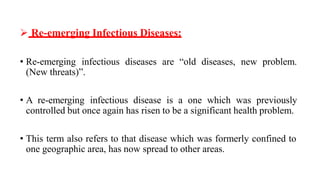
 Re-emerging Infectious Diseases:
• Re-emerging infectious diseases are “old diseases, new problem.
(New threats)”.
• A re-emerging infectious disease is a one which was previously
controlled but once again has risen to be a significant health problem.
• This term also refers to that disease which was formerly confined to
one geographic area, has now spread to other areas.
EPIDEMIOLOGY
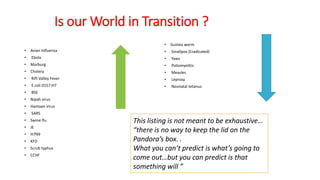
Is our World in Transition ?
• Avian Influenza
• Ebola
• Marburg
• Cholera
• Rift Valley Fever
• E.coli 0157:H7
• BSE
• Nipah virus
• Hantaan virus
• SARS
• Swine flu
• JE
• H7N9
• KFD
• Scrub typhus
• CCHF
• Guinea worm
• Smallpox (Eradicated)
• Yaws
• Poliomyelitis
• Measles
• Leprosy
• Neonatal tetanus
This listing is not meant to be exhaustive…
“there is no way to keep the lid on the
Pandora’s box. .
What you can’t predict is what’s going to
come out…but you can predict is that
something will ”
Factors contributing to the emergence of infectious
diseases:
1. Human demographics and behaviour
2. Technology and industry
3. Economic development and land use
4. International travel and commerce
5. Microbial adaptation and change
6. Breakdown of public health measures
7. Human susceptibility to infection
8. Climate and weather
9. Changing ecosystems
10. Poverty and social inequality
11. War and famine
12. Lack of political will
13. Intent to harm
Factors contributing to the emergence
 AGENT:
• Evolution of pathogenic infectious agents (microbial adaptation & change)
• Development of resistance to drugs: Wrong prescribing practices
Non-adherence by patients
Counterfeit drugs
Use of anti-infective drugs in animals & plants
• Resistance of vectors to pesticides
HOST:
• Human demographic change (inhabiting new areas)
• Human behaviour: 1. Unsafe sexual practices (HIV, Gonorrhoea, Syphilis)
2. Changes in agricultural & food production patterns-
food- borne infectious agents (E. coli)
3. Increased international travel (Influenza)
• Human susceptibility to infection (Immunosuppression)
• Poverty & social inequality
ENVIRONMENT:
• Climate & changing ecosystems:
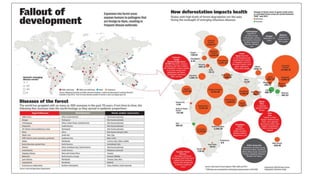
Deforestation forces animals into closer human contact- increased possibility for
agents to breach species barrier between animals & humans
EL Nino- Triggers natural disasters & related outbreaks of infectious diseases
(Malaria, Cholera)
Global warming- spread of Malaria, Dengue, Leishmaniasis, Filariasis
• Economic development & Land use (urbanization, deforestation)
• Technology & industry (food processing & handling)
• International travel & commerce
• Deterioration in surveillance systems (lack of political will)
• Breakdown of public health measure (war, unrest, overcrowding):
Poor populations- major reservoir & source of continued transmission
Poverty- Malnutrition- Severe infectious disease cycle
Lack of funding, Poor prioritization of health funds, Misplaced in curative rather
than preventive infrastructure, failure to develop adequate health delivery systems
• Uncontrolled Urbanization & Population Displacement:
Growth of densely populated cities- substandard housing, unsafe water, poor
sanitation, overcrowding, indoor air pollution (>10% preventable ill health)
Problem of refugees & displaced persons
Diarrhoeal & Intestinal parasitic diseases,ARI 8
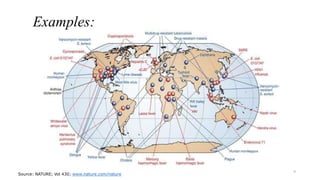
Examples:
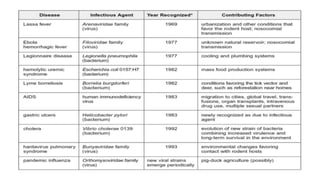
Source: NATURE; Vol 430; www.nature.com/nature
9
• 1993: Hantavirus pulmonary syndrome (United States)
• 1994: Plague (India)
• 1995: Ebola fever (Democratic Republic of Congo)
• 1996: New variant Creutzfeldt-Jakob disease (United Kingdom)
• 1997: H5N1 influenza (Hong Kong);
• 1998: Nipah virus encephalitis (Malaysia, Singapore)
• 1999: West Nile virus encephalitis (Russia, United States)
• 2000: Rift Valley fever (Kenya, SaudiArabia, Yemen); Ebola fever(Uganda)
• 2001:Anthrax (United States); foot-and-mouth disease(United Kingdom)
• 2002: Vancomycin-resistant Staphylococcus aureus (United States)
• 2003: Severe acute respiratory syndrome (SARS) (multiple countries); monkeypox (USA)
• 2004: H5N1 influenza (SoutheastAsia)
• 2015: Zika outbreak
• 2020: SARS-CoV-2
Examples of Emerging Infectious Diseases
• Hepatitis C- First identified in 1989
In mid 1990s estimated global prevalence 3%
• Hepatitis B- Identified several decades earlier
Upward trend in all countries
Prevalence >90% in high-risk population
• Zoonoses-1,415 microbes are infectious for human
Of these, 868 (61%) considered zoonotic
70% of newly recognized pathogens are zoonoses
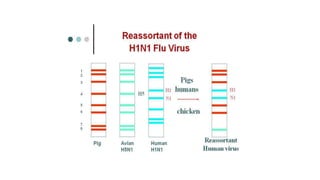
Emerging Influenza infections in Humans associated with Chickens, Pigs
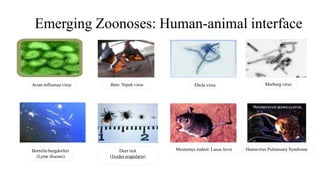
Emerging Zoonoses: Human-animal interface
Marburg virus
Hantavirus Pulmonary Syndrome
Ebola virus
Borrelia burgdorferi
(Lyme disease)
Deer tick
(Ixodes scapularis)
Mostomys rodent: Lassa fever
Avian influenza virus Bats: Nipah virus
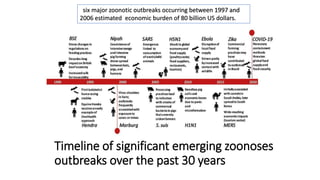
Timeline of significant emerging zoonoses
outbreaks over the past 30 years
six major zoonotic outbreaks occurring between 1997 and
2006 estimated economic burden of 80 billion US dollars.
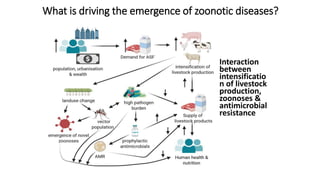
What is driving the emergence of zoonotic diseases?
Interaction
between
intensificatio
n of livestock
production,
zoonoses &
antimicrobial
resistance
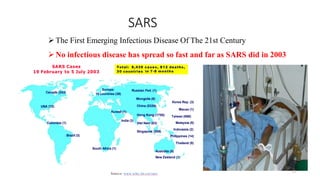
SARS Cases
19 February to 5 July 2003
China (5326)
Singapore (206)
Hong Kong (1755)
Viet Nam (63)
Europe:
10 countries (38)
Thailand (9)
Brazil (3)
Canada (243)
USA (72)
Colombia (1)
Kuwait (1)
South Africa (1)
India (3)
Australia (5)
New Zealand (1)
Korea Rep. (3)
Macao (1)
Taiwan (698)
Malaysia (5)
Indonesia (2)
Philippines (14)
Mongolia (9)
Russian Fed. (1)
Total: 8,439 cases, 812 deaths,
30 countries in 7-8 months
Source: www.who.int.csr/sars
SARS
The First Emerging Infectious Disease Of The 21st Century
No infectious disease has spread so fast and far as SARS did in 2003
13
Lesson learnt from SARS
• An infectious disease in one country is a threat to all
• Important role of air travel in international spread
• Tremendous negative economic impact on trade, travel and tourism, estimated loss
of $ 30 to $150 billion
• High level commitment is crucial for rapid containment
• WHO can play a critical role in catalyzing international cooperation and support
• Global partnerships & rapid sharing of data/information enhances preparedness and
response
Swine Flu (H1N1)
• Swine flu causes respiratory disease – high level of illness, low death rates
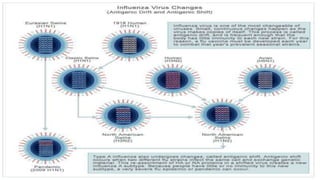
• Causative agent- InfluenzaA- RNAviruses of the family Orthomyxoviridae
• RNAvirus- highly mutagenic
• Pigs can get infected by human, avian and swine influenza virus
• Pandemic outbreak sinceApril 2009
• April 15th 2009 CDC identifies H1N1 (swine flu)
• April 25th 2009 WHO declares public health emergency
• By May 5th 2009 more than 1000 cases confirmed in 21 countries
• May 16th 2009India reports first confirmed case
• Cases of swine flu have been reported in India, with over 31,156 positive test
cases and 1,841 deaths up to March 2015
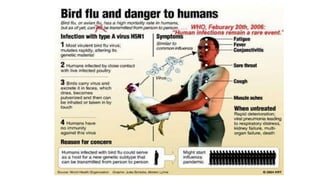
Highly Pathogenic Avian Influenza (H5N1)
• Since Nov 2003, avian influenza H5N1 in birds affected 60 countries across Asia,
Europe, Middle-East &Africa
• >220 million birds killed by this virus or culled to prevent further spread
• Majority of human H5N1 infection due to direct contact with birds infected with
virus
EMERGING FOOD BORNE & WATER BORNE DISEASE
• Accounts for 20 million cases in the world annually (T.D. Chugh-2008)
• Incidence is increasing
• Half of all known food borne pathogens discovered during the past 25 years
• Most common associated organisms are: Entero hemorrhagic Escherichia coli, Vibrio
cholerae, Campylobacter sp.
EBOLA
• Ebola was first discovered in 1976 near the Ebola River. Since then, outbreaks have
appeared sporadically inAfrica.
• Ebola Hemorrhagic Fever Outbreak:
• 2000-2001: Uganda
• 2002-2003: Gabon and Democratic Republic of the Congo (DRC)
• 2004: South Sudan
• 2007: DRC, Uganda.
• 2011-2012: Uganda, DRC
• 2014-2016: WestAfrica
ZIKA
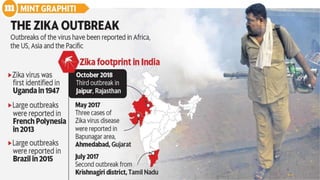
• Zika virus was first discovered in a monkey in the Zika Forest of Uganda in 1947.
• In 1952, the first human cases of Zika were detected and since then, outbreaks of Zika
have been reported in tropicalAfrica, SoutheastAsia, and the Pacific Islands.
• Before 2007, at least 14 human cases of Zika had been documented, although other
cases were likely to have occurred and were not reported.
• The first travel notice for Zika in Brazil was posted in June 2015.
• On January 22, 2016, CDC activated its Emergency Operations Center (EOC) to
respond to outbreaks of Zika occurring in theAmericas and increased reports of birth
defects and Guillain-Barré syndrome in areas affected by Zika.
ZIKA
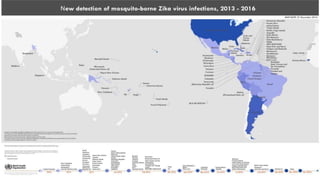
• Since 2015, 69 countries and territories reported evidence of vector-borne Zika
virus transmission.
• Brazil is by far the most affected country, reporting the most cases of people
infected with the Zika virus.
• Transmitted through bite of Aedes mosquito (Aedes aegyptii and Aedes
albopictus) and they bite during both day and night.
• Can be transmitted during pregnancy leading to birth defects.
• As of 2nd Aug 2021, 65 cases of Zika virus reported in Kerala.
Malaysian Nipah virus epidemic 1998-1999
• An outbreak of Nipah virus in Malaysia and Singapore
• Nipah virus belongs to family Paramyxoviridae
• Virus aerosolisation caused infection of pigs
• Overcrowding results in viral transmission to pig handlers
• The virus persists in low numbers in the island flying fox (Pteropus hypomelanus), a type
of fruit bat and Malayan flying fox (Pteropus vampyrus)
• Of the 269 human cases of viral encephalitis associated with Nipah virus infection
reported in Malaysia in 1999, 108 were fatal (Ministry of Health Malaysia, 2001).
• The Nipah outbreak was reported in Kozhikode and Malappuram districts of
Kerala in May 2018.
• Third of Nipah Virus Outbreaks in India.
• The earlier being in 2001 and 2007, both in West Bengal.
• A total of 23 cases were identified, including the index case with 18 laboratory-
confirmed cases.
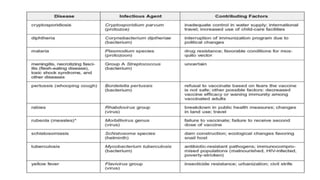
Examples of Re-Emerging Infectious
Diseases
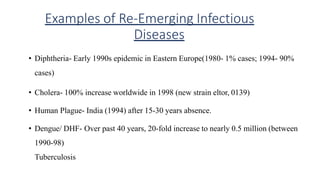
• Diphtheria- Early 1990s epidemic in Eastern Europe(1980- 1% cases; 1994- 90%
cases)
• Cholera- 100% increase worldwide in 1998 (new strain eltor, 0139)
• Human Plague- India (1994) after 15-30 years absence.
• Dengue/ DHF- Over past 40 years, 20-fold increase to nearly 0.5 million (between
1990-98)
Tuberculosis
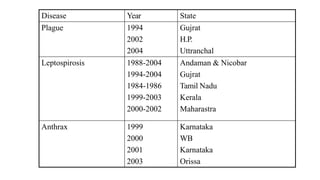
Disease Year State
Plague 1994 Gujrat
2002 H.P.
2004 Uttranchal
Leptospirosis 1988-2004 Andaman & Nicobar
1994-2004 Gujrat
1984-1986 Tamil Nadu
1999-2003 Kerala
2000-2002 Maharastra
Anthrax 1999 Karnataka
2000 WB
2001 Karnataka
2003 Orissa
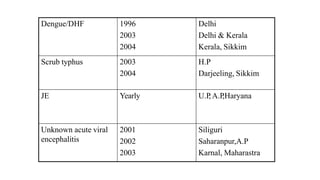
Dengue/DHF 1996 Delhi
2003 Delhi & Kerala
2004 Kerala, Sikkim
Scrub typhus 2003 H.P
2004 Darjeeling, Sikkim
JE Yearly U.P
,A.P
,Haryana
Unknown acute viral 2001 Siliguri
encephalitis 2002 Saharanpur,A.P
2003 Karnal, Maharastra
Antibiotic resistance
• Emerge in environment due to inappropriate use of antibiotic
• WHO estimates that 10 million people are dying of infectious diseases related to
antibiotic resistance.
• Proper antibiotic guidelines needed to prevent the drug resistance.
Multi-resistant pathogens
Staphylococcus aureus is the most frequently identified drug-resistant pathogen.
Singhal et al (2007)reported ciprofloxacin-resistant meningococci in an outbreak
in Delhi.
Resistance of Salmonella typhi and S. paratyphi to chloramphenicol, ampicillin
and cotrimoxazole is widespread.
AMR in Shigella: resistance to azithromycin, ceftriaxone and ciprofloxacin on
the increase
Methicillin/oxacillin-resistant Staphylococcus aureus (MRSA)
Vancomycin-resistant enterococci (VRE);
Extended-spectrum beta-lactamases (which are resistant to cephalosporins &
monobactams) (ESBLs);
Penicillin-resistant Streptococcus pneumoniae (PRSP);
Multi-drug resistant tuberculosis (MDR-TB);
CRKP- Carbapenem Resistant Klebsiella Pneumoniae
S. typhimurium - DT104 (resistant to five antibiotics: ampicillin, chloramphenicol,
streptomycin, sufonamides and tetracycline)
Bioterrorism
• Possible deliberate release of infectious agents by dissident individuals or terrorist groups
• Biological agents are attractive instruments of terror- easy to produce, mass casualties,
difficult to detect, widespread panic & civil disruption
• Highest potential- B. anthracis, C. botulinum toxin, Y
. pestis, Variola virus, Viral
haemorrhagic fever viruses
• Likeliest route- aerosol dissemination
PREVENTION
Strategies to Control Emerging and Re-emerging
Diseases
• Controlling the reservoir
• Interrupting the transmission
• Protecting the susceptible host
• Strengthening of the disease surveillance system
• Encouraging research initiations for treatment regimens and diagnostics
• Encouraging research for new methods of control measures
• Establishment of drug resistance
Role of Doctors in Prevention
Increase knowledge and skill ; Educate the public
Encourage partnerships with consumers and other disciplines to identify needs, set
priorities, develop strategies and evaluate progress
Support health care legislation
Involve in research
Encourage using multidisciplinary efforts.
Influence local and National economic and political options
Continue to advance nursing concern
Role of Public Health Authorities
National programme for prevention and control of vector borne diseases
Legislations for elimination
Communities awareness of the disease
Minimizing transmission of infection: By
• Risk communication to the family members
• Minimizing vector population
• Minimizing vector – individual contact
Reporting to the nearest public health authority
Public health measures to prevent infectious
diseases
Safe water
Sewage treatment and disposal
Food safety programme
Animal control programme
Vaccination programme
Public health organization
Response of the WHO
• Developing global and regional strategies
• Appointing Task Force
• Generous grant from WHO regular budget
• Support the World Bank grant
• GOARN (Global OutbreakAlert & Response Network)
• Mechanism for combating international disease outbreaks
• Ensure rapid deployment of technical assistance, contribute to long-term epidemic preparedness &
capacity building
VECTOR SURVEILLANCE
o Vector borne epidemic prone diseases: JE, Dengue, Plague, KalaAzar, Rickettsial
o Early warning signals
- increase density of vectors
- increase in breeding sites for vectors Insecticide susceptibility
status
o To assess impact of routine measures under national programme
PREVENTIVE STRATEGY IN INDIA
LAB SURVEILLANCE
Serological Surveillance
To collect baseline prevalence data
To identify high risk areas
To identify high risk age group
As early warning signal for impending outbreak
Microbial surveillance
Changing genotype
Mutations
Development ofAntimicrobial Resistance
Eg. Salmonella, Cholera, Plague,Anthrax
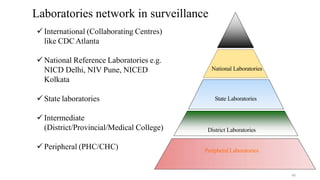
 International (Collaborating Centres)
like CDCAtlanta
 National Reference Laboratories e.g.
NICD Delhi, NIV Pune, NICED
Kolkata
 State laboratories
 Intermediate
(District/Provincial/Medical College)
 Peripheral (PHC/CHC)
State Laboratories
National Laboratories
District Laboratories
Peripheral Laboratories
40
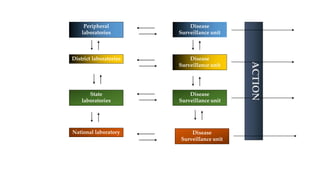
Laboratories network in surveillance
Peripheral
laboratories
District laboratories
Disease
Surveillance unit
Disease
Surveillance unit
Disease
Surveillance unit
National laboratory
State
laboratories
Disease
Surveillance unit
ACTION
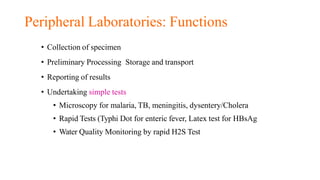
Peripheral Laboratories: Functions
• Collection of specimen
• Preliminary Processing Storage and transport
• Reporting of results
• Undertaking simple tests
• Microscopy for malaria, TB, meningitis, dysentery/Cholera
• Rapid Tests (Typhi Dot for enteric fever, Latex test for HBsAg
• Water Quality Monitoring by rapid H2S Test
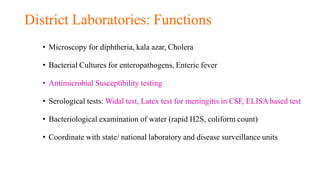
District Laboratories: Functions
• Microscopy for diphtheria, kala azar, Cholera
• Bacterial Cultures for enteropathogens, Enteric fever
• Antimicrobial Susceptibility testing
• Serological tests: Widal test, Latex test for meningitis in CSF, ELISAbased test
• Bacteriological examination of water (rapid H2S, coliform count)
• Coordinate with state/ national laboratory and disease surveillance units
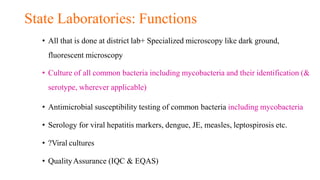
State Laboratories: Functions
• All that is done at district lab+ Specialized microscopy like dark ground,
fluorescent microscopy
• Culture of all common bacteria including mycobacteria and their identification (&
serotype, wherever applicable)
• Antimicrobial susceptibility testing of common bacteria including mycobacteria
• Serology for viral hepatitis markers, dengue, JE, measles, leptospirosis etc.
• ?Viral cultures
• QualityAssurance (IQC & EQAS)
National Laboratories: Functions
• Specialized tests eg for Plague,Anthrax and other possible agents of bioterrorism
• High Containment laboratory (P3/ BSL--3)
• Assist in outbreak investigation
• Confirm new isolates
• All types of Lab based epidemiological markers
• Training/Preparation of Teaching Material and reagents/antisera etc
• Organize external quality assessment schemes
• Collation of national data
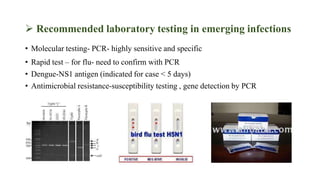
 Recommended laboratory testing in emerging infections
• Molecular testing- PCR- highly sensitive and specific
• Rapid test – for flu- need to confirm with PCR
• Dengue-NS1 antigen (indicated for case < 5 days)
• Antimicrobial resistance-susceptibility testing , gene detection by PCR
WAY FORWARD
• Strengthening of Surveillance at national (IDSP), regional, global level
• epidemiological,
• laboratory
• ecological
• anthropological
• Investigation and early control measures
• Implement prevention measures
• behavioural, political, environmental
• Monitoring, evaluation
Factors affecting emerging
infections
Solution
Migration Proper health screening, vaccination
Travel Immunization, infection control measure
Urbanization Proper sanitation, adequate housing, good infrastructure
Human behaviour Education, behaviour modification
Antibiotic usage Judicious use of antibiotic
Correct antibiotic for correct pathogen (with right
dosage and route).
Strengthen infection control measures 51
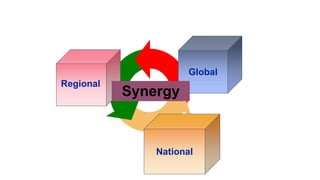
National
Regional
Global
Synergy
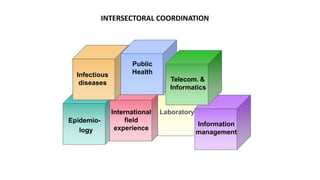
Infectious
diseases
Epidemio-
logy
Public
Health
International
field
experience
Information
management
Laboratory
Telecom. &
Informatics
INTERSECTORAL COORDINATION
Emerging & Re-emerging.pptx

Emerging & Re-emerging.pptx

  • 1.
  • 2.
    PLAN OF PRESENTATION •INTRODUCTION • EPIDEMIOLOGY • EMERGING DISEAESES • REEMERGING DISEASES • PREVENTION AND CONTROL • WAY FORWARD
  • 3.
    INTRODUCTION  Emerging InfectiousDiseases: • Emerging infectious diseases are “New diseases; new problem (New threats)” • An emerging infectious disease is a one that is caused by a newly discovered infectious agent or • by a newly identified pathogen, which has emerged and whose incidence in humans has increased during the last 2 decades and is threatening to increase in the near future.
  • 5.
     Re-emerging InfectiousDiseases: • Re-emerging infectious diseases are “old diseases, new problem. (New threats)”. • A re-emerging infectious disease is a one which was previously controlled but once again has risen to be a significant health problem. • This term also refers to that disease which was formerly confined to one geographic area, has now spread to other areas.
  • 7.
  • 8.
    Is our Worldin Transition ? • Avian Influenza • Ebola • Marburg • Cholera • Rift Valley Fever • E.coli 0157:H7 • BSE • Nipah virus • Hantaan virus • SARS • Swine flu • JE • H7N9 • KFD • Scrub typhus • CCHF • Guinea worm • Smallpox (Eradicated) • Yaws • Poliomyelitis • Measles • Leprosy • Neonatal tetanus This listing is not meant to be exhaustive… “there is no way to keep the lid on the Pandora’s box. . What you can’t predict is what’s going to come out…but you can predict is that something will ”
  • 9.
    Factors contributing tothe emergence of infectious diseases: 1. Human demographics and behaviour 2. Technology and industry 3. Economic development and land use 4. International travel and commerce 5. Microbial adaptation and change 6. Breakdown of public health measures 7. Human susceptibility to infection 8. Climate and weather 9. Changing ecosystems 10. Poverty and social inequality 11. War and famine 12. Lack of political will 13. Intent to harm
  • 10.
    Factors contributing tothe emergence  AGENT: • Evolution of pathogenic infectious agents (microbial adaptation & change) • Development of resistance to drugs: Wrong prescribing practices Non-adherence by patients Counterfeit drugs Use of anti-infective drugs in animals & plants • Resistance of vectors to pesticides
  • 11.
    HOST: • Human demographicchange (inhabiting new areas) • Human behaviour: 1. Unsafe sexual practices (HIV, Gonorrhoea, Syphilis) 2. Changes in agricultural & food production patterns- food- borne infectious agents (E. coli) 3. Increased international travel (Influenza) • Human susceptibility to infection (Immunosuppression) • Poverty & social inequality
  • 12.
    ENVIRONMENT: • Climate &changing ecosystems: Deforestation forces animals into closer human contact- increased possibility for agents to breach species barrier between animals & humans EL Nino- Triggers natural disasters & related outbreaks of infectious diseases (Malaria, Cholera) Global warming- spread of Malaria, Dengue, Leishmaniasis, Filariasis • Economic development & Land use (urbanization, deforestation) • Technology & industry (food processing & handling) • International travel & commerce • Deterioration in surveillance systems (lack of political will)
  • 14.
    • Breakdown ofpublic health measure (war, unrest, overcrowding): Poor populations- major reservoir & source of continued transmission Poverty- Malnutrition- Severe infectious disease cycle Lack of funding, Poor prioritization of health funds, Misplaced in curative rather than preventive infrastructure, failure to develop adequate health delivery systems • Uncontrolled Urbanization & Population Displacement: Growth of densely populated cities- substandard housing, unsafe water, poor sanitation, overcrowding, indoor air pollution (>10% preventable ill health) Problem of refugees & displaced persons Diarrhoeal & Intestinal parasitic diseases,ARI 8
  • 15.
    Examples: Source: NATURE; Vol430; www.nature.com/nature 9
  • 16.
    • 1993: Hantaviruspulmonary syndrome (United States) • 1994: Plague (India) • 1995: Ebola fever (Democratic Republic of Congo) • 1996: New variant Creutzfeldt-Jakob disease (United Kingdom) • 1997: H5N1 influenza (Hong Kong); • 1998: Nipah virus encephalitis (Malaysia, Singapore) • 1999: West Nile virus encephalitis (Russia, United States) • 2000: Rift Valley fever (Kenya, SaudiArabia, Yemen); Ebola fever(Uganda) • 2001:Anthrax (United States); foot-and-mouth disease(United Kingdom) • 2002: Vancomycin-resistant Staphylococcus aureus (United States) • 2003: Severe acute respiratory syndrome (SARS) (multiple countries); monkeypox (USA) • 2004: H5N1 influenza (SoutheastAsia) • 2015: Zika outbreak • 2020: SARS-CoV-2 Examples of Emerging Infectious Diseases
  • 17.
    • Hepatitis C-First identified in 1989 In mid 1990s estimated global prevalence 3% • Hepatitis B- Identified several decades earlier Upward trend in all countries Prevalence >90% in high-risk population • Zoonoses-1,415 microbes are infectious for human Of these, 868 (61%) considered zoonotic 70% of newly recognized pathogens are zoonoses Emerging Influenza infections in Humans associated with Chickens, Pigs
  • 18.
    Emerging Zoonoses: Human-animalinterface Marburg virus Hantavirus Pulmonary Syndrome Ebola virus Borrelia burgdorferi (Lyme disease) Deer tick (Ixodes scapularis) Mostomys rodent: Lassa fever Avian influenza virus Bats: Nipah virus
  • 19.
    Timeline of significantemerging zoonoses outbreaks over the past 30 years six major zoonotic outbreaks occurring between 1997 and 2006 estimated economic burden of 80 billion US dollars.
  • 20.
    What is drivingthe emergence of zoonotic diseases? Interaction between intensificatio n of livestock production, zoonoses & antimicrobial resistance
  • 21.
    SARS Cases 19 Februaryto 5 July 2003 China (5326) Singapore (206) Hong Kong (1755) Viet Nam (63) Europe: 10 countries (38) Thailand (9) Brazil (3) Canada (243) USA (72) Colombia (1) Kuwait (1) South Africa (1) India (3) Australia (5) New Zealand (1) Korea Rep. (3) Macao (1) Taiwan (698) Malaysia (5) Indonesia (2) Philippines (14) Mongolia (9) Russian Fed. (1) Total: 8,439 cases, 812 deaths, 30 countries in 7-8 months Source: www.who.int.csr/sars SARS The First Emerging Infectious Disease Of The 21st Century No infectious disease has spread so fast and far as SARS did in 2003 13
  • 22.
    Lesson learnt fromSARS • An infectious disease in one country is a threat to all • Important role of air travel in international spread • Tremendous negative economic impact on trade, travel and tourism, estimated loss of $ 30 to $150 billion • High level commitment is crucial for rapid containment • WHO can play a critical role in catalyzing international cooperation and support • Global partnerships & rapid sharing of data/information enhances preparedness and response
  • 23.
    Swine Flu (H1N1) •Swine flu causes respiratory disease – high level of illness, low death rates • Causative agent- InfluenzaA- RNAviruses of the family Orthomyxoviridae • RNAvirus- highly mutagenic • Pigs can get infected by human, avian and swine influenza virus • Pandemic outbreak sinceApril 2009 • April 15th 2009 CDC identifies H1N1 (swine flu) • April 25th 2009 WHO declares public health emergency • By May 5th 2009 more than 1000 cases confirmed in 21 countries • May 16th 2009India reports first confirmed case • Cases of swine flu have been reported in India, with over 31,156 positive test cases and 1,841 deaths up to March 2015
  • 26.
    Highly Pathogenic AvianInfluenza (H5N1) • Since Nov 2003, avian influenza H5N1 in birds affected 60 countries across Asia, Europe, Middle-East &Africa • >220 million birds killed by this virus or culled to prevent further spread • Majority of human H5N1 infection due to direct contact with birds infected with virus
  • 28.
    EMERGING FOOD BORNE& WATER BORNE DISEASE • Accounts for 20 million cases in the world annually (T.D. Chugh-2008) • Incidence is increasing • Half of all known food borne pathogens discovered during the past 25 years • Most common associated organisms are: Entero hemorrhagic Escherichia coli, Vibrio cholerae, Campylobacter sp.
  • 29.
    EBOLA • Ebola wasfirst discovered in 1976 near the Ebola River. Since then, outbreaks have appeared sporadically inAfrica. • Ebola Hemorrhagic Fever Outbreak: • 2000-2001: Uganda • 2002-2003: Gabon and Democratic Republic of the Congo (DRC) • 2004: South Sudan • 2007: DRC, Uganda. • 2011-2012: Uganda, DRC • 2014-2016: WestAfrica
  • 30.
    ZIKA • Zika viruswas first discovered in a monkey in the Zika Forest of Uganda in 1947. • In 1952, the first human cases of Zika were detected and since then, outbreaks of Zika have been reported in tropicalAfrica, SoutheastAsia, and the Pacific Islands. • Before 2007, at least 14 human cases of Zika had been documented, although other cases were likely to have occurred and were not reported. • The first travel notice for Zika in Brazil was posted in June 2015. • On January 22, 2016, CDC activated its Emergency Operations Center (EOC) to respond to outbreaks of Zika occurring in theAmericas and increased reports of birth defects and Guillain-Barré syndrome in areas affected by Zika.
  • 31.
    ZIKA • Since 2015,69 countries and territories reported evidence of vector-borne Zika virus transmission. • Brazil is by far the most affected country, reporting the most cases of people infected with the Zika virus. • Transmitted through bite of Aedes mosquito (Aedes aegyptii and Aedes albopictus) and they bite during both day and night. • Can be transmitted during pregnancy leading to birth defects. • As of 2nd Aug 2021, 65 cases of Zika virus reported in Kerala.
  • 34.
    Malaysian Nipah virusepidemic 1998-1999 • An outbreak of Nipah virus in Malaysia and Singapore • Nipah virus belongs to family Paramyxoviridae • Virus aerosolisation caused infection of pigs • Overcrowding results in viral transmission to pig handlers • The virus persists in low numbers in the island flying fox (Pteropus hypomelanus), a type of fruit bat and Malayan flying fox (Pteropus vampyrus) • Of the 269 human cases of viral encephalitis associated with Nipah virus infection reported in Malaysia in 1999, 108 were fatal (Ministry of Health Malaysia, 2001).
  • 35.
    • The Nipahoutbreak was reported in Kozhikode and Malappuram districts of Kerala in May 2018. • Third of Nipah Virus Outbreaks in India. • The earlier being in 2001 and 2007, both in West Bengal. • A total of 23 cases were identified, including the index case with 18 laboratory- confirmed cases.
  • 36.
    Examples of Re-EmergingInfectious Diseases • Diphtheria- Early 1990s epidemic in Eastern Europe(1980- 1% cases; 1994- 90% cases) • Cholera- 100% increase worldwide in 1998 (new strain eltor, 0139) • Human Plague- India (1994) after 15-30 years absence. • Dengue/ DHF- Over past 40 years, 20-fold increase to nearly 0.5 million (between 1990-98) Tuberculosis
  • 37.
    Disease Year State Plague1994 Gujrat 2002 H.P. 2004 Uttranchal Leptospirosis 1988-2004 Andaman & Nicobar 1994-2004 Gujrat 1984-1986 Tamil Nadu 1999-2003 Kerala 2000-2002 Maharastra Anthrax 1999 Karnataka 2000 WB 2001 Karnataka 2003 Orissa
  • 38.
    Dengue/DHF 1996 Delhi 2003Delhi & Kerala 2004 Kerala, Sikkim Scrub typhus 2003 H.P 2004 Darjeeling, Sikkim JE Yearly U.P ,A.P ,Haryana Unknown acute viral 2001 Siliguri encephalitis 2002 Saharanpur,A.P 2003 Karnal, Maharastra
  • 39.
    Antibiotic resistance • Emergein environment due to inappropriate use of antibiotic • WHO estimates that 10 million people are dying of infectious diseases related to antibiotic resistance. • Proper antibiotic guidelines needed to prevent the drug resistance.
  • 40.
    Multi-resistant pathogens Staphylococcus aureusis the most frequently identified drug-resistant pathogen. Singhal et al (2007)reported ciprofloxacin-resistant meningococci in an outbreak in Delhi. Resistance of Salmonella typhi and S. paratyphi to chloramphenicol, ampicillin and cotrimoxazole is widespread. AMR in Shigella: resistance to azithromycin, ceftriaxone and ciprofloxacin on the increase Methicillin/oxacillin-resistant Staphylococcus aureus (MRSA)
  • 41.
    Vancomycin-resistant enterococci (VRE); Extended-spectrumbeta-lactamases (which are resistant to cephalosporins & monobactams) (ESBLs); Penicillin-resistant Streptococcus pneumoniae (PRSP); Multi-drug resistant tuberculosis (MDR-TB); CRKP- Carbapenem Resistant Klebsiella Pneumoniae S. typhimurium - DT104 (resistant to five antibiotics: ampicillin, chloramphenicol, streptomycin, sufonamides and tetracycline)
  • 42.
    Bioterrorism • Possible deliberaterelease of infectious agents by dissident individuals or terrorist groups • Biological agents are attractive instruments of terror- easy to produce, mass casualties, difficult to detect, widespread panic & civil disruption • Highest potential- B. anthracis, C. botulinum toxin, Y . pestis, Variola virus, Viral haemorrhagic fever viruses • Likeliest route- aerosol dissemination
  • 43.
  • 44.
    Strategies to ControlEmerging and Re-emerging Diseases • Controlling the reservoir • Interrupting the transmission • Protecting the susceptible host • Strengthening of the disease surveillance system • Encouraging research initiations for treatment regimens and diagnostics • Encouraging research for new methods of control measures • Establishment of drug resistance
  • 45.
    Role of Doctorsin Prevention Increase knowledge and skill ; Educate the public Encourage partnerships with consumers and other disciplines to identify needs, set priorities, develop strategies and evaluate progress Support health care legislation Involve in research Encourage using multidisciplinary efforts. Influence local and National economic and political options Continue to advance nursing concern
  • 46.
    Role of PublicHealth Authorities National programme for prevention and control of vector borne diseases Legislations for elimination Communities awareness of the disease Minimizing transmission of infection: By • Risk communication to the family members • Minimizing vector population • Minimizing vector – individual contact Reporting to the nearest public health authority
  • 47.
    Public health measuresto prevent infectious diseases Safe water Sewage treatment and disposal Food safety programme Animal control programme Vaccination programme Public health organization
  • 48.
    Response of theWHO • Developing global and regional strategies • Appointing Task Force • Generous grant from WHO regular budget • Support the World Bank grant • GOARN (Global OutbreakAlert & Response Network) • Mechanism for combating international disease outbreaks • Ensure rapid deployment of technical assistance, contribute to long-term epidemic preparedness & capacity building
  • 49.
    VECTOR SURVEILLANCE o Vectorborne epidemic prone diseases: JE, Dengue, Plague, KalaAzar, Rickettsial o Early warning signals - increase density of vectors - increase in breeding sites for vectors Insecticide susceptibility status o To assess impact of routine measures under national programme PREVENTIVE STRATEGY IN INDIA
  • 50.
    LAB SURVEILLANCE Serological Surveillance Tocollect baseline prevalence data To identify high risk areas To identify high risk age group As early warning signal for impending outbreak Microbial surveillance Changing genotype Mutations Development ofAntimicrobial Resistance Eg. Salmonella, Cholera, Plague,Anthrax
  • 51.
     International (CollaboratingCentres) like CDCAtlanta  National Reference Laboratories e.g. NICD Delhi, NIV Pune, NICED Kolkata  State laboratories  Intermediate (District/Provincial/Medical College)  Peripheral (PHC/CHC) State Laboratories National Laboratories District Laboratories Peripheral Laboratories 40 Laboratories network in surveillance
  • 52.
    Peripheral laboratories District laboratories Disease Surveillance unit Disease Surveillanceunit Disease Surveillance unit National laboratory State laboratories Disease Surveillance unit ACTION
  • 53.
    Peripheral Laboratories: Functions •Collection of specimen • Preliminary Processing Storage and transport • Reporting of results • Undertaking simple tests • Microscopy for malaria, TB, meningitis, dysentery/Cholera • Rapid Tests (Typhi Dot for enteric fever, Latex test for HBsAg • Water Quality Monitoring by rapid H2S Test
  • 54.
    District Laboratories: Functions •Microscopy for diphtheria, kala azar, Cholera • Bacterial Cultures for enteropathogens, Enteric fever • Antimicrobial Susceptibility testing • Serological tests: Widal test, Latex test for meningitis in CSF, ELISAbased test • Bacteriological examination of water (rapid H2S, coliform count) • Coordinate with state/ national laboratory and disease surveillance units
  • 55.
    State Laboratories: Functions •All that is done at district lab+ Specialized microscopy like dark ground, fluorescent microscopy • Culture of all common bacteria including mycobacteria and their identification (& serotype, wherever applicable) • Antimicrobial susceptibility testing of common bacteria including mycobacteria • Serology for viral hepatitis markers, dengue, JE, measles, leptospirosis etc. • ?Viral cultures • QualityAssurance (IQC & EQAS)
  • 56.
    National Laboratories: Functions •Specialized tests eg for Plague,Anthrax and other possible agents of bioterrorism • High Containment laboratory (P3/ BSL--3) • Assist in outbreak investigation • Confirm new isolates • All types of Lab based epidemiological markers • Training/Preparation of Teaching Material and reagents/antisera etc • Organize external quality assessment schemes • Collation of national data
  • 57.
     Recommended laboratorytesting in emerging infections • Molecular testing- PCR- highly sensitive and specific • Rapid test – for flu- need to confirm with PCR • Dengue-NS1 antigen (indicated for case < 5 days) • Antimicrobial resistance-susceptibility testing , gene detection by PCR
  • 58.
    WAY FORWARD • Strengtheningof Surveillance at national (IDSP), regional, global level • epidemiological, • laboratory • ecological • anthropological • Investigation and early control measures • Implement prevention measures • behavioural, political, environmental • Monitoring, evaluation
  • 59.
    Factors affecting emerging infections Solution MigrationProper health screening, vaccination Travel Immunization, infection control measure Urbanization Proper sanitation, adequate housing, good infrastructure Human behaviour Education, behaviour modification Antibiotic usage Judicious use of antibiotic Correct antibiotic for correct pathogen (with right dosage and route). Strengthen infection control measures 51
  • 60.
  • 61.