Strengthening Local 
Climate Change Adaptation 
and DRR Strategies 
in West Africa 
Implementing Ecosystem-Based DRR 
Jean-Marc Garreau 
IUCN - West and Central Africa Programme
© 
An old reality in the Sahel 
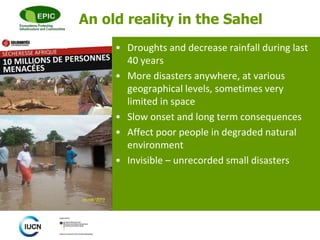
• Droughts and decrease rainfall during last 
40 years 
• More disasters anywhere, at various 
geographical levels, sometimes very 
limited in space 
• Slow onset and long term consequences 
• Affect poor people in degraded natural 
environment 
• Invisible – unrecorded small disasters
© 
Two Sahelian sites 
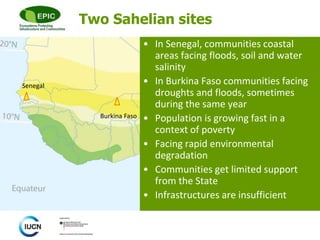
• In Senegal, communities coastal 
areas facing floods, soil and water 
salinity 
• In Burkina Faso communities facing 
droughts and floods, sometimes 
during the same year 
• Population is growing fast in a 
context of poverty 
• Facing rapid environmental 
degradation 
• Communities get limited support 
from the State 
• Infrastructures are insufficient 
Senegal 
Burkina Faso
© 
Plan the change with disasters and 
climate change 
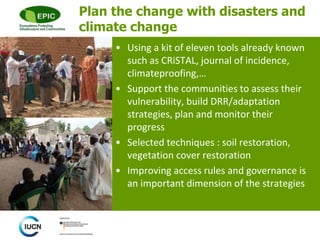
• Using a kit of eleven tools already known 
such as CRiSTAL, journal of incidence, 
climateproofing,… 
• Support the communities to assess their 
vulnerability, build DRR/adaptation 
strategies, plan and monitor their 
progress 
• Selected techniques : soil restoration, 
vegetation cover restoration 
• Improving access rules and governance is 
an important dimension of the strategies
© 
Adapted response 
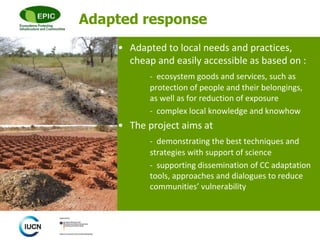
• Adapted to local needs and practices, 
cheap and easily accessible as based on : 
- ecosystem goods and services, such as 
protection of people and their belongings, 
as well as for reduction of exposure 
- complex local knowledge and knowhow 
• The project aims at 
- demonstrating the best techniques and 
strategies with support of science 
- supporting dissemination of CC adaptation 
tools, approaches and dialogues to reduce 
communities’ vulnerability
© 
Factors ensuring success 
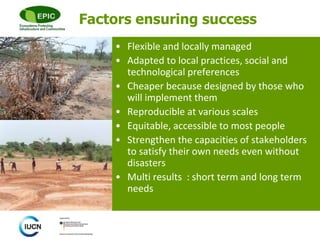
• Flexible and locally managed 
• Adapted to local practices, social and 
technological preferences 
• Cheaper because designed by those who 
will implement them 
• Reproducible at various scales 
• Equitable, accessible to most people 
• Strengthen the capacities of stakeholders 
to satisfy their own needs even without 
disasters 
• Multi results : short term and long term 
needs
© 
Involving key stakeholders 
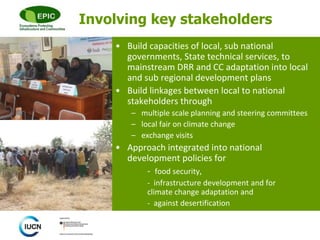
• Build capacities of local, sub national 
governments, State technical services, to 
mainstream DRR and CC adaptation into local 
and sub regional development plans 
• Build linkages between local to national 
stakeholders through 
– multiple scale planning and steering committees 
– local fair on climate change 
– exchange visits 
• Approach integrated into national 
development policies for 
- food security, 
- infrastructure development and for 
climate change adaptation and 
- against desertification
© 
Challenges 
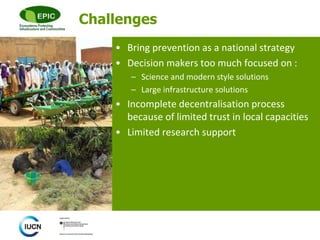
• Bring prevention as a national strategy 
• Decision makers too much focused on : 
– Science and modern style solutions 
– Large infrastructure solutions 
• Incomplete decentralisation process 
because of limited trust in local capacities 
• Limited research support
© 
Added value for the Post 2015 Framework 
for Disaster Risk Reduction 
• How did your work support the 
implementation of the Hyogo Framework for 
Action: 
– Reducing vulnerability of rural communities 
• From your perspective what are the main 
gaps, needs and further steps to be addressed 
in the Post 2015 Framework for Disaster Risk 
Reduction in 
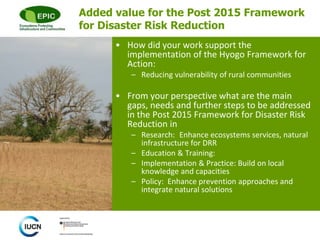
– Research: Enhance ecosystems services, natural 
infrastructure for DRR 
– Education & Training: 
– Implementation & Practice: Build on local 
knowledge and capacities 
– Policy: Enhance prevention approaches and 
integrate natural solutions
© 
Main text + picture 
Subtitle 
Thank you 
http://iucn.paco

West Africa regional

  • 1.
    Strengthening Local ClimateChange Adaptation and DRR Strategies in West Africa Implementing Ecosystem-Based DRR Jean-Marc Garreau IUCN - West and Central Africa Programme
  • 2.
    © An oldreality in the Sahel • Droughts and decrease rainfall during last 40 years • More disasters anywhere, at various geographical levels, sometimes very limited in space • Slow onset and long term consequences • Affect poor people in degraded natural environment • Invisible – unrecorded small disasters
  • 3.
    © Two Saheliansites • In Senegal, communities coastal areas facing floods, soil and water salinity • In Burkina Faso communities facing droughts and floods, sometimes during the same year • Population is growing fast in a context of poverty • Facing rapid environmental degradation • Communities get limited support from the State • Infrastructures are insufficient Senegal Burkina Faso
  • 4.
    © Plan thechange with disasters and climate change • Using a kit of eleven tools already known such as CRiSTAL, journal of incidence, climateproofing,… • Support the communities to assess their vulnerability, build DRR/adaptation strategies, plan and monitor their progress • Selected techniques : soil restoration, vegetation cover restoration • Improving access rules and governance is an important dimension of the strategies
  • 5.
    © Adapted response • Adapted to local needs and practices, cheap and easily accessible as based on : - ecosystem goods and services, such as protection of people and their belongings, as well as for reduction of exposure - complex local knowledge and knowhow • The project aims at - demonstrating the best techniques and strategies with support of science - supporting dissemination of CC adaptation tools, approaches and dialogues to reduce communities’ vulnerability
  • 6.
    © Factors ensuringsuccess • Flexible and locally managed • Adapted to local practices, social and technological preferences • Cheaper because designed by those who will implement them • Reproducible at various scales • Equitable, accessible to most people • Strengthen the capacities of stakeholders to satisfy their own needs even without disasters • Multi results : short term and long term needs
  • 7.
    © Involving keystakeholders • Build capacities of local, sub national governments, State technical services, to mainstream DRR and CC adaptation into local and sub regional development plans • Build linkages between local to national stakeholders through – multiple scale planning and steering committees – local fair on climate change – exchange visits • Approach integrated into national development policies for - food security, - infrastructure development and for climate change adaptation and - against desertification
  • 8.
    © Challenges •Bring prevention as a national strategy • Decision makers too much focused on : – Science and modern style solutions – Large infrastructure solutions • Incomplete decentralisation process because of limited trust in local capacities • Limited research support
  • 9.
    © Added valuefor the Post 2015 Framework for Disaster Risk Reduction • How did your work support the implementation of the Hyogo Framework for Action: – Reducing vulnerability of rural communities • From your perspective what are the main gaps, needs and further steps to be addressed in the Post 2015 Framework for Disaster Risk Reduction in – Research: Enhance ecosystems services, natural infrastructure for DRR – Education & Training: – Implementation & Practice: Build on local knowledge and capacities – Policy: Enhance prevention approaches and integrate natural solutions
  • 10.
    © Main text+ picture Subtitle Thank you http://iucn.paco

Editor's Notes

  • #2 Title / subtitle can be changed
  • #6 - ecosystem capacities to deliver goods and services, such as protection of people and their belongings, as well as for reduction of exposure
  • #7 Cheaper because designed by those who will implement them with local natural resources MULTI RESULTS as they respond to short term needs such as food and energy, as well to longer term issues such as risk reduction and climate change adaptation Good approaches to poverty reduction