IDEAS OF CHANGE Essential Questions: How did the Enlightenment in Europe impact the English colonies? How did/would Enlightenment philosophers and political scientists impact the development of the revolutionary ideas?
WIND OF CHANGE During the 1700s ideas of change began to circulate in the colonies Ideas that challenged the old view the world Partly brought on by the effects of the falsity of the Salem witch trials Benjamin Franklin was an outstanding enlightenment figure Embraced the idea of truth through experimentation and reason
THE ENLIGHTENMENT The Enlightenment Period in Europe during which   philosophers, scientists, and political scientists felt reason and logic could be applied to all forms of human activity Society Government Enlightenment ideas spread in New England Puritans supported public education in their colonies Higher literacy rates
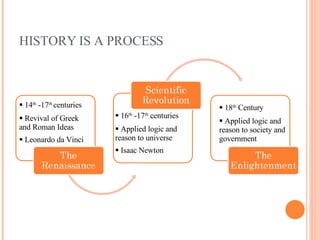
HISTORY IS A PROCESS 14 th  -17 th  centuries Revival of Greek and Roman Ideas Leonardo da Vinci 16 th  -17 th  centuries Applied logic and reason to universe Isaac Newton 18 th  Century Applied logic and reason to society and government
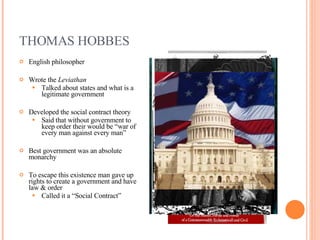
THOMAS HOBBES English philosopher Wrote the  Leviathan Talked about states and what is a legitimate government Developed the social contract theory Said that without government to keep order their would be “war of every man against every man” Best government was an absolute monarchy To escape this existence man gave up rights to create a government and have law & order Called it a “Social Contract”
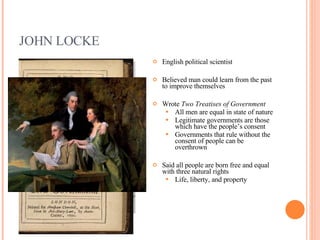
JOHN LOCKE English political scientist Believed man could learn from the past to improve themselves Wrote  Two Treatises of Government All men are equal in state of nature Legitimate governments are those which have the people’s consent Governments that rule without the consent of people can be overthrown Said all people are born free and equal with three natural rights Life, liberty, and property
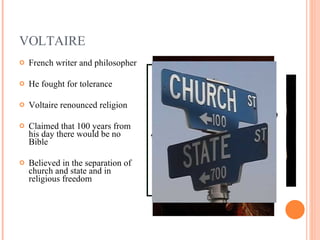
VOLTAIRE French writer and philosopher He fought for tolerance Voltaire renounced religion Claimed that 100 years from his day there would be no Bible Believed in the separation of church and state and in religious freedom
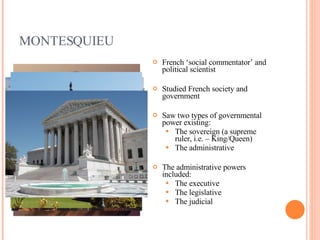
MONTESQUIEU French ‘social commentator’ and political scientist Studied French society and government Saw two types of governmental power existing: The sovereign (a supreme ruler, i.e. – King/Queen) The administrative The administrative powers included: The executive The legislative The judicial
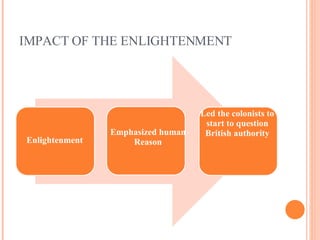
IMPACT OF THE ENLIGHTENMENT Enlightenment Emphasized human Reason Led the colonists to start to question British authority

Ideas Of Change

  • 1.
    IDEAS OF CHANGEEssential Questions: How did the Enlightenment in Europe impact the English colonies? How did/would Enlightenment philosophers and political scientists impact the development of the revolutionary ideas?
  • 2.
    WIND OF CHANGEDuring the 1700s ideas of change began to circulate in the colonies Ideas that challenged the old view the world Partly brought on by the effects of the falsity of the Salem witch trials Benjamin Franklin was an outstanding enlightenment figure Embraced the idea of truth through experimentation and reason
  • 3.
    THE ENLIGHTENMENT TheEnlightenment Period in Europe during which philosophers, scientists, and political scientists felt reason and logic could be applied to all forms of human activity Society Government Enlightenment ideas spread in New England Puritans supported public education in their colonies Higher literacy rates
  • 4.
    HISTORY IS APROCESS 14 th -17 th centuries Revival of Greek and Roman Ideas Leonardo da Vinci 16 th -17 th centuries Applied logic and reason to universe Isaac Newton 18 th Century Applied logic and reason to society and government
  • 5.
    THOMAS HOBBES Englishphilosopher Wrote the Leviathan Talked about states and what is a legitimate government Developed the social contract theory Said that without government to keep order their would be “war of every man against every man” Best government was an absolute monarchy To escape this existence man gave up rights to create a government and have law & order Called it a “Social Contract”
  • 6.
    JOHN LOCKE Englishpolitical scientist Believed man could learn from the past to improve themselves Wrote Two Treatises of Government All men are equal in state of nature Legitimate governments are those which have the people’s consent Governments that rule without the consent of people can be overthrown Said all people are born free and equal with three natural rights Life, liberty, and property
  • 7.
    VOLTAIRE French writerand philosopher He fought for tolerance Voltaire renounced religion Claimed that 100 years from his day there would be no Bible Believed in the separation of church and state and in religious freedom
  • 8.
    MONTESQUIEU French ‘socialcommentator’ and political scientist Studied French society and government Saw two types of governmental power existing: The sovereign (a supreme ruler, i.e. – King/Queen) The administrative The administrative powers included: The executive The legislative The judicial
  • 9.
    IMPACT OF THEENLIGHTENMENT Enlightenment Emphasized human Reason Led the colonists to start to question British authority