The EnlightenmentModern European History and World History: Patterns of Interaction
The Important Timeline of the Enlightenment1690 John Locke publishes the Essay Concerning Human Understanding and The Second Treatise of Government1748 Montesquieu publishes The Spirit of the Laws1751-1772 28 volumes of the Encyclopedia are published1759 Voltaire publishes Candide1762 Rousseau published Emile and the Social Contract
The Important Timeline of the Enlightenment1764- CesareBeccaria publishes the Essay on Crimes and Punishments.1776- Adam Smith publishes the Wealth of Nations1795 Condorcet’s Progress of the Human Mind is published
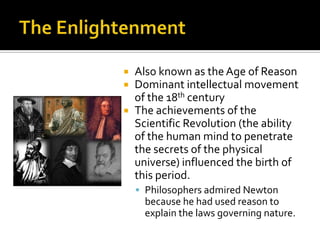
The EnlightenmentAlso known as the Age of ReasonDominant intellectual movement of the 18th centuryThe achievements of the Scientific Revolution (the ability of the human mind to penetrate the secrets of the physical universe) influenced the birth of this period.Philosophers admired Newton because he had used reason to explain the laws governing nature.
Scientific Rev and EnlightenmentThe difference between Scientific Revolution movers and the Enlightenment thinkers:The former used their intellectual powers to discover the natural laws that governed the operation of the physical universe. (Newton’s 3 laws of motion, Rene Descarte’scogito, ergo sum and Discourse Method 1637.The latter sought through reasoning to discover the natural laws that governed the affairs of human beings and human society.
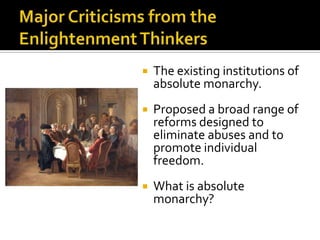
Major Criticisms from the Enlightenment ThinkersThe existing institutions of absolute monarchy.Proposed a broad range of reforms designed to eliminate abuses and to promote individual freedom.What is absolute monarchy?
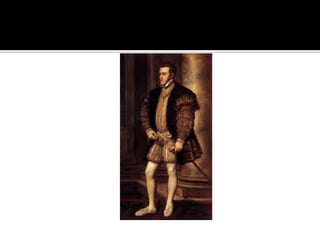
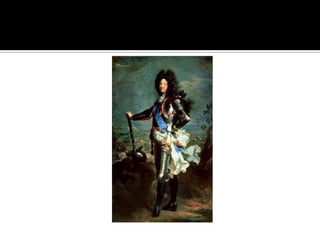
Absolute MonarchyAbsolute monarchs believed that all power within their state rested in their hands.GOAL: To control every aspect of society.Absolute monarchs believed in the “divine right”Monarchy was created by God and that the head of the monarchy acted as God’s representative on earth.Philip II and Louis XIV
AssignmentGive me 5 examples of clothing that were used to convey or express power/authority.½ crosswise
Two Views on GovernmentThomas Hobbes’s Social Contract and John Locke’s Natural RightsBoth Hobbes and Locke experienced political turmoil of England early in the 1600s. Tell me if their conclusions about government and human nature differ from one another. If so, in what extent?
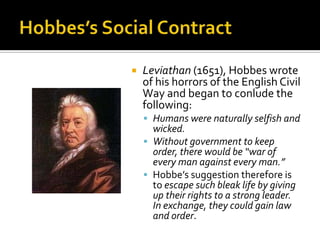
Hobbes’s Social Contract Leviathan (1651), Hobbes wrote of his horrors of the English Civil Way and began to conlude the following:Humans were naturally selfish and wicked.Without government to keep order, there would be “war of every man against every man.”Hobbe’s suggestion therefore is to escape such bleak life by giving up their rights to a strong leader. In exchange, they could gain law and order.
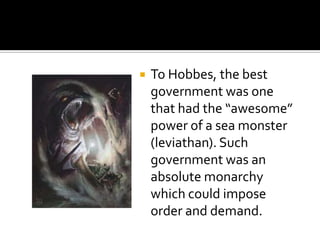
To Hobbes, the best government was one that had the “awesome” power of a sea monster (leviathan). Such government was an absolute monarchy which could impose order and demand.
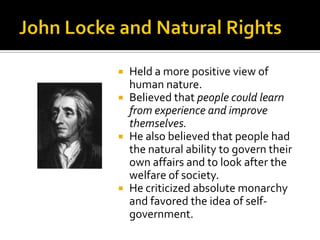
John Locke and Natural RightsHeld a more positive view of human nature.Believed that people could learn from experience and improve themselves.He also believed that people had the natural ability to govern their own affairs and to look after the welfare of society. He criticized absolute monarchy and favored the idea of self-government.
John LockeArgument: All people are born free and equal with three natural rights:LIFELIBERTYPROPERTY
John LockeSees the government to have the main purpose of protecting these rights.OLD IDEA: A monarch’s rule is justified by divine right.NEW IDEA: A government’s power comes from the consent of the people (governed).
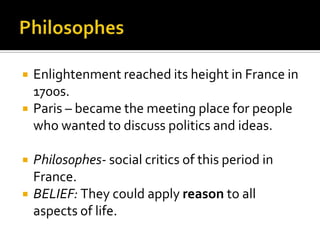
PhilosophesEnlightenment reached its height in France in 1700s.Paris – became the meeting place for people who wanted to discuss politics and ideas.Philosophes- social critics of this period in France.BELIEF: They could apply reason to all aspects of life.
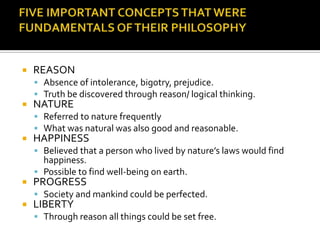
FIVE IMPORTANT CONCEPTS THAT WERE FUNDAMENTALS OF THEIR PHILOSOPHYREASONAbsence of intolerance, bigotry, prejudice.Truth be discovered through reason/ logical thinking.NATUREReferred to nature frequentlyWhat was natural was also good and reasonable.HAPPINESSBelieved that a person who lived by nature’s laws would find happiness.Possible to find well-being on earth.PROGRESSSociety and mankind could be perfected.LIBERTYThrough reason all things could be set free.

The enlightenment

  • 1.
    The EnlightenmentModern EuropeanHistory and World History: Patterns of Interaction
  • 3.
    The Important Timelineof the Enlightenment1690 John Locke publishes the Essay Concerning Human Understanding and The Second Treatise of Government1748 Montesquieu publishes The Spirit of the Laws1751-1772 28 volumes of the Encyclopedia are published1759 Voltaire publishes Candide1762 Rousseau published Emile and the Social Contract
  • 4.
    The Important Timelineof the Enlightenment1764- CesareBeccaria publishes the Essay on Crimes and Punishments.1776- Adam Smith publishes the Wealth of Nations1795 Condorcet’s Progress of the Human Mind is published
  • 5.
    The EnlightenmentAlso knownas the Age of ReasonDominant intellectual movement of the 18th centuryThe achievements of the Scientific Revolution (the ability of the human mind to penetrate the secrets of the physical universe) influenced the birth of this period.Philosophers admired Newton because he had used reason to explain the laws governing nature.
  • 6.
    Scientific Rev andEnlightenmentThe difference between Scientific Revolution movers and the Enlightenment thinkers:The former used their intellectual powers to discover the natural laws that governed the operation of the physical universe. (Newton’s 3 laws of motion, Rene Descarte’scogito, ergo sum and Discourse Method 1637.The latter sought through reasoning to discover the natural laws that governed the affairs of human beings and human society.
  • 7.
    Major Criticisms fromthe Enlightenment ThinkersThe existing institutions of absolute monarchy.Proposed a broad range of reforms designed to eliminate abuses and to promote individual freedom.What is absolute monarchy?
  • 8.
    Absolute MonarchyAbsolute monarchsbelieved that all power within their state rested in their hands.GOAL: To control every aspect of society.Absolute monarchs believed in the “divine right”Monarchy was created by God and that the head of the monarchy acted as God’s representative on earth.Philip II and Louis XIV
  • 11.
    AssignmentGive me 5examples of clothing that were used to convey or express power/authority.½ crosswise
  • 12.
    Two Views onGovernmentThomas Hobbes’s Social Contract and John Locke’s Natural RightsBoth Hobbes and Locke experienced political turmoil of England early in the 1600s. Tell me if their conclusions about government and human nature differ from one another. If so, in what extent?
  • 13.
    Hobbes’s Social ContractLeviathan (1651), Hobbes wrote of his horrors of the English Civil Way and began to conlude the following:Humans were naturally selfish and wicked.Without government to keep order, there would be “war of every man against every man.”Hobbe’s suggestion therefore is to escape such bleak life by giving up their rights to a strong leader. In exchange, they could gain law and order.
  • 14.
    To Hobbes, thebest government was one that had the “awesome” power of a sea monster (leviathan). Such government was an absolute monarchy which could impose order and demand.
  • 15.
    John Locke andNatural RightsHeld a more positive view of human nature.Believed that people could learn from experience and improve themselves.He also believed that people had the natural ability to govern their own affairs and to look after the welfare of society. He criticized absolute monarchy and favored the idea of self-government.
  • 16.
    John LockeArgument: Allpeople are born free and equal with three natural rights:LIFELIBERTYPROPERTY
  • 17.
    John LockeSees thegovernment to have the main purpose of protecting these rights.OLD IDEA: A monarch’s rule is justified by divine right.NEW IDEA: A government’s power comes from the consent of the people (governed).
  • 18.
    PhilosophesEnlightenment reached itsheight in France in 1700s.Paris – became the meeting place for people who wanted to discuss politics and ideas.Philosophes- social critics of this period in France.BELIEF: They could apply reason to all aspects of life.
  • 19.
    FIVE IMPORTANT CONCEPTSTHAT WERE FUNDAMENTALS OF THEIR PHILOSOPHYREASONAbsence of intolerance, bigotry, prejudice.Truth be discovered through reason/ logical thinking.NATUREReferred to nature frequentlyWhat was natural was also good and reasonable.HAPPINESSBelieved that a person who lived by nature’s laws would find happiness.Possible to find well-being on earth.PROGRESSSociety and mankind could be perfected.LIBERTYThrough reason all things could be set free.