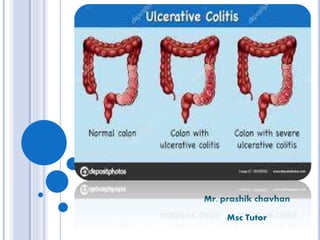
Mr. prashik chavhan
Msc Tutor
DEFINITION
 “ Ulcerative colitis” or “colitis ulcerosa” is an
inflammatory bowel disease (IBD) that causes long-
lasting inflammation and ulcers (sores) in your digestive
tract.”
 It affects the innermost lining of your large intestine
(colon) and rectum. It can be debilitating and can
sometimes lead to life-threatening complications.
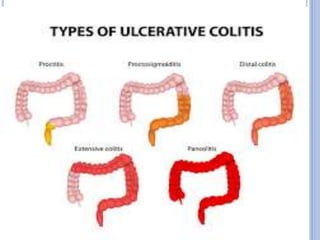
TYPES
1. Ulcerative proctitis
- Inflammation is confined to the area closest to the anus
(rectum), and rectal bleeding may be the only sign of the
disease.
- This form of ulcerative colitis tends to be the mildest.
2. Proctosigmoiditis
- Inflammation involves the rectum and sigmoid colon
(lower end of the colon).
- Signs and symptoms include bloody diarrhea,
abdominal cramps and pain, and an inability to move
the bowels in spite of the urge to do so (tenesmus).
3. Left-sided colitis
- Inflammation extends from the rectum up through
the sigmoid and descending colon.
- Signs and symptoms include bloody diarrhea,
abdominal cramping and pain on the left side, and
unintended weight loss.
4. Pancolitis
Pancolitis often affects the entire colon and causes bouts of
bloody diarrhea that may be severe, abdominal cramps and
pain, fatigue, and significant weight loss.
5. Acute severe ulcerative colitis
This rare form of colitis affects the entire colon and causes
severe pain, profuse diarrhea, bleeding, fever and inability
to eat.
CAUSES
1. Genetic factors
- Aggregation of ulcerative colitis in families.
- Identical twin concordance rate of 10% and dizygotic
twin concordance rate of 3%
2. Environmental factors
Diet:-High intake of unsaturated fat and vitamin B6, Sulfur
restricted diets
3. Autoimmune disease - characterized by T-cells infiltrating
the colon
PATHOPHYSIOLOGY
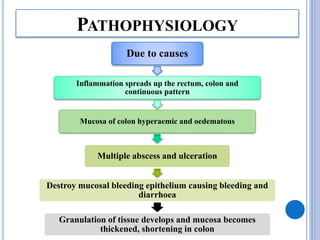
Due to causes
Inflammation spreads up the rectum, colon and
continuous pattern
Mucosa of colon hyperaemic and oedematous
Multiple abscess and ulceration
Destroy mucosal bleeding epithelium causing bleeding and
diarrhoea
Granulation of tissue develops and mucosa becomes
thickened, shortening in colon
CLINICAL MANIFESTATION
 The main symptom of ulcerative colitis is
bloody diarrhea There might be some pus in your stools,
too. Other problems include:-
1. Crampy belly pain
2. Sudden urges to empty colon right away
3. Anorexia
4. Weight loss
5. Feeling tired
6. Fever 7. Dehydration
8. Joint pain or soreness 9. Canker sores
10. Eye pain when look at a bright light
11. Too few red blood cells, called anemia
12. Skin sores
13. Feeling like haven’t completely emptied your colon after
use the bathroom
14. Waking up at night to go
15. Not being able to hold your stools in
DIAGNOSTIC EVALUATION
1. History collection
2. Physical examination
3. Complete blood count
4. Electrolyte studies
5. Renal function tests
6. X-ray
7. Urinalysis
8. Stool culture :- to rule out parasites and infectious causes.
9. Erythrocyte Sedimentation Rate:-
10. C-reactive protein :- can be measured, with an elevated
level being another indication of inflammation.
11. Sigmoidoscopy :- a type of endoscopy which can detect the
presence of ulcers in the large intestine after a trial of an enema.
12. Biopsies of the mucosa
COMPLICATIONS
1. Severe bleeding
2. A hole in the colon (perforated colon)
3. Severe dehydration
4. Liver disease (rare)
5. Bone loss (osteoporosis)
6. Inflammation of skin, joints and eyes
7. An increased risk of colon cancer
8. A rapidly swelling colon (toxic megacolon)
9. Increased risk of blood clots in veins and arteries
MANAGEMENT
Medical management
1. Anti-inflammatory drugs
- Corticosteroids ex. prednisone and budesonide
2. Immune system suppressors (target your immune
system, which produces the substances that cause
inflammation.)
Ex. Azathioprine (Azasan, Imuran) and mercaptopurine
(Purinethol, Purixan)
3. Antibiotics Ex. ciprofloxacin (Cipro) and metronidazole
(Flagyl).
5. Other medications
Anti-diarrheals :- A fiber supplement, such as psyllium
powder (Metamucil) or methylcellulose (Citrucel)
Pain relievers :- acetaminophen (Tylenol,)
Iron supplements
Vitamin B-12 shots
Calcium and vitamin D supplements
SURGICAL MANAGEMENT
1.Proctocolectomy
It means removing your entire colon and rectum
2.Ileal pouch anal anastomosis
This procedure eliminates the need to wear a bag to collect
stool. surgeon constructs a pouch from the end of your small
intestine. The pouch is then attached directly to anus, allowing
to expel waste relatively normally.
LIFESTYLE AND HOME REMEDIES
1. Foods to limit or avoid
- Limit dairy products , Limit fibre, if it's a problem food, Avoid
other problem foods. Spicy foods, alcohol and caffeine
2. Other dietary measures
- Eat small meals, Drink plenty of liquids, Talk to a dietician
3. Stress
Exercise, Biofeedback, Regular relaxation and breathing
exercises
NURSING MANAGEMENT
1. Assessment
2. Maintaining normal elimination patterns
3. Reliving pain
4. Maintaining fluid intake
5. Maintaining optimal nutrition
6. Promoting rest
7. Reducing anxiety
8. Enhancing coping measure
9. Preventing skin breakdown
10. Monitoring and managing potential complications
11. Promoting home and community based care
12.Providing preoperative/ postoperative care
NURSING DIAGNOSIS
1. Diarrhoea R/T the inflammatory process
2. Acute pain R/T increased peristalsis and GI inflammation
3. Deficient fluid volume R/T anorexia, nausea and diarrhoea
4. Imbalance nutrition pattern less than body requirements
R/T dietary restrictions, nausea and malabsorptions
5. Activity intolerance R/T generalized weakness
1. BRUNNER & SUDDARTH’S – Textbook of Medical
Surgical Nursing ; Volume 2 ; 13 th edition ; page No.
1083-1086
2. BT BASAVATHAPPA - Textbook of Medical Surgical
Nursing ; page No.
3. www.wikipedia.com/ myoclinic. Com
IBD=Ulcerative colitis.pptx

IBD=Ulcerative colitis.pptx

  • 1.
  • 2.
    DEFINITION  “ Ulcerativecolitis” or “colitis ulcerosa” is an inflammatory bowel disease (IBD) that causes long- lasting inflammation and ulcers (sores) in your digestive tract.”  It affects the innermost lining of your large intestine (colon) and rectum. It can be debilitating and can sometimes lead to life-threatening complications.
  • 3.
    TYPES 1. Ulcerative proctitis -Inflammation is confined to the area closest to the anus (rectum), and rectal bleeding may be the only sign of the disease. - This form of ulcerative colitis tends to be the mildest.
  • 4.
    2. Proctosigmoiditis - Inflammationinvolves the rectum and sigmoid colon (lower end of the colon). - Signs and symptoms include bloody diarrhea, abdominal cramps and pain, and an inability to move the bowels in spite of the urge to do so (tenesmus).
  • 5.
    3. Left-sided colitis -Inflammation extends from the rectum up through the sigmoid and descending colon. - Signs and symptoms include bloody diarrhea, abdominal cramping and pain on the left side, and unintended weight loss.
  • 6.
    4. Pancolitis Pancolitis oftenaffects the entire colon and causes bouts of bloody diarrhea that may be severe, abdominal cramps and pain, fatigue, and significant weight loss. 5. Acute severe ulcerative colitis This rare form of colitis affects the entire colon and causes severe pain, profuse diarrhea, bleeding, fever and inability to eat.
  • 8.
    CAUSES 1. Genetic factors -Aggregation of ulcerative colitis in families. - Identical twin concordance rate of 10% and dizygotic twin concordance rate of 3% 2. Environmental factors Diet:-High intake of unsaturated fat and vitamin B6, Sulfur restricted diets 3. Autoimmune disease - characterized by T-cells infiltrating the colon
  • 9.
    PATHOPHYSIOLOGY Due to causes Inflammationspreads up the rectum, colon and continuous pattern Mucosa of colon hyperaemic and oedematous Multiple abscess and ulceration Destroy mucosal bleeding epithelium causing bleeding and diarrhoea Granulation of tissue develops and mucosa becomes thickened, shortening in colon
  • 10.
    CLINICAL MANIFESTATION  Themain symptom of ulcerative colitis is bloody diarrhea There might be some pus in your stools, too. Other problems include:- 1. Crampy belly pain 2. Sudden urges to empty colon right away 3. Anorexia 4. Weight loss 5. Feeling tired
  • 11.
    6. Fever 7.Dehydration 8. Joint pain or soreness 9. Canker sores 10. Eye pain when look at a bright light 11. Too few red blood cells, called anemia 12. Skin sores 13. Feeling like haven’t completely emptied your colon after use the bathroom 14. Waking up at night to go 15. Not being able to hold your stools in
  • 12.
    DIAGNOSTIC EVALUATION 1. Historycollection 2. Physical examination 3. Complete blood count 4. Electrolyte studies 5. Renal function tests 6. X-ray 7. Urinalysis
  • 13.
    8. Stool culture:- to rule out parasites and infectious causes. 9. Erythrocyte Sedimentation Rate:- 10. C-reactive protein :- can be measured, with an elevated level being another indication of inflammation. 11. Sigmoidoscopy :- a type of endoscopy which can detect the presence of ulcers in the large intestine after a trial of an enema. 12. Biopsies of the mucosa
  • 14.
    COMPLICATIONS 1. Severe bleeding 2.A hole in the colon (perforated colon) 3. Severe dehydration 4. Liver disease (rare) 5. Bone loss (osteoporosis) 6. Inflammation of skin, joints and eyes 7. An increased risk of colon cancer 8. A rapidly swelling colon (toxic megacolon) 9. Increased risk of blood clots in veins and arteries
  • 15.
    MANAGEMENT Medical management 1. Anti-inflammatorydrugs - Corticosteroids ex. prednisone and budesonide 2. Immune system suppressors (target your immune system, which produces the substances that cause inflammation.) Ex. Azathioprine (Azasan, Imuran) and mercaptopurine (Purinethol, Purixan)
  • 16.
    3. Antibiotics Ex.ciprofloxacin (Cipro) and metronidazole (Flagyl). 5. Other medications Anti-diarrheals :- A fiber supplement, such as psyllium powder (Metamucil) or methylcellulose (Citrucel) Pain relievers :- acetaminophen (Tylenol,) Iron supplements Vitamin B-12 shots Calcium and vitamin D supplements
  • 17.
    SURGICAL MANAGEMENT 1.Proctocolectomy It meansremoving your entire colon and rectum 2.Ileal pouch anal anastomosis This procedure eliminates the need to wear a bag to collect stool. surgeon constructs a pouch from the end of your small intestine. The pouch is then attached directly to anus, allowing to expel waste relatively normally.
  • 18.
    LIFESTYLE AND HOMEREMEDIES 1. Foods to limit or avoid - Limit dairy products , Limit fibre, if it's a problem food, Avoid other problem foods. Spicy foods, alcohol and caffeine 2. Other dietary measures - Eat small meals, Drink plenty of liquids, Talk to a dietician 3. Stress Exercise, Biofeedback, Regular relaxation and breathing exercises
  • 19.
    NURSING MANAGEMENT 1. Assessment 2.Maintaining normal elimination patterns 3. Reliving pain 4. Maintaining fluid intake 5. Maintaining optimal nutrition 6. Promoting rest 7. Reducing anxiety
  • 20.
    8. Enhancing copingmeasure 9. Preventing skin breakdown 10. Monitoring and managing potential complications 11. Promoting home and community based care 12.Providing preoperative/ postoperative care
  • 21.
    NURSING DIAGNOSIS 1. DiarrhoeaR/T the inflammatory process 2. Acute pain R/T increased peristalsis and GI inflammation 3. Deficient fluid volume R/T anorexia, nausea and diarrhoea 4. Imbalance nutrition pattern less than body requirements R/T dietary restrictions, nausea and malabsorptions 5. Activity intolerance R/T generalized weakness
  • 22.
    1. BRUNNER &SUDDARTH’S – Textbook of Medical Surgical Nursing ; Volume 2 ; 13 th edition ; page No. 1083-1086 2. BT BASAVATHAPPA - Textbook of Medical Surgical Nursing ; page No. 3. www.wikipedia.com/ myoclinic. Com