DEFINITION OF ORGANIZATION
• Organisation is the form of every human
association for the attainment of common
purpose & the process of relating specific
duties or function in a whole.
– J D Mooney
• Organization is a system of co-operative
activities of two or more persons.
– CHESTER I BERNARD
• Organization consists of the relationship of
individual to individual and groups to
groups which are related as to bring about
an orderly division of labor.
• Pfiffiner
ELEMENTS
1. People
2. Physical resources
3. Economic and market condition, Climate
4. Attitude
5. Legal constraints
Environment n organization
• Organization n environment can always
interact in one of the three ways.
– Directed to environment
– Adoptive environment
– Growth n development
Internal environment
• Following are the factors leading to internal environments;
1. Forecasts of industry or institution and demand for
expansion strategy
2. Competitors information
3. Consumer data for firm
4. Information related to their costs and profits
5. Physical location of the industry or institution (hospital)
6. Labor management
7. Morale of the people working in the organization
8. Team spirit
External environment
• Main aspects of the external environment in an organization could be
classified as-
1. Political stability
– Polity is an art based on certain understanding.
– Polity stability is of great importance to a manager.
– In case of stable political situation, a business manager deals with a known condition in
making his plans.
– Under the unstable political condition it is difficult to fore cast the environment.
2. Government control
– Government control is of great importance to the organization.
– Making policies
– Act of statuatory bodies like MNC, INC.
– Classification of industries or institutions or hospital.
3. Fiscal policy
– The closely related to the government control is the effect of government and monetary
policy.
– Increasing and decreasing the existing taxes.
– Exempting small scale industries from certain restrictions to encourage their growth
– Special investment offers.
4. Economic -
• The national income plays a very important role in the purchasing power
and hence in the demand for the various products of the organization.
Following few important factors
Economic disparity.
Effective demand ( it is the demand backed up by the purchasing power).
Pricing policy( it helps in monetary resource allocation).
Cont..
• 5. Technology
• The basic object before a manager is to reduce the manufacturing costs.
– Therefore, the management must weight the cost and benefits of new
technology by considering the following factors-
– New process resulting cheaper and more efficient production or services
– Progress in R and D
– New products or services
– Machine-product value or service value
– Value added concepts
– Man-machine balance
6. Socio environment
1. Factors affecting socio-environment-
2. Social segment
3. Cultural variations
4. Socio-disparity
7. Ecological environment - factor affecting ecological
environment
• Land pollution
• Water and air pollution
• Non-renewal matters
• Sewage disposal.
Thus, no organization is functioning in a water-tight
compartment but has to consider the socio and ecological
environments in order to function efficiently.
Nature of organization
• 4 “P”
– Purposes
– Process
– Person target group, e.g. eligible couple
downtrodden.
– Place setting, e.g. primary health center,hospital
Importance of organization
• Organization increases managerial efficiency in a number of ways.
• Ensures an optimum use of human efforts through specialization and also makes use of all resources,
determines needs for innovative and new technologies.
• Organization places a proportionate and balanced emphasis on various activities.
• Organization facilities co-ordination in the enterprises.
• Organization provides scope for training and developing managers.
• Organization helps to consolidation growth and expansion of the institution.
• Invites creative and innovative ideas to working through adopting human relation approach.
• Prevents the growth of laggards, wirepullers, intriguers or other forms of corrupters.
• Unsound organization becomes the breeding ground of corruption, dishonesty and such odd things.
Theory of organization
1. The classical theory of management
2. Neo-classical theory
3. The modern management
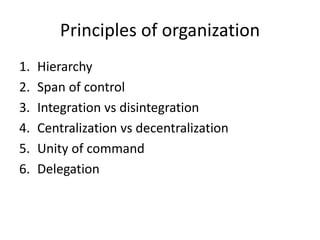
Principles of organization
1. Hierarchy
2. Span of control
3. Integration vs disintegration
4. Centralization vs decentralization
5. Unity of command
6. Delegation
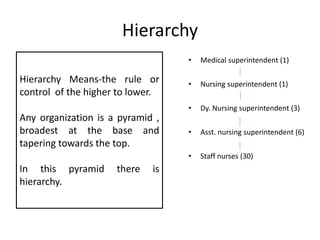
Hierarchy
• Medical superintendent (1)
• Nursing superintendent (1)
• Dy. Nursing superintendent (3)
• Asst. nursing superintendent (6)
• Staff nurses (30)
Hierarchy Means-the rule or
control of the higher to lower.
Any organization is a pyramid ,
broadest at the base and
tapering towards the top.
In this pyramid there is
hierarchy.
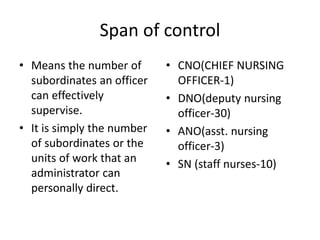
Span of control
• Means the number of
subordinates an officer
can effectively
supervise.
• It is simply the number
of subordinates or the
units of work that an
administrator can
personally direct.
• CNO(CHIEF NURSING
OFFICER-1)
• DNO(deputy nursing
officer-30)
• ANO(asst. nursing
officer-3)
• SN (staff nurses-10)
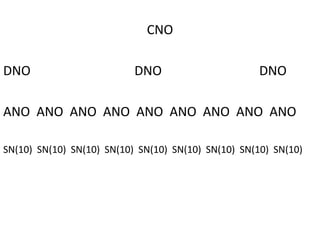
CNO
DNO DNO DNO
ANO ANO ANO ANO ANO ANO ANO ANO ANO
SN(10) SN(10) SN(10) SN(10) SN(10) SN(10) SN(10) SN(10) SN(10)
DELEGATION
Type of organization
1. Formal
2. Non formal
3. Informal
4. Line
5. Staff
6. Line and staff
7. Committee
8. Social
Steps of organization
1. Determining and enumeration of objectives
for each activity.
2. Grouping and assessing activities.
3. Allocation of fixed duties to definite persons.
4. Delegation of authority.
In brief, the important steps in organizing are-
• Determining of objectives of each activity.
• Deciding on the various type of activities to be undertaken within
the framework of the formulated plan to attain the goals of the
organization
• Grouping of activities
• Deciding different group of activities in terms of number of staff
• Determining the authority, responsibility and accountability
• Integration between the identified group of activities through
authority relationship and organised communication system
Trends in organization structures
• System approach
• Project organization
• Matrix organization
Organization design

ORGANIZATION.pptx

  • 2.
    DEFINITION OF ORGANIZATION •Organisation is the form of every human association for the attainment of common purpose & the process of relating specific duties or function in a whole. – J D Mooney • Organization is a system of co-operative activities of two or more persons. – CHESTER I BERNARD
  • 3.
    • Organization consistsof the relationship of individual to individual and groups to groups which are related as to bring about an orderly division of labor. • Pfiffiner
  • 4.
    ELEMENTS 1. People 2. Physicalresources 3. Economic and market condition, Climate 4. Attitude 5. Legal constraints
  • 5.
    Environment n organization •Organization n environment can always interact in one of the three ways. – Directed to environment – Adoptive environment – Growth n development
  • 6.
    Internal environment • Followingare the factors leading to internal environments; 1. Forecasts of industry or institution and demand for expansion strategy 2. Competitors information 3. Consumer data for firm 4. Information related to their costs and profits 5. Physical location of the industry or institution (hospital) 6. Labor management 7. Morale of the people working in the organization 8. Team spirit
  • 7.
    External environment • Mainaspects of the external environment in an organization could be classified as- 1. Political stability – Polity is an art based on certain understanding. – Polity stability is of great importance to a manager. – In case of stable political situation, a business manager deals with a known condition in making his plans. – Under the unstable political condition it is difficult to fore cast the environment. 2. Government control – Government control is of great importance to the organization. – Making policies – Act of statuatory bodies like MNC, INC. – Classification of industries or institutions or hospital. 3. Fiscal policy – The closely related to the government control is the effect of government and monetary policy. – Increasing and decreasing the existing taxes. – Exempting small scale industries from certain restrictions to encourage their growth – Special investment offers.
  • 8.
    4. Economic - •The national income plays a very important role in the purchasing power and hence in the demand for the various products of the organization. Following few important factors Economic disparity. Effective demand ( it is the demand backed up by the purchasing power). Pricing policy( it helps in monetary resource allocation).
  • 9.
    Cont.. • 5. Technology •The basic object before a manager is to reduce the manufacturing costs. – Therefore, the management must weight the cost and benefits of new technology by considering the following factors- – New process resulting cheaper and more efficient production or services – Progress in R and D – New products or services – Machine-product value or service value – Value added concepts – Man-machine balance
  • 10.
    6. Socio environment 1.Factors affecting socio-environment- 2. Social segment 3. Cultural variations 4. Socio-disparity 7. Ecological environment - factor affecting ecological environment • Land pollution • Water and air pollution • Non-renewal matters • Sewage disposal. Thus, no organization is functioning in a water-tight compartment but has to consider the socio and ecological environments in order to function efficiently.
  • 11.
    Nature of organization •4 “P” – Purposes – Process – Person target group, e.g. eligible couple downtrodden. – Place setting, e.g. primary health center,hospital
  • 12.
    Importance of organization •Organization increases managerial efficiency in a number of ways. • Ensures an optimum use of human efforts through specialization and also makes use of all resources, determines needs for innovative and new technologies. • Organization places a proportionate and balanced emphasis on various activities. • Organization facilities co-ordination in the enterprises. • Organization provides scope for training and developing managers. • Organization helps to consolidation growth and expansion of the institution. • Invites creative and innovative ideas to working through adopting human relation approach. • Prevents the growth of laggards, wirepullers, intriguers or other forms of corrupters. • Unsound organization becomes the breeding ground of corruption, dishonesty and such odd things.
  • 13.
    Theory of organization 1.The classical theory of management 2. Neo-classical theory 3. The modern management
  • 14.
    Principles of organization 1.Hierarchy 2. Span of control 3. Integration vs disintegration 4. Centralization vs decentralization 5. Unity of command 6. Delegation
  • 15.
    Hierarchy • Medical superintendent(1) • Nursing superintendent (1) • Dy. Nursing superintendent (3) • Asst. nursing superintendent (6) • Staff nurses (30) Hierarchy Means-the rule or control of the higher to lower. Any organization is a pyramid , broadest at the base and tapering towards the top. In this pyramid there is hierarchy.
  • 16.
    Span of control •Means the number of subordinates an officer can effectively supervise. • It is simply the number of subordinates or the units of work that an administrator can personally direct. • CNO(CHIEF NURSING OFFICER-1) • DNO(deputy nursing officer-30) • ANO(asst. nursing officer-3) • SN (staff nurses-10)
  • 17.
    CNO DNO DNO DNO ANOANO ANO ANO ANO ANO ANO ANO ANO SN(10) SN(10) SN(10) SN(10) SN(10) SN(10) SN(10) SN(10) SN(10)
  • 18.
  • 19.
    Type of organization 1.Formal 2. Non formal 3. Informal 4. Line 5. Staff 6. Line and staff 7. Committee 8. Social
  • 20.
    Steps of organization 1.Determining and enumeration of objectives for each activity. 2. Grouping and assessing activities. 3. Allocation of fixed duties to definite persons. 4. Delegation of authority.
  • 21.
    In brief, theimportant steps in organizing are- • Determining of objectives of each activity. • Deciding on the various type of activities to be undertaken within the framework of the formulated plan to attain the goals of the organization • Grouping of activities • Deciding different group of activities in terms of number of staff • Determining the authority, responsibility and accountability • Integration between the identified group of activities through authority relationship and organised communication system
  • 22.
    Trends in organizationstructures • System approach • Project organization • Matrix organization
  • 23.