PRESENTED BY
Mr. CHETAN R SANGATI, M.Sc (N) CCH
ASSISTANT PROFESSOR
DEPT OF MEDICAL SURGICAL NURSING
INTRODUCTION
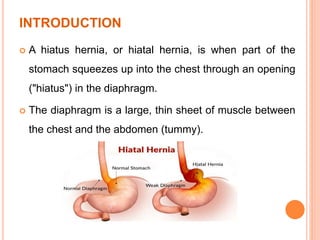
 A hiatus hernia, or hiatal hernia, is when part of the
stomach squeezes up into the chest through an opening
("hiatus") in the diaphragm.
 The diaphragm is a large, thin sheet of muscle between
the chest and the abdomen (tummy).
DEFINITION
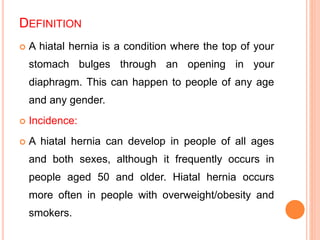
 A hiatal hernia is a condition where the top of your
stomach bulges through an opening in your
diaphragm. This can happen to people of any age
and any gender.
 Incidence:
 A hiatal hernia can develop in people of all ages
and both sexes, although it frequently occurs in
people aged 50 and older. Hiatal hernia occurs
more often in people with overweight/obesity and
smokers.
TYPES OF HIATUS HERNIA
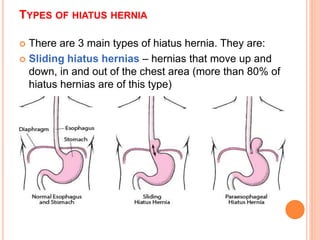
 There are 3 main types of hiatus hernia. They are:
 Sliding hiatus hernias – hernias that move up and
down, in and out of the chest area (more than 80% of
hiatus hernias are of this type)
 Para-oesophageal hiatus hernias – also called rolling
hiatus hernias, where part of the stomach pushes up
through the hole in the diaphragm next to the oesophagus
(about 5-15% of hiatus hernias are of this type)
THE MIXED OR COMPOUND HIATUS HERNIA
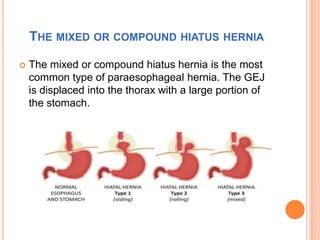
 The mixed or compound hiatus hernia is the most
common type of paraesophageal hernia. The GEJ
is displaced into the thorax with a large portion of
the stomach.
CAUSES
 The most common cause of a hiatal hernia is an increase in pressure
in the abdominal cavity.
 Coughing: A hiatus hernia can result in a cough that is dry and
persistent. Many individuals document this cough mainly at night.
This symptom occurs when you lay down after a meal at night,
resulting in stomach acid reflux. The recurrent stomach acid reflux
irritates the cough centers in the throat resulting in a cough.
 Vomiting.
 Straining during a bowel movement.
 Heavy lifting.
 Physical strain.
 hiatal hernia during pregnancy,
 If you have obesity, or if there’s extra fluid in your abdomen.
PATHOPHYSIOLOGY
CLINICAL SIGN AND SYMPTOMS
 Heartburn
 Regurgitation of food or liquids into the mouth
 Backflow of stomach acid into the esophagus (acid
reflux)
 Difficulty swallowing
 Chest or abdominal pain
 Feeling full soon after you eat
 Shortness of breath
 Vomiting of blood or passing of black stools, which may
indicate gastrointestinal bleeding
DIAGNOSTIC EVALUATION
 X-ray of your upper digestive system. X-rays are
taken after you drink a chalky liquid that coats and
fills the inside lining of your digestive tract. The
coating allows your doctor to see a silhouette of
your esophagus, stomach and upper intestine.
 Upper endoscopy. Your doctor inserts a thin,
flexible tube equipped with a light and camera
(endoscope) down your throat, to examine the
inside of your esophagus and stomach and check
for inflammation.
 Esophageal manometry. This test measures the
rhythmic muscle contractions in your esophagus
when you swallow. Esophageal manometry also
measures the coordination and force exerted by the
muscles of your esophagus.
 Gastroscopy
 The gastroscope will be inserted into your mouth
and down your throat, and will be used to help
identify any problems. The procedure may be
carried out using a local anaesthetic or a sedative
to help you relax.
 Barium meal X-ray
 The barium meal X-ray, also called the barium
swallow test, is an effective way of identifying a
hiatus hernia.
 As part of the test, you'll be asked to drink some
barium solution. Barium is a non-toxic chemical that
shows up clearly on an X-ray. Once the barium
moves down into your digestive system, a series of
X-rays will be taken to identify any problems.
MANAGEMENT
 PARMACOLOGY
 Antacids that neutralize stomach acid. Antacids,
such as Aluminum hydroxide gel. Calcium
carbonate Magnesium hydroxide may provide quick
relief. Overuse of some antacids can cause side
effects, such as diarrhea or sometimes kidney
problems.
 Medications to reduce acid production. These
medications — known as H-2-receptor blockers —
include cimetidine (Tagamet HB), famotidine
(Pepcid AC) and nizatidine (Axid AR).
 Medications that block acid production and heal
the esophagus. These medications — known as
proton pump inhibitors — are stronger acid blockers
than H-2-receptor blockers and allow time for
damaged esophageal tissue to heal. Over-the-
counter proton pump inhibitors include lansoprazole
(Prevacid 24HR) and omeprazole (Prilosec,
Zegerid).
SUGICAL MANAGEMENT
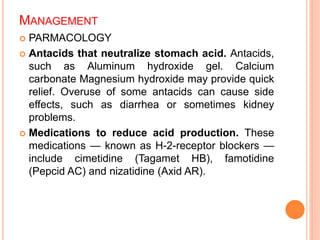
 Hiatus repair surgery. This surgery uses sutures
and prosthetic mesh to tighten and decrease the
size of the enlarged hiatus, which is the opening in
the diaphragm that the esophagus travels through
on its way to the stomach. It prevents your stomach
from bulging upward through the hiatus and is used
for early-stage Hiatal hernias.
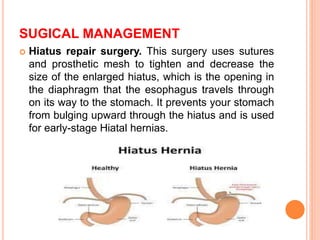
 Nissen Fundoplication. This procedure involves using
stitches to wrap the upper part of the stomach, called
the fundus, around the bottom portion of the
esophagus in order to hold the stomach in place below
the diaphragmatic hiatus. The stitches create pressure
at the end of your esophagus which prevents stomach
acid and food from flowing up from the stomach.
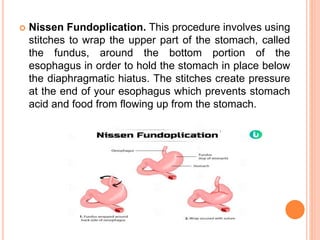
 Collis-Nissen gastroplasty. This surgery is used to
lengthen the esophagus in patients with more complex
forms of Hiatal hernia due to esophageal shortening. In
this procedure, a surgeon will use tissue from the upper
part of your stomach to extend your esophagus.
BELSEY MARK IV FUNDOPLICATION
 Antireflux fundoplication is a classic procedure that
has proven to be a successful and durable
antireflux operation. Over a 15-year period, Ronald
Belsey performed clinical trials to develop and
refine the operation, culminating in 4 iterations, with
the fourth or Mark IV being the final and most
successful.
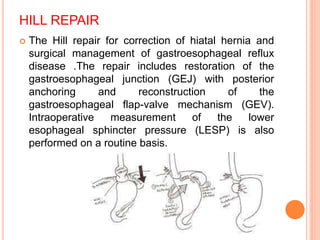
HILL REPAIR
 The Hill repair for correction of hiatal hernia and
surgical management of gastroesophageal reflux
disease .The repair includes restoration of the
gastroesophageal junction (GEJ) with posterior
anchoring and reconstruction of the
gastroesophageal flap-valve mechanism (GEV).
Intraoperative measurement of the lower
esophageal sphincter pressure (LESP) is also
performed on a routine basis.
COMPLICATION
 Epigastria hernia includes any basic complications
surrounding surgery and general anesthesia as well as those
related to this specific surgical procedure. These
complications may include:
 Bleeding
 Pain
 Wound infection at the surgical site
 Scarring left after healing
 blood clots
 Development of a lump that isn’t a hernia
 A low chance of the hernia recurring
NURSING INTERVENTIONS
 Advise the patient about preventing reflux of gastric
contents into esophagus by:
 Eating smaller meals to reduce stomach bulk.
 Avoiding stimulation of gastric secretions by omitting
caffeine and alcohol, which may intensify symptoms.
 Refraining from smoking, which stimulates gastric acid
secretions.
 Avoiding fatty foods, which promote reflux and delay
gastric emptying.
 Refraining from lying down for at least 1 hour after
meals.
 Losing weight, if obese.
 Avoiding bending from the waist or wearing tight-fitting
clothes.
 Advise the patient to report health care facility
immediately at onset of acute chest pain – may
indicate incarceration of paraesophageal hernia.
 Reassure patient that he or she is not having a heart
attack, but all instances of chest pain should be taken
seriously and reported to the patient’s health care
provider.
I) Nursing Diagnosis
 Acute Pain
 May be related to
Surgical repair
 Possibly evidenced by
 Change in facial expression in the child
 Irritability in infant
 Verbalization of pain
 Guarding behavior
 Crying, Moaning
 Refusal to move
 Desired Outcomes
The client will express feelings of comfort and reduce
pain as described using a pain scale.
II) Nursing Diagnosis
 Deficient Knowledge
 May be related to
 Lack of knowledge about postoperative care
 Possibly evidenced by
 Request for information about activity allowed, wound
care, diet, bathing, and comfort measures
 Desired Outcomes
 Parents will obtain knowledge about postoperative
care.
Hiatal Hernia.pptx

Hiatal Hernia.pptx

  • 1.
    PRESENTED BY Mr. CHETANR SANGATI, M.Sc (N) CCH ASSISTANT PROFESSOR DEPT OF MEDICAL SURGICAL NURSING
  • 2.
    INTRODUCTION  A hiatushernia, or hiatal hernia, is when part of the stomach squeezes up into the chest through an opening ("hiatus") in the diaphragm.  The diaphragm is a large, thin sheet of muscle between the chest and the abdomen (tummy).
  • 3.
    DEFINITION  A hiatalhernia is a condition where the top of your stomach bulges through an opening in your diaphragm. This can happen to people of any age and any gender.  Incidence:  A hiatal hernia can develop in people of all ages and both sexes, although it frequently occurs in people aged 50 and older. Hiatal hernia occurs more often in people with overweight/obesity and smokers.
  • 4.
    TYPES OF HIATUSHERNIA  There are 3 main types of hiatus hernia. They are:  Sliding hiatus hernias – hernias that move up and down, in and out of the chest area (more than 80% of hiatus hernias are of this type)
  • 5.
     Para-oesophageal hiatushernias – also called rolling hiatus hernias, where part of the stomach pushes up through the hole in the diaphragm next to the oesophagus (about 5-15% of hiatus hernias are of this type)
  • 6.
    THE MIXED ORCOMPOUND HIATUS HERNIA  The mixed or compound hiatus hernia is the most common type of paraesophageal hernia. The GEJ is displaced into the thorax with a large portion of the stomach.
  • 7.
    CAUSES  The mostcommon cause of a hiatal hernia is an increase in pressure in the abdominal cavity.  Coughing: A hiatus hernia can result in a cough that is dry and persistent. Many individuals document this cough mainly at night. This symptom occurs when you lay down after a meal at night, resulting in stomach acid reflux. The recurrent stomach acid reflux irritates the cough centers in the throat resulting in a cough.  Vomiting.  Straining during a bowel movement.  Heavy lifting.  Physical strain.  hiatal hernia during pregnancy,  If you have obesity, or if there’s extra fluid in your abdomen.
  • 8.
  • 9.
    CLINICAL SIGN ANDSYMPTOMS  Heartburn  Regurgitation of food or liquids into the mouth  Backflow of stomach acid into the esophagus (acid reflux)  Difficulty swallowing  Chest or abdominal pain  Feeling full soon after you eat  Shortness of breath  Vomiting of blood or passing of black stools, which may indicate gastrointestinal bleeding
  • 10.
    DIAGNOSTIC EVALUATION  X-rayof your upper digestive system. X-rays are taken after you drink a chalky liquid that coats and fills the inside lining of your digestive tract. The coating allows your doctor to see a silhouette of your esophagus, stomach and upper intestine.  Upper endoscopy. Your doctor inserts a thin, flexible tube equipped with a light and camera (endoscope) down your throat, to examine the inside of your esophagus and stomach and check for inflammation.  Esophageal manometry. This test measures the rhythmic muscle contractions in your esophagus when you swallow. Esophageal manometry also measures the coordination and force exerted by the muscles of your esophagus.
  • 11.
     Gastroscopy  Thegastroscope will be inserted into your mouth and down your throat, and will be used to help identify any problems. The procedure may be carried out using a local anaesthetic or a sedative to help you relax.  Barium meal X-ray  The barium meal X-ray, also called the barium swallow test, is an effective way of identifying a hiatus hernia.  As part of the test, you'll be asked to drink some barium solution. Barium is a non-toxic chemical that shows up clearly on an X-ray. Once the barium moves down into your digestive system, a series of X-rays will be taken to identify any problems.
  • 12.
    MANAGEMENT  PARMACOLOGY  Antacidsthat neutralize stomach acid. Antacids, such as Aluminum hydroxide gel. Calcium carbonate Magnesium hydroxide may provide quick relief. Overuse of some antacids can cause side effects, such as diarrhea or sometimes kidney problems.  Medications to reduce acid production. These medications — known as H-2-receptor blockers — include cimetidine (Tagamet HB), famotidine (Pepcid AC) and nizatidine (Axid AR).
  • 13.
     Medications thatblock acid production and heal the esophagus. These medications — known as proton pump inhibitors — are stronger acid blockers than H-2-receptor blockers and allow time for damaged esophageal tissue to heal. Over-the- counter proton pump inhibitors include lansoprazole (Prevacid 24HR) and omeprazole (Prilosec, Zegerid).
  • 14.
    SUGICAL MANAGEMENT  Hiatusrepair surgery. This surgery uses sutures and prosthetic mesh to tighten and decrease the size of the enlarged hiatus, which is the opening in the diaphragm that the esophagus travels through on its way to the stomach. It prevents your stomach from bulging upward through the hiatus and is used for early-stage Hiatal hernias.
  • 15.
     Nissen Fundoplication.This procedure involves using stitches to wrap the upper part of the stomach, called the fundus, around the bottom portion of the esophagus in order to hold the stomach in place below the diaphragmatic hiatus. The stitches create pressure at the end of your esophagus which prevents stomach acid and food from flowing up from the stomach.
  • 16.
     Collis-Nissen gastroplasty.This surgery is used to lengthen the esophagus in patients with more complex forms of Hiatal hernia due to esophageal shortening. In this procedure, a surgeon will use tissue from the upper part of your stomach to extend your esophagus.
  • 17.
    BELSEY MARK IVFUNDOPLICATION  Antireflux fundoplication is a classic procedure that has proven to be a successful and durable antireflux operation. Over a 15-year period, Ronald Belsey performed clinical trials to develop and refine the operation, culminating in 4 iterations, with the fourth or Mark IV being the final and most successful.
  • 18.
    HILL REPAIR  TheHill repair for correction of hiatal hernia and surgical management of gastroesophageal reflux disease .The repair includes restoration of the gastroesophageal junction (GEJ) with posterior anchoring and reconstruction of the gastroesophageal flap-valve mechanism (GEV). Intraoperative measurement of the lower esophageal sphincter pressure (LESP) is also performed on a routine basis.
  • 19.
    COMPLICATION  Epigastria herniaincludes any basic complications surrounding surgery and general anesthesia as well as those related to this specific surgical procedure. These complications may include:  Bleeding  Pain  Wound infection at the surgical site  Scarring left after healing  blood clots  Development of a lump that isn’t a hernia  A low chance of the hernia recurring
  • 20.
    NURSING INTERVENTIONS  Advisethe patient about preventing reflux of gastric contents into esophagus by:  Eating smaller meals to reduce stomach bulk.  Avoiding stimulation of gastric secretions by omitting caffeine and alcohol, which may intensify symptoms.  Refraining from smoking, which stimulates gastric acid secretions.  Avoiding fatty foods, which promote reflux and delay gastric emptying.  Refraining from lying down for at least 1 hour after meals.  Losing weight, if obese.  Avoiding bending from the waist or wearing tight-fitting clothes.
  • 21.
     Advise thepatient to report health care facility immediately at onset of acute chest pain – may indicate incarceration of paraesophageal hernia.  Reassure patient that he or she is not having a heart attack, but all instances of chest pain should be taken seriously and reported to the patient’s health care provider.
  • 22.
    I) Nursing Diagnosis Acute Pain  May be related to Surgical repair  Possibly evidenced by  Change in facial expression in the child  Irritability in infant  Verbalization of pain  Guarding behavior  Crying, Moaning  Refusal to move  Desired Outcomes The client will express feelings of comfort and reduce pain as described using a pain scale.
  • 23.
    II) Nursing Diagnosis Deficient Knowledge  May be related to  Lack of knowledge about postoperative care  Possibly evidenced by  Request for information about activity allowed, wound care, diet, bathing, and comfort measures  Desired Outcomes  Parents will obtain knowledge about postoperative care.