http://lawrencekok.blogspot.com
Prepared by
Lawrence Kok
Tutorial on Collision Theory, Arrhenius Equation
Maxwell Boltzmann Distribution Curve.
Collision Theory
Chemical rxn to occur bet A +B
• Molecule collide with right orientation (geometry)
( effective collision take place)
• Molecule collide with total energy greater > activation energy
• Effective collision will lead to product formation
Collision bet A + B
No product formation
• Energy collision < activation energy
• Collision not in correct orientation
or energetic enough to overcome Ea
Product formation
• Energy collision > activation energy
• Collision energetic enough to overcome Ea
Rate of Reaction
• Conc reactant increase ↑
• Freq of collision increase ↑
• Freq of effective collision increase ↑
• Temp increase ↑ by 10 C
• Rate increase ↑ by 100%
• Exponential relationship
bet Temp and Rate
Rate = k [A]1[B]1 1st order – A
1st order – B
Conc A doubles x2 – Rate x2
Conc A triples x3 – Rate x3
Collision Theory
• Temp increase ↑ by 10C
• Fraction of molecules with
energy > Ea doubles
• Rate increases ↑ by 100%
Ineffective collision Effective collision
Concentration
Temperaturedepends
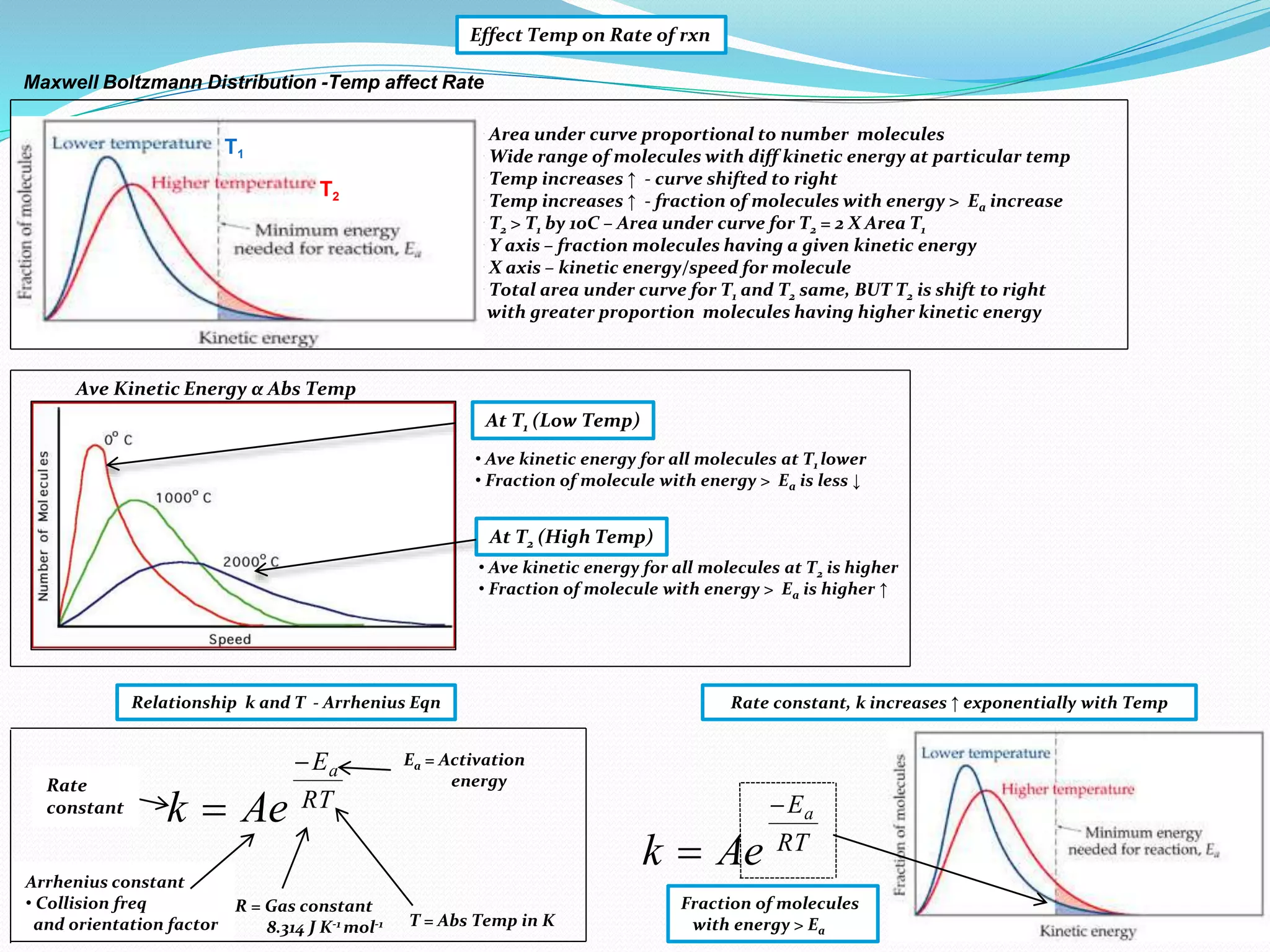
Effect Temp on Rate of rxn
• Area under curve proportional to number molecules
• Wide range of molecules with diff kinetic energy at particular temp
• Temp increases ↑ - curve shifted to right
• Temp increases ↑ - fraction of molecules with energy > Ea increase
• T2 > T1 by 10C – Area under curve for T2 = 2 X Area T1
• Y axis – fraction molecules having a given kinetic energy
• X axis – kinetic energy/speed for molecule
• Total area under curve for T1 and T2 same, BUT T2 is shift to right
with greater proportion molecules having higher kinetic energy
Ave Kinetic Energy α Abs Temp
• Ave kinetic energy for all molecules at T1 lower
• Fraction of molecule with energy > Ea is less ↓
• Ave kinetic energy for all molecules at T2 is higher
• Fraction of molecule with energy > Ea is higher ↑
Maxwell Boltzmann Distribution -Temp affect Rate
At T1 (Low Temp)
At T2 (High Temp)
T1
T2
RT
Ea
Aek


Relationship k and T - Arrhenius Eqn
Rate
constant
Arrhenius constant
• Collision freq
and orientation factor
Ea = Activation
energy
T = Abs Temp in K
R = Gas constant
8.314 J K-1 mol-1
RT
Ea
Aek


Fraction of molecules
with energy > Ea
Rate constant, k increases ↑ exponentially with Temp
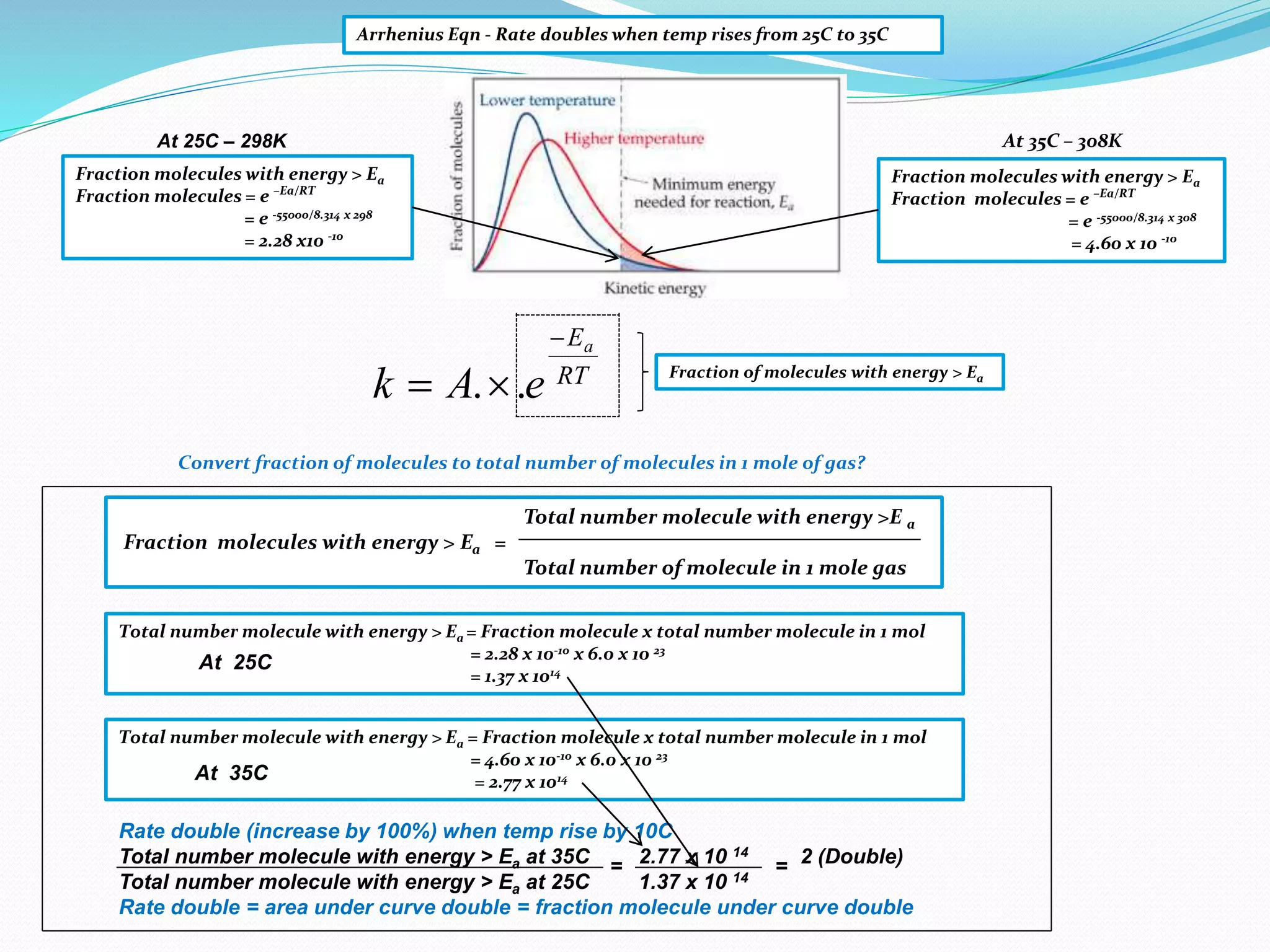
Fraction molecules with energy > Ea
Fraction molecules = e –Ea/RT
= e -55000/8.314 x 298
= 2.28 x10 -10
Fraction molecules with energy > Ea
Fraction molecules = e –Ea/RT
= e -55000/8.314 x 308
= 4.60 x 10 -10
Total number molecule with energy > Ea = Fraction molecule x total number molecule in 1 mol
= 2.28 x 10-10 x 6.0 x 10 23
= 1.37 x 10¹⁴
Total number molecule with energy > Ea = Fraction molecule x total number molecule in 1 mol
= 4.60 x 10-10 x 6.0 x 10 23
= 2.77 x 10¹⁴
Total number molecule with energy >E a
Fraction molecules with energy > Ea =
Total number of molecule in 1 mole gas
Rate double (increase by 100%) when temp rise by 10C
Total number molecule with energy > Ea at 35C 2.77 x 10 14 2 (Double)
Total number molecule with energy > Ea at 25C 1.37 x 10 14
Rate double = area under curve double = fraction molecule under curve double
Arrhenius Eqn - Rate doubles when temp rises from 25C to 35C
At 35C – 308KAt 25C – 298K
Convert fraction of molecules to total number of molecules in 1 mole of gas?
At 35C
At 25C
= =
Fraction of molecules with energy > EaRT
Ea
eAk

 ..
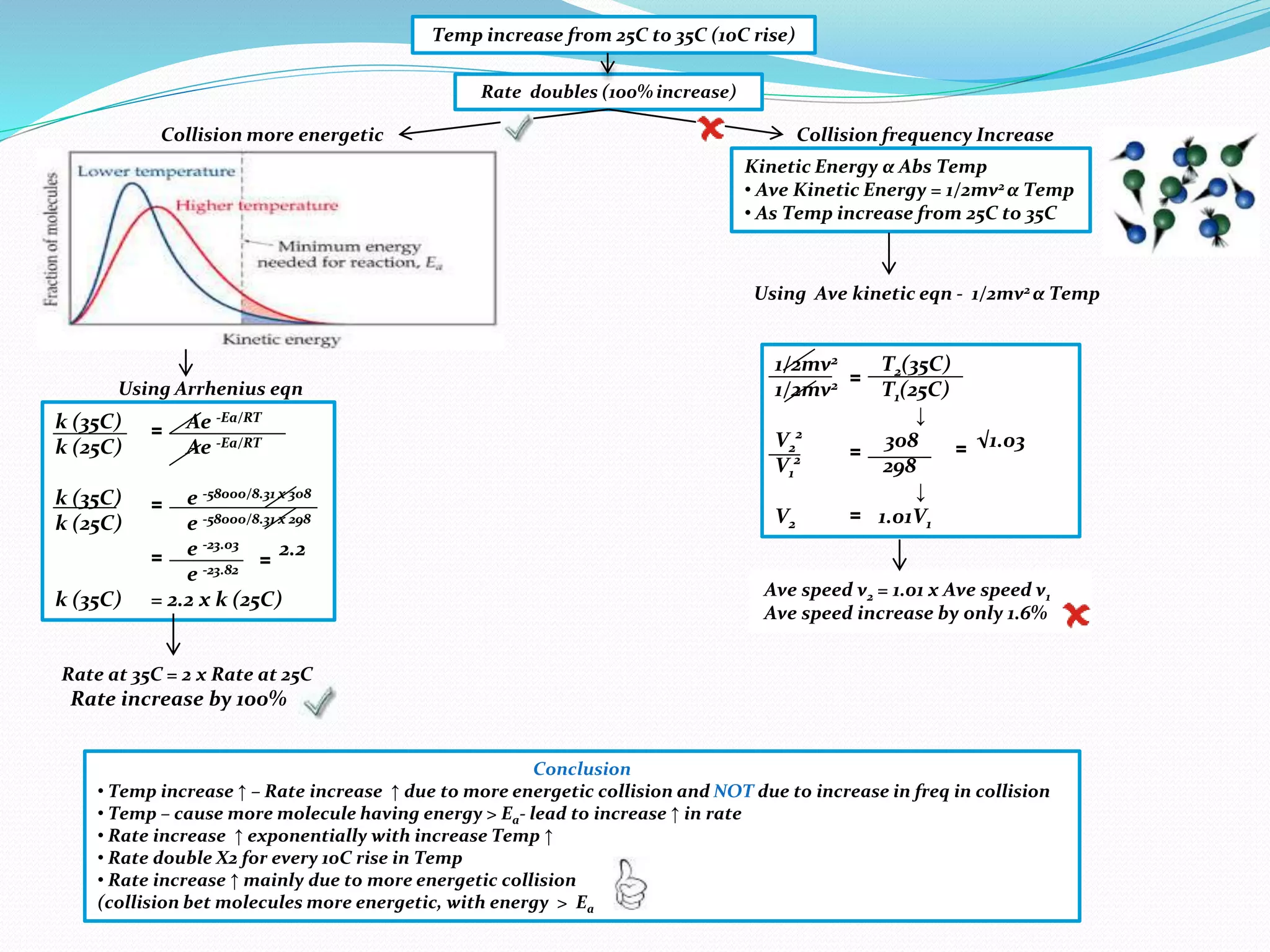
Temp increase from 25C to 35C (10C rise)
Rate doubles (100% increase)
Collision more energetic
Kinetic Energy α Abs Temp
• Ave Kinetic Energy = 1/2mv2 α Temp
• As Temp increase from 25C to 35C
1/2mv2 T2(35C)
1/2mv2 T1(25C)
↓
V2
2
308 √1.03
V1
2
298
↓
V2 1.01V1
Ave speed v2 = 1.01 x Ave speed v1
Ave speed increase by only 1.6%
Using Arrhenius eqn
k (35C) Ae -Ea/RT
k (25C) Ae -Ea/RT
k (35C) e -58000/8.31 x 308
k (25C) e -58000/8.31 x 298
e -23.03 2.2
e -23.82
k (35C) = 2.2 x k (25C)
Rate at 35C = 2 x Rate at 25C
Rate increase by 100%
Collision frequency Increase
Using Ave kinetic eqn - 1/2mv2 α Temp
=
=
=
=
=
= =
=
Conclusion
• Temp increase ↑ – Rate increase ↑ due to more energetic collision and NOT due to increase in freq in collision
• Temp – cause more molecule having energy > Ea- lead to increase ↑ in rate
• Rate increase ↑ exponentially with increase Temp ↑
• Rate double X2 for every 10C rise in Temp
• Rate increase ↑ mainly due to more energetic collision
(collision bet molecules more energetic, with energy > Ea
Temp and rate constant link by Arrhenius Eqn
X + Y → Z
Rate of rxn = (Total number collision) x ( fraction collision, energy >Ea) x ( [X] [Y] )
Arrhenius Constant
A
Fraction molecule energy > Ea
e –Ea/RT
Conc
[X][Y]
Rate of rxn = A e –Ea/RT [X][Y]
Rate of rxn = k [X] [Y]
If conc constant BUT Temp changes, combine eqn 1 and 2
Rate of rxn = k [X]1
[Y]1
= A e –Ea/RT [X][Y]
k = A e –Ea/RT
Rate rxn written in TWO forms
Rate of rxn = A e –Ea/RT [X] [Y]
Eqn 1 Eqn 2
Cancel both sides
Rate of rxn = A e –Ea/RT [X][Y]
Fraction molecule energy > Ea
e –Ea/RT
Conc
[X][Y]
Temp increase
Fraction with energy > Ea increase
Rate increase exponentially
Conc increase
Freq collision increase
Rate increase
Arrhenius Eqn - Ea by graphical Method
RT
Ea
eAk

 ..







TR
E
Ak a 1
lnln 






TR
E
Ak a 1
303.2
lglg
Plot ln k vs 1/T
• Gradient = -Ea/R
• ln A = intercept y axis
Plot log k vs 1/T
• Gradient = -Ea/R
• log A = intercept y axis
ln both sides log both sides
ln k lg k
1/T1/T
-Ea/R -Ea/R
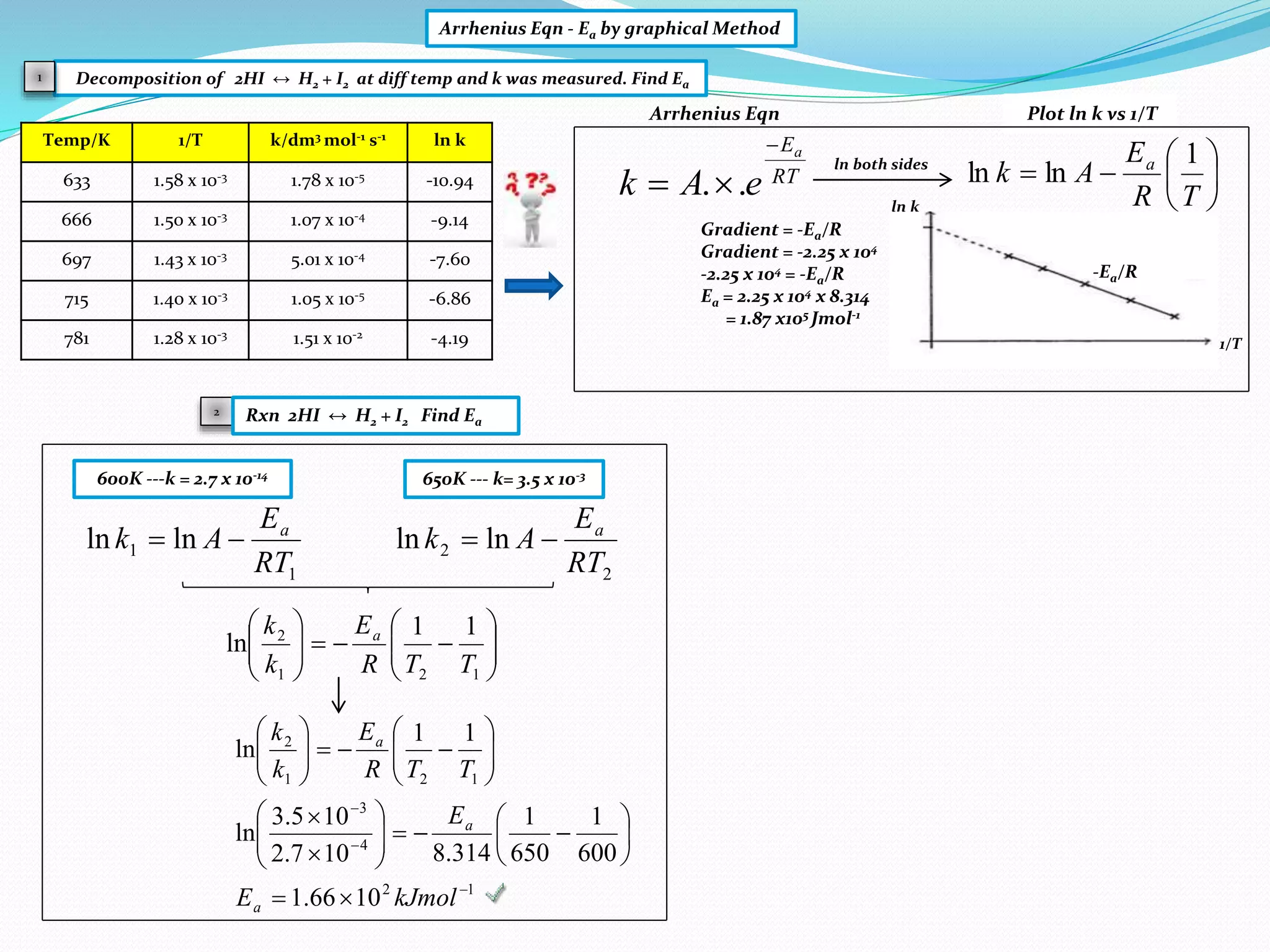
Decomposition of 2HI ↔ H2 + I2 at diff temp and k was measured. Find Ea
Arrhenius Eqn
Ea from its gradient
Arrhenius Eqn - Ea by graphical Method
Temp/K 1/T k/dm3 mol-1 s-1 ln k
633 1.58 x 10⁻³ 1.78 x 10⁻⁵ -10.94
666 1.50 x 10⁻³ 1.07 x 10⁻⁴ -9.14
697 1.43 x 10⁻³ 5.01 x 10⁻⁴ -7.60
715 1.40 x 10⁻³ 1.05 x 10⁻⁵ -6.86
781 1.28 x 10⁻³ 1.51 x 10⁻² -4.19
1
RT
Ea
eAk

 .. 






TR
E
Ak a 1
lnln
Plot ln k vs 1/T
2
ln both sides
-Ea/R
Gradient = -Ea/R
Gradient = -2.25 x 10⁴
-2.25 x 104 = -Ea/R
Ea = 2.25 x 104 x 8.314
= 1.87 x10⁵ Jmol-1
ln k
1/T
Rxn 2HI ↔ H2 + I2 Find Ea
1
1 lnln
RT
E
Ak a

2
2 lnln
RT
E
Ak a

12
4
3
121
2
1066.1
600
1
650
1
314.8107.2
105.3
ln
11
ln






























kJmolE
E
TTR
E
k
k
a
a
a












121
2 11
ln
TTR
E
k
k a
600K ---k = 2.7 x 10⁻¹⁴ 650K --- k= 3.5 x 10⁻³
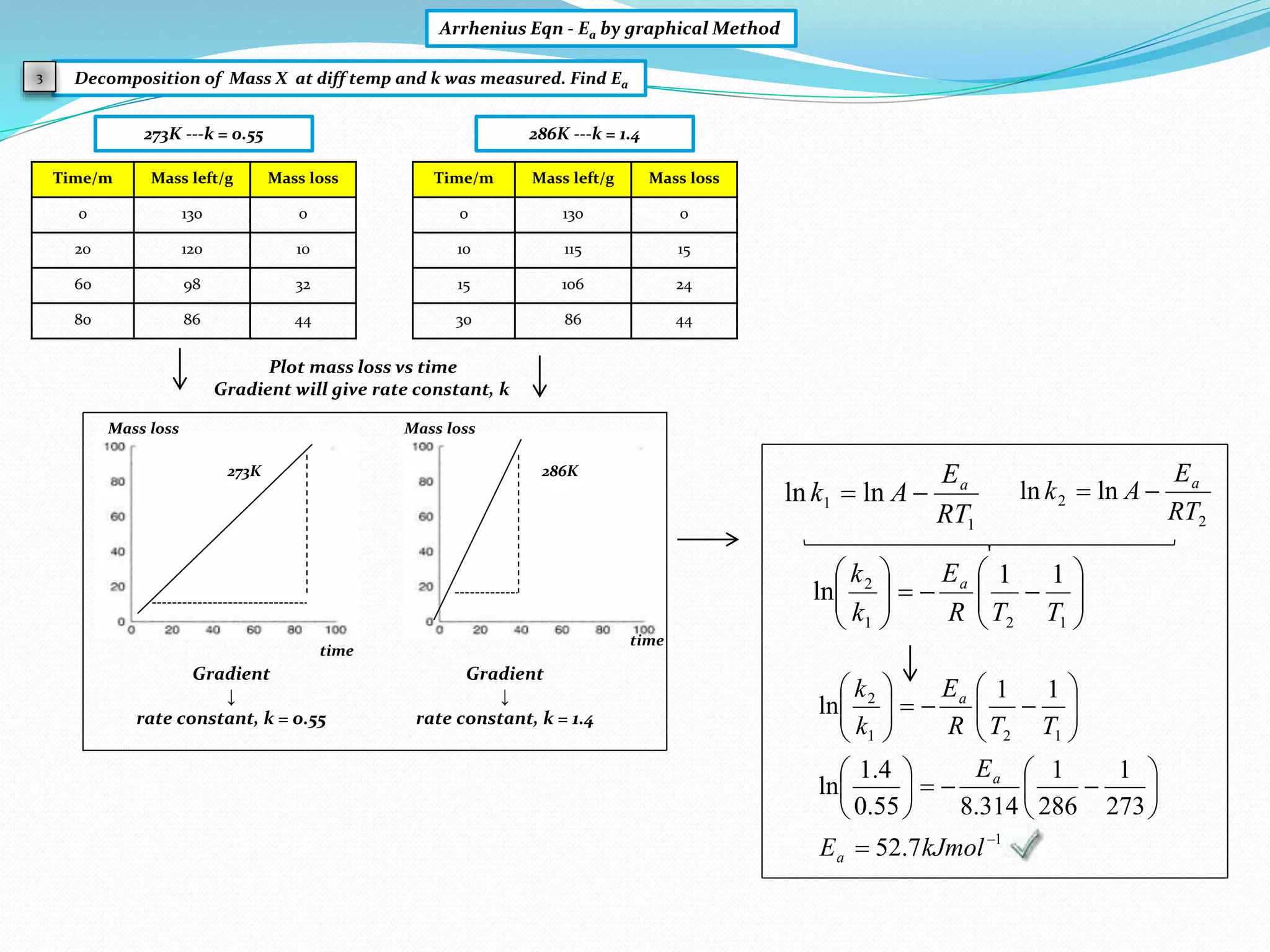
Decomposition of Mass X at diff temp and k was measured. Find Ea
Arrhenius Eqn - Ea by graphical Method
3
1
1 lnln
RT
E
Ak a

2
2 lnln
RT
E
Ak a

1
121
2
7.52
273
1
286
1
314.855.0
4.1
ln
11
ln


























kJmolE
E
TTR
E
k
k
a
a
a












121
2 11
ln
TTR
E
k
k a
Time/m Mass left/g Mass loss
0 130 0
20 120 10
60 98 32
80 86 44
273K ---k = 0.55 286K ---k = 1.4
Time/m Mass left/g Mass loss
0 130 0
10 115 15
15 106 24
30 86 44
Plot mass loss vs time
Gradient will give rate constant, k
Mass loss
273K 286K
Mass loss
time
time
Gradient
↓
rate constant, k = 0.55
Gradient
↓
rate constant, k = 1.4
Acknowledgements
Thanks to source of pictures and video used in this presentation
Thanks to Creative Commons for excellent contribution on licenses
http://creativecommons.org/licenses/
Prepared by Lawrence Kok
Check out more video tutorials from my site and hope you enjoy this tutorial
http://lawrencekok.blogspot.com

IB Chemistry Collision Theory, Arrhenius Equation and Maxwell Boltzmann Distribution

  • 1.
    http://lawrencekok.blogspot.com Prepared by Lawrence Kok Tutorialon Collision Theory, Arrhenius Equation Maxwell Boltzmann Distribution Curve.
  • 2.
    Collision Theory Chemical rxnto occur bet A +B • Molecule collide with right orientation (geometry) ( effective collision take place) • Molecule collide with total energy greater > activation energy • Effective collision will lead to product formation Collision bet A + B No product formation • Energy collision < activation energy • Collision not in correct orientation or energetic enough to overcome Ea Product formation • Energy collision > activation energy • Collision energetic enough to overcome Ea Rate of Reaction • Conc reactant increase ↑ • Freq of collision increase ↑ • Freq of effective collision increase ↑ • Temp increase ↑ by 10 C • Rate increase ↑ by 100% • Exponential relationship bet Temp and Rate Rate = k [A]1[B]1 1st order – A 1st order – B Conc A doubles x2 – Rate x2 Conc A triples x3 – Rate x3 Collision Theory • Temp increase ↑ by 10C • Fraction of molecules with energy > Ea doubles • Rate increases ↑ by 100% Ineffective collision Effective collision Concentration Temperaturedepends
  • 3.
    Effect Temp onRate of rxn • Area under curve proportional to number molecules • Wide range of molecules with diff kinetic energy at particular temp • Temp increases ↑ - curve shifted to right • Temp increases ↑ - fraction of molecules with energy > Ea increase • T2 > T1 by 10C – Area under curve for T2 = 2 X Area T1 • Y axis – fraction molecules having a given kinetic energy • X axis – kinetic energy/speed for molecule • Total area under curve for T1 and T2 same, BUT T2 is shift to right with greater proportion molecules having higher kinetic energy Ave Kinetic Energy α Abs Temp • Ave kinetic energy for all molecules at T1 lower • Fraction of molecule with energy > Ea is less ↓ • Ave kinetic energy for all molecules at T2 is higher • Fraction of molecule with energy > Ea is higher ↑ Maxwell Boltzmann Distribution -Temp affect Rate At T1 (Low Temp) At T2 (High Temp) T1 T2 RT Ea Aek   Relationship k and T - Arrhenius Eqn Rate constant Arrhenius constant • Collision freq and orientation factor Ea = Activation energy T = Abs Temp in K R = Gas constant 8.314 J K-1 mol-1 RT Ea Aek   Fraction of molecules with energy > Ea Rate constant, k increases ↑ exponentially with Temp
  • 4.
    Fraction molecules withenergy > Ea Fraction molecules = e –Ea/RT = e -55000/8.314 x 298 = 2.28 x10 -10 Fraction molecules with energy > Ea Fraction molecules = e –Ea/RT = e -55000/8.314 x 308 = 4.60 x 10 -10 Total number molecule with energy > Ea = Fraction molecule x total number molecule in 1 mol = 2.28 x 10-10 x 6.0 x 10 23 = 1.37 x 10¹⁴ Total number molecule with energy > Ea = Fraction molecule x total number molecule in 1 mol = 4.60 x 10-10 x 6.0 x 10 23 = 2.77 x 10¹⁴ Total number molecule with energy >E a Fraction molecules with energy > Ea = Total number of molecule in 1 mole gas Rate double (increase by 100%) when temp rise by 10C Total number molecule with energy > Ea at 35C 2.77 x 10 14 2 (Double) Total number molecule with energy > Ea at 25C 1.37 x 10 14 Rate double = area under curve double = fraction molecule under curve double Arrhenius Eqn - Rate doubles when temp rises from 25C to 35C At 35C – 308KAt 25C – 298K Convert fraction of molecules to total number of molecules in 1 mole of gas? At 35C At 25C = = Fraction of molecules with energy > EaRT Ea eAk   ..
  • 5.
    Temp increase from25C to 35C (10C rise) Rate doubles (100% increase) Collision more energetic Kinetic Energy α Abs Temp • Ave Kinetic Energy = 1/2mv2 α Temp • As Temp increase from 25C to 35C 1/2mv2 T2(35C) 1/2mv2 T1(25C) ↓ V2 2 308 √1.03 V1 2 298 ↓ V2 1.01V1 Ave speed v2 = 1.01 x Ave speed v1 Ave speed increase by only 1.6% Using Arrhenius eqn k (35C) Ae -Ea/RT k (25C) Ae -Ea/RT k (35C) e -58000/8.31 x 308 k (25C) e -58000/8.31 x 298 e -23.03 2.2 e -23.82 k (35C) = 2.2 x k (25C) Rate at 35C = 2 x Rate at 25C Rate increase by 100% Collision frequency Increase Using Ave kinetic eqn - 1/2mv2 α Temp = = = = = = = = Conclusion • Temp increase ↑ – Rate increase ↑ due to more energetic collision and NOT due to increase in freq in collision • Temp – cause more molecule having energy > Ea- lead to increase ↑ in rate • Rate increase ↑ exponentially with increase Temp ↑ • Rate double X2 for every 10C rise in Temp • Rate increase ↑ mainly due to more energetic collision (collision bet molecules more energetic, with energy > Ea
  • 6.
    Temp and rateconstant link by Arrhenius Eqn X + Y → Z Rate of rxn = (Total number collision) x ( fraction collision, energy >Ea) x ( [X] [Y] ) Arrhenius Constant A Fraction molecule energy > Ea e –Ea/RT Conc [X][Y] Rate of rxn = A e –Ea/RT [X][Y] Rate of rxn = k [X] [Y] If conc constant BUT Temp changes, combine eqn 1 and 2 Rate of rxn = k [X]1 [Y]1 = A e –Ea/RT [X][Y] k = A e –Ea/RT Rate rxn written in TWO forms Rate of rxn = A e –Ea/RT [X] [Y] Eqn 1 Eqn 2 Cancel both sides Rate of rxn = A e –Ea/RT [X][Y] Fraction molecule energy > Ea e –Ea/RT Conc [X][Y] Temp increase Fraction with energy > Ea increase Rate increase exponentially Conc increase Freq collision increase Rate increase Arrhenius Eqn - Ea by graphical Method RT Ea eAk   ..        TR E Ak a 1 lnln        TR E Ak a 1 303.2 lglg Plot ln k vs 1/T • Gradient = -Ea/R • ln A = intercept y axis Plot log k vs 1/T • Gradient = -Ea/R • log A = intercept y axis ln both sides log both sides ln k lg k 1/T1/T -Ea/R -Ea/R
  • 7.
    Decomposition of 2HI↔ H2 + I2 at diff temp and k was measured. Find Ea Arrhenius Eqn Ea from its gradient Arrhenius Eqn - Ea by graphical Method Temp/K 1/T k/dm3 mol-1 s-1 ln k 633 1.58 x 10⁻³ 1.78 x 10⁻⁵ -10.94 666 1.50 x 10⁻³ 1.07 x 10⁻⁴ -9.14 697 1.43 x 10⁻³ 5.01 x 10⁻⁴ -7.60 715 1.40 x 10⁻³ 1.05 x 10⁻⁵ -6.86 781 1.28 x 10⁻³ 1.51 x 10⁻² -4.19 1 RT Ea eAk   ..        TR E Ak a 1 lnln Plot ln k vs 1/T 2 ln both sides -Ea/R Gradient = -Ea/R Gradient = -2.25 x 10⁴ -2.25 x 104 = -Ea/R Ea = 2.25 x 104 x 8.314 = 1.87 x10⁵ Jmol-1 ln k 1/T Rxn 2HI ↔ H2 + I2 Find Ea 1 1 lnln RT E Ak a  2 2 lnln RT E Ak a  12 4 3 121 2 1066.1 600 1 650 1 314.8107.2 105.3 ln 11 ln                               kJmolE E TTR E k k a a a             121 2 11 ln TTR E k k a 600K ---k = 2.7 x 10⁻¹⁴ 650K --- k= 3.5 x 10⁻³
  • 8.
    Decomposition of MassX at diff temp and k was measured. Find Ea Arrhenius Eqn - Ea by graphical Method 3 1 1 lnln RT E Ak a  2 2 lnln RT E Ak a  1 121 2 7.52 273 1 286 1 314.855.0 4.1 ln 11 ln                           kJmolE E TTR E k k a a a             121 2 11 ln TTR E k k a Time/m Mass left/g Mass loss 0 130 0 20 120 10 60 98 32 80 86 44 273K ---k = 0.55 286K ---k = 1.4 Time/m Mass left/g Mass loss 0 130 0 10 115 15 15 106 24 30 86 44 Plot mass loss vs time Gradient will give rate constant, k Mass loss 273K 286K Mass loss time time Gradient ↓ rate constant, k = 0.55 Gradient ↓ rate constant, k = 1.4
  • 9.
    Acknowledgements Thanks to sourceof pictures and video used in this presentation Thanks to Creative Commons for excellent contribution on licenses http://creativecommons.org/licenses/ Prepared by Lawrence Kok Check out more video tutorials from my site and hope you enjoy this tutorial http://lawrencekok.blogspot.com