Photochemistry CECH-509
UNIT-4A
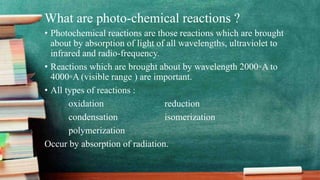
What are photo-chemical reactions ?
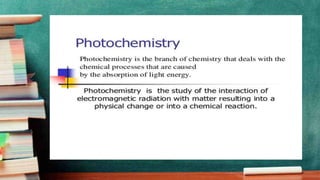
• Photochemical reactions are those reactions which are brought
about by absorption of light of all wavelengths, ultraviolet to
infrared and radio-frequency.
• Reactions which are brought about by wavelength 2000◦A to
4000◦A (visible range ) are important.
• All types of reactions :
oxidation reduction
condensation isomerization
polymerization
Occur by absorption of radiation.
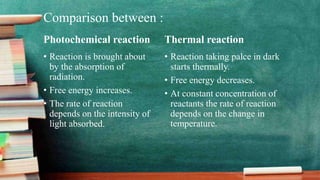
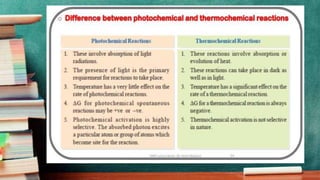
Comparison between :
Photochemical reaction
• Reaction is brought about
by the absorption of
radiation.
• Free energy increases.
• The rate of reaction
depends on the intensity of
light absorbed.
Thermal reaction
• Reaction taking palce in dark
starts thermally.
• Free energy decreases.
• At constant concentration of
reactants the rate of reaction
depends on the change in
temperature.
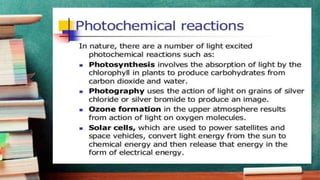
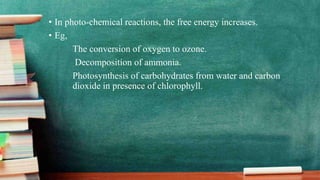
• In photo-chemical reactions, the free energy increases.
• Eg,
The conversion of oxygen to ozone.
Decomposition of ammonia.
Photosynthesis of carbohydrates from water and carbon
dioxide in presence of chlorophyll.
Laws of photochemistry :-
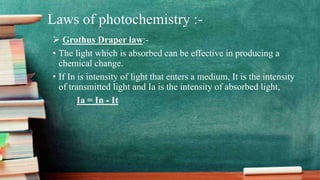
 Grothus Draper law:-
• The light which is absorbed can be effective in producing a
chemical change.
• If In is intensity of light that enters a medium, It is the intensity
of transmitted light and Ia is the intensity of absorbed light,
Ia = In - It
Laws of photochemistry :-
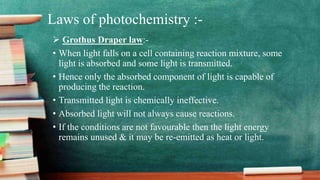
 Grothus Draper law:-
• When light falls on a cell containing reaction mixture, some
light is absorbed and some light is transmitted.
• Hence only the absorbed component of light is capable of
producing the reaction.
• Transmitted light is chemically ineffective.
• Absorbed light will not always cause reactions.
• If the conditions are not favourable then the light energy
remains unused & it may be re-emitted as heat or light.
Laws of photochemistry :-
 Grothus Draper law:-
Limitations :-
• It gives no idea about the relation between the absorbed
radiation and the molecules undergoing change.
• It purely works on the qualitative aspect.
Laws of photochemistry :-
Stark- Einstein law:-
• Stark and Einstein studied the quantitative aspect of
photochemical reactions by application of quantum theory of
light.
• They noted :
• Each molecule taking part in reaction absorbs only a single
quantum or photon of light.
• The molecule gains one photon equivalent energy is activated
and enters into the reaction.
Laws of photochemistry :-
Stark- Einstein law:-
In a photochemical reaction, each molecule of thereacting
substance absorbs a single photon of radiation causing the
reaction and is activated to form the products.
Laws of photochemistry :-
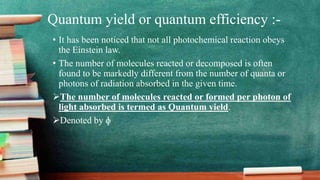
Quantum yield or quantum efficiency :-
• It has been noticed that not all photochemical reaction obeys
the Einstein law.
• The number of molecules reacted or decomposed is often
found to be markedly different from the number of quanta or
photons of radiation absorbed in the given time.
The number of molecules reacted or formed per photon of
light absorbed is termed as Quantum yield.
Denoted by ɸ
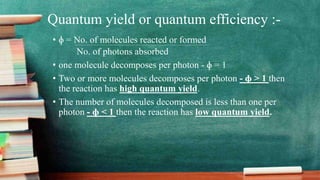
Quantum yield or quantum efficiency :-
• ɸ = No. of molecules reacted or formed
No. of photons absorbed
• one molecule decomposes per photon - ɸ = 1
• Two or more molecules decomposes per photon - ɸ > 1 then
the reaction has high quantum yield.
• The number of molecules decomposed is less than one per
photon - ɸ < 1 then the reaction has low quantum yield.
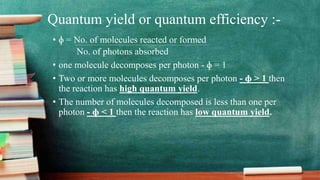
Quantum yield or quantum efficiency :-
• ɸ = No. of molecules reacted or formed
No. of photons absorbed
• one molecule decomposes per photon - ɸ = 1
• Two or more molecules decomposes per photon - ɸ > 1 then
the reaction has high quantum yield.
• The number of molecules decomposed is less than one per
photon - ɸ < 1 then the reaction has low quantum yield.
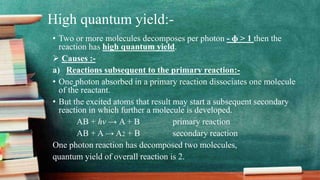
High quantum yield:-
• Two or more molecules decomposes per photon - ɸ > 1 then the
reaction has high quantum yield.
 Causes :-
a) Reactions subsequent to the primary reaction:-
• One photon absorbed in a primary reaction dissociates one molecule
of the reactant.
• But the excited atoms that result may start a subsequent secondary
reaction in which further a molecule is developed.
AB + hv → A + B primary reaction
AB + A → A2 + B secondary reaction
One photon reaction has decomposed two molecules,
quantum yield of overall reaction is 2.
High quantum yield:-
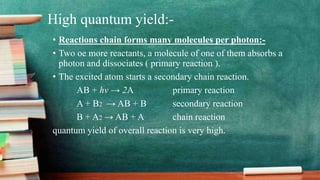
• Reactions chain forms many molecules per photon:-
• Two oe more reactants, a molecule of one of them absorbs a
photon and dissociates ( primary reaction ).
• The excited atom starts a secondary chain reaction.
AB + hv → 2A primary reaction
A + B2 → AB + B secondary reaction
B + A2 → AB + A chain reaction
quantum yield of overall reaction is very high.
High quantum yield:-
 examples :-
I. Decomposition of HI.
II. Hydrogen- chlorine reaction.
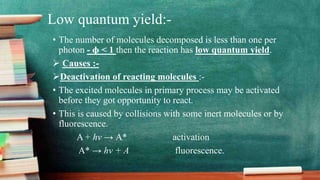
Low quantum yield:-
• The number of molecules decomposed is less than one per
photon - ɸ < 1 then the reaction has low quantum yield.
 Causes :-
Deactivation of reacting molecules :-
• The excited molecules in primary process may be activated
before they got opportunity to react.
• This is caused by collisions with some inert molecules or by
fluorescence.
A + hv → A* activation
A* → hv + A fluorescence.
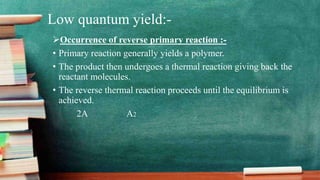
Low quantum yield:-
Occurrence of reverse primary reaction :-
• Primary reaction generally yields a polymer.
• The product then undergoes a thermal reaction giving back the
reactant molecules.
• The reverse thermal reaction proceeds until the equilibrium is
achieved.
2A A2
Low quantum yield:-
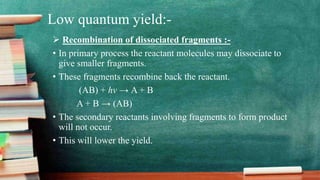
 Recombination of dissociated fragments :-
• In primary process the reactant molecules may dissociate to
give smaller fragments.
• These fragments recombine back the reactant.
(AB) + hv → A + B
A + B → (AB)
• The secondary reactants involving fragments to form product
will not occur.
• This will lower the yield.
Low quantum yield:-
 examples :-
I. Dimerization of anthracene
II. Combination of hydrogen and bromine molecule

Photochemistry sem 5 509

  • 1.
  • 5.
    What are photo-chemicalreactions ? • Photochemical reactions are those reactions which are brought about by absorption of light of all wavelengths, ultraviolet to infrared and radio-frequency. • Reactions which are brought about by wavelength 2000◦A to 4000◦A (visible range ) are important. • All types of reactions : oxidation reduction condensation isomerization polymerization Occur by absorption of radiation.
  • 6.
    Comparison between : Photochemicalreaction • Reaction is brought about by the absorption of radiation. • Free energy increases. • The rate of reaction depends on the intensity of light absorbed. Thermal reaction • Reaction taking palce in dark starts thermally. • Free energy decreases. • At constant concentration of reactants the rate of reaction depends on the change in temperature.
  • 8.
    • In photo-chemicalreactions, the free energy increases. • Eg, The conversion of oxygen to ozone. Decomposition of ammonia. Photosynthesis of carbohydrates from water and carbon dioxide in presence of chlorophyll.
  • 11.
    Laws of photochemistry:-  Grothus Draper law:- • The light which is absorbed can be effective in producing a chemical change. • If In is intensity of light that enters a medium, It is the intensity of transmitted light and Ia is the intensity of absorbed light, Ia = In - It
  • 12.
    Laws of photochemistry:-  Grothus Draper law:- • When light falls on a cell containing reaction mixture, some light is absorbed and some light is transmitted. • Hence only the absorbed component of light is capable of producing the reaction. • Transmitted light is chemically ineffective. • Absorbed light will not always cause reactions. • If the conditions are not favourable then the light energy remains unused & it may be re-emitted as heat or light.
  • 13.
    Laws of photochemistry:-  Grothus Draper law:- Limitations :- • It gives no idea about the relation between the absorbed radiation and the molecules undergoing change. • It purely works on the qualitative aspect.
  • 14.
    Laws of photochemistry:- Stark- Einstein law:- • Stark and Einstein studied the quantitative aspect of photochemical reactions by application of quantum theory of light. • They noted : • Each molecule taking part in reaction absorbs only a single quantum or photon of light. • The molecule gains one photon equivalent energy is activated and enters into the reaction.
  • 15.
    Laws of photochemistry:- Stark- Einstein law:- In a photochemical reaction, each molecule of thereacting substance absorbs a single photon of radiation causing the reaction and is activated to form the products.
  • 16.
  • 17.
    Quantum yield orquantum efficiency :- • It has been noticed that not all photochemical reaction obeys the Einstein law. • The number of molecules reacted or decomposed is often found to be markedly different from the number of quanta or photons of radiation absorbed in the given time. The number of molecules reacted or formed per photon of light absorbed is termed as Quantum yield. Denoted by ɸ
  • 18.
    Quantum yield orquantum efficiency :- • ɸ = No. of molecules reacted or formed No. of photons absorbed • one molecule decomposes per photon - ɸ = 1 • Two or more molecules decomposes per photon - ɸ > 1 then the reaction has high quantum yield. • The number of molecules decomposed is less than one per photon - ɸ < 1 then the reaction has low quantum yield.
  • 19.
    Quantum yield orquantum efficiency :- • ɸ = No. of molecules reacted or formed No. of photons absorbed • one molecule decomposes per photon - ɸ = 1 • Two or more molecules decomposes per photon - ɸ > 1 then the reaction has high quantum yield. • The number of molecules decomposed is less than one per photon - ɸ < 1 then the reaction has low quantum yield.
  • 20.
    High quantum yield:- •Two or more molecules decomposes per photon - ɸ > 1 then the reaction has high quantum yield.  Causes :- a) Reactions subsequent to the primary reaction:- • One photon absorbed in a primary reaction dissociates one molecule of the reactant. • But the excited atoms that result may start a subsequent secondary reaction in which further a molecule is developed. AB + hv → A + B primary reaction AB + A → A2 + B secondary reaction One photon reaction has decomposed two molecules, quantum yield of overall reaction is 2.
  • 21.
    High quantum yield:- •Reactions chain forms many molecules per photon:- • Two oe more reactants, a molecule of one of them absorbs a photon and dissociates ( primary reaction ). • The excited atom starts a secondary chain reaction. AB + hv → 2A primary reaction A + B2 → AB + B secondary reaction B + A2 → AB + A chain reaction quantum yield of overall reaction is very high.
  • 22.
    High quantum yield:- examples :- I. Decomposition of HI. II. Hydrogen- chlorine reaction.
  • 23.
    Low quantum yield:- •The number of molecules decomposed is less than one per photon - ɸ < 1 then the reaction has low quantum yield.  Causes :- Deactivation of reacting molecules :- • The excited molecules in primary process may be activated before they got opportunity to react. • This is caused by collisions with some inert molecules or by fluorescence. A + hv → A* activation A* → hv + A fluorescence.
  • 24.
    Low quantum yield:- Occurrenceof reverse primary reaction :- • Primary reaction generally yields a polymer. • The product then undergoes a thermal reaction giving back the reactant molecules. • The reverse thermal reaction proceeds until the equilibrium is achieved. 2A A2
  • 25.
    Low quantum yield:- Recombination of dissociated fragments :- • In primary process the reactant molecules may dissociate to give smaller fragments. • These fragments recombine back the reactant. (AB) + hv → A + B A + B → (AB) • The secondary reactants involving fragments to form product will not occur. • This will lower the yield.
  • 26.
    Low quantum yield:- examples :- I. Dimerization of anthracene II. Combination of hydrogen and bromine molecule