Temperature and Reaction Rates
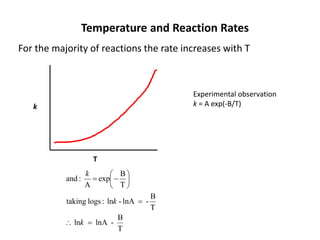
For the majority of reactions the rate increases with T
k
T
Experimental observation
k = A exp(-B/T)
T
B
-
lnA
ln
T
B
-
lnA
-
ln
:
logs
taking
T
B
exp
A
:
and
=
∴
=






−
=
k
k
k
lnk
1/T
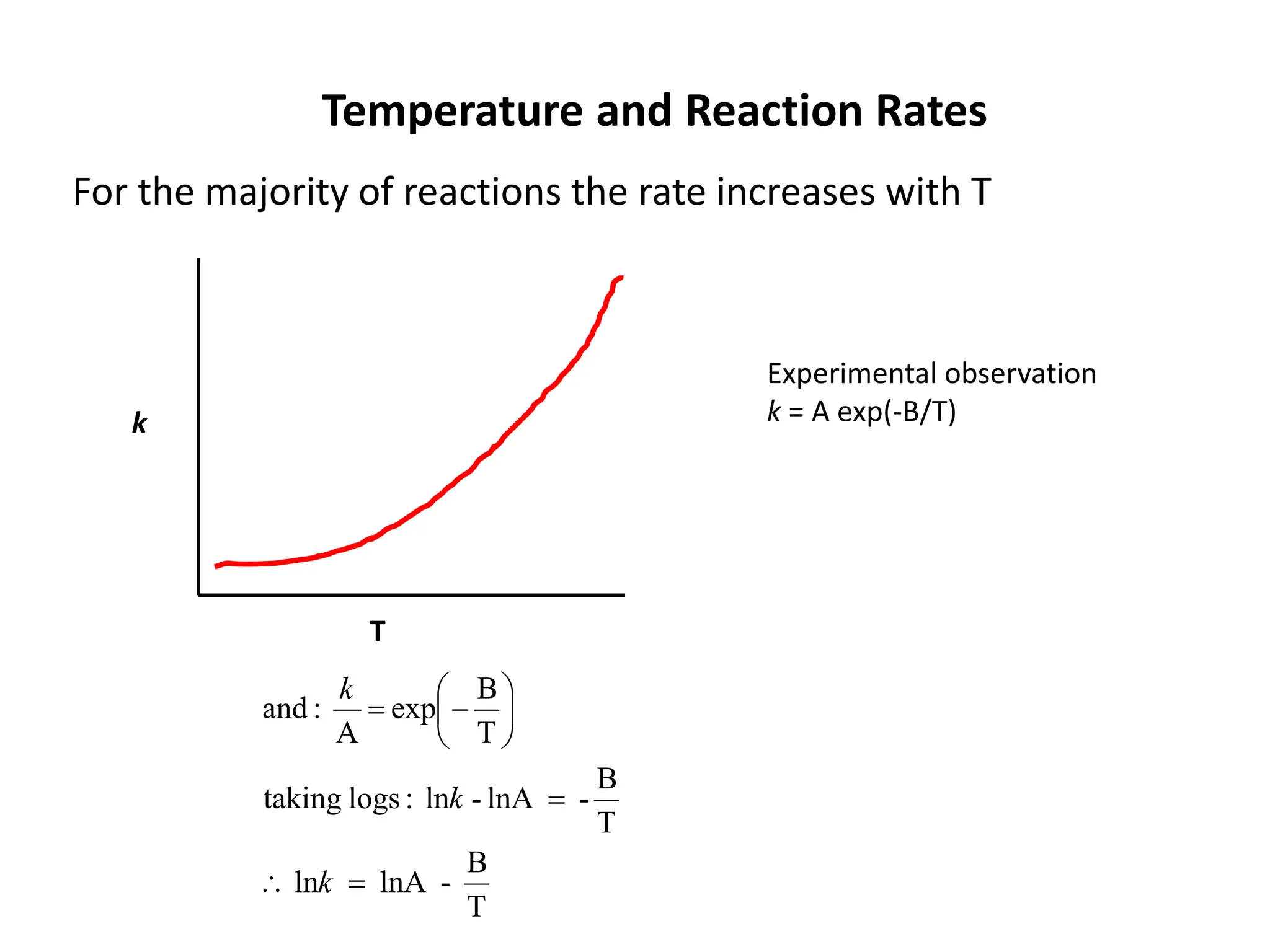
Intercept = lnA
Slope = -B
In practice can only
measure over a limited
Temperature range
B is positive if rate increases with T
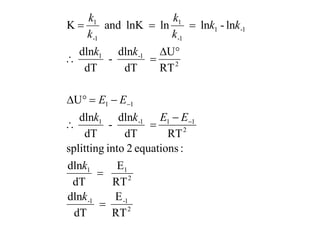
Van’t Hoff Treatment
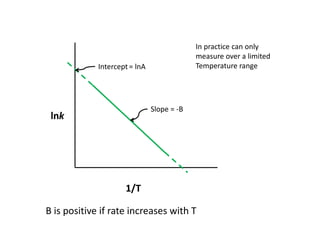
• Just as equilibrium constant K varies with T, so does k
Remember?
• Temperature dependence of K is given by:
Consider the following reaction:
C + D Y + Z
2
RT
U
dT
dlnK ο
∆
=
k1
k-1
2
1
-
1
-
2
1
1
2
1
1
1
-
1
1
1
2
1
-
1
1
-
1
1
-
1
1
-
1
RT
E
dT
dln
RT
E
dT
dln
:
equations
2
into
splitting
RT
dT
dln
-
dT
dln
U
RT
U
dT
dln
-
dT
dln
ln
-
ln
ln
lnK
and
K
=
=
−
=
∴
−
=
°
∆
°
∆
=
∴
=
=
=
−
−
k
k
E
E
k
k
E
E
k
k
k
k
k
k
k
k






=






=






=
=
=
∴
RT
E
-
Aexp
:
Generally
RT
E
-
exp
A
RT
E
-
exp
A
:
gives
g
integratin
dT
RT
E
dln
and
dT
RT
E
dln
1
-
1
-
1
-
1
1
1
2
1
-
1
-
2
1
1
k
k
k
k
k
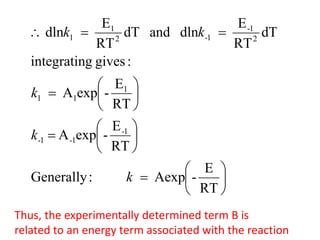
Thus, the experimentally determined term B is
related to an energy term associated with the reaction
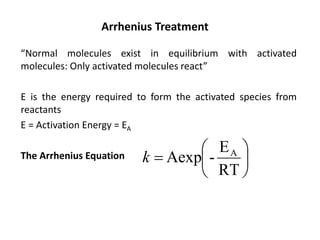
Arrhenius Treatment
“Normal molecules exist in equilibrium with activated
molecules: Only activated molecules react”
E is the energy required to form the activated species from
reactants
E = Activation Energy = EA
The Arrhenius Equation 





=
RT
E
-
Aexp A
k
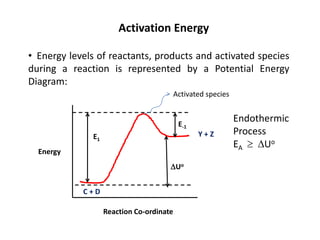
Activation Energy
• Energy levels of reactants, products and activated species
during a reaction is represented by a Potential Energy
Diagram:
Energy
Reaction Co-ordinate
E1
E-1
∆Uo
C + D
Y + Z
Endothermic
Process
EA ≥ ∆Uo
Activated species
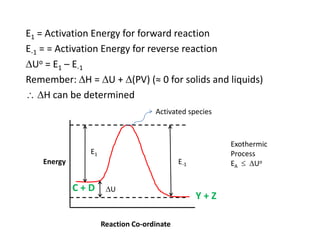
E1 = Activation Energy for forward reaction
E-1 = = Activation Energy for reverse reaction
∆Uo = E1 – E-1
Remember: ∆H = ∆U + ∆(PV) (≈ 0 for solids and liquids)
∴ ∆H can be determined
Energy
Reaction Co-ordinate
Activated species
E1
∆U
C + D
Y + Z
E-1
Exothermic
Process
EA ≤ ∆Uo
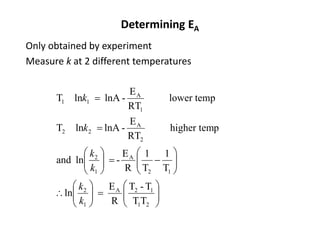
Determining EA
Only obtained by experiment
Measure k at 2 different temperatures








=








∴








−
=








=
=
2
1
1
2
A
1
2
1
2
A
1
2
2
A
2
2
1
A
1
1
T
T
T
-
T
R
E
ln
T
1
T
1
R
E
-
ln
and
p
higher tem
RT
E
-
lnA
ln
T
lower temp
RT
E
-
lnA
ln
T
k
k
k
k
k
k
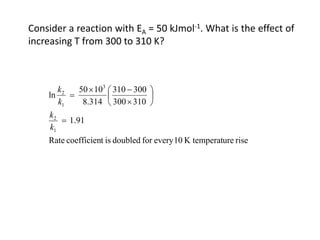
Consider a reaction with EA = 50 kJmol-1. What is the effect of
increasing T from 300 to 310 K?
rise
ure
K temperat
10
every
for
doubled
is
t
coefficien
Rate
1.91
310
300
300
310
8.314
10
50
ln
1
2
3
1
2
=






×
−
×
=
k
k
k
k
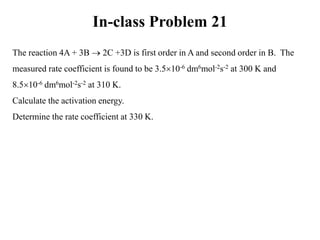
In-class Problem 21
The reaction 4A + 3B → 2C +3D is first order in A and second order in B. The
measured rate coefficient is found to be 3.5×10⁻⁶ dm6mol-2s-2 at 300 K and
8.5×10⁻⁶ dm6mol-2s-2 at 310 K.
Calculate the activation energy.
Determine the rate coefficient at 330 K.
In-class Problem 22
The rate coefficient for a reaction at 30°C is measured to be exactly three times
that of the value at 20°C. Calculate the activation energy.
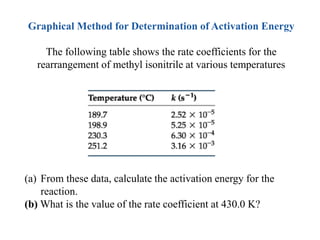
Graphical Method for Determination of Activation Energy
The following table shows the rate coefficients for the
rearrangement of methyl isonitrile at various temperatures
(a) From these data, calculate the activation energy for the
reaction.
(b) What is the value of the rate coefficient at 430.0 K?
Analyze and Plan: We are given the rate coefficients, k,
measured at several temperatures. We can obtain EA from the
slope of a graph of ln k versus 1/T . Once we know EA we can use
the Arrhenius equation together with the given rate data to
calculate the rate coefficient at 430.0 K.
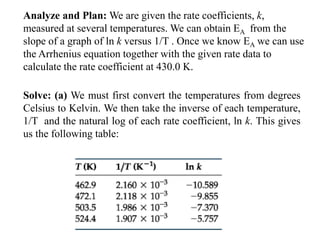
Solve: (a) We must first convert the temperatures from degrees
Celsius to Kelvin. We then take the inverse of each temperature,
1/T and the natural log of each rate coefficient, ln k. This gives
us the following table:
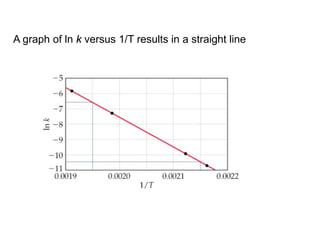
A graph of ln k versus 1/T results in a straight line
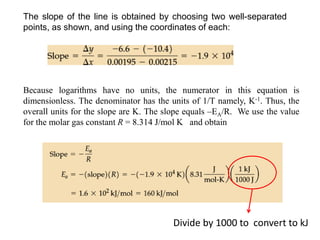
The slope of the line is obtained by choosing two well-separated
points, as shown, and using the coordinates of each:
Because logarithms have no units, the numerator in this equation is
dimensionless. The denominator has the units of 1/T namely, K-1. Thus, the
overall units for the slope are K. The slope equals –EA/R. We use the value
for the molar gas constant R = 8.314 J/mol K and obtain
Divide by 1000 to convert to kJ
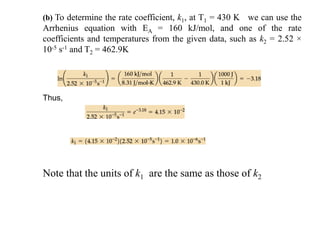
(b) To determine the rate coefficient, k1, at T1 = 430 K we can use the
Arrhenius equation with EA = 160 kJ/mol, and one of the rate
coefficients and temperatures from the given data, such as k2 = 2.52 ×
10-5 s-1 and T2 = 462.9K
Thus,
Note that the units of k1 are the same as those of k2
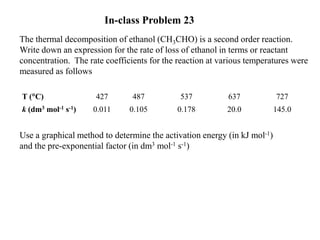
In-class Problem 23
The thermal decomposition of ethanol (CH3CHO) is a second order reaction.
Write down an expression for the rate of loss of ethanol in terms or reactant
concentration. The rate coefficients for the reaction at various temperatures were
measured as follows
Use a graphical method to determine the activation energy (in kJ mol-1)
and the pre-exponential factor (in dm3 mol-1 s-1)
T (°C) 427 487 537 637 727
k (dm3 mol-1 s-1) 0.011 0.105 0.178 20.0 145.0
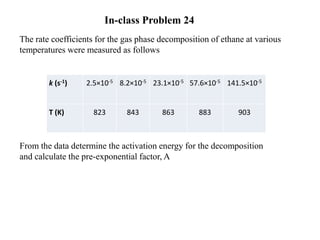
In-class Problem 24
The rate coefficients for the gas phase decomposition of ethane at various
temperatures were measured as follows
From the data determine the activation energy for the decomposition
and calculate the pre-exponential factor, A
k (s-1) 2.5×10⁻⁵ 8.2×10⁻⁵ 23.1×10⁻⁵ 57.6×10⁻⁵ 141.5×10⁻⁵
T (K) 823 843 863 883 903
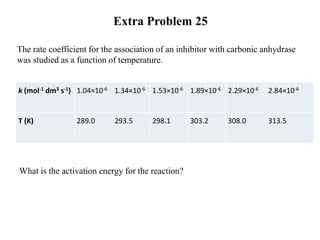
The rate coefficient for the association of an inhibitor with carbonic anhydrase
was studied as a function of temperature.
Extra Problem 25
What is the activation energy for the reaction?
k (mol-1 dm3 s-1) 1.04×10⁻⁶ 1.34×10⁻⁶ 1.53×10⁻⁶ 1.89×10⁻⁶ 2.29×10⁻⁶ 2.84×10⁻⁶
T (K) 289.0 293.5 298.1 303.2 308.0 313.5

Chemical Kinetics including Arrhenius equation

  • 1.
    Temperature and ReactionRates For the majority of reactions the rate increases with T k T Experimental observation k = A exp(-B/T) T B - lnA ln T B - lnA - ln : logs taking T B exp A : and = ∴ =       − = k k k
  • 2.
    lnk 1/T Intercept = lnA Slope= -B In practice can only measure over a limited Temperature range B is positive if rate increases with T
  • 3.
    Van’t Hoff Treatment •Just as equilibrium constant K varies with T, so does k Remember? • Temperature dependence of K is given by: Consider the following reaction: C + D Y + Z 2 RT U dT dlnK ο ∆ = k1 k-1
  • 4.
  • 5.
  • 6.
    Arrhenius Treatment “Normal moleculesexist in equilibrium with activated molecules: Only activated molecules react” E is the energy required to form the activated species from reactants E = Activation Energy = EA The Arrhenius Equation       = RT E - Aexp A k
  • 7.
    Activation Energy • Energylevels of reactants, products and activated species during a reaction is represented by a Potential Energy Diagram: Energy Reaction Co-ordinate E1 E-1 ∆Uo C + D Y + Z Endothermic Process EA ≥ ∆Uo Activated species
  • 8.
    E1 = ActivationEnergy for forward reaction E-1 = = Activation Energy for reverse reaction ∆Uo = E1 – E-1 Remember: ∆H = ∆U + ∆(PV) (≈ 0 for solids and liquids) ∴ ∆H can be determined Energy Reaction Co-ordinate Activated species E1 ∆U C + D Y + Z E-1 Exothermic Process EA ≤ ∆Uo
  • 9.
    Determining EA Only obtainedby experiment Measure k at 2 different temperatures         =         ∴         − =         = = 2 1 1 2 A 1 2 1 2 A 1 2 2 A 2 2 1 A 1 1 T T T - T R E ln T 1 T 1 R E - ln and p higher tem RT E - lnA ln T lower temp RT E - lnA ln T k k k k k k
  • 10.
    Consider a reactionwith EA = 50 kJmol-1. What is the effect of increasing T from 300 to 310 K? rise ure K temperat 10 every for doubled is t coefficien Rate 1.91 310 300 300 310 8.314 10 50 ln 1 2 3 1 2 =       × − × = k k k k
  • 11.
    In-class Problem 21 Thereaction 4A + 3B → 2C +3D is first order in A and second order in B. The measured rate coefficient is found to be 3.5×10⁻⁶ dm6mol-2s-2 at 300 K and 8.5×10⁻⁶ dm6mol-2s-2 at 310 K. Calculate the activation energy. Determine the rate coefficient at 330 K.
  • 12.
    In-class Problem 22 Therate coefficient for a reaction at 30°C is measured to be exactly three times that of the value at 20°C. Calculate the activation energy.
  • 13.
    Graphical Method forDetermination of Activation Energy The following table shows the rate coefficients for the rearrangement of methyl isonitrile at various temperatures (a) From these data, calculate the activation energy for the reaction. (b) What is the value of the rate coefficient at 430.0 K?
  • 14.
    Analyze and Plan:We are given the rate coefficients, k, measured at several temperatures. We can obtain EA from the slope of a graph of ln k versus 1/T . Once we know EA we can use the Arrhenius equation together with the given rate data to calculate the rate coefficient at 430.0 K. Solve: (a) We must first convert the temperatures from degrees Celsius to Kelvin. We then take the inverse of each temperature, 1/T and the natural log of each rate coefficient, ln k. This gives us the following table:
  • 15.
    A graph ofln k versus 1/T results in a straight line
  • 16.
    The slope ofthe line is obtained by choosing two well-separated points, as shown, and using the coordinates of each: Because logarithms have no units, the numerator in this equation is dimensionless. The denominator has the units of 1/T namely, K-1. Thus, the overall units for the slope are K. The slope equals –EA/R. We use the value for the molar gas constant R = 8.314 J/mol K and obtain Divide by 1000 to convert to kJ
  • 17.
    (b) To determinethe rate coefficient, k1, at T1 = 430 K we can use the Arrhenius equation with EA = 160 kJ/mol, and one of the rate coefficients and temperatures from the given data, such as k2 = 2.52 × 10⁻⁵ s-1 and T2 = 462.9K Thus, Note that the units of k1 are the same as those of k2
  • 18.
    In-class Problem 23 Thethermal decomposition of ethanol (CH3CHO) is a second order reaction. Write down an expression for the rate of loss of ethanol in terms or reactant concentration. The rate coefficients for the reaction at various temperatures were measured as follows Use a graphical method to determine the activation energy (in kJ mol-1) and the pre-exponential factor (in dm3 mol-1 s-1) T (°C) 427 487 537 637 727 k (dm3 mol-1 s-1) 0.011 0.105 0.178 20.0 145.0
  • 19.
    In-class Problem 24 Therate coefficients for the gas phase decomposition of ethane at various temperatures were measured as follows From the data determine the activation energy for the decomposition and calculate the pre-exponential factor, A k (s-1) 2.5×10⁻⁵ 8.2×10⁻⁵ 23.1×10⁻⁵ 57.6×10⁻⁵ 141.5×10⁻⁵ T (K) 823 843 863 883 903
  • 20.
    The rate coefficientfor the association of an inhibitor with carbonic anhydrase was studied as a function of temperature. Extra Problem 25 What is the activation energy for the reaction? k (mol-1 dm3 s-1) 1.04×10⁻⁶ 1.34×10⁻⁶ 1.53×10⁻⁶ 1.89×10⁻⁶ 2.29×10⁻⁶ 2.84×10⁻⁶ T (K) 289.0 293.5 298.1 303.2 308.0 313.5