Ventricular
Assist
Device
 A Ventricular assist device, or VAD, is
 a mechanical circulatory device that is used to
 partially or completely replace the function of a
 failing heart. Some VADs are intended for short
 term use, typically for patients recovering
 from heart attacks or heart surgery, while
 others are intended for long term use (months
 to years and in some cases for life), typically for
 patients suffering from congestive heart failure.
 VADs need to be clearly distinguished
  from artificial hearts, which are designed to
  completely take over cardiac function and
  generally require the removal of the patient's
  heart.
 VADs are designed to assist either the right
  (RVAD) or left (LVAD)ventricle, or both at once
  (BiVAD). Which of these types is used depends
  primarily on the underlying heart disease and
  the pulmonary arterial resistance that
  determines the load on the right ventricle.
 LVADs are most commonly used, but when
  pulmonary arterial resistance is high, right
  ventricular assistance becomes necessary. Long term
  VADs are normally used to keep patients alive with a
  good quality of life while they wait for a heart
  transplantation (known as a "bridge to
  transplantation"). However, LVADs are sometimes
  used asdestination therapy and sometimes as a
  bridge to recovery.
 In the last few years, VADs have improved
  significantly in terms of providing survival and
  quality of life among recipients.
 VADs are mechanical devices that support the
 lower left heart chamber (left ventricular assist
 devices, or LVADs), the lower right heart
 chamber (right ventricular assist devices, or
 RVADs) or both lower heart chambers
 (biventricular assist devices, or BIVADs).
 Your doctor may recommend you have a VAD
 implanted if:

You're waiting for a heart transplant.
  You may have a VAD implanted temporarily while
 you wait for a donor heart to become available. A
 VAD can keep blood pumping despite a diseased
 heart and will be removed when your new heart is
 implanted. When a VAD is implanted while you're
 waiting for a heart transplant, it's referred to as a
 "bridge to transplant."
 Your heart's function can become normal again. If
 your heart failure is temporary, your doctor may
 recommend implanting a VAD until your heart is
 healthy enough to pump blood on its own again. It's
 also possible you'll have a VAD implanted for a short
 time if you're recovering from heart surgery. You may
 have a VAD implanted for only a few weeks or
 months. RVADs are often temporarily implanted after
 some heart surgeries. An RVAD can help keep blood
 flowing from the right ventricle to your lungs.
 You're not a good candidate for a heart
 transplant. VADs are increasingly being used as a
 long-term treatment for people who have heart
 failure, but aren't good candidates for a heart
 transplant. A VAD can improve your quality of life.
 When a VAD is implanted as a permanent treatment
 for heart failure, it's referred to as destination
 therapy.
 If VADs can't help your heart, another treatment
 option your doctor may consider is a total artificial
 heart (TAH). This device replaces the two ventricles
 of your heart. Because a total artificial heart is
 difficult to implant and can cause serious
 complications, it's only used in a small number of
 people.
Types of
Ventricular
Assist
Devices
 The two basic types of VADs are a left ventricular
 assist device (LVAD) and a right ventricular assist
 device (RVAD). If both types are used at the same
 time, they're called a biventricular assist device
 (BIVAD).
 The LVAD is the most common type of VAD. It helps
  the left ventricle pump blood to the aorta. The aorta
  is the main artery that carries oxygen-rich blood
  from your heart to your body.
 RVADs usually are used only for short-term support
  of the right ventricle after LVAD surgery or
  other heart surgery. An RVAD helps the right
  ventricle pump blood to the pulmonary artery. This is
  the artery that carries blood from the heart to the
  lungs to pick up oxygen.
 A BIVAD might be used if both ventricles don't work well
  enough to meet the body's needs. Another treatment
  option for this condition is a total artificial heart(TAH). A
  TAH is a device that replaces the ventricles.
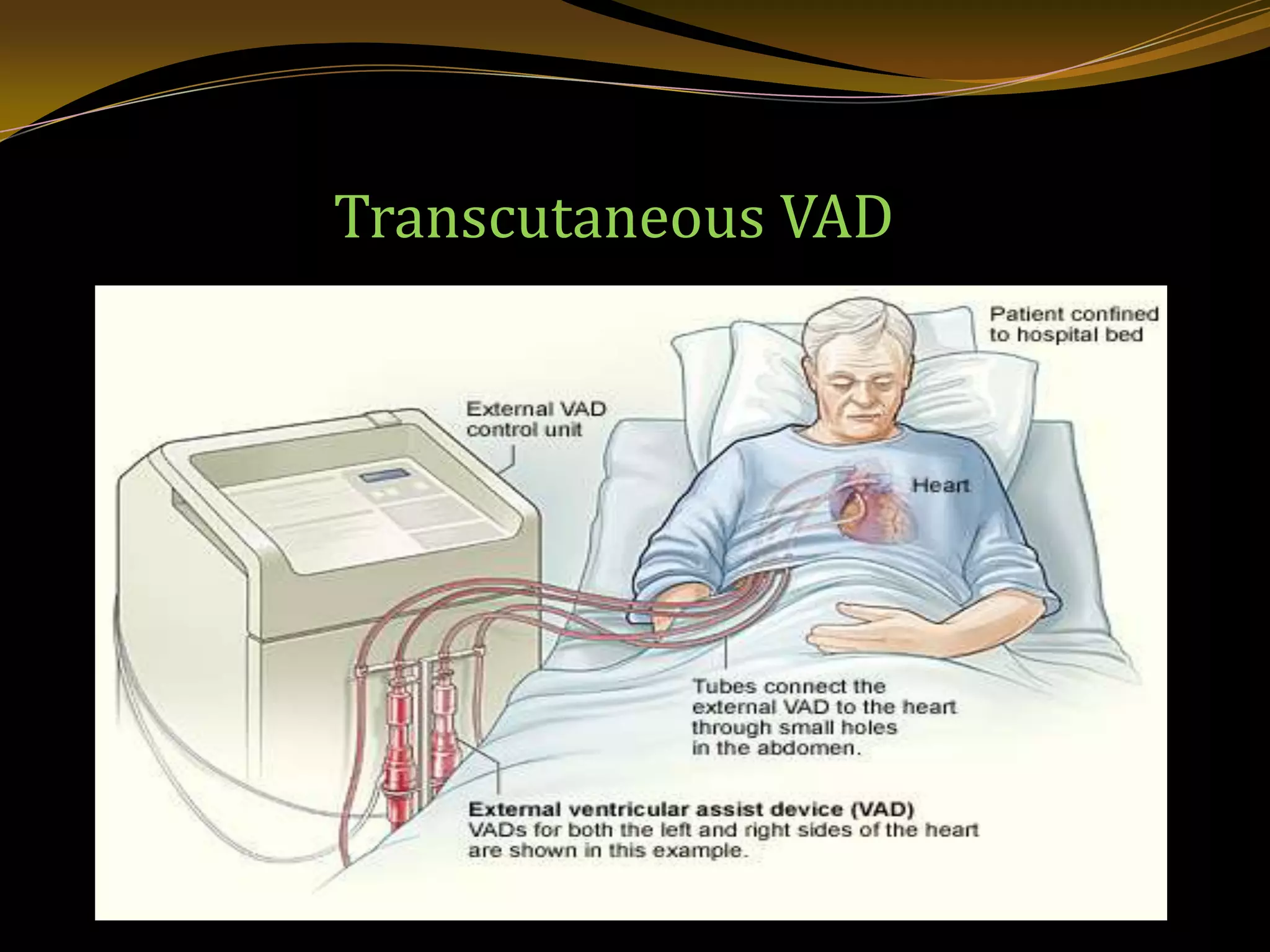
 VADs have two basic designs. A transcutaneous VAD has
  its pump and power source located outside of the body.
  Tubes connect the pump to the heart through small holes
  in the abdomen. This type of VAD might be used for
  short-term support during or after surgery.
Transcutaneous VAD
How you
prepare?
 Before your VAD is implanted, it's likely you'll
 stay in the hospital for some time preparing for
 surgery. While you're in the hospital, you may
 have other treatments for your weakened heart
 or heart failure. Your doctors will make sure
 you're healthy enough to have surgery to
 implant a VAD. You may need many tests or
 other procedures before the surgery, including:
 Echocardiogram. An echocardiogram, which is an
 imaging test, helps your doctor determine the
 pumping function of your heart, check your heart
 valves and help determine the cause of your heart
 failure. This can help your doctor decide if you're a
 candidate for a VAD and if there are any other
 treatment options available.

 Chest X-ray. Your doctor uses a chest X-ray to see
 the size and shape of your heart and lungs.
 Blood tests. Your doctor will order blood tests to see
 if your liver and kidneys are working properly before
 the surgery to implant your VAD. Your doctor might
 also check for other chemicals in your blood that
 show how well your heart is working. Blood tests are
 commonly used to check for diabetes, thyroid
 problems or symptoms of infection, which will need
 to be treated before you can have surgery.

 Electrocardiogram (EKG). An electrocardiogram
 can help your doctor check your heart rhythm before
 surgery.
 Cardiac catheterization. In this test, a short tube
 (sheath) is inserted into a vein or artery in your
 upper leg (groin) or arm. A hollow, flexible and
 longer tube (guide catheter) is then inserted into the
 sheath. Aided by X-ray images on a monitor, your
 doctor threads the guide catheter through that artery
 until it reaches your heart. This test checks the
 pressures in your heart and may be used to
 determine if you are a candidate for a VAD and if you
 may need additional devices.
Pumps
 The pumps used in VADs can be divided into two
 main categories – pulsatile pumps, that mimic the
 natural pulsing action of the heart, and continuous
 flow pumps.
 Continuous flow VADs normally use
 either centrifugal pumps or an axial flow pump. Both
 types have a central rotor containing permanent
 magnets. Controlled electric currents running
 through coils contained in the pump housing apply
 forces to the magnets, which in turn cause the rotors
 to spin. In the centrifugal pumps, the rotors are
 shaped to accelerate the blood circumferentially and
 thereby cause it to move toward the outer rim of the
 pump, whereas in the axial flow pumps the rotors are
 more or less cylindrical with blades that are helical,
 causing the blood to be accelerated in the direction of
 the rotor's axis.
Implanting and
using a VAD has
 some rare but
 serious risks,
   including:
 Blood clots can slow or block normal blood flow
  through your heart, which can lead to stroke or
  heart attack, or cause your VAD to stop working.
 Your doctor may prescribe a blood-thinning
  medication such as aspirin or warfarin
  (Coumadin, Jantoven) to help prevent blood clots
  after your VAD is implanted. It's very important to
  follow the instructions for taking warfarin
  carefully to reduce the risk of life-threatening
  blood clots. Warfarin is a medication that can
  have dangerous side effects if not taken exactly as
  instructed, so talk to your doctor about any
  special instructions you'll need to follow.
 Bleeding. Implanting a VAD requires open-heart
 surgery. Having open-heart surgery can increase your
 risk of bleeding after your operation. Taking blood-
 thinning medications to reduce your risk of clotting
 also increases your risk of dangerous bleeding into
 the gastrointestinal track and the brain.
 Infection. Because the power source and control unit
 for your VAD are outside your body and connected
 through a port in your skin, there's an increased risk
 of germs getting in the port and causing a serious
 infection. You and your medical team should watch
 for signs of infection, such as soreness or redness
 near the port, fluid draining from the site, or a fever.
 Device malfunctions. It's possible that your VAD
 may stop working properly after it's implanted. The
 pumping action of the device might not work exactly
 right, making it so not enough blood pumps through
 your heart. The power supply to the device could also
 fail, or other parts of the device may stop working
 properly. Each of these problems requires immediate
 medical attention.
 Right heart failure. If you have an LVAD implanted,
  it will pump more blood from the left ventricle of
  your heart than what your heart might have been
  used to. Your right ventricle may be too weak to
  pump the increased amount of blood.
 If you develop right heart failure, medications may
  help improve the pumping ability of the right
  ventricle. An RVAD might also be implanted to
  support the right ventricle if you develop this
  complication.
 Treatment of VAD-related infection is exceedingly
 difficult and many patients die of infection despite
 optimal treatment. Initial treatment should be with
 broad spectrum antibiotics, but every effort must be
 made to obtain appropriate samples for culture. A
 final decision regarding antibiotic therapy must be
 based on the results of microbiogical cultures.
 Other problems include immunosuppression,clotting
 with resultant stroke, and bleeding secondary to
 anticoagulation. Some of the
 polyurethane components used in the devices cause
 the deletion of a subset of immune cells when blood
 comes in contact with them. This predisposes the
 patient to fungal and some viral infections
 necessitating appropriate prophylactic therapy
VADs extend the quantity of life. People
 who have had VADs implanted have had
 lower rates of depression than those
 people suffering from cardiac disease
 that have not undergone implantation
 surgery.
What you
can expect
 During the procedure
  The procedure to implant a VAD is an open-heart
  surgery that usually takes four to six hours. You'll be
  asleep during the procedure, so you shouldn't feel
  any pain during the procedure.
 You'll be connected to a machine that helps you
  breathe (ventilator) during your surgery. A tube will
  be run down your throat to your lungs and connected
  to the ventilator. You may need to remain connected
  to the ventilator for several days after your surgery.
 A cut will be made down the center of your chest.
  Your chest bone (sternum) is separated and your rib
  cage is opened so that your doctors can operate on
  your heart. Your heart is stopped during the surgery.
  You will be connected to a heart-lung bypass machine
  that keeps oxygenated blood flowing through your
  body during surgery.
 Once your VAD is implanted and working properly,
  your doctors will take you off the heart-lung bypass
  machine so that the VAD can begin pumping blood
  through your heart.
 Some VADs pump blood similar to the way your heart
 does, with a pumping action. Other VADs allow a
 continuous stream of blood to flow through your
 heart. If you have a continuous stream of blood
 flowing through your LVAD, you may not have a
 normal pulse, even though your body is getting the
 blood it needs.
After the
procedure
 When you wake up from your surgery, you'll be in the
 intensive care unit (ICU). You'll stay in the ICU for
 several days, where you'll be fed and given fluids and
 medications through an intravenous (IV) line. You'll
 have a tube in your bladder to drain your urine and
 other tubes in your chest to drain fluid and blood.
 Your lungs may not work properly immediately after
 your surgery, so you may need to remain connected
 to a ventilator for a few more days until you're able to
 breathe on your own.
 After a few days in the ICU, you'll likely be moved to a
 regular hospital room. As you recover, nurses will
 help you become increasingly active. They may help
 you get out of bed, sit up and walk around the
 hallways of the hospital. You may also have visits
 with a physical therapist to help you continue to gain
 strength and get used to performing daily activities.
 The amount of time you'll spend in the ICU and in the
 hospital can vary, depending on your condition
 before the procedure and how well you recover after
 your VAD is placed.
 You'll likely be prescribed antibiotics and blood-
  thinning medications to prevent infection and other
  complications while you're in the hospital. Your
  doctor will order blood tests periodically to check
  your kidney function and to make sure your
  medications are effective.
 While you're recovering in the hospital, it can be
  helpful to have friends and family visit. Visitors can
  help you perform some physical activities, and they
  can learn to help you care for your VAD when you go
  home.
Results
 After you're released from the hospital, you may be
 able to return to most of your daily activities.
 Depending on your condition, you may be able to
 return to work, be sexually active and drive. Your
 doctor should tell you what activities are appropriate
 for you.
 You will likely have weekly appointments at a
 specialized clinic or hospital to check how well your
 VAD is working. Your doctor may also recommend a
 cardiac rehabilitation program (cardiac rehab).
 Cardiac rehab is a customized program of exercise
 and education, designed to help you recover after a
 heart attack, from other forms of heart disease or
 after surgery to treat heart disease.
 Living with a VAD can seem stressful. You may worry
 that your VAD will stop working or that you'll get an
 infection. If you're waiting for a heart transplant, you
 may worry that your VAD won't keep you alive long
 enough to receive a donor heart. Tell your medical
 team and family if you feel this way. It may help to
 discuss how you're feeling, join a support group or
 talk with a professional counselor.
 VADs and heart transplants
 If you have a VAD implanted to help your heart pump
 blood while you wait for a heart transplant, you'll
 remain in close contact with your doctor and
 transplant center while you remain on the waiting
 list. It's likely you won't be allowed to travel farther
 than two hours driving time of your hospital in case a
 donor heart becomes available.
ALTERNATIVE TREATMENTS
Your doctor will initially attempt to treat your heart
disease with medications and lifestyle .
Medications often used to treat heart failure
include beta blockers and ACE inhibitors, which decrease
the workload of the heart. Diuretics are often used to get
rid of excess fluid which accumulates as a result of heart
failure. Examples of good lifestyle changes that can make
the heart healthier are:
.• Regular exercise and weight loss
• Cholesterol and blood pressure management with they
help of your doctor
• Smoking cessation
• Controlling diabetes (if applicable)
We’re done
thank you so
   much for
 listening! 

Ventricular Assist Device

  • 1.
  • 2.
     A Ventricularassist device, or VAD, is a mechanical circulatory device that is used to partially or completely replace the function of a failing heart. Some VADs are intended for short term use, typically for patients recovering from heart attacks or heart surgery, while others are intended for long term use (months to years and in some cases for life), typically for patients suffering from congestive heart failure.
  • 3.
     VADs needto be clearly distinguished from artificial hearts, which are designed to completely take over cardiac function and generally require the removal of the patient's heart.  VADs are designed to assist either the right (RVAD) or left (LVAD)ventricle, or both at once (BiVAD). Which of these types is used depends primarily on the underlying heart disease and the pulmonary arterial resistance that determines the load on the right ventricle.
  • 4.
     LVADs aremost commonly used, but when pulmonary arterial resistance is high, right ventricular assistance becomes necessary. Long term VADs are normally used to keep patients alive with a good quality of life while they wait for a heart transplantation (known as a "bridge to transplantation"). However, LVADs are sometimes used asdestination therapy and sometimes as a bridge to recovery.  In the last few years, VADs have improved significantly in terms of providing survival and quality of life among recipients.
  • 5.
     VADs aremechanical devices that support the lower left heart chamber (left ventricular assist devices, or LVADs), the lower right heart chamber (right ventricular assist devices, or RVADs) or both lower heart chambers (biventricular assist devices, or BIVADs).
  • 6.
     Your doctormay recommend you have a VAD implanted if: You're waiting for a heart transplant. You may have a VAD implanted temporarily while you wait for a donor heart to become available. A VAD can keep blood pumping despite a diseased heart and will be removed when your new heart is implanted. When a VAD is implanted while you're waiting for a heart transplant, it's referred to as a "bridge to transplant."
  • 7.
     Your heart'sfunction can become normal again. If your heart failure is temporary, your doctor may recommend implanting a VAD until your heart is healthy enough to pump blood on its own again. It's also possible you'll have a VAD implanted for a short time if you're recovering from heart surgery. You may have a VAD implanted for only a few weeks or months. RVADs are often temporarily implanted after some heart surgeries. An RVAD can help keep blood flowing from the right ventricle to your lungs.
  • 8.
     You're nota good candidate for a heart transplant. VADs are increasingly being used as a long-term treatment for people who have heart failure, but aren't good candidates for a heart transplant. A VAD can improve your quality of life. When a VAD is implanted as a permanent treatment for heart failure, it's referred to as destination therapy.
  • 9.
     If VADscan't help your heart, another treatment option your doctor may consider is a total artificial heart (TAH). This device replaces the two ventricles of your heart. Because a total artificial heart is difficult to implant and can cause serious complications, it's only used in a small number of people.
  • 10.
  • 11.
     The twobasic types of VADs are a left ventricular assist device (LVAD) and a right ventricular assist device (RVAD). If both types are used at the same time, they're called a biventricular assist device (BIVAD).
  • 12.
     The LVADis the most common type of VAD. It helps the left ventricle pump blood to the aorta. The aorta is the main artery that carries oxygen-rich blood from your heart to your body.  RVADs usually are used only for short-term support of the right ventricle after LVAD surgery or other heart surgery. An RVAD helps the right ventricle pump blood to the pulmonary artery. This is the artery that carries blood from the heart to the lungs to pick up oxygen.
  • 13.
     A BIVADmight be used if both ventricles don't work well enough to meet the body's needs. Another treatment option for this condition is a total artificial heart(TAH). A TAH is a device that replaces the ventricles.  VADs have two basic designs. A transcutaneous VAD has its pump and power source located outside of the body. Tubes connect the pump to the heart through small holes in the abdomen. This type of VAD might be used for short-term support during or after surgery.
  • 14.
  • 15.
  • 16.
     Before yourVAD is implanted, it's likely you'll stay in the hospital for some time preparing for surgery. While you're in the hospital, you may have other treatments for your weakened heart or heart failure. Your doctors will make sure you're healthy enough to have surgery to implant a VAD. You may need many tests or other procedures before the surgery, including:
  • 17.
     Echocardiogram. Anechocardiogram, which is an imaging test, helps your doctor determine the pumping function of your heart, check your heart valves and help determine the cause of your heart failure. This can help your doctor decide if you're a candidate for a VAD and if there are any other treatment options available.  Chest X-ray. Your doctor uses a chest X-ray to see the size and shape of your heart and lungs.
  • 18.
     Blood tests.Your doctor will order blood tests to see if your liver and kidneys are working properly before the surgery to implant your VAD. Your doctor might also check for other chemicals in your blood that show how well your heart is working. Blood tests are commonly used to check for diabetes, thyroid problems or symptoms of infection, which will need to be treated before you can have surgery.  Electrocardiogram (EKG). An electrocardiogram can help your doctor check your heart rhythm before surgery.
  • 19.
     Cardiac catheterization.In this test, a short tube (sheath) is inserted into a vein or artery in your upper leg (groin) or arm. A hollow, flexible and longer tube (guide catheter) is then inserted into the sheath. Aided by X-ray images on a monitor, your doctor threads the guide catheter through that artery until it reaches your heart. This test checks the pressures in your heart and may be used to determine if you are a candidate for a VAD and if you may need additional devices.
  • 20.
  • 21.
     The pumpsused in VADs can be divided into two main categories – pulsatile pumps, that mimic the natural pulsing action of the heart, and continuous flow pumps.
  • 22.
     Continuous flowVADs normally use either centrifugal pumps or an axial flow pump. Both types have a central rotor containing permanent magnets. Controlled electric currents running through coils contained in the pump housing apply forces to the magnets, which in turn cause the rotors to spin. In the centrifugal pumps, the rotors are shaped to accelerate the blood circumferentially and thereby cause it to move toward the outer rim of the pump, whereas in the axial flow pumps the rotors are more or less cylindrical with blades that are helical, causing the blood to be accelerated in the direction of the rotor's axis.
  • 23.
    Implanting and using aVAD has some rare but serious risks, including:
  • 24.
     Blood clotscan slow or block normal blood flow through your heart, which can lead to stroke or heart attack, or cause your VAD to stop working.  Your doctor may prescribe a blood-thinning medication such as aspirin or warfarin (Coumadin, Jantoven) to help prevent blood clots after your VAD is implanted. It's very important to follow the instructions for taking warfarin carefully to reduce the risk of life-threatening blood clots. Warfarin is a medication that can have dangerous side effects if not taken exactly as instructed, so talk to your doctor about any special instructions you'll need to follow.
  • 25.
     Bleeding. Implantinga VAD requires open-heart surgery. Having open-heart surgery can increase your risk of bleeding after your operation. Taking blood- thinning medications to reduce your risk of clotting also increases your risk of dangerous bleeding into the gastrointestinal track and the brain.
  • 26.
     Infection. Becausethe power source and control unit for your VAD are outside your body and connected through a port in your skin, there's an increased risk of germs getting in the port and causing a serious infection. You and your medical team should watch for signs of infection, such as soreness or redness near the port, fluid draining from the site, or a fever.
  • 27.
     Device malfunctions.It's possible that your VAD may stop working properly after it's implanted. The pumping action of the device might not work exactly right, making it so not enough blood pumps through your heart. The power supply to the device could also fail, or other parts of the device may stop working properly. Each of these problems requires immediate medical attention.
  • 28.
     Right heartfailure. If you have an LVAD implanted, it will pump more blood from the left ventricle of your heart than what your heart might have been used to. Your right ventricle may be too weak to pump the increased amount of blood.  If you develop right heart failure, medications may help improve the pumping ability of the right ventricle. An RVAD might also be implanted to support the right ventricle if you develop this complication.
  • 29.
     Treatment ofVAD-related infection is exceedingly difficult and many patients die of infection despite optimal treatment. Initial treatment should be with broad spectrum antibiotics, but every effort must be made to obtain appropriate samples for culture. A final decision regarding antibiotic therapy must be based on the results of microbiogical cultures.
  • 30.
     Other problemsinclude immunosuppression,clotting with resultant stroke, and bleeding secondary to anticoagulation. Some of the polyurethane components used in the devices cause the deletion of a subset of immune cells when blood comes in contact with them. This predisposes the patient to fungal and some viral infections necessitating appropriate prophylactic therapy
  • 31.
    VADs extend thequantity of life. People who have had VADs implanted have had lower rates of depression than those people suffering from cardiac disease that have not undergone implantation surgery.
  • 32.
  • 33.
     During theprocedure The procedure to implant a VAD is an open-heart surgery that usually takes four to six hours. You'll be asleep during the procedure, so you shouldn't feel any pain during the procedure.  You'll be connected to a machine that helps you breathe (ventilator) during your surgery. A tube will be run down your throat to your lungs and connected to the ventilator. You may need to remain connected to the ventilator for several days after your surgery.
  • 34.
     A cutwill be made down the center of your chest. Your chest bone (sternum) is separated and your rib cage is opened so that your doctors can operate on your heart. Your heart is stopped during the surgery. You will be connected to a heart-lung bypass machine that keeps oxygenated blood flowing through your body during surgery.  Once your VAD is implanted and working properly, your doctors will take you off the heart-lung bypass machine so that the VAD can begin pumping blood through your heart.
  • 35.
     Some VADspump blood similar to the way your heart does, with a pumping action. Other VADs allow a continuous stream of blood to flow through your heart. If you have a continuous stream of blood flowing through your LVAD, you may not have a normal pulse, even though your body is getting the blood it needs.
  • 36.
  • 37.
     When youwake up from your surgery, you'll be in the intensive care unit (ICU). You'll stay in the ICU for several days, where you'll be fed and given fluids and medications through an intravenous (IV) line. You'll have a tube in your bladder to drain your urine and other tubes in your chest to drain fluid and blood. Your lungs may not work properly immediately after your surgery, so you may need to remain connected to a ventilator for a few more days until you're able to breathe on your own.
  • 38.
     After afew days in the ICU, you'll likely be moved to a regular hospital room. As you recover, nurses will help you become increasingly active. They may help you get out of bed, sit up and walk around the hallways of the hospital. You may also have visits with a physical therapist to help you continue to gain strength and get used to performing daily activities. The amount of time you'll spend in the ICU and in the hospital can vary, depending on your condition before the procedure and how well you recover after your VAD is placed.
  • 39.
     You'll likelybe prescribed antibiotics and blood- thinning medications to prevent infection and other complications while you're in the hospital. Your doctor will order blood tests periodically to check your kidney function and to make sure your medications are effective.  While you're recovering in the hospital, it can be helpful to have friends and family visit. Visitors can help you perform some physical activities, and they can learn to help you care for your VAD when you go home.
  • 40.
  • 41.
     After you'rereleased from the hospital, you may be able to return to most of your daily activities. Depending on your condition, you may be able to return to work, be sexually active and drive. Your doctor should tell you what activities are appropriate for you.
  • 42.
     You willlikely have weekly appointments at a specialized clinic or hospital to check how well your VAD is working. Your doctor may also recommend a cardiac rehabilitation program (cardiac rehab). Cardiac rehab is a customized program of exercise and education, designed to help you recover after a heart attack, from other forms of heart disease or after surgery to treat heart disease.
  • 43.
     Living witha VAD can seem stressful. You may worry that your VAD will stop working or that you'll get an infection. If you're waiting for a heart transplant, you may worry that your VAD won't keep you alive long enough to receive a donor heart. Tell your medical team and family if you feel this way. It may help to discuss how you're feeling, join a support group or talk with a professional counselor.
  • 44.
     VADs andheart transplants If you have a VAD implanted to help your heart pump blood while you wait for a heart transplant, you'll remain in close contact with your doctor and transplant center while you remain on the waiting list. It's likely you won't be allowed to travel farther than two hours driving time of your hospital in case a donor heart becomes available.
  • 45.
    ALTERNATIVE TREATMENTS Your doctorwill initially attempt to treat your heart disease with medications and lifestyle . Medications often used to treat heart failure include beta blockers and ACE inhibitors, which decrease the workload of the heart. Diuretics are often used to get rid of excess fluid which accumulates as a result of heart failure. Examples of good lifestyle changes that can make the heart healthier are: .• Regular exercise and weight loss • Cholesterol and blood pressure management with they help of your doctor • Smoking cessation • Controlling diabetes (if applicable)
  • 46.
    We’re done thank youso much for listening! 