IABP troubleshooting
Dr Siva Subramaniyan
PGIMER &Dr.RML Hospital
New Delhi
IABP
• The intra-aortic balloon pump (IABP) is a mechanical device that is temporarily
used to improve cardiac function.
• In many situations, the IABP is life-saving in its ability to stabilize patients as they
await procedures such as heart transplant, coronary artery bypass grafting
(CABG), or percutaneous coronary interventions (PCI) such as PTCA.
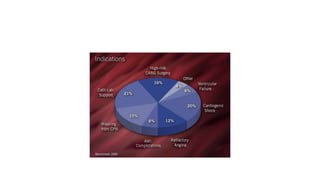
• An IABP may be further indicated in the management of cardiogenic shock
Basic principles of counterpulsation
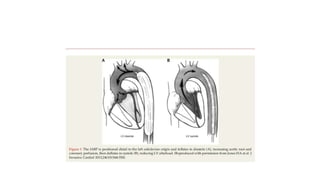
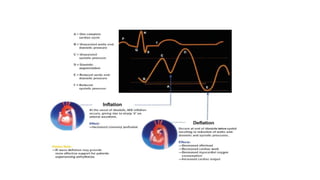
• Counterpulsation (augmentation) is a term that describes balloon inflation in
diastole and deflation in early systole.
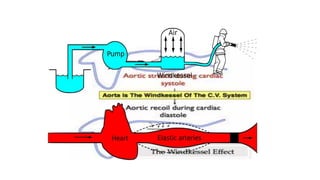
• Balloon inflation causes ‘volume displacement’ of blood within the aorta, both
proximally and distally. This leads to a potential increase in coronary blood flow
and potential improvements in systemic perfusion by augmentation of the
intrinsic ‘Windkessel effect’, whereby potential energy stored in the aortic root
during systole is converted to kinetic energy with the elastic recoil of the aortic
root.
Physiological effects of IABP therapy
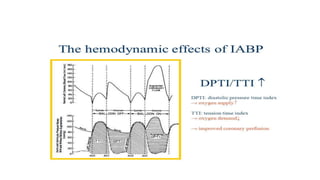
• The primary goal of IABP treatment is to improve the ventricular performance of
the failing heart by facilitating an increase in myocardial oxygen supply and a
decrease in myocardial oxygen demand.
Expected changes with IABP support in hemodynamic profile in patients
with Cardiogenic shock
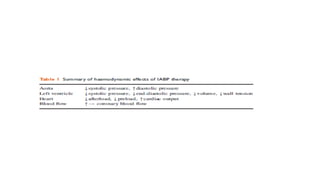
- Decrease in SBP by 20 %
- Increase in aortic Diastolic Press. by 30 % ( raise coronary blood flow)
- Increase in MAP
- Reduction of the HR by 20%
-Decrease in the mean PCWP by 20 %
- Elevation in the COP by 20%
• Although these effects are predominately associated with enhancement of LV
performance, IABP may also have favourable effects on right ventricular (RV)
function by complex mechanisms including accentuation of RV myocardial blood
flow, unloading the left ventricle causing reduction in left atrial and pulmonary
vascular pressures and RV afterload.
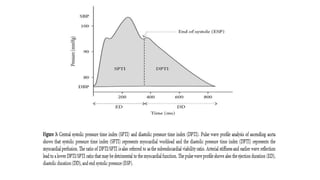
• IABP inflates at the onset of diastole, thereby increasing diastolic pressure and
deflates just before systole, thus reducing LV afterload
The magnitude of these effects depends upon:
(i) Balloon volume: the amount of blood displaced is proportional to the volume of
the balloon.
(ii) Heart rate: LV and aortic diastolic filling times are inversely proportional to heart
rate; shorter diastolic time produces lesser balloon augmentation per unit time.
(iii) Aortic compliance: as aortic compliance increases (or SVR decreases), the
magnitude of diastolic augmentation decreases.
14
IABP –instrumentation and
techniques
15
The IAB Counter pulsation system
two principal parts
A flexible catheter -2 lumen
• first - for distal aspiration/flushing or pressure monitoring
• second - for the periodic delivery and removal of helium gas to a
closed balloon.
A mobile console
• system for helium transfer
• computer for control of the inflation and deflation cycle
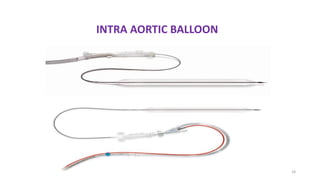
BALLOON
IABP catheter:
• 10-20 cm long polyurethane bladder
• 25cc to 50cc capacity
• Optimal 85% of aorta occluded (not 100%)
• The shaft of the balloon catheter contains 2 lumens:
- one allows for gas exchange from console to balloon
- second lumen for catheter delivery over a guide wire for
monitoring of central aortic pressure after installation.
17
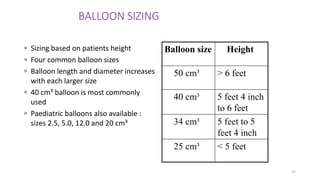
BALLOON SIZING
 Sizing based on patients height
 Four common balloon sizes
 Balloon length and diameter increases
with each larger size
 40 cm³ balloon is most commonly
used
 Paediatric balloons also available :
sizes 2.5, 5.0, 12.0 and 20 cm³
Balloon size Height
50 cm³ > 6 feet
40 cm³ 5 feet 4 inch
to 6 feet
34 cm³ 5 feet to 5
feet 4 inch
25 cm³ < 5 feet
18
INTRA AORTIC BALLOON
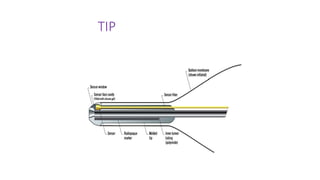
TIP
24
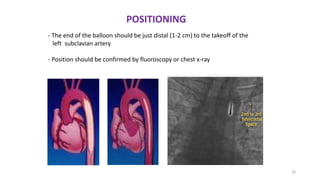
- The end of the balloon should be just distal (1-2 cm) to the takeoff of the
left subclavian artery
- Position should be confirmed by fluoroscopy or chest x-ray
POSITIONING
25
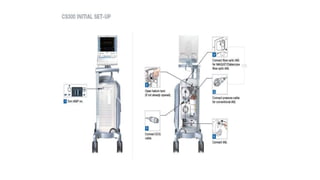
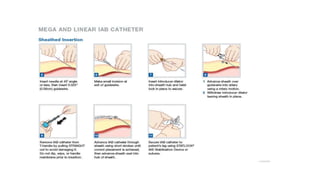
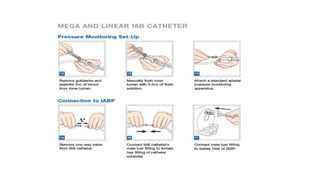
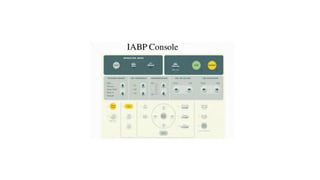
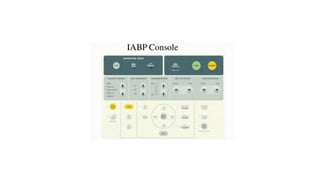
Connecting to console:
- Connect helium gas tube to the console via a long extender
- Open helium tank.
- The central lumen of the catheter is flushed and connected to pressure
tubing with 3 way and then to a pressure transducer to allow for
monitoring of central aortic pressure.
- Zero the transducer
Initial set-up:
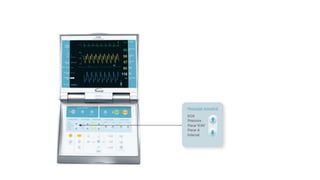
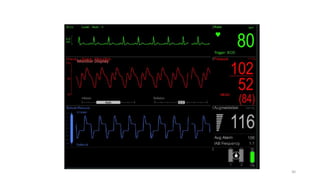
- Once connected properly the console would show ECG and pressure
waveforms.
- Check Basal mean pressure
- Make sure the setting is at “auto”
- Usually IABP started at 1:1 or 1:2 augmentation
- Usually Augmentation is kept at maxim
Modes of operation:
• The trigger can be “automatic”, the computer sets trigger source, computer sets
inflation and deflation times. Trigger automatically searches for most optimal
source if initial trigger is not detected.
• The Trigger can also be “semi automatic” the operator sets the source, operator
sets initial inflation and deflation times. Computer will determine subsequent
timing intervals.
30
31
32
waveform is acceptable ?
• First change from 1:1 to 1:2 augmentation
• Check the dicrotic notch
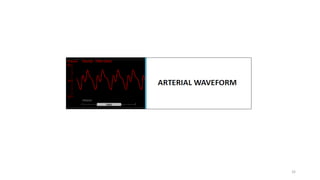
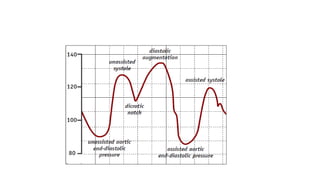
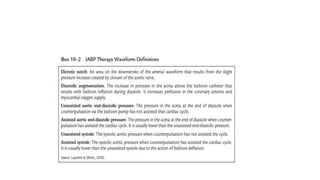
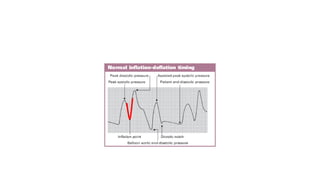
• As the balloon inflates at the onset of diastole, a sharp and deep ‘V’ is observed
at the dicrotic notch. Balloon inflation causes augmentation of diastolic pressure
and a second peak is observed. This peak is referred to as diastolic augmentation.
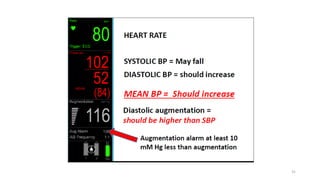
Diastolic augmentation is ideally higher than the patient’s systolic pressure except
when reduced stroke volume causes a relative decrease in augmentation
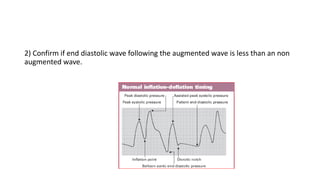
2) Confirm if end diastolic wave following the augmented wave is less than an non
augmented wave.
• The balloon aortic end-diastolic pressure is 5 mmhg to 10 mmhg less than the
patient’s aortic end-diastolic pressure and
• The assisted systolic pressure is 5 mmhg to 10 mmhg less than the patient’s
previous systolic pressure
41
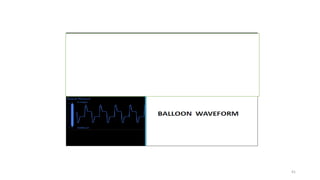
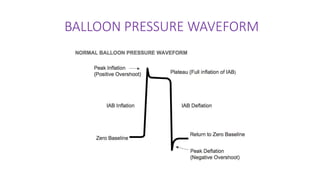
BALLOON PRESSURE WAVEFORM
TROUBLESHOOTING OF IABP
TROUBLESHOOTING
• Challenges can occur when IABP therapy is used in the CCU. The most
frequent causes for IABP malfunction include the possibility that the
- balloon may not adequately augment CO,
- ECG trigger may not be functioning properly, or
- autofill function may fail
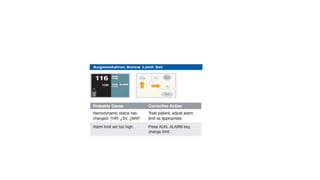
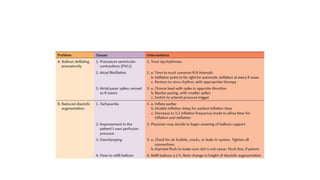
1) Augmentation below the set limit
Reasons for low diastolic augmentation include the following issues:
● Incorrect timing of balloon inflation and deflation. This problem can be corrected
by adjusting inflation and deflation on console.
● Leak in the balloon catheter. Occasionally balloons can rupture or tear. This
problem warrants prompt changing of the balloon catheter.
● Leak in the gas circuit resulting in poor inflation. Check all connections from the
catheter to the gas cylinder and tighten them as necessary.
●Balloon not unwrapped completely. This issue results in poor or incomplete
opening of the balloon. Check the position of the catheter with an x-ray. Attempt to
inflate the balloon with an appropriate-sized syringe. If this measure is
unsuccessful, the catheter will need to be replaced.
● Poor cardiac function or low vascular resistance. If appropriate, add positive
inotropic agents and vasoactive agents.
● Dysrhythmias such as atrial fibrillation or ventricular tachycardia that result in
low stroke volume. To correct these conditions, administer antiarrhythmics as
ordered, and improve oxygen and electrolyte imbalances.
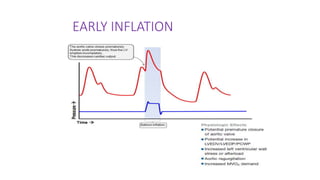
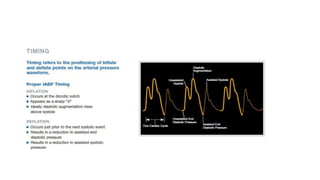
EARLY INFLATION
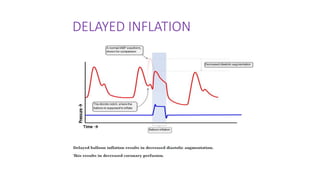
DELAYED INFLATION
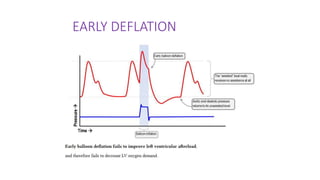
EARLY DEFLATION
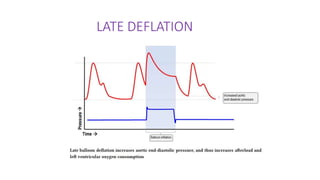
LATE DEFLATION
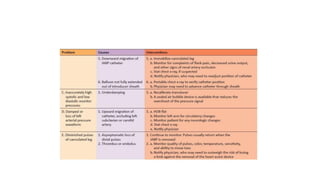
2) NO TRIGGER
• On occasion, the ECG trigger may not function properly.
• Common causes of a faulty trigger include poor electrode placement, low ECG
voltage, faulty electrode pads or cables, dysrhythmias, and other equipment’s
interference with the ECG signal.
• If the problem cannot be easily rectified, switching to the arterial pressure trigger
will be necessary until the problem can be solved.
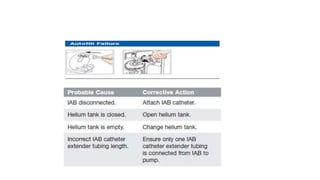
3) Autofill Failure
• The autofill feature on the IABP maintains the volume of gas within the balloon.
if this feature is not functioning properly, an autofill alarm will sound. The cause
of this problem could be an insufficient amount of gas in the tank or occlusion of
the gas outlet. The amount of gas in the tank should be checked and the tank
replaced as needed.
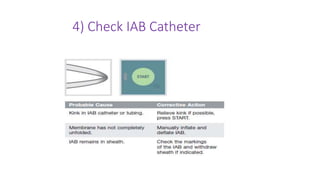
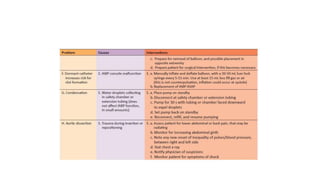
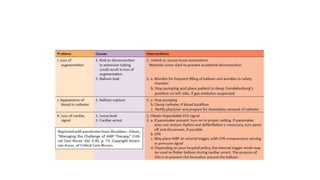
4) Check IAB Catheter
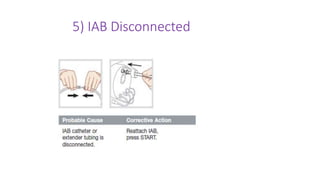
5) IAB Disconnected
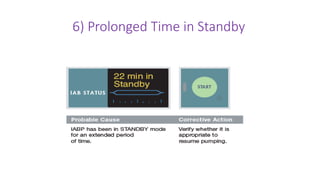
6) Prolonged Time in Standby
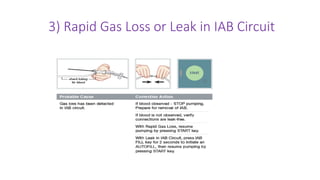
3) Rapid Gas Loss or Leak in IAB Circuit
59
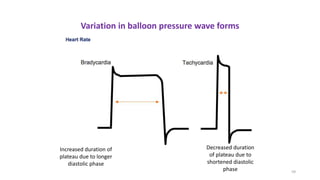
Variation in balloon pressure wave forms
Increased duration of
plateau due to longer
diastolic phase
Decreased duration
of plateau due to
shortened diastolic
phase
60
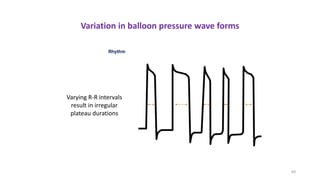
Variation in balloon pressure wave forms
Varying R-R intervals
result in irregular
plateau durations
61
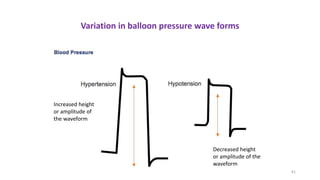
Variation in balloon pressure wave forms
Increased height
or amplitude of
the waveform
Decreased height
or amplitude of the
waveform
62
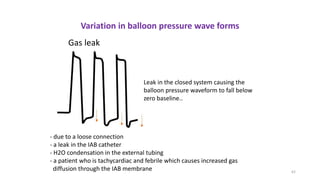
Variation in balloon pressure wave forms
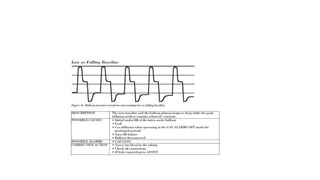
Gas leak
Leak in the closed system causing the
balloon pressure waveform to fall below
zero baseline..
- due to a loose connection
- a leak in the IAB catheter
- H2O condensation in the external tubing
- a patient who is tachycardiac and febrile which causes increased gas
diffusion through the IAB membrane
63
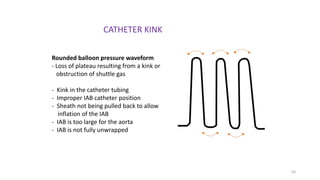
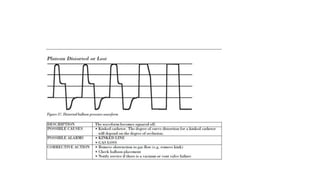
CATHETER KINK
Rounded balloon pressure waveform
- Loss of plateau resulting from a kink or
obstruction of shuttle gas
- Kink in the catheter tubing
- Improper IAB catheter position
- Sheath not being pulled back to allow
inflation of the IAB
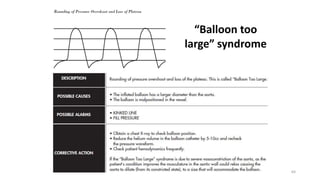
- IAB is too large for the aorta
- IAB is not fully unwrapped
64
“Balloon too
large” syndrome
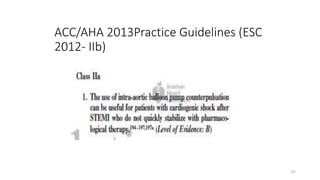
ACC/AHA 2013Practice Guidelines (ESC
2012- IIb)
67
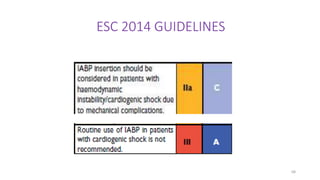
ESC 2014 GUIDELINES
68
THANK YOU

iabp troubleshooting and management.pdf

  • 1.
    IABP troubleshooting Dr SivaSubramaniyan PGIMER &Dr.RML Hospital New Delhi
  • 2.
    IABP • The intra-aorticballoon pump (IABP) is a mechanical device that is temporarily used to improve cardiac function. • In many situations, the IABP is life-saving in its ability to stabilize patients as they await procedures such as heart transplant, coronary artery bypass grafting (CABG), or percutaneous coronary interventions (PCI) such as PTCA. • An IABP may be further indicated in the management of cardiogenic shock
  • 3.
    Basic principles ofcounterpulsation • Counterpulsation (augmentation) is a term that describes balloon inflation in diastole and deflation in early systole. • Balloon inflation causes ‘volume displacement’ of blood within the aorta, both proximally and distally. This leads to a potential increase in coronary blood flow and potential improvements in systemic perfusion by augmentation of the intrinsic ‘Windkessel effect’, whereby potential energy stored in the aortic root during systole is converted to kinetic energy with the elastic recoil of the aortic root.
  • 6.
    Physiological effects ofIABP therapy • The primary goal of IABP treatment is to improve the ventricular performance of the failing heart by facilitating an increase in myocardial oxygen supply and a decrease in myocardial oxygen demand.
  • 10.
    Expected changes withIABP support in hemodynamic profile in patients with Cardiogenic shock - Decrease in SBP by 20 % - Increase in aortic Diastolic Press. by 30 % ( raise coronary blood flow) - Increase in MAP - Reduction of the HR by 20% -Decrease in the mean PCWP by 20 % - Elevation in the COP by 20%
  • 11.
    • Although theseeffects are predominately associated with enhancement of LV performance, IABP may also have favourable effects on right ventricular (RV) function by complex mechanisms including accentuation of RV myocardial blood flow, unloading the left ventricle causing reduction in left atrial and pulmonary vascular pressures and RV afterload. • IABP inflates at the onset of diastole, thereby increasing diastolic pressure and deflates just before systole, thus reducing LV afterload
  • 12.
    The magnitude ofthese effects depends upon: (i) Balloon volume: the amount of blood displaced is proportional to the volume of the balloon. (ii) Heart rate: LV and aortic diastolic filling times are inversely proportional to heart rate; shorter diastolic time produces lesser balloon augmentation per unit time. (iii) Aortic compliance: as aortic compliance increases (or SVR decreases), the magnitude of diastolic augmentation decreases.
  • 14.
  • 15.
    15 The IAB Counterpulsation system two principal parts A flexible catheter -2 lumen • first - for distal aspiration/flushing or pressure monitoring • second - for the periodic delivery and removal of helium gas to a closed balloon. A mobile console • system for helium transfer • computer for control of the inflation and deflation cycle
  • 16.
    BALLOON IABP catheter: • 10-20cm long polyurethane bladder • 25cc to 50cc capacity • Optimal 85% of aorta occluded (not 100%) • The shaft of the balloon catheter contains 2 lumens: - one allows for gas exchange from console to balloon - second lumen for catheter delivery over a guide wire for monitoring of central aortic pressure after installation.
  • 17.
    17 BALLOON SIZING  Sizingbased on patients height  Four common balloon sizes  Balloon length and diameter increases with each larger size  40 cm³ balloon is most commonly used  Paediatric balloons also available : sizes 2.5, 5.0, 12.0 and 20 cm³ Balloon size Height 50 cm³ > 6 feet 40 cm³ 5 feet 4 inch to 6 feet 34 cm³ 5 feet to 5 feet 4 inch 25 cm³ < 5 feet
  • 18.
  • 19.
  • 24.
    24 - The endof the balloon should be just distal (1-2 cm) to the takeoff of the left subclavian artery - Position should be confirmed by fluoroscopy or chest x-ray POSITIONING
  • 25.
    25 Connecting to console: -Connect helium gas tube to the console via a long extender - Open helium tank. - The central lumen of the catheter is flushed and connected to pressure tubing with 3 way and then to a pressure transducer to allow for monitoring of central aortic pressure. - Zero the transducer Initial set-up: - Once connected properly the console would show ECG and pressure waveforms. - Check Basal mean pressure - Make sure the setting is at “auto” - Usually IABP started at 1:1 or 1:2 augmentation - Usually Augmentation is kept at maxim
  • 27.
    Modes of operation: •The trigger can be “automatic”, the computer sets trigger source, computer sets inflation and deflation times. Trigger automatically searches for most optimal source if initial trigger is not detected. • The Trigger can also be “semi automatic” the operator sets the source, operator sets initial inflation and deflation times. Computer will determine subsequent timing intervals.
  • 30.
  • 31.
  • 32.
  • 36.
    waveform is acceptable? • First change from 1:1 to 1:2 augmentation • Check the dicrotic notch • As the balloon inflates at the onset of diastole, a sharp and deep ‘V’ is observed at the dicrotic notch. Balloon inflation causes augmentation of diastolic pressure and a second peak is observed. This peak is referred to as diastolic augmentation. Diastolic augmentation is ideally higher than the patient’s systolic pressure except when reduced stroke volume causes a relative decrease in augmentation
  • 38.
    2) Confirm ifend diastolic wave following the augmented wave is less than an non augmented wave.
  • 39.
    • The balloonaortic end-diastolic pressure is 5 mmhg to 10 mmhg less than the patient’s aortic end-diastolic pressure and • The assisted systolic pressure is 5 mmhg to 10 mmhg less than the patient’s previous systolic pressure
  • 41.
  • 42.
  • 43.
  • 44.
    TROUBLESHOOTING • Challenges canoccur when IABP therapy is used in the CCU. The most frequent causes for IABP malfunction include the possibility that the - balloon may not adequately augment CO, - ECG trigger may not be functioning properly, or - autofill function may fail
  • 45.
    1) Augmentation belowthe set limit Reasons for low diastolic augmentation include the following issues: ● Incorrect timing of balloon inflation and deflation. This problem can be corrected by adjusting inflation and deflation on console. ● Leak in the balloon catheter. Occasionally balloons can rupture or tear. This problem warrants prompt changing of the balloon catheter. ● Leak in the gas circuit resulting in poor inflation. Check all connections from the catheter to the gas cylinder and tighten them as necessary.
  • 46.
    ●Balloon not unwrappedcompletely. This issue results in poor or incomplete opening of the balloon. Check the position of the catheter with an x-ray. Attempt to inflate the balloon with an appropriate-sized syringe. If this measure is unsuccessful, the catheter will need to be replaced. ● Poor cardiac function or low vascular resistance. If appropriate, add positive inotropic agents and vasoactive agents. ● Dysrhythmias such as atrial fibrillation or ventricular tachycardia that result in low stroke volume. To correct these conditions, administer antiarrhythmics as ordered, and improve oxygen and electrolyte imbalances.
  • 48.
  • 49.
  • 50.
  • 51.
  • 52.
    2) NO TRIGGER •On occasion, the ECG trigger may not function properly. • Common causes of a faulty trigger include poor electrode placement, low ECG voltage, faulty electrode pads or cables, dysrhythmias, and other equipment’s interference with the ECG signal. • If the problem cannot be easily rectified, switching to the arterial pressure trigger will be necessary until the problem can be solved.
  • 53.
    3) Autofill Failure •The autofill feature on the IABP maintains the volume of gas within the balloon. if this feature is not functioning properly, an autofill alarm will sound. The cause of this problem could be an insufficient amount of gas in the tank or occlusion of the gas outlet. The amount of gas in the tank should be checked and the tank replaced as needed.
  • 55.
    4) Check IABCatheter
  • 56.
  • 57.
  • 58.
    3) Rapid GasLoss or Leak in IAB Circuit
  • 59.
    59 Variation in balloonpressure wave forms Increased duration of plateau due to longer diastolic phase Decreased duration of plateau due to shortened diastolic phase
  • 60.
    60 Variation in balloonpressure wave forms Varying R-R intervals result in irregular plateau durations
  • 61.
    61 Variation in balloonpressure wave forms Increased height or amplitude of the waveform Decreased height or amplitude of the waveform
  • 62.
    62 Variation in balloonpressure wave forms Gas leak Leak in the closed system causing the balloon pressure waveform to fall below zero baseline.. - due to a loose connection - a leak in the IAB catheter - H2O condensation in the external tubing - a patient who is tachycardiac and febrile which causes increased gas diffusion through the IAB membrane
  • 63.
    63 CATHETER KINK Rounded balloonpressure waveform - Loss of plateau resulting from a kink or obstruction of shuttle gas - Kink in the catheter tubing - Improper IAB catheter position - Sheath not being pulled back to allow inflation of the IAB - IAB is too large for the aorta - IAB is not fully unwrapped
  • 64.
  • 67.
  • 68.
  • 73.