Marketing- Product
Management
A PRESENTATION BY SURYA PRAJAPAT
Index
1) Marketing
2) Market Research & Information System
3) Target Marketing & Market Targeting
4) Product & Services
5) Product Positioning
6) Product Life Cycle
7) Product Line & Product Mix
8) Developing New Product
9) Brand Management
10) Branding, Packaging and Labeling
11) Pricing & Price planning
1. Marketing
There is only one valid definition of business purpose – “to create customer”
“The performance of business activities that directs the flow of goods and services from the
producer to consumer or user.”
“Marketing is the process of planning and executing the conception, pricing, promotion
and distribution of ideas, goods and services to create exchange that satisfy individual
and organizational objectives.”
Marketing Concept :
 Market or customer orientation
 Formulation of company goals
 Integration and unification of
company operations
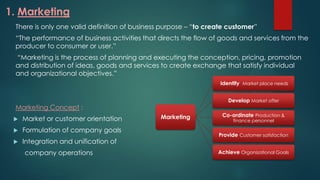
Marketing
Identify Market place needs
Develop Market offer
Co-ordinate Production &
finance personnel
Provide Customer satisfaction
Achieve Organizational Goals
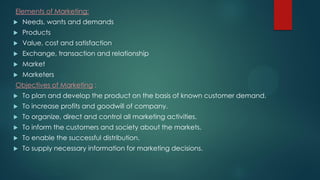
Elements of Marketing:
 Needs, wants and demands
 Products
 Value, cost and satisfaction
 Exchange, transaction and relationship
 Market
 Marketers
Objectives of Marketing :
 To plan and develop the product on the basis of known customer demand.
 To increase profits and goodwill of company.
 To organize, direct and control all marketing activities.
 To inform the customers and society about the markets.
 To enable the successful distribution.
 To supply necessary information for marketing decisions.
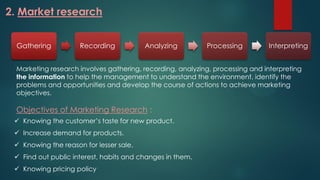
2. Market research
Gathering Recording Analyzing Processing Interpreting
Marketing research involves gathering, recording, analyzing, processing and interpreting
the information to help the management to understand the environment, identify the
problems and opportunities and develop the course of actions to achieve marketing
objectives.
Objectives of Marketing Research :
 Knowing the customer’s taste for new product.
 Increase demand for products.
 Knowing the reason for lesser sale.
 Find out public interest, habits and changes in them.
 Knowing pricing policy
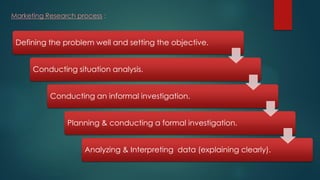
Defining the problem well and setting the objective.
Conducting situation analysis.
Conducting an informal investigation.
Planning & conducting a formal investigation.
Analyzing & Interpreting data (explaining clearly).
Marketing Research process :
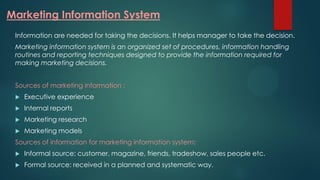
Marketing Information System
Information are needed for taking the decisions. It helps manager to take the decision.
Marketing information system is an organized set of procedures, information handling
routines and reporting techniques designed to provide the information required for
making marketing decisions.
Sources of marketing information :
 Executive experience
 Internal reports
 Marketing research
 Marketing models
Sources of information for marketing information system:
 Informal source: customer, magazine, friends, tradeshow, sales people etc.
 Formal source: received in a planned and systematic way.
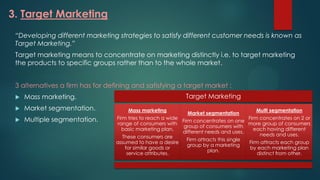
3. Target Marketing
“Developing different marketing strategies to satisfy different customer needs is known as
Target Marketing.”
Target marketing means to concentrate on marketing distinctly i.e. to target marketing
the products to specific groups rather than to the whole market.
3 alternatives a firm has for defining and satisfying a target market :
 Mass marketing.
 Market segmentation.
 Multiple segmentation.
Target Marketing
Mass marketing
Firm tries to reach a wide
range of consumers with
basic marketing plan.
These consumers are
assumed to have a desire
for similar goods or
service attributes.
Market segmentation
Firm concentrates on one
group of consumers with
different needs and uses.
Firm attracts this single
group by a marketing
plan.
Multi segmentation
Firm concentrates on 2 or
more group of consumers
each having different
needs and uses.
Firm attracts each group
by each marketing plan
distinct from other.
Market Targeting
It is the process of formulating market coverage policies.
The firm has to evaluate the various segments of the market and their structural
attractiveness and then decide how many and which ones to target.
Market targeting process :
Step 1) Evaluating market segment
Step 2) Selecting Target Market-
a. Limited coverage market targeting-
Single segment concentration : only a single segment of the market is selected as target.
Selective specialization : Targeting many segments for the products.
Product specialization : targeting all markets for one product.
Market specialization : targeting one market for many products.
b. Full coverage market targeting-
Mass Marketing (undifferentiated marketing)
Multi segmentation (differentiated marketing)
4. Product and services
Any firm that market products or services has 2 aims to achieve i.e. customer satisfaction and
profit maximization.
Product
 Product is anything that satisfies a need and can be offered in an exchange. A product can
be good, service, idea.
“Product is a set of tangible and intangible attributes including packaging, color, price,
quality and brand, plus the services and reputation of the seller.”
“Anything the purchaser gets in exchange of his money to satisfy his needs.”
Services
 A service is any act or performance that one party can offer to another that is essentially
intangible and does not result in the ownership of anything.
It has 4 characteristics:
1. Intangibility 2. Perishability 3. Inseparability 4. Variability
5. Product Positioning
it is the final step in Market targeting.
 “Positioning is the process of distinguishing a brand from its competitors so that it becomes
the preferred brand in the defined market segment.”
 “Positioning is what you do to the mind of customer i.e. position of product in the mind of
the prospect.”
 “Positioning is the act of designing the company’s offer and image so that it occupies a
distinct and valued place in the target customer’s mind.”
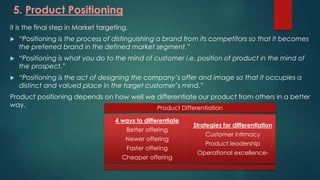
Product positioning depends on how well we differentiate our product from others in a better
way. Product Differentiation
4 ways to differentiate
Better offering
Newer offering
Faster offering
Cheaper offering
Strategies for differentiation
Customer intimacy
Product leadership
Operational excellence-
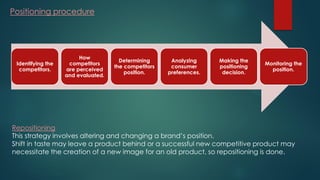
Positioning procedure
Identifying the
competitors.
How
competitors
are perceived
and evaluated.
Determining
the competitors
position.
Analyzing
consumer
preferences.
Making the
positioning
decision.
Monitoring the
position.
Repositioning
This strategy involves altering and changing a brand’s position.
Shift in taste may leave a product behind or a successful new competitive product may
necessitate the creation of a new image for an old product, so repositioning is done.
6. Product Life Cycle
 It is a concept that attempts to describe a product’s sales, profit, customers, competitors
and marketing from its beginning until its removal from the market.
 Product life cycle is the life of product in which it progress through various stages starting
from introduction in the market till death of the product.
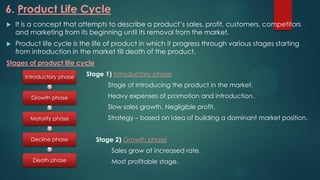
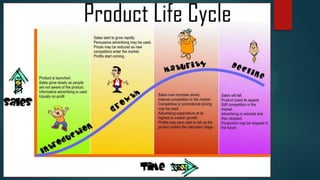
Stages of product life cycle
Stage 1) Introductory phase
Stage of introducing the product in the market.
Heavy expenses of promotion and introduction.
Slow sales growth, Negligible profit.
Strategy – based on idea of building a dominant market position.
Stage 2) Growth phase
Sales grow at increased rate.
Most profitable stage.
Introductory phase
Growth phase
Maturity phase
Decline phase
Death phase
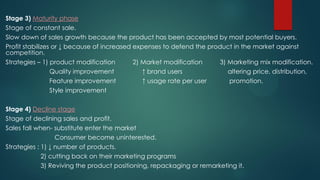
Stage 3) Maturity phase
Stage of constant sale.
Slow down of sales growth because the product has been accepted by most potential buyers.
Profit stabilizes or ↓ because of increased expenses to defend the product in the market against
competition.
Strategies – 1) product modification 2) Market modification 3) Marketing mix modification.
Quality improvement ↑ brand users altering price, distribution,
Feature improvement ↑ usage rate per user promotion.
Style improvement
Stage 4) Decline stage
Stage of declining sales and profit.
Sales fall when- substitute enter the market
Consumer become uninterested.
Strategies : 1) ↓ number of products.
2) cutting back on their marketing programs
3) Reviving the product positioning, repackaging or remarketing it.
7. Product line & Product mix strategies
 Product management involves:
1. Product mix decision.
2. Product modification decision.
3. Product elimination decision.
4. New product decision.
5. Branding and packaging decision.
Product mix decision
Product mix is the full list of all products offered for sales by the company.
 Product mix includes:
a. Product line
b. Product width
c. Product depth/length
d. Product item
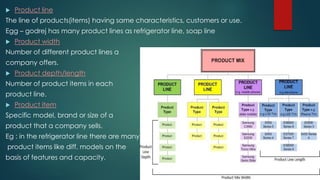
 Product line
The line of products(items) having same characteristics, customers or use.
Egg – godrej has many product lines as refrigerator line, soap line
 Product width
Number of different product lines a
company offers.
 Product depth/length
Number of product items in each
product line.
 Product item
Specific model, brand or size of a
product that a company sells.
Eg : in the refrigerator line there are many
product items like diff. models on the
basis of features and capacity.
 Major product line policies &
strategies
1. Expansion of product mix
2. Contraction of product mix
3. Alteration of existing products
4. Developing new use for existing
products
5. Trading up and trading down
6. Product differentiation & market
segmentation
 Product line decisions
1. Product line length decisions
2. Product line stretching decisions.
3. Product line filling decisions.
a. Downward stretch
b. Upward stretch
c. Combined stretch
4. Product line filling decisions.
5. Product line modernization
decisions.
6. Product line featuring decisions.
 Cannibalization
Situation when an organization’s new product experiences
increased sales mainly because of decreased sales of its
established product.
8. Developing the new product
Every company needs a new product
development program. New products are
the future of a business.
 Sources of new product
• Innovation
• Modification of existing products
• Acquisition of products of other firms
 Why new products fail?
• Product problem
• Distribution & channel problem
• Promotional problem
• Pricing problem
• Timing problem
• Competition
Strategy for new product development
Deciding the objective of how to reach the customer.
To communicate and consult with R&D, it may lead in creating interest
among the different personnel (marketing, production, finance).
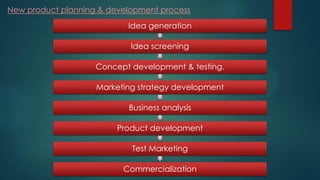
Idea generation
Idea screening
Concept development & testing.
Marketing strategy development
Business analysis
Product development
Test Marketing
Commercialization
New product planning & development process
9. Brand Management
The process of creating a relationship or connection between a
company’s product and emotional perception of the customer
is called Brand Management.
Brand management includes managing the tangible and
intangible characteristics of brand.
Brand
It is a name, symbol, design or any other feature that identifies
one seller’s good as distinct from other sellers.
Brands are “What the consumers buy.”
Products are “What the company makes.”
 Brand is accumulation of emotional and functional
associations.
 Brand is a promise that the product will perform as per
customer’s expectation.
 Important concepts of
Brand Management
1. Brand Name
2. Brand attributes
3. Brand positioning
4. Brand identity
5. Brand image
6. Brand identity v/s Brand
image
7. Brand personality
8. Brand loyalty
9. Brand association
10. Brand equity
11. Brand extension
1. Brand name: Brand name is the name, term, sign, symbol or design or a combination of
them which differentiate one product from another.
2. Brand attributes: Brand attributes are a bundle of features that highlight the physical and
personality aspects of the brand. Brand attributes helps in creating brand identity.
Ex: Relevancy, Consistency, Sustainable, Inspirational, Credibility, Appealing.
3. Brand positioning: Brand positioning refers to target the customer’s reason to buy your
brand in preference to others.
4. Brand identity: Brand identity is the noticeable elements of a brand (logo, trademark
color, symbol etc.) that differentiate and identify a brand in target customer’s mind.
It establish and immediate connection between company & customer.
5. Brand image: It is the current views of customer about a brand. Brand image is the
overall impression in consumer’s mind that is formed from all associations of the product.
6. Brand Personality: Brand personality is the way brand speaks and behaves. When brand
identity or brand image is expressed in terms of human traits/characteristics then it is
called Brand personality.
7. Brand loyalty: Brand loyalty is the extent to which consumer constantly buys the product
of same brand. It is a scenario where the consumer fears to purchase and consume
another brand which he doesn’t trust.
8. Brand Associations: Brand associations are images & symbols associated with a brand.
Ex: Nokia sound, Britannia sound (ting ting ta ding)
Microsoft – Bill Gates
9. Brand promise: Brand promise is What you say to customer and What is to be delivered.
If brand promise is not delivered, business will not survive
10. Brand equity: Brand equity is the value & strength of the brand that decides its worth
“It is a phrase in marketing industry which describes the value of having a well known
brand name.”
11. Brand extension: Brand extension is the use of established brand name in new product
category. The existing brand that gives rise to a brand extension is referred to as Parent
Brand.
10. Branding, Packaging & Labeling
Branding
 Brand Mark : That part of brand that can be recognized but cannot be vocalized such as
design or symbol or color.
 Trade Character : it is a brand mark that is personified. (Nirma Girl)
 Trade Mark : Trade mark is a brand name, brand mark, or trade character or combination
of them that is given legal protection.
 TM denotes unregistered trademark, a mark used to promote.
 SM denotes unregistered service mark.
 ® denotes registered trademark.
 Patents : are public documents offering certain rights, privileges, titles. No other can market
such kind of patented protected product without the permission of inventor during the
patent period.
 Copy Right: when patent is applied for books then called copy right.
 Packaging
Packaging is the activity of product planning which involves designing and producing
the container or wrapper for a product.
Packing is wrapping a commodity or bundling it in a way suitable for transporting, storing
and handling.
 Labeling
Label is the part of product which carries information about the product and the seller. A
label contains product’s brand name, manufacturer name, company logo, ingredients,
promotional message and instructions to use.
11. Pricing & Price Planning
 Price represents the value of good or service for both seller and buyer.
Price is the only element of the marketing mix which generate revenue otherwise all the
elements have cost.
 Pricing objectives
 Survival
 Profit
 Return on investment
 Market share
 Cash flow
 Status quo
 Product quality
 Pricing of new product
Penetration pricing
Meet the competition pricing
Price skimming
Penetration pricing
Here the marketer set a low initial price in order to penetrate the market quickly and
deeply. It creates instant acceptance in the market.
Meet the competition pricing
It means the marketer will enter the market with the new product priced the same or
approximately same as those of the competitors
Price skimming approach
A skimming price is the high price put on a new product so that it can generate high
initial profits especially if the new product has no competition. The initial high price may
create an image of high quality and prestige
Thank You
A Presentation By Surya Prajapat

Marketing - Product Management

  • 1.
  • 2.
    Index 1) Marketing 2) MarketResearch & Information System 3) Target Marketing & Market Targeting 4) Product & Services 5) Product Positioning 6) Product Life Cycle 7) Product Line & Product Mix 8) Developing New Product 9) Brand Management 10) Branding, Packaging and Labeling 11) Pricing & Price planning
  • 3.
    1. Marketing There isonly one valid definition of business purpose – “to create customer” “The performance of business activities that directs the flow of goods and services from the producer to consumer or user.” “Marketing is the process of planning and executing the conception, pricing, promotion and distribution of ideas, goods and services to create exchange that satisfy individual and organizational objectives.” Marketing Concept :  Market or customer orientation  Formulation of company goals  Integration and unification of company operations Marketing Identify Market place needs Develop Market offer Co-ordinate Production & finance personnel Provide Customer satisfaction Achieve Organizational Goals
  • 4.
    Elements of Marketing: Needs, wants and demands  Products  Value, cost and satisfaction  Exchange, transaction and relationship  Market  Marketers Objectives of Marketing :  To plan and develop the product on the basis of known customer demand.  To increase profits and goodwill of company.  To organize, direct and control all marketing activities.  To inform the customers and society about the markets.  To enable the successful distribution.  To supply necessary information for marketing decisions.
  • 5.
    2. Market research GatheringRecording Analyzing Processing Interpreting Marketing research involves gathering, recording, analyzing, processing and interpreting the information to help the management to understand the environment, identify the problems and opportunities and develop the course of actions to achieve marketing objectives. Objectives of Marketing Research :  Knowing the customer’s taste for new product.  Increase demand for products.  Knowing the reason for lesser sale.  Find out public interest, habits and changes in them.  Knowing pricing policy
  • 6.
    Defining the problemwell and setting the objective. Conducting situation analysis. Conducting an informal investigation. Planning & conducting a formal investigation. Analyzing & Interpreting data (explaining clearly). Marketing Research process :
  • 7.
    Marketing Information System Informationare needed for taking the decisions. It helps manager to take the decision. Marketing information system is an organized set of procedures, information handling routines and reporting techniques designed to provide the information required for making marketing decisions. Sources of marketing information :  Executive experience  Internal reports  Marketing research  Marketing models Sources of information for marketing information system:  Informal source: customer, magazine, friends, tradeshow, sales people etc.  Formal source: received in a planned and systematic way.
  • 8.
    3. Target Marketing “Developingdifferent marketing strategies to satisfy different customer needs is known as Target Marketing.” Target marketing means to concentrate on marketing distinctly i.e. to target marketing the products to specific groups rather than to the whole market. 3 alternatives a firm has for defining and satisfying a target market :  Mass marketing.  Market segmentation.  Multiple segmentation. Target Marketing Mass marketing Firm tries to reach a wide range of consumers with basic marketing plan. These consumers are assumed to have a desire for similar goods or service attributes. Market segmentation Firm concentrates on one group of consumers with different needs and uses. Firm attracts this single group by a marketing plan. Multi segmentation Firm concentrates on 2 or more group of consumers each having different needs and uses. Firm attracts each group by each marketing plan distinct from other.
  • 9.
    Market Targeting It isthe process of formulating market coverage policies. The firm has to evaluate the various segments of the market and their structural attractiveness and then decide how many and which ones to target. Market targeting process : Step 1) Evaluating market segment Step 2) Selecting Target Market- a. Limited coverage market targeting- Single segment concentration : only a single segment of the market is selected as target. Selective specialization : Targeting many segments for the products. Product specialization : targeting all markets for one product. Market specialization : targeting one market for many products. b. Full coverage market targeting- Mass Marketing (undifferentiated marketing) Multi segmentation (differentiated marketing)
  • 10.
    4. Product andservices Any firm that market products or services has 2 aims to achieve i.e. customer satisfaction and profit maximization. Product  Product is anything that satisfies a need and can be offered in an exchange. A product can be good, service, idea. “Product is a set of tangible and intangible attributes including packaging, color, price, quality and brand, plus the services and reputation of the seller.” “Anything the purchaser gets in exchange of his money to satisfy his needs.” Services  A service is any act or performance that one party can offer to another that is essentially intangible and does not result in the ownership of anything. It has 4 characteristics: 1. Intangibility 2. Perishability 3. Inseparability 4. Variability
  • 11.
    5. Product Positioning itis the final step in Market targeting.  “Positioning is the process of distinguishing a brand from its competitors so that it becomes the preferred brand in the defined market segment.”  “Positioning is what you do to the mind of customer i.e. position of product in the mind of the prospect.”  “Positioning is the act of designing the company’s offer and image so that it occupies a distinct and valued place in the target customer’s mind.” Product positioning depends on how well we differentiate our product from others in a better way. Product Differentiation 4 ways to differentiate Better offering Newer offering Faster offering Cheaper offering Strategies for differentiation Customer intimacy Product leadership Operational excellence-
  • 12.
    Positioning procedure Identifying the competitors. How competitors areperceived and evaluated. Determining the competitors position. Analyzing consumer preferences. Making the positioning decision. Monitoring the position. Repositioning This strategy involves altering and changing a brand’s position. Shift in taste may leave a product behind or a successful new competitive product may necessitate the creation of a new image for an old product, so repositioning is done.
  • 13.
    6. Product LifeCycle  It is a concept that attempts to describe a product’s sales, profit, customers, competitors and marketing from its beginning until its removal from the market.  Product life cycle is the life of product in which it progress through various stages starting from introduction in the market till death of the product. Stages of product life cycle Stage 1) Introductory phase Stage of introducing the product in the market. Heavy expenses of promotion and introduction. Slow sales growth, Negligible profit. Strategy – based on idea of building a dominant market position. Stage 2) Growth phase Sales grow at increased rate. Most profitable stage. Introductory phase Growth phase Maturity phase Decline phase Death phase
  • 15.
    Stage 3) Maturityphase Stage of constant sale. Slow down of sales growth because the product has been accepted by most potential buyers. Profit stabilizes or ↓ because of increased expenses to defend the product in the market against competition. Strategies – 1) product modification 2) Market modification 3) Marketing mix modification. Quality improvement ↑ brand users altering price, distribution, Feature improvement ↑ usage rate per user promotion. Style improvement Stage 4) Decline stage Stage of declining sales and profit. Sales fall when- substitute enter the market Consumer become uninterested. Strategies : 1) ↓ number of products. 2) cutting back on their marketing programs 3) Reviving the product positioning, repackaging or remarketing it.
  • 16.
    7. Product line& Product mix strategies  Product management involves: 1. Product mix decision. 2. Product modification decision. 3. Product elimination decision. 4. New product decision. 5. Branding and packaging decision. Product mix decision Product mix is the full list of all products offered for sales by the company.  Product mix includes: a. Product line b. Product width c. Product depth/length d. Product item
  • 17.
     Product line Theline of products(items) having same characteristics, customers or use. Egg – godrej has many product lines as refrigerator line, soap line  Product width Number of different product lines a company offers.  Product depth/length Number of product items in each product line.  Product item Specific model, brand or size of a product that a company sells. Eg : in the refrigerator line there are many product items like diff. models on the basis of features and capacity.
  • 18.
     Major productline policies & strategies 1. Expansion of product mix 2. Contraction of product mix 3. Alteration of existing products 4. Developing new use for existing products 5. Trading up and trading down 6. Product differentiation & market segmentation  Product line decisions 1. Product line length decisions 2. Product line stretching decisions. 3. Product line filling decisions. a. Downward stretch b. Upward stretch c. Combined stretch 4. Product line filling decisions. 5. Product line modernization decisions. 6. Product line featuring decisions.  Cannibalization Situation when an organization’s new product experiences increased sales mainly because of decreased sales of its established product.
  • 19.
    8. Developing thenew product Every company needs a new product development program. New products are the future of a business.  Sources of new product • Innovation • Modification of existing products • Acquisition of products of other firms  Why new products fail? • Product problem • Distribution & channel problem • Promotional problem • Pricing problem • Timing problem • Competition Strategy for new product development Deciding the objective of how to reach the customer. To communicate and consult with R&D, it may lead in creating interest among the different personnel (marketing, production, finance).
  • 20.
    Idea generation Idea screening Conceptdevelopment & testing. Marketing strategy development Business analysis Product development Test Marketing Commercialization New product planning & development process
  • 21.
    9. Brand Management Theprocess of creating a relationship or connection between a company’s product and emotional perception of the customer is called Brand Management. Brand management includes managing the tangible and intangible characteristics of brand. Brand It is a name, symbol, design or any other feature that identifies one seller’s good as distinct from other sellers. Brands are “What the consumers buy.” Products are “What the company makes.”  Brand is accumulation of emotional and functional associations.  Brand is a promise that the product will perform as per customer’s expectation.  Important concepts of Brand Management 1. Brand Name 2. Brand attributes 3. Brand positioning 4. Brand identity 5. Brand image 6. Brand identity v/s Brand image 7. Brand personality 8. Brand loyalty 9. Brand association 10. Brand equity 11. Brand extension
  • 22.
    1. Brand name:Brand name is the name, term, sign, symbol or design or a combination of them which differentiate one product from another. 2. Brand attributes: Brand attributes are a bundle of features that highlight the physical and personality aspects of the brand. Brand attributes helps in creating brand identity. Ex: Relevancy, Consistency, Sustainable, Inspirational, Credibility, Appealing. 3. Brand positioning: Brand positioning refers to target the customer’s reason to buy your brand in preference to others. 4. Brand identity: Brand identity is the noticeable elements of a brand (logo, trademark color, symbol etc.) that differentiate and identify a brand in target customer’s mind. It establish and immediate connection between company & customer. 5. Brand image: It is the current views of customer about a brand. Brand image is the overall impression in consumer’s mind that is formed from all associations of the product. 6. Brand Personality: Brand personality is the way brand speaks and behaves. When brand identity or brand image is expressed in terms of human traits/characteristics then it is called Brand personality.
  • 23.
    7. Brand loyalty:Brand loyalty is the extent to which consumer constantly buys the product of same brand. It is a scenario where the consumer fears to purchase and consume another brand which he doesn’t trust. 8. Brand Associations: Brand associations are images & symbols associated with a brand. Ex: Nokia sound, Britannia sound (ting ting ta ding) Microsoft – Bill Gates 9. Brand promise: Brand promise is What you say to customer and What is to be delivered. If brand promise is not delivered, business will not survive 10. Brand equity: Brand equity is the value & strength of the brand that decides its worth “It is a phrase in marketing industry which describes the value of having a well known brand name.” 11. Brand extension: Brand extension is the use of established brand name in new product category. The existing brand that gives rise to a brand extension is referred to as Parent Brand.
  • 24.
    10. Branding, Packaging& Labeling Branding  Brand Mark : That part of brand that can be recognized but cannot be vocalized such as design or symbol or color.  Trade Character : it is a brand mark that is personified. (Nirma Girl)  Trade Mark : Trade mark is a brand name, brand mark, or trade character or combination of them that is given legal protection.  TM denotes unregistered trademark, a mark used to promote.  SM denotes unregistered service mark.  ® denotes registered trademark.  Patents : are public documents offering certain rights, privileges, titles. No other can market such kind of patented protected product without the permission of inventor during the patent period.  Copy Right: when patent is applied for books then called copy right.
  • 25.
     Packaging Packaging isthe activity of product planning which involves designing and producing the container or wrapper for a product. Packing is wrapping a commodity or bundling it in a way suitable for transporting, storing and handling.  Labeling Label is the part of product which carries information about the product and the seller. A label contains product’s brand name, manufacturer name, company logo, ingredients, promotional message and instructions to use.
  • 26.
    11. Pricing &Price Planning  Price represents the value of good or service for both seller and buyer. Price is the only element of the marketing mix which generate revenue otherwise all the elements have cost.  Pricing objectives  Survival  Profit  Return on investment  Market share  Cash flow  Status quo  Product quality
  • 27.
     Pricing ofnew product Penetration pricing Meet the competition pricing Price skimming Penetration pricing Here the marketer set a low initial price in order to penetrate the market quickly and deeply. It creates instant acceptance in the market. Meet the competition pricing It means the marketer will enter the market with the new product priced the same or approximately same as those of the competitors Price skimming approach A skimming price is the high price put on a new product so that it can generate high initial profits especially if the new product has no competition. The initial high price may create an image of high quality and prestige
  • 28.
    Thank You A PresentationBy Surya Prajapat