Competitive Strategy By Michael Porter Instructor: Wesley Shu
Competitive Strategy A framework for understanding the underlying forces of competition in industries
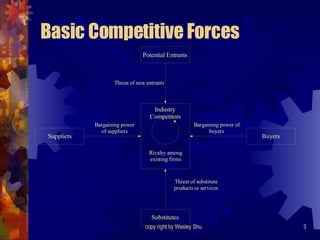
Basic Competitive Forces
The Five Forces Threat of entry Intensity of rivalry among existing competitors Pressure from substitute products Bargaining power of buyers Bargaining power of suppliers They Are Structural Determinants of the Intensity of Competition
Threat of Entry Barriers to entry Economies of Scale Product differentiation Capital requirements Switching costs next
Economies of Scale can be also achieved by “joint costs” including brand name or know-how Not only manufacturing, but also Marketing, service network (Amazon) R&D, branding, marketing etc. Ex. McDonald share promotion among franchised stores return
Product Differentiation Differentiated products enjoy customer loyalty and brand identification return
Capital Requirement 既存廠商可以創新價格模式﹐使得資本比重相對提高﹑回收期加長﹐例如租賃影印機
Switching Cost 指買方不容易另求賣方﹐尤其是下游廠商對上游的依賴度。例如﹐公司一旦採用了某種  ERP  產品﹐要更換就不容易了﹐因為  ERP  除了價格不菲之外﹐一旦更換﹐訓練成本得重新付出﹐過去的維護成本完全付之流水。如此﹐新的  ERP  就不容易打入市場。
Other Barrier to Entry Access to distribution channels Cost disadvantages independent of scale, e.g., proprietary product, favorable access to raw materials, favorable locations, government subsidies, learning or experience curve, government policy, etc.
Threat of Entry Expected retaliation The entry deterring price Properties of entry barriers, e.g., vertical integration to lower cost Network externalities
Expected retaliation History of vigorous retaliation Established firms with substantial resources to fight back Slow industry growth return
The entry deterring price 競爭者想要進入某個產業﹐一定是覺得有利可圖。有利與否決定於競爭者對加入市場後的產品價格﹑自己的生產成本﹑以及為了進入該產業所需付出的努力。產業的既存者如果不想讓競爭者進入﹐可以將產品價格降低﹐低到競爭者覺得無利可圖。此時如果既存者為了爭取利潤而不降價﹐使得市場價格高於競爭者心目中的  Entry deterring price﹐ 就徒然讓他們蠢蠢欲動﹐和自己過不去了。
The entry deterring price 在不成熟的第三世界國家﹐金融產業是被高度控制的。控制方法之一就是特許制度。任何特許﹑伴隨著法律上對政府的約束微弱﹐都無法避免貪污賄賂。而政府對不中意的行賄者﹐可以索取一定的回扣﹐使得該行賄者覺得無利可圖﹐就是操作  Entry deterring price  的一種方式。 return
Network externalities Network Externalities:  指的是﹐一件商品對消費者的價值決定於消費者的總數﹐而消費者購買的決定也取決於其總數。例如電話機﹑電腦操作系統﹑ eBay  都是。
Intensity of rivalry among existing competitors Numerous or equally balanced competitors Slow industry growth High fixed or storage costs High fixed cost:  為了沖銷大量的固定成本﹐廠商可能會傾向多生產﹐如此導致價格降低﹑廠商之間的競爭加劇。 High storage cost:  為了出清存貨﹐降低儲存成本﹐廠商可能降價求售﹐如此增加了產業內的競爭。
Intensity of rivalry among existing competitors Lack of differentiation or switching costs Products are like commodity. Capacity augmented in large increments 一旦如此﹐廠商會形成周期性的產量驟增。如果產品需求穩定﹐當產量驟增﹐供需就失衡﹐如此增加了產業內的競爭。 High exit barriers: specialized assets, strategic interrelationship, emotional barriers, etc.
Intensity of rivalry among existing competitors Diverse competitors 如此﹐各個廠商就無法正確了解對手的行為﹐形成混亂的戰局。此外﹐廠商也比較難提出普效的策略﹐因為對某一對手有效﹐對其他對手就未必。 High strategic stakes 當廠商進入某一產業具有策略考量﹐ 通常表示他不太會放棄該產業﹑有意在該產業擴張﹑願意犧牲利潤以成就策略。這些再再增加了產業內的競爭。
Pressure from substitute products Price elasticity 指價格的變動率對需求變動率的影響。價格的彈性愈高的話﹐價格上漲﹐需求就愈減少。亦即﹐消費者就愈傾向買替代品。讓價格彈性降低的方法很多﹐如運用  CRM  的技巧﹐增加消費者對品牌的認知和忠誠度﹑產品差異化。 If the price elasticity is high, rising industry prices tend to drive consumers to purchase substitutes.
Bargaining power of buyers The buyer purchases large volumes. The products are standard or undifferentiated. It faces few switching costs Buyers pose a credible threat of  backward integration .  E.g., GM or Ford’s self-manufacture as bargaining level for part suppliers
Bargaining power of buyers The industry’s product is unimportant to the quality of the buyers’ products or services The buyers have full information
Bargaining power of suppliers Fewer and concentrated suppliers. Suppliers are not obliged to contend with other substitute products 如果沒有競爭者生產替代品﹐該供應商自然就有較高的 bargaining power. The industry is not an important customer of the suppliers The suppliers’ product is an important input to the buyer’s business.
Bargaining power of suppliers The supplier group’s products are differentiated or it has built up switching costs The supplier group poses a credible threat of forward integration
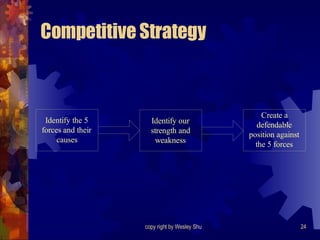
Competitive Strategy
Competitive Strategy Identify the five forces and their causes Identify a firm’s strengths and weaknesses relative to the industry Create a defendable position against the five competitive forces
Competitive Strategy Approaches Positioning Position the firm in the industry where the forces are weakest, or provide the best defense against the competitive forces. Influencing the balance Change the firm itself to eliminate the causes of the forces. Exploiting change  by choosing a strategy appropriate to the new competitive balance before rivals recognize it
Generic Competitive Strategies Cost leadership Differentiation Focus
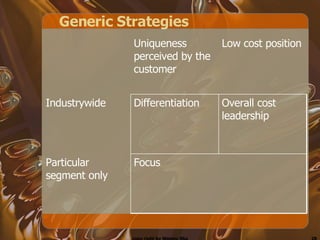
Generic Strategies Focus Particular segment only Overall cost leadership Differentiation Industrywide Low cost position Uniqueness perceived by the customer
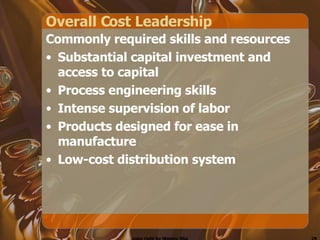
Overall Cost Leadership Commonly required skills and resources Substantial capital investment and access to capital Process engineering skills Intense supervision of labor Products designed for ease in manufacture Low-cost distribution system
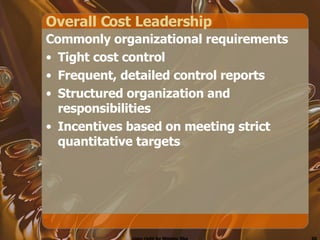
Overall Cost Leadership Commonly organizational requirements Tight cost control Frequent, detailed control reports Structured organization and responsibilities Incentives based on meeting strict quantitative targets
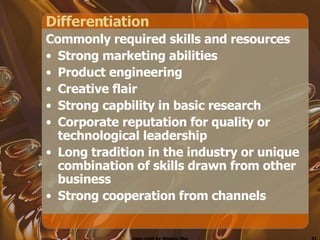
Differentiation  Commonly required skills and resources Strong marketing abilities Product engineering Creative flair Strong capbility in basic research Corporate reputation for quality or technological leadership Long tradition in the industry or unique combination of skills drawn from other business Strong cooperation from channels
Differentiation  Common organizational requirements Strong coordination among functions in R&D, product development, and marketing Subjective measurement and incentives instead of quantitative measures Amenities to attract highly skilled labor, scientists, or creative people
Focus Commonly required skills and resources Combination of the above policies directed at the particular strategic target
Focus Common organizational requirements Combination of the above policies directed at the particular strategic target
Competitor Analysis - Objective Develop a profile of the nature and success of the likely strategy changes each competitor might make
Competitor Analysis Identify current and  potential competitors : Firms not in the industry but who could overcome entry barriers particularly cheaply Firms for whom there is obvious synergy from being in the industry Firms for whom competing in the industry is an obvious extension of the corporate strategy Customers or suppliers who may integrate backward or forward
Competitor Analysis Future Goals of the competitors Current Strategy of the competitors Assumptions of the competitors Capabilities of the competitors -> Competitor’s response profile
Future Goals What drives the competitor? Knowledge of goals allows predictions about whether the competitor is satisfied with its present position. Allows to predict its reaction to our strategic changes Helps interpret the seriousness of initiatives the competitor takes
Assumptions Identify each competitor’s assumptions about itself and about the industry and the other companies in it

Competitive Strategy

  • 1.
    Competitive Strategy ByMichael Porter Instructor: Wesley Shu
  • 2.
    Competitive Strategy Aframework for understanding the underlying forces of competition in industries
  • 3.
  • 4.
    The Five ForcesThreat of entry Intensity of rivalry among existing competitors Pressure from substitute products Bargaining power of buyers Bargaining power of suppliers They Are Structural Determinants of the Intensity of Competition
  • 5.
    Threat of EntryBarriers to entry Economies of Scale Product differentiation Capital requirements Switching costs next
  • 6.
    Economies of Scalecan be also achieved by “joint costs” including brand name or know-how Not only manufacturing, but also Marketing, service network (Amazon) R&D, branding, marketing etc. Ex. McDonald share promotion among franchised stores return
  • 7.
    Product Differentiation Differentiatedproducts enjoy customer loyalty and brand identification return
  • 8.
  • 9.
    Switching Cost 指買方不容易另求賣方﹐尤其是下游廠商對上游的依賴度。例如﹐公司一旦採用了某種 ERP 產品﹐要更換就不容易了﹐因為 ERP 除了價格不菲之外﹐一旦更換﹐訓練成本得重新付出﹐過去的維護成本完全付之流水。如此﹐新的 ERP 就不容易打入市場。
  • 10.
    Other Barrier toEntry Access to distribution channels Cost disadvantages independent of scale, e.g., proprietary product, favorable access to raw materials, favorable locations, government subsidies, learning or experience curve, government policy, etc.
  • 11.
    Threat of EntryExpected retaliation The entry deterring price Properties of entry barriers, e.g., vertical integration to lower cost Network externalities
  • 12.
    Expected retaliation Historyof vigorous retaliation Established firms with substantial resources to fight back Slow industry growth return
  • 13.
    The entry deterringprice 競爭者想要進入某個產業﹐一定是覺得有利可圖。有利與否決定於競爭者對加入市場後的產品價格﹑自己的生產成本﹑以及為了進入該產業所需付出的努力。產業的既存者如果不想讓競爭者進入﹐可以將產品價格降低﹐低到競爭者覺得無利可圖。此時如果既存者為了爭取利潤而不降價﹐使得市場價格高於競爭者心目中的 Entry deterring price﹐ 就徒然讓他們蠢蠢欲動﹐和自己過不去了。
  • 14.
    The entry deterringprice 在不成熟的第三世界國家﹐金融產業是被高度控制的。控制方法之一就是特許制度。任何特許﹑伴隨著法律上對政府的約束微弱﹐都無法避免貪污賄賂。而政府對不中意的行賄者﹐可以索取一定的回扣﹐使得該行賄者覺得無利可圖﹐就是操作 Entry deterring price 的一種方式。 return
  • 15.
    Network externalities NetworkExternalities: 指的是﹐一件商品對消費者的價值決定於消費者的總數﹐而消費者購買的決定也取決於其總數。例如電話機﹑電腦操作系統﹑ eBay 都是。
  • 16.
    Intensity of rivalryamong existing competitors Numerous or equally balanced competitors Slow industry growth High fixed or storage costs High fixed cost: 為了沖銷大量的固定成本﹐廠商可能會傾向多生產﹐如此導致價格降低﹑廠商之間的競爭加劇。 High storage cost: 為了出清存貨﹐降低儲存成本﹐廠商可能降價求售﹐如此增加了產業內的競爭。
  • 17.
    Intensity of rivalryamong existing competitors Lack of differentiation or switching costs Products are like commodity. Capacity augmented in large increments 一旦如此﹐廠商會形成周期性的產量驟增。如果產品需求穩定﹐當產量驟增﹐供需就失衡﹐如此增加了產業內的競爭。 High exit barriers: specialized assets, strategic interrelationship, emotional barriers, etc.
  • 18.
    Intensity of rivalryamong existing competitors Diverse competitors 如此﹐各個廠商就無法正確了解對手的行為﹐形成混亂的戰局。此外﹐廠商也比較難提出普效的策略﹐因為對某一對手有效﹐對其他對手就未必。 High strategic stakes 當廠商進入某一產業具有策略考量﹐ 通常表示他不太會放棄該產業﹑有意在該產業擴張﹑願意犧牲利潤以成就策略。這些再再增加了產業內的競爭。
  • 19.
    Pressure from substituteproducts Price elasticity 指價格的變動率對需求變動率的影響。價格的彈性愈高的話﹐價格上漲﹐需求就愈減少。亦即﹐消費者就愈傾向買替代品。讓價格彈性降低的方法很多﹐如運用 CRM 的技巧﹐增加消費者對品牌的認知和忠誠度﹑產品差異化。 If the price elasticity is high, rising industry prices tend to drive consumers to purchase substitutes.
  • 20.
    Bargaining power ofbuyers The buyer purchases large volumes. The products are standard or undifferentiated. It faces few switching costs Buyers pose a credible threat of backward integration . E.g., GM or Ford’s self-manufacture as bargaining level for part suppliers
  • 21.
    Bargaining power ofbuyers The industry’s product is unimportant to the quality of the buyers’ products or services The buyers have full information
  • 22.
    Bargaining power ofsuppliers Fewer and concentrated suppliers. Suppliers are not obliged to contend with other substitute products 如果沒有競爭者生產替代品﹐該供應商自然就有較高的 bargaining power. The industry is not an important customer of the suppliers The suppliers’ product is an important input to the buyer’s business.
  • 23.
    Bargaining power ofsuppliers The supplier group’s products are differentiated or it has built up switching costs The supplier group poses a credible threat of forward integration
  • 24.
  • 25.
    Competitive Strategy Identifythe five forces and their causes Identify a firm’s strengths and weaknesses relative to the industry Create a defendable position against the five competitive forces
  • 26.
    Competitive Strategy ApproachesPositioning Position the firm in the industry where the forces are weakest, or provide the best defense against the competitive forces. Influencing the balance Change the firm itself to eliminate the causes of the forces. Exploiting change by choosing a strategy appropriate to the new competitive balance before rivals recognize it
  • 27.
    Generic Competitive StrategiesCost leadership Differentiation Focus
  • 28.
    Generic Strategies FocusParticular segment only Overall cost leadership Differentiation Industrywide Low cost position Uniqueness perceived by the customer
  • 29.
    Overall Cost LeadershipCommonly required skills and resources Substantial capital investment and access to capital Process engineering skills Intense supervision of labor Products designed for ease in manufacture Low-cost distribution system
  • 30.
    Overall Cost LeadershipCommonly organizational requirements Tight cost control Frequent, detailed control reports Structured organization and responsibilities Incentives based on meeting strict quantitative targets
  • 31.
    Differentiation Commonlyrequired skills and resources Strong marketing abilities Product engineering Creative flair Strong capbility in basic research Corporate reputation for quality or technological leadership Long tradition in the industry or unique combination of skills drawn from other business Strong cooperation from channels
  • 32.
    Differentiation Commonorganizational requirements Strong coordination among functions in R&D, product development, and marketing Subjective measurement and incentives instead of quantitative measures Amenities to attract highly skilled labor, scientists, or creative people
  • 33.
    Focus Commonly requiredskills and resources Combination of the above policies directed at the particular strategic target
  • 34.
    Focus Common organizationalrequirements Combination of the above policies directed at the particular strategic target
  • 35.
    Competitor Analysis -Objective Develop a profile of the nature and success of the likely strategy changes each competitor might make
  • 36.
    Competitor Analysis Identifycurrent and potential competitors : Firms not in the industry but who could overcome entry barriers particularly cheaply Firms for whom there is obvious synergy from being in the industry Firms for whom competing in the industry is an obvious extension of the corporate strategy Customers or suppliers who may integrate backward or forward
  • 37.
    Competitor Analysis FutureGoals of the competitors Current Strategy of the competitors Assumptions of the competitors Capabilities of the competitors -> Competitor’s response profile
  • 38.
    Future Goals Whatdrives the competitor? Knowledge of goals allows predictions about whether the competitor is satisfied with its present position. Allows to predict its reaction to our strategic changes Helps interpret the seriousness of initiatives the competitor takes
  • 39.
    Assumptions Identify eachcompetitor’s assumptions about itself and about the industry and the other companies in it