Creating
Competitive
Advantage

Chapter 18
Objectives
Learn how to understand competitors as
well as customers via competitor
analysis.
Learn the fundamentals of competitive
marketing strategies based on creating
value for customers.
Realize the need for balancing customer
and competitor organizations in order to
become a truly market-centered
organization.
c
Intel

Has dominated the
chip industry
Success is directly
related to Intel’s
competitive
strategy
Strategy focuses
on superior value
and product

Heavy focus on
product and
advertising innovation
and R&D investments
Changing market
needs have
challenged Intel to
adapt
Intel is capitalizing on
Definition
Competitive Advantage
 An advantage
over competitors
gained by offering
consumers greater
value than
competitors offer.
Definition
Competitive Analysis
 The process of identifying key
competitors; assessing their
objectives, strategies, strengths
and weaknesses, and reaction
patterns; and selecting which
competitors to attack or avoid.
Figure 18-1:

Steps in Analyzing
Competitors
Competitor Analysis
Steps in the
Process:
Identifying
Competitors
Assessing
Competitors
Selecting
Competitors to
Attack or Avoid

Firms face a wide
range of competition
Be careful to avoid
“competitor myopia”
Methods of
identifying
competitors:
 Industry point-of-view
 Market point-of-view
 Competitor

can help

maps
230-year-old
Encyclopedia
Britannica
viewed itself as
competing with
your publishers
of printed
encyclopedias.
Big mistake! Its
real competitors
were software
encyclopedias
and the Internet.
Figure 18-2:

Competitor Map
Discussion Question
Create a competitor
map for one of the
following:
•
•
•
•
•

WalMart
McDonald’s
Nike
Starbucks
Google
Competitor Analysis
Steps in the
Process:
Identifying
Competitors
Assessing
Competitors
Selecting
Competitors to
Attack or Avoid

Determining
competitors’ objectives
Identifying competitors’
strategies
 Strategic groups

Assessing competitors’
strengths and
weaknesses
 Benchmarking

Estimating competitors’
reactions
Competitor Analysis
Steps in the
Process:
Identifying
Competitors
Assessing
Competitors
Selecting
Competitors to
Attack or Avoid

Strong or weak
competitors
 Customer value analysis

Close or distant
competitors
 Most companies compete
against close competitors

“Good” or “Bad”
competitors
 The existence of
competitors offers several
strategic benefits
Competitive Strategies
Basic Winning Competitive
Strategies: Porter
 Overall cost leadership
 Lowest production and
distribution costs
 Differentiation
 Creating a highly
differentiated product line
and marketing program
 Focus
 Effort is focused on serving
a few market segments
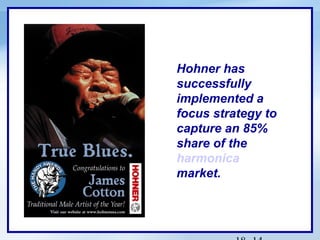
Hohner has
successfully
implemented a
focus strategy to
capture an 85%
share of the
harmonica
market.
Competitive Strategies
Basic Competitive Strategies:
Value Disciplines
 Operational excellence


Superior value via price and convenience

 Customer intimacy


Superior value by means of building strong
relationships with buyers and satisfying
needs

 Product leadership


Superior value via product innovation
Figure 18-3:

Hypothetical
Market Structure
Competitive Strategy
Competitive
Positions
Market Leader
Market
Challenger
Market
Follower
Market Nicher

Expanding the total
demand
 Finding new users
 Discovering and
promoting new product
uses
 Encouraging greater
product usage

Protecting market share
 Many considerations
 Continuous innovation

Expanding market share
 Profitability rises with
market share
Competitive Strategy
WD-40 has a knack
for developing new
uses for its product.
What other brands
have adopted a
similar strategy?

WD40
Competitive Strategy
Competitive
Positions
Market Leader
Market
Challenger
Market
Follower
Market Nicher

Option 1: challenge the
market leader
 High-risk but high-gain
 Sustainable competitive
advantage over the leader
is key to success

Option 2: challenge firms
of the same size, smaller
size or challenge
regional or local firms
Full frontal vs. indirect
attacks
Pepsi is an
example of
market
challenger
that has
chosen to use
a full frontal
attack
Competitive Strategy
Competitive
Positions
Market Leader
Market
Challenger
Market
Follower
Market Nicher

Follow the market
leader
 Focus is on improving
profit instead of
market share
 Many advantages:
 Learn

from the
market leader’s
experience
 Copy or improve on
the leader’s offerings
 Strong profitability
Dial Corporation
successfully
uses a market
follower strategy
Competitive Strategy
Competitive
Positions
Market Leader
Market
Challenger
Market
Follower
Market Nicher

Serving market
niches means
targeting
subsegments
Good strategy for
small firms with
limited resources
Offers high margins
Specialization is key
 By market, customer,
product, or marketing
mix lines
Balancing Customer and
Competitor Orientations
Companies can become so
competitor centered that they
lose their customer focus.
Types of companies:




Competitor-centered companies
Customer-centered companies
Market-centered companies
Game playing industry
a.

Nintendo
a. Wii hyperlink

b.

Microsoft
a. Xbox 360

c.

Sony
a. Play Station
Threat of New Entry
the existence of barriers to entry
economies of product differences
brand equity
switching costs
capital requirements
access to distribution
absolute cost advantages
learning curve advantages
expected retaliation
government policies
Competitive Rivalry
number of competitors
rate of industry growth
intermittent industry overcapacity
exit barriers
diversity of competitors
informational complexity and
asymmetry
brand equity
fixed cost allocation per value added
level of advertising expense
Supplier Power
supplier switching costs relative to
firm switching costs
degree of differentiation of inputs
presence of substitute inputs
supplier concentration to firm
concentration ratio
threat of forward integration by
suppliers relative to the threat of
backward integration by firms
cost of inputs relative to selling price
of the product
Buyer Power
buyer concentration to firm concentration
ratio
bargaining leverage
buyer volume
buyer switching costs relative to firm
switching costs
buyer information availability
ability to backward integrate
availability of existing substitute products
buyer price sensitivity
price of total purchase
Threat of Substitution
buyer propensity to
substitute
relative price performance of
substitutes
buyer switching costs
perceived level of product
differentiation

competitive advantage

  • 1.
  • 2.
    Objectives Learn how tounderstand competitors as well as customers via competitor analysis. Learn the fundamentals of competitive marketing strategies based on creating value for customers. Realize the need for balancing customer and competitor organizations in order to become a truly market-centered organization.
  • 3.
    c Intel Has dominated the chipindustry Success is directly related to Intel’s competitive strategy Strategy focuses on superior value and product Heavy focus on product and advertising innovation and R&D investments Changing market needs have challenged Intel to adapt Intel is capitalizing on
  • 4.
    Definition Competitive Advantage  Anadvantage over competitors gained by offering consumers greater value than competitors offer.
  • 5.
    Definition Competitive Analysis  Theprocess of identifying key competitors; assessing their objectives, strategies, strengths and weaknesses, and reaction patterns; and selecting which competitors to attack or avoid.
  • 6.
    Figure 18-1: Steps inAnalyzing Competitors
  • 7.
    Competitor Analysis Steps inthe Process: Identifying Competitors Assessing Competitors Selecting Competitors to Attack or Avoid Firms face a wide range of competition Be careful to avoid “competitor myopia” Methods of identifying competitors:  Industry point-of-view  Market point-of-view  Competitor can help maps
  • 8.
    230-year-old Encyclopedia Britannica viewed itself as competingwith your publishers of printed encyclopedias. Big mistake! Its real competitors were software encyclopedias and the Internet.
  • 9.
  • 10.
    Discussion Question Create acompetitor map for one of the following: • • • • • WalMart McDonald’s Nike Starbucks Google
  • 11.
    Competitor Analysis Steps inthe Process: Identifying Competitors Assessing Competitors Selecting Competitors to Attack or Avoid Determining competitors’ objectives Identifying competitors’ strategies  Strategic groups Assessing competitors’ strengths and weaknesses  Benchmarking Estimating competitors’ reactions
  • 12.
    Competitor Analysis Steps inthe Process: Identifying Competitors Assessing Competitors Selecting Competitors to Attack or Avoid Strong or weak competitors  Customer value analysis Close or distant competitors  Most companies compete against close competitors “Good” or “Bad” competitors  The existence of competitors offers several strategic benefits
  • 13.
    Competitive Strategies Basic WinningCompetitive Strategies: Porter  Overall cost leadership  Lowest production and distribution costs  Differentiation  Creating a highly differentiated product line and marketing program  Focus  Effort is focused on serving a few market segments
  • 14.
    Hohner has successfully implemented a focusstrategy to capture an 85% share of the harmonica market.
  • 15.
    Competitive Strategies Basic CompetitiveStrategies: Value Disciplines  Operational excellence  Superior value via price and convenience  Customer intimacy  Superior value by means of building strong relationships with buyers and satisfying needs  Product leadership  Superior value via product innovation
  • 16.
  • 17.
    Competitive Strategy Competitive Positions Market Leader Market Challenger Market Follower MarketNicher Expanding the total demand  Finding new users  Discovering and promoting new product uses  Encouraging greater product usage Protecting market share  Many considerations  Continuous innovation Expanding market share  Profitability rises with market share
  • 18.
    Competitive Strategy WD-40 hasa knack for developing new uses for its product. What other brands have adopted a similar strategy? WD40
  • 19.
    Competitive Strategy Competitive Positions Market Leader Market Challenger Market Follower MarketNicher Option 1: challenge the market leader  High-risk but high-gain  Sustainable competitive advantage over the leader is key to success Option 2: challenge firms of the same size, smaller size or challenge regional or local firms Full frontal vs. indirect attacks
  • 20.
    Pepsi is an exampleof market challenger that has chosen to use a full frontal attack
  • 21.
    Competitive Strategy Competitive Positions Market Leader Market Challenger Market Follower MarketNicher Follow the market leader  Focus is on improving profit instead of market share  Many advantages:  Learn from the market leader’s experience  Copy or improve on the leader’s offerings  Strong profitability
  • 22.
    Dial Corporation successfully uses amarket follower strategy
  • 23.
    Competitive Strategy Competitive Positions Market Leader Market Challenger Market Follower MarketNicher Serving market niches means targeting subsegments Good strategy for small firms with limited resources Offers high margins Specialization is key  By market, customer, product, or marketing mix lines
  • 24.
    Balancing Customer and CompetitorOrientations Companies can become so competitor centered that they lose their customer focus. Types of companies:    Competitor-centered companies Customer-centered companies Market-centered companies
  • 25.
    Game playing industry a. Nintendo a.Wii hyperlink b. Microsoft a. Xbox 360 c. Sony a. Play Station
  • 27.
    Threat of NewEntry the existence of barriers to entry economies of product differences brand equity switching costs capital requirements access to distribution absolute cost advantages learning curve advantages expected retaliation government policies
  • 28.
    Competitive Rivalry number ofcompetitors rate of industry growth intermittent industry overcapacity exit barriers diversity of competitors informational complexity and asymmetry brand equity fixed cost allocation per value added level of advertising expense
  • 29.
    Supplier Power supplier switchingcosts relative to firm switching costs degree of differentiation of inputs presence of substitute inputs supplier concentration to firm concentration ratio threat of forward integration by suppliers relative to the threat of backward integration by firms cost of inputs relative to selling price of the product
  • 30.
    Buyer Power buyer concentrationto firm concentration ratio bargaining leverage buyer volume buyer switching costs relative to firm switching costs buyer information availability ability to backward integrate availability of existing substitute products buyer price sensitivity price of total purchase
  • 31.
    Threat of Substitution buyerpropensity to substitute relative price performance of substitutes buyer switching costs perceived level of product differentiation

Editor's Notes

  • #19 Clicking the WWW icon will open your web browser and link to the web site pictured in the screen shot.