2

NHÓM 5
WELCOME TO
TR NG CAO D NGƯỜ Ẳ
SONADEZI
THÀNH VIÊN TRONG NHÓM
Lê Minh Hoàn
Gịp Nhộc Phùng
Hồng Phương Thảo
Tiêu Thị Ngọc Yến
Lớp: K10AV
4
Chapter 5
Product Strategy
5
6
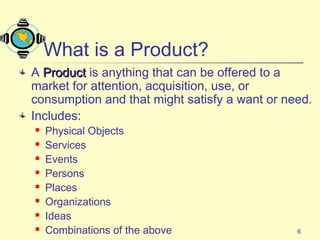
What is a Product?
A ProductProduct is anything that can be offered to a
market for attention, acquisition, use, or
consumption and that might satisfy a want or need.
Includes:
 Physical Objects
 Services
 Events
 Persons
 Places
 Organizations
 Ideas
 Combinations of the above
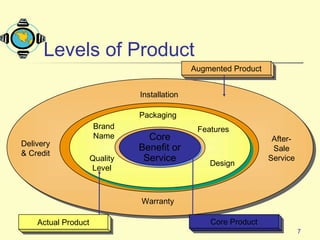
7
Brand
Name
Quality
Level
Packaging
Design
Features
Delivery
& Credit
Installation
Warranty
After-
Sale
Service
Core
Benefit or
Service
Core
Benefit or
Service
Actual ProductActual Product Core ProductCore Product
Augmented ProductAugmented Product
Levels of Product
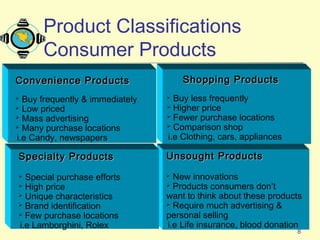
8
Unsought ProductsUnsought Products

New innovations
 Products consumers don’t
want to think about these products
 Require much advertising &
personal selling
i.e Life insurance, blood donation
Product Classifications
Consumer Products
Specialty ProductsSpecialty Products

Special purchase efforts
 High price
 Unique characteristics
 Brand identification
 Few purchase locations
i.e Lamborghini, Rolex
Shopping ProductsShopping Products

Buy less frequently
 Higher price
 Fewer purchase locations
 Comparison shop
i.e Clothing, cars, appliances
Convenience ProductsConvenience Products

Buy frequently & immediately
 Low priced
 Mass advertising
 Many purchase locations
i.e Candy, newspapers
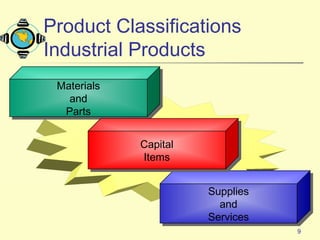
9
Supplies
and
Services
Supplies
and
Services
Materials
and
Parts
Materials
and
Parts
Capital
Items
Capital
Items
Product Classifications
Industrial Products
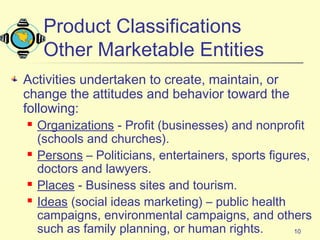
10
Product Classifications
Other Marketable Entities
Activities undertaken to create, maintain, or
change the attitudes and behavior toward the
following:
 Organizations - Profit (businesses) and nonprofit
(schools and churches).
 Persons – Politicians, entertainers, sports figures,
doctors and lawyers.
 Places - Business sites and tourism.
 Ideas (social ideas marketing) – public health
campaigns, environmental campaigns, and others
such as family planning, or human rights.
11
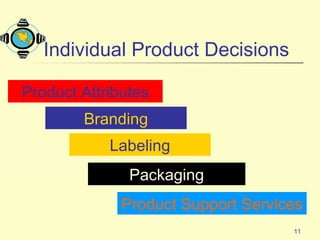
Individual Product Decisions
Product Attributes
Branding
Packaging
Labeling
Product Support Services
12
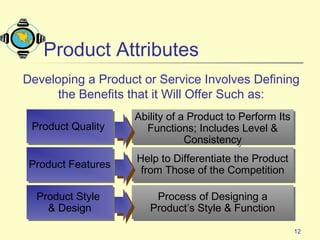
Product QualityProduct Quality
Product FeaturesProduct Features
Product Style
& Design
Product Style
& Design
Ability of a Product to Perform Its
Functions; Includes Level &
Consistency
Ability of a Product to Perform Its
Functions; Includes Level &
Consistency
Help to Differentiate the Product
from Those of the Competition
Help to Differentiate the Product
from Those of the Competition
Process of Designing a
Product’s Style & Function
Process of Designing a
Product’s Style & Function
Developing a Product or Service Involves Defining
the Benefits that it Will Offer Such as:
Product Attributes
13
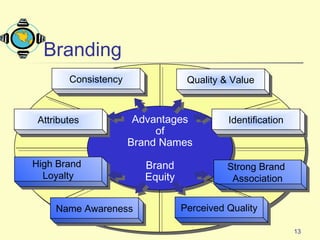
Advantages
of
Brand Names
Brand
Equity
Advantages
of
Brand Names
Brand
Equity
Strong Brand
Association
Strong Brand
Association
AttributesAttributes
Quality & ValueQuality & ValueConsistencyConsistency
IdentificationIdentification
Perceived QualityPerceived QualityName AwarenessName Awareness
High Brand
Loyalty
High Brand
Loyalty
Branding
14
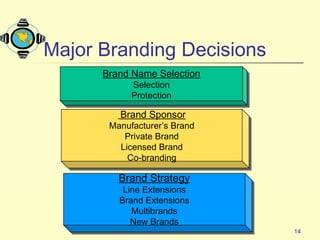
Brand Strategy
Line Extensions
Brand Extensions
Multibrands
New Brands
Brand Strategy
Line Extensions
Brand Extensions
Multibrands
New Brands
Brand Sponsor
Manufacturer’s Brand
Private Brand
Licensed Brand
Co-branding
Brand Sponsor
Manufacturer’s Brand
Private Brand
Licensed Brand
Co-branding
Brand Name Selection
Selection
Protection
Brand Name Selection
Selection
Protection
Major Branding Decisions
15
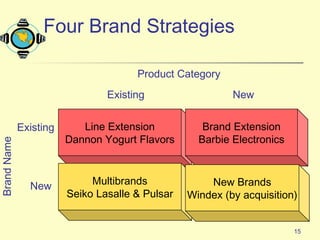
Line Extension
Dannon Yogurt Flavors
Multibrands
Seiko Lasalle & Pulsar
Brand Extension
Barbie Electronics
New Brands
Windex (by acquisition)
BrandName
Existing New
Product Category
Existing
New
Four Brand Strategies
16
17
Brand Strategy
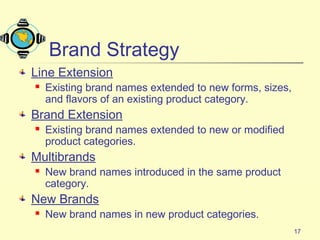
Line Extension
 Existing brand names extended to new forms, sizes,
and flavors of an existing product category.
Brand Extension
 Existing brand names extended to new or modified
product categories.
Multibrands
 New brand names introduced in the same product
category.
New Brands
 New brand names in new product categories.
18
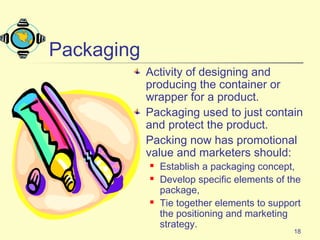
Packaging
Activity of designing and
producing the container or
wrapper for a product.
Packaging used to just contain
and protect the product.
Packing now has promotional
value and marketers should:
 Establish a packaging concept,
 Develop specific elements of the
package,
 Tie together elements to support
the positioning and marketing
strategy.
19
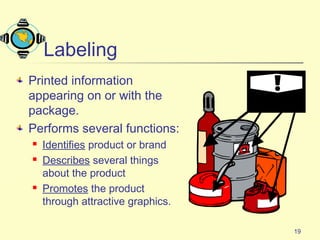
Labeling
Printed information
appearing on or with the
package.
Performs several functions:
 Identifies product or brand
 Describes several things
about the product
 Promotes the product
through attractive graphics.
20
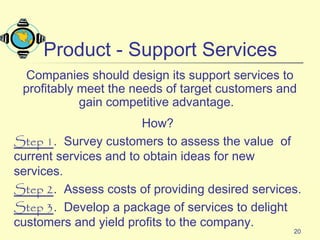
Product - Support Services
Companies should design its support services to
profitably meet the needs of target customers and
gain competitive advantage.
How?
Step 1. Survey customers to assess the value of
current services and to obtain ideas for new
services.
Step 2. Assess costs of providing desired services.
Step 3. Develop a package of services to delight
customers and yield profits to the company.
21
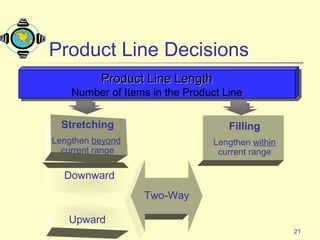
Stretching
Lengthen beyond
current range
Product Line LengthProduct Line Length
Number of Items in the Product Line
Product Line LengthProduct Line Length
Number of Items in the Product Line
Two-Way
Downward
Upward
Filling
Lengthen within
current range
Product Line Decisions
22
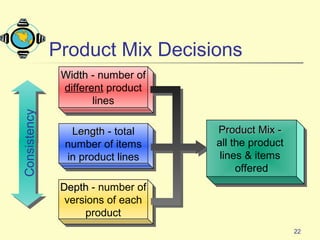
WidthWidth - number of
different product
lines
WidthWidth - number of
different product
lines
LengthLength - total
number of items
in product lines
LengthLength - total
number of items
in product lines
DepthDepth - number of
versions of each
product
DepthDepth - number of
versions of each
product
Product Mix -Product Mix -
all the product
lines & items
offered
Product Mix -Product Mix -
all the product
lines & items
offered
Consistency
Product Mix Decisions
23
24
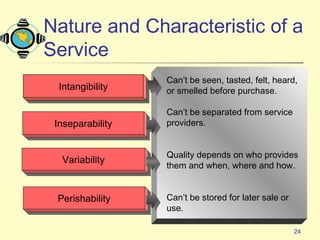
IntangibilityIntangibility
InseparabilityInseparability
VariabilityVariability
PerishabilityPerishability
Can’t be seen, tasted, felt, heard,
or smelled before purchase.
Can’t be separated from service
providers.
Quality depends on who provides
them and when, where and how.
Can’t be stored for later sale or
use.
Nature and Characteristic of a
Service
25
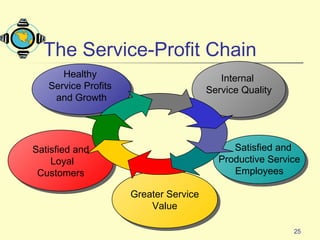
Satisfied and
Loyal
Customers
Satisfied and
Loyal
Customers
Greater Service
Value
Greater Service
Value
Healthy
Service Profits
and Growth
Healthy
Service Profits
and Growth
Satisfied and
Productive Service
Employees
Satisfied and
Productive Service
Employees
Internal
Service Quality
Internal
Service Quality
The Service-Profit Chain
26
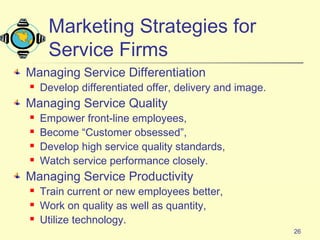
Marketing Strategies for
Service Firms
Managing Service Differentiation
 Develop differentiated offer, delivery and image.
Managing Service Quality
 Empower front-line employees,
 Become “Customer obsessed”,
 Develop high service quality standards,
 Watch service performance closely.
Managing Service Productivity
 Train current or new employees better,
 Work on quality as well as quantity,
 Utilize technology.
27
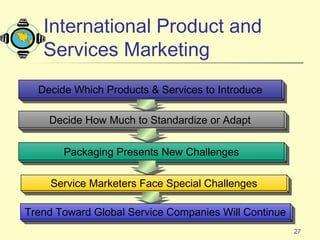
Decide Which Products & Services to IntroduceDecide Which Products & Services to Introduce
Decide How Much to Standardize or AdaptDecide How Much to Standardize or Adapt
Packaging Presents New ChallengesPackaging Presents New Challenges
Service Marketers Face Special ChallengesService Marketers Face Special Challenges
Trend Toward Global Service Companies Will ContinueTrend Toward Global Service Companies Will Continue
International Product and
Services Marketing
28
Product Life Cycle
Introduction
Growth
Maturity
Decline
Stages of product life cycle
Introduction
- period of slow growth of sales as the
product is introduced in the market
- Profits are low because of heavy
expenses of product introduction
Growth
- a period of rapid increase in sales
- substantial profit
Stages of product life cycle
Maturity
- a period of slowdown in sales growth because the
product has achieved by most of the potential buyers
- Profits stabilize or decline because of increased
marketing outlays to defend the product against
competition
Decline
- the period when sales show a strong downward drift
- profits erode
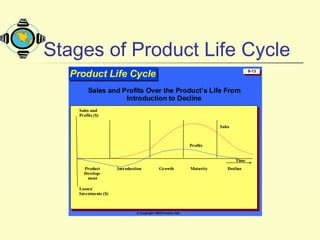
Stages of Product Life Cycle
© Copyright 1999 Prentice Hall
9-139-13
Product Life CycleProduct Life Cycle
Time
Product
Develop-
ment
Introduction
Profits
Sales
Growth Maturity Decline
Losses/
Investments ($)
Sales and
Profits ($)
Sales and Profits Over the Product’s Life From
Introduction to Decline
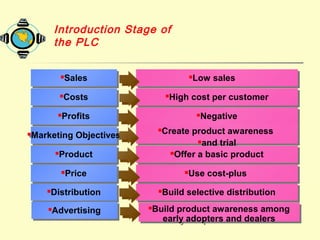
Introduction Stage of
the PLC
SalesSales
CostsCosts
ProfitsProfits
Marketing ObjectivesMarketing Objectives
ProductProduct
PricePrice
Low salesLow sales
High cost per customerHigh cost per customer
NegativeNegative
Create product awareness
and trial
Create product awareness
and trial
Offer a basic productOffer a basic product
Use cost-plusUse cost-plus
DistributionDistribution Build selective distributionBuild selective distribution
AdvertisingAdvertising Build product awareness among
early adopters and dealers
Build product awareness among
early adopters and dealers
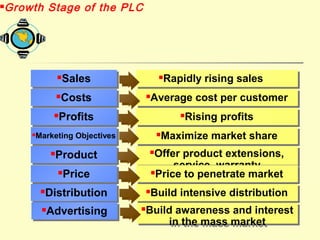
SalesSales
CostsCosts
ProfitsProfits
Marketing ObjectivesMarketing Objectives
ProductProduct
PricePrice
Rapidly rising salesRapidly rising sales
Average cost per customerAverage cost per customer
Rising profitsRising profits
Maximize market shareMaximize market share
Offer product extensions,
service, warranty
Offer product extensions,
service, warranty
Price to penetrate marketPrice to penetrate market
DistributionDistribution Build intensive distributionBuild intensive distribution
AdvertisingAdvertising Build awareness and interest
in the mass market
Build awareness and interest
in the mass market
Growth Stage of the PLC
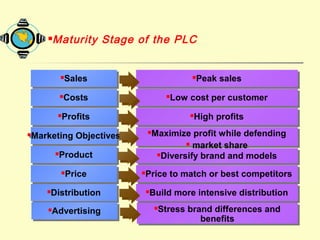
SalesSales
CostsCosts
ProfitsProfits
Marketing ObjectivesMarketing Objectives
ProductProduct
PricePrice
Peak salesPeak sales
Low cost per customerLow cost per customer
High profitsHigh profits
Maximize profit while defending
 market share
Maximize profit while defending
 market share
Diversify brand and modelsDiversify brand and models
Price to match or best competitorsPrice to match or best competitors
DistributionDistribution Build more intensive distributionBuild more intensive distribution
AdvertisingAdvertising Stress brand differences and
benefits
Stress brand differences and
benefits
Maturity Stage of the PLC
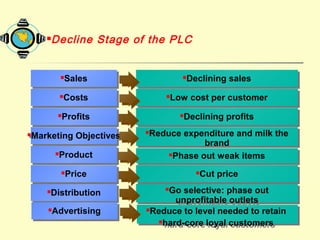
SalesSales
CostsCosts
ProfitsProfits
Marketing ObjectivesMarketing Objectives
ProductProduct
PricePrice
Declining salesDeclining sales
Low cost per customerLow cost per customer
Declining profitsDeclining profits
Reduce expenditure and milk the
brand
Reduce expenditure and milk the
brand
Phase out weak itemsPhase out weak items
Cut priceCut price
DistributionDistribution Go selective: phase out
unprofitable outlets
Go selective: phase out
unprofitable outlets
AdvertisingAdvertising Reduce to level needed to retain
hard-core loyal customers
Reduce to level needed to retain
hard-core loyal customers
Decline Stage of the PLC
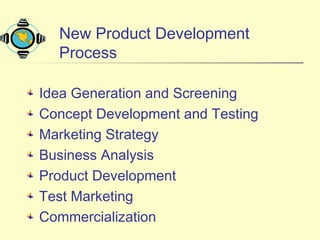
New Product Development
Process
Idea Generation and Screening
Concept Development and Testing
Marketing Strategy
Business Analysis
Product Development
Test Marketing
Commercialization
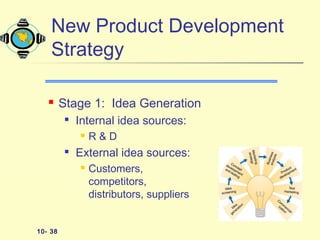
10- 38
 Stage 1: Idea Generation

Internal idea sources:
 R & D

External idea sources:
 Customers,
competitors,
distributors, suppliers
New Product Development
Strategy
10- 39
New Product Development
Strategy
 Stage 2: Idea Screening

Product development
costs increase dramatically
in later stages.

Ideas are evaluated
against criteria;
most are eliminated.
10- 40
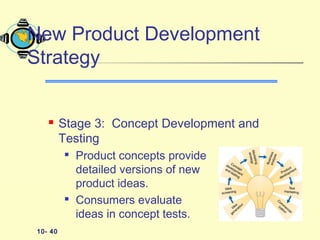
 Stage 3: Concept Development and
Testing

Product concepts provide
detailed versions of new
product ideas.

Consumers evaluate
ideas in concept tests.
New Product Development
Strategy
10- 41
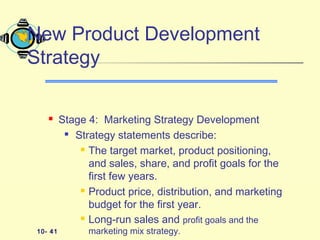
 Stage 4: Marketing Strategy Development

Strategy statements describe:
 The target market, product positioning,
and sales, share, and profit goals for the
first few years.
 Product price, distribution, and marketing
budget for the first year.
 Long-run sales and profit goals and the
marketing mix strategy.
New Product Development
Strategy
10- 42
 Stage 5: Business Analysis

Sales, cost, and profit
projections
 Stage 6: Product
Development

Prototype development
and testing
New Product Development
Strategy
10- 43
 Stage 7: Test Marketing

Standard test markets

Controlled test markets

Simulated test markets
 Stage 8:
Commercialization
New Product Development
Strategy
44
45

Product strategy

  • 2.
  • 3.
     NHÓM 5 WELCOME TO TRNG CAO D NGƯỜ Ẳ SONADEZI THÀNH VIÊN TRONG NHÓM Lê Minh Hoàn Gịp Nhộc Phùng Hồng Phương Thảo Tiêu Thị Ngọc Yến Lớp: K10AV
  • 4.
  • 5.
  • 6.
    6 What is aProduct? A ProductProduct is anything that can be offered to a market for attention, acquisition, use, or consumption and that might satisfy a want or need. Includes:  Physical Objects  Services  Events  Persons  Places  Organizations  Ideas  Combinations of the above
  • 7.
    7 Brand Name Quality Level Packaging Design Features Delivery & Credit Installation Warranty After- Sale Service Core Benefit or Service Core Benefitor Service Actual ProductActual Product Core ProductCore Product Augmented ProductAugmented Product Levels of Product
  • 8.
    8 Unsought ProductsUnsought Products  Newinnovations  Products consumers don’t want to think about these products  Require much advertising & personal selling i.e Life insurance, blood donation Product Classifications Consumer Products Specialty ProductsSpecialty Products  Special purchase efforts  High price  Unique characteristics  Brand identification  Few purchase locations i.e Lamborghini, Rolex Shopping ProductsShopping Products  Buy less frequently  Higher price  Fewer purchase locations  Comparison shop i.e Clothing, cars, appliances Convenience ProductsConvenience Products  Buy frequently & immediately  Low priced  Mass advertising  Many purchase locations i.e Candy, newspapers
  • 9.
  • 10.
    10 Product Classifications Other MarketableEntities Activities undertaken to create, maintain, or change the attitudes and behavior toward the following:  Organizations - Profit (businesses) and nonprofit (schools and churches).  Persons – Politicians, entertainers, sports figures, doctors and lawyers.  Places - Business sites and tourism.  Ideas (social ideas marketing) – public health campaigns, environmental campaigns, and others such as family planning, or human rights.
  • 11.
    11 Individual Product Decisions ProductAttributes Branding Packaging Labeling Product Support Services
  • 12.
    12 Product QualityProduct Quality ProductFeaturesProduct Features Product Style & Design Product Style & Design Ability of a Product to Perform Its Functions; Includes Level & Consistency Ability of a Product to Perform Its Functions; Includes Level & Consistency Help to Differentiate the Product from Those of the Competition Help to Differentiate the Product from Those of the Competition Process of Designing a Product’s Style & Function Process of Designing a Product’s Style & Function Developing a Product or Service Involves Defining the Benefits that it Will Offer Such as: Product Attributes
  • 13.
    13 Advantages of Brand Names Brand Equity Advantages of Brand Names Brand Equity StrongBrand Association Strong Brand Association AttributesAttributes Quality & ValueQuality & ValueConsistencyConsistency IdentificationIdentification Perceived QualityPerceived QualityName AwarenessName Awareness High Brand Loyalty High Brand Loyalty Branding
  • 14.
    14 Brand Strategy Line Extensions BrandExtensions Multibrands New Brands Brand Strategy Line Extensions Brand Extensions Multibrands New Brands Brand Sponsor Manufacturer’s Brand Private Brand Licensed Brand Co-branding Brand Sponsor Manufacturer’s Brand Private Brand Licensed Brand Co-branding Brand Name Selection Selection Protection Brand Name Selection Selection Protection Major Branding Decisions
  • 15.
    15 Line Extension Dannon YogurtFlavors Multibrands Seiko Lasalle & Pulsar Brand Extension Barbie Electronics New Brands Windex (by acquisition) BrandName Existing New Product Category Existing New Four Brand Strategies
  • 16.
  • 17.
    17 Brand Strategy Line Extension Existing brand names extended to new forms, sizes, and flavors of an existing product category. Brand Extension  Existing brand names extended to new or modified product categories. Multibrands  New brand names introduced in the same product category. New Brands  New brand names in new product categories.
  • 18.
    18 Packaging Activity of designingand producing the container or wrapper for a product. Packaging used to just contain and protect the product. Packing now has promotional value and marketers should:  Establish a packaging concept,  Develop specific elements of the package,  Tie together elements to support the positioning and marketing strategy.
  • 19.
    19 Labeling Printed information appearing onor with the package. Performs several functions:  Identifies product or brand  Describes several things about the product  Promotes the product through attractive graphics.
  • 20.
    20 Product - SupportServices Companies should design its support services to profitably meet the needs of target customers and gain competitive advantage. How? Step 1. Survey customers to assess the value of current services and to obtain ideas for new services. Step 2. Assess costs of providing desired services. Step 3. Develop a package of services to delight customers and yield profits to the company.
  • 21.
    21 Stretching Lengthen beyond current range ProductLine LengthProduct Line Length Number of Items in the Product Line Product Line LengthProduct Line Length Number of Items in the Product Line Two-Way Downward Upward Filling Lengthen within current range Product Line Decisions
  • 22.
    22 WidthWidth - numberof different product lines WidthWidth - number of different product lines LengthLength - total number of items in product lines LengthLength - total number of items in product lines DepthDepth - number of versions of each product DepthDepth - number of versions of each product Product Mix -Product Mix - all the product lines & items offered Product Mix -Product Mix - all the product lines & items offered Consistency Product Mix Decisions
  • 23.
  • 24.
    24 IntangibilityIntangibility InseparabilityInseparability VariabilityVariability PerishabilityPerishability Can’t be seen,tasted, felt, heard, or smelled before purchase. Can’t be separated from service providers. Quality depends on who provides them and when, where and how. Can’t be stored for later sale or use. Nature and Characteristic of a Service
  • 25.
    25 Satisfied and Loyal Customers Satisfied and Loyal Customers GreaterService Value Greater Service Value Healthy Service Profits and Growth Healthy Service Profits and Growth Satisfied and Productive Service Employees Satisfied and Productive Service Employees Internal Service Quality Internal Service Quality The Service-Profit Chain
  • 26.
    26 Marketing Strategies for ServiceFirms Managing Service Differentiation  Develop differentiated offer, delivery and image. Managing Service Quality  Empower front-line employees,  Become “Customer obsessed”,  Develop high service quality standards,  Watch service performance closely. Managing Service Productivity  Train current or new employees better,  Work on quality as well as quantity,  Utilize technology.
  • 27.
    27 Decide Which Products& Services to IntroduceDecide Which Products & Services to Introduce Decide How Much to Standardize or AdaptDecide How Much to Standardize or Adapt Packaging Presents New ChallengesPackaging Presents New Challenges Service Marketers Face Special ChallengesService Marketers Face Special Challenges Trend Toward Global Service Companies Will ContinueTrend Toward Global Service Companies Will Continue International Product and Services Marketing
  • 28.
  • 29.
  • 30.
    Stages of productlife cycle Introduction - period of slow growth of sales as the product is introduced in the market - Profits are low because of heavy expenses of product introduction Growth - a period of rapid increase in sales - substantial profit
  • 31.
    Stages of productlife cycle Maturity - a period of slowdown in sales growth because the product has achieved by most of the potential buyers - Profits stabilize or decline because of increased marketing outlays to defend the product against competition Decline - the period when sales show a strong downward drift - profits erode
  • 32.
    Stages of ProductLife Cycle © Copyright 1999 Prentice Hall 9-139-13 Product Life CycleProduct Life Cycle Time Product Develop- ment Introduction Profits Sales Growth Maturity Decline Losses/ Investments ($) Sales and Profits ($) Sales and Profits Over the Product’s Life From Introduction to Decline
  • 33.
    Introduction Stage of thePLC SalesSales CostsCosts ProfitsProfits Marketing ObjectivesMarketing Objectives ProductProduct PricePrice Low salesLow sales High cost per customerHigh cost per customer NegativeNegative Create product awareness and trial Create product awareness and trial Offer a basic productOffer a basic product Use cost-plusUse cost-plus DistributionDistribution Build selective distributionBuild selective distribution AdvertisingAdvertising Build product awareness among early adopters and dealers Build product awareness among early adopters and dealers
  • 34.
    SalesSales CostsCosts ProfitsProfits Marketing ObjectivesMarketing Objectives ProductProduct PricePrice Rapidlyrising salesRapidly rising sales Average cost per customerAverage cost per customer Rising profitsRising profits Maximize market shareMaximize market share Offer product extensions, service, warranty Offer product extensions, service, warranty Price to penetrate marketPrice to penetrate market DistributionDistribution Build intensive distributionBuild intensive distribution AdvertisingAdvertising Build awareness and interest in the mass market Build awareness and interest in the mass market Growth Stage of the PLC
  • 35.
    SalesSales CostsCosts ProfitsProfits Marketing ObjectivesMarketing Objectives ProductProduct PricePrice PeaksalesPeak sales Low cost per customerLow cost per customer High profitsHigh profits Maximize profit while defending  market share Maximize profit while defending  market share Diversify brand and modelsDiversify brand and models Price to match or best competitorsPrice to match or best competitors DistributionDistribution Build more intensive distributionBuild more intensive distribution AdvertisingAdvertising Stress brand differences and benefits Stress brand differences and benefits Maturity Stage of the PLC
  • 36.
    SalesSales CostsCosts ProfitsProfits Marketing ObjectivesMarketing Objectives ProductProduct PricePrice DecliningsalesDeclining sales Low cost per customerLow cost per customer Declining profitsDeclining profits Reduce expenditure and milk the brand Reduce expenditure and milk the brand Phase out weak itemsPhase out weak items Cut priceCut price DistributionDistribution Go selective: phase out unprofitable outlets Go selective: phase out unprofitable outlets AdvertisingAdvertising Reduce to level needed to retain hard-core loyal customers Reduce to level needed to retain hard-core loyal customers Decline Stage of the PLC
  • 37.
    New Product Development Process IdeaGeneration and Screening Concept Development and Testing Marketing Strategy Business Analysis Product Development Test Marketing Commercialization
  • 38.
    10- 38  Stage1: Idea Generation  Internal idea sources:  R & D  External idea sources:  Customers, competitors, distributors, suppliers New Product Development Strategy
  • 39.
    10- 39 New ProductDevelopment Strategy  Stage 2: Idea Screening  Product development costs increase dramatically in later stages.  Ideas are evaluated against criteria; most are eliminated.
  • 40.
    10- 40  Stage3: Concept Development and Testing  Product concepts provide detailed versions of new product ideas.  Consumers evaluate ideas in concept tests. New Product Development Strategy
  • 41.
    10- 41  Stage4: Marketing Strategy Development  Strategy statements describe:  The target market, product positioning, and sales, share, and profit goals for the first few years.  Product price, distribution, and marketing budget for the first year.  Long-run sales and profit goals and the marketing mix strategy. New Product Development Strategy
  • 42.
    10- 42  Stage5: Business Analysis  Sales, cost, and profit projections  Stage 6: Product Development  Prototype development and testing New Product Development Strategy
  • 43.
    10- 43  Stage7: Test Marketing  Standard test markets  Controlled test markets  Simulated test markets  Stage 8: Commercialization New Product Development Strategy
  • 44.
  • 45.