Product Strategy Development
Outline:

•   Selection Of Product Strategy
•   Benefits Of Strategy
•   Elements Of Product Strategy
•   Positioning
•   Managing Brand Equity
•   Product Strategy Over Life Cycle
Selection Of Product Strategy
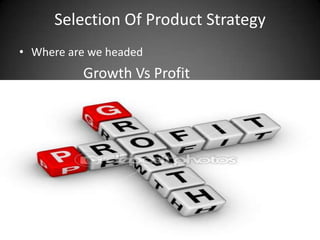
• Where are we headed
          Growth Vs Profit
Selection Of Product Strategy


• How will we get there
    Existing / New customers
  - Customer targets
  - Competitive targets
  - The proposition
   (General Offerings)
Selection Of Product Strategy
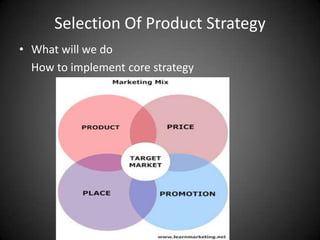
• What will we do
  How to implement core strategy
Benefits Of Strategy

• Co-ordination
  among functional
  areas of organization
Benefits Of Strategy
• Allocation of
  resources
Benefits Of Strategy

• Superior market position
       i) Something competitor cant do.
      ii) Something competitor will not do.
     iii) Competitor will be at disadvantage if
          they do it.
    iv) It causes us to gain if the competition
          does it.
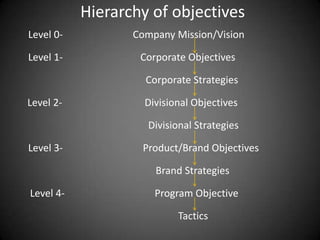
Hierarchy of objectives
Level 0-          Company Mission/Vision

Level 1-           Corporate Objectives

                    Corporate Strategies

Level 2-            Divisional Objectives

                     Divisional Strategies

Level 3-           Product/Brand Objectives

                      Brand Strategies

Level 4-              Program Objective

                           Tactics
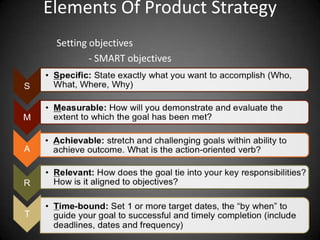
Elements Of Product Strategy
 Setting objectives
         - SMART objectives
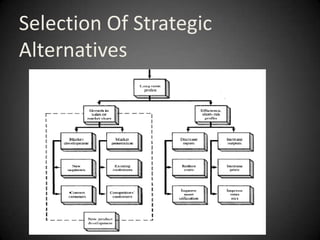
Selection Of Strategic
Alternatives

 Increasing Sales/Market share
 Increasing Profitability
Selection Of Strategic
Alternatives
Increasing Sales/Market Share


Market Development Strategies
Market Penetration Strategies
Increasing Profitability

Decreasing Inputs
Increasing Outputs
Positioning

The place a product occupies in consumers’ minds relative
                  to competing products.
Positioning Example


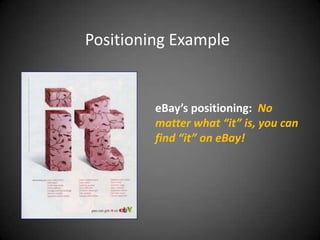
         eBay’s positioning: No
         matter what “it” is, you can
         find “it” on eBay!
Positioning Example


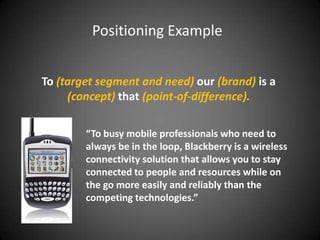
To (target segment and need) our (brand) is a
     (concept) that (point-of-difference).

        “To busy mobile professionals who need to
        always be in the loop, Blackberry is a wireless
        connectivity solution that allows you to stay
        connected to people and resources while on
        the go more easily and reliably than the
        competing technologies.”
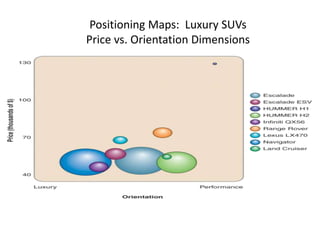
Positioning Maps: Luxury SUVs
Price vs. Orientation Dimensions
Positioning Strategy
 Competitive advantages
 Points of Parity
 Points of Difference => Differentiation


  Positioning results from differentiation and competitive
                         advantages.

             Positioning may change over time.
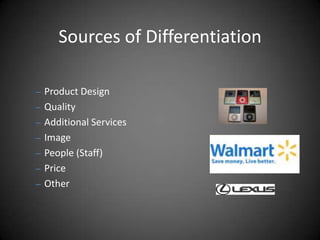
Sources of Differentiation

– Product Design
– Quality
– Additional Services
– Image
– People (Staff)
– Price
– Other
Choosing the Right Competitive Advantages

  The best competitive advantages are…

    Important
    Distinctive
    Superior
    Communicable
    Pre-emptive
    Affordable (to company and consumer)
    Profitable


       Moral: Avoid meaningless differentiation.
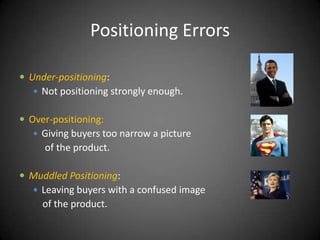
Positioning Errors

 Under-positioning:
    Not positioning strongly enough.


 Over-positioning:
    Giving buyers too narrow a picture
     of the product.

 Muddled Positioning:
    Leaving buyers with a confused image
     of the product.
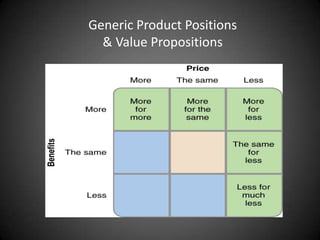
Generic Product Positions
  & Value Propositions
Managing Brand Equity

• Brand name is an asset
• It requires to combat lower-priced
  competitors by reemphasize the brand names
• Brand recognition is important
• Brands are engaged in global warfare against
  counterfeiters and “knockoffs”
Brand Equity as described by Aaker

•   Brand Loyalty
•   Brand Awareness
•   Perceived Quality
•   Brand Association
•   Other Brand Assets
Measuring Brand Value

In order to measure brand equity, it is helpful to
  measure it.

These measures focus on the image of brands
  (i.e. the customer’s view)
Relation to Customer Strategy

•   Customer Acquisition
•   Customer retention
•   Customer Expansion
•   Customer Deletion
Product Strategy Over the Life Cycle
  A company’s positioning and differentiation strategy
  must change as the product, market, and
  competitors change over the product life cycle(PLC).
  To say that a product has a life cycle is to assert four
  things:
1. Products have a limited life.
2. Product sales pass through distinct stages, each
   posing different challenges, opportunities, and
   problems to the seller.
Cont…

3. Profits rise and fall at different stages of the product
    life cycle.
4. Products require different marketing, financial,
    manufacturing, purchasing, and human resource
    strategies in each life-cycle stage.
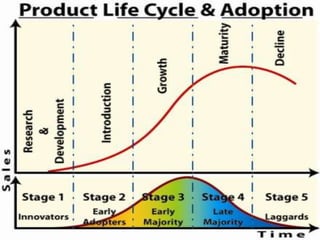
Product Life Cycles
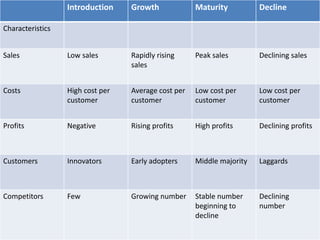
• Introduction: A period of slow sales growth as the
  product is introduced in the market. Profits are
  nonexistent because of the heavy expenses of the
  product introduction.
• Growth: A period of rapid market acceptance and
  substantial profit improvement.
• Maturity: A slowdown in the sales growth because
  the product has achieved acceptance by most
  potential buyers. Profits stabilize or decline because
  of increased competition
• Decline: Sales show a downward drift and profits
  erode.
Introduction    Growth             Maturity          Decline

Characteristics


Sales             Low sales       Rapidly rising     Peak sales        Declining sales
                                  sales


Costs             High cost per   Average cost per   Low cost per      Low cost per
                  customer        customer           customer          customer


Profits           Negative        Rising profits     High profits      Declining profits


Customers         Innovators      Early adopters     Middle majority   Laggards


Competitors       Few             Growing number     Stable number     Declining
                                                     beginning to      number
                                                     decline
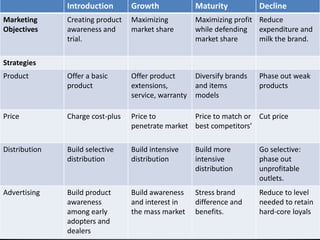
Introduction       Growth              Maturity           Decline
Marketing      Creating product   Maximizing          Maximizing profit Reduce
Objectives     awareness and      market share        while defending expenditure and
               trial.                                 market share      milk the brand.

Strategies
Product        Offer a basic      Offer product       Diversify brands   Phase out weak
               product            extensions,         and items          products
                                  service, warranty   models

Price          Charge cost-plus   Price to         Price to match or Cut price
                                  penetrate market best competitors’

Distribution   Build selective    Build intensive     Build more         Go selective:
               distribution       distribution        intensive          phase out
                                                      distribution       unprofitable
                                                                         outlets.
Advertising    Build product      Build awareness     Stress brand       Reduce to level
               awareness          and interest in     difference and     needed to retain
               among early        the mass market     benefits.          hard-core loyals
               adopters and
               dealers
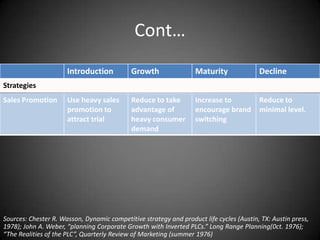
Cont…
                      Introduction          Growth                 Maturity              Decline
Strategies
Sales Promotion       Use heavy sales       Reduce to take         Increase to           Reduce to
                      promotion to          advantage of           encourage brand       minimal level.
                      attract trial         heavy consumer         switching
                                            demand


Sources: Chester R. Wasson, Dynamic competitive strategy and product life cycles (Austin, TX: Austin press,
1978); John A. Weber, “planning Corporate Growth with Inverted PLCs.” Long Range Planning(0ct. 1976);
“The Realities of the PLC”, Quarterly Review of Marketing (summer 1976)
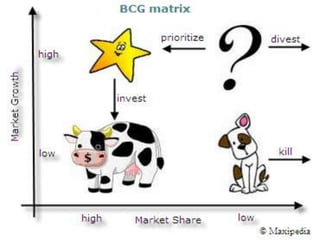
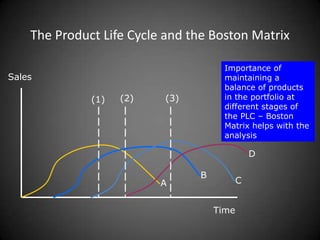
The Product Life Cycle and the Boston Matrix

                                      Importance of
                                      (3) Cash from ‘C’
                                      (2) ‘A’ is at maturity
Sales                                 (1) Cash from ‘B’
                                      maintaining a
                                      The product
                                      used tocash cow.
                                      balance support
                                      used to of products
                                      stage – support
                                      portfolio –‘D’ and
                                      in throughfour
                                      growth of funds for
              (1)   (2)   (3)         ‘C’the portfolio at
                                      Generates growth
                                      productsto finance
                                      different in the of
                                      possibly stages of
                                      the development
                                      stage and to
                                      portfolio Boston
                                      the PLC ‘D’.strategy
                                      extension ‘A’ now
                                      launch –
                                      ‘D’
                                      Matrix helps with the
                                      for ‘B’? a dog?
                                      possibly
                                      analysis

                                               D

                                B
                          A                C


                                    Time

Product strategy development

  • 1.
  • 2.
    Outline: • Selection Of Product Strategy • Benefits Of Strategy • Elements Of Product Strategy • Positioning • Managing Brand Equity • Product Strategy Over Life Cycle
  • 3.
    Selection Of ProductStrategy • Where are we headed Growth Vs Profit
  • 4.
    Selection Of ProductStrategy • How will we get there Existing / New customers - Customer targets - Competitive targets - The proposition (General Offerings)
  • 5.
    Selection Of ProductStrategy • What will we do How to implement core strategy
  • 6.
    Benefits Of Strategy •Co-ordination among functional areas of organization
  • 7.
    Benefits Of Strategy •Allocation of resources
  • 8.
    Benefits Of Strategy •Superior market position i) Something competitor cant do. ii) Something competitor will not do. iii) Competitor will be at disadvantage if they do it. iv) It causes us to gain if the competition does it.
  • 9.
    Hierarchy of objectives Level0- Company Mission/Vision Level 1- Corporate Objectives Corporate Strategies Level 2- Divisional Objectives Divisional Strategies Level 3- Product/Brand Objectives Brand Strategies Level 4- Program Objective Tactics
  • 10.
    Elements Of ProductStrategy Setting objectives - SMART objectives
  • 11.
    Selection Of Strategic Alternatives Increasing Sales/Market share  Increasing Profitability
  • 12.
  • 13.
    Increasing Sales/Market Share MarketDevelopment Strategies Market Penetration Strategies
  • 14.
  • 15.
    Positioning The place aproduct occupies in consumers’ minds relative to competing products.
  • 16.
    Positioning Example eBay’s positioning: No matter what “it” is, you can find “it” on eBay!
  • 17.
    Positioning Example To (targetsegment and need) our (brand) is a (concept) that (point-of-difference). “To busy mobile professionals who need to always be in the loop, Blackberry is a wireless connectivity solution that allows you to stay connected to people and resources while on the go more easily and reliably than the competing technologies.”
  • 18.
    Positioning Maps: LuxurySUVs Price vs. Orientation Dimensions
  • 19.
    Positioning Strategy  Competitiveadvantages  Points of Parity  Points of Difference => Differentiation Positioning results from differentiation and competitive advantages. Positioning may change over time.
  • 20.
    Sources of Differentiation –Product Design – Quality – Additional Services – Image – People (Staff) – Price – Other
  • 21.
    Choosing the RightCompetitive Advantages  The best competitive advantages are…  Important  Distinctive  Superior  Communicable  Pre-emptive  Affordable (to company and consumer)  Profitable Moral: Avoid meaningless differentiation.
  • 22.
    Positioning Errors  Under-positioning:  Not positioning strongly enough.  Over-positioning:  Giving buyers too narrow a picture of the product.  Muddled Positioning:  Leaving buyers with a confused image of the product.
  • 23.
    Generic Product Positions & Value Propositions
  • 24.
    Managing Brand Equity •Brand name is an asset • It requires to combat lower-priced competitors by reemphasize the brand names • Brand recognition is important • Brands are engaged in global warfare against counterfeiters and “knockoffs”
  • 25.
    Brand Equity asdescribed by Aaker • Brand Loyalty • Brand Awareness • Perceived Quality • Brand Association • Other Brand Assets
  • 26.
    Measuring Brand Value Inorder to measure brand equity, it is helpful to measure it. These measures focus on the image of brands (i.e. the customer’s view)
  • 27.
    Relation to CustomerStrategy • Customer Acquisition • Customer retention • Customer Expansion • Customer Deletion
  • 28.
    Product Strategy Overthe Life Cycle A company’s positioning and differentiation strategy must change as the product, market, and competitors change over the product life cycle(PLC). To say that a product has a life cycle is to assert four things: 1. Products have a limited life. 2. Product sales pass through distinct stages, each posing different challenges, opportunities, and problems to the seller.
  • 29.
    Cont… 3. Profits riseand fall at different stages of the product life cycle. 4. Products require different marketing, financial, manufacturing, purchasing, and human resource strategies in each life-cycle stage.
  • 30.
    Product Life Cycles •Introduction: A period of slow sales growth as the product is introduced in the market. Profits are nonexistent because of the heavy expenses of the product introduction. • Growth: A period of rapid market acceptance and substantial profit improvement. • Maturity: A slowdown in the sales growth because the product has achieved acceptance by most potential buyers. Profits stabilize or decline because of increased competition • Decline: Sales show a downward drift and profits erode.
  • 32.
    Introduction Growth Maturity Decline Characteristics Sales Low sales Rapidly rising Peak sales Declining sales sales Costs High cost per Average cost per Low cost per Low cost per customer customer customer customer Profits Negative Rising profits High profits Declining profits Customers Innovators Early adopters Middle majority Laggards Competitors Few Growing number Stable number Declining beginning to number decline
  • 33.
    Introduction Growth Maturity Decline Marketing Creating product Maximizing Maximizing profit Reduce Objectives awareness and market share while defending expenditure and trial. market share milk the brand. Strategies Product Offer a basic Offer product Diversify brands Phase out weak product extensions, and items products service, warranty models Price Charge cost-plus Price to Price to match or Cut price penetrate market best competitors’ Distribution Build selective Build intensive Build more Go selective: distribution distribution intensive phase out distribution unprofitable outlets. Advertising Build product Build awareness Stress brand Reduce to level awareness and interest in difference and needed to retain among early the mass market benefits. hard-core loyals adopters and dealers
  • 34.
    Cont… Introduction Growth Maturity Decline Strategies Sales Promotion Use heavy sales Reduce to take Increase to Reduce to promotion to advantage of encourage brand minimal level. attract trial heavy consumer switching demand Sources: Chester R. Wasson, Dynamic competitive strategy and product life cycles (Austin, TX: Austin press, 1978); John A. Weber, “planning Corporate Growth with Inverted PLCs.” Long Range Planning(0ct. 1976); “The Realities of the PLC”, Quarterly Review of Marketing (summer 1976)
  • 36.
    The Product LifeCycle and the Boston Matrix Importance of (3) Cash from ‘C’ (2) ‘A’ is at maturity Sales (1) Cash from ‘B’ maintaining a The product used tocash cow. balance support used to of products stage – support portfolio –‘D’ and in throughfour growth of funds for (1) (2) (3) ‘C’the portfolio at Generates growth productsto finance different in the of possibly stages of the development stage and to portfolio Boston the PLC ‘D’.strategy extension ‘A’ now launch – ‘D’ Matrix helps with the for ‘B’? a dog? possibly analysis D B A C Time