
PRODUCT
STRATEGY
SOURABH KHEDKAR,
LALJI A.S.
SHUBHAM DWIVEDI
TOPIC OVERVIEW
 “PRODUCT” AS CONCEPT & CLASSIFICATION
 PRODUCT SYSTEMS & MIXES
 MANAGING PRODUCT LINES
 PRODUCT-MIX PRICING
 PACKAGING AND LABELS
“PRODUCT” AS CONCEPT
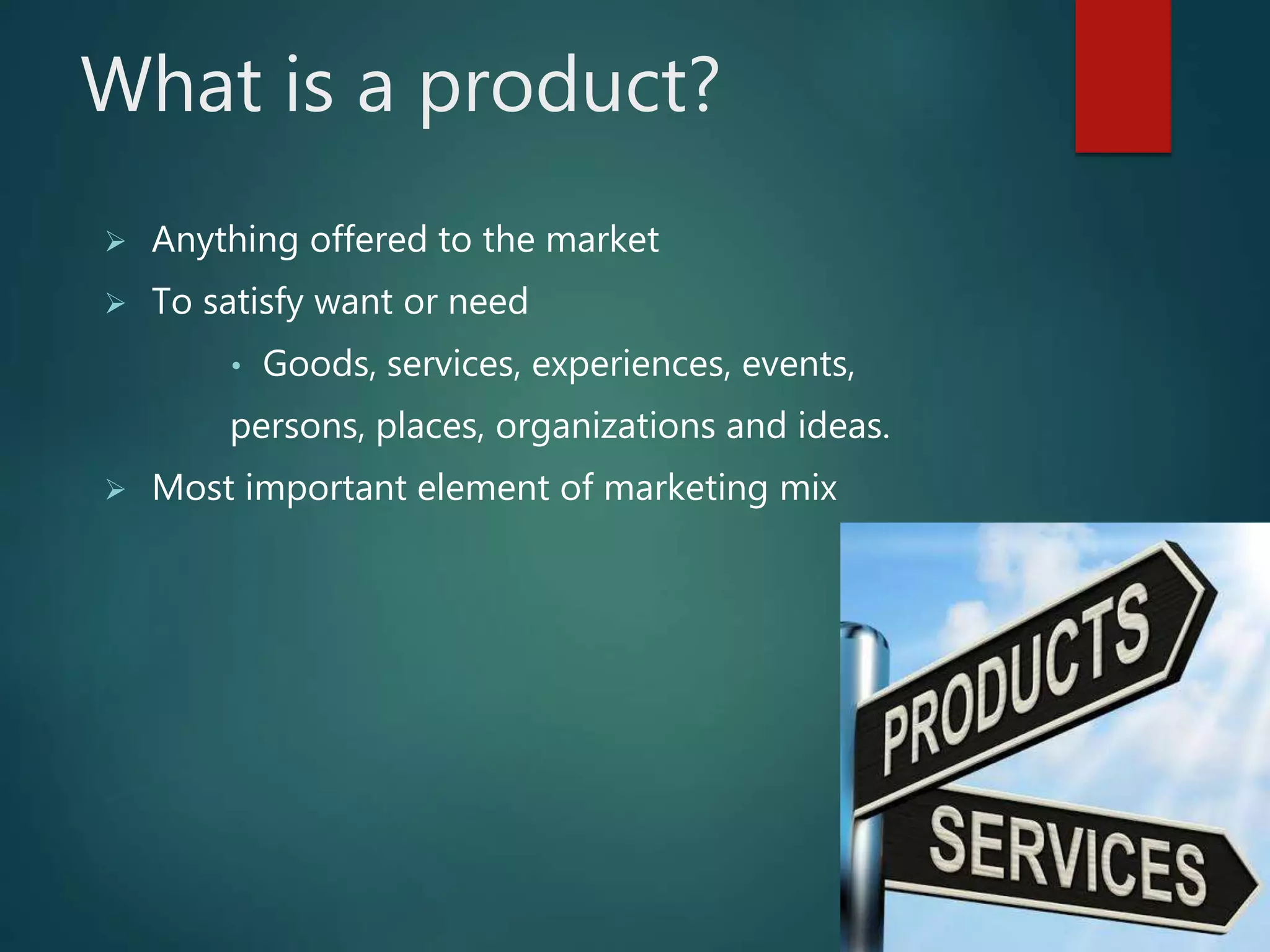
What is a product?
 Anything offered to the market
 To satisfy want or need
• Goods, services, experiences, events,
persons, places, organizations and ideas.
 Most important element of marketing mix
Market offering
 Customer will judge the offering by three basic
elements
• Product features and quality
• Service mix and quality
• price
Product levels
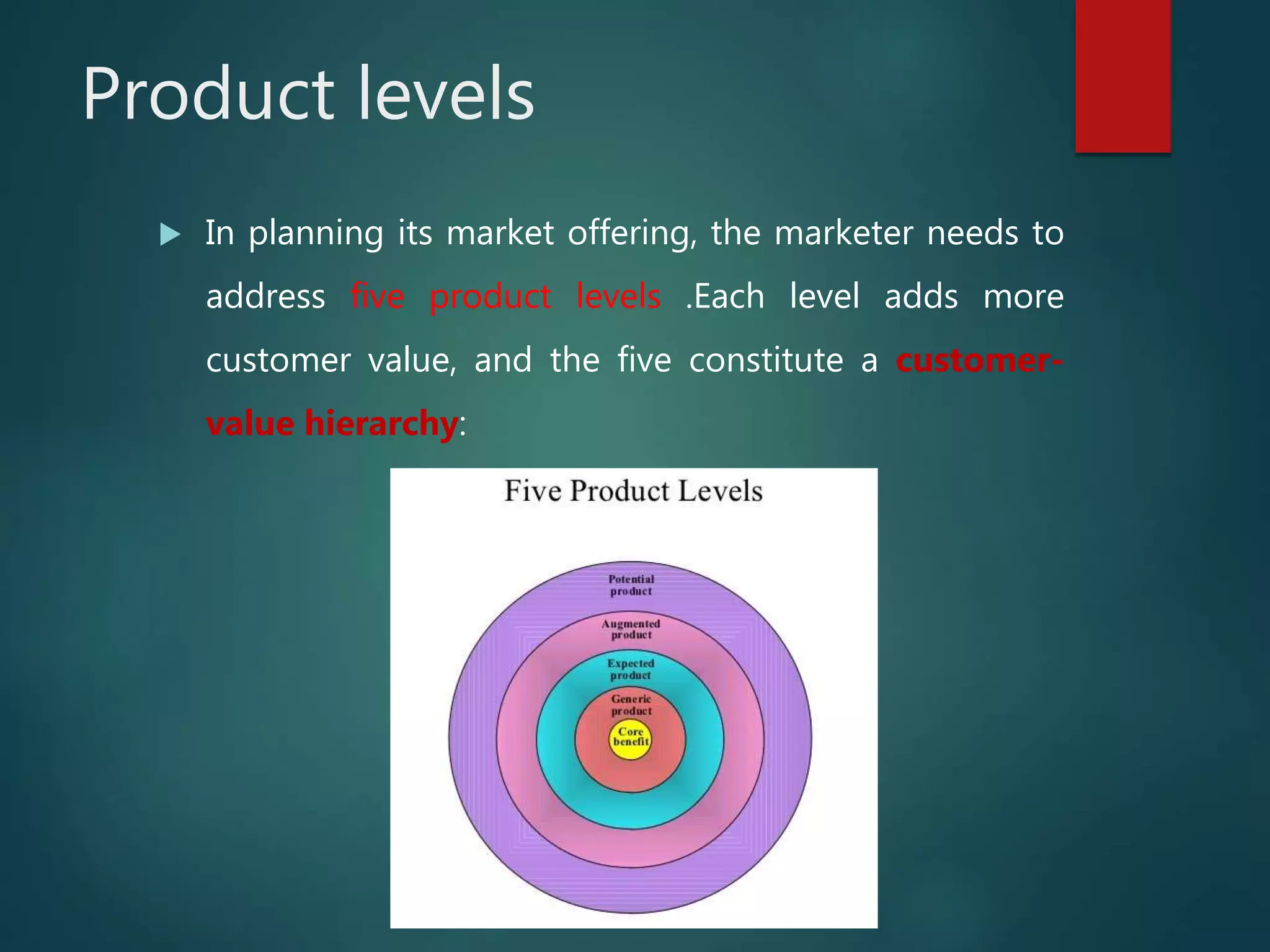
 In planning its market offering, the marketer needs to
address five product levels .Each level adds more
customer value, and the five constitute a customer-
value hierarchy:
CORE BENEFIT • The service or benefit the
customer is really buying.
• A hotel guest is buying rest
and sleep.
• The purchaser of a drill is
buying holes.
• Marketers must see
themselves as benefit
providers.
BASIC PRODUCT
EXPECTED PRODUCT
AUGMENTED PRODUCT
POTENTIAL PRODUCT
CORE BENEFIT • The marketer must turn the
core benefit into a basic
product.
• Thus a hotel room includes a
bed, bathroom, towels, desk,
dresser, and closet.
BASIC PRODUCT
EXPECTED PRODUCT
AUGMENTED PRODUCT
POTENTIAL PRODUCT
CORE BENEFIT • The marketer prepares an
expected product, a set of
attributes and conditions
buyers normally expect when
they purchase this product.
• Hotel guests minimally expect
a clean bed, fresh towels,
working lamps, and a relative
degree of quiet
BASIC PRODUCT
EXPECTED PRODUCT
AUGMENTED PRODUCT
POTENTIAL PRODUCT
CORE BENEFIT • The marketer prepares an
augmented product that
exceeds customer
expectations.
BASIC PRODUCT
EXPECTED PRODUCT
AUGMENTED PRODUCT
POTENTIAL PRODUCT
CORE BENEFIT • `The potential product, which
encompasses all the possible
augmentations and
transformations the product
or offering might undergo in
the future.
BASIC PRODUCT
EXPECTED PRODUCT
AUGMENTED PRODUCT
POTENTIAL PRODUCT
PRODUCT CLASSIFICATION
Marketers classify product based on
• Durability and Tangibility
• Use
 Consumer
 Industrial
Durability and tangilbility
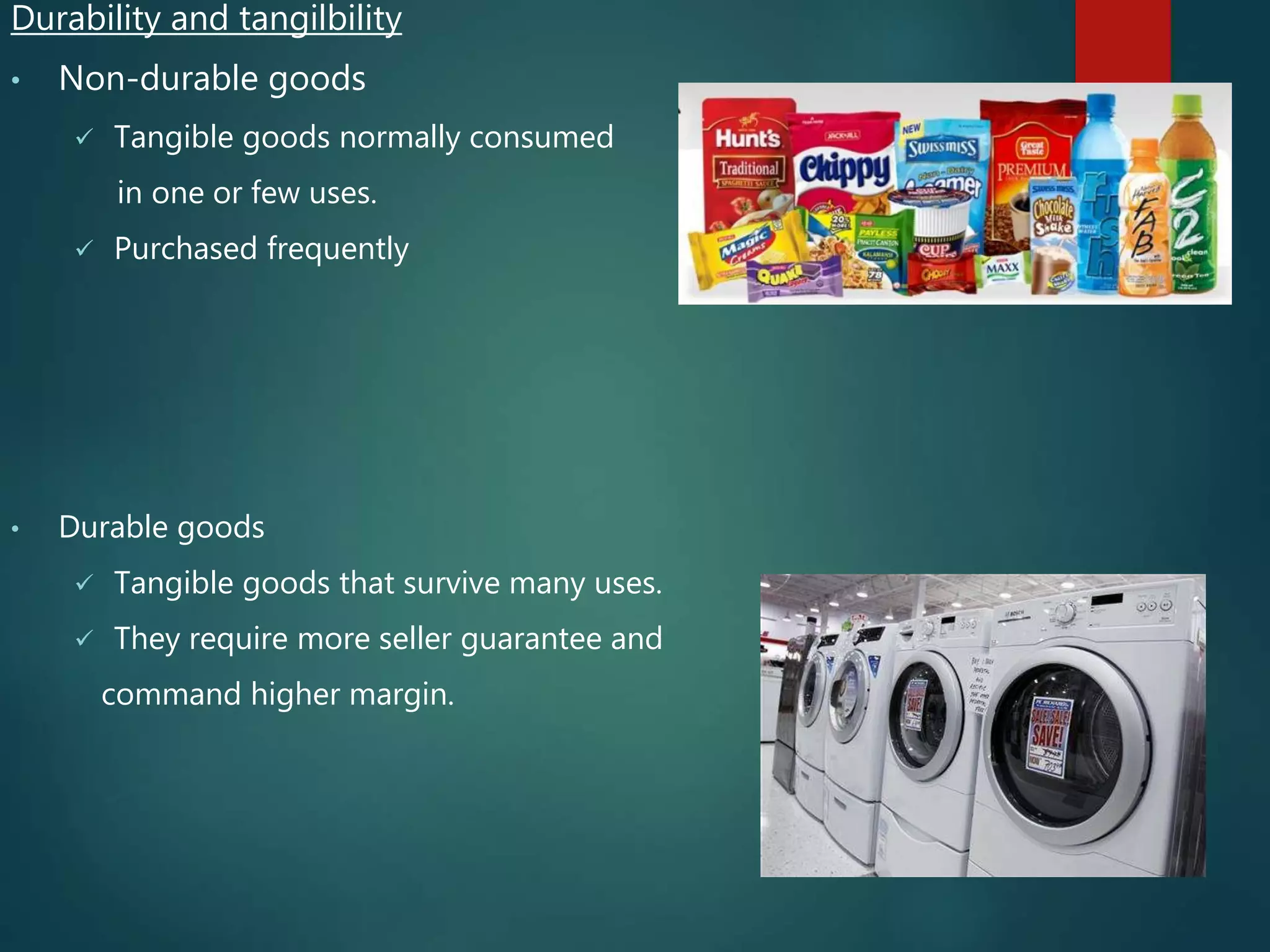
• Non-durable goods
 Tangible goods normally consumed
in one or few uses.
 Purchased frequently
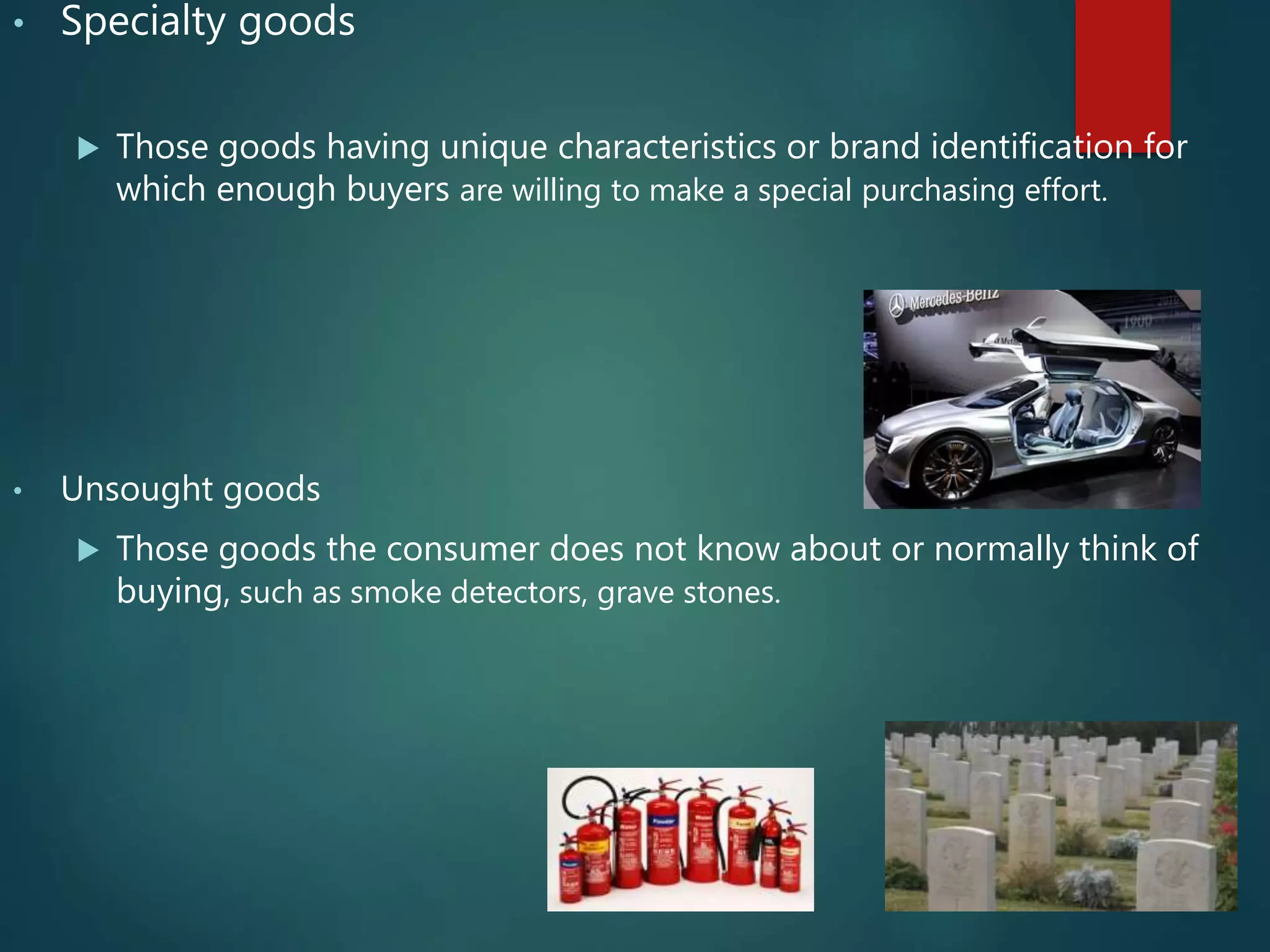
• Durable goods
 Tangible goods that survive many uses.
 They require more seller guarantee and
command higher margin.
Intangible products
• Services
 Intangible
 Requires more quality control, supplier credibility
and adaptability
Consumer goods classification
• Convenience goods
 goods purchased frequently and
immediately with minimum effort
 Staples, impulse goods and emergency
goods
• Shopping goods
 Those goods consumer characteristically compares on such bases as suitability,
quality, price, and style.
 Homogeneous and heterogeneous
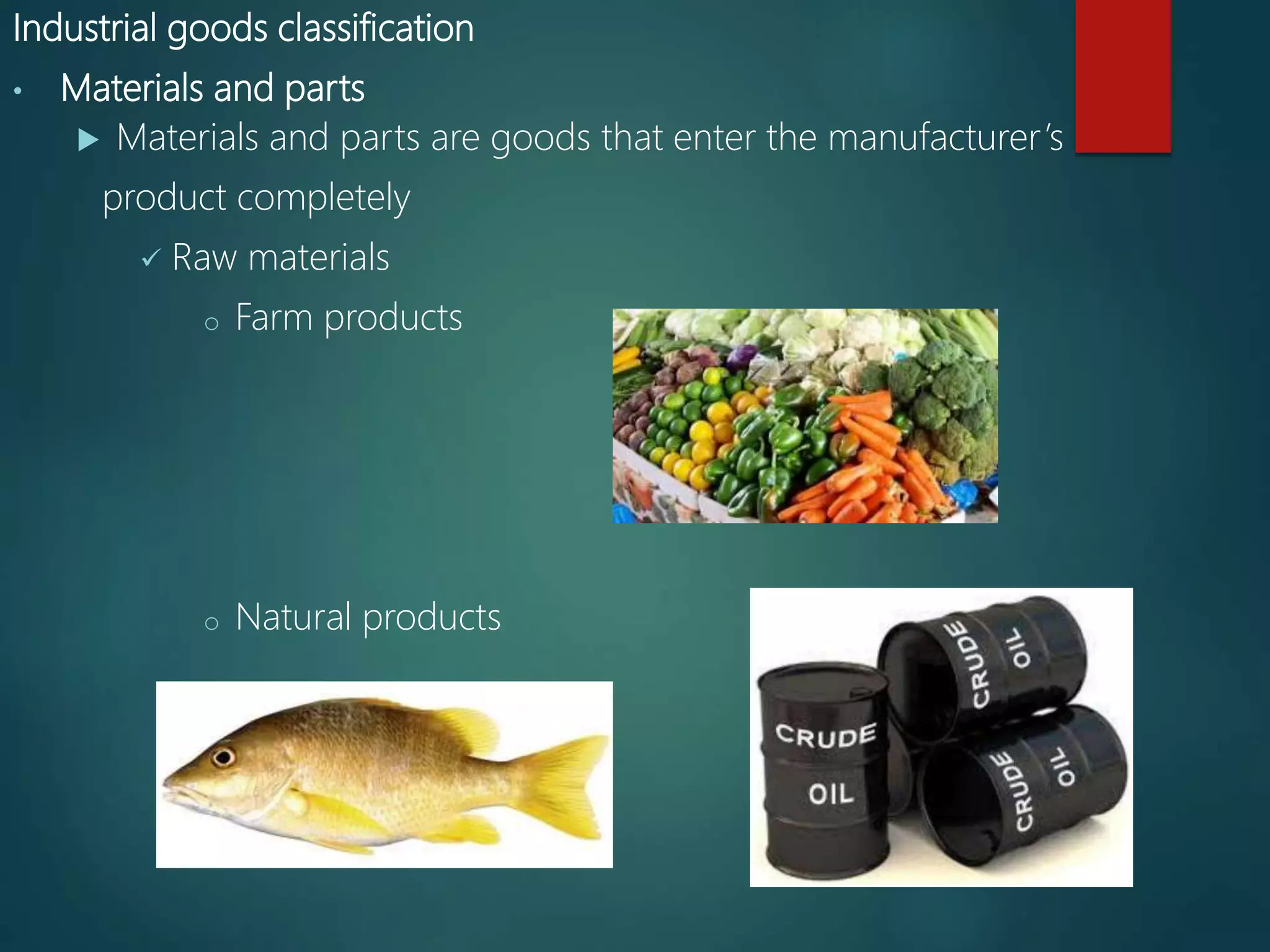
• Specialty goods
 Those goods having unique characteristics or brand identification for
which enough buyers are willing to make a special purchasing effort.
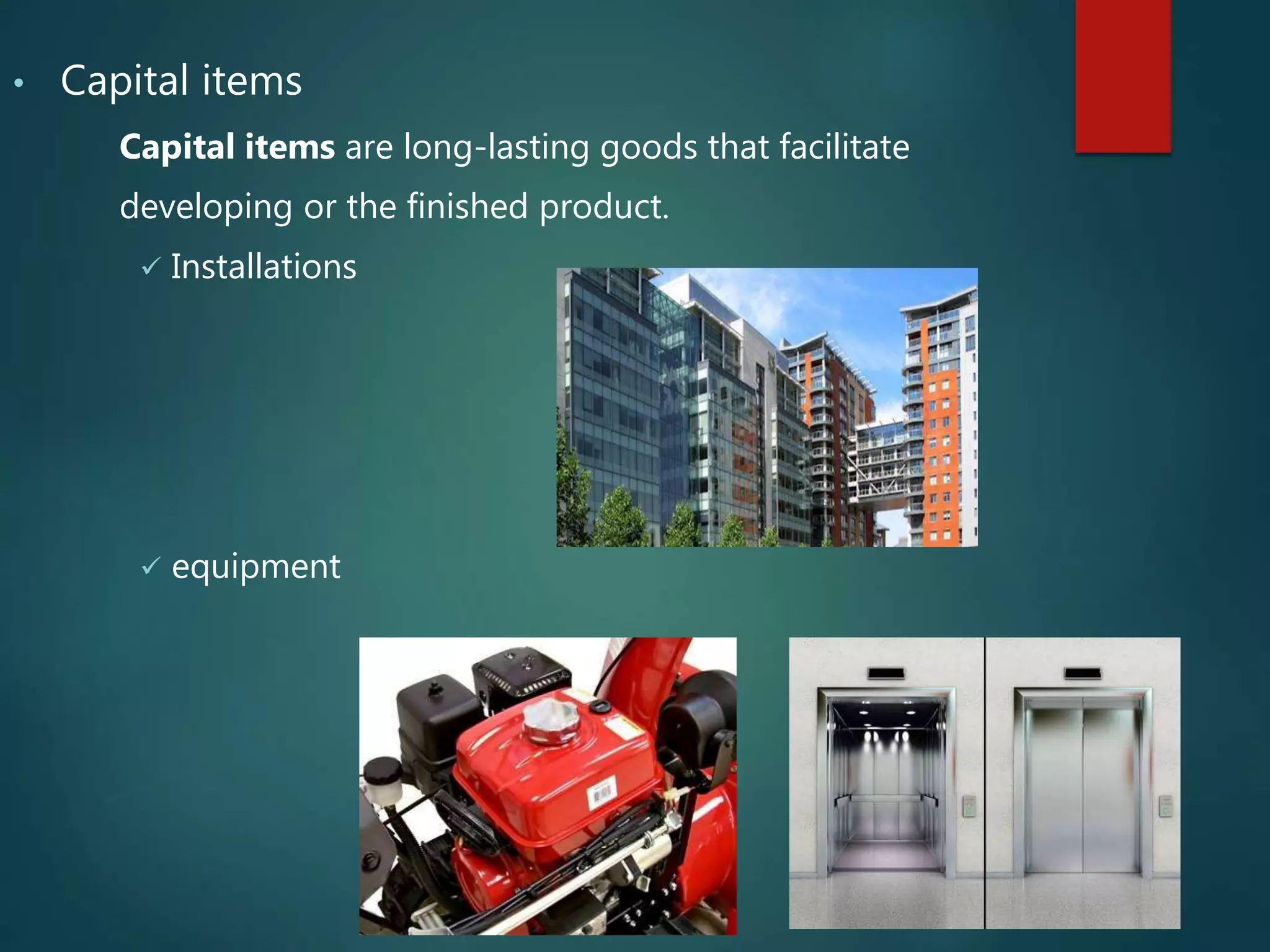
• Unsought goods
 Those goods the consumer does not know about or normally think of
buying, such as smoke detectors, grave stones.
Industrial goods classification
 Material and parts
 Capital items
 Supplies and business services
Industrial goods classification
• Materials and parts
 Materials and parts are goods that enter the manufacturer’s
product completely
 Raw materials
o Farm products
o Natural products
 Manufactured materials
 Component materials
 Component parts
• Capital items
Capital items are long-lasting goods that facilitate
developing or the finished product.
 Installations
 equipment
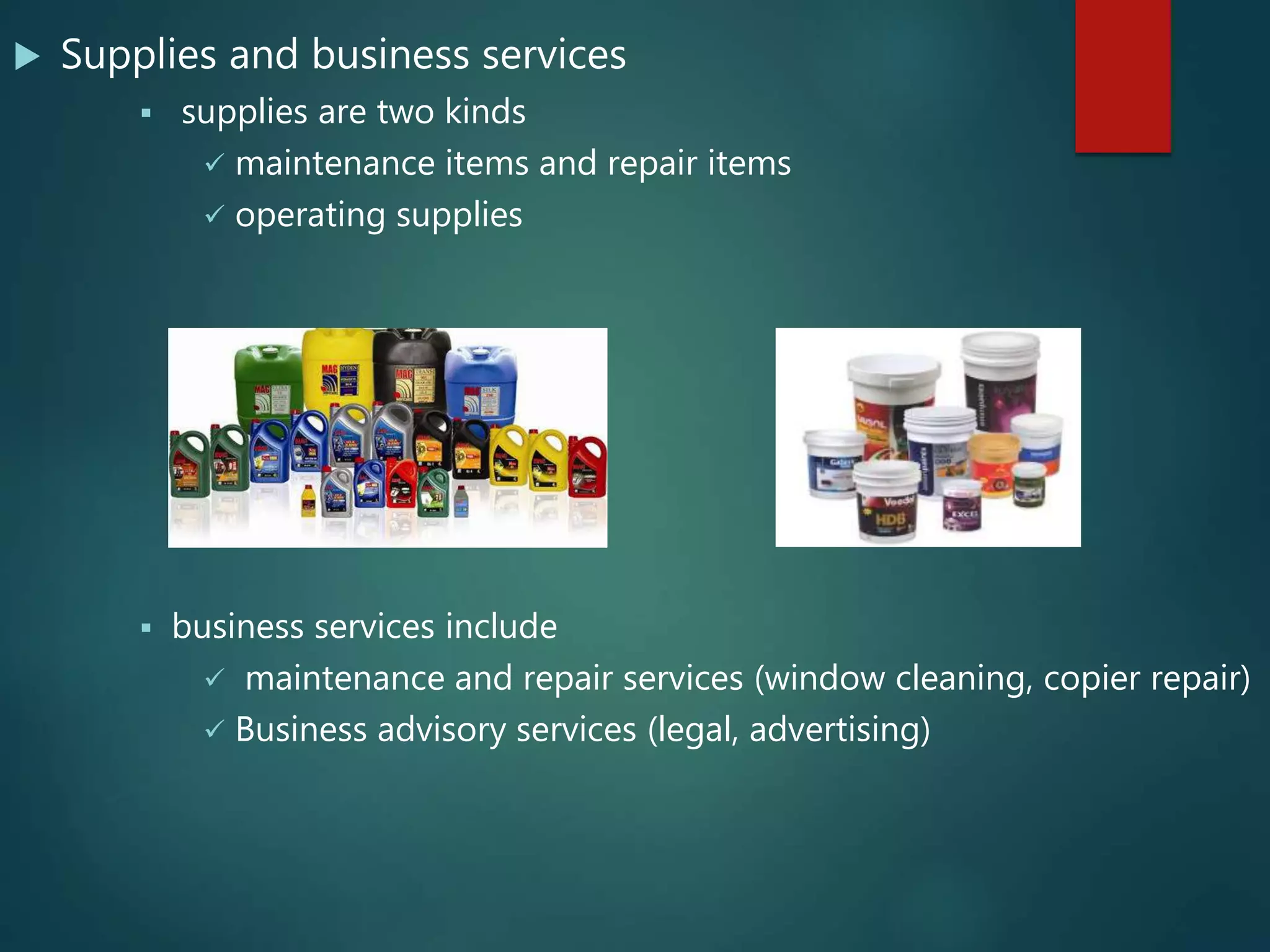
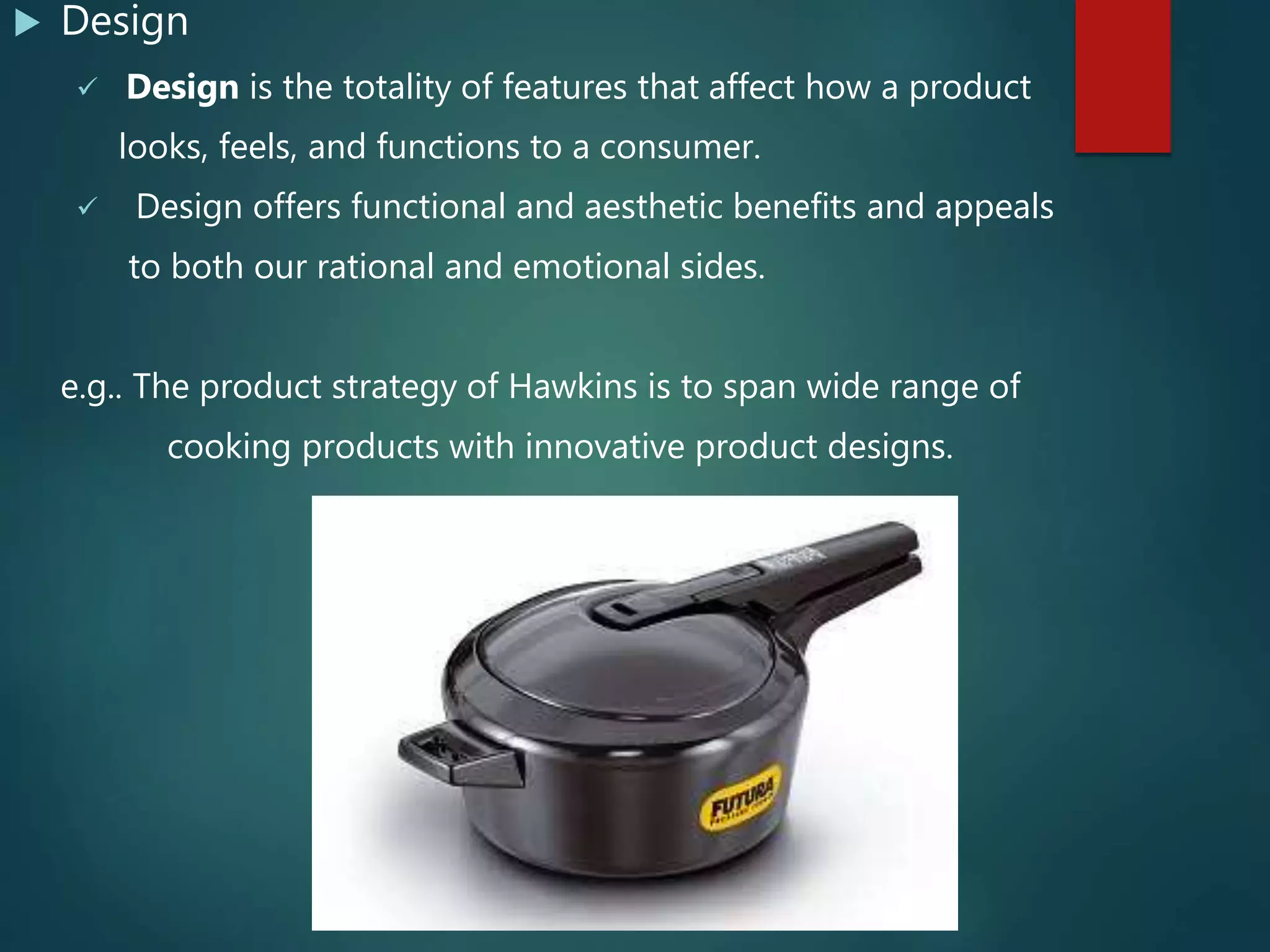
 Supplies and business services
 supplies are two kinds
 maintenance items and repair items
 operating supplies
 business services include
 maintenance and repair services (window cleaning, copier repair)
 Business advisory services (legal, advertising)
 Product and service differentiation
 product differentiation
Form
Features
customizations
Performance
quality
Conformance
quality
Durability Reliability
Reparability
style
 Service differentiation
 Ordering ease
 Delivery
 Installation
 Customer rating
 Customer consulting
 Maintenance and repair
 Returns
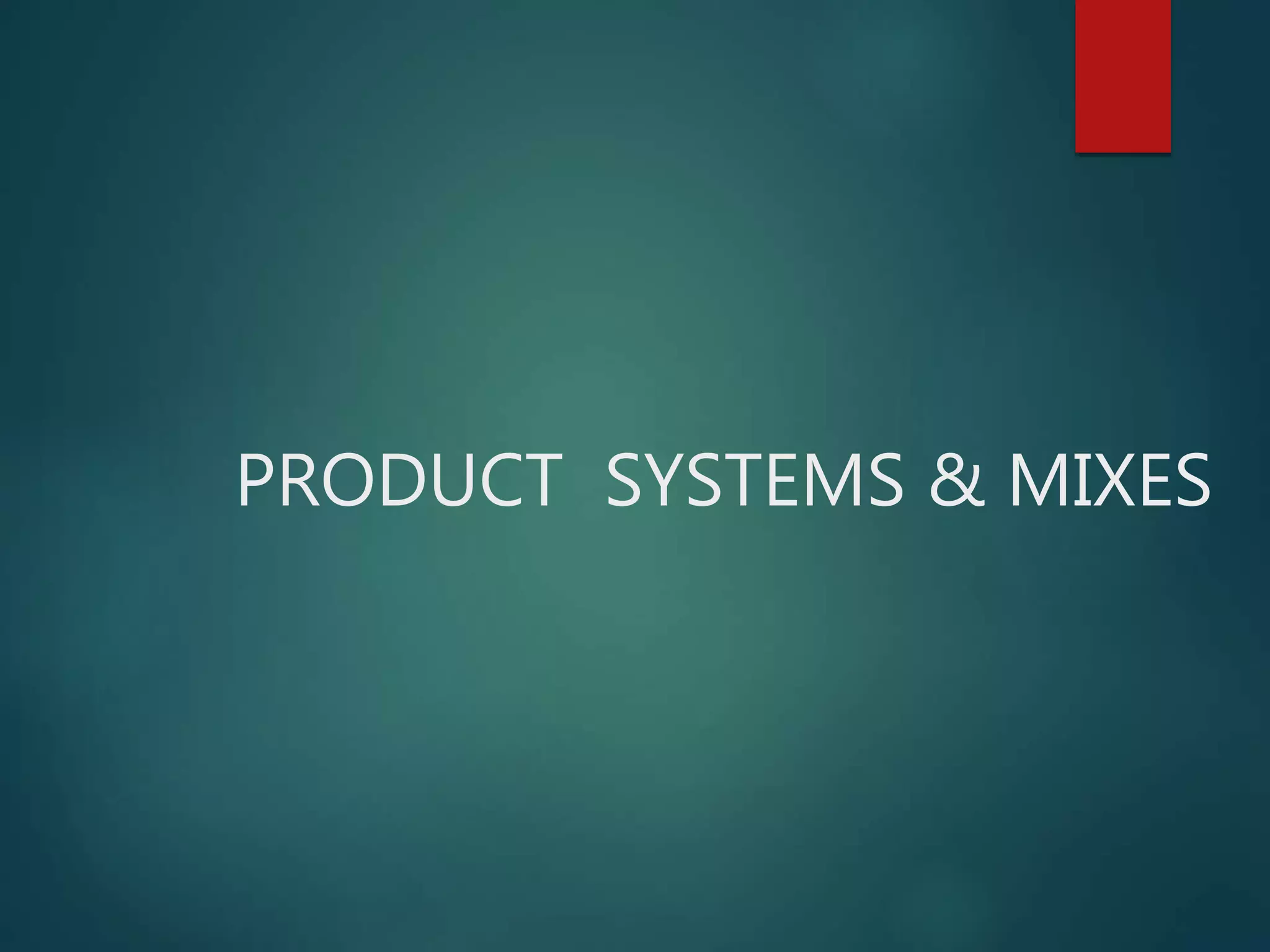
 Design
 Design is the totality of features that affect how a product
looks, feels, and functions to a consumer.
 Design offers functional and aesthetic benefits and appeals
to both our rational and emotional sides.
e.g.. The product strategy of Hawkins is to span wide range of
cooking products with innovative product designs.
PRODUCT SYSTEMS & MIXES
PRODUCT SYSTEMS &
MIXES
Product Systems
Product Mixes
Product Systems Properties
Product System
 Is a group of diverse but related items that functions in
compatible manner
 Why its call Product System??
 Eg. Mobile Phone Industry, Automobile Industry
Product Mixes
Set of all products and items a particular seller
offers for sales
Product Mixes Properties
Product
Mixes
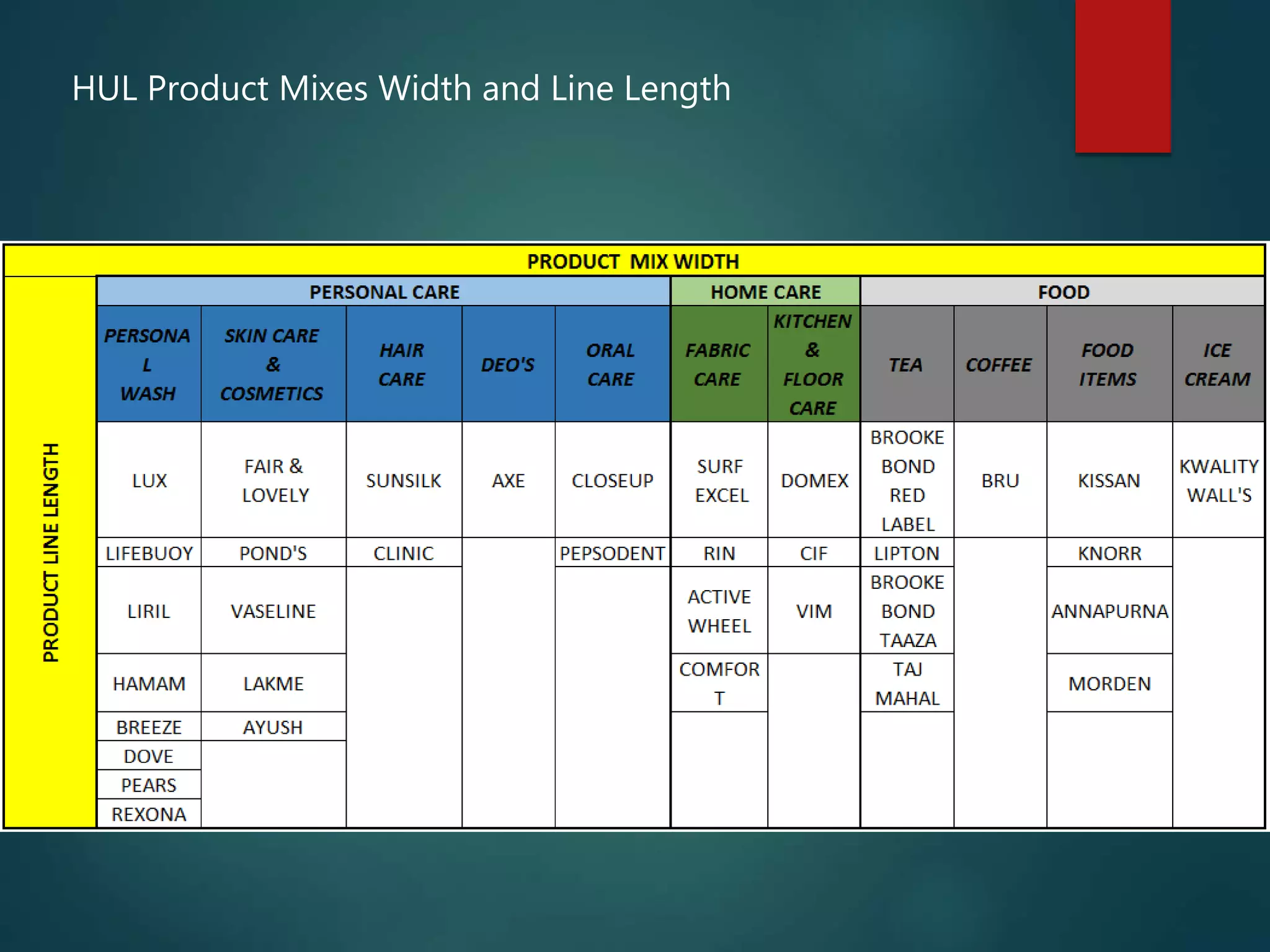
LENGTH
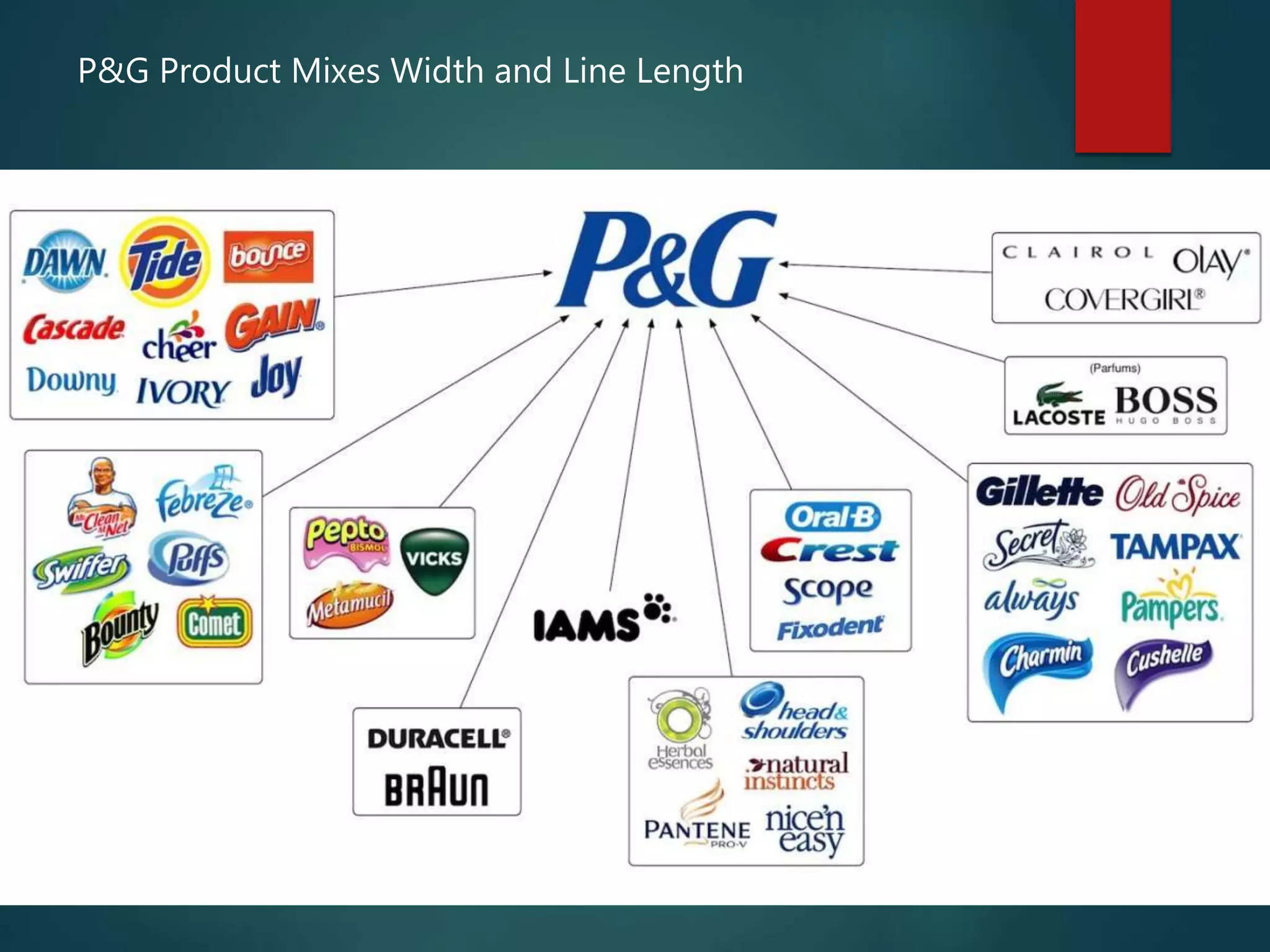
WIDTH
DEPTH
CONSISTANCY
• NO.DIFFERENT PRODUCT
LINE COMPAINY OFFERSWIDTH
• TOTAL NO. OF PRODUCT
IN SINGLE LINELENGTH
• NO. VARIANTS OF EACH
PRODUCT IN LINEDEPTH
• HOW CLOSELY RELATED
PRODUCT LINES ARECONSISTANCY
HUL Product Mixes Width and Line Length
P&G Product Mixes Width and Line Length
Nestle Product Mixes Width and Line Length
ITC Product Mixes Width and Line Length
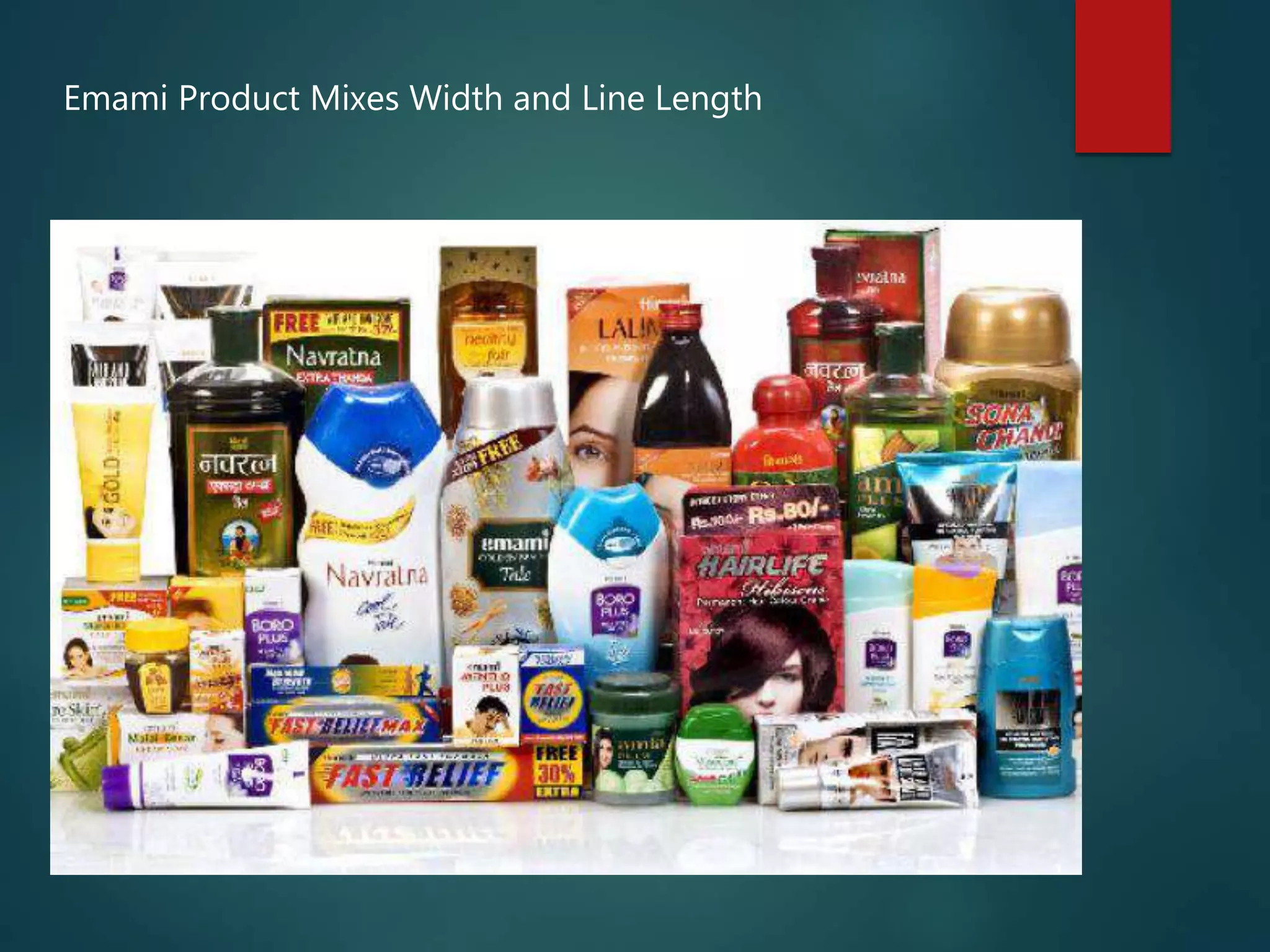
Emami Product Mixes Width and Line Length
MANAGING PRODUCT LINES
MANAGING
PRODUCT
LINES
LINE LENGTH
LINE
STRETCHING
LINE FILLING
LINE ANALYSIS
SALES AND
PROFITS
MARKET
PROFILE
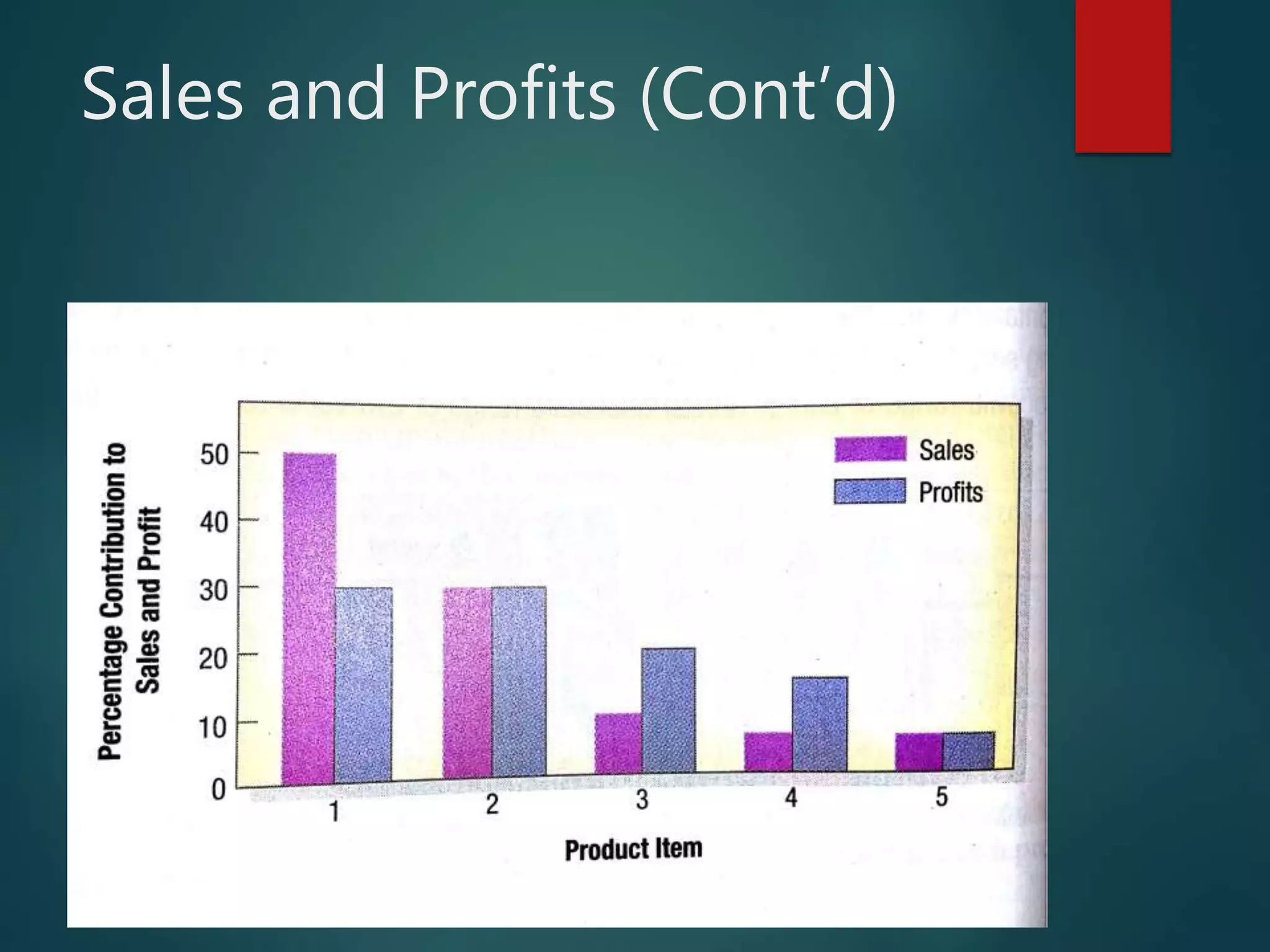
Managing “Sales and Profit”
can help determine which items to Build,
Maintain, Promote or Discontinue.
Sales and Profits (Cont’d)
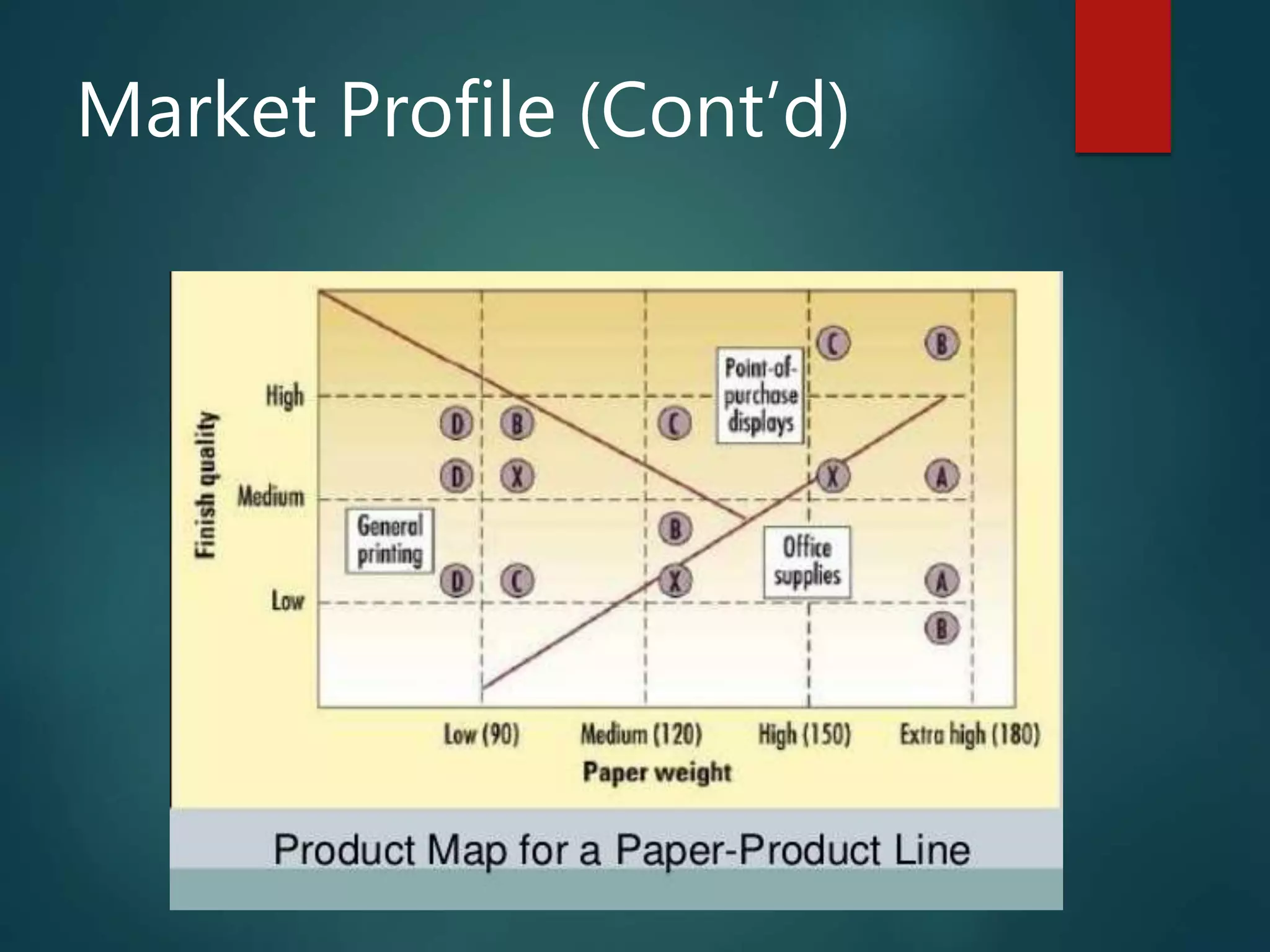
Product line managers must review how
the line is positioned against competitor’s
line to enhance “Market Profile”
Market Profile (Cont’d)
Objective behind managing
product line length
 To induce up-selling
 To facilitates cross-selling
 Protects against economic ups and downs
 To use excess manufacturing capacity
 To satisfy specific customer demands
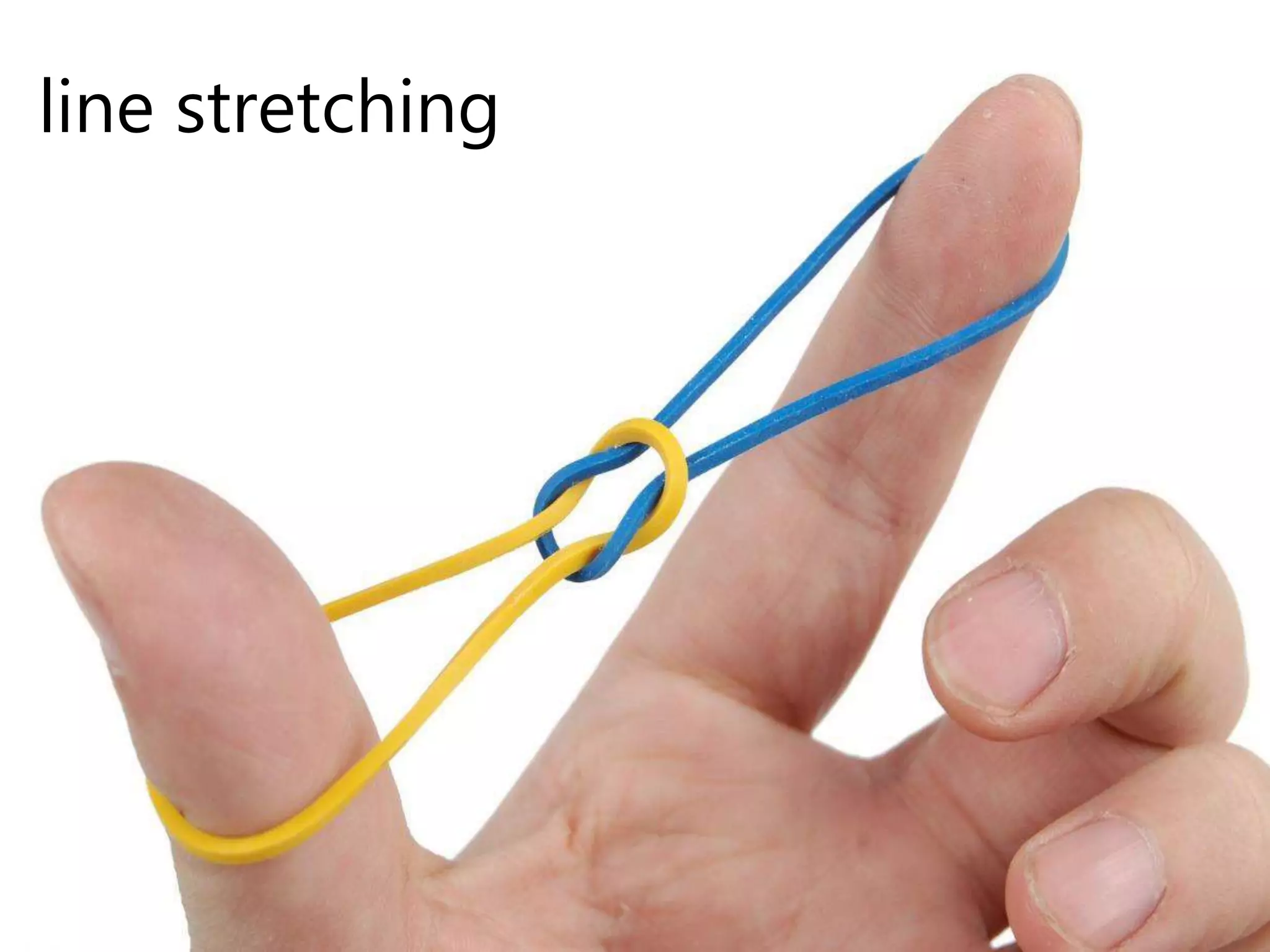
line stretching
Occurs when company lengthens its
product line beyond its current
range
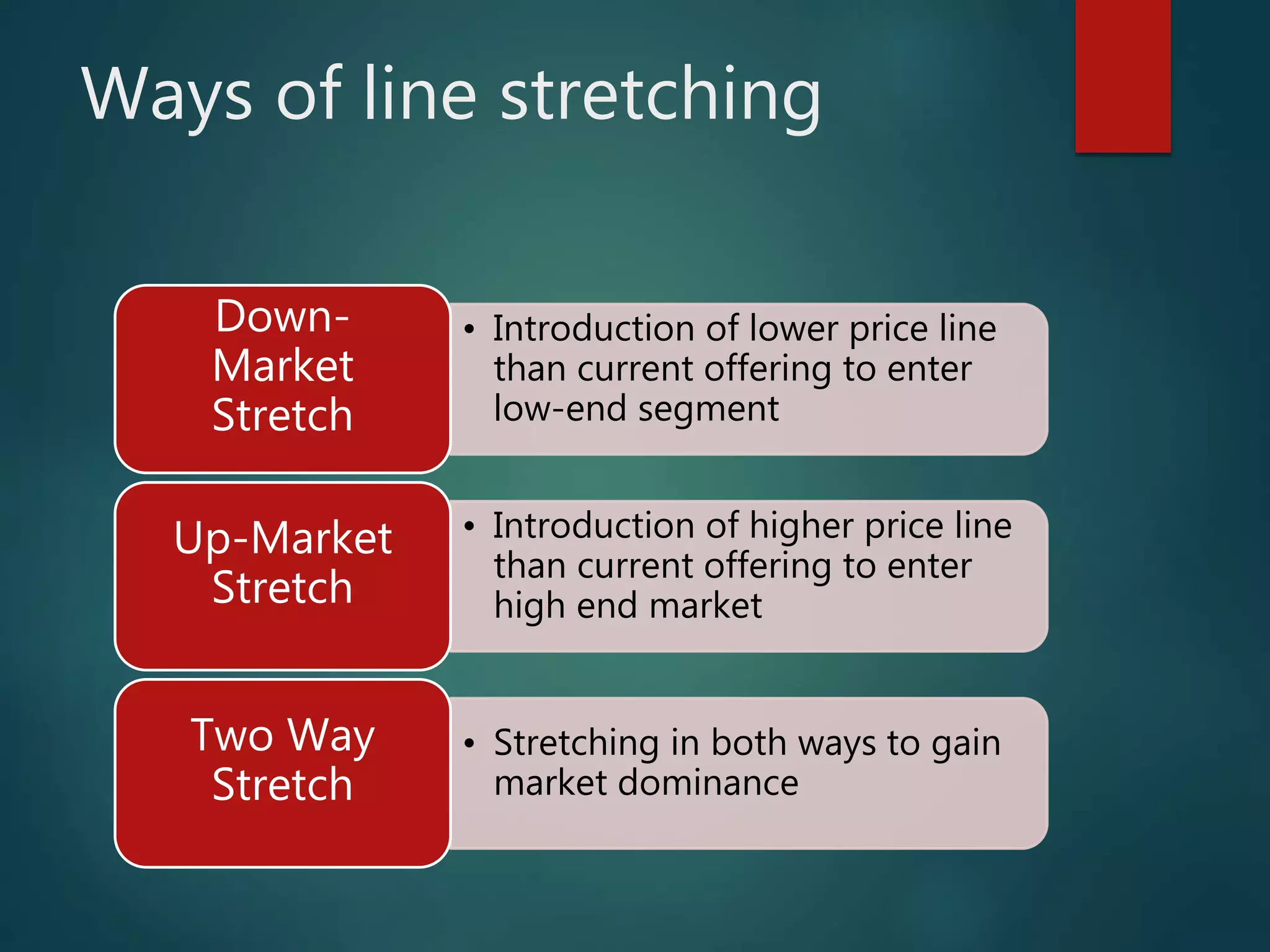
Ways of line stretching
• Introduction of lower price line
than current offering to enter
low-end segment
Down-
Market
Stretch
• Introduction of higher price line
than current offering to enter
high end market
Up-Market
Stretch
• Stretching in both ways to gain
market dominance
Two Way
Stretch
line Stretching Illustration
Line filling
 Lengthening product line by adding more item within
present range
 Plugging holes to keep out competitors
 Overdone result in Cannibalization and Customer
Confusion
 BMW’s evolution one brand five model to 3 brands 14
Series
 Good Knight journey to market leader
Product line management
 Line Modernization: Introducing advance product
 Line Featuring: Introducing Special edition’s
 Line pruning: Cutting Product Line
PRODUCT-MIX PRICING
PRODUCT-MIX PRICING
STRATEGIES
PRICING
PRICE IS THE VALUE THAT IS PUT TO A PRODUCT OR SERVICE
IT IS THE RESULT OF A COMPLEX SET OF CALCULATIONS,
RESEARCH AND UNDERSTANDING AND RISK TAKING ABILITY.
PRICING STRATEGY TAKES INTO ACCOUNT SEGMENTS, ABILITY
TO PAY, MARKET CONDITIONS, COMPETITOR ACTIONS, TRADE
MARGINS AND INPUT COSTS.
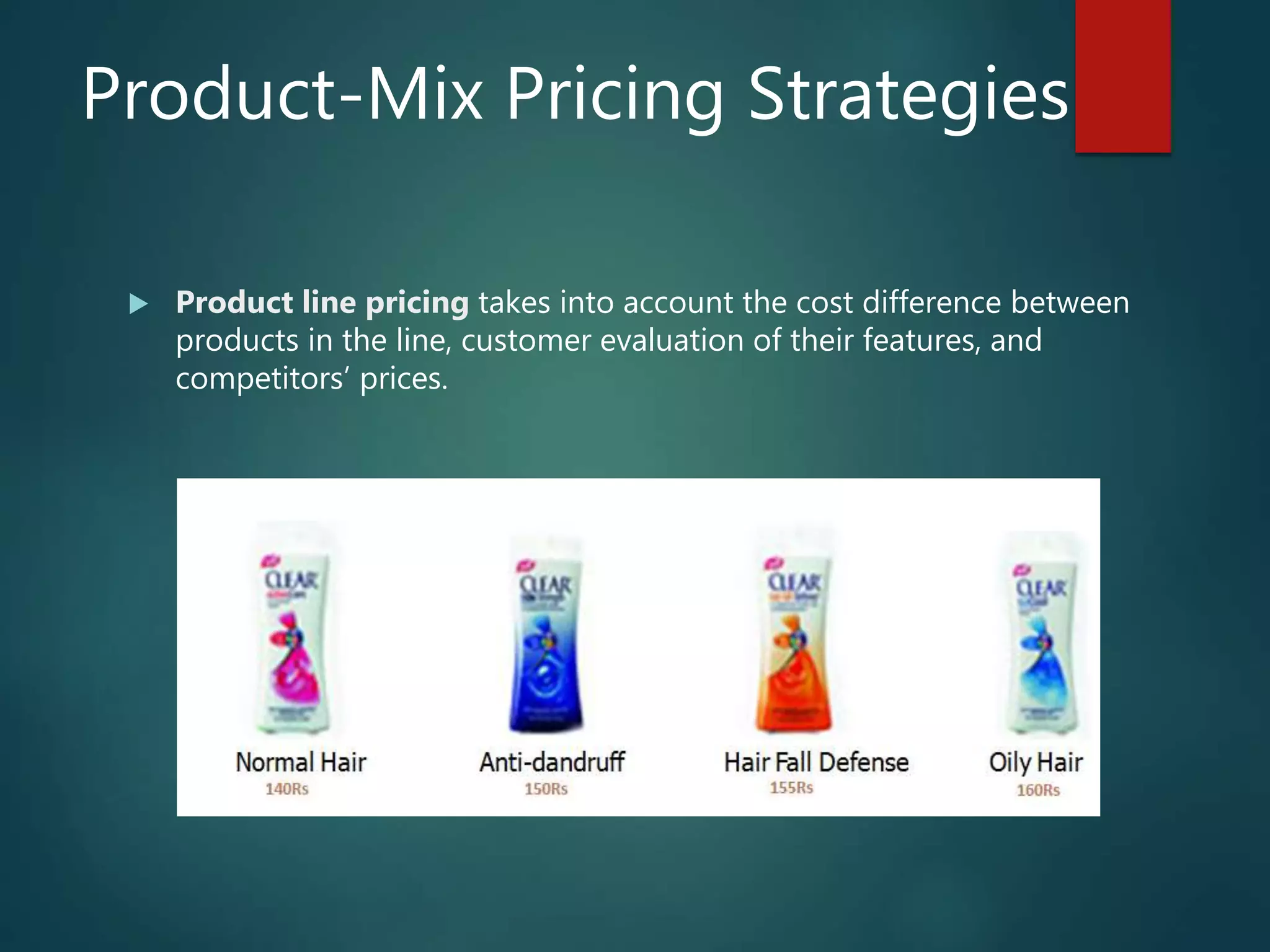
Product-Mix Pricing Strategies
 Product line pricing takes into account the cost difference between
products in the line, customer evaluation of their features, and
competitors’ prices.
Product-Mix Pricing
Strategies
 Optional product pricing takes into account
optional or accessory products along with the main
product.
New car with ordinary
rims
8,00,000Rs
New car with sports rims
8,60,000Rs
Product-Mix Pricing
Strategies
 Captive product pricing involves products that
must be used along with the main product.
 Two-part pricing is where the price is broken into
 Fixed fee
 Variable usage fee
Copyright©2009PearsonEducationSouthAsiaPteLtd
11
-
57
Product –Mix Pricing
Strategies
 Product bundle pricing combines
several products at a reduced price.
1 bottle: 60Rs
Bundled 2 bottles: 100Rs
Product-Mix Pricing
Strategies
Pricing Strategies
 Product line pricing
 Optional product pricing
 Captive product pricing
 By-product pricing
 Product bundle pricing
PACKAGING AND LABELS
PACKAGING
The package refers to physical container or wrapping for a product
It is an integral part of product planning and promotion
 10% of the retail price is spent on developing, designing, and
producing just the package
Companies sometimes change packaging to update their image
and reach a new market
Tropicana Famous
Packaging Failure:
PepsiCo experienced great success with its Tropicana brad, acquired in
1998.Then in 2009, the company launched a redesigned package to “Refresh
and modernize” the brand. The goal was to create an “emotional attachment
with design and trumpeting the natural fruit goodness.
After the new packing and design, Tropicana hit by record 20percent sales
dropped in 2months, PepsiCo management announced it would revert to old
packaging.
FACTORS INFLUENCING
PACKAGING
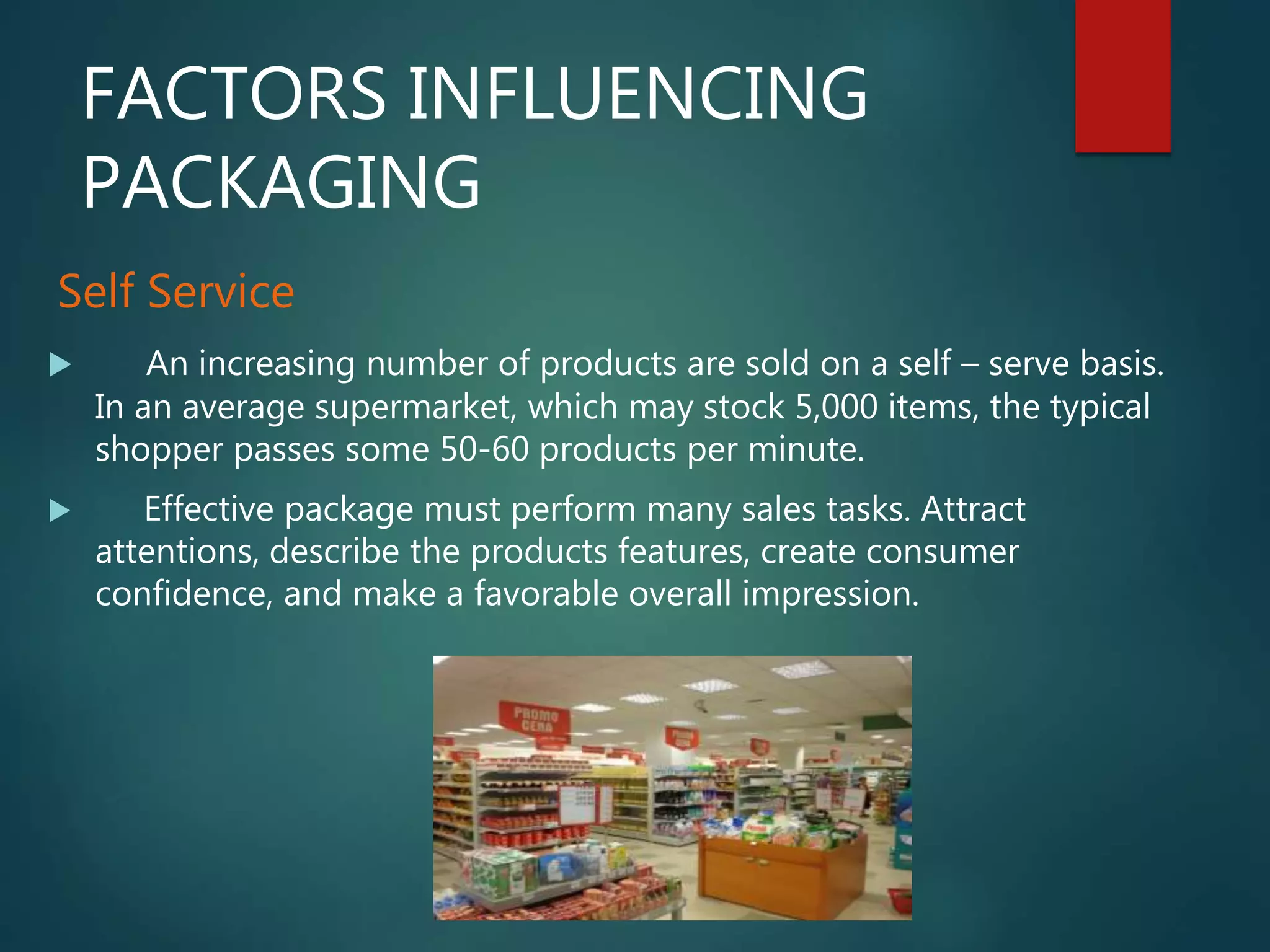
Self Service
 An increasing number of products are sold on a self – serve basis.
In an average supermarket, which may stock 5,000 items, the typical
shopper passes some 50-60 products per minute.
 Effective package must perform many sales tasks. Attract
attentions, describe the products features, create consumer
confidence, and make a favorable overall impression.
Factors Influencing Packaging
Cont’d
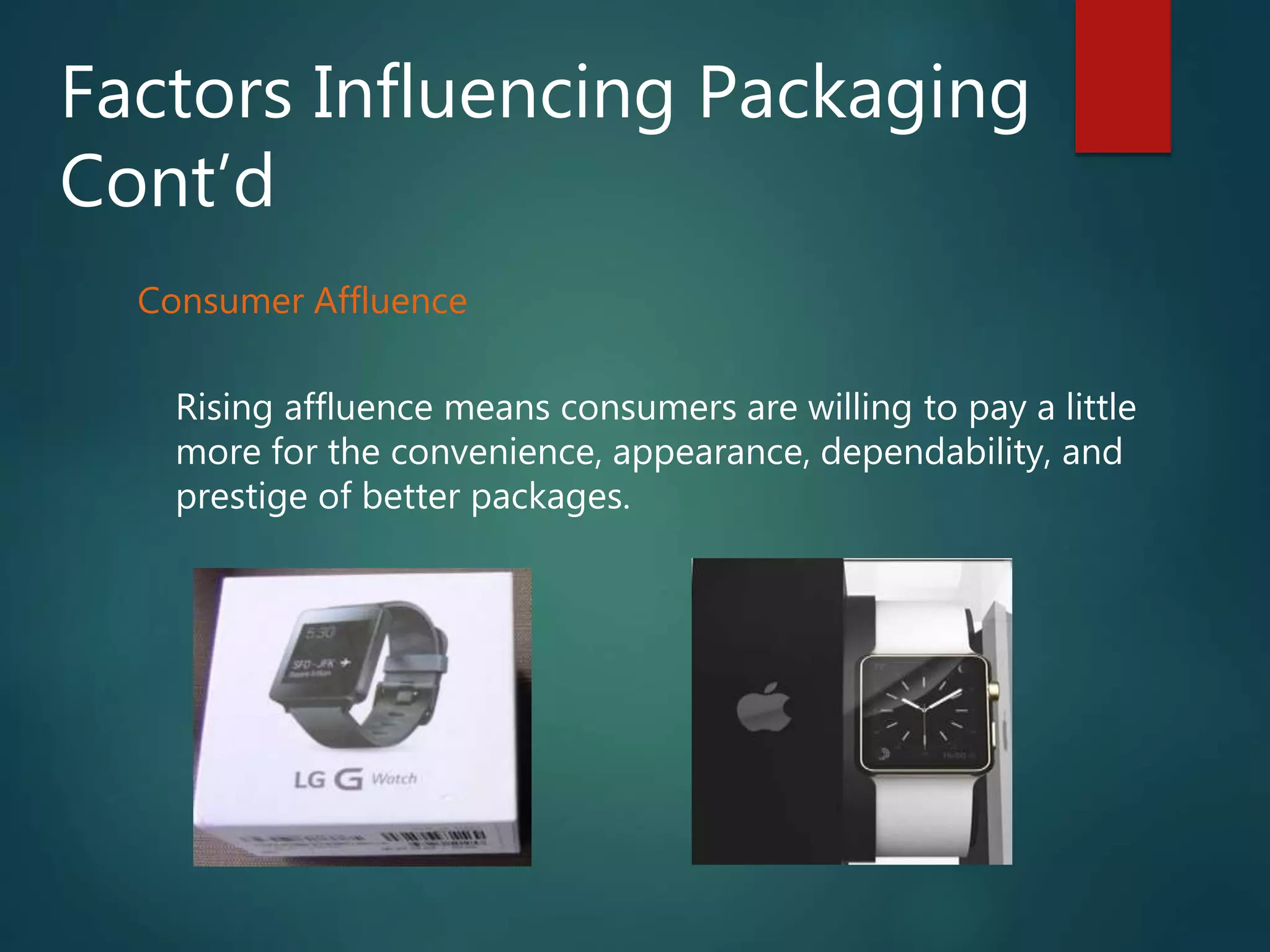
Consumer Affluence
Rising affluence means consumers are willing to pay a little
more for the convenience, appearance, dependability, and
prestige of better packages.
Factors Influencing
Packaging Cont’d
Company And Brand Image
Packages contribute to instant recognitions of the company or
brand. In the store, they can create a billboard effect.
Factors Influencing
Packaging Cont’d
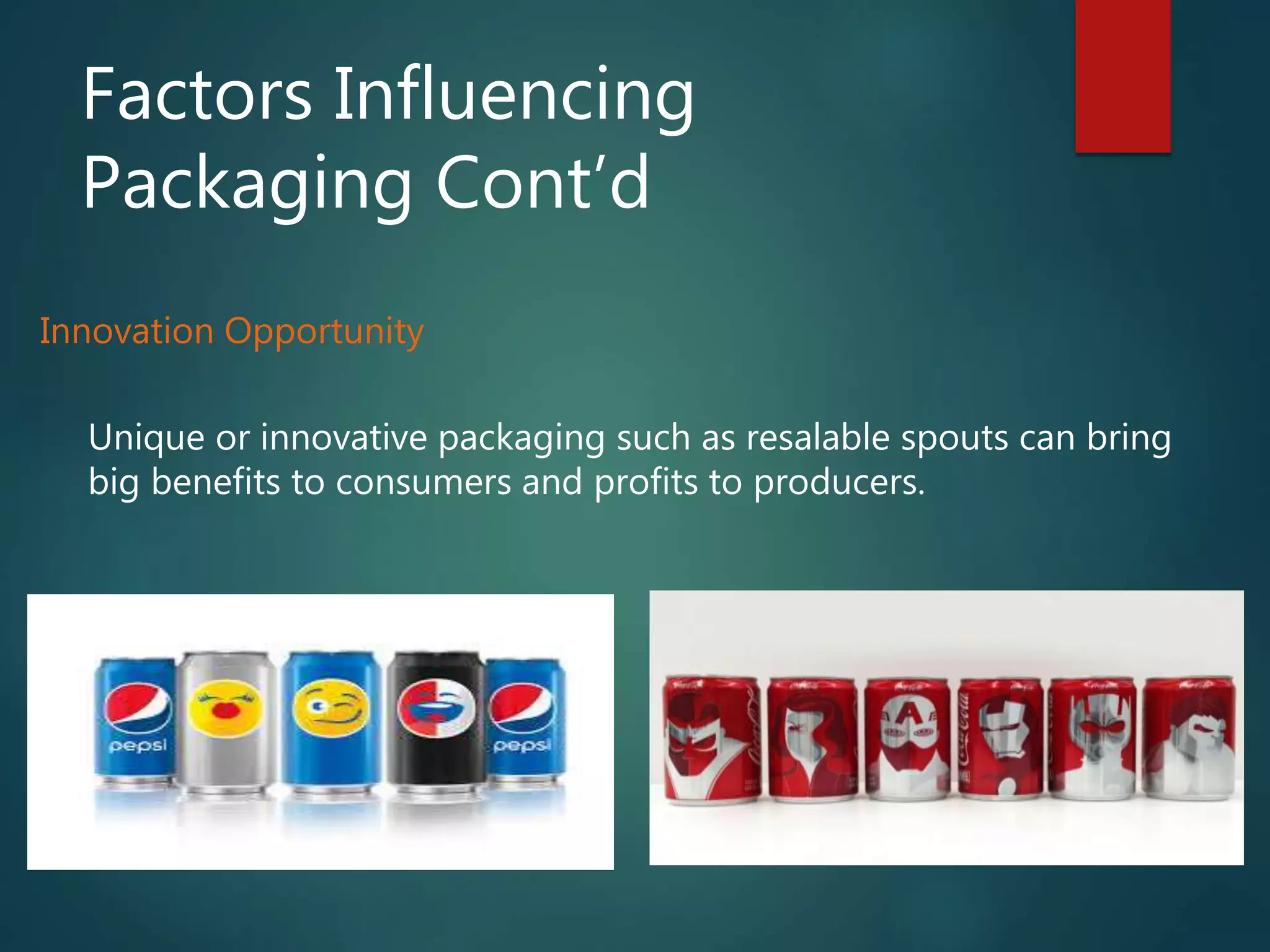
Innovation Opportunity
Unique or innovative packaging such as resalable spouts can bring
big benefits to consumers and profits to producers.
OBJECTIVES OF
PACKAGING
1. Promoting and Selling the Product
2. Defining Product Identity
3. Providing Information
4. Expressing Customer Needs
5. Ensure Safe Use
6. Protecting the Product
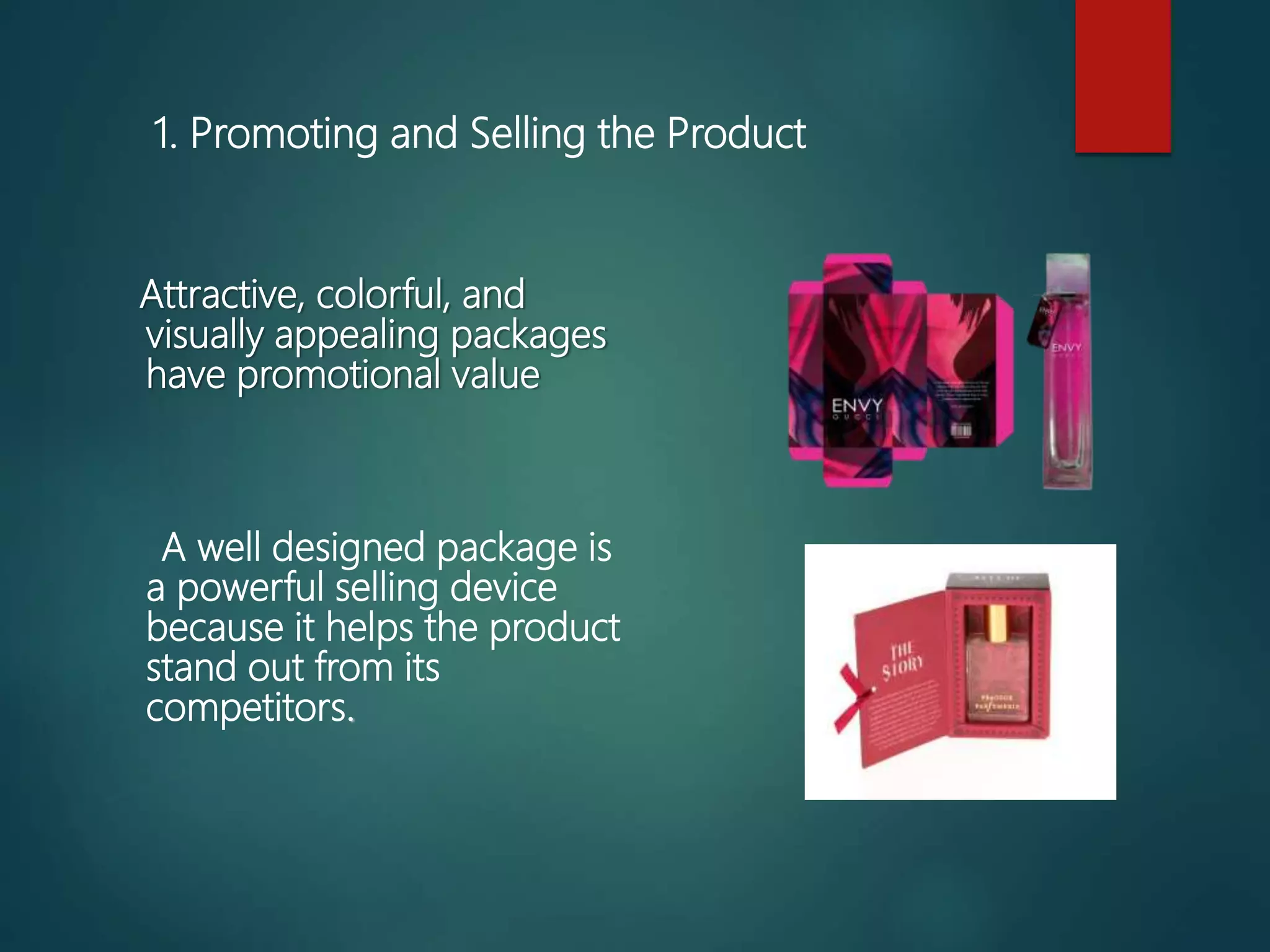
1. Promoting and Selling the Product
Attractive, colorful, and
visually appealing packages
have promotional value
A well designed package is
a powerful selling device
because it helps the product
stand out from its
competitors.
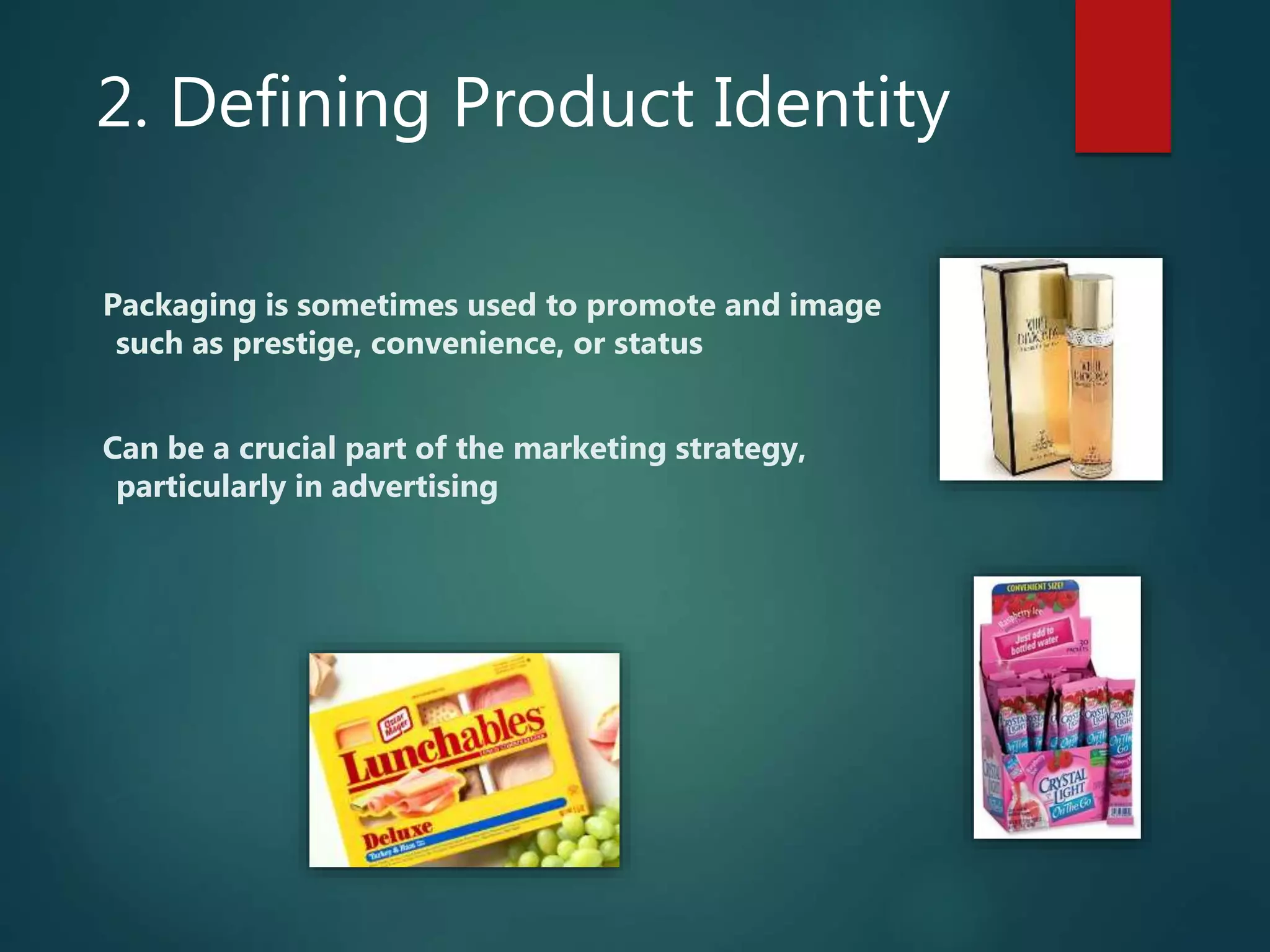
2. Defining Product Identity
Packaging is sometimes used to promote and image
such as prestige, convenience, or status
Can be a crucial part of the marketing strategy,
particularly in advertising
3. Providing Information
Gives customer useful information
on:
 directions for using the product
its contents
product guarantees
nutritional value
potential hazards
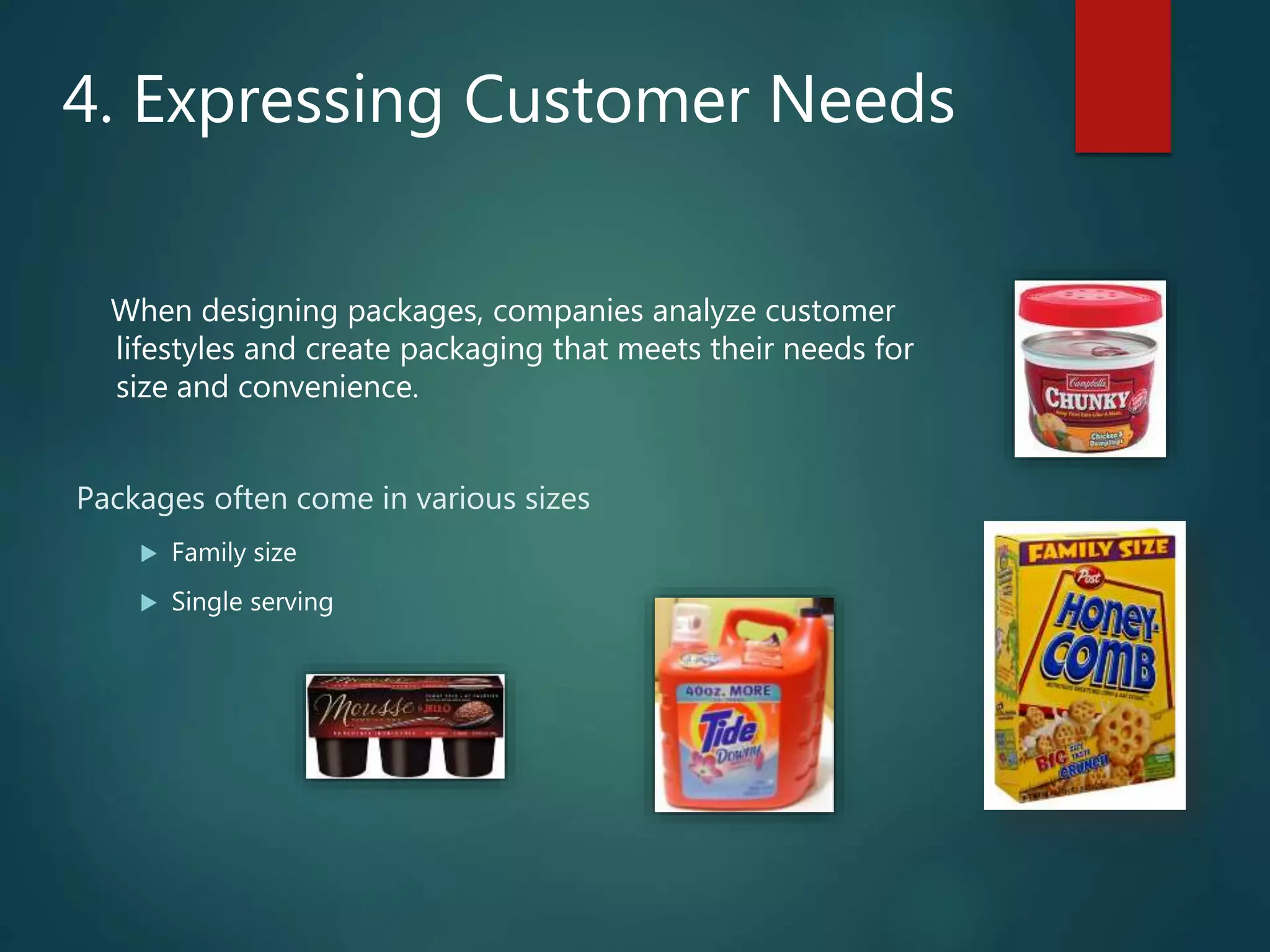
4. Expressing Customer Needs
When designing packages, companies analyze customer
lifestyles and create packaging that meets their needs for
size and convenience.
Packages often come in various sizes
 Family size
 Single serving
5. Ensure Safe Use
Proper packaging helps to eliminate potential injuries
or misuse of a product
 Formerly glass containers are now plastic
 Childproof caps
 Tamper resistant packages
 Blister packs – packages with preformed plastic
molds surrounding individual items arranged on a
backing
6. Protecting the Product
 Must protect during shipping, storage, and display
 Prevent or discourage from tampering
 Prevent shoplifting
 Protect against breakage and spoilage
LABELING
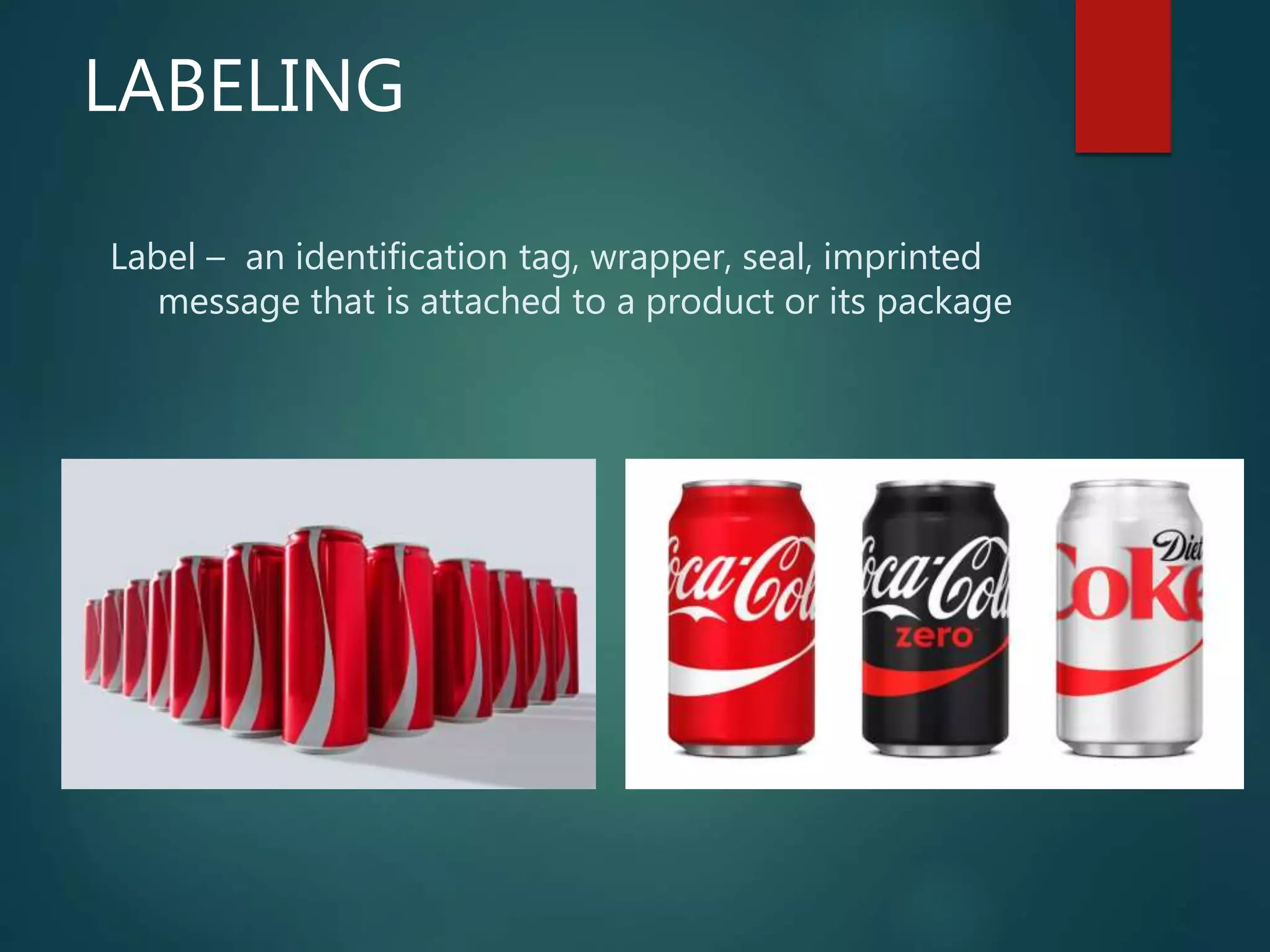
Label – an identification tag, wrapper, seal, imprinted
message that is attached to a product or its package
KINDS OF LABELS
1. Brand Label – gives brand name and trademark or logo
Kinds of Labels Cont’d
 Descriptive Label – give information about product
use, construction, care, performance, and other
features
Kinds of Labels Cont’d
 Grade Label – Some products have given grade label.
Grade label shows the grade of the product. It shows
the quality of products by words, letters, or figure.
References and Sources
 A Marketing Management: A South Asian Perspective
By Kotler, Keller, Koshy, Jha
 www.slideshare.com

Product Strategy

  • 1.
  • 2.
    TOPIC OVERVIEW  “PRODUCT”AS CONCEPT & CLASSIFICATION  PRODUCT SYSTEMS & MIXES  MANAGING PRODUCT LINES  PRODUCT-MIX PRICING  PACKAGING AND LABELS
  • 3.
  • 4.
    What is aproduct?  Anything offered to the market  To satisfy want or need • Goods, services, experiences, events, persons, places, organizations and ideas.  Most important element of marketing mix
  • 5.
    Market offering  Customerwill judge the offering by three basic elements • Product features and quality • Service mix and quality • price
  • 6.
    Product levels  Inplanning its market offering, the marketer needs to address five product levels .Each level adds more customer value, and the five constitute a customer- value hierarchy:
  • 7.
    CORE BENEFIT •The service or benefit the customer is really buying. • A hotel guest is buying rest and sleep. • The purchaser of a drill is buying holes. • Marketers must see themselves as benefit providers. BASIC PRODUCT EXPECTED PRODUCT AUGMENTED PRODUCT POTENTIAL PRODUCT
  • 8.
    CORE BENEFIT •The marketer must turn the core benefit into a basic product. • Thus a hotel room includes a bed, bathroom, towels, desk, dresser, and closet. BASIC PRODUCT EXPECTED PRODUCT AUGMENTED PRODUCT POTENTIAL PRODUCT
  • 9.
    CORE BENEFIT •The marketer prepares an expected product, a set of attributes and conditions buyers normally expect when they purchase this product. • Hotel guests minimally expect a clean bed, fresh towels, working lamps, and a relative degree of quiet BASIC PRODUCT EXPECTED PRODUCT AUGMENTED PRODUCT POTENTIAL PRODUCT
  • 10.
    CORE BENEFIT •The marketer prepares an augmented product that exceeds customer expectations. BASIC PRODUCT EXPECTED PRODUCT AUGMENTED PRODUCT POTENTIAL PRODUCT
  • 11.
    CORE BENEFIT •`The potential product, which encompasses all the possible augmentations and transformations the product or offering might undergo in the future. BASIC PRODUCT EXPECTED PRODUCT AUGMENTED PRODUCT POTENTIAL PRODUCT
  • 12.
    PRODUCT CLASSIFICATION Marketers classifyproduct based on • Durability and Tangibility • Use  Consumer  Industrial
  • 13.
    Durability and tangilbility •Non-durable goods  Tangible goods normally consumed in one or few uses.  Purchased frequently • Durable goods  Tangible goods that survive many uses.  They require more seller guarantee and command higher margin.
  • 14.
    Intangible products • Services Intangible  Requires more quality control, supplier credibility and adaptability
  • 15.
    Consumer goods classification •Convenience goods  goods purchased frequently and immediately with minimum effort  Staples, impulse goods and emergency goods • Shopping goods  Those goods consumer characteristically compares on such bases as suitability, quality, price, and style.  Homogeneous and heterogeneous
  • 16.
    • Specialty goods Those goods having unique characteristics or brand identification for which enough buyers are willing to make a special purchasing effort. • Unsought goods  Those goods the consumer does not know about or normally think of buying, such as smoke detectors, grave stones.
  • 17.
    Industrial goods classification Material and parts  Capital items  Supplies and business services
  • 18.
    Industrial goods classification •Materials and parts  Materials and parts are goods that enter the manufacturer’s product completely  Raw materials o Farm products o Natural products
  • 19.
     Manufactured materials Component materials  Component parts
  • 20.
    • Capital items Capitalitems are long-lasting goods that facilitate developing or the finished product.  Installations  equipment
  • 21.
     Supplies andbusiness services  supplies are two kinds  maintenance items and repair items  operating supplies  business services include  maintenance and repair services (window cleaning, copier repair)  Business advisory services (legal, advertising)
  • 22.
     Product andservice differentiation  product differentiation Form Features customizations Performance quality Conformance quality Durability Reliability Reparability style
  • 24.
     Service differentiation Ordering ease  Delivery  Installation  Customer rating  Customer consulting  Maintenance and repair  Returns
  • 25.
     Design  Designis the totality of features that affect how a product looks, feels, and functions to a consumer.  Design offers functional and aesthetic benefits and appeals to both our rational and emotional sides. e.g.. The product strategy of Hawkins is to span wide range of cooking products with innovative product designs.
  • 26.
  • 27.
    PRODUCT SYSTEMS & MIXES ProductSystems Product Mixes Product Systems Properties
  • 28.
    Product System  Isa group of diverse but related items that functions in compatible manner  Why its call Product System??  Eg. Mobile Phone Industry, Automobile Industry
  • 29.
    Product Mixes Set ofall products and items a particular seller offers for sales
  • 30.
  • 31.
    • NO.DIFFERENT PRODUCT LINECOMPAINY OFFERSWIDTH • TOTAL NO. OF PRODUCT IN SINGLE LINELENGTH • NO. VARIANTS OF EACH PRODUCT IN LINEDEPTH • HOW CLOSELY RELATED PRODUCT LINES ARECONSISTANCY
  • 32.
    HUL Product MixesWidth and Line Length
  • 33.
    HUL Product MixesWidth and Line Length
  • 34.
    P&G Product MixesWidth and Line Length
  • 35.
    Nestle Product MixesWidth and Line Length
  • 36.
    ITC Product MixesWidth and Line Length
  • 37.
    Emami Product MixesWidth and Line Length
  • 39.
  • 40.
    MANAGING PRODUCT LINES MANAGING PRODUCT LINES LINELENGTH LINE STRETCHING LINE FILLING LINE ANALYSIS SALES AND PROFITS MARKET PROFILE
  • 41.
    Managing “Sales andProfit” can help determine which items to Build, Maintain, Promote or Discontinue.
  • 42.
  • 43.
    Product line managersmust review how the line is positioned against competitor’s line to enhance “Market Profile”
  • 44.
  • 45.
    Objective behind managing productline length  To induce up-selling  To facilitates cross-selling  Protects against economic ups and downs  To use excess manufacturing capacity  To satisfy specific customer demands
  • 46.
  • 47.
    Occurs when companylengthens its product line beyond its current range
  • 48.
    Ways of linestretching • Introduction of lower price line than current offering to enter low-end segment Down- Market Stretch • Introduction of higher price line than current offering to enter high end market Up-Market Stretch • Stretching in both ways to gain market dominance Two Way Stretch
  • 49.
  • 50.
    Line filling  Lengtheningproduct line by adding more item within present range  Plugging holes to keep out competitors  Overdone result in Cannibalization and Customer Confusion  BMW’s evolution one brand five model to 3 brands 14 Series  Good Knight journey to market leader
  • 51.
    Product line management Line Modernization: Introducing advance product  Line Featuring: Introducing Special edition’s  Line pruning: Cutting Product Line
  • 52.
  • 53.
    PRODUCT-MIX PRICING STRATEGIES PRICING PRICE ISTHE VALUE THAT IS PUT TO A PRODUCT OR SERVICE IT IS THE RESULT OF A COMPLEX SET OF CALCULATIONS, RESEARCH AND UNDERSTANDING AND RISK TAKING ABILITY. PRICING STRATEGY TAKES INTO ACCOUNT SEGMENTS, ABILITY TO PAY, MARKET CONDITIONS, COMPETITOR ACTIONS, TRADE MARGINS AND INPUT COSTS.
  • 54.
    Product-Mix Pricing Strategies Product line pricing takes into account the cost difference between products in the line, customer evaluation of their features, and competitors’ prices.
  • 55.
    Product-Mix Pricing Strategies  Optionalproduct pricing takes into account optional or accessory products along with the main product. New car with ordinary rims 8,00,000Rs New car with sports rims 8,60,000Rs
  • 56.
    Product-Mix Pricing Strategies  Captiveproduct pricing involves products that must be used along with the main product.  Two-part pricing is where the price is broken into  Fixed fee  Variable usage fee
  • 57.
  • 58.
    Product –Mix Pricing Strategies Product bundle pricing combines several products at a reduced price. 1 bottle: 60Rs Bundled 2 bottles: 100Rs
  • 59.
    Product-Mix Pricing Strategies Pricing Strategies Product line pricing  Optional product pricing  Captive product pricing  By-product pricing  Product bundle pricing
  • 60.
  • 61.
    PACKAGING The package refersto physical container or wrapping for a product It is an integral part of product planning and promotion  10% of the retail price is spent on developing, designing, and producing just the package Companies sometimes change packaging to update their image and reach a new market
  • 62.
    Tropicana Famous Packaging Failure: PepsiCoexperienced great success with its Tropicana brad, acquired in 1998.Then in 2009, the company launched a redesigned package to “Refresh and modernize” the brand. The goal was to create an “emotional attachment with design and trumpeting the natural fruit goodness. After the new packing and design, Tropicana hit by record 20percent sales dropped in 2months, PepsiCo management announced it would revert to old packaging.
  • 64.
    FACTORS INFLUENCING PACKAGING Self Service An increasing number of products are sold on a self – serve basis. In an average supermarket, which may stock 5,000 items, the typical shopper passes some 50-60 products per minute.  Effective package must perform many sales tasks. Attract attentions, describe the products features, create consumer confidence, and make a favorable overall impression.
  • 65.
    Factors Influencing Packaging Cont’d ConsumerAffluence Rising affluence means consumers are willing to pay a little more for the convenience, appearance, dependability, and prestige of better packages.
  • 66.
    Factors Influencing Packaging Cont’d CompanyAnd Brand Image Packages contribute to instant recognitions of the company or brand. In the store, they can create a billboard effect.
  • 67.
    Factors Influencing Packaging Cont’d InnovationOpportunity Unique or innovative packaging such as resalable spouts can bring big benefits to consumers and profits to producers.
  • 68.
    OBJECTIVES OF PACKAGING 1. Promotingand Selling the Product 2. Defining Product Identity 3. Providing Information 4. Expressing Customer Needs 5. Ensure Safe Use 6. Protecting the Product
  • 69.
    1. Promoting andSelling the Product Attractive, colorful, and visually appealing packages have promotional value A well designed package is a powerful selling device because it helps the product stand out from its competitors.
  • 70.
    2. Defining ProductIdentity Packaging is sometimes used to promote and image such as prestige, convenience, or status Can be a crucial part of the marketing strategy, particularly in advertising
  • 71.
    3. Providing Information Givescustomer useful information on:  directions for using the product its contents product guarantees nutritional value potential hazards
  • 72.
    4. Expressing CustomerNeeds When designing packages, companies analyze customer lifestyles and create packaging that meets their needs for size and convenience. Packages often come in various sizes  Family size  Single serving
  • 73.
    5. Ensure SafeUse Proper packaging helps to eliminate potential injuries or misuse of a product  Formerly glass containers are now plastic  Childproof caps  Tamper resistant packages  Blister packs – packages with preformed plastic molds surrounding individual items arranged on a backing
  • 74.
    6. Protecting theProduct  Must protect during shipping, storage, and display  Prevent or discourage from tampering  Prevent shoplifting  Protect against breakage and spoilage
  • 75.
    LABELING Label – anidentification tag, wrapper, seal, imprinted message that is attached to a product or its package
  • 76.
    KINDS OF LABELS 1.Brand Label – gives brand name and trademark or logo
  • 77.
    Kinds of LabelsCont’d  Descriptive Label – give information about product use, construction, care, performance, and other features
  • 78.
    Kinds of LabelsCont’d  Grade Label – Some products have given grade label. Grade label shows the grade of the product. It shows the quality of products by words, letters, or figure.
  • 79.
    References and Sources A Marketing Management: A South Asian Perspective By Kotler, Keller, Koshy, Jha  www.slideshare.com