INTERNATIONAL
BUSINESS MANAGEMENT
UNIT 3: INTERNATIONAL
STRATEGIC MANAGEMENT
Prepared and presented by,
N. Ganesha Pandian,
Assistant Professor,
Madurai School of
Management,
Madurai.
References:
1. International Business : K
Aswathappa
2. International Business-
competing in the global
market : Charles W L Hill and
Arun K Jain
Year : II Semester : IV
1
 Strategic Compulsions – Standardization vs.

Differentiation
 Strategic Options
 Global Portfolio Management
 Global Entry Strategy
 Different Forms of International Business – Advantages
 Organizational Issues of International Business
 Organizational Structures
 Controlling of International Business – Approaches to
Control
 Performance of Global Business
 Performance Evaluation System. 2
Nature of international strategic
management
 Strategic management is concerned with the
process of formulating, implementing and
evaluating strategies to achieve a firm’s
objectives
 Geographic differences, cultural and national
differences and variations in business
practices and different norms makes it
difficult
3
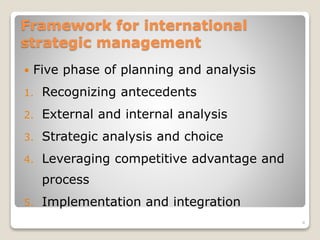
Framework for international
strategic management
 Five phase of planning and analysis
1. Recognizing antecedents
2. External and internal analysis
3. Strategic analysis and choice
4. Leveraging competitive advantage and
process
5. Implementation and integration
4
International strategic planning
 International strategic planning is a
process of evaluating the internal and
external environment by multinational
organizations, through which they set their
long term and short term goals and then
they implement a specific plan of action in
order to achieve those objectives
5
Area of strategic compulsions
 Orientation of globalization
 Emerging e-commerce and culture
 Cut throat competition
 Diversification
 Active pressure group
 Motive for CSR Corporate social
responsibility and ethics
6
International strategic
management process
Four dispositions of strategic management
process in international business
 Ethnocentric orientation
 Polycentric orientation
 Regio centric predisposition
 Geocentric
7
Steps in Strategic management
process
 Scanning of global environment
 Formulation of strategies
 Implementation of strategies
 Measure and evaluate performance
8
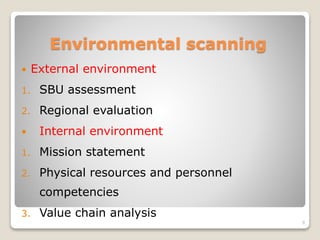
Environmental scanning
 External environment
1. SBU assessment
2. Regional evaluation
 Internal environment
1. Mission statement
2. Physical resources and personnel
competencies
3. Value chain analysis
9
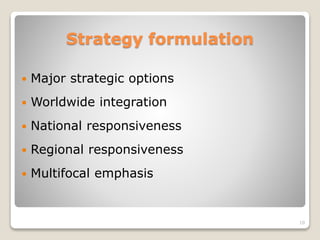
Strategy formulation
 Major strategic options
 Worldwide integration
 National responsiveness
 Regional responsiveness
 Multifocal emphasis
10
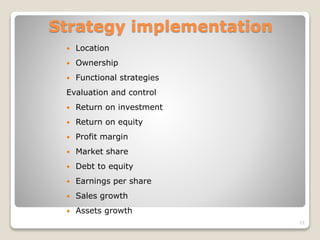
Strategy implementation
 Location
 Ownership
 Functional strategies
Evaluation and control
 Return on investment
 Return on equity
 Profit margin
 Market share
 Debt to equity
 Earnings per share
 Sales growth
 Assets growth
11
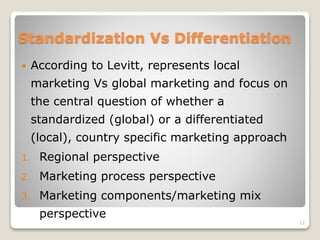
Standardization Vs Differentiation
 According to Levitt, represents local
marketing Vs global marketing and focus on
the central question of whether a
standardized (global) or a differentiated
(local), country specific marketing approach
1. Regional perspective
2. Marketing process perspective
3. Marketing components/marketing mix
perspective
12
Strategic Options
 Global strategy
 International strategy
 Trans-national strategy
 Multi-domestic strategy
13
Factors affecting strategic options
 External constraints
 Intra-organizational forces and managerial power-
relations
 Values and preferences and managerial attitudes
risk
 Impact of past strategy
 Time constraints in choice of strategy
 Information constraints
 Competitors’ reaction
14
Global portfolio investment
 Global portfolio investment means the
purchase of stocks, bonds and money market
instrument by foreigners for the purpose of
realizing financial return which does not result
in foreign management, ownership or control
 Portfolio investment is part of the capital
account on the balance of payment statistics
15
Factors affecting Global portfolio
investment
 Tax rates on interest and dividends
 Interest rates
 Exchange rates
16
Problems of Global portfolio
investment
 Unfavorable exchange rate movement
 Frictions in international financial market
 Manipulation of security prices
 Unequal access to information
17
Global entry strategies
Level of
involvement:
1. Wholly owned
subsidiary
2. Company
acquisitions
3. Assembly
operations
4. Joint venture
5. Strategic
alliances
6. Contract
Manufacture
7. Licensing
8. Direct marketing
9. Distribution and
agents
10. Sales force
11. Trading
companies
12. Export
management
companies
18
Global Entry Strategies
 Exporting as an entry strategies
1. Indirect exporting
2. Direct exporting
 Manufacturing strategies without FDI
1.Licensing
2. Franchising
3. Contract manufacture
4. Turnkey projects
5. Management contracts
19
Contd…
 Manufacturing strategies with FDI
1. Joint ventures
2. Strategic alliances
3. Merger
4. Acquisition
5. Wholly owned subsidiary
6. Assembly operations
20
Factors affecting the entry mode
 External factors
1. Market size
2. Market growth
3. Government regulations
4. Level of competition
5. Level of risk
 Internal factors
1. Company objectives
2. Availability of company resources
3. Level of commitment
4. International experience
5. Flexibility
21
Organizational structure
 An organizational structure defines how
activities such as task allocation, co-
ordination and supervision are directed
towards the achievement of organizational
aims.
22
Designing organization
structure
 Includes the analysis of following aspects:
1. External environment
2. Overall aims and purpose of the enterprise
3. Objectives
4. Activities
5. Decisions
6. Relationships
7. Organization structure
8. Job structure
9. Organization climate
10. Management style
11. Human resource
23
Types of organization structure
 International division’s structure
 Functional division’s structure
 Product division structure
 Geographic (Area) structure
 Matrix division structure
 Mixed structure
24
Methods of control system
 Personal controls
 Bureaucratic controls
 Output controls
 Cultural controls
Approaches tocontrol
 Market approach
 Rules approach
 Corporate culture approach
25
Process of performance
measurement
 Establishing standards of performance
 Measure actual performance
 Analyze performance and compare it with
standards
 Construct and implement an action plan
 Review and revise standards
26
Performance evaluation system
 Defined as “Periodic review of operations to
ensure that the objectives of the enterprises
are being accomplished”
 Various performance indicators:
1. Financial measures
a, Return on investment (ROI)
b, Budget as a success indicator
2. Non Financial measures
27
Types of performance evaluation
system
 Budget programming
 Management Audit
 PERT (Program evaluation review
technique)
 Management information system
28
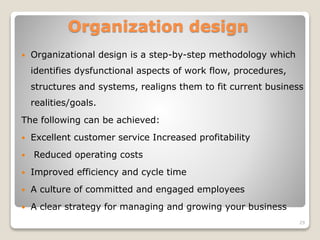
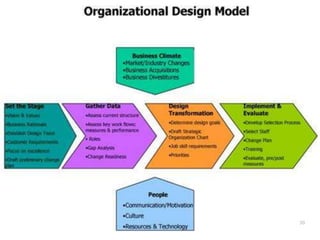
Organization design
 Organizational design is a step-by-step methodology which
identifies dysfunctional aspects of work flow, procedures,
structures and systems, realigns them to fit current business
realities/goals.
The following can be achieved:
 Excellent customer service Increased profitability
 Reduced operating costs
 Improved efficiency and cycle time
 A culture of committed and engaged employees
 A clear strategy for managing and growing your business
29
30
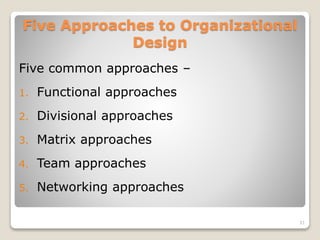
Five Approaches to Organizational
Design
Five common approaches –
1. Functional approaches
2. Divisional approaches
3. Matrix approaches
4. Team approaches
5. Networking approaches
31
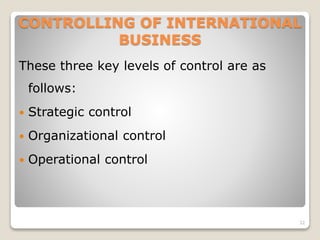
CONTROLLING OF INTERNATIONAL
BUSINESS
These three key levels of control are as
follows:
 Strategic control
 Organizational control
 Operational control
32
Organizational control
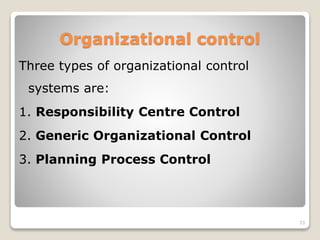
Three types of organizational control
systems are:
1. Responsibility Centre Control
2. Generic Organizational Control
3. Planning Process Control
33
Establishing International Control
Systems
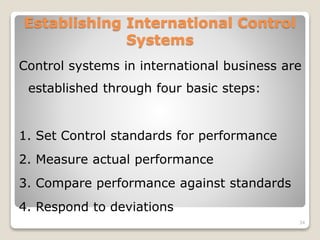
Control systems in international business are
established through four basic steps:
1. Set Control standards for performance
2. Measure actual performance
3. Compare performance against standards
4. Respond to deviations
34
Essential Controlling Techniques
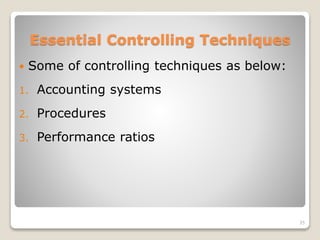
 Some of controlling techniques as below:
1. Accounting systems
2. Procedures
3. Performance ratios
35
Quality dimensions
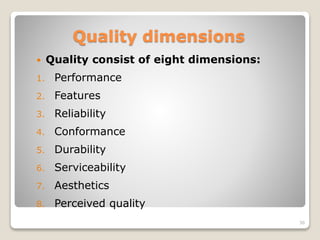
 Quality consist of eight dimensions:
1. Performance
2. Features
3. Reliability
4. Conformance
5. Durability
6. Serviceability
7. Aesthetics
8. Perceived quality
36
PERFORMANCE OF GLOBAL
BUSINESS
 Global Business Performance is a flexible, web based
solution that provides the key components to support
global decision making.
 It offers the integration and management of multiple,
cross-country data sources including POS, retailer
direct, syndicated and consumer data.
 Global Business Performance identifies trends and
opportunities and delivers sales and performance
insights across regions, countries and categories, only
days after data is available.
37
The End
38

Unit 3 international strategic management

  • 1.
    INTERNATIONAL BUSINESS MANAGEMENT UNIT 3:INTERNATIONAL STRATEGIC MANAGEMENT Prepared and presented by, N. Ganesha Pandian, Assistant Professor, Madurai School of Management, Madurai. References: 1. International Business : K Aswathappa 2. International Business- competing in the global market : Charles W L Hill and Arun K Jain Year : II Semester : IV 1
  • 2.
     Strategic Compulsions– Standardization vs. Differentiation  Strategic Options  Global Portfolio Management  Global Entry Strategy  Different Forms of International Business – Advantages  Organizational Issues of International Business  Organizational Structures  Controlling of International Business – Approaches to Control  Performance of Global Business  Performance Evaluation System. 2
  • 3.
    Nature of internationalstrategic management  Strategic management is concerned with the process of formulating, implementing and evaluating strategies to achieve a firm’s objectives  Geographic differences, cultural and national differences and variations in business practices and different norms makes it difficult 3
  • 4.
    Framework for international strategicmanagement  Five phase of planning and analysis 1. Recognizing antecedents 2. External and internal analysis 3. Strategic analysis and choice 4. Leveraging competitive advantage and process 5. Implementation and integration 4
  • 5.
    International strategic planning International strategic planning is a process of evaluating the internal and external environment by multinational organizations, through which they set their long term and short term goals and then they implement a specific plan of action in order to achieve those objectives 5
  • 6.
    Area of strategiccompulsions  Orientation of globalization  Emerging e-commerce and culture  Cut throat competition  Diversification  Active pressure group  Motive for CSR Corporate social responsibility and ethics 6
  • 7.
    International strategic management process Fourdispositions of strategic management process in international business  Ethnocentric orientation  Polycentric orientation  Regio centric predisposition  Geocentric 7
  • 8.
    Steps in Strategicmanagement process  Scanning of global environment  Formulation of strategies  Implementation of strategies  Measure and evaluate performance 8
  • 9.
    Environmental scanning  Externalenvironment 1. SBU assessment 2. Regional evaluation  Internal environment 1. Mission statement 2. Physical resources and personnel competencies 3. Value chain analysis 9
  • 10.
    Strategy formulation  Majorstrategic options  Worldwide integration  National responsiveness  Regional responsiveness  Multifocal emphasis 10
  • 11.
    Strategy implementation  Location Ownership  Functional strategies Evaluation and control  Return on investment  Return on equity  Profit margin  Market share  Debt to equity  Earnings per share  Sales growth  Assets growth 11
  • 12.
    Standardization Vs Differentiation According to Levitt, represents local marketing Vs global marketing and focus on the central question of whether a standardized (global) or a differentiated (local), country specific marketing approach 1. Regional perspective 2. Marketing process perspective 3. Marketing components/marketing mix perspective 12
  • 13.
    Strategic Options  Globalstrategy  International strategy  Trans-national strategy  Multi-domestic strategy 13
  • 14.
    Factors affecting strategicoptions  External constraints  Intra-organizational forces and managerial power- relations  Values and preferences and managerial attitudes risk  Impact of past strategy  Time constraints in choice of strategy  Information constraints  Competitors’ reaction 14
  • 15.
    Global portfolio investment Global portfolio investment means the purchase of stocks, bonds and money market instrument by foreigners for the purpose of realizing financial return which does not result in foreign management, ownership or control  Portfolio investment is part of the capital account on the balance of payment statistics 15
  • 16.
    Factors affecting Globalportfolio investment  Tax rates on interest and dividends  Interest rates  Exchange rates 16
  • 17.
    Problems of Globalportfolio investment  Unfavorable exchange rate movement  Frictions in international financial market  Manipulation of security prices  Unequal access to information 17
  • 18.
    Global entry strategies Levelof involvement: 1. Wholly owned subsidiary 2. Company acquisitions 3. Assembly operations 4. Joint venture 5. Strategic alliances 6. Contract Manufacture 7. Licensing 8. Direct marketing 9. Distribution and agents 10. Sales force 11. Trading companies 12. Export management companies 18
  • 19.
    Global Entry Strategies Exporting as an entry strategies 1. Indirect exporting 2. Direct exporting  Manufacturing strategies without FDI 1.Licensing 2. Franchising 3. Contract manufacture 4. Turnkey projects 5. Management contracts 19
  • 20.
    Contd…  Manufacturing strategieswith FDI 1. Joint ventures 2. Strategic alliances 3. Merger 4. Acquisition 5. Wholly owned subsidiary 6. Assembly operations 20
  • 21.
    Factors affecting theentry mode  External factors 1. Market size 2. Market growth 3. Government regulations 4. Level of competition 5. Level of risk  Internal factors 1. Company objectives 2. Availability of company resources 3. Level of commitment 4. International experience 5. Flexibility 21
  • 22.
    Organizational structure  Anorganizational structure defines how activities such as task allocation, co- ordination and supervision are directed towards the achievement of organizational aims. 22
  • 23.
    Designing organization structure  Includesthe analysis of following aspects: 1. External environment 2. Overall aims and purpose of the enterprise 3. Objectives 4. Activities 5. Decisions 6. Relationships 7. Organization structure 8. Job structure 9. Organization climate 10. Management style 11. Human resource 23
  • 24.
    Types of organizationstructure  International division’s structure  Functional division’s structure  Product division structure  Geographic (Area) structure  Matrix division structure  Mixed structure 24
  • 25.
    Methods of controlsystem  Personal controls  Bureaucratic controls  Output controls  Cultural controls Approaches tocontrol  Market approach  Rules approach  Corporate culture approach 25
  • 26.
    Process of performance measurement Establishing standards of performance  Measure actual performance  Analyze performance and compare it with standards  Construct and implement an action plan  Review and revise standards 26
  • 27.
    Performance evaluation system Defined as “Periodic review of operations to ensure that the objectives of the enterprises are being accomplished”  Various performance indicators: 1. Financial measures a, Return on investment (ROI) b, Budget as a success indicator 2. Non Financial measures 27
  • 28.
    Types of performanceevaluation system  Budget programming  Management Audit  PERT (Program evaluation review technique)  Management information system 28
  • 29.
    Organization design  Organizationaldesign is a step-by-step methodology which identifies dysfunctional aspects of work flow, procedures, structures and systems, realigns them to fit current business realities/goals. The following can be achieved:  Excellent customer service Increased profitability  Reduced operating costs  Improved efficiency and cycle time  A culture of committed and engaged employees  A clear strategy for managing and growing your business 29
  • 30.
  • 31.
    Five Approaches toOrganizational Design Five common approaches – 1. Functional approaches 2. Divisional approaches 3. Matrix approaches 4. Team approaches 5. Networking approaches 31
  • 32.
    CONTROLLING OF INTERNATIONAL BUSINESS Thesethree key levels of control are as follows:  Strategic control  Organizational control  Operational control 32
  • 33.
    Organizational control Three typesof organizational control systems are: 1. Responsibility Centre Control 2. Generic Organizational Control 3. Planning Process Control 33
  • 34.
    Establishing International Control Systems Controlsystems in international business are established through four basic steps: 1. Set Control standards for performance 2. Measure actual performance 3. Compare performance against standards 4. Respond to deviations 34
  • 35.
    Essential Controlling Techniques Some of controlling techniques as below: 1. Accounting systems 2. Procedures 3. Performance ratios 35
  • 36.
    Quality dimensions  Qualityconsist of eight dimensions: 1. Performance 2. Features 3. Reliability 4. Conformance 5. Durability 6. Serviceability 7. Aesthetics 8. Perceived quality 36
  • 37.
    PERFORMANCE OF GLOBAL BUSINESS Global Business Performance is a flexible, web based solution that provides the key components to support global decision making.  It offers the integration and management of multiple, cross-country data sources including POS, retailer direct, syndicated and consumer data.  Global Business Performance identifies trends and opportunities and delivers sales and performance insights across regions, countries and categories, only days after data is available. 37
  • 38.