Global Marketing, R & D
Global Marketing and R&D

   Among different countries, why and how:
    – It makes sense to vary the attributes of products

    – Distribution strategy may vary

    – Advertising and promotion strategies may vary

    – Pricing strategy may vary

   How globalization affects new-product
    development
Levitt, 1983


“A powerful force drives the world
toward a converging commonality,
   and that force is technology”


      (Prof. Ted Levitt, HBS)
Globalization of Markets?
 Levitt’s“Converging commonality” has
  not happened universally
 Consumer product tastes converged less
  than industrial product specifications
 Media, communications means have
  – made consumers world-wide more aware of
    their mutual preferences
  – have contributed to creation of world brands
  – have caused market segments to emerge
    across some national markets--inter-market
    segments
Market Segmentation
   The process of identifying groups of consumers whose
    purchasing behavior is unique in important ways
    – Is based on demography, geography, social-cultural
      factors, psychological factors
    – Allows firms to adjust marketing mix to meet the needs of
      separate market segments
   Marketing mix variables:
    product-price-place (distribution)-promotion
Market Segmentation Across
          National Markets
 Standardization:    companies may
  – Offer same products
  – Adjust balance of marketing mix to market
   segments with similar needs across countries
 Adaptation:    companies may
  – Offer different products
  – Adjust balance of marketing mix to market
   segments with differing needs across countries
Marketing Strategy
   Standardization (Global Integration Pressures)
    – Efficiencies through integrated R&D, production,
      marketing
    – Control implications
   Adaptation (Local Responsiveness Pressures)
    – Buyer behavior (cultural, economic influence,
      brand perception--country of origin idea)
    – Laws, regulations
    – Local environment needs
    – Responsiveness to local condition shifts
   Implications on marketing mix
International Marketing Mix: Product
 Product:   a bundle of attributes
  –   Hamburger: meat type, taste, texture, size
  –   Automobile: power, design, quality,
      performance, comfort, size/capacity
 Attributesneed to be adapted to a greater or
 lesser extent to satisfy
  –   Consumer preferences/tastes due to culture
  –   Economic development levels affect consumer
      behavior
  –   National product/technical standards state
      mandated
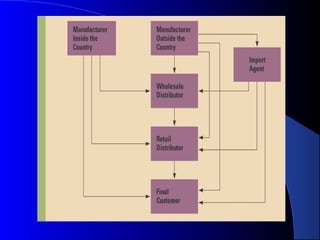
International Marketing Mix: Place
 Optimal   channel a company chooses
  to deliver the product
 The most locally responsive element
  of marketing mix because
  distribution channels vary
  dramatically across countries
  – Retail system: concentrated-
    fragmented
  – Channel length: long, short
  – Channel exclusivity
International Marketing Mix: Promotion

 How   firm communicates the product
  attributes / benefits to customers
 Barriers to international communication
  – Cultural barriers
  – Source effects (country of origin effects)
  – Noise levels
 Standardized advertising strategy
 possible; standardized advertising strategy
 execution more difficult (culture, laws)
International Marketing Mix:
            Promotion
 Push   vs pull strategies
  – Push strategy: personal selling emphasis
      Industrial products; complex new products

      Short distribution channels

      Few print or electronic media

  – Pull strategy: mass media advertising
    emphasis
      Consumer goods
      Long distribution channels

      Marketing message may be carried via print /

       electronic media
International Marketing Mix: Price
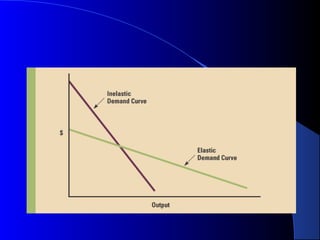
Price discrimination: demand elasticity
Strategic pricing
  – Predatory (quick share-of-market focus):
          lower prices to drive competitors out, then raise prices
  – Multipoint pricing:
          pricing in one market may have an impact in another
           market; subsidize low pricing in one market from
           profits in another
  –   Experience curve:
       use   aggressive pricing to build volume and move firm
           down experience curve (lower marginal costs)
Regulatory       issues:
       antidumping,     monopoly restriction
New Product Development
New    product development
  – High risk / high return
  – Technological innovation
  – Creative destruction
Location      of R&D
  –   Disperse R&D to trend/technology leading
      markets
       High investment on basic and applied research
       Strong underlying demand; affluent consumers
       Intense competition
New Product Development
 Integrate   R&D, marketing and Production
 Ensure:
  –   Product development driven by customer needs
  –   New products can be manufactured
      efficiently/effectively
  –   Time to market is minimized
 Plan   clearly: goals, milestones, budgets
New Product Development
   Use cross-functional, multinationally diverse teams
   Span: initial concept development to market
    introduction
   Team composition critical
    –   Assign heavyweight project manager
          High status in organization; high power and authority
          Dedicated to fullest possible extent to project
    –   Team should have representative from each function
   Physical co-location
    –   When appropriate?
    –   Build team culture
    –   Communication and conflict resolution processes
Strategic Analysis
Why do organizations decide to enter
  international business? Passive entry:
 Follow customers overseas
 Respond to enquiries from overseas
 Competition is in overseas markets
 Seek profitable growth
 Sell capacity “as is”
Strategic Analysis
   Eventually one or more of key distributors become
    a candidate for acquisition (FDI)
   Foreign regional development organizations
    actively recruit FDI
   Competitive pressures force examination of local
    assembly or production nearer to key international
    markets
   Major international customers demand local
    support
Strategic Analysis
 Organization  acquires companies that are
  complimentary to existing businesses
 Continued growth requires regional
  management, development, distribution,
  technical and customer support
Strategic Analysis
 Issues involved in conducting international
  business become “significant”
 Demands for organization’s resources
  increases:
   Management
   Cash
   Product adaptation or unique development
   Customer support
Strategic Analysis
     Eventually, these demands force the
active planning of international business by
the organization – Active strategy
Strategic Analysis
 SWOT


 Strengthand Weaknesses – decisions made
 and controlled by management

 Opportunities
              and Threats – business
 environment – events that are likely to
 occur
Marketing Mix (4 Ps)
 Product
 Promotion
 Pricing
 Place  (Distribution) – the most important
  for international business entry
Marketing Mix (4 Ps)
 Place (Distribution) – the most important
 for international business entry:
   Incoterms determine where title to goods
    changes
   Transportation to international freight carrier,
    freight, insurance, documentation, customs
    clearance, local transportation, logistic
    management “in the market”, currency risk
Marketing Mix (4 Ps)
 Product   – usually controlled by the
    exporter, initially the least impacted
    element of the marketing mix

 However,    “localization” often required:
            approvals and certificates
            packaging & labeling
            measures, etc
Marketing Mix (4 Ps)
 Promotion   – success at home leads to
  interest from potential importers, licensors,
  joint venture partners
 Local knowledge essential on initial entries:
   Integrated market communication
   Trade and consumer sales promotion
   Sales management
   Trade shows
Marketing Mix (4 Ps)
 Pricing  : What tasks need to be performed
  to get the product from place of
  manufacture to foreign customers?
 The remainder of the marketing mix needs
  to be determined in order to set prices
Export Pricing Policy Issues

    Channel length: longer channels than domestic
    markets, may drive up end user prices

     Price influence: distribution partners negotiate
    for the lowest possible “landed cost”

     Price-setting authority: How much pricing
    authority should be given to distributors or to
    subsidiaries?
Dumping
   WTO: Sale of an imported product at ‘less
    than fair value’ and causes ‘material injury to
    a domestic industry’.
   US: An unfair trade practice that results in
    injury, destruction, or the prevention of the
    establishment of an American industry.
   US considers dumping when price is >5%
    below home market price or,
   Price is below cost of production
Grey Marketing
 Grey  (or parallel marketing)
 Products are imported outside of the
  established distribution channel –
  undercutting the authorized channel pricing
 Usually results from high imported prices

Marketing ch. 15

  • 1.
  • 2.
    Global Marketing andR&D  Among different countries, why and how: – It makes sense to vary the attributes of products – Distribution strategy may vary – Advertising and promotion strategies may vary – Pricing strategy may vary  How globalization affects new-product development
  • 3.
    Levitt, 1983 “A powerfulforce drives the world toward a converging commonality, and that force is technology” (Prof. Ted Levitt, HBS)
  • 4.
    Globalization of Markets? Levitt’s“Converging commonality” has not happened universally  Consumer product tastes converged less than industrial product specifications  Media, communications means have – made consumers world-wide more aware of their mutual preferences – have contributed to creation of world brands – have caused market segments to emerge across some national markets--inter-market segments
  • 5.
    Market Segmentation  The process of identifying groups of consumers whose purchasing behavior is unique in important ways – Is based on demography, geography, social-cultural factors, psychological factors – Allows firms to adjust marketing mix to meet the needs of separate market segments  Marketing mix variables: product-price-place (distribution)-promotion
  • 6.
    Market Segmentation Across National Markets  Standardization: companies may – Offer same products – Adjust balance of marketing mix to market segments with similar needs across countries  Adaptation: companies may – Offer different products – Adjust balance of marketing mix to market segments with differing needs across countries
  • 7.
    Marketing Strategy  Standardization (Global Integration Pressures) – Efficiencies through integrated R&D, production, marketing – Control implications  Adaptation (Local Responsiveness Pressures) – Buyer behavior (cultural, economic influence, brand perception--country of origin idea) – Laws, regulations – Local environment needs – Responsiveness to local condition shifts  Implications on marketing mix
  • 8.
    International Marketing Mix:Product  Product: a bundle of attributes – Hamburger: meat type, taste, texture, size – Automobile: power, design, quality, performance, comfort, size/capacity  Attributesneed to be adapted to a greater or lesser extent to satisfy – Consumer preferences/tastes due to culture – Economic development levels affect consumer behavior – National product/technical standards state mandated
  • 9.
    International Marketing Mix:Place  Optimal channel a company chooses to deliver the product  The most locally responsive element of marketing mix because distribution channels vary dramatically across countries – Retail system: concentrated- fragmented – Channel length: long, short – Channel exclusivity
  • 11.
    International Marketing Mix:Promotion  How firm communicates the product attributes / benefits to customers  Barriers to international communication – Cultural barriers – Source effects (country of origin effects) – Noise levels  Standardized advertising strategy possible; standardized advertising strategy execution more difficult (culture, laws)
  • 12.
    International Marketing Mix: Promotion  Push vs pull strategies – Push strategy: personal selling emphasis  Industrial products; complex new products  Short distribution channels  Few print or electronic media – Pull strategy: mass media advertising emphasis  Consumer goods  Long distribution channels  Marketing message may be carried via print / electronic media
  • 13.
    International Marketing Mix:Price Price discrimination: demand elasticity Strategic pricing – Predatory (quick share-of-market focus):  lower prices to drive competitors out, then raise prices – Multipoint pricing:  pricing in one market may have an impact in another market; subsidize low pricing in one market from profits in another – Experience curve: use aggressive pricing to build volume and move firm down experience curve (lower marginal costs) Regulatory issues: antidumping, monopoly restriction
  • 15.
    New Product Development New product development – High risk / high return – Technological innovation – Creative destruction Location of R&D – Disperse R&D to trend/technology leading markets High investment on basic and applied research Strong underlying demand; affluent consumers Intense competition
  • 16.
    New Product Development Integrate R&D, marketing and Production  Ensure: – Product development driven by customer needs – New products can be manufactured efficiently/effectively – Time to market is minimized  Plan clearly: goals, milestones, budgets
  • 17.
    New Product Development  Use cross-functional, multinationally diverse teams  Span: initial concept development to market introduction  Team composition critical – Assign heavyweight project manager  High status in organization; high power and authority  Dedicated to fullest possible extent to project – Team should have representative from each function  Physical co-location – When appropriate? – Build team culture – Communication and conflict resolution processes
  • 18.
    Strategic Analysis Why doorganizations decide to enter international business? Passive entry:  Follow customers overseas  Respond to enquiries from overseas  Competition is in overseas markets  Seek profitable growth  Sell capacity “as is”
  • 19.
    Strategic Analysis  Eventually one or more of key distributors become a candidate for acquisition (FDI)  Foreign regional development organizations actively recruit FDI  Competitive pressures force examination of local assembly or production nearer to key international markets  Major international customers demand local support
  • 20.
    Strategic Analysis  Organization acquires companies that are complimentary to existing businesses  Continued growth requires regional management, development, distribution, technical and customer support
  • 21.
    Strategic Analysis  Issuesinvolved in conducting international business become “significant”  Demands for organization’s resources increases:  Management  Cash  Product adaptation or unique development  Customer support
  • 22.
    Strategic Analysis  Eventually, these demands force the active planning of international business by the organization – Active strategy
  • 23.
    Strategic Analysis  SWOT Strengthand Weaknesses – decisions made and controlled by management  Opportunities and Threats – business environment – events that are likely to occur
  • 24.
    Marketing Mix (4Ps)  Product  Promotion  Pricing  Place (Distribution) – the most important for international business entry
  • 25.
    Marketing Mix (4Ps)  Place (Distribution) – the most important for international business entry:  Incoterms determine where title to goods changes  Transportation to international freight carrier, freight, insurance, documentation, customs clearance, local transportation, logistic management “in the market”, currency risk
  • 26.
    Marketing Mix (4Ps)  Product – usually controlled by the exporter, initially the least impacted element of the marketing mix  However, “localization” often required:  approvals and certificates  packaging & labeling  measures, etc
  • 27.
    Marketing Mix (4Ps)  Promotion – success at home leads to interest from potential importers, licensors, joint venture partners  Local knowledge essential on initial entries:  Integrated market communication  Trade and consumer sales promotion  Sales management  Trade shows
  • 28.
    Marketing Mix (4Ps)  Pricing : What tasks need to be performed to get the product from place of manufacture to foreign customers?  The remainder of the marketing mix needs to be determined in order to set prices
  • 29.
    Export Pricing PolicyIssues  Channel length: longer channels than domestic markets, may drive up end user prices  Price influence: distribution partners negotiate for the lowest possible “landed cost”  Price-setting authority: How much pricing authority should be given to distributors or to subsidiaries?
  • 30.
    Dumping  WTO: Sale of an imported product at ‘less than fair value’ and causes ‘material injury to a domestic industry’.  US: An unfair trade practice that results in injury, destruction, or the prevention of the establishment of an American industry.  US considers dumping when price is >5% below home market price or,  Price is below cost of production
  • 31.
    Grey Marketing  Grey (or parallel marketing)  Products are imported outside of the established distribution channel – undercutting the authorized channel pricing  Usually results from high imported prices

Editor's Notes