1. Culture comes from the Latin term "cultura" meaning cultivation or agriculture, and refers to a learned system of meanings that help people make sense of the world and their place in it.
2. Culture consists of patterns of traditions, beliefs, values, norms, meanings and symbols that are shared to varying degrees within a community.
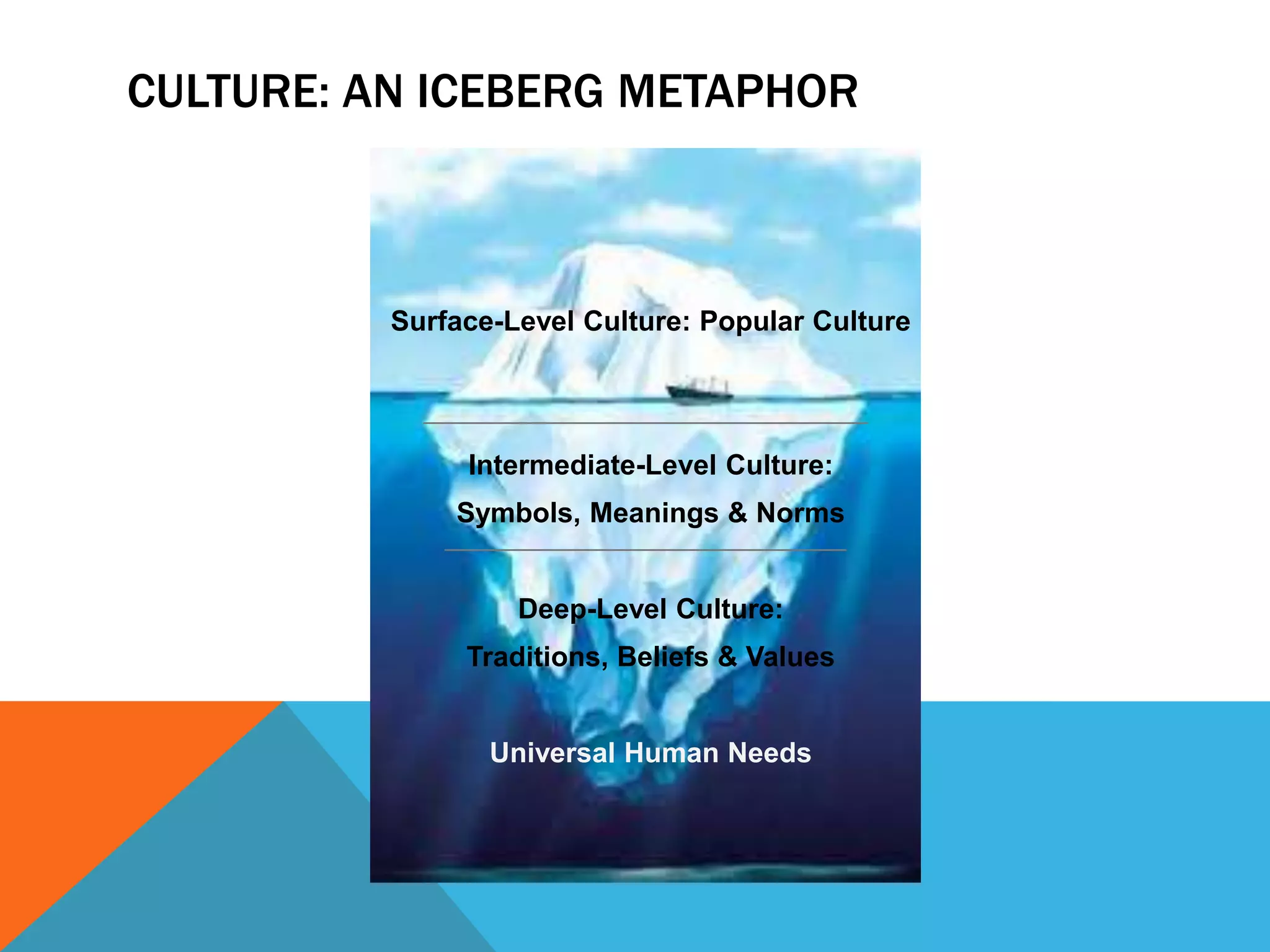
3. Culture can be thought of as an iceberg, with surface level popular culture at the top, intermediate levels of symbols and norms below, and deep levels of traditions, beliefs and values at the bottom.
Defining CultureThis lecturecomes from the text:Understanding Intercultural Communication (2005)Written by Stella Ting-Toomey and Leeva C. Chung
2.
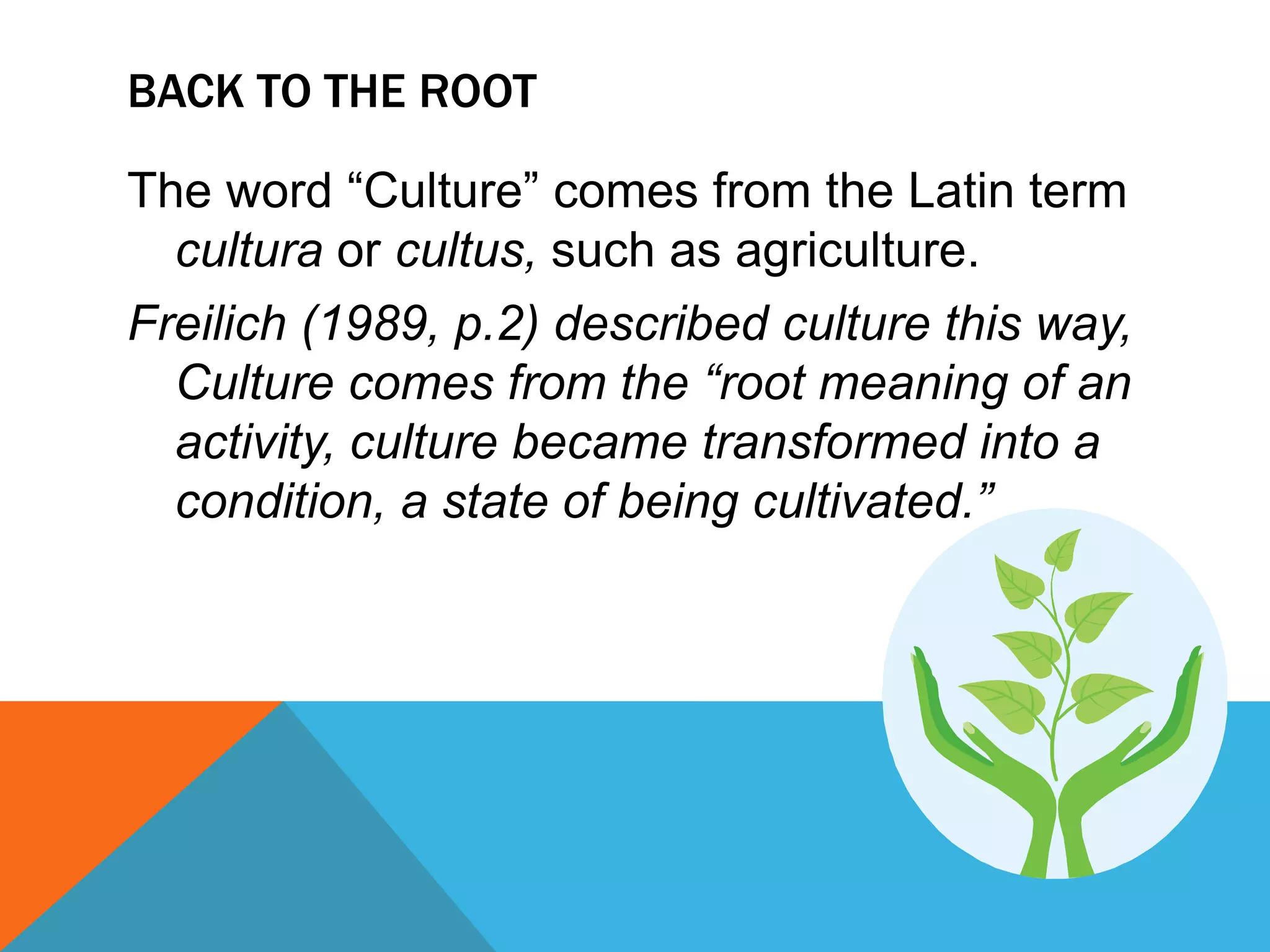
BACK To THEROOTThe word “Culture” comes from the Latin term cultura or cultus, such as agriculture.Freilich(1989, p.2) described culture this way, Culture comes from the “root meaning of an activity, culture became transformed into a condition, a state of being cultivated.”
3.
What does itmean to be “cultivated?” “To be a ‘cultivated’ member of a cultural community, the implication is that you understand what it means to be a ‘desirable and ideal’ member of that particular system or group” (p. 27).
4.
Culture is. .. Culture is a learned system of meanings—a value-laden system of meaning which help you make sense of the world and your existence within the world.It fosters a shared sense of identity. Creating:IngroupsandOutgroupsCulture DefinedCulture is defined “as a learned meaning system that consists of patterns of traditions, beliefs, values, norms, meanings and symbols. . .shared to varying degrees by interacting members of the community” (p. 28)
Culture: an icebergmetaphorSurface-Level Culture: Popular CultureIntermediate-Level Culture:Symbols, Meanings & NormsDeep-Level Culture:Traditions, Beliefs & ValuesUniversal Human Needs
7.
The surface: popcultureFor better or for worse, we learn about other cultures through Pop Culture artifacts.WAKA WAKAWhat do we learn about “African” culture from this video?
8.
The surface: popculture “Popular culture basically refers to cultural artifacts or systems that have mass appeal and that infiltrate our daily life” (p. 29).
9.
The surface: popculturePopular images as portrayed in television, film, advertising, pop music, and even comic strips reinforce cultural and gender ideologies in society. . .then we export them.What are your favorite Television Shows? Why?
10.
The surface: popcultureSome forms of popular culture have a direct correlation with the cultures' underlying values and norms, but other forms of popular culture have been created for sheer entertainment.
11.
The surface: popculturePop Culture is directly connected to economics.A LITERAL EXAMPLE:
12.
The surface: popcultureHow authentic are the pop culture images we encounter?
13.
Diving Down: Culturalsymbols, meanings & NOrmsSymbol: is a sign, artifact, word(s), gesture, or nonverbal behavior that stands for or reflections something meaningful.
14.
Diving Down: Culturalsymbols, meanings & NOrmsMeanings: or interpretations we attach to a symbol cue both objective and subjective reactions.
15.
Diving Down: Culturalsymbols, meanings & NOrmsCultural Norms: Collective Expectations we have of what constitutes proper or improper behavior in a given interaction scene. . .this is our cultural script.Sheena Iyengar
16.
Culture: an icebergmetaphorSurface-Level Culture: Popular CultureIntermediate-Level Culture:Symbols, Meanings & NormsDeep-Level Culture:Traditions, Beliefs & ValuesUniversal Human Needs
17.
DEEP & DARK:Traditions, beliefs & valuesUnderstanding normative culture v. subjective culture:Normative Culture is the patterned way of living by a group of interacting individuals who share a common set of history, traditions, values, and interdependent fate.Subjective Culture is the degree of importance culture members assign to the layers of cultural beliefs and values.
18.
DEEP & DARK:Traditions, beliefs & valuesCulturally Shared TraditionsHealingsWeddingsCultural shared traditions reinforce the “ingroup” solidarity, communal memory, cultural stability and continuity functions.Funeral Rituals
19.
DEEP & DARK:Traditions, beliefs & valuesCultural Shared BeliefsExistenceRealityGodOrigins
20.
DEEP & DARK:Traditions, beliefs & valuesCulturally Shared Values“good” and “bad” Shalom Schwarts’ (1992) research indicates that there are clear cultural value structures which reflect people’s needs, for example, benevolence. This value structure indicates how valuable a culture perceives a “deeper” meaning in life.
21.
DEEP & DARK:Traditions, beliefs & valuesVALUESUnderstanding particular cultural value dimensions and orientations, we can meaningfully link some of those patterns with different communication styles issues.Values serve as guidelines and preferable modes of conduct in the pursuit of certain valued existential outcomes. These are called instrumental values.Values also serve as preferable end states or goals. These are known as terminal values.