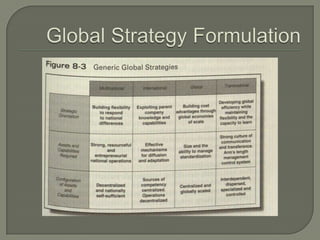
Ch. 8: Global Strategy Formulation
                    Meghan Davidson
                   Berklye Dominguez
                        Justin Pickard
                     Michael Simpson
                       Andrew Vargas
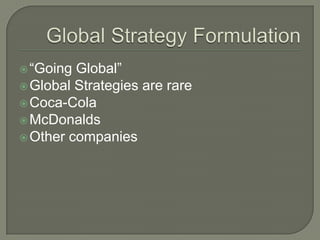
 “Going Global”
 Global Strategies are rare
 Coca-Cola
 McDonalds
 Other companies
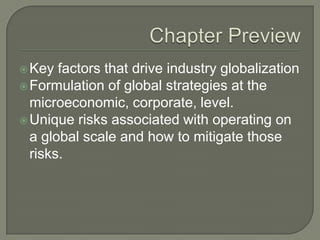
 Key  factors that drive industry globalization
 Formulation of global strategies at the
  microeconomic, corporate, level.
 Unique risks associated with operating on
  a global scale and how to mitigate those
  risks.
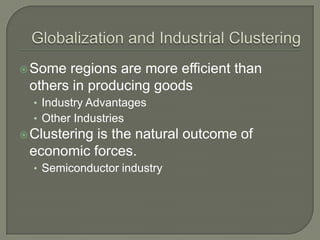
 Some regions are more efficient than
 others in producing goods
  • Industry Advantages
  • Other Industries
 Clustering
           is the natural outcome of
 economic forces.
  • Semiconductor industry
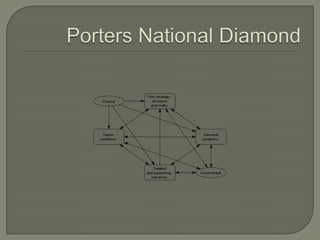
 Factor   Conditions:
  • Natural vs. Created
 Demand     Conditions
  • Size
 Relatedand Supporting Industries
 Competitiveness in the Home Industry
  • Porters 5 Forces (chapter 3)
 Public   Policy (government)
  • deregulation
  • Local, regional, national
 Chance
  • Outside the control of the firm
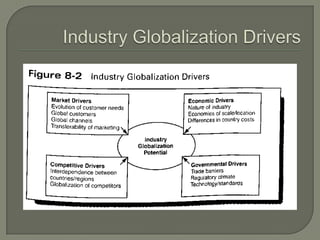
 Forces  that push companies to think more
  globally to challenge competition
 Regional or global similarity in product or
  service calls for a global product.
  • Ex. Coca Cola and adapting to local markets
 GlobalBranding and Marketing important
 to success
 Minimum    sales volume required for cost
  efficiency no longer available in one
  country
 Economies of Scale have become critical
  for Global success. This creates need for
  critical mass in different parts of the value
  chain
  • Ex. Pharmaceutical companies and R&D
 Globalization potential of an industry
  influenced by competitive drivers such as:
  • (1)High levels of trade
  • (2)Competitor’s Diversity
  • (3) Interdependence created between competitive
    strategies
 Useful Questions:
  • Do we face the same principle competitors in different
    parts of the world?
  • How many competitive arenas does our company
    compete in?
 Some    Industries regulated more than
 others
  • Ex. Steel Industry and barriers
 Companies     paying attention to nonmarket
  dimensions
 Leads to companies trying to shape the
  global competitive environment to their
  advantage
 Thereare Five additional Dimensions
 which are: (1) Market Participation
     (2) Standardization/Positioning
     (3)Activity Concentration
     (4) Coordination of Decision
  Making, and
     (5) Nonmarket Factors.
 Few  companies can afford to enter all
  markets open to them.
 Distinguish between “must” markets and
  “nice-to–be-in” markets
  • Must: compete in to realize global ambitions (Volume
    perspective)
  • Nice-to-be-in: participation is desirable but not critical
 Paceof international expansion is dictated by
 customer demand
  • Ex. Toyota Prius release date in Japan and U.S.
 Primary motivations for standardization:
  Reducing cost and enhancing quality
 Adopt a more global market positioning
  • Not necessarily mean standardizing all elements of the
   marketing mix, but by applying a global cost benefit
   approach to formulate the market strategy and seek
   balance flexibility with uniformity
 The use of global branding helps build in
 brand recognition, enhance customer
 preference and reduce worldwide marketing
 cost
  • Ex: Nestle, Coca-cola, Ford, IBM and Disney
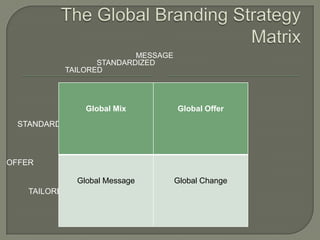
MESSAGE
                  STANDARDIZED
           TAILORED


                 Global Mix         Global Offer
  STANDARDIZED


OFFER

               Global Message       Global Change
    TAILORED
 Global(Marketing) Mix: Strategy under
 which both the offer and the message are the
 same
  • Are relatively rare because only a few industries are
    truly global
  • This applies when: Product's usage patterns and
    brand potential are homogeneous on a global scale,
    when scale and scope cost advantages substantially
    outweigh the benefits of partial or full adaptation, and
    when competitive circumstance are such that a long-
    term sustainable advantage can be secured using a
    standardize approach
   Global Offer: strategy characterized by and
    identical offer but different positioning around the
    world
    • Applies when fixed costs associated with the offer are
      high, when key core benefits offered are identical, and
      when there are natural market boundaries
    • Advantage-give a degree of flexibility in positioning the
      product or service for maximum local advantage
    • Disadvantage- it could be difficult to sustain as customers
      become increasingly global in their outlook and confused by
      the different messages in different parts of the world
    • Example Holiday Inn
 Global Message: strategy under which the
 offer might be different in various parts of the
 world but the message is the same
  • Primary motivation is the enormous power behind
    crating a global brand
  • Applies when customers are highly mobile; in which
    the cost of product or service adaptation is fairly low
  • Disadvantage-can be risky in the long run because
    global customers might not find elsewhere what they
    expect at home
  • Example: McDonald’s
 Global Change: strategy under which
 both the offer and message are adapted to
 local market circumstances
  • The most common
  • Adaptation of both the offer and the message is
   necessary. Differences in a product’s usage
   patterns, benefits sought, brand
   image, competitive structures, distribution
   channels etc all dictate some form of local
   adaptation
 Many   factors must be considered in
  selecting the right level of participation and
  the location for key value-added activities
  • Ex: Factor conditions, the presence of supporting
    industrial activity, the nature and location of the
    demand for the product, industry rivalry etc.
 Example: Eli Lilly
  • To reduce cost, Lilly expanded their R&D efforts in
    India and china to include clinical tirals
 Which   markets to participate in, how to
  allocate resources, and how to compete
  defines the extent to which globalization has
  been implemented successfully
 Many think that integrating and coordinating
  activity on a global scale is at least as
  important as control. This can take the form of
  leveraging regional cost differentials, sharing
  key resources, cross-subsidizing national or
  regional battles for market share, or pursuing
  global brand and distribution positions
 Global  corporate success is influenced by
  nonmarket factors that are governed by
  social, political and legal arrangements
 Different countries have different
  political, economic, and legal systems and
  are at different stages of economic
  development
 These differences can have profound
  implication for the rules that shape global
  competition and for crafting a global strategy
 In
   moving toward a more global strategic
 posture, there are several choices a
 company can make. Each of these has
 their own advantages and disadvantages.
  • Exporting
  • Licensing
  • Strategic alliances and joint ventures
  • Acquisitions or greenfield startups
 Tohelp companies with thinking through
 their globalization strategies, there is a five
 dimensional framework that maps a
 particular country or region’s institutional
 contexts.
  1.   Political and social systems
  2.   Openness
  3.   Product markets
  4.   Labor markets
  5.   Capital markets
 The  largest retailer in the world, Wal-Mart
  Stores, is a great example of a company’s
  transformation from a domestic company
  into a major global company.
 Wal-Mart has three different operations:
  1. Wal-Mart Stores
  2. Sam’s Clubs
  3. Supercenters
 Wal-Mart   began pursuing globalization in
  1991 by the need to grow. Today, almost
  25% of its stores are located outside the U.S.
 If they kept the stores in the domestic
  market, it would not be exposed to 96% of the
  world’s potential consumers.
 The committed workforce is a large success
  for the company. For this, there is a link
  between growth and its effect on stock price
  and the morale of the company.
 Wal-Mart    exploited tremendous buying power
  with dominant suppliers like Hallmark, Proctor
  &
  Gamble, Kellogg, Nestlé, Coke, Revlon, and
  more to procure good cost-effectively for their
  foreign stores.
 The company also took advantage of
  domestically developed competencies and
  knowledge in areas of store
  management, merchandising
  skills, logistics, and the use of technology.
 During  the first 5 years of Wal-Mart’s
  globalization, it focused on their presence
  in the Americas:
  Brazil, Mexico, Canada, and Argentina.
  This was because they realized they didn’t
  have the resources to expand to Europe
  and it wouldn’t be a good entry market for
  them at that point.
 In 1996, Wal-Mart felt prepared to target
  China.
 Afterselecting their targets, Wal-Mart had
 to select a mode of entry.
  • Entered Canada through an acquisition.
  • Entered Mexico through a 50-50 joint venture with
    Cifra.
  • Entered Brazil through a 60-40 joint venture with
    Lojas Americana.
  • Entered Argentina through a wholly owned
    subsidiary.
 Wal-Mart acquired the Canadian Woolco and
 reconfigured it along the lines of a successful
 U.S. model:
  • A transition team familiarized Woolco with Wal-Mart’s
      way
  •   Brought the outlets up to Wal-Mart standards
  •   Brought high brand recognition into customer
      acceptance and loyalty
  •   Focused on merchandise, high in-stock position, and
      customer service
  •   Implemented employee rewards
 Wal-Mart’s entrance into China was a
 great example of the problems of local
 adaptation.
  • Experimented with store designs
  • Varied merchandise
  • Began purchasing 75% of goods sold in China
 Acquiring a dominant player
 Acquiring a weak player
 Launching a frontal attack on the
  incumbent.
 Wal-Mart   is continuing to struggle in
  England.
 Wal-Mart had to sell out of the German
  market after being unable to create the
  economies of scale needed to dominate
  the market.
 Types   of Risk
  • Political Risk
  • Legal Risk
  • Financial/Economic Risk
  • Societal/Cultural Risk
 Wal-Mart  used economies of scale and
  standardization to go global.
 Cemex, however, took advantage of
  differences in global markets in order to
  grow globally.

Global strategy

  • 1.
    Ch. 8: GlobalStrategy Formulation Meghan Davidson Berklye Dominguez Justin Pickard Michael Simpson Andrew Vargas
  • 2.
     “Going Global” Global Strategies are rare  Coca-Cola  McDonalds  Other companies
  • 3.
     Key factors that drive industry globalization  Formulation of global strategies at the microeconomic, corporate, level.  Unique risks associated with operating on a global scale and how to mitigate those risks.
  • 4.
     Some regionsare more efficient than others in producing goods • Industry Advantages • Other Industries  Clustering is the natural outcome of economic forces. • Semiconductor industry
  • 6.
     Factor Conditions: • Natural vs. Created  Demand Conditions • Size  Relatedand Supporting Industries  Competitiveness in the Home Industry • Porters 5 Forces (chapter 3)
  • 7.
     Public Policy (government) • deregulation • Local, regional, national  Chance • Outside the control of the firm
  • 9.
     Forces that push companies to think more globally to challenge competition  Regional or global similarity in product or service calls for a global product. • Ex. Coca Cola and adapting to local markets  GlobalBranding and Marketing important to success
  • 10.
     Minimum sales volume required for cost efficiency no longer available in one country  Economies of Scale have become critical for Global success. This creates need for critical mass in different parts of the value chain • Ex. Pharmaceutical companies and R&D
  • 11.
     Globalization potentialof an industry influenced by competitive drivers such as: • (1)High levels of trade • (2)Competitor’s Diversity • (3) Interdependence created between competitive strategies  Useful Questions: • Do we face the same principle competitors in different parts of the world? • How many competitive arenas does our company compete in?
  • 12.
     Some Industries regulated more than others • Ex. Steel Industry and barriers  Companies paying attention to nonmarket dimensions  Leads to companies trying to shape the global competitive environment to their advantage
  • 14.
     Thereare Fiveadditional Dimensions which are: (1) Market Participation (2) Standardization/Positioning (3)Activity Concentration (4) Coordination of Decision Making, and (5) Nonmarket Factors.
  • 15.
     Few companies can afford to enter all markets open to them.  Distinguish between “must” markets and “nice-to–be-in” markets • Must: compete in to realize global ambitions (Volume perspective) • Nice-to-be-in: participation is desirable but not critical  Paceof international expansion is dictated by customer demand • Ex. Toyota Prius release date in Japan and U.S.
  • 16.
     Primary motivationsfor standardization: Reducing cost and enhancing quality  Adopt a more global market positioning • Not necessarily mean standardizing all elements of the marketing mix, but by applying a global cost benefit approach to formulate the market strategy and seek balance flexibility with uniformity  The use of global branding helps build in brand recognition, enhance customer preference and reduce worldwide marketing cost • Ex: Nestle, Coca-cola, Ford, IBM and Disney
  • 17.
    MESSAGE STANDARDIZED TAILORED Global Mix Global Offer STANDARDIZED OFFER Global Message Global Change TAILORED
  • 18.
     Global(Marketing) Mix:Strategy under which both the offer and the message are the same • Are relatively rare because only a few industries are truly global • This applies when: Product's usage patterns and brand potential are homogeneous on a global scale, when scale and scope cost advantages substantially outweigh the benefits of partial or full adaptation, and when competitive circumstance are such that a long- term sustainable advantage can be secured using a standardize approach
  • 19.
    Global Offer: strategy characterized by and identical offer but different positioning around the world • Applies when fixed costs associated with the offer are high, when key core benefits offered are identical, and when there are natural market boundaries • Advantage-give a degree of flexibility in positioning the product or service for maximum local advantage • Disadvantage- it could be difficult to sustain as customers become increasingly global in their outlook and confused by the different messages in different parts of the world • Example Holiday Inn
  • 20.
     Global Message:strategy under which the offer might be different in various parts of the world but the message is the same • Primary motivation is the enormous power behind crating a global brand • Applies when customers are highly mobile; in which the cost of product or service adaptation is fairly low • Disadvantage-can be risky in the long run because global customers might not find elsewhere what they expect at home • Example: McDonald’s
  • 21.
     Global Change:strategy under which both the offer and message are adapted to local market circumstances • The most common • Adaptation of both the offer and the message is necessary. Differences in a product’s usage patterns, benefits sought, brand image, competitive structures, distribution channels etc all dictate some form of local adaptation
  • 22.
     Many factors must be considered in selecting the right level of participation and the location for key value-added activities • Ex: Factor conditions, the presence of supporting industrial activity, the nature and location of the demand for the product, industry rivalry etc.  Example: Eli Lilly • To reduce cost, Lilly expanded their R&D efforts in India and china to include clinical tirals
  • 23.
     Which markets to participate in, how to allocate resources, and how to compete defines the extent to which globalization has been implemented successfully  Many think that integrating and coordinating activity on a global scale is at least as important as control. This can take the form of leveraging regional cost differentials, sharing key resources, cross-subsidizing national or regional battles for market share, or pursuing global brand and distribution positions
  • 24.
     Global corporate success is influenced by nonmarket factors that are governed by social, political and legal arrangements  Different countries have different political, economic, and legal systems and are at different stages of economic development  These differences can have profound implication for the rules that shape global competition and for crafting a global strategy
  • 25.
     In moving toward a more global strategic posture, there are several choices a company can make. Each of these has their own advantages and disadvantages. • Exporting • Licensing • Strategic alliances and joint ventures • Acquisitions or greenfield startups
  • 26.
     Tohelp companieswith thinking through their globalization strategies, there is a five dimensional framework that maps a particular country or region’s institutional contexts. 1. Political and social systems 2. Openness 3. Product markets 4. Labor markets 5. Capital markets
  • 27.
     The largest retailer in the world, Wal-Mart Stores, is a great example of a company’s transformation from a domestic company into a major global company.  Wal-Mart has three different operations: 1. Wal-Mart Stores 2. Sam’s Clubs 3. Supercenters
  • 28.
     Wal-Mart began pursuing globalization in 1991 by the need to grow. Today, almost 25% of its stores are located outside the U.S.  If they kept the stores in the domestic market, it would not be exposed to 96% of the world’s potential consumers.  The committed workforce is a large success for the company. For this, there is a link between growth and its effect on stock price and the morale of the company.
  • 29.
     Wal-Mart exploited tremendous buying power with dominant suppliers like Hallmark, Proctor & Gamble, Kellogg, Nestlé, Coke, Revlon, and more to procure good cost-effectively for their foreign stores.  The company also took advantage of domestically developed competencies and knowledge in areas of store management, merchandising skills, logistics, and the use of technology.
  • 30.
     During the first 5 years of Wal-Mart’s globalization, it focused on their presence in the Americas: Brazil, Mexico, Canada, and Argentina. This was because they realized they didn’t have the resources to expand to Europe and it wouldn’t be a good entry market for them at that point.  In 1996, Wal-Mart felt prepared to target China.
  • 31.
     Afterselecting theirtargets, Wal-Mart had to select a mode of entry. • Entered Canada through an acquisition. • Entered Mexico through a 50-50 joint venture with Cifra. • Entered Brazil through a 60-40 joint venture with Lojas Americana. • Entered Argentina through a wholly owned subsidiary.
  • 32.
     Wal-Mart acquiredthe Canadian Woolco and reconfigured it along the lines of a successful U.S. model: • A transition team familiarized Woolco with Wal-Mart’s way • Brought the outlets up to Wal-Mart standards • Brought high brand recognition into customer acceptance and loyalty • Focused on merchandise, high in-stock position, and customer service • Implemented employee rewards
  • 33.
     Wal-Mart’s entranceinto China was a great example of the problems of local adaptation. • Experimented with store designs • Varied merchandise • Began purchasing 75% of goods sold in China
  • 34.
     Acquiring adominant player  Acquiring a weak player  Launching a frontal attack on the incumbent.
  • 35.
     Wal-Mart is continuing to struggle in England.  Wal-Mart had to sell out of the German market after being unable to create the economies of scale needed to dominate the market.
  • 36.
     Types of Risk • Political Risk • Legal Risk • Financial/Economic Risk • Societal/Cultural Risk
  • 37.
     Wal-Mart used economies of scale and standardization to go global.  Cemex, however, took advantage of differences in global markets in order to grow globally.