Tapping Into
Global Markets
Marketing Management, 13th ed
21
Copyright © 2009 Pearson Education, Inc. Publishing as Prentice Hall 21-2
Chapter Questions
• What factors should a company review before
deciding to go abroad?
• How can companies evaluate and select
specific foreign markets to enter?
• What are the major ways of entering a foreign
market?
• To what extent must the company adapt its
products and marketing program to each foreign
country?
• How should the company manage and organize
its international activities?
Copyright © 2009 Pearson Education, Inc. Publishing as Prentice Hall 21-3
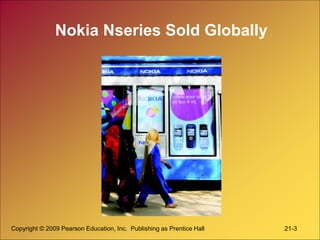
Nokia Nseries Sold Globally
Copyright © 2009 Pearson Education, Inc. Publishing as Prentice Hall 21-4
What is a Global Firm?
A global firm is one that operates in
more than one country and captures
R&D, production, logistical, marketing,
and financial advantages in its costs
and reputation that are not available to
purely domestic competitors.
Copyright © 2009 Pearson Education, Inc. Publishing as Prentice Hall 21-5
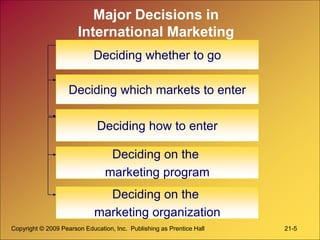
Major Decisions in
International Marketing
Deciding whether to go
Deciding which markets to enter
Deciding how to enter
Deciding on the
marketing program
Deciding on the
marketing organization
Copyright © 2009 Pearson Education, Inc. Publishing as Prentice Hall 21-6
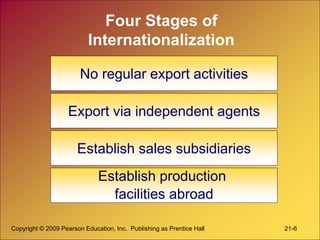
Four Stages of
Internationalization
No regular export activities
Export via independent agents
Establish sales subsidiaries
Establish production
facilities abroad
Copyright © 2009 Pearson Education, Inc. Publishing as Prentice Hall 21-7
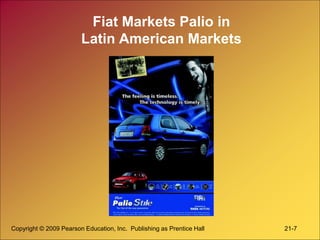
Fiat Markets Palio in
Latin American Markets
Copyright © 2009 Pearson Education, Inc. Publishing as Prentice Hall 21-8
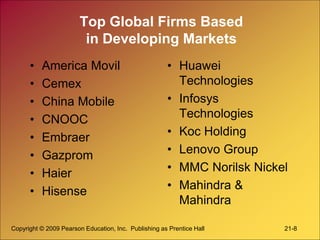
Top Global Firms Based
in Developing Markets
• America Movil
• Cemex
• China Mobile
• CNOOC
• Embraer
• Gazprom
• Haier
• Hisense
• Huawei
Technologies
• Infosys
Technologies
• Koc Holding
• Lenovo Group
• MMC Norilsk Nickel
• Mahindra &
Mahindra
Copyright © 2009 Pearson Education, Inc. Publishing as Prentice Hall 21-9
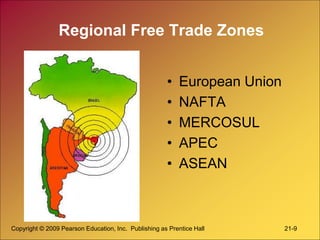
Regional Free Trade Zones
• European Union
• NAFTA
• MERCOSUL
• APEC
• ASEAN
Copyright © 2009 Pearson Education, Inc. Publishing as Prentice Hall 21-10
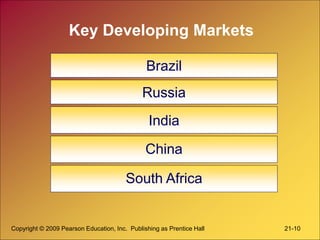
Key Developing Markets
Brazil
Russia
India
China
South Africa
Copyright © 2009 Pearson Education, Inc. Publishing as Prentice Hall 21-11
Desired Country
Characteristics for Market Entry
• Rank high on market
attractiveness
• Rank low in market
risk
• Possess a competitive
advantage
Copyright © 2009 Pearson Education, Inc. Publishing as Prentice Hall 21-12
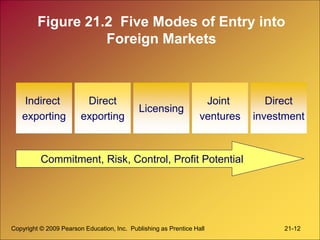
Figure 21.2 Five Modes of Entry into
Foreign Markets
Indirect
exporting
Direct
exporting
Licensing
Joint
ventures
Direct
investment
Commitment, Risk, Control, Profit Potential
Copyright © 2009 Pearson Education, Inc. Publishing as Prentice Hall 21-13
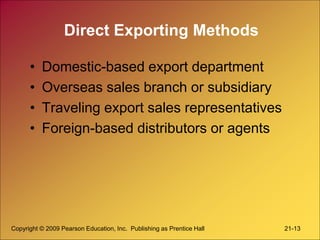
Direct Exporting Methods
• Domestic-based export department
• Overseas sales branch or subsidiary
• Traveling export sales representatives
• Foreign-based distributors or agents
Copyright © 2009 Pearson Education, Inc. Publishing as Prentice Hall 21-14
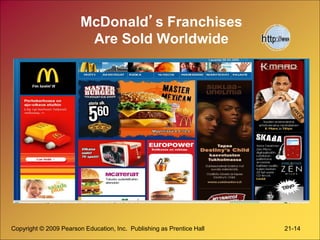
McDonald’s Franchises
Are Sold Worldwide
Copyright © 2009 Pearson Education, Inc. Publishing as Prentice Hall 21-15
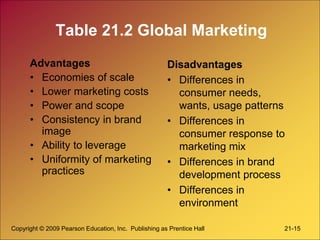
Table 21.2 Global Marketing
Advantages
• Economies of scale
• Lower marketing costs
• Power and scope
• Consistency in brand
image
• Ability to leverage
• Uniformity of marketing
practices
Disadvantages
• Differences in
consumer needs,
wants, usage patterns
• Differences in
consumer response to
marketing mix
• Differences in brand
development process
• Differences in
environment
Copyright © 2009 Pearson Education, Inc. Publishing as Prentice Hall 21-16
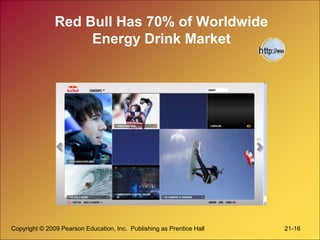
Red Bull Has 70% of Worldwide
Energy Drink Market
Copyright © 2009 Pearson Education, Inc. Publishing as Prentice Hall 21-17
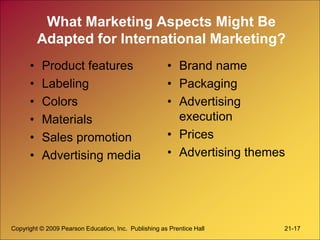
What Marketing Aspects Might Be
Adapted for International Marketing?
• Product features
• Labeling
• Colors
• Materials
• Sales promotion
• Advertising media
• Brand name
• Packaging
• Advertising
execution
• Prices
• Advertising themes
Copyright © 2009 Pearson Education, Inc. Publishing as Prentice Hall 21-18
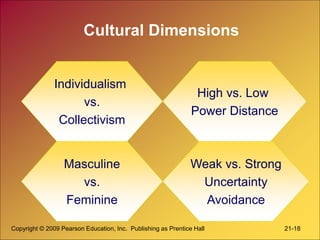
Cultural Dimensions
Individualism
vs.
Collectivism
Weak vs. Strong
Uncertainty
Avoidance
High vs. Low
Power Distance
Masculine
vs.
Feminine
Copyright © 2009 Pearson Education, Inc. Publishing as Prentice Hall 21-19
Commandments of
Global Branding
• Understand similarities and differences in the
global branding landscape
• Do not take shortcuts in brand building
• Establish a marketing infrastructure
• Embrace integrated marketing
communications
• Establish brand partnerships
Copyright © 2009 Pearson Education, Inc. Publishing as Prentice Hall 21-20
Commandments of
Global Branding (cont.)
• Balance standardization and customization
• Balance global and local control
• Establish operable guidelines
• Implement a global brand-equity
measurement system
• Leverage brand elements
Copyright © 2009 Pearson Education, Inc. Publishing as Prentice Hall 21-21
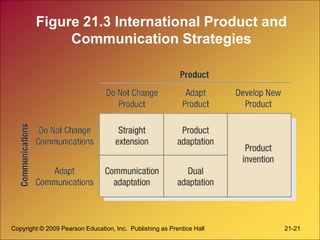
Figure 21.3 International Product and
Communication Strategies
Copyright © 2009 Pearson Education, Inc. Publishing as Prentice Hall 21-22
Levels of Product Adaptation
• Production of regional product versions
• Production of country versions
• Production of city versions
• Production of retailer versions
Copyright © 2009 Pearson Education, Inc. Publishing as Prentice Hall 21-23
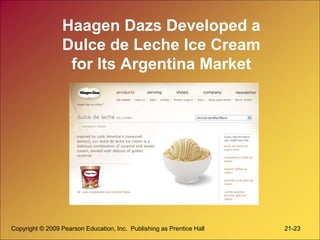
Haagen Dazs Developed a
Dulce de Leche Ice Cream
for Its Argentina Market
Copyright © 2009 Pearson Education, Inc. Publishing as Prentice Hall 21-24
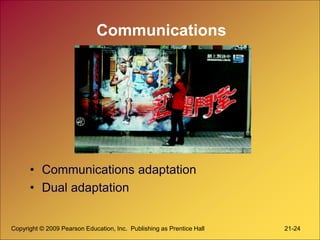
Communications
• Communications adaptation
• Dual adaptation
Copyright © 2009 Pearson Education, Inc. Publishing as Prentice Hall 21-25
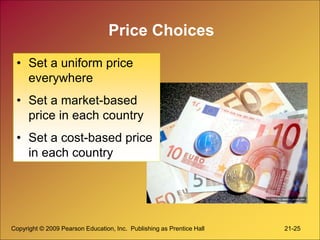
Price Choices
• Set a uniform price
everywhere
• Set a market-based
price in each country
• Set a cost-based price
in each country
Copyright © 2009 Pearson Education, Inc. Publishing as Prentice Hall 21-26
What is a Gray Market?
A gray market consists of branded
products diverted from normal or
authorized distributions channels in the
country of product origin or cross
international borders; dealers in lower
priced countries sell products in higher
priced countries.
Copyright © 2009 Pearson Education, Inc. Publishing as Prentice Hall 21-27
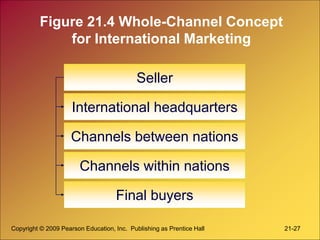
Figure 21.4 Whole-Channel Concept
for International Marketing
Seller
International headquarters
Channels between nations
Channels within nations
Final buyers
Copyright © 2009 Pearson Education, Inc. Publishing as Prentice Hall 21-28
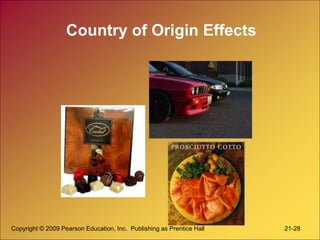
Country of Origin Effects
Copyright © 2009 Pearson Education, Inc. Publishing as Prentice Hall 21-29
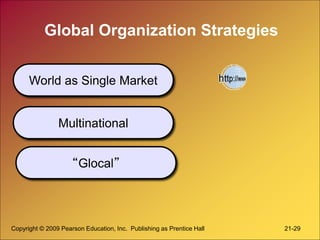
Global Organization Strategies
World as Single Market
Multinational
“Glocal”
Copyright © 2009 Pearson Education, Inc. Publishing as Prentice Hall 21-30
Marketing Debate
 Is the world coming closer together?
Take a position:
1. People are becoming more and more
similar.
or
2. The differences between people of
different cultures far outweigh their
similarities.
Copyright © 2009 Pearson Education, Inc. Publishing as Prentice Hall 21-31
Marketing Discussion
 Think of some of your favorite brands.
 Do you know where they come from?
 Where and how they are made or
provided?
 Would knowing affect your perceptions
of quality or satisfaction?

Pertemuan - 11 - kotler.ppt

  • 1.
  • 2.
    Copyright © 2009Pearson Education, Inc. Publishing as Prentice Hall 21-2 Chapter Questions • What factors should a company review before deciding to go abroad? • How can companies evaluate and select specific foreign markets to enter? • What are the major ways of entering a foreign market? • To what extent must the company adapt its products and marketing program to each foreign country? • How should the company manage and organize its international activities?
  • 3.
    Copyright © 2009Pearson Education, Inc. Publishing as Prentice Hall 21-3 Nokia Nseries Sold Globally
  • 4.
    Copyright © 2009Pearson Education, Inc. Publishing as Prentice Hall 21-4 What is a Global Firm? A global firm is one that operates in more than one country and captures R&D, production, logistical, marketing, and financial advantages in its costs and reputation that are not available to purely domestic competitors.
  • 5.
    Copyright © 2009Pearson Education, Inc. Publishing as Prentice Hall 21-5 Major Decisions in International Marketing Deciding whether to go Deciding which markets to enter Deciding how to enter Deciding on the marketing program Deciding on the marketing organization
  • 6.
    Copyright © 2009Pearson Education, Inc. Publishing as Prentice Hall 21-6 Four Stages of Internationalization No regular export activities Export via independent agents Establish sales subsidiaries Establish production facilities abroad
  • 7.
    Copyright © 2009Pearson Education, Inc. Publishing as Prentice Hall 21-7 Fiat Markets Palio in Latin American Markets
  • 8.
    Copyright © 2009Pearson Education, Inc. Publishing as Prentice Hall 21-8 Top Global Firms Based in Developing Markets • America Movil • Cemex • China Mobile • CNOOC • Embraer • Gazprom • Haier • Hisense • Huawei Technologies • Infosys Technologies • Koc Holding • Lenovo Group • MMC Norilsk Nickel • Mahindra & Mahindra
  • 9.
    Copyright © 2009Pearson Education, Inc. Publishing as Prentice Hall 21-9 Regional Free Trade Zones • European Union • NAFTA • MERCOSUL • APEC • ASEAN
  • 10.
    Copyright © 2009Pearson Education, Inc. Publishing as Prentice Hall 21-10 Key Developing Markets Brazil Russia India China South Africa
  • 11.
    Copyright © 2009Pearson Education, Inc. Publishing as Prentice Hall 21-11 Desired Country Characteristics for Market Entry • Rank high on market attractiveness • Rank low in market risk • Possess a competitive advantage
  • 12.
    Copyright © 2009Pearson Education, Inc. Publishing as Prentice Hall 21-12 Figure 21.2 Five Modes of Entry into Foreign Markets Indirect exporting Direct exporting Licensing Joint ventures Direct investment Commitment, Risk, Control, Profit Potential
  • 13.
    Copyright © 2009Pearson Education, Inc. Publishing as Prentice Hall 21-13 Direct Exporting Methods • Domestic-based export department • Overseas sales branch or subsidiary • Traveling export sales representatives • Foreign-based distributors or agents
  • 14.
    Copyright © 2009Pearson Education, Inc. Publishing as Prentice Hall 21-14 McDonald’s Franchises Are Sold Worldwide
  • 15.
    Copyright © 2009Pearson Education, Inc. Publishing as Prentice Hall 21-15 Table 21.2 Global Marketing Advantages • Economies of scale • Lower marketing costs • Power and scope • Consistency in brand image • Ability to leverage • Uniformity of marketing practices Disadvantages • Differences in consumer needs, wants, usage patterns • Differences in consumer response to marketing mix • Differences in brand development process • Differences in environment
  • 16.
    Copyright © 2009Pearson Education, Inc. Publishing as Prentice Hall 21-16 Red Bull Has 70% of Worldwide Energy Drink Market
  • 17.
    Copyright © 2009Pearson Education, Inc. Publishing as Prentice Hall 21-17 What Marketing Aspects Might Be Adapted for International Marketing? • Product features • Labeling • Colors • Materials • Sales promotion • Advertising media • Brand name • Packaging • Advertising execution • Prices • Advertising themes
  • 18.
    Copyright © 2009Pearson Education, Inc. Publishing as Prentice Hall 21-18 Cultural Dimensions Individualism vs. Collectivism Weak vs. Strong Uncertainty Avoidance High vs. Low Power Distance Masculine vs. Feminine
  • 19.
    Copyright © 2009Pearson Education, Inc. Publishing as Prentice Hall 21-19 Commandments of Global Branding • Understand similarities and differences in the global branding landscape • Do not take shortcuts in brand building • Establish a marketing infrastructure • Embrace integrated marketing communications • Establish brand partnerships
  • 20.
    Copyright © 2009Pearson Education, Inc. Publishing as Prentice Hall 21-20 Commandments of Global Branding (cont.) • Balance standardization and customization • Balance global and local control • Establish operable guidelines • Implement a global brand-equity measurement system • Leverage brand elements
  • 21.
    Copyright © 2009Pearson Education, Inc. Publishing as Prentice Hall 21-21 Figure 21.3 International Product and Communication Strategies
  • 22.
    Copyright © 2009Pearson Education, Inc. Publishing as Prentice Hall 21-22 Levels of Product Adaptation • Production of regional product versions • Production of country versions • Production of city versions • Production of retailer versions
  • 23.
    Copyright © 2009Pearson Education, Inc. Publishing as Prentice Hall 21-23 Haagen Dazs Developed a Dulce de Leche Ice Cream for Its Argentina Market
  • 24.
    Copyright © 2009Pearson Education, Inc. Publishing as Prentice Hall 21-24 Communications • Communications adaptation • Dual adaptation
  • 25.
    Copyright © 2009Pearson Education, Inc. Publishing as Prentice Hall 21-25 Price Choices • Set a uniform price everywhere • Set a market-based price in each country • Set a cost-based price in each country
  • 26.
    Copyright © 2009Pearson Education, Inc. Publishing as Prentice Hall 21-26 What is a Gray Market? A gray market consists of branded products diverted from normal or authorized distributions channels in the country of product origin or cross international borders; dealers in lower priced countries sell products in higher priced countries.
  • 27.
    Copyright © 2009Pearson Education, Inc. Publishing as Prentice Hall 21-27 Figure 21.4 Whole-Channel Concept for International Marketing Seller International headquarters Channels between nations Channels within nations Final buyers
  • 28.
    Copyright © 2009Pearson Education, Inc. Publishing as Prentice Hall 21-28 Country of Origin Effects
  • 29.
    Copyright © 2009Pearson Education, Inc. Publishing as Prentice Hall 21-29 Global Organization Strategies World as Single Market Multinational “Glocal”
  • 30.
    Copyright © 2009Pearson Education, Inc. Publishing as Prentice Hall 21-30 Marketing Debate  Is the world coming closer together? Take a position: 1. People are becoming more and more similar. or 2. The differences between people of different cultures far outweigh their similarities.
  • 31.
    Copyright © 2009Pearson Education, Inc. Publishing as Prentice Hall 21-31 Marketing Discussion  Think of some of your favorite brands.  Do you know where they come from?  Where and how they are made or provided?  Would knowing affect your perceptions of quality or satisfaction?