INTERNATIONAL ENTRY MODESPresented By:AmitKumarAvanika Babel
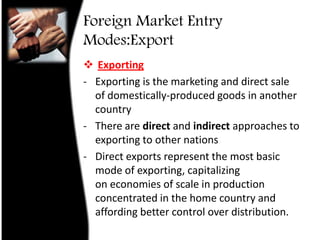
THIS PRESENTATION WILL COVER THE FOLLOWING:IntroductionCriteria for country selectionVarious market entry modes
INTRODUCTIONIn today's globalizing world, firms are increasing, looking towards other regions of the world to trade in. What are the steps taken by the executives of these firms before deciding on which market to enter? How do they make sure they make their journey a successful one?
Introduction contd.The decision requires an analysis of the aspects of the foreign market.                - Whether to go abroad                - Which markets to enter                - How to enter those markets                - Choice of marketing program                -Marketing organization
Introduction Contd.Criteria for Country selection :1. Country/market Attractiveness in terms of the following:                o Market size               o Market growth and need potential in terms of demand2. Company strength in terms of brand and accessibility3. When the risk e.g. political is marginal compared to opportunities4. Customer response5. Competitive situation
Introduction contd.A firm becomes proactive i.e. pulled by the potentials and advantages in the foreign market due to the following reasons:1. The firms specific advantages in terms of profit2. The advantage of having a unique brand3. When a firm possesses technological advantages4. The availability of resources in the foreign countries5. Economies of scale6. Economic and political factors
Introduction Contd.A firm becomes reactive i.e. pushed by bad domestic markets when the following is evident:1. The pressure of domestic competition2. Poor domestic market due to stagnant or declining sales figures3. Saturated domestic markets4. Overproduction
Choosing Product to trade in I.Manything that can be offered to market to satisfy a want or need.They can be physical goods, services, experiences, events, persons, places, properties, organizations, information's & ideas.What are new products?New product lineAddition to product lineRepositioning to new market segmentsImprovements/revisionsCost reductionsReason of failure of different foreign companies like Kellogg's, Pizza hut, Mac Donald, Dominos was-Gross overestimation of spending patterns of Indian consumersGross overestimation of strength of the transnational brandGross underestimation of the strengths of ethnic Indian products
INTERNATIONAL  BUSINESS APPROACHESETHNOCENTRIC   APPROACHPOLYCENTRIC     APPROACHREGIOCENTRIC   APPROACHGEOCENTRIC      APPROACH
ETHNOCENTRIC APPROACHUnder this approach , companies market the products in various countries in the same way it does domestically.POLYCENTRIC APPROACHUnder this approach, the companies customizes the marketing mix to meet the taste, performance and needs of the customers of each international market.REGIOCENTRIC APPROACHUnder this approach, the company operating successfully in a foreign country thinks of thinks of exporting other neighboring countries of the host country.At this stage, the concerned subsidiary considers the regional environment ( such as laws, culture, policies etc) for formulating the policies & strategies.
GEOCENTRIC APPROACHUnder this approach, the company analyses the tastes, preference and needs of the customers in all foreign markets and then adopts a standardized marketing mix for all the foreign markets.Coca-cola adopted this strategy by selling its popular soft drink with the same content, packaging, branding & advertisement themes worldwideWhirlpool designs a world-washer – small, stripped-down automatic washing machine for Mexico, Brazil & India. However, it modified its product for Indian market to wash the delicate “sarees”.
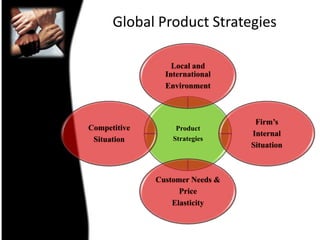
Global Product Strategies
Strategy for new product launchWaterfall approachSprinkler approach
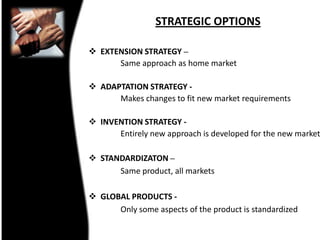
STRATEGIC OPTIONSEXTENSION STRATEGY –Same approach as home marketADAPTATION STRATEGY -Makes changes to fit new market requirementsINVENTION STRATEGY -Entirely new approach is developed for the new marketSTANDARDIZATON –	Same product, all marketsGLOBAL PRODUCTS -	Only some aspects of the product is standardized
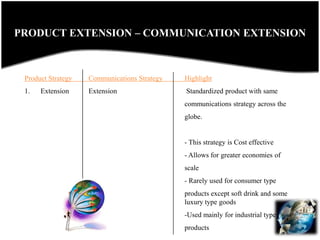
OPTION 1.PRODUCT EXTENSION – COMMUNICATION EXTENSIONProduct Strategy	Communications Strategy	HighlightExtension	Extension			 Standardized product with same				communications strategy across the				globe.				- This strategy is Cost effective				- Allows for greater economies of 				scale				- Rarely used for consumer type 				products except soft drink and some 			luxury type goods				-Used mainly for industrial type				products
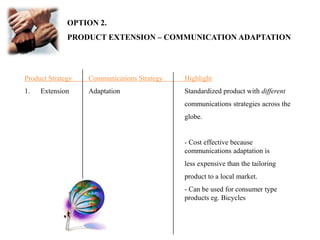
OPTION 2.PRODUCT EXTENSION – COMMUNICATION ADAPTATIONProduct Strategy	Communications Strategy	HighlightExtension	Adaptation			Standardized product with different				communications strategies across the				globe.				- Cost effective because 				communications adaptation is				less expensive than the tailoring				product to a local market.				- Can be used for consumer type 				products eg. Bicycles
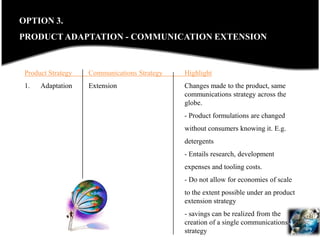
OPTION 3.PRODUCT ADAPTATION - COMMUNICATION EXTENSIONProduct Strategy	Communications Strategy	HighlightAdaptation	Extension			Changes made to the product, same					communications strategy across the 					globe.				- Product formulations are changed				without consumers knowing it. E.g.				detergents 				- Entails research, development				expenses and tooling costs.				- Do not allow for economies of scale				to the extent possible under an product 			extension strategy				- savings can be realized from the 			creation of a single communications 			strategy
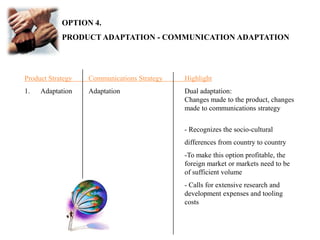
OPTION 4.PRODUCT ADAPTATION - COMMUNICATION ADAPTATIONProduct Strategy	Communications Strategy	HighlightAdaptation	Adaptation			Dual adaptation:							Changes made to the product, changes 					made to communications strategy 											- Recognizes the socio-cultural				differences from country to country				-To make this option profitable, the 			foreign market or markets need to be 			of sufficient volume				- Calls for extensive research and 			development expenses and tooling 			costs
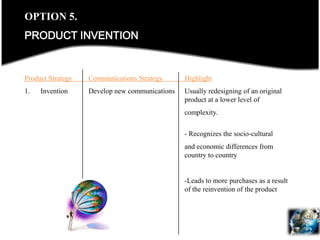
OPTION 5.PRODUCT INVENTIONProduct Strategy	Communications Strategy	HighlightInvention	Develop new communications	Usually redesigning of an original 					product at a lower level of					complexity. 											- Recognizes the socio-cultural				and economic differences from 				country to country				-Leads to more purchases as a result 			of the reinvention of the product
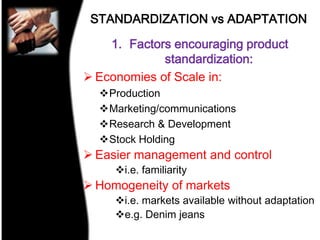
STANDARDIZATION vs ADAPTATIONFactors encouraging product standardization:Economies of Scale in:
Production
Marketing/communications
Research & Development
Stock Holding
Easier management and control
i.e. familiarity
Homogeneity of markets
i.e. markets available without adaptation
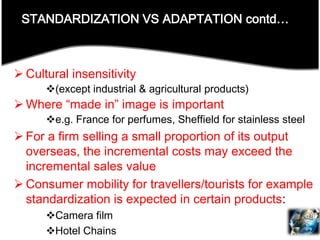
e.g. Denim jeansSTANDARDIZATION VS ADAPTATION contd…Cultural insensitivity
(except industrial & agricultural products)
Where “made in” image is important
e.g. France for perfumes, Sheffield for stainless steel
For a firm selling a small proportion of its output overseas, the incremental costs may exceed the incremental sales value
Consumer mobility for travellers/tourists for example standardization is expected in certain products:
Camera film
Hotel ChainsSTANDARDIZATION VS ADAPTATION contd…Factors encouraging adaptation/modificationVoluntary factors influencing product adaptation in I.M
Consumer Demographics
Culture
Local custom & Tradition
Condition of use
Price
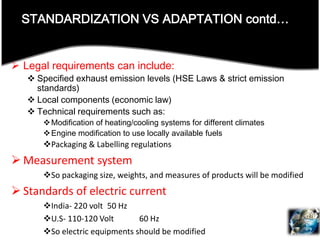
Mandatory Modification:

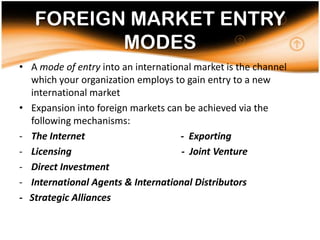
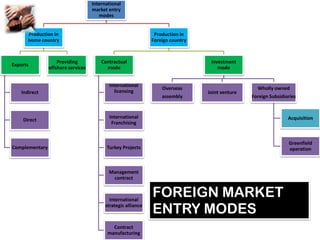
International entry modes

  • 1.
    INTERNATIONAL ENTRY MODESPresented By:AmitKumarAvanika Babel
  • 2.
    THIS PRESENTATION WILLCOVER THE FOLLOWING:IntroductionCriteria for country selectionVarious market entry modes
  • 3.
    INTRODUCTIONIn today's globalizingworld, firms are increasing, looking towards other regions of the world to trade in. What are the steps taken by the executives of these firms before deciding on which market to enter? How do they make sure they make their journey a successful one?
  • 4.
    Introduction contd.The decisionrequires an analysis of the aspects of the foreign market. - Whether to go abroad - Which markets to enter - How to enter those markets - Choice of marketing program -Marketing organization
  • 5.
    Introduction Contd.Criteria forCountry selection :1. Country/market Attractiveness in terms of the following: o Market size o Market growth and need potential in terms of demand2. Company strength in terms of brand and accessibility3. When the risk e.g. political is marginal compared to opportunities4. Customer response5. Competitive situation
  • 6.
    Introduction contd.A firmbecomes proactive i.e. pulled by the potentials and advantages in the foreign market due to the following reasons:1. The firms specific advantages in terms of profit2. The advantage of having a unique brand3. When a firm possesses technological advantages4. The availability of resources in the foreign countries5. Economies of scale6. Economic and political factors
  • 7.
    Introduction Contd.A firmbecomes reactive i.e. pushed by bad domestic markets when the following is evident:1. The pressure of domestic competition2. Poor domestic market due to stagnant or declining sales figures3. Saturated domestic markets4. Overproduction
  • 8.
    Choosing Product totrade in I.Manything that can be offered to market to satisfy a want or need.They can be physical goods, services, experiences, events, persons, places, properties, organizations, information's & ideas.What are new products?New product lineAddition to product lineRepositioning to new market segmentsImprovements/revisionsCost reductionsReason of failure of different foreign companies like Kellogg's, Pizza hut, Mac Donald, Dominos was-Gross overestimation of spending patterns of Indian consumersGross overestimation of strength of the transnational brandGross underestimation of the strengths of ethnic Indian products
  • 9.
    INTERNATIONAL BUSINESSAPPROACHESETHNOCENTRIC APPROACHPOLYCENTRIC APPROACHREGIOCENTRIC APPROACHGEOCENTRIC APPROACH
  • 10.
    ETHNOCENTRIC APPROACHUnder thisapproach , companies market the products in various countries in the same way it does domestically.POLYCENTRIC APPROACHUnder this approach, the companies customizes the marketing mix to meet the taste, performance and needs of the customers of each international market.REGIOCENTRIC APPROACHUnder this approach, the company operating successfully in a foreign country thinks of thinks of exporting other neighboring countries of the host country.At this stage, the concerned subsidiary considers the regional environment ( such as laws, culture, policies etc) for formulating the policies & strategies.
  • 11.
    GEOCENTRIC APPROACHUnder thisapproach, the company analyses the tastes, preference and needs of the customers in all foreign markets and then adopts a standardized marketing mix for all the foreign markets.Coca-cola adopted this strategy by selling its popular soft drink with the same content, packaging, branding & advertisement themes worldwideWhirlpool designs a world-washer – small, stripped-down automatic washing machine for Mexico, Brazil & India. However, it modified its product for Indian market to wash the delicate “sarees”.
  • 12.
  • 13.
    Strategy for newproduct launchWaterfall approachSprinkler approach
  • 14.
    STRATEGIC OPTIONSEXTENSION STRATEGY–Same approach as home marketADAPTATION STRATEGY -Makes changes to fit new market requirementsINVENTION STRATEGY -Entirely new approach is developed for the new marketSTANDARDIZATON – Same product, all marketsGLOBAL PRODUCTS - Only some aspects of the product is standardized
  • 15.
    OPTION 1.PRODUCT EXTENSION– COMMUNICATION EXTENSIONProduct Strategy Communications Strategy HighlightExtension Extension Standardized product with same communications strategy across the globe. - This strategy is Cost effective - Allows for greater economies of scale - Rarely used for consumer type products except soft drink and some luxury type goods -Used mainly for industrial type products
  • 16.
    OPTION 2.PRODUCT EXTENSION– COMMUNICATION ADAPTATIONProduct Strategy Communications Strategy HighlightExtension Adaptation Standardized product with different communications strategies across the globe. - Cost effective because communications adaptation is less expensive than the tailoring product to a local market. - Can be used for consumer type products eg. Bicycles
  • 17.
    OPTION 3.PRODUCT ADAPTATION- COMMUNICATION EXTENSIONProduct Strategy Communications Strategy HighlightAdaptation Extension Changes made to the product, same communications strategy across the globe. - Product formulations are changed without consumers knowing it. E.g. detergents - Entails research, development expenses and tooling costs. - Do not allow for economies of scale to the extent possible under an product extension strategy - savings can be realized from the creation of a single communications strategy
  • 18.
    OPTION 4.PRODUCT ADAPTATION- COMMUNICATION ADAPTATIONProduct Strategy Communications Strategy HighlightAdaptation Adaptation Dual adaptation: Changes made to the product, changes made to communications strategy - Recognizes the socio-cultural differences from country to country -To make this option profitable, the foreign market or markets need to be of sufficient volume - Calls for extensive research and development expenses and tooling costs
  • 19.
    OPTION 5.PRODUCT INVENTIONProductStrategy Communications Strategy HighlightInvention Develop new communications Usually redesigning of an original product at a lower level of complexity. - Recognizes the socio-cultural and economic differences from country to country -Leads to more purchases as a result of the reinvention of the product
  • 20.
    STANDARDIZATION vs ADAPTATIONFactorsencouraging product standardization:Economies of Scale in:
  • 21.
  • 22.
  • 23.
  • 24.
  • 25.
  • 26.
  • 27.
  • 28.
    i.e. markets availablewithout adaptation
  • 29.
    e.g. Denim jeansSTANDARDIZATIONVS ADAPTATION contd…Cultural insensitivity
  • 30.
    (except industrial &agricultural products)
  • 31.
    Where “made in”image is important
  • 32.
    e.g. France forperfumes, Sheffield for stainless steel
  • 33.
    For a firmselling a small proportion of its output overseas, the incremental costs may exceed the incremental sales value
  • 34.
    Consumer mobility fortravellers/tourists for example standardization is expected in certain products:
  • 35.
  • 36.
    Hotel ChainsSTANDARDIZATION VSADAPTATION contd…Factors encouraging adaptation/modificationVoluntary factors influencing product adaptation in I.M
  • 37.
  • 38.
  • 39.
  • 40.
  • 41.
  • 42.