I C ANALYSIS & AMBIGUITY
Dr. Abha Pandey
INTRODUCTION
 IC analysis is a method of sentence analysis first
mentioned by Leonard Bloomfield and developed
further by Rulon Wells.
 The process reached a full blown strategy for
analyzing sentence structure in the early works
of Noam Chomsky. The practice is now
widespread.
 Most tree structures employed to represent the
syntactic structure of sentences are products of
some form of IC-analysis.
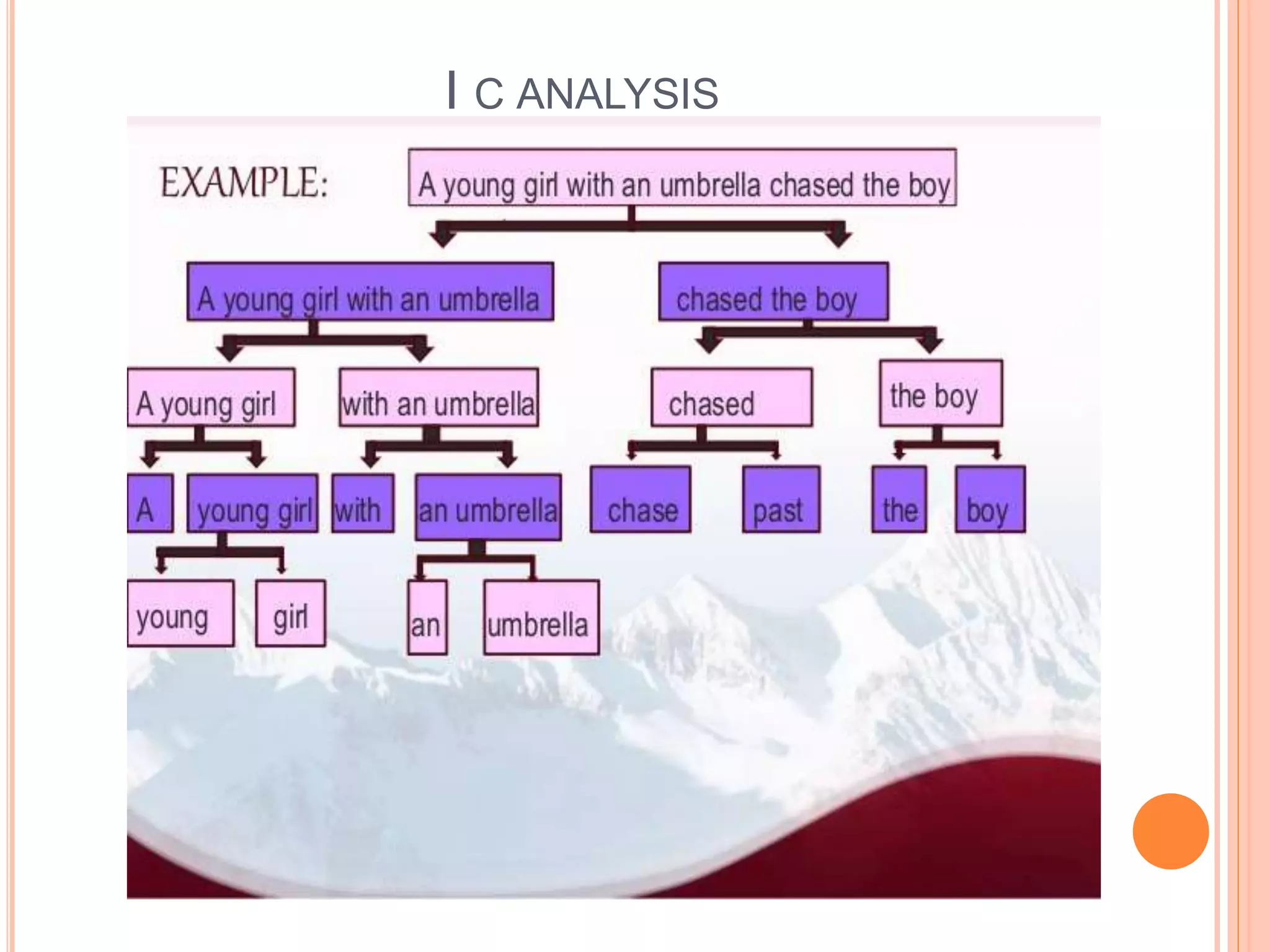
I C ANALYSIS
I C analysis is based on the notion
that a sentence is just not a linear
string of words but a sequence of
components or groups of words.
It is a system of grammatical analysis
that break up sentences into
sequential layers, or constituents.
Constituents consist of only a word or
a meaningful part of word.
CONSTITUTE, CONSTITUENT AND
CONSTRUCTION
 When they are joined by horizontal line , they are
said to be in ‘construction’ with each other .
 The construction establishes relationship between
the constituents.
 The concepts of constitute, constituent and
construction are of immense importance for
analysis.
 Examples:
 Her new hat - constitute
 her, new, hat - constituents
 posessive+ adjective, noun - construction
IMMEDIATE AND ULTIMATE CONSTITUENTS
 The constituents of a constitute are its immediate
constituents. The ultimate constituents (Ucs) are the
constituents which cannot be further analyzed.
 The analysis starts with the whole sentence being
divided into its principal parts: subject and
predicate.( NP+VP) which are further divided into
sub parts. Example:
 He resented her unkind remark.
He + resented her unkind remark
resented + her unkind remark
her + unkind+ remark
He resent+ed she+ poss un+kind +remark
We have eight ultimate constituents .
MODES OF REPRESENTATION
 Poor John
NP
lost his watch
VP
 [s[NPPoor John][VP lost his
watch]]
 S NP-VP
I C ANALYSIS
LABELS
One of the limitation of the I C analysis
it does not indicate the nature and
grammatical function of the
constituent.
This was removed by Mak Haliday by
labeling the constituents: Class labels
and functional labels.
Class labels: NP, VP, Art., Adj, etc.
Functional labels are S, V O
TREE DIAGRAM
Structural description of the sentence “The man will hit the
ball,” assigned by the rules of a simple phrase-structure
grammar.Encyclopædia Britannica, Inc.
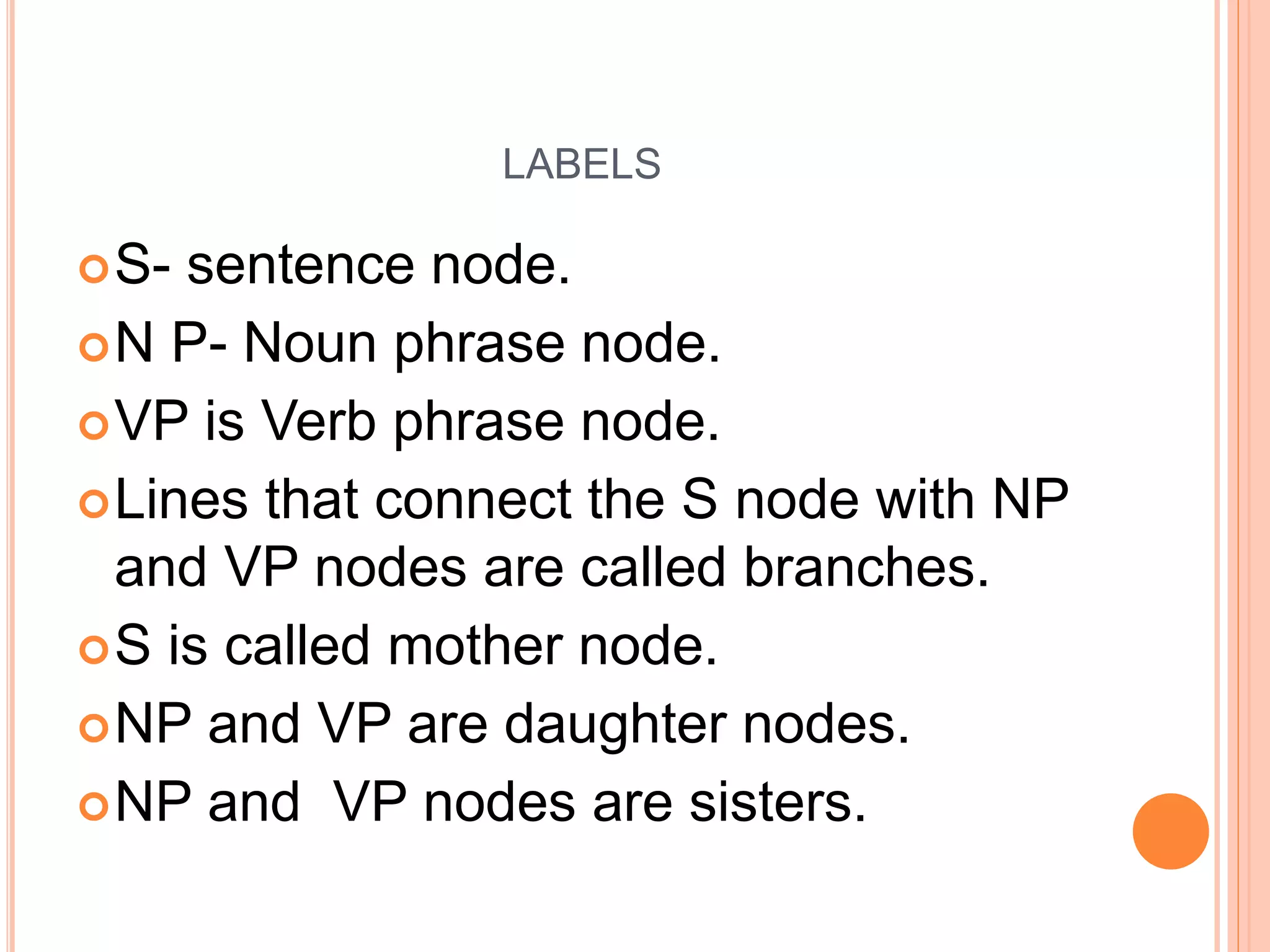
LABELS
S- sentence node.
N P- Noun phrase node.
VP is Verb phrase node.
Lines that connect the S node with NP
and VP nodes are called branches.
S is called mother node.
NP and VP are daughter nodes.
NP and VP nodes are sisters.
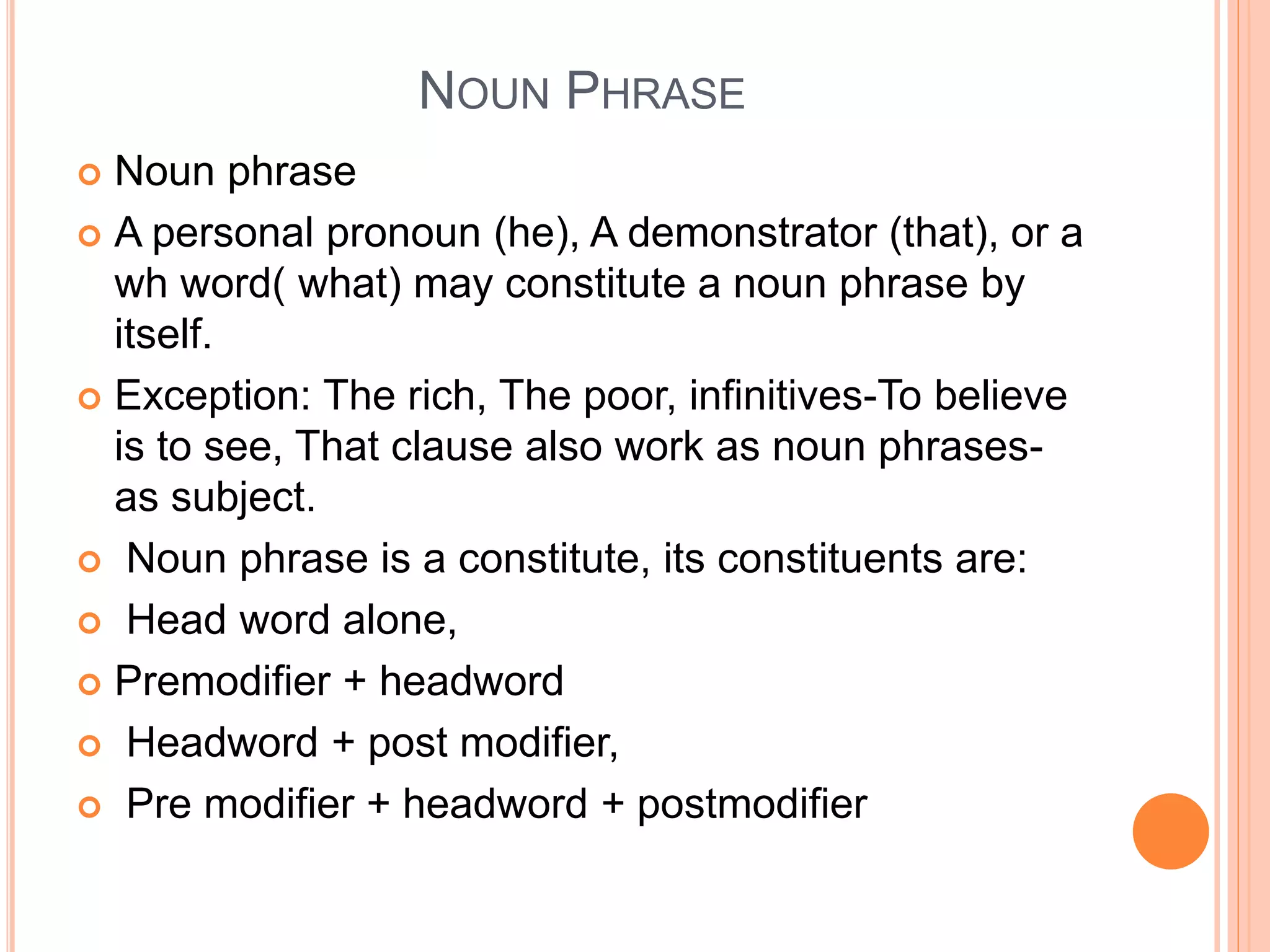
NOUN PHRASE
 Noun phrase
 A personal pronoun (he), A demonstrator (that), or a
wh word( what) may constitute a noun phrase by
itself.
 Exception: The rich, The poor, infinitives-To believe
is to see, That clause also work as noun phrases-
as subject.
 Noun phrase is a constitute, its constituents are:
 Head word alone,
 Premodifier + headword
 Headword + post modifier,
 Pre modifier + headword + postmodifier
DIAGRAMMATIC REPRESENTATION OF A
NOUN PHRASE- PRE MODIFIERS
NP
Pre-determiner determiner ordinal quantifier
 Adj phrase classifier Noun

Intensifier adjective
AMBIGUITY
Some sentences can be ambiguous
For eg.
She took the baby out of the water
and threw it away.
Flying planes can be dangerous.
Syntactic ambiguity, also called
amphiboly or amphibology, is a situation
where a sentence may be interpreted in
more than one way due to ambiguous
sentence structure.
AMBIGUITY
In English grammar, syntactic
ambiguity is the presence of two or
more possible meanings within a
single sentence or sequence of words.
Also called structural
ambiguity or grammatical ambiguity.
Compare with lexical ambiguity (the
presence of two or more possible
meanings within a single word).
SYNTACTICAL/ STRUCTURAL AMBIGUITY
 The intended meaning of a syntactically
ambiguous sentence can often (but not always)
be determined by context.
 Example : The shooting of hunters was terrible.
 It could mean: The way animals were shot by the
hunters.
 The fact that hunters were shot was terrible.
 Passivization removes the ambiguity:
 Syntactic structures and semantics should be
included as an integral part of the grammatical
anlysis of languages.
TYPES OF AMBIGUITY
 In speech and writing, there are two basic
types of ambiguity:
(1) lexical ambiguity (the presence of two
or more possible meanings within a single
word);
(2) syntactic ambiguity (the presence of
two or more possible meanings within a
single sentence or sequence of words). C
analysis can help to account for ambiguity
of certain constructions
THE END

I C Analysis and Ambiguity

  • 1.
    I C ANALYSIS& AMBIGUITY Dr. Abha Pandey
  • 2.
    INTRODUCTION  IC analysisis a method of sentence analysis first mentioned by Leonard Bloomfield and developed further by Rulon Wells.  The process reached a full blown strategy for analyzing sentence structure in the early works of Noam Chomsky. The practice is now widespread.  Most tree structures employed to represent the syntactic structure of sentences are products of some form of IC-analysis.
  • 3.
    I C ANALYSIS IC analysis is based on the notion that a sentence is just not a linear string of words but a sequence of components or groups of words. It is a system of grammatical analysis that break up sentences into sequential layers, or constituents. Constituents consist of only a word or a meaningful part of word.
  • 4.
    CONSTITUTE, CONSTITUENT AND CONSTRUCTION When they are joined by horizontal line , they are said to be in ‘construction’ with each other .  The construction establishes relationship between the constituents.  The concepts of constitute, constituent and construction are of immense importance for analysis.  Examples:  Her new hat - constitute  her, new, hat - constituents  posessive+ adjective, noun - construction
  • 5.
    IMMEDIATE AND ULTIMATECONSTITUENTS  The constituents of a constitute are its immediate constituents. The ultimate constituents (Ucs) are the constituents which cannot be further analyzed.  The analysis starts with the whole sentence being divided into its principal parts: subject and predicate.( NP+VP) which are further divided into sub parts. Example:  He resented her unkind remark. He + resented her unkind remark resented + her unkind remark her + unkind+ remark He resent+ed she+ poss un+kind +remark We have eight ultimate constituents .
  • 6.
    MODES OF REPRESENTATION Poor John NP lost his watch VP  [s[NPPoor John][VP lost his watch]]  S NP-VP
  • 7.
  • 8.
    LABELS One of thelimitation of the I C analysis it does not indicate the nature and grammatical function of the constituent. This was removed by Mak Haliday by labeling the constituents: Class labels and functional labels. Class labels: NP, VP, Art., Adj, etc. Functional labels are S, V O
  • 9.
    TREE DIAGRAM Structural descriptionof the sentence “The man will hit the ball,” assigned by the rules of a simple phrase-structure grammar.Encyclopædia Britannica, Inc.
  • 10.
    LABELS S- sentence node. NP- Noun phrase node. VP is Verb phrase node. Lines that connect the S node with NP and VP nodes are called branches. S is called mother node. NP and VP are daughter nodes. NP and VP nodes are sisters.
  • 11.
    NOUN PHRASE  Nounphrase  A personal pronoun (he), A demonstrator (that), or a wh word( what) may constitute a noun phrase by itself.  Exception: The rich, The poor, infinitives-To believe is to see, That clause also work as noun phrases- as subject.  Noun phrase is a constitute, its constituents are:  Head word alone,  Premodifier + headword  Headword + post modifier,  Pre modifier + headword + postmodifier
  • 12.
    DIAGRAMMATIC REPRESENTATION OFA NOUN PHRASE- PRE MODIFIERS NP Pre-determiner determiner ordinal quantifier  Adj phrase classifier Noun  Intensifier adjective
  • 13.
    AMBIGUITY Some sentences canbe ambiguous For eg. She took the baby out of the water and threw it away. Flying planes can be dangerous. Syntactic ambiguity, also called amphiboly or amphibology, is a situation where a sentence may be interpreted in more than one way due to ambiguous sentence structure.
  • 14.
    AMBIGUITY In English grammar,syntactic ambiguity is the presence of two or more possible meanings within a single sentence or sequence of words. Also called structural ambiguity or grammatical ambiguity. Compare with lexical ambiguity (the presence of two or more possible meanings within a single word).
  • 15.
    SYNTACTICAL/ STRUCTURAL AMBIGUITY The intended meaning of a syntactically ambiguous sentence can often (but not always) be determined by context.  Example : The shooting of hunters was terrible.  It could mean: The way animals were shot by the hunters.  The fact that hunters were shot was terrible.  Passivization removes the ambiguity:  Syntactic structures and semantics should be included as an integral part of the grammatical anlysis of languages.
  • 16.
    TYPES OF AMBIGUITY In speech and writing, there are two basic types of ambiguity: (1) lexical ambiguity (the presence of two or more possible meanings within a single word); (2) syntactic ambiguity (the presence of two or more possible meanings within a single sentence or sequence of words). C analysis can help to account for ambiguity of certain constructions
  • 17.