Dr. Abha Pandey
Chairperson Central Board of
Studies
English Literature
Incorporating Indian
Knowledge System in
the Curricula of English
Literature
Indian Knowledge System
• (NEP) 2020 recognizes Indian knowledge and
thought as a guiding principle.
• NEP has mandated inclusion of (IKS) in
HEI’s.
• Objective: To provide a unique perspective
(Bhāratiya Drishti) to solve the current and
emerging challenges of India and the world
• Rejuvenating and integrating IKS into the
fabric of Education System
Indian Knowledge System
IKS would include a wide range of several
branches:
Astronomy, Ayurveda & Yoga architecture,
Mathematics Languages, Linguistics and
Literature, Rasa-Shastra, Metallurgy, Public
Administration, Philosophy, War Technology,
Management Science, agriculture, engineering,
governance, polity, conservation and many more.
Indian Knowledge System
What is IKS?
Its Nature and Structure
• Jnan, Vignan, and Jeevan Darshan
evolved from experience, observation,
experimentation, and rigorous
analysis.
• IKS is the foundation of the
knowledge power of India.
IKS: Nature and Structure
• IKS is a collective range of Indian
knowledge
• IKS comprises of
• The Vedic literature to the country’s
native and tribal folklore.
• The vast repository of knowledge is
available in Sanskrit, Pali and Prakrit,
and in all native Indian languages.
IKS: Scope and History
• IKS teaches us
• How to inquire?
• In what way? To what extent?
• Fundamental sutras re-orient our
thinking process.
• IKS creates a new worldview that is
rooted in axiomatic faith
• “Vasudhaiva Kutumbakam” and
• Sarve Bhavantu Sukhinah
IKS: Scope and History
• The integration process involves
• The amalgamation of fundamental IKS
concepts into modern textbooks.
• Developing Indian Thought Models based
on available IKS literature and
• their application in contemporary
problems solving methods.
Why IKS: The Need and
Significance
“Every contemporary knowledge stream has a link
with the ancient Indian knowledge tradition”.
Kautilya education shall aim at three outcomes
Vidya, Vivek, Vilakshanta
This requires the integration of Technical
knowledge and life skills
Ancient Indian wisdom has an important role in this
balancing knowledge and value system.
IKS: The Need and Significance
• NEP envisions an education system rooted in
Indian ethos.
• The fundamental principle of inclusion of
IKS is
"a rootedness and pride in India, and its rich,
diverse, ancient and modern culture and
knowledge systems and traditions"
IKS: The Need and Significance
• Education based on outcomes of Western
research
• IKS beneficial in supplementing, enhancing or
even replacing the obligatory systems.
• The practical utility of IKS need to be
highlighted
• Combining traditional wisdom and modern
knowledge required for holistic solutions.
• UGC guidelines for incorporating IKS in HEIs
are inclusive and integrated with an NEP 2020
spirit.
• Guidelines for Incorporating Indian
Knowledge in Higher Education Curricula has
been issued in June 2023.
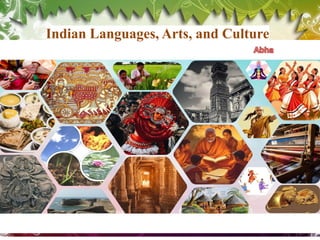
• The IKS policy emphasizes the promotion of
Indian Languages, Arts, and Culture.
• It recognizes that firsthand learners imbibe the
knowledge of the rich diversity of India.
The IKS policy
Indian Languages, Arts, and Culture
Conscious Collaborative Responsible effort
required to Bring the wisdom from the past.
• Integration of IKS into the curricula will
facilitate our students to
• rediscover themselves,
• experiment, refine instruments of
knowledge,
• and equip themselves with perfect
experience to address contemporary
organizations' demands and challenges.
Purpose
• “Language provides light to the life” Dandi
Rishi
• “Language is the foundation of the human
thinking process.” “Thinking is impossible
without language”. Bhartruhari,
• No knowing exists without word. All
knowledge is intertwined with word - the
language.
IL: Indian Languages in Education
• Language education is an integral part of
education system.
• Indian Languages play a very crucial role.
• A judicious balance of IKS and IL education
is required
• for quality research leading to harmonious
economic growth.
IL: Indian Languages in Education
Suggestions made by UGC
10 Appendix Model Curricula of Courses have been
framed.
The curriculum of Foundational Literature of Indian
Civilization seems important to us.
The major topics to be covered in the curricula are
• The Vedic Corpus.
• The Itihasas— Ramayana and Mahabharata,
Guidelines for Incorporating Indian
Knowledge in Higher Education Curricula
• The Puranas..
• Foundational Texts of Indian Philosophies-the
Jaina and Bauddha.
• Foundational Texts of Indian Religious
Sampradayas, from the Vedic period to the
Bhakti traditions
• The Six Vedangas
• Other Streams of Indian Knowledge System:
Foundational Literature of Indian Civilization
▪ Shruti Literature – means ‘to hear’ and describes
the sacred texts which comprise of Vedas,
Brahmanas, Aranyakas, & Upanishads.
▪ Smriti Literature – literally means to be
remembered and may change over time.
• Smriti Literature is the entire body of the post-
Vedic Classical Sanskrit literature and consists of
Vedanga, Shad darsana, Puranas, Itihasa, Upveda,
Tantras, Agamas, Upangas.
Vedic literature
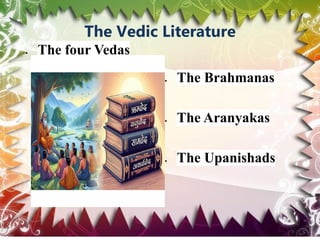
The Vedic Literature
• The four Vedas
• The Brahmanas
• The Aranyakas
• The Upanishads
Vedic Literature
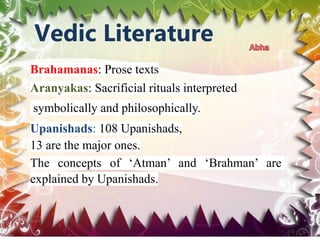
Brahamanas: Prose texts
Aranyakas: Sacrificial rituals interpreted
symbolically and philosophically.
Upanishads: 108 Upanishads,
13 are the major ones.
The concepts of ‘Atman’ and ‘Brahman’ are
explained by Upanishads.
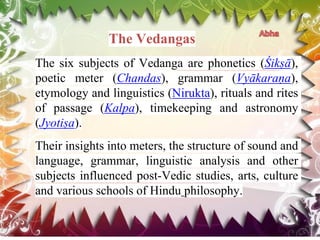
The six subjects of Vedanga are phonetics (Śikṣā),
poetic meter (Chandas), grammar (Vyākaraṇa),
etymology and linguistics (Nirukta), rituals and rites
of passage (Kalpa), timekeeping and astronomy
(Jyotiṣa).
Their insights into meters, the structure of sound and
language, grammar, linguistic analysis and other
subjects influenced post-Vedic studies, arts, culture
and various schools of Hindu philosophy.
The Vedangas
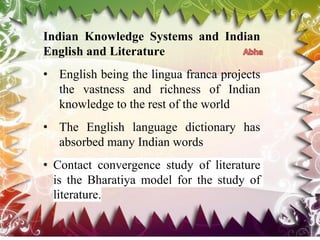
Indian Knowledge Systems and Indian
English and Literature
• English being the lingua franca projects
the vastness and richness of Indian
knowledge to the rest of the world
• The English language dictionary has
absorbed many Indian words
• Contact convergence study of literature
is the Bharatiya model for the study of
literature.
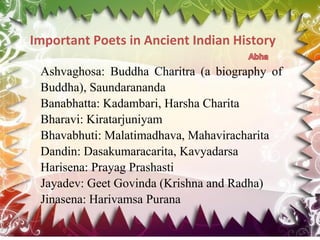
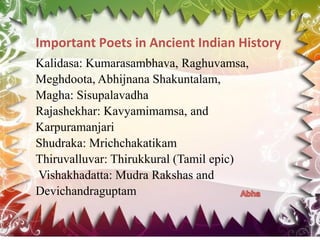
Important Poets in Ancient Indian History
Ashvaghosa: Buddha Charitra (a biography of
Buddha), Saundarananda
Banabhatta: Kadambari, Harsha Charita
Bharavi: Kiratarjuniyam
Bhavabhuti: Malatimadhava, Mahaviracharita
Dandin: Dasakumaracarita, Kavyadarsa
Harisena: Prayag Prashasti
Jayadev: Geet Govinda (Krishna and Radha)
Jinasena: Harivamsa Purana
Kalidasa: Kumarasambhava, Raghuvamsa,
Meghdoota, Abhijnana Shakuntalam,
Magha: Sisupalavadha
Rajashekhar: Kavyamimamsa, and
Karpuramanjari
Shudraka: Mrichchakatikam
Thiruvalluvar: Thirukkural (Tamil epic)
Vishakhadatta: Mudra Rakshas and
Devichandraguptam
Important Poets in Ancient Indian History
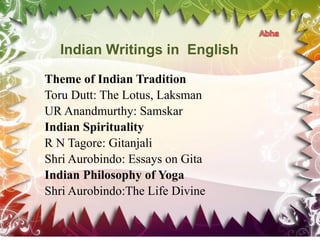
Theme of Indian Tradition
Toru Dutt: The Lotus, Laksman
UR Anandmurthy: Samskar
Indian Spirituality
R N Tagore: Gitanjali
Shri Aurobindo: Essays on Gita
Indian Philosophy of Yoga
Shri Aurobindo:The Life Divine
Indian Writings in English
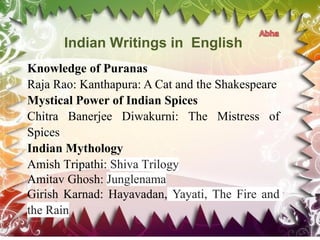
Knowledge of Puranas
Raja Rao: Kanthapura: A Cat and the Shakespeare
Mystical Power of Indian Spices
Chitra Banerjee Diwakurni: The Mistress of
Spices
Indian Mythology
Amish Tripathi: Shiva Trilogy
Amitav Ghosh: Junglenama
Girish Karnad: Hayavadan, Yayati, The Fire and
the Rain
Indian Writings in English
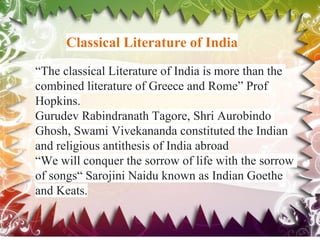
“The classical Literature of India is more than the
combined literature of Greece and Rome” Prof
Hopkins.
Gurudev Rabindranath Tagore, Shri Aurobindo
Ghosh, Swami Vivekananda constituted the Indian
and religious antithesis of India abroad
“We will conquer the sorrow of life with the sorrow
of songs“ Sarojini Naidu known as Indian Goethe
and Keats.
Classical Literature of India
• “Where the mind is without fear and the
head is held high”
• “Go where the tiller is tilling the land”
• Oh God, you are within me and without me.
Oh God, you are above and behind me.
Whatever I have left behind it's not
necessary for me.
Whatever I collect now is useful for me.
Oh God stay with me behind me around me.
Tagore's Mysticism
• R W Emerson
• H W Thoreau
• W B Yeats
• T S Eliot
• Somerset Maugham
• Christopher Isherwood
• J D Salinger
• Albert Ginsberg
• Aldous Huxley
Authors Associated with Vedanta
Philosophy
• Drama is a primary art form in India from
which every other art form emerged.
• It is unique to India to have the first
systematic text on the art of drama and
aesthetics.
• Bharat Muni’s The Rasa theory is the most
fundamental and complete philosophy that
cuts across all disciplines of Arts.
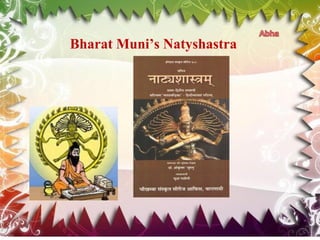
Bharat Muni’s Natyshastra
• Mahabharata The longest epic in the world
Ramayana- equally popular.
India has the largest collections of folk tales
Panchatantra: Most of the famous folk tales
from all over the world
Aesop’s Fables and the Arabian Knights
considered to have been inspired by
Panchatantra and other story collections
from India
Ramayana, Mahabharata, Panctantra
Performative Readings
• Mahasweta Devi: Mother of 1084
Rudali, Draupadi
• Vijay Tendulkar: The Court is in
Session,
• Girish Karnad: Nagamandala
• Manjula Padmanabhan: Lights Out,
Harvest
Indian Language Science
Language Sciences and the preservation of the
Vedic corpus.
Varnamala of Indian languages based on
classification of sounds based on their origin and
effort involved.
The special feature of the scripts of most Indian
languages, is that each symbol is associated with
a unique sound.
Word formation in Sanskrit and Indian languages.
Indian Language Science
Basic purpose of the Science of Vyakarana as
established by Panini.
Important texts of Indian Language Sciences —
Siksha or phonetics,
Nirukta or etymology,
Vyakarana or Grammar,
Chandas or Prosody.
How the Indian Language Sciences continued to
flourish in the 18/19th centuries. Navyanyaya and
Navya-vyakarana in Navadvipa, Varanasi and
West and South India.
Linguistics in India
• Bloomfield comment on Panini’s Ashtadhyayi
“It was one of the greatest monuments of human
intelligence”.
• Panini’s Ashtadhyayi composed in 5th Century
BC is an explicit, rule bound, comprehensive
description of
• spoken language (Bhasha) and the
• compositional language (Vaidiki)
Linguistics in India
• Phonetics was studied in 500 BC in ancient India,
• The major Indic alphabets today order their
consonants according to Pāṇini's classification.
• Shiva Sutras, an auxiliary text to the Ashtadhyayi,
introduces a list of the phonemes of the Sanskrit
language
• A notational system deals with matters of
morphology, syntax and semantics.
• Patanjali wrote the philosophy of grammar of
language in relation to thought (Mahabhashya)
• Barthari has established grammar as a
philosophical doctrine(Vakyapadya)
Linguistics in India
Towards the end
NEP has opened its doors to explore
• the native technique in Indian literature,
• to give a prominent place to Indigenous genres,
and literature
• to make learning interesting, inclusive, holistic,
multicultural, and multilingual in secondary and
higher education.
Last Point
• It is important the teachers first immerse
themselves into what IKS is and its
relevance before they can impart it to
students.
• By imparting IKS, we do not just want to
give data but also change the process in
which education is imparted
• IKS is not about what but how?
Finally
• IKS is not satisfied with discussing Sushruta,
Arybhata, Agastya, but strives to create an
ecosystem that will inspire and give rise to many
more Sushrutas, and Arybhatas.
• Our Indian thought and knowledge offer to
resolve the problems of sustainability of the earth
leading us to a better tomorrow.
• If we concentrate in a dedicated manner, Bharat
can become a true beacon of light to the world - a
true Vishwaguru.
References
• Incorporating Indian Knowledge System in Higher Education
Curriculahttps://www.cessedu.org/blog/incorporating-indian-
knowledge-system-higher-education-curricula#:
• Integration of IKS and ILs in Indian Education through NEP2020
Prof. Shrinivasa Varakhedi Vice Chancellor Central Sanskrit
University, New Delhi e-mail : vc@csu.co.in
https://www.sanskrit.nic.in/uploads/2022_07_06_article.pdf
• IKS in Indian education system : Possibilities and challenges
Subramanian Chidambaran
https://www.linkedin.com/pulse/iks-indian-education-system-
possibilities-challenges-chidambaran-9c4df/