((MarkednessMarkedness))
Marked orMarked or
Unmarked formsUnmarked forms
MarkednessMarkedness
A relationship betweenA relationship between
linguistic elements in whichlinguistic elements in which
one element is moreone element is more
distinctivelydistinctively markedmarked thanthan
anotheranother unmarkedunmarked element.element.
Whats Markedness?Whats Markedness?
That is a contrast between two orThat is a contrast between two or
more members of a category such asmore members of a category such as
numbernumber,, casecase, or, or tensetense, one of them is, one of them is
called 'called 'markedmarked' if it contains some' if it contains some
extraextra affixaffix, as opposed to the, as opposed to the
''unmarkedunmarked' member which does not.' member which does not.
Marked can mean...Marked can mean...
 Indicated by a morphological marker, e.g. Eng. PluralIndicated by a morphological marker, e.g. Eng. Plural
-s-s, as opposed to the "unmarked" singular, as opposed to the "unmarked" singular
 semantically/functionally more specific (or moresemantically/functionally more specific (or more
complex) .Inherently more difficult for humans tocomplex) .Inherently more difficult for humans to
process (or learn, or produce).process (or learn, or produce).
 Irregular/abnormal as opposed to the "unmarked"Irregular/abnormal as opposed to the "unmarked"
regular forms/patterns.regular forms/patterns.
 phonetic/phonological: vowel (unmarked) vs. nasalphonetic/phonological: vowel (unmarked) vs. nasal
vowel (marked)vowel (marked)
Semantic MarkednessSemantic Markedness
MarkednessMarkedness also applies inalso applies in semanticssemantics,,
that’s calledthat’s called semantic markingsemantic marking. In a neutral. In a neutral
context the unmarked term in a pair iscontext the unmarked term in a pair is
used. Thus of the pairused. Thus of the pair oldold versusversus youngyoung,, oldold
is the unmarked term (e.g.is the unmarked term (e.g. How old is theHow old is the
baby ?baby ?
The termThe term markednessmarkedness refers to therefers to the
relationship between the two polesrelationship between the two poles
of an opposition; the termsof an opposition; the terms
markedmarked andand unmarkedunmarked refer to therefer to the
evaluation of the poles; theevaluation of the poles; the
simpler more general pole is thesimpler more general pole is the
unmarked term of the oppositionunmarked term of the opposition
while the more complex andwhile the more complex and
focused pole is the marked term.focused pole is the marked term.
In linguistics,In linguistics, markednessmarkedness refers to the wayrefers to the way
words are changed or added to give awords are changed or added to give a
special meaning. Thespecial meaning. The unmarked choiceunmarked choice isis
just the normal meaning. For example, thejust the normal meaning. For example, the
present tense is unmarked for Englishpresent tense is unmarked for English
verbs. If I just say "walk" that refers toverbs. If I just say "walk" that refers to
the present tense. But if we add somethingthe present tense. But if we add something
to "walk" (marking it), such as addingto "walk" (marking it), such as adding
‘ed’ to the end, I can indicate the past:‘ed’ to the end, I can indicate the past:
"walked"."walked".
MARKED AND UNMARKED TERMSMARKED AND UNMARKED TERMS : Terms in: Terms in
LINGUISTICSLINGUISTICS which designate a contrasting pair,which designate a contrasting pair,
one possessing a special ‘mark’, the other neutral.one possessing a special ‘mark’, the other neutral.
InIn play/playedplay/played,, playplay is unmarked and neutral, andis unmarked and neutral, and
playedplayed has the markhas the mark -ed-ed. Similarly,. Similarly, hosthost is unmarked,is unmarked,
butbut hostesshostess is morphologically marked for femaleness.is morphologically marked for femaleness.
The mark is not necessarily visible or audible: in theThe mark is not necessarily visible or audible: in the
pairpair horse/mulehorse/mule, horse is the more general, unmarked, horse is the more general, unmarked
term, whileterm, while mulemule is marked for femaleness. In the pairis marked for femaleness. In the pair
cow/bullcow/bull, cow is unmarked, while, cow is unmarked, while bullbull is marked foris marked for
maleness.maleness.
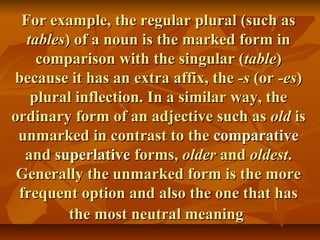
For example, the regular plural (such asFor example, the regular plural (such as
tablestables) of a noun is the marked form in) of a noun is the marked form in
comparison with the singular (comparison with the singular (tabletable))
because it has an extra affix, thebecause it has an extra affix, the -s-s (or(or -es-es))
plural inflection. In a similar way, theplural inflection. In a similar way, the
ordinary form of an adjective such asordinary form of an adjective such as oldold isis
unmarked in contrast to theunmarked in contrast to the comparativecomparative
andand superlativesuperlative forms,forms, olderolder andand oldestoldest..
Generally the unmarked form is the moreGenerally the unmarked form is the more
frequent option and also the one that hasfrequent option and also the one that has
the most neutral meaningthe most neutral meaning
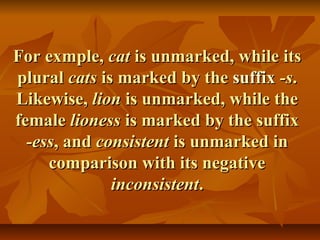
For exmple,For exmple, catcat is unmarked, while itsis unmarked, while its
pluralplural catscats is marked by theis marked by the suffixsuffix -s-s..
Likewise,Likewise, lionlion is unmarked, while theis unmarked, while the
femalefemale lionesslioness is marked by the suffixis marked by the suffix
-ess-ess, and, and consistentconsistent is unmarked inis unmarked in
comparison with its negativecomparison with its negative
inconsistentinconsistent..
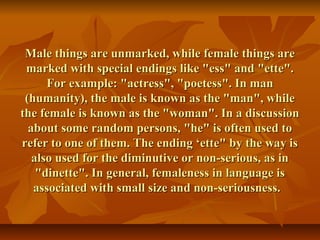
Male things are unmarked, while female things areMale things are unmarked, while female things are
marked with special endings like "ess" and "ette".marked with special endings like "ess" and "ette".
For example: "actress", "poetess". In manFor example: "actress", "poetess". In man
(humanity), the male is known as the "man", while(humanity), the male is known as the "man", while
the female is known as the "woman". In a discussionthe female is known as the "woman". In a discussion
about some random persons, "he" is often used toabout some random persons, "he" is often used to
refer to one of them. The ending ‘ette" by the way isrefer to one of them. The ending ‘ette" by the way is
also used for the diminutive or non-serious, as inalso used for the diminutive or non-serious, as in
"dinette". In general, femaleness in language is"dinette". In general, femaleness in language is
associated with small size and non-seriousness.associated with small size and non-seriousness.
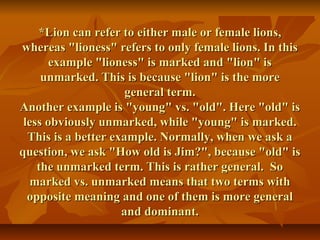
*Lion can refer to either male or female lions,*Lion can refer to either male or female lions,
whereas "lioness" refers to only female lions. In thiswhereas "lioness" refers to only female lions. In this
example "lioness" is marked and "lion" isexample "lioness" is marked and "lion" is
unmarked. This is because "lion" is the moreunmarked. This is because "lion" is the more
general term.general term.
Another example is "young" vs. "old". Here "old" isAnother example is "young" vs. "old". Here "old" is
less obviously unmarked, while "young" is marked.less obviously unmarked, while "young" is marked.
This is a better example. Normally, when we ask aThis is a better example. Normally, when we ask a
question, we ask "How old is Jim?", because "old" isquestion, we ask "How old is Jim?", because "old" is
the unmarked term. This is rather general. Sothe unmarked term. This is rather general. So
marked vs. unmarked means that two terms withmarked vs. unmarked means that two terms with
opposite meaning and one of them is more generalopposite meaning and one of them is more general
and dominant.and dominant.
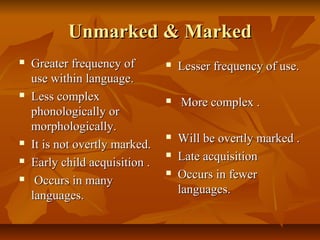
Unmarked & MarkedUnmarked & Marked
 Greater frequency ofGreater frequency of
use within language.use within language.
 Less complexLess complex
phonologically orphonologically or
morphologically.morphologically.
 It is not overtly marked.It is not overtly marked.
 Early child acquisition .Early child acquisition .
 Occurs in manyOccurs in many
languages.languages.
 Lesser frequency of use.Lesser frequency of use.
 More complex .More complex .
 Will be overtly marked .Will be overtly marked .
 Late acquisitionLate acquisition
 Occurs in fewerOccurs in fewer
languages.languages.
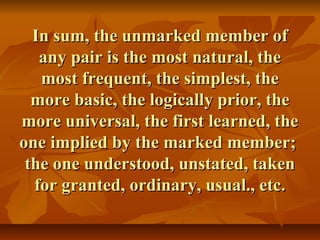
In sum, the unmarked member ofIn sum, the unmarked member of
any pair is the most natural, theany pair is the most natural, the
most frequent, the simplest, themost frequent, the simplest, the
more basic, the logically prior, themore basic, the logically prior, the
more universal, the first learned, themore universal, the first learned, the
one implied by the marked member;one implied by the marked member;
the one understood, unstated, takenthe one understood, unstated, taken
for granted, ordinary, usual., etc.for granted, ordinary, usual., etc.

Markedness

  • 1.
  • 2.
    MarkednessMarkedness A relationship betweenArelationship between linguistic elements in whichlinguistic elements in which one element is moreone element is more distinctivelydistinctively markedmarked thanthan anotheranother unmarkedunmarked element.element.
  • 3.
    Whats Markedness?Whats Markedness? Thatis a contrast between two orThat is a contrast between two or more members of a category such asmore members of a category such as numbernumber,, casecase, or, or tensetense, one of them is, one of them is called 'called 'markedmarked' if it contains some' if it contains some extraextra affixaffix, as opposed to the, as opposed to the ''unmarkedunmarked' member which does not.' member which does not.
  • 4.
    Marked can mean...Markedcan mean...  Indicated by a morphological marker, e.g. Eng. PluralIndicated by a morphological marker, e.g. Eng. Plural -s-s, as opposed to the "unmarked" singular, as opposed to the "unmarked" singular  semantically/functionally more specific (or moresemantically/functionally more specific (or more complex) .Inherently more difficult for humans tocomplex) .Inherently more difficult for humans to process (or learn, or produce).process (or learn, or produce).  Irregular/abnormal as opposed to the "unmarked"Irregular/abnormal as opposed to the "unmarked" regular forms/patterns.regular forms/patterns.  phonetic/phonological: vowel (unmarked) vs. nasalphonetic/phonological: vowel (unmarked) vs. nasal vowel (marked)vowel (marked)
  • 5.
    Semantic MarkednessSemantic Markedness MarkednessMarkednessalso applies inalso applies in semanticssemantics,, that’s calledthat’s called semantic markingsemantic marking. In a neutral. In a neutral context the unmarked term in a pair iscontext the unmarked term in a pair is used. Thus of the pairused. Thus of the pair oldold versusversus youngyoung,, oldold is the unmarked term (e.g.is the unmarked term (e.g. How old is theHow old is the baby ?baby ?
  • 6.
    The termThe termmarkednessmarkedness refers to therefers to the relationship between the two polesrelationship between the two poles of an opposition; the termsof an opposition; the terms markedmarked andand unmarkedunmarked refer to therefer to the evaluation of the poles; theevaluation of the poles; the simpler more general pole is thesimpler more general pole is the unmarked term of the oppositionunmarked term of the opposition while the more complex andwhile the more complex and focused pole is the marked term.focused pole is the marked term.
  • 7.
    In linguistics,In linguistics,markednessmarkedness refers to the wayrefers to the way words are changed or added to give awords are changed or added to give a special meaning. Thespecial meaning. The unmarked choiceunmarked choice isis just the normal meaning. For example, thejust the normal meaning. For example, the present tense is unmarked for Englishpresent tense is unmarked for English verbs. If I just say "walk" that refers toverbs. If I just say "walk" that refers to the present tense. But if we add somethingthe present tense. But if we add something to "walk" (marking it), such as addingto "walk" (marking it), such as adding ‘ed’ to the end, I can indicate the past:‘ed’ to the end, I can indicate the past: "walked"."walked".
  • 8.
    MARKED AND UNMARKEDTERMSMARKED AND UNMARKED TERMS : Terms in: Terms in LINGUISTICSLINGUISTICS which designate a contrasting pair,which designate a contrasting pair, one possessing a special ‘mark’, the other neutral.one possessing a special ‘mark’, the other neutral. InIn play/playedplay/played,, playplay is unmarked and neutral, andis unmarked and neutral, and playedplayed has the markhas the mark -ed-ed. Similarly,. Similarly, hosthost is unmarked,is unmarked, butbut hostesshostess is morphologically marked for femaleness.is morphologically marked for femaleness. The mark is not necessarily visible or audible: in theThe mark is not necessarily visible or audible: in the pairpair horse/mulehorse/mule, horse is the more general, unmarked, horse is the more general, unmarked term, whileterm, while mulemule is marked for femaleness. In the pairis marked for femaleness. In the pair cow/bullcow/bull, cow is unmarked, while, cow is unmarked, while bullbull is marked foris marked for maleness.maleness.
  • 9.
    For example, theregular plural (such asFor example, the regular plural (such as tablestables) of a noun is the marked form in) of a noun is the marked form in comparison with the singular (comparison with the singular (tabletable)) because it has an extra affix, thebecause it has an extra affix, the -s-s (or(or -es-es)) plural inflection. In a similar way, theplural inflection. In a similar way, the ordinary form of an adjective such asordinary form of an adjective such as oldold isis unmarked in contrast to theunmarked in contrast to the comparativecomparative andand superlativesuperlative forms,forms, olderolder andand oldestoldest.. Generally the unmarked form is the moreGenerally the unmarked form is the more frequent option and also the one that hasfrequent option and also the one that has the most neutral meaningthe most neutral meaning
  • 10.
    For exmple,For exmple,catcat is unmarked, while itsis unmarked, while its pluralplural catscats is marked by theis marked by the suffixsuffix -s-s.. Likewise,Likewise, lionlion is unmarked, while theis unmarked, while the femalefemale lionesslioness is marked by the suffixis marked by the suffix -ess-ess, and, and consistentconsistent is unmarked inis unmarked in comparison with its negativecomparison with its negative inconsistentinconsistent..
  • 11.
    Male things areunmarked, while female things areMale things are unmarked, while female things are marked with special endings like "ess" and "ette".marked with special endings like "ess" and "ette". For example: "actress", "poetess". In manFor example: "actress", "poetess". In man (humanity), the male is known as the "man", while(humanity), the male is known as the "man", while the female is known as the "woman". In a discussionthe female is known as the "woman". In a discussion about some random persons, "he" is often used toabout some random persons, "he" is often used to refer to one of them. The ending ‘ette" by the way isrefer to one of them. The ending ‘ette" by the way is also used for the diminutive or non-serious, as inalso used for the diminutive or non-serious, as in "dinette". In general, femaleness in language is"dinette". In general, femaleness in language is associated with small size and non-seriousness.associated with small size and non-seriousness.
  • 12.
    *Lion can referto either male or female lions,*Lion can refer to either male or female lions, whereas "lioness" refers to only female lions. In thiswhereas "lioness" refers to only female lions. In this example "lioness" is marked and "lion" isexample "lioness" is marked and "lion" is unmarked. This is because "lion" is the moreunmarked. This is because "lion" is the more general term.general term. Another example is "young" vs. "old". Here "old" isAnother example is "young" vs. "old". Here "old" is less obviously unmarked, while "young" is marked.less obviously unmarked, while "young" is marked. This is a better example. Normally, when we ask aThis is a better example. Normally, when we ask a question, we ask "How old is Jim?", because "old" isquestion, we ask "How old is Jim?", because "old" is the unmarked term. This is rather general. Sothe unmarked term. This is rather general. So marked vs. unmarked means that two terms withmarked vs. unmarked means that two terms with opposite meaning and one of them is more generalopposite meaning and one of them is more general and dominant.and dominant.
  • 13.
    Unmarked & MarkedUnmarked& Marked  Greater frequency ofGreater frequency of use within language.use within language.  Less complexLess complex phonologically orphonologically or morphologically.morphologically.  It is not overtly marked.It is not overtly marked.  Early child acquisition .Early child acquisition .  Occurs in manyOccurs in many languages.languages.  Lesser frequency of use.Lesser frequency of use.  More complex .More complex .  Will be overtly marked .Will be overtly marked .  Late acquisitionLate acquisition  Occurs in fewerOccurs in fewer languages.languages.
  • 14.
    In sum, theunmarked member ofIn sum, the unmarked member of any pair is the most natural, theany pair is the most natural, the most frequent, the simplest, themost frequent, the simplest, the more basic, the logically prior, themore basic, the logically prior, the more universal, the first learned, themore universal, the first learned, the one implied by the marked member;one implied by the marked member; the one understood, unstated, takenthe one understood, unstated, taken for granted, ordinary, usual., etc.for granted, ordinary, usual., etc.