
MODERN ENGLISH GRAMMAR AND
USAGE
Verbal, Noun Phrase and Relationals
Dr. Abha Pandey
Ppt prepared for pre Ph.D Course 2014-15
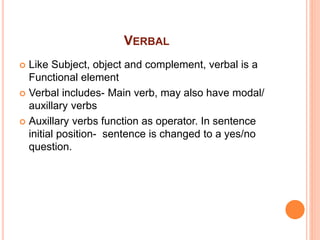
VERBAL
 Like Subject, object and complement, verbal is a
Functional element
 Verbal includes- Main verb, may also have modal/
auxillary verbs
 Auxillary verbs function as operator. In sentence
initial position- sentence is changed to a yes/no
question.
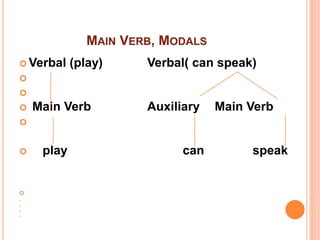
MAIN VERB, MODALS
 Verbal (play) Verbal( can speak)


 Main Verb Auxiliary Main Verb

 play can speak





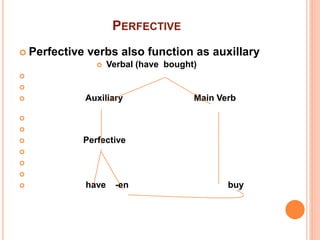
PERFECTIVE
 Perfective verbs also function as auxillary
 Verbal (have bought)


 Auxiliary Main Verb


 Perfective



 have -en buy
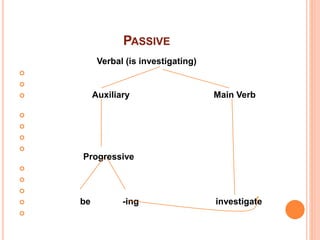
PASSIVE
Verbal (is investigating)


 Auxiliary Main Verb




Progressive



 be -ing investigate

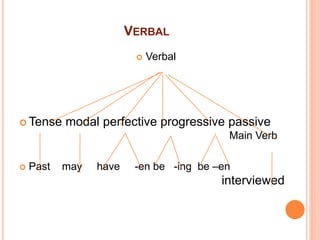
VERBAL
 Verbal
 Tense modal perfective progressive passive
Main Verb
 Past may have -en be -ing be –en
interviewed
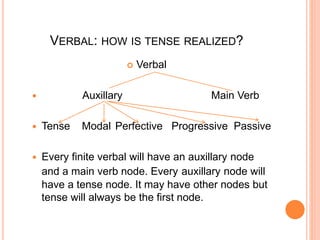
VERBAL: HOW IS TENSE REALIZED?
 Verbal
 Auxillary Main Verb
 Tense Modal Perfective Progressive Passive
 Every finite verbal will have an auxillary node
and a main verb node. Every auxillary node will
have a tense node. It may have other nodes but
tense will always be the first node.
BE HAVE AND DO : PRIMARY VERBS
 Be and have can be used as main verbs.
 She is my daughter
 Have has a stative meaning- possession and
relationship and a dynamic meaning – experience
 a). He has a car. Has he a car?
 ‘have’ functions as an operator.
 b). He had tea with biscuits. Did he have….?
 ‘have’ does not function as an operator.
 It needs a do support or do insertion.
 All other main verbs also require do as an empty or
dummy operator
 Do can also function as as main verb
 She has done the assignment
THE NOUN PHRASE: FUNCTIONS AND FORM
 Noun phrase is a formal label, like verbal,
adjective and adverb phrase.
 Functional labels: subject, object
(direct/indirect) subject complement, object
complement and adjunct depending on its
function in a sentence.
 Form: Noun phrase is a group of words with
a noun as a head, with and without any
words before of after the head. A noun
phrase must have a noun and may or may
not have pre/post modifiers
NOUN PHRASE
 A personal pronoun (he), A demonstrator (that),
or a wh word( what) may constitute a noun
phrase by itself.
 Exception: The rich, The poor, infinitives-To
believe is to see, That clause also work as
noun phrases- as subject.
 Noun phrase is a constitute, its constituents
are:
 Head word alone,
 Premodifier + headword
 Headword + post modifier,
 Pre modifier + headword + postmodifier
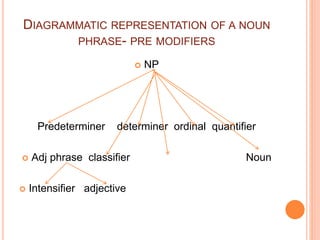
DIAGRAMMATIC REPRESENTATION OF A NOUN
PHRASE- PRE MODIFIERS
 NP
Predeterminer determiner ordinal quantifier
 Adj phrase classifier Noun
 Intensifier adjective
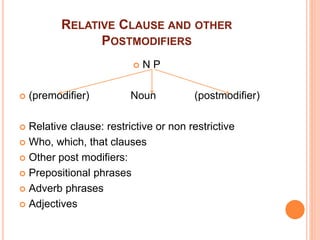
RELATIVE CLAUSE AND OTHER
POSTMODIFIERS
 N P
 (premodifier) Noun (postmodifier)
 Relative clause: restrictive or non restrictive
 Who, which, that clauses
 Other post modifiers:
 Prepositional phrases
 Adverb phrases
 Adjectives
THANK YOU

Verbal, Noun Phrase and Relationals

  • 1.
    MODERN ENGLISH GRAMMARAND USAGE Verbal, Noun Phrase and Relationals Dr. Abha Pandey Ppt prepared for pre Ph.D Course 2014-15
  • 2.
    VERBAL  Like Subject,object and complement, verbal is a Functional element  Verbal includes- Main verb, may also have modal/ auxillary verbs  Auxillary verbs function as operator. In sentence initial position- sentence is changed to a yes/no question.
  • 3.
    MAIN VERB, MODALS Verbal (play) Verbal( can speak)    Main Verb Auxiliary Main Verb   play can speak     
  • 4.
    PERFECTIVE  Perfective verbsalso function as auxillary  Verbal (have bought)    Auxiliary Main Verb    Perfective     have -en buy
  • 5.
    PASSIVE Verbal (is investigating)   Auxiliary Main Verb     Progressive     be -ing investigate 
  • 6.
    VERBAL  Verbal  Tensemodal perfective progressive passive Main Verb  Past may have -en be -ing be –en interviewed
  • 7.
    VERBAL: HOW ISTENSE REALIZED?  Verbal  Auxillary Main Verb  Tense Modal Perfective Progressive Passive  Every finite verbal will have an auxillary node and a main verb node. Every auxillary node will have a tense node. It may have other nodes but tense will always be the first node.
  • 8.
    BE HAVE ANDDO : PRIMARY VERBS  Be and have can be used as main verbs.  She is my daughter  Have has a stative meaning- possession and relationship and a dynamic meaning – experience  a). He has a car. Has he a car?  ‘have’ functions as an operator.  b). He had tea with biscuits. Did he have….?  ‘have’ does not function as an operator.  It needs a do support or do insertion.  All other main verbs also require do as an empty or dummy operator  Do can also function as as main verb  She has done the assignment
  • 9.
    THE NOUN PHRASE:FUNCTIONS AND FORM  Noun phrase is a formal label, like verbal, adjective and adverb phrase.  Functional labels: subject, object (direct/indirect) subject complement, object complement and adjunct depending on its function in a sentence.  Form: Noun phrase is a group of words with a noun as a head, with and without any words before of after the head. A noun phrase must have a noun and may or may not have pre/post modifiers
  • 10.
    NOUN PHRASE  Apersonal pronoun (he), A demonstrator (that), or a wh word( what) may constitute a noun phrase by itself.  Exception: The rich, The poor, infinitives-To believe is to see, That clause also work as noun phrases- as subject.  Noun phrase is a constitute, its constituents are:  Head word alone,  Premodifier + headword  Headword + post modifier,  Pre modifier + headword + postmodifier
  • 11.
    DIAGRAMMATIC REPRESENTATION OFA NOUN PHRASE- PRE MODIFIERS  NP Predeterminer determiner ordinal quantifier  Adj phrase classifier Noun  Intensifier adjective
  • 12.
    RELATIVE CLAUSE ANDOTHER POSTMODIFIERS  N P  (premodifier) Noun (postmodifier)  Relative clause: restrictive or non restrictive  Who, which, that clauses  Other post modifiers:  Prepositional phrases  Adverb phrases  Adjectives
  • 13.