
THE SENTENCE AND THE UTTERANCE   The sentence. Different approaches to the study of the sentence.   The utterance. Informative structure of the utterance.   Functional typology of utterances.
The sentence is the central syntactic construction used as the minimal communicative unit  has its primary predication,  actualises a definite structural scheme  possesses definite intonation characteristics.
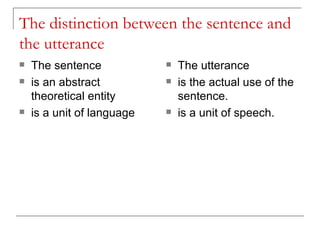
The distinction between the sentence and the utterance The sentence  is an abstract theoretical entity  is a unit of language  The utterance  is the actual use of the sentence.  is a unit of speech.
The most essential features of the sentence as a linguistic unit are a) its  structural  characteristics – subject-predicate relations (primary predication),  b) its  semantic  characteristics – it refers to some fact in the objective reality.
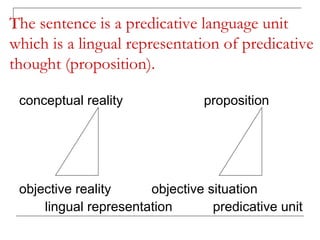
The sentence is a predicative language unit which is a lingual representation of predicative thought (proposition).   conceptual reality  proposition objective reality  objective situation  lingual representation  predicative unit
 
Principal and secondary parts of the sentence   Depending on the number of predicative lines (the predicative connection between the Subject and the Predicate) sentences may be monopredicative and  polypredicative.
A simple sentence is a sentence with one predicative line.  All simple sentences are divided into  two-axis constructions and  one-axis constructions.
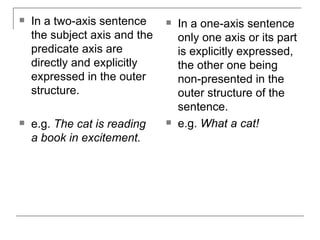
In a two-axis sentence the subject axis and the predicate axis are directly and explicitly expressed in the outer structure.  e.g.  The cat is reading a book in excitement. In a one-axis sentence only one axis or its part is explicitly expressed, the other one being non-presented in the outer structure of the sentence.  e.g.  What a cat!
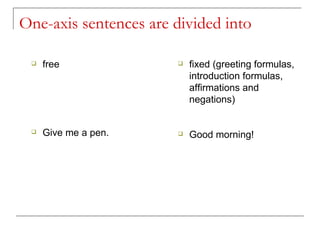
One-axis sentences are divided into  free Give me a pen. fixed (greeting formulas, introduction formulas, affirmations and negations) Good morning!
The semantic classification of simple sentences should be effected on the basis of: subject categorial meanings; predicate categorial meanings; subject-object relation.
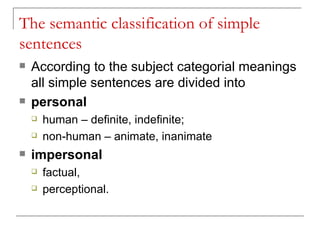
The semantic classification of simple sentences According to the subject categorial meanings all simple sentences are divided into  personal   human – definite, indefinite;  non-human – animate, inanimate impersonal   factual,  perceptional.
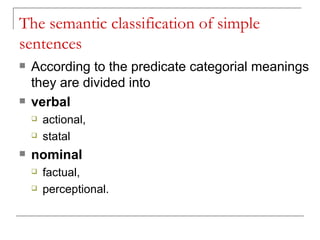
The semantic classification of simple sentences According to the predicate categorial meanings they are divided into  verbal  actional,  statal nominal   factual,  perceptional.
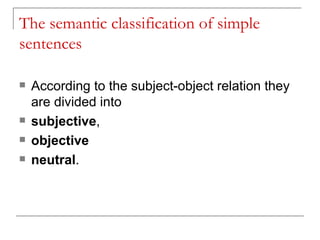
The semantic classification of simple sentences According to the subject-object relation they are divided into  subjective ,  objective   neutral .
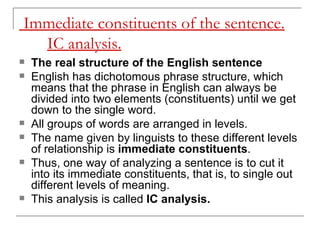
Immediate constituents of the sentence. IC analysis.   The real structure of the English sentence   English has dichotomous phrase structure, which means that the phrase in English can always be divided into two elements (constituents) until we get down to the single word.  All groups of words are arranged in levels.  The name given by linguists to these different levels of relationship is  immediate constituents . Thus, one way of analyzing a sentence is to cut it into its immediate constituents, that is, to single out different levels of meaning.  This analysis is called  IC analysis.
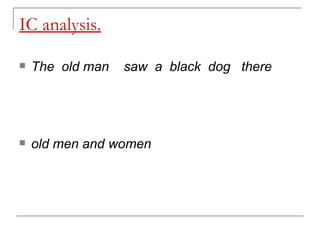
IC analysis. The  old man  saw  a  black  dog  there   old men and women
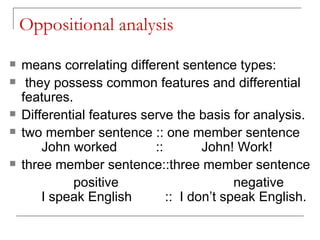
Oppositional analysis   means correlating different sentence types: they possess common features and differential features.  Differential features serve the basis for analysis.   two member sentence :: one member sentence  John worked   ::  John! Work!  three member sentence::three member sentence positive  negative I speak English  ::  I don’t speak English.
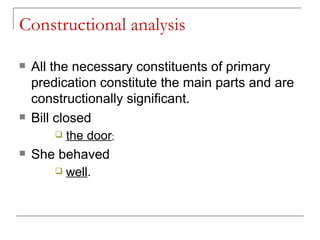
Constructional analysis   All the necessary constituents of primary predication constitute the main parts and are constructionally significant.   Bill closed  the door ;  She behaved  well .
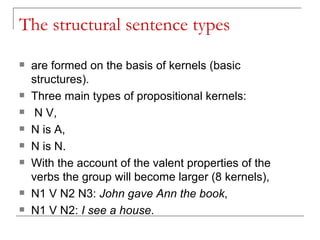
The structural sentence types are formed on the basis of kernels (basic structures).  Three main types of propositional kernels: N V,  N is A,  N is N.  With the account of the valent properties of the verbs the group will become larger (8 kernels),  N1 V N2 N3:  John gave Ann the book ,  N1 V N2:  I see a house .
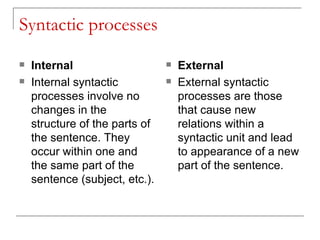
Syntactic processes Internal   Internal syntactic processes involve no changes in the structure of the parts of the sentence. They occur within one and the same part of the sentence (subject, etc.).  External External syntactic processes are those that cause new relations within a syntactic unit and lead to appearance of a new part of the sentence.
The internal syntactic processes are: Expansion   The phone was ringing  and ringing Compression  They  were laughing and singing Complication  (a synt. unit becomes complicated)  I have seen it – I  could  have seen it  Contamination  (two parts of the sentence are joined together – e.g. double predicate)  The moon  rose red
The internal syntactic processes are: Replacement  – the use of the words that have a generalized meaning:  one, do,  etc,  I’d like to take this  one . Representation  – a part of the syntactic unit represents the whole syntactic unit:  Would you like to come along? I’d love  to . Ellipsis  –  Where are you going?  To the movies .
The external syntactic processes are: Extension  -  a nice dress – a nice  cotton  dress. Ajoinment -  the use of specifying words, most often particles:  He did it –  Only  he did it. Enclosure   –  inserting modal words and other discourse markers:  after all, anyway, naturally,  etc.
The utterance.  The utterance as opposed to the sentence is the unit of speech.  The main categories of the utterance from the point of view of its informative structure are considered to be  the theme  and  the rheme . They are the main components of the Functional Sentence Perspective (FSP) – actual division of the utterance.
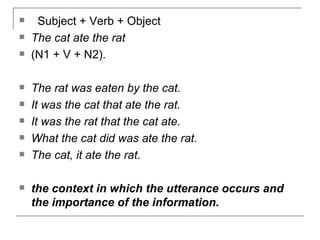
Subject + Verb + Object  The cat ate the rat  (N1 + V + N2).  The rat was eaten by the cat. It was the cat that ate the rat. It was the rat that the cat ate. What the cat did was ate the rat. The cat, it ate the rat. the context in which the utterance occurs and the importance of the information.
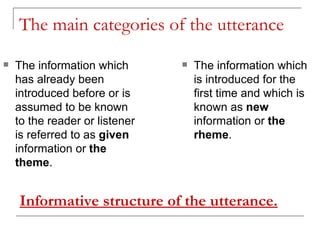
The main categories of the utterance The information which has already been introduced before or is assumed to be known to the reader or listener is referred to as  given  information or  the theme .  The information which is introduced for the first time and which is known as  new  information or  the rheme . Informative structure of the utterance.
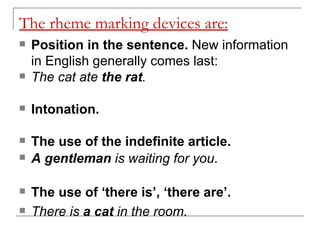
The rheme marking devices are: Position in the sentence.  New information in English generally comes last:  The cat ate  the rat .   Intonation. The use of the indefinite article.   A gentleman  is waiting for you . The use of ‘there is’, ‘there are’.   There is  a cat  in the room.
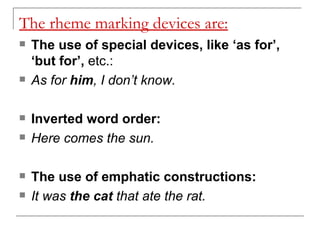
The rheme marking devices are: The use of special devices, like ‘as for’, ‘but for’,  etc.:  As for  him , I don’t know. Inverted word order:   Here comes the sun. The use of emphatic constructions:   It was  the cat  that ate the rat.
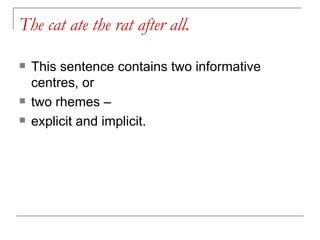
The cat ate the rat after all. This sentence contains two informative centres, or  two rhemes –  explicit and implicit.
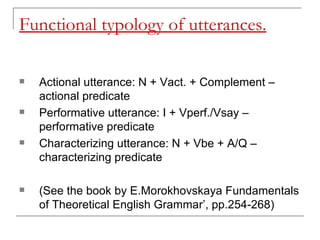
Functional typology of utterances. Actional utterance: N + Vact. + Complement – actional predicate Performative utterance: I + Vperf./Vsay – performative predicate Characterizing utterance: N + Vbe + A/Q – characterizing predicate (See the book by E.Morokhovskaya Fundamentals of Theoretical English Grammar’, pp.254-268)
THE TEXT, TEXTLINGUISTICS   Text as a syntactic unit.   The notion of coherence. The notion of cohesion. Text connecting devices.   Textual deictic markers.
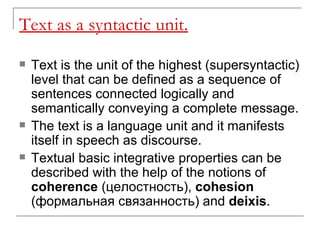
Text as a syntactic unit. Text is the unit of the highest (supersyntactic) level that can be defined as a sequence of sentences connected logically and semantically conveying a complete message.  The text is a language unit and it manifests itself in speech as discourse.  Textual basic integrative properties can be described with the help of the notions of  coherence  ( ц е лостность ),  cohesion  ( формальная связанность)  and  deixis .
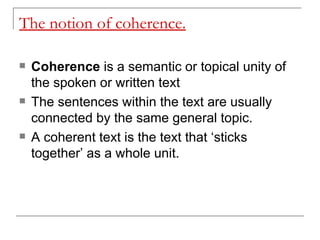
The notion of coherence. Coherence  is a semantic or topical unity of the spoken or written text  The sentences within the text are usually connected by the same general topic. A coherent text is the text that ‘sticks together’ as a whole unit.
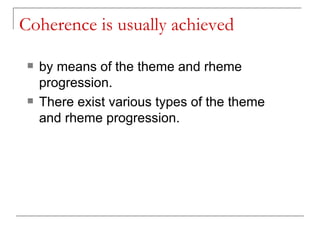
Coherence is usually achieved by means of the theme and rheme progression. There exist various types of the theme and rheme progression .
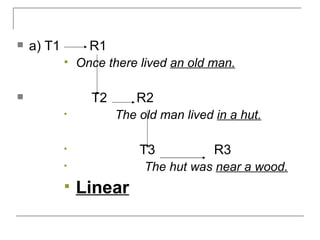
a)   T1  R1  Once there lived  an old man. T2  R2  The old man lived  in a hut. T3  R3  The hut was  near a wood. Linear
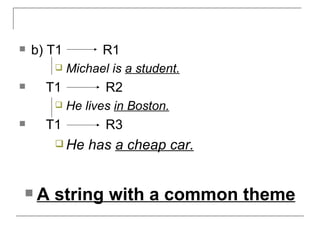
b) T1  R1  Michael is  a student. T1  R2  He lives  in Boston. T1  R3  He has  a cheap car. A string with a common theme
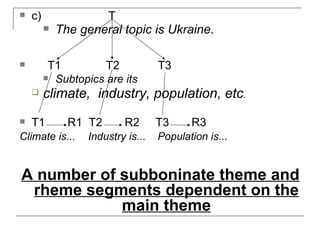
c)  T  The general topic is Ukraine.   T1  T2  T3  Subtopics are its  climate,  industry, population, etc . T1  R1  T2  R2  T3  R3  Climate is...   Industry is...  Population is... A number of subboninate theme and rheme segments dependent on the main theme
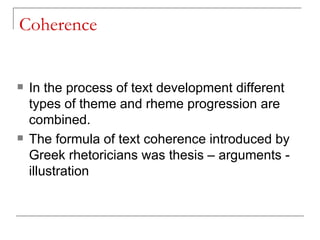
Coherence In the process of text development different types of theme and rheme progression are combined. The formula of text coherence   introduced by Greek rhetoricians was thesis – arguments - illustration
The notion of cohesion. Text connecting devices.   Cohesion  is a succession of spoken or written sentences.  The connection we want to draw between various parts of the text may be achieved by  textual  and  lexical  cohesion.
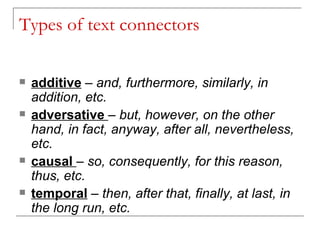
Text connecting devices. Textual cohesion  may be achieved by formal markers which express conjunctive relations and serve as text connectors.  Text  connectors  may be of four different  types :
Types of text connectors  additive  –  and, furthermore, similarly, in addition, etc. adversative  –  but, however, on the other hand, in fact, anyway, after all, nevertheless, etc. causal  –  so, consequently, for this reason, thus, etc. temporal  –  then, after that, finally, at last, in the long run, etc.
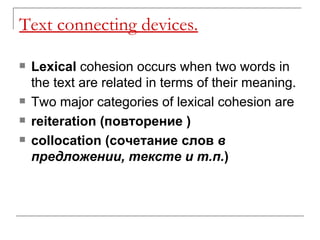
Text connecting devices. Lexical  cohesion occurs when two words in the text are related in terms of their meaning. Two major categories of lexical cohesion are reiteration ( повторение   )   collocation ( сочетание слов  в   предложении ,  тексте   и   т.п. )
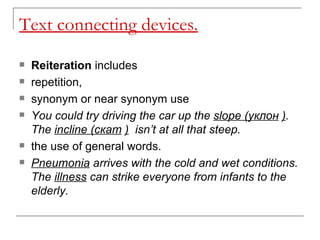
Text connecting devices. Reiteration  includes  repetition,  synonym or near synonym use  You could try driving the car up the  slope ( уклон   ) . The  incline ( скат   )   isn’t at all that steep.  the use of general words.  Pneumonia  arrives with the cold and wet conditions. The  illness  can strike everyone from infants to the elderly.
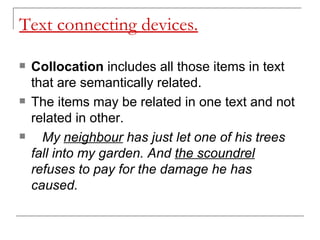
Text connecting devices. Collocation  includes all those items in text that are semantically related.  The items may be related in one text and not related in other. My  neighbour  has just let one of his trees fall into my garden. And  the scoundrel  refuses to pay for the damage he has caused.
Text connecting devices. Cohesive ties within the text are also formed by  endophoric  relations.  Endophoric relations are of two kinds –  those that look back in the text for their interpretation are called  anaphoric  relations:  Look at  the sun .  It  is going down quickly.  ‘It’ refers back to ‘the sun’. those that look forward in the text are called  cataphoric  relations: It  is going down quickly,  the sun .  ‘It’ refers forwards to ‘the sun’.
Textual deictic markers. Deixis  means ‘identification by pointing’. Much of the textual meaning can be understood by looking at linguistic markers that have a pointing function in a given context.  “ Sorry, I missed you. I’m in my other office. Back in an hour.”  Those terms that we cannot interpret without an immediate context are called  deixis .
Textual deictic markers. Deictic terms are used to refer to ourselves, to others, and  to objects in our environment .  They are also used to locate actions in a time frame relative  to the present .  Deictic terms can show  social relationship  – the social location of individuals in relation to others.  They may be used  to locate parts  of a text in relation  to other parts .
Textual deictic markers. Deictic expressions are typically  pronouns,  certain time and place adverbs ( here, now, etc.),  some verbs of motion ( come/go ), and even tenses.  We can identify five major types of deictic markers – person, place, time, textual and social.
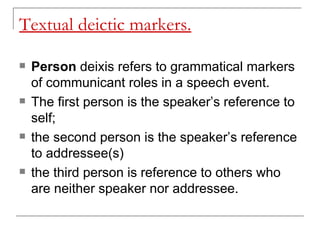
Textual deictic markers. Person  deixis refers to grammatical markers of communicant roles in a speech event.  The first person is the speaker’s reference to self;  the second person is the speaker’s reference to addressee(s)  the third person is reference to others who are neither speaker nor addressee.
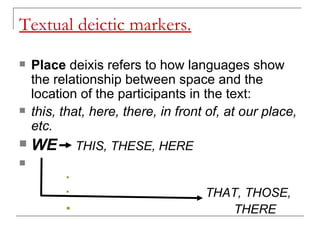
Textual deictic markers. Place  deixis refers to how languages show the relationship between space and the location of the participants in the text:  this, that, here, there, in front of, at our place, etc. WE   THIS, THESE, HERE   THAT, THOSE, THERE
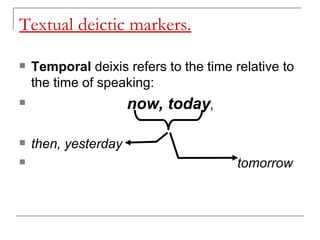
Textual deictic markers. Temporal  deixis refers to the time relative to the time of speaking:  now, today ,  then, yesterday  tomorrow
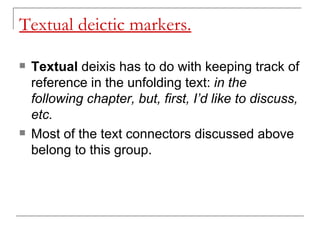
Textual deictic markers. Textual  deixis has to do with keeping track of reference in the unfolding text:  in the following chapter, but, first, I’d like to discuss, etc.  Most of the text connectors discussed above belong to this group.
Textual deictic markers. Social  deixis is used to code social relationships between speakers and addressee or audience.  Here belong  honorifics ,  titles of addresses  and  pronouns .  There are two kinds of social deixis: relational and absolute.
Textual deictic markers. Absolute  deictic markers are forms attached to a social role:  Your Honor, Mr.President, Your Grace, Madam, etc.  Relational  deictic markers locate persons in relation to the speaker rather than by their roles in the society:  my cousin, you, her, etc.  In English, social deixis is not heavily coded in the pronoun system. ‘You’ refers to both – singular and plural.  English possesses ‘a powerful  we ’:  We are happy to inform…, In this article we…

The sentence and the utterance

  • 1.
    THE SENTENCE ANDTHE UTTERANCE The sentence. Different approaches to the study of the sentence. The utterance. Informative structure of the utterance. Functional typology of utterances.
  • 2.
    The sentence isthe central syntactic construction used as the minimal communicative unit has its primary predication, actualises a definite structural scheme possesses definite intonation characteristics.
  • 3.
    The distinction betweenthe sentence and the utterance The sentence is an abstract theoretical entity is a unit of language The utterance is the actual use of the sentence. is a unit of speech.
  • 4.
    The most essentialfeatures of the sentence as a linguistic unit are a) its structural characteristics – subject-predicate relations (primary predication), b) its semantic characteristics – it refers to some fact in the objective reality.
  • 5.
    The sentence isa predicative language unit which is a lingual representation of predicative thought (proposition). conceptual reality proposition objective reality objective situation lingual representation predicative unit
  • 6.
  • 7.
    Principal and secondaryparts of the sentence Depending on the number of predicative lines (the predicative connection between the Subject and the Predicate) sentences may be monopredicative and polypredicative.
  • 8.
    A simple sentenceis a sentence with one predicative line. All simple sentences are divided into two-axis constructions and one-axis constructions.
  • 9.
    In a two-axissentence the subject axis and the predicate axis are directly and explicitly expressed in the outer structure. e.g. The cat is reading a book in excitement. In a one-axis sentence only one axis or its part is explicitly expressed, the other one being non-presented in the outer structure of the sentence. e.g. What a cat!
  • 10.
    One-axis sentences aredivided into free Give me a pen. fixed (greeting formulas, introduction formulas, affirmations and negations) Good morning!
  • 11.
    The semantic classificationof simple sentences should be effected on the basis of: subject categorial meanings; predicate categorial meanings; subject-object relation.
  • 12.
    The semantic classificationof simple sentences According to the subject categorial meanings all simple sentences are divided into personal human – definite, indefinite; non-human – animate, inanimate impersonal factual, perceptional.
  • 13.
    The semantic classificationof simple sentences According to the predicate categorial meanings they are divided into verbal actional, statal nominal factual, perceptional.
  • 14.
    The semantic classificationof simple sentences According to the subject-object relation they are divided into subjective , objective neutral .
  • 15.
    Immediate constituents ofthe sentence. IC analysis. The real structure of the English sentence English has dichotomous phrase structure, which means that the phrase in English can always be divided into two elements (constituents) until we get down to the single word. All groups of words are arranged in levels. The name given by linguists to these different levels of relationship is immediate constituents . Thus, one way of analyzing a sentence is to cut it into its immediate constituents, that is, to single out different levels of meaning. This analysis is called IC analysis.
  • 16.
    IC analysis. The old man saw a black dog there old men and women
  • 17.
    Oppositional analysis means correlating different sentence types: they possess common features and differential features. Differential features serve the basis for analysis. two member sentence :: one member sentence John worked :: John! Work! three member sentence::three member sentence positive negative I speak English :: I don’t speak English.
  • 18.
    Constructional analysis All the necessary constituents of primary predication constitute the main parts and are constructionally significant. Bill closed the door ; She behaved well .
  • 19.
    The structural sentencetypes are formed on the basis of kernels (basic structures). Three main types of propositional kernels: N V, N is A, N is N. With the account of the valent properties of the verbs the group will become larger (8 kernels), N1 V N2 N3: John gave Ann the book , N1 V N2: I see a house .
  • 20.
    Syntactic processes Internal Internal syntactic processes involve no changes in the structure of the parts of the sentence. They occur within one and the same part of the sentence (subject, etc.). External External syntactic processes are those that cause new relations within a syntactic unit and lead to appearance of a new part of the sentence.
  • 21.
    The internal syntacticprocesses are: Expansion The phone was ringing and ringing Compression They were laughing and singing Complication (a synt. unit becomes complicated) I have seen it – I could have seen it Contamination (two parts of the sentence are joined together – e.g. double predicate) The moon rose red
  • 22.
    The internal syntacticprocesses are: Replacement – the use of the words that have a generalized meaning: one, do, etc, I’d like to take this one . Representation – a part of the syntactic unit represents the whole syntactic unit: Would you like to come along? I’d love to . Ellipsis – Where are you going? To the movies .
  • 23.
    The external syntacticprocesses are: Extension - a nice dress – a nice cotton dress. Ajoinment - the use of specifying words, most often particles: He did it – Only he did it. Enclosure – inserting modal words and other discourse markers: after all, anyway, naturally, etc.
  • 24.
    The utterance. The utterance as opposed to the sentence is the unit of speech. The main categories of the utterance from the point of view of its informative structure are considered to be the theme and the rheme . They are the main components of the Functional Sentence Perspective (FSP) – actual division of the utterance.
  • 25.
    Subject + Verb+ Object The cat ate the rat (N1 + V + N2). The rat was eaten by the cat. It was the cat that ate the rat. It was the rat that the cat ate. What the cat did was ate the rat. The cat, it ate the rat. the context in which the utterance occurs and the importance of the information.
  • 26.
    The main categoriesof the utterance The information which has already been introduced before or is assumed to be known to the reader or listener is referred to as given information or the theme . The information which is introduced for the first time and which is known as new information or the rheme . Informative structure of the utterance.
  • 27.
    The rheme markingdevices are: Position in the sentence. New information in English generally comes last: The cat ate the rat . Intonation. The use of the indefinite article. A gentleman is waiting for you . The use of ‘there is’, ‘there are’. There is a cat in the room.
  • 28.
    The rheme markingdevices are: The use of special devices, like ‘as for’, ‘but for’, etc.: As for him , I don’t know. Inverted word order: Here comes the sun. The use of emphatic constructions: It was the cat that ate the rat.
  • 29.
    The cat atethe rat after all. This sentence contains two informative centres, or two rhemes – explicit and implicit.
  • 30.
    Functional typology ofutterances. Actional utterance: N + Vact. + Complement – actional predicate Performative utterance: I + Vperf./Vsay – performative predicate Characterizing utterance: N + Vbe + A/Q – characterizing predicate (See the book by E.Morokhovskaya Fundamentals of Theoretical English Grammar’, pp.254-268)
  • 31.
    THE TEXT, TEXTLINGUISTICS Text as a syntactic unit. The notion of coherence. The notion of cohesion. Text connecting devices. Textual deictic markers.
  • 32.
    Text as asyntactic unit. Text is the unit of the highest (supersyntactic) level that can be defined as a sequence of sentences connected logically and semantically conveying a complete message. The text is a language unit and it manifests itself in speech as discourse. Textual basic integrative properties can be described with the help of the notions of coherence ( ц е лостность ), cohesion ( формальная связанность) and deixis .
  • 33.
    The notion ofcoherence. Coherence is a semantic or topical unity of the spoken or written text The sentences within the text are usually connected by the same general topic. A coherent text is the text that ‘sticks together’ as a whole unit.
  • 34.
    Coherence is usuallyachieved by means of the theme and rheme progression. There exist various types of the theme and rheme progression .
  • 35.
    a) T1 R1 Once there lived an old man. T2 R2 The old man lived in a hut. T3 R3 The hut was near a wood. Linear
  • 36.
    b) T1 R1 Michael is a student. T1 R2 He lives in Boston. T1 R3 He has a cheap car. A string with a common theme
  • 37.
    c) T The general topic is Ukraine. T1 T2 T3 Subtopics are its climate, industry, population, etc . T1 R1 T2 R2 T3 R3 Climate is... Industry is... Population is... A number of subboninate theme and rheme segments dependent on the main theme
  • 38.
    Coherence In theprocess of text development different types of theme and rheme progression are combined. The formula of text coherence introduced by Greek rhetoricians was thesis – arguments - illustration
  • 39.
    The notion ofcohesion. Text connecting devices. Cohesion is a succession of spoken or written sentences. The connection we want to draw between various parts of the text may be achieved by textual and lexical cohesion.
  • 40.
    Text connecting devices.Textual cohesion may be achieved by formal markers which express conjunctive relations and serve as text connectors. Text connectors may be of four different types :
  • 41.
    Types of textconnectors additive – and, furthermore, similarly, in addition, etc. adversative – but, however, on the other hand, in fact, anyway, after all, nevertheless, etc. causal – so, consequently, for this reason, thus, etc. temporal – then, after that, finally, at last, in the long run, etc.
  • 42.
    Text connecting devices.Lexical cohesion occurs when two words in the text are related in terms of their meaning. Two major categories of lexical cohesion are reiteration ( повторение ) collocation ( сочетание слов в предложении , тексте и т.п. )
  • 43.
    Text connecting devices.Reiteration includes repetition, synonym or near synonym use You could try driving the car up the slope ( уклон ) . The incline ( скат ) isn’t at all that steep. the use of general words. Pneumonia arrives with the cold and wet conditions. The illness can strike everyone from infants to the elderly.
  • 44.
    Text connecting devices.Collocation includes all those items in text that are semantically related. The items may be related in one text and not related in other. My neighbour has just let one of his trees fall into my garden. And the scoundrel refuses to pay for the damage he has caused.
  • 45.
    Text connecting devices.Cohesive ties within the text are also formed by endophoric relations. Endophoric relations are of two kinds – those that look back in the text for their interpretation are called anaphoric relations: Look at the sun . It is going down quickly. ‘It’ refers back to ‘the sun’. those that look forward in the text are called cataphoric relations: It is going down quickly, the sun . ‘It’ refers forwards to ‘the sun’.
  • 46.
    Textual deictic markers.Deixis means ‘identification by pointing’. Much of the textual meaning can be understood by looking at linguistic markers that have a pointing function in a given context. “ Sorry, I missed you. I’m in my other office. Back in an hour.” Those terms that we cannot interpret without an immediate context are called deixis .
  • 47.
    Textual deictic markers.Deictic terms are used to refer to ourselves, to others, and to objects in our environment . They are also used to locate actions in a time frame relative to the present . Deictic terms can show social relationship – the social location of individuals in relation to others. They may be used to locate parts of a text in relation to other parts .
  • 48.
    Textual deictic markers.Deictic expressions are typically pronouns, certain time and place adverbs ( here, now, etc.), some verbs of motion ( come/go ), and even tenses. We can identify five major types of deictic markers – person, place, time, textual and social.
  • 49.
    Textual deictic markers.Person deixis refers to grammatical markers of communicant roles in a speech event. The first person is the speaker’s reference to self; the second person is the speaker’s reference to addressee(s) the third person is reference to others who are neither speaker nor addressee.
  • 50.
    Textual deictic markers.Place deixis refers to how languages show the relationship between space and the location of the participants in the text: this, that, here, there, in front of, at our place, etc. WE THIS, THESE, HERE THAT, THOSE, THERE
  • 51.
    Textual deictic markers.Temporal deixis refers to the time relative to the time of speaking: now, today , then, yesterday tomorrow
  • 52.
    Textual deictic markers.Textual deixis has to do with keeping track of reference in the unfolding text: in the following chapter, but, first, I’d like to discuss, etc. Most of the text connectors discussed above belong to this group.
  • 53.
    Textual deictic markers.Social deixis is used to code social relationships between speakers and addressee or audience. Here belong honorifics , titles of addresses and pronouns . There are two kinds of social deixis: relational and absolute.
  • 54.
    Textual deictic markers.Absolute deictic markers are forms attached to a social role: Your Honor, Mr.President, Your Grace, Madam, etc. Relational deictic markers locate persons in relation to the speaker rather than by their roles in the society: my cousin, you, her, etc. In English, social deixis is not heavily coded in the pronoun system. ‘You’ refers to both – singular and plural. English possesses ‘a powerful we ’: We are happy to inform…, In this article we…